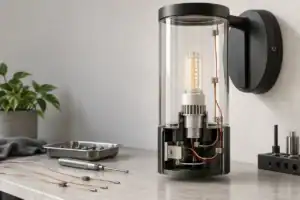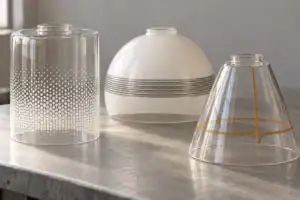
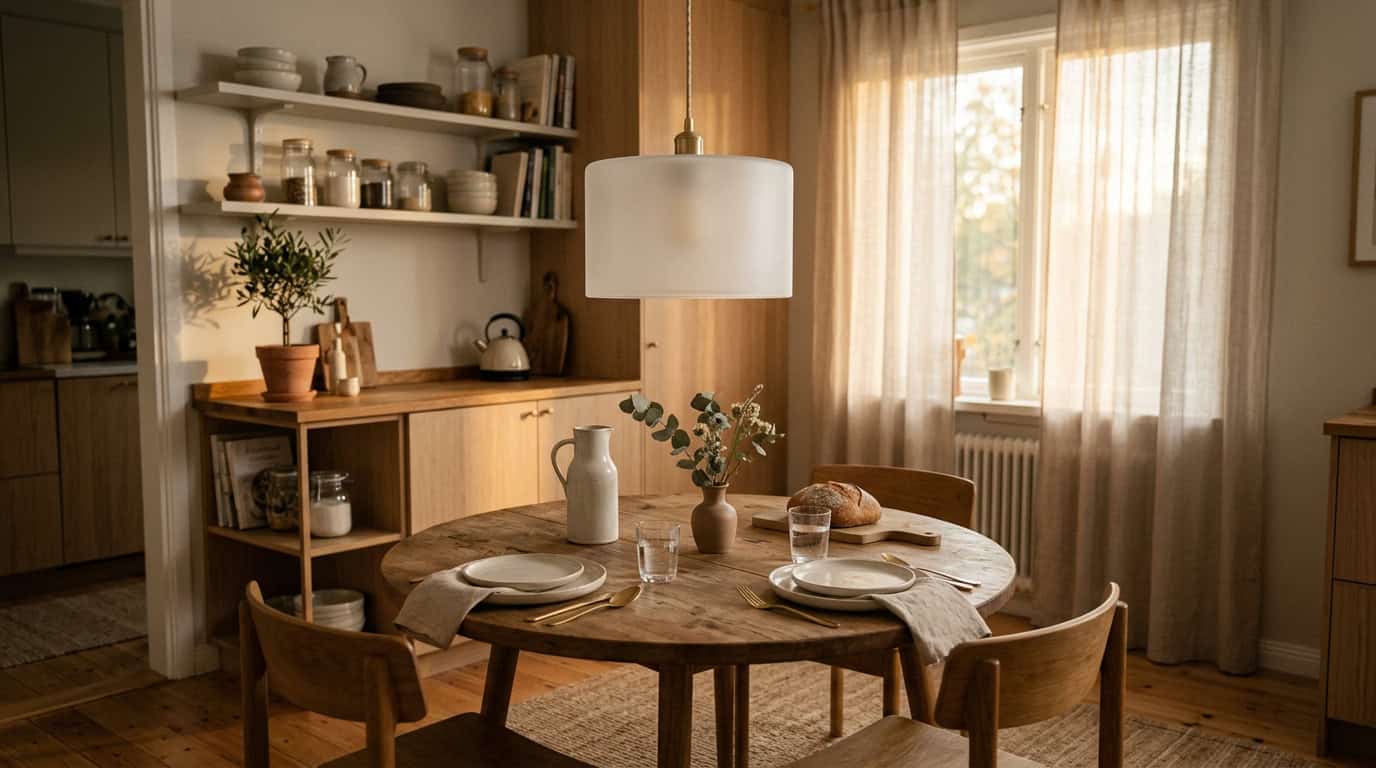
A lampshade for a hanging lamp needs a matching fitter type (spider, UNO, or ring), a shade diameter roughly half the fixture’s drop height, and a material (fabric, glass, or rattan) suited to the room’s light needs.
You’ve hung the pendant lamp. It’s centered, it works, and then you step back and the bare bulb looks wrong. Too harsh, too exposed. So you order a shade. It arrives and the fitter ring won’t thread onto the socket. Now you’re a week into returns, staring at a $90 shade still in its box because the thread diameter was off by an eighth of an inch.
The top three Google results for this keyword are product category pages. Creative Cables, Color Cord Company, IKEA. None of them answer a single sizing or fitting question. They show inventory. This guide covers every decision point between “I need a lampshade for a hanging lamp” and “the right one is installed.”
What is a lampshade for a hanging lamp?
A lampshade for a hanging lamp, also called a pendant shade or ceiling light shade, is a cover that mounts around the bulb on a suspended fixture. It diffuses light, cuts glare, and shapes how illumination falls into the room.
That sounds simple. In practice, pendant shades differ from table and floor lamp shades in three ways that matter at purchase time: fitter type, weight tolerance, and light direction. Get any one wrong and you end up with a shade that won’t attach, or one that droops, or one that throws harsh light directly at eye level instead of down onto a surface where you need it.
How pendant shades differ from table and floor lamp shades
Table and floor lamp shades sit on a harp, a wire frame that rests on a saddle beneath the socket. Their weight is supported from below. A lampshade for a hanging lamp attaches to a pendant socket hanging from the ceiling, so the shade connects from above or wraps directly around the socket itself.
The fitter hardware is completely different, and many buyers don’t realize this until a shade arrives that simply won’t clip on. Direction is the second difference. Table lamp shades throw light upward and outward in a near-360-degree pattern. Pendant shades direct light downward, which is why open-bottom drum and bowl shapes dominate the pendant market and tall empire shades (which push light upward) are uncommon in hanging fixtures.
The three parts that determine fit: body, fitter, and diffuser
Every lampshade for a hanging lamp has three functional parts:
- The body (fabric, glass, metal, rattan) controls aesthetics and how much light passes through
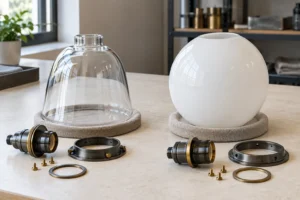
- The fitter, a hardware ring or frame, connects the shade to the pendant socket
- The diffuser, either an internal panel or the body material itself, softens and spreads the light output
Getting the body shape right makes the lamp look correct. Getting the fitter type right makes it actually attach. Miss either one and you’re making a return.
| Feature | Pendant / Hanging Lamp | Table Lamp | Floor Lamp |
|---|---|---|---|
| Fitter type | Spider, UNO ring, or ring adapter | Spider on harp, clip-on | Spider on harp |
| Weight limit | ~2-5 lbs (socket-mounted) | ~5-10 lbs (harp-supported) | ~10 lbs+ (base-supported) |
| Primary light direction | Downward / ambient | Up + outward 360° | Up + outward 360° |
| Installation | Clips or threads onto pendant socket | Rests on harp saddle | Rests on harp saddle |
| Common shapes | Drum, globe, bell, cone | Empire, drum, bell | Drum, empire, torchiere |
Types of lampshades for hanging lamps
The right lampshade for a hanging lamp depends on three variables: shape, material, and fitter type. Most buyers only think about the first one. By the time they’ve ordered a beautiful globe shade in the wrong fitter size, they’ve paid for that lesson.
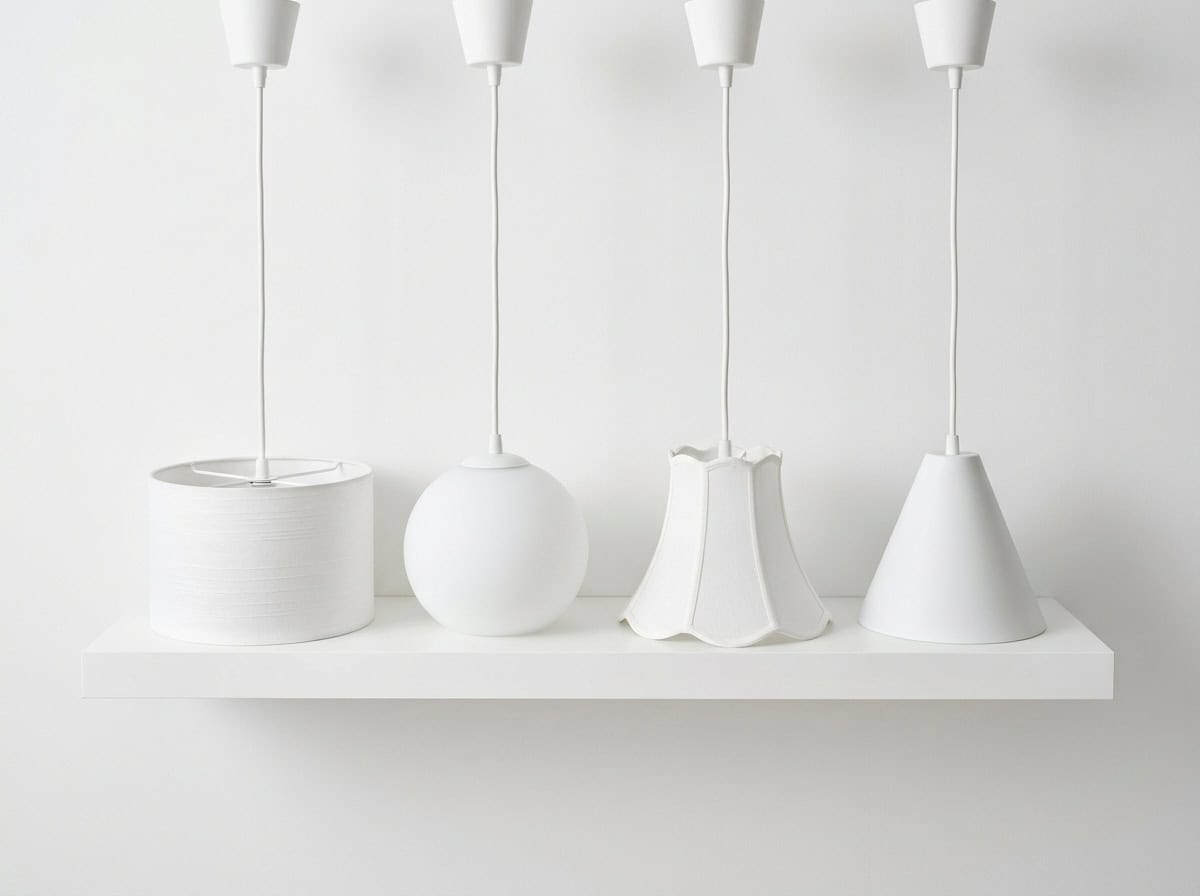
By shape: drum, empire, bell, globe, cone, and tapered
Drum shades are the most widely used option for a lampshade for a hanging lamp in 2026. Equal width top and bottom, they cast light both downward and slightly outward, suit nearly every interior style, and are available in every material. If you’re new to pendant shades and not sure which shape to try, a drum is the safest default.
Globe shades enclose the bulb in a sphere or near-sphere. Glass globe pendants define mid-century and Scandinavian design. They diffuse light evenly in all directions, making them ideal over a kitchen island or reading nook where you want soft spread-out illumination rather than a focused downward beam.
Bell shades taper from a wider top to a narrower bottom opening. The classic Victorian parlor form. They concentrate light more directly downward than a drum or globe, which makes them strong choices over dining tables where you want light focused on the surface rather than washing the ceiling.
Cone shades are the functional workhorse. A flat disk at the top, a sharp taper to a wide-open bottom. Common in industrial settings, cafes, and workshops. The cone sends light in a tight defined circle below, which makes it poor for ambient fill but effective for task lighting.
Tapered cylinder shades split the difference between drum and cone. Slightly narrower at the bottom, they add visual interest while still producing a near-omnidirectional spread, a common choice for minimalist interiors where a plain drum feels too expected.
Empire shades (tall and steeply angled) are the most table-lamp-specific shape. They push light upward more than downward, which is useful for ambiance but uncommon as a lampshade for a hanging lamp because they tend to produce ceiling glare rather than useful illumination at table level.
By material: glass, fabric, rattan, metal, and acrylic
Material determines how your lampshade for a hanging lamp handles light: how much passes through, how much gets absorbed, and whether the shade glows warmly or reflects harshly. It also determines heat tolerance, which matters more than most people expect.
| Material | Light Transmission | Heat Tolerance | Ideal Room | Maintenance |
|---|---|---|---|---|
| Clear glass | 90%+ direct | High, safe with incandescent | Kitchen, industrial loft | Wipe with damp cloth |
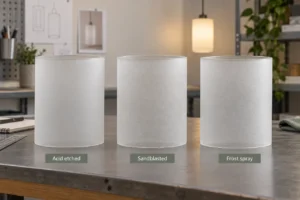
| Frosted / opal glass | 60-75% diffused | High, safe with incandescent | Bedroom, dining room | Wipe with damp cloth |
| Linen / cotton fabric | 20-40% diffused | Low, LED only (max 40W eq.) | Living room, bedroom | Lint brush, spot clean |
| Rattan / wicker | Open-weave, patterned shadows | Medium, max 40W eq. | Boho, outdoor-covered | Dust regularly |
| Metal (painted/powder-coated) | 0%, fully opaque | Very high | Industrial, kitchen | Wipe; check for rust on raw steel |
| Acrylic | 50-80% diffused | Low, LED only | Office, modern | Microfiber cloth only |
Glass deserves particular attention in the pendant context. According to the U.S. Department of Energy’s LED lighting guidance, incandescent bulbs convert roughly 10% of their energy to visible light, with the remainder becoming heat. Inside an enclosed or tight-fitting shade, that heat accumulates. A glass lampshade for a hanging lamp handles this safely; a fabric shade with an old incandescent does not.
By fitter type: spider, UNO, ring adapter, and clip-on
This is where most buying mistakes happen. The fitter is invisible in most product photos, but it’s the only thing that determines whether your new shade actually attaches.
A spider fitter is a cross of wires in the center of the shade frame that rests on a lamp harp. Standard on table lamps and less common on purpose-built pendant shades, though you’ll encounter it when adapting a table lamp shade to a hanging fixture. For that you’ll need a ring-to-spider adapter.
A UNO fitter is a threaded ring that screws directly onto the pendant lamp socket. Most dedicated pendant shades use UNO fitters because the threaded connection is stable for a shade hanging in space. Two standard thread diameters exist: 1⅝” and 2⅜”. They look similar but are not interchangeable.
A ring adapter bridges an incompatible fitter to a socket. If you want a shade built for a different fitter type, a ring adapter typically costs under $10 and solves the problem.
A clip-on fitter grips directly onto the light bulb. Quick and convenient for lightweight decorative shades, but unreliable for anything over about 1 lb. Vibrations gradually loosen the grip, and a heavy glass shade on a clip-on is asking for trouble.
How to measure the right size lampshade for a hanging lamp
The most common sizing error: a shade that looks proportional in product photos turns out to be completely out of scale once it’s hanging seven feet above the floor. Measure first.
The width rule: proportional sizing for pendant lamps
The standard guideline for a lampshade for a hanging lamp is that shade diameter should be roughly half the pendant’s hanging height. A pendant that drops 20 inches below the ceiling canopy calls for approximately a 10-inch shade diameter. That’s a starting point, not a rigid formula. Over a work surface like a dining table, kitchen island, or desk, a wider shade spreads light across the area below more effectively. For a purely decorative pendant where ambiance matters more than output, a narrower shade keeps the fixture sculptural rather than dominant.
Our glass lamp shade sizes guide covers the full dimensional breakdown: top diameter, bottom diameter, slant height, and drop, for the most common pendant shade profiles.
Drop height, ceiling clearance, and the eye-level rule
The Illuminating Engineering Society recommends pendant lights over dining tables at 60-66 inches from floor to the bottom of the shade, or 30-36 inches above the table surface. Over kitchen islands without bar seating, 66-72 inches from floor is the standard spec.
The practical check is simpler: sit in the chair nearest the pendant. Your eye line should fall below the shade’s bottom edge so you’re never looking directly into the bulb. If the shade bottom is at eye level when seated, the fixture hangs too low.
Fitter ring diameter: the measurement most buyers miss
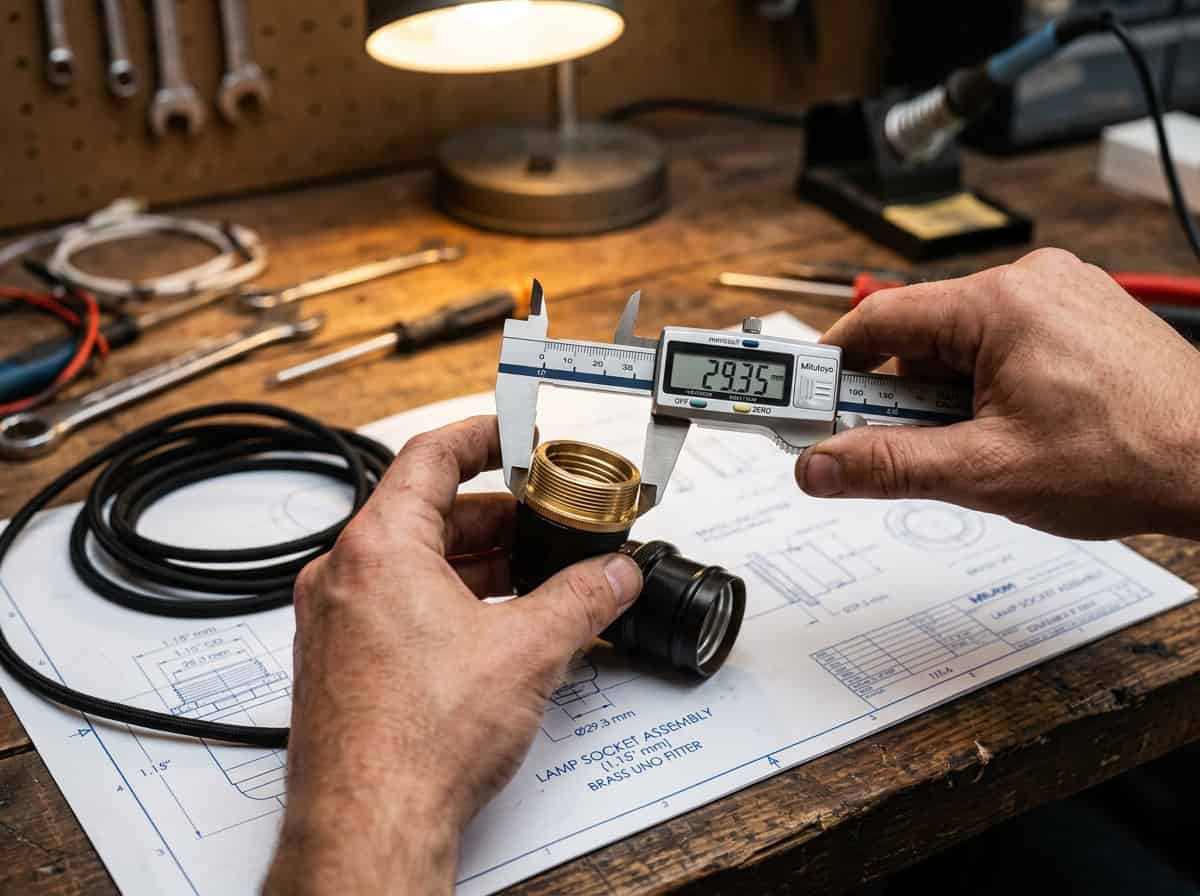
Before ordering any lampshade for a hanging lamp, measure the socket’s outside thread diameter with calipers or a flexible tape. The two UNO sizes, 1⅝” and 2⅜”, sound similar. They are not compatible. Taking thirty seconds to verify this measurement eliminates the most common pendant shade return.
| Room Type | Recommended Shade Diameter | Mounting Height (bottom of shade) |
|---|---|---|
| Dining room / over table | 12-18″ | 30-36″ above table surface |
| Kitchen island (per pendant) | 8-12″ | 66-72″ from floor |
| Bedroom (bedside pendant) | 6-10″ | 18-24″ above mattress top |
| Living room (ambient) | 14-20″ | 60-66″ from floor |
| Entryway / foyer | 12-18″ (scale to ceiling height) | At least 84″ / 7′ from floor |
Choosing a lampshade to match your hanging lamp
A correctly sized lampshade for a hanging lamp can still look wrong if the style, material, or light quality doesn’t suit the room.
By room: kitchen, dining, bedroom, living room, outdoor
Kitchen task lighting prioritizes bright, downward-focused output on prep surfaces. Clear glass globe pendants or metal cone shades work well. Heavily diffusing shades that eat lumen output are the wrong choice over a cutting board.
In a dining room, warmth and ambiance matter more than raw lumen output. A fabric drum shade or frosted glass bell shade creates a soft pool of light that flatters both food and the people seated around the table. Warm white LED bulbs (2700K) strengthen the effect. Our restaurant-grade glass lamp shades reflect the same logic applied to commercial dining environments.
A lampshade for a hanging lamp in the bedroom should produce zero direct glare from a lying-down position. Low-glare, diffusing materials like opal glass, linen, or rattan with wide drum or globe forms work best. Avoid cone shades (they concentrate light) or clear glass (too much direct-glare risk at ceiling height).
The living room is the most flexible space. A statement pendant shade, whether a large drum, oversized globe, or sculptural artisan glass form, can be the room’s visual anchor. Here the fixture’s appearance matters as much as its light output.
For outdoor covered spaces, material durability comes first. Opal and borosilicate glass are moisture-resistant. Rattan and most fabric shades are not. Verify both the shade’s IP rating and the bulb’s outdoor certification before installing any lampshade for a hanging lamp on a porch, pergola, or covered terrace.
By interior style: minimalist, industrial, bohemian, traditional, mid-century
For minimalist interiors, white or pale gray drum shades in matte opal glass or linen work best, typically with flush-fitting hardware and no visible bulb. Industrial spaces call for metal cone or warehouse shades in matte black, gunmetal, or galvanized finish with a visible Edison filament. Bohemian rooms favor rattan, jute, or handwoven fabric in irregular organic shapes, often paired with warm amber glass. Traditional interiors suit fabric empire or bell shades in neutral tones with pleated detail and gold or brushed brass hardware. Mid-century modern spaces pair well with spun metal or fiberglass cone shades, teak or walnut fixture arms, and warm amber or olive colorways.
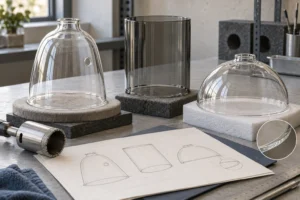
For glass specifically, our lamp shade shapes guide shows how the geometry of a glass shade, whether dome, bell, cylinder, or globe, changes the direction and quality of light in each of these style contexts.
By light function: ambient, task, and accent
Ambient lighting needs a wide bottom opening and translucent material so light spreads across the room. Drum, globe, and bell shades in fabric or frosted glass fit this use case well. Task lighting requires the opposite: a narrow bottom opening and opaque exterior to direct light to one spot, which is where cone, bowl, and reflector shades in metal come in. For accent lighting, the shade itself is the visual object. Colored glass, textured rattan, and hand-blown forms work because the material is the point, not the output.
How to replace a hanging lamp shade
You can change the lampshade for a hanging lamp on most fixtures in under ten minutes without an electrician.
Step-by-step shade swap (no electrician required)
- Turn off the light. Let the bulb cool for at least 15 minutes. Glass and metal retain heat longer than you expect.
- Identify the existing fitter type. Is the current shade threaded onto the socket (UNO), resting on a wire spider frame, or clipped onto the bulb?
- Measure the fitter ring diameter. Use calipers around the socket’s outside thread. Confirm whether it’s 1⅝” or 2⅜”.
- Remove the old shade. UNO fitters unthread counterclockwise. Spider fitters lift straight up off the harp. Clip-on fitters squeeze and pull.
- Attach the new shade. UNO fitters thread clockwise until snug. Don’t overtighten, especially on glass. Clip-ons center on the bulb then press until the grip seats.
- Check balance. For glass or heavier shades, confirm the shade sits level and the fitter ring is fully seated before letting go.
- Turn the light on. Verify no direct glare from the bottom opening. Adjust hanging height if needed.
The only time you need an electrician is if you’re changing the canopy, pendant cord length, or socket wiring. Not the shade itself.
Replace vs. repair: when a new fixture makes more sense
| Symptom | Recommended Action | Estimated Cost |
|---|---|---|
| Shade discolored / yellowed fabric | Replace shade only | $15-$80 |
| Crack in glass shade | Replace shade only | $20-$120 |
| Fitter ring bent or threads stripped | Replace fitter adapter or full shade | $8-$80 |
| Shade looks dated, hardware still works | Replace shade only | $20-$200 |
| Pendant cord frayed or socket sparking | Replace fixture (electrician) | $80-$250 incl. labor |
| Ceiling canopy cracked or loose | Replace fixture (DIY or electrician) | $30-$150 |
Pendant lampshade trends for 2026 and beyond
The lampshade for a hanging lamp has become one of the more actively discussed elements in interior design publishing this year. People who renovated in recent years are now in the refinement phase, swapping out commodity fixtures for pieces that feel considered. Two shifts are driving the pendant shade market in 2026.
Organic shapes and artisan-blown glass
Clean geometric drums still dominate new construction, but custom and artisan-blown glass pendants are the growth category. Mouth-blown glass produces irregular forms, subtle surface bubbles, and color variance that machine-made glass can’t replicate. According to Architectural Digest’s lighting design coverage, handcrafted lighting, including blown glass pendant shades, is among the fastest-growing categories in residential renovation spending.
A mouth-blown lampshade for a hanging lamp is one-of-a-kind in a literal sense. Every piece comes out slightly different from the last, which is the opposite of what you get from a mass-market supplier and probably why the category keeps growing.
Our mouth-blown glass lamp shades cover a range of forms, globe, bell, and custom, all produced using traditional hand-blowing techniques without molds.
Natural fibers and sustainable material choices
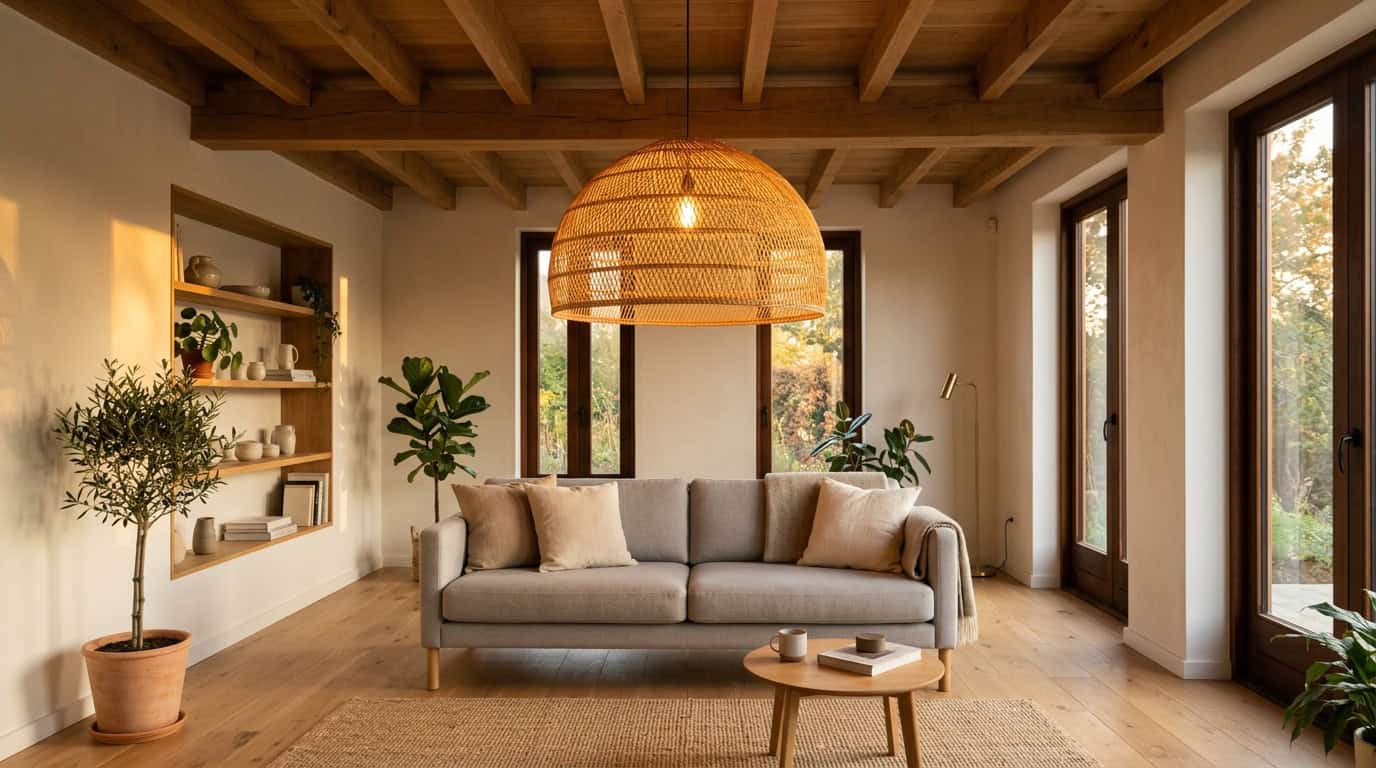
Rattan, bamboo, jute, and seagrass are gaining ground as lampshade materials, driven by the same sustainability shift that’s moved through furniture and textiles. The open-weave structure of rattan creates dappled shadow patterns on walls and ceilings, a side effect that’s both functional and decorative.
Rattan handles ambient warmth, bohemian and coastal aesthetics, and outdoor-covered applications well. Where it falls short: task lighting (too much scatter), humid environments (warps over time), and formal or traditional interiors where it looks out of place. Searches for “rattan pendant shade” in the U.S. grew approximately 40% year-over-year through early 2026, tracking alongside the broader natural-material home goods resurgence.
| Trend | Primary Material | Style Fit | Why It’s Growing |
|---|---|---|---|
| Artisan-blown glass | Hand-blown borosilicate or soda-lime glass | Mid-century, eclectic, maximalist | Uniqueness premium; mass-market fatigue |
| Natural fiber pendants | Rattan, jute, bamboo, wicker | Bohemian, coastal, biophilic | Sustainability values + warm texture |
| Matte black metal | Powder-coated steel or aluminum | Industrial, minimalist, modern farmhouse | Consistent with matte fixture finishes |
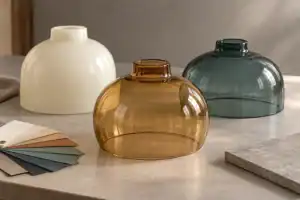
| Colored opal glass | Opal glass in sage, amber, blush | Maximalist, retro, artsy | Color returning to neutral-saturated interiors |
| Oversized statement shades | Any material, 18″+ diameter | Contemporary, grand open-plan | Large rooms need visual anchors |
FAQ
Can you change the hanging lamp shade?
In most cases, yes. You can replace the lampshade for a hanging lamp in under ten minutes with no tools. Turn off the light, let it cool, identify the fitter type, and swap it out. The only scenario requiring an electrician is changing the socket wiring, cord length, or ceiling canopy. Not the shade itself. The fitter type (UNO vs. spider vs. clip-on) is the only thing you need to verify before ordering a replacement.
What size lampshade do I need for a pendant light?
Start with a shade diameter roughly half the pendant’s hanging height. A 20-inch drop suggests a 10-inch shade. Over a dining table, the bottom of a lampshade for a hanging lamp should sit 30-36 inches above the table surface according to the Illuminating Engineering Society’s standard recommendations. Adjust up or down based on ceiling height and room proportion. Our lamp shade sizes guide covers the full dimensional breakdown.
What’s the difference between a pendant shade and a regular lampshade?
The primary differences are fitter type and orientation. A pendant shade, a lampshade for a hanging lamp, uses a UNO ring or ring adapter that threads onto the hanging socket from above. A regular table lamp shade rests on a harp supported from below. Pendant shades direct light downward, while table lamp shades scatter light upward and outward. You can adapt one type for the other with a ring adapter, but buying the shade designed for the fixture type is almost always cleaner.
How do I know which fitter type I need?
Identify your socket’s current attachment method: is there a threaded socket ring (UNO), a wire harp, or a bulb-gripping clip? For UNO sockets, measure the outside thread diameter. The two standard sizes are 1⅝” and 2⅜”. When ordering a new lampshade for a hanging lamp, match the shade’s listed fitter diameter to your socket measurement. A $10 ring adapter covers most mismatches.
Are glass lampshades good for pendant lights?
Glass is one of the strongest material choices for a lampshade for a hanging lamp. It’s heat-resistant, handles incandescent and halogen without risk of scorching or warping, cleans easily, and produces distinctive light quality: clear glass for bright directional output, frosted or opal glass for diffused ambient warmth. As Wikipedia’s lamp shade overview notes, glass has been the dominant material for pendant shades in domestic and commercial settings since the late 19th century. The trade-off is fragility during installation: handle with both hands and don’t overtighten the UNO ring.
What wattage bulb is safe inside a fabric pendant shade?
Most fabric shades for a lampshade for a hanging lamp are rated for a maximum of 40-60 watts using incandescent bulbs. With LED bulbs running at roughly 75% lower heat output than equivalent incandescent, a 10W LED (equivalent to a 60W incandescent) is safe inside most 40W-rated fabric shades. UL’s luminaire safety testing underpins these wattage ratings, which is why the label on the shade is worth reading before you pick a bulb. When uncertain, use LED.
Can I use a drum shade on a hanging lamp?
Drum shades are the most widely used shape for a lampshade for a hanging lamp, so yes, they work well. Equal top and bottom diameter, they suit most interior styles, produce a balanced mix of downward and ambient light, and are available in every material from linen to opal glass to woven metal mesh. For pendant use, confirm the shade has a UNO fitter or comes with a ring adapter rather than a spider harp. Spider harps are designed for table lamp hardware.
How low should a pendant lamp hang with a shade?
The shade’s bottom edge should clear seated eye level, typically 60-66 inches from the floor for living and dining spaces. Over a table or island, 30-36 inches from the table surface to the shade bottom is the standard. For bedside pendants, 18-24 inches above the mattress top is the practical range. If your lampshade for a hanging lamp is unusually large (18″+ diameter), raise it slightly. An oversized shade at low height compresses the room visually and creates glare for anyone seated below.
Picking the right lampshade for your hanging lamp
The right lampshade for a hanging lamp comes down to four numbers: shade diameter, fitter ring diameter, hanging height, and room ceiling clearance. One material decision based on light function. Everything else is preference.
Glass shades handle heat better than fabric or rattan, clean easily, and produce a quality of diffused light that’s hard to replicate with other materials. If you’re sourcing glass shades for pendant lamps, whether replacing a single shade or fitting out a new space, browse our glass lamp shade collection across the full range of shapes and diffusion levels, or contact us about custom glass lamp shades sized to your specific fixture.