
Soda-Lime vs Borosilicate Glass for Lamp Shades: An Engineering Comparison
When buyers compare borosilicate glass vs soda lime glass for lamp shades, the first engineering difference to check is thermal expansion. A documented borosilicate grade usually expands less than a soda-lime grade for the same temperature change, which can reduce thermal strain when a shade sees uneven or repeated heating. Soda-lime glass can still be a sound choice for a stable, moderate-temperature design that passes the required assembly tests. Neither material name alone proves that a finished outdoor lamp is weatherproof, impact-safe, or suitable for a particular bulb.
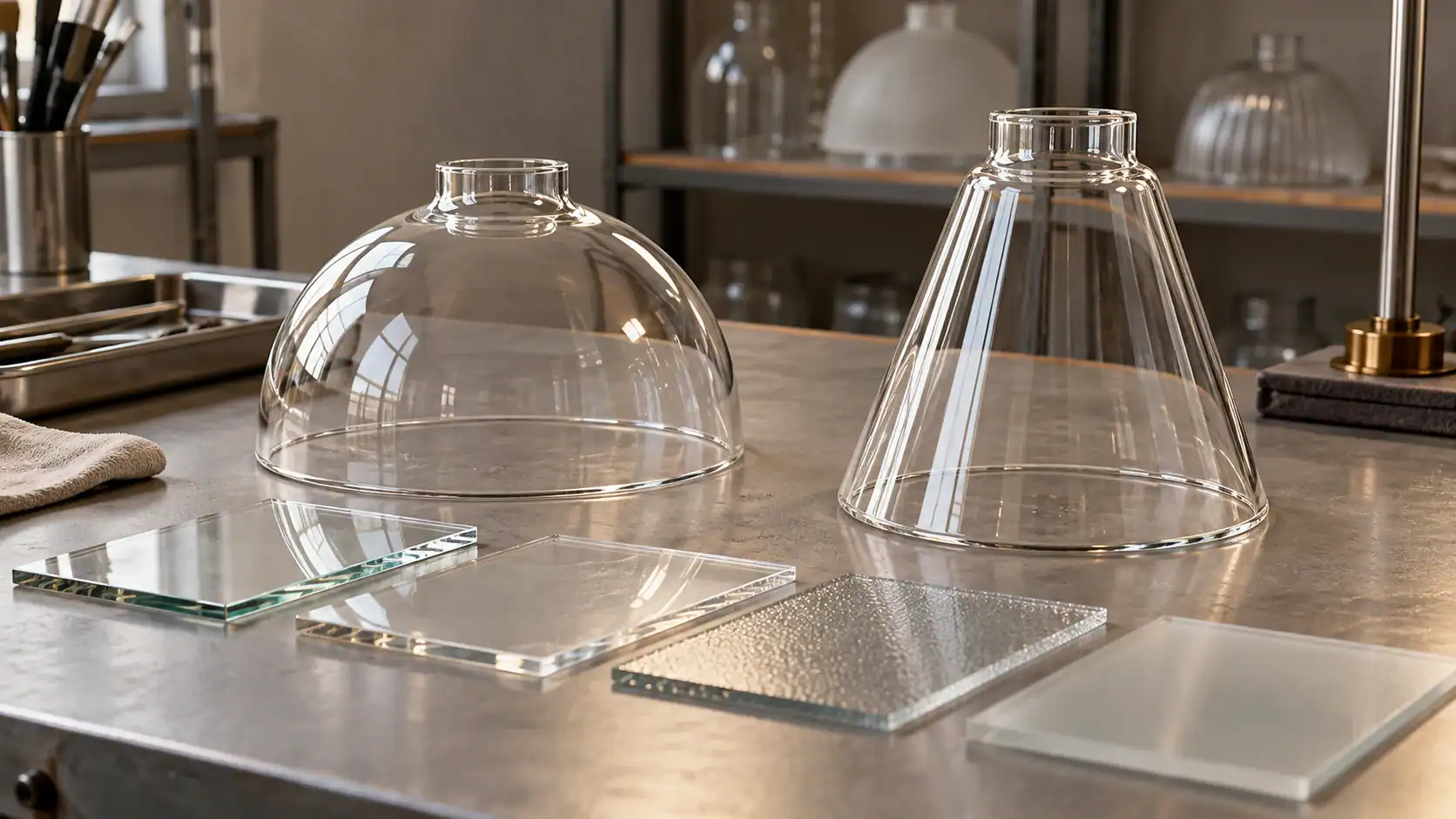
The images in this article are generated illustrations for visual reference. They are not JX product photographs, test records, or material certificates.
Quick answer: which glass should a lighting buyer specify?
Start with the failure condition you need to control. If the glass is likely to develop a steep temperature gradient or repeated rapid temperature changes, shortlist a specified borosilicate grade and validate the finished shade. If the assembly stays within a modest, steady temperature range, a suitable soda-lime grade may meet the design need at lower material cost. Do not select by the words “borosilicate” or “soda-lime” alone.
For outdoor lighting, exposure by itself does not settle the material choice. The design still needs to address rain and water paths, temperature cycling, mounting, impact risk, corrosion of surrounding hardware, surface coatings, and the luminaire’s applicable ingress and electrical requirements. A glass shade is one part of that assembly.
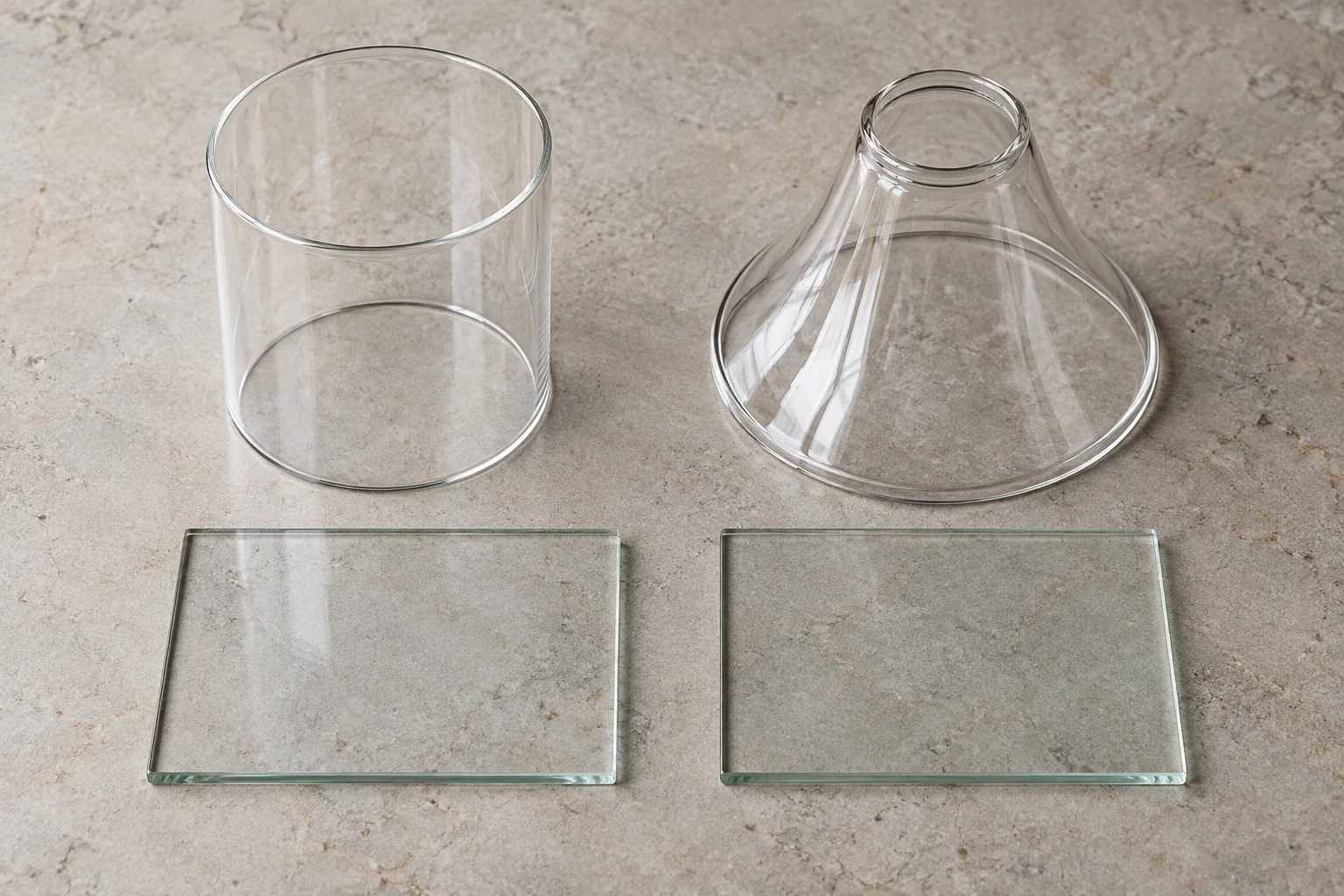
Compare named glass grades, not just material families
“Soda-lime” and “borosilicate” describe broad glass families. Commercial products within each family can differ in chemistry, forming method, thickness, annealing, finish and tolerances. The property sheet for a named grade is a better starting point than a generic category comparison.
For a grade-to-grade reference, SCHOTT lists AR-GLAS as a soda-lime glass with a mean linear thermal expansion coefficient of 9.1 × 10⁻⁶ K⁻¹ over 20-300°C. SCHOTT’s BOROFLOAT 33 data sheet lists 3.25 × 10⁻⁶ K⁻¹ over the same interval. Those are properties of the two named SCHOTT products, not guaranteed values for every soda-lime or borosilicate lamp shade. ISO 3585 specifies properties for borosilicate glass 3.3; it does not turn every product sold as borosilicate into that grade.
Ask the supplier for the exact grade or composition designation, applicable technical data sheet, thickness range, forming route, and any grade-specific temperature limits. If the supplier cannot identify the glass beyond a family name, treat the material claim as unverified for specification purposes.
Thermal expansion: what the reference values tell you
The coefficient of linear thermal expansion (CTE) estimates how much a material changes length as its temperature changes. Using the reference values above, the ratio is about 2.8 to 1: BOROFLOAT 33’s listed CTE is roughly one third of AR-GLAS’s.
A simple free-expansion example makes the scale clearer. For a 100 mm span heated uniformly by 100°C, the estimates are about 0.091 mm for AR-GLAS and 0.0325 mm for BOROFLOAT 33. The difference is about 0.0585 mm. This calculation compares those two sheet-glass grades under an assumed uniform temperature change. It is not a stress calculation and does not predict whether a formed shade will crack.
Stress depends on more than free expansion. A gradient from the hotter center to a cooler rim can restrain movement; so can a tight fitter, point contact, holes, a rigid retaining ring, or an uneven gasket. Shape, glass thickness, residual stress and edge damage also matter. Treat a lower CTE as a selection clue. The finished shade still needs to be checked in its actual fit and thermal conditions.

Thermal shock and operating temperature are different checks
Thermal shock describes damage caused by a rapid or uneven temperature change. A bulb can heat the glass near the light source while the edge remains cooler. A shade may also warm in sunlight and then encounter cooler air or water. Lower thermal expansion can reduce one source of thermal strain, but the temperature gradient and mechanical restraint still determine how the assembly behaves.
Do not use a glass transition temperature or a product’s maximum operating-temperature line as the permitted temperature for the complete lamp. For example, SCHOTT lists BOROFLOAT 33 maximum operating temperatures of 450°C for long-term use and 500°C for short-term use. Those are product-specific glass data, not a lamp-shade assembly rating, a safe bulb-wattage limit, or a test result for a finished luminaire. The fixture, coating, socket, wiring, seals and local product requirements may impose lower limits.
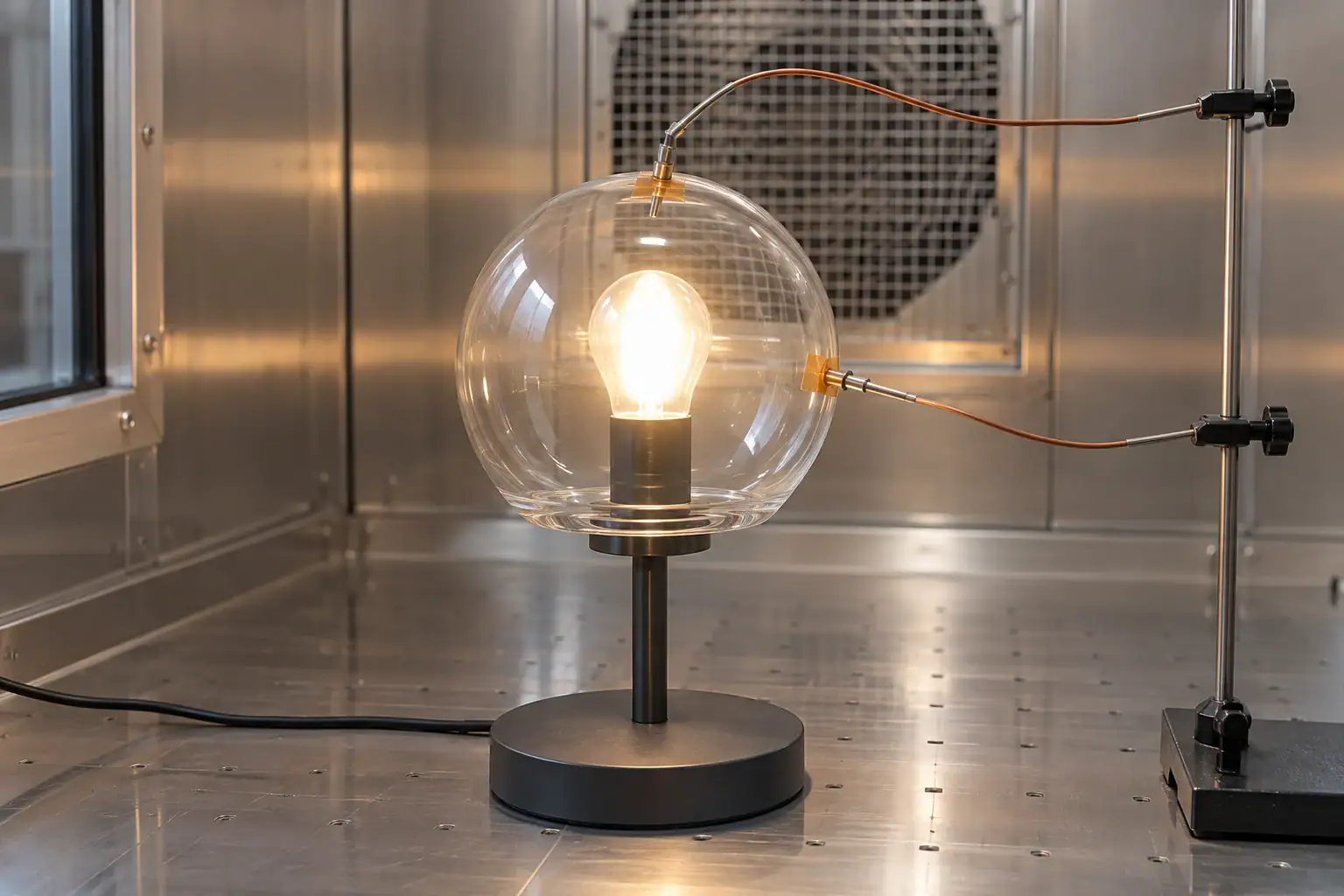
For a real comparison, measure or establish the hottest glass location in the intended fixture and operating conditions. Record the lamp or LED model, input power, dimming state, orientation, ambient range, exposure cycle and the test acceptance criteria. Test the actual glass geometry and mounting arrangement.
Is borosilicate better for outdoor lamp shades?
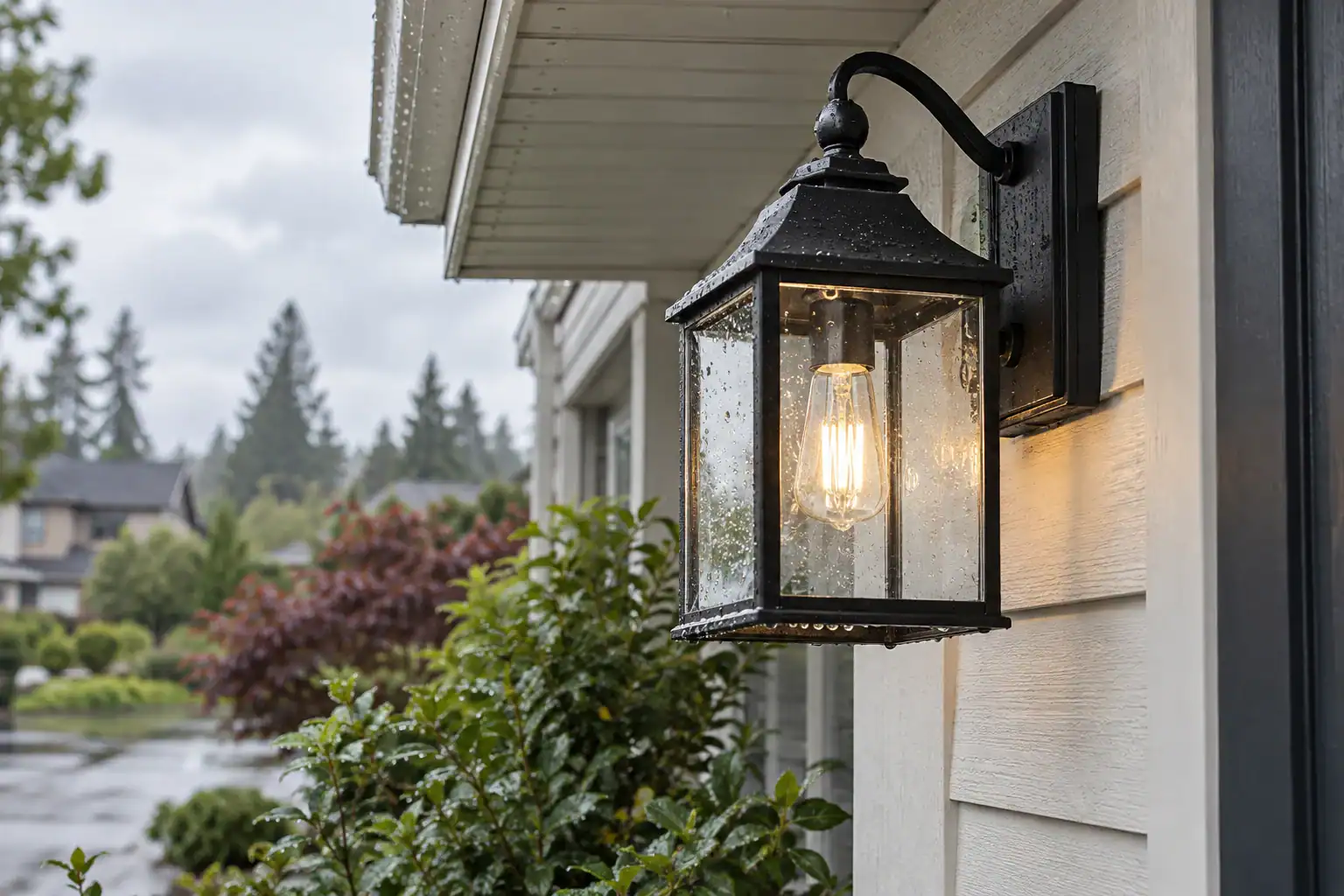
Borosilicate can be a good candidate when an outdoor design has a defined thermal-cycling risk that a specific grade may help address. “Outdoor” by itself does not give enough information to choose a material. A sheltered porch lantern, a sun-exposed garden fixture and a high-output industrial luminaire have different heat paths and exposure conditions.
Check the full installation: how water drains, whether the shade is sealed or ventilated, how it is held, whether the mounting hardware corrodes, whether coatings or colored finishes see UV exposure, and what impact hazards are foreseeable. Confirm the luminaire’s weather and electrical requirements separately. The base glass material does not provide an ingress-protection rating.
If temperature cycling is the concern, define the cycle before asking for a material recommendation: initial glass temperature, hot and cold limits, rate of change, dwell time, number of cycles, water contact if relevant, and pass/fail criteria. A supplier can then review whether the proposed grade and design are appropriate for testing.
Impact resistance depends on the shade and its mounting
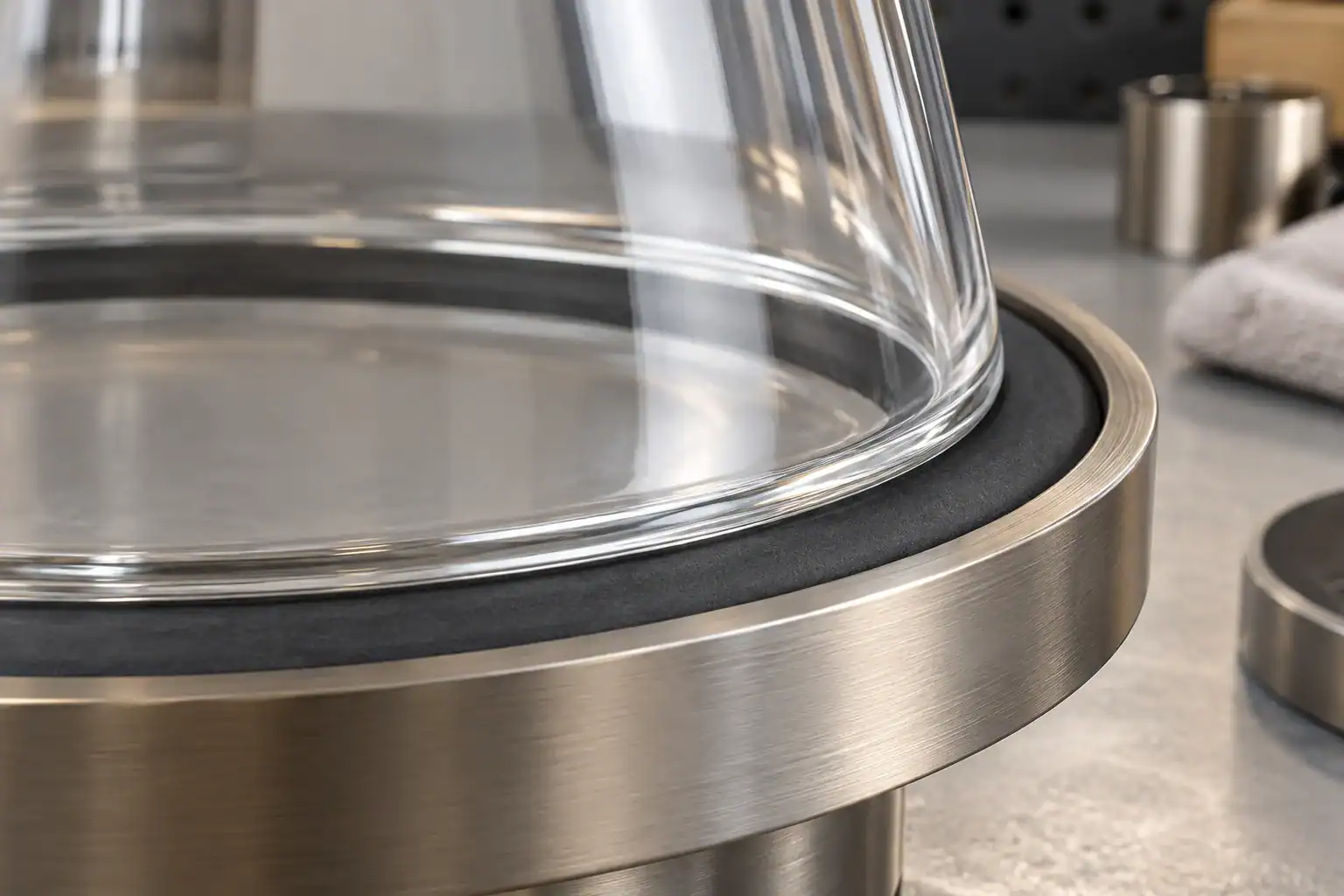
Borosilicate does not mean shatterproof or tempered. SCHOTT states that BOROFLOAT 33 impact resistance depends on fit, panel size and thickness, impact type, drilled holes and their arrangement, among other factors. A formed lamp shade has its own geometry, edges and support points, so the sheet-glass data cannot replace assembly testing.
Review how the fitter or retaining ring supports the shade. Avoid point loads and forced alignment. Check whether the edge is properly finished, the gasket is compatible and evenly compressed, and the retaining parts allow for tolerances. If impact or vibration matters, specify the relevant test method, impact location, mounting condition and acceptable outcome. Do not infer impact performance from a material label.
Light transmission, color and finish need a sample check
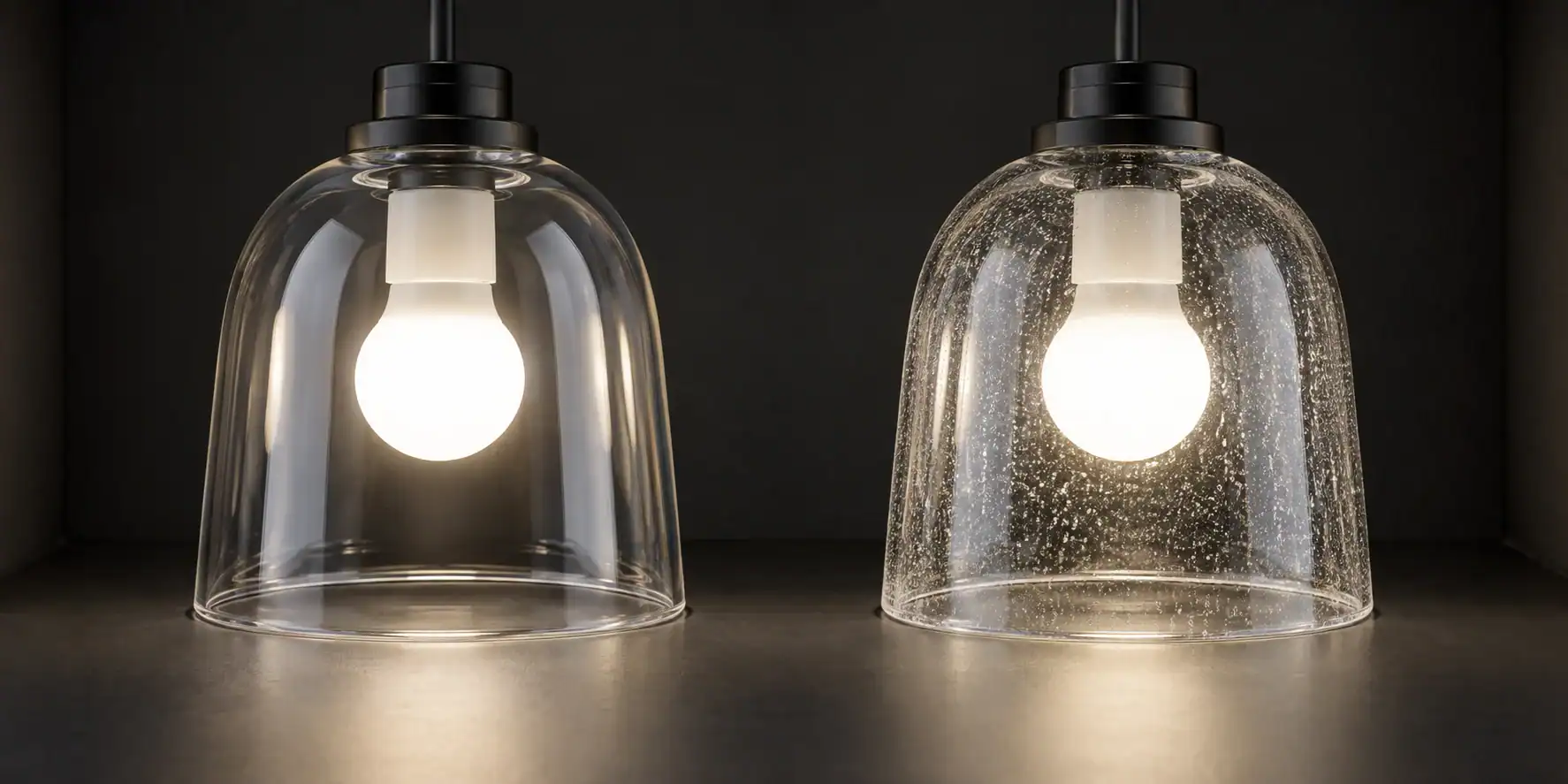
Material family alone does not determine how bright or warm a shade looks. Glass color, thickness, surface texture, coatings, frosting, source spectrum and viewing angle all affect transmitted light. Two clear samples can look different when unlit and when placed around the intended LED or lamp.
For an OEM program, compare samples in the actual fixture under the intended light source. Record whether the target is clear, diffusing, opal, tinted, patterned or coated. Approve the physical sample and revision; a product photograph cannot lock the appearance across production.
Fit, thickness and edge details can outweigh the material label
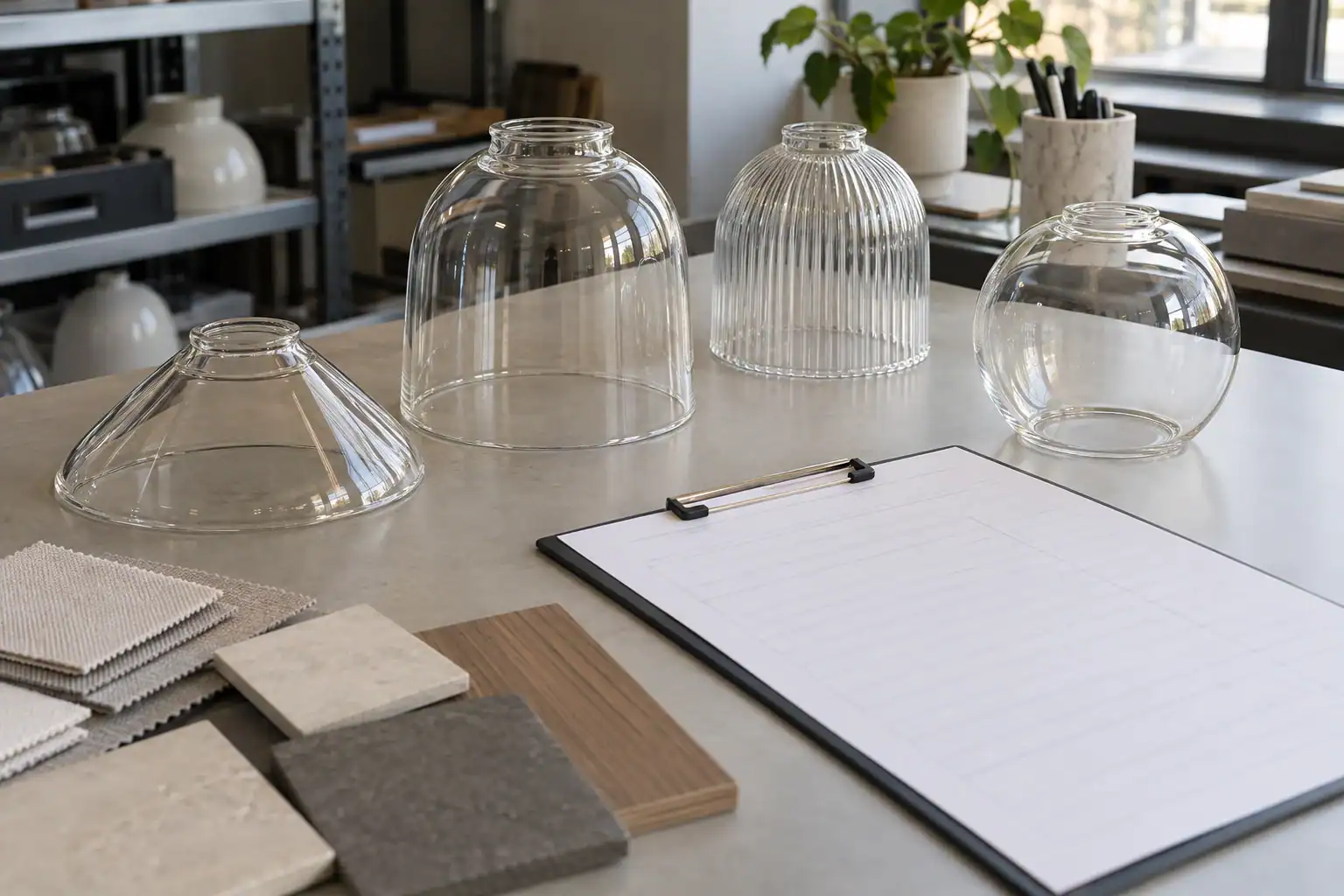
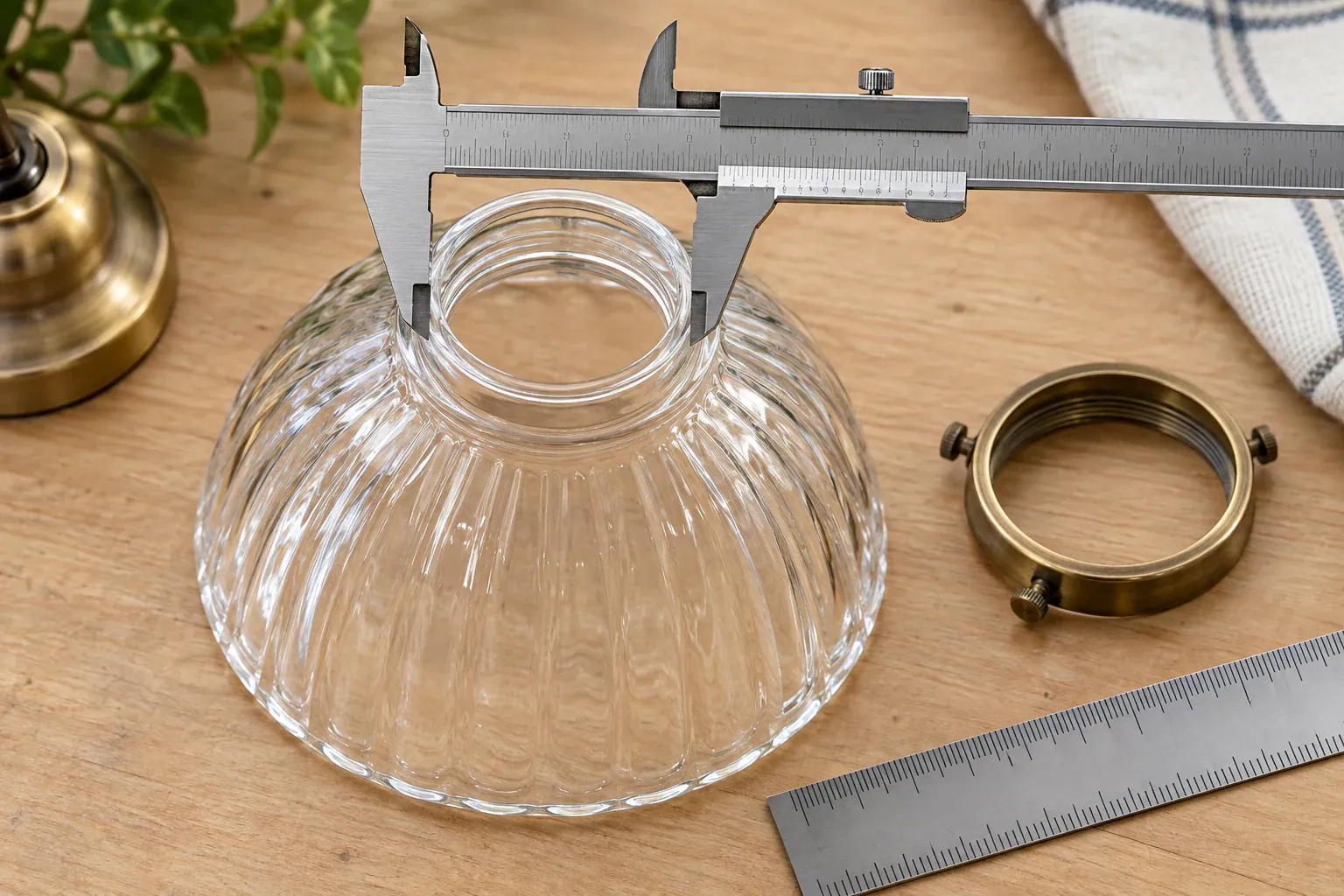
Before changing glass family, check that the replacement or new design fits the fixture. For a replacement shade, record the fitter or opening diameter, retaining method, overall height, widest diameter, wall thickness, edge finish and clearance to the lamp. Include front, side and installed photographs with a ruler for scale.
The mounting must hold the shade without forcing it into alignment. Confirm gasket width and hardness, ring contact, fastener position, tolerance stack-up and whether the edge is exposed. A low-expansion glass that is clamped too tightly can still be damaged; a correctly supported soda-lime shade can perform well within its validated operating conditions.
A practical material selection sequence for engineers
Use this sequence before setting a material in the drawing:
- Define the environment and failure mode: temperature cycling, impact, vibration, water exposure, chemical contact, optical appearance, or a combination.
- Identify the glass grades available and compare their published properties over the temperature range that matters.
- Check the actual shade geometry, thickness, openings, edge finish and mounting restraint.
- Measure the hottest and coolest relevant glass locations in the intended fixture, then describe the operating cycle.
- Test a production-representative sample using the stated mounting and pass/fail criteria.
- Approve the material designation, drawing revision, sample, inspection points and packaging requirements together.
This order prevents a common specification gap: asking for a “heat-resistant glass shade” without defining where the heat is, how quickly it changes, or what the assembly must survive.
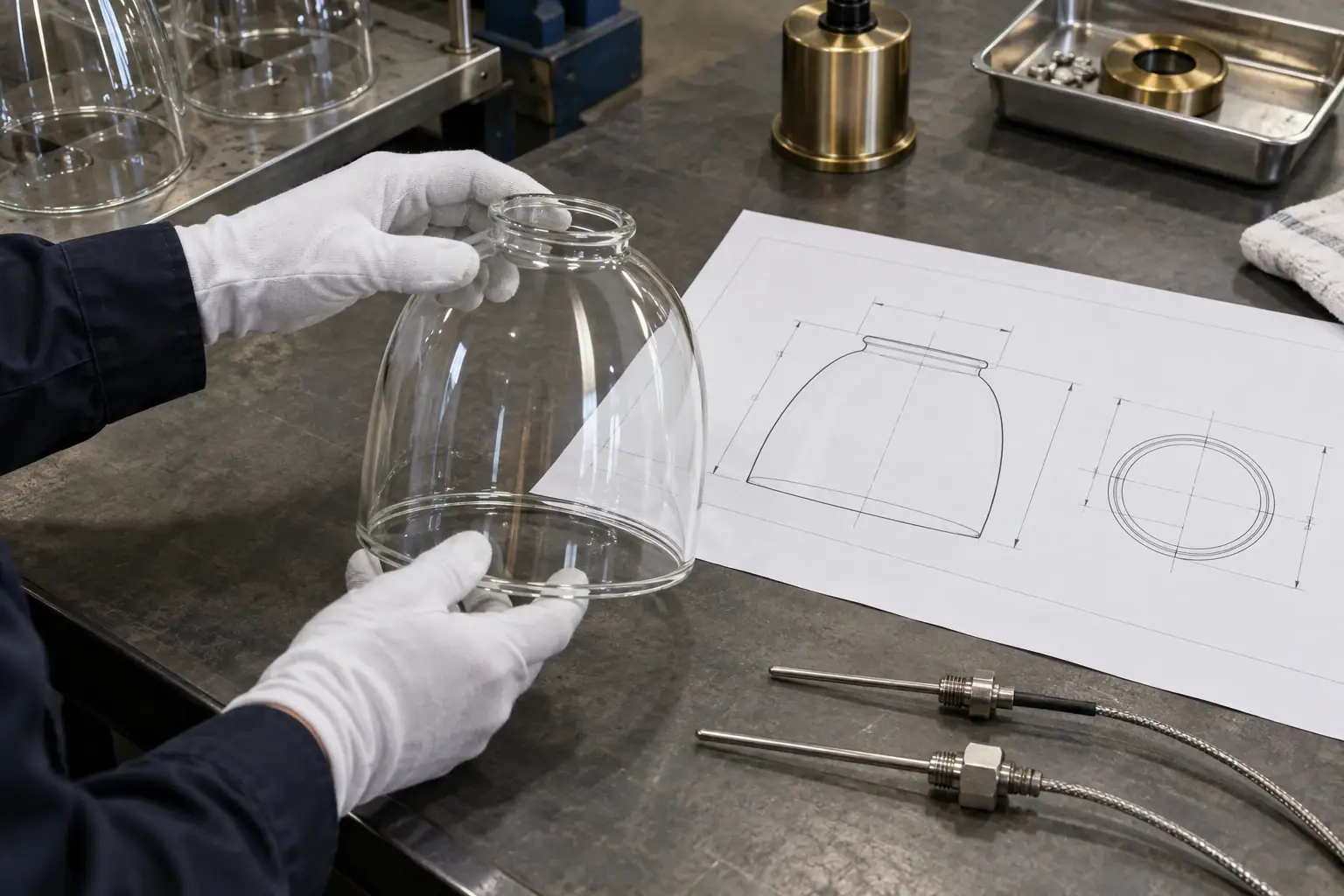
What to include in a lamp-shade glass RFQ
Send enough information for the supplier to assess the material and manufacturing route rather than quote from a family name. Include:
- A dimensioned drawing or sample, including opening, height, maximum diameter, thickness and edge details.
- The requested glass grade or the properties that drive the choice, such as a target CTE or temperature-cycling requirement.
- Lamp or LED model, electrical input, intended orientation and measured or required glass-temperature range.
- Ambient conditions and the thermal, water, impact or vibration tests the finished assembly must pass.
- Mounting method, gasket and retaining-ring details, clearances and any drilled holes.
- Required tint, transparency, diffusion, pattern or coating, plus a physical reference where appearance matters.
- Estimated quantity, repeat-order expectations, destination market and packaging requirements.
If a standard such as ISO 3585 is specified, name the required glass class and provide the relevant drawing and verification criteria. The standard reference does not replace agreement on the finished shade, tolerance or assembly test.
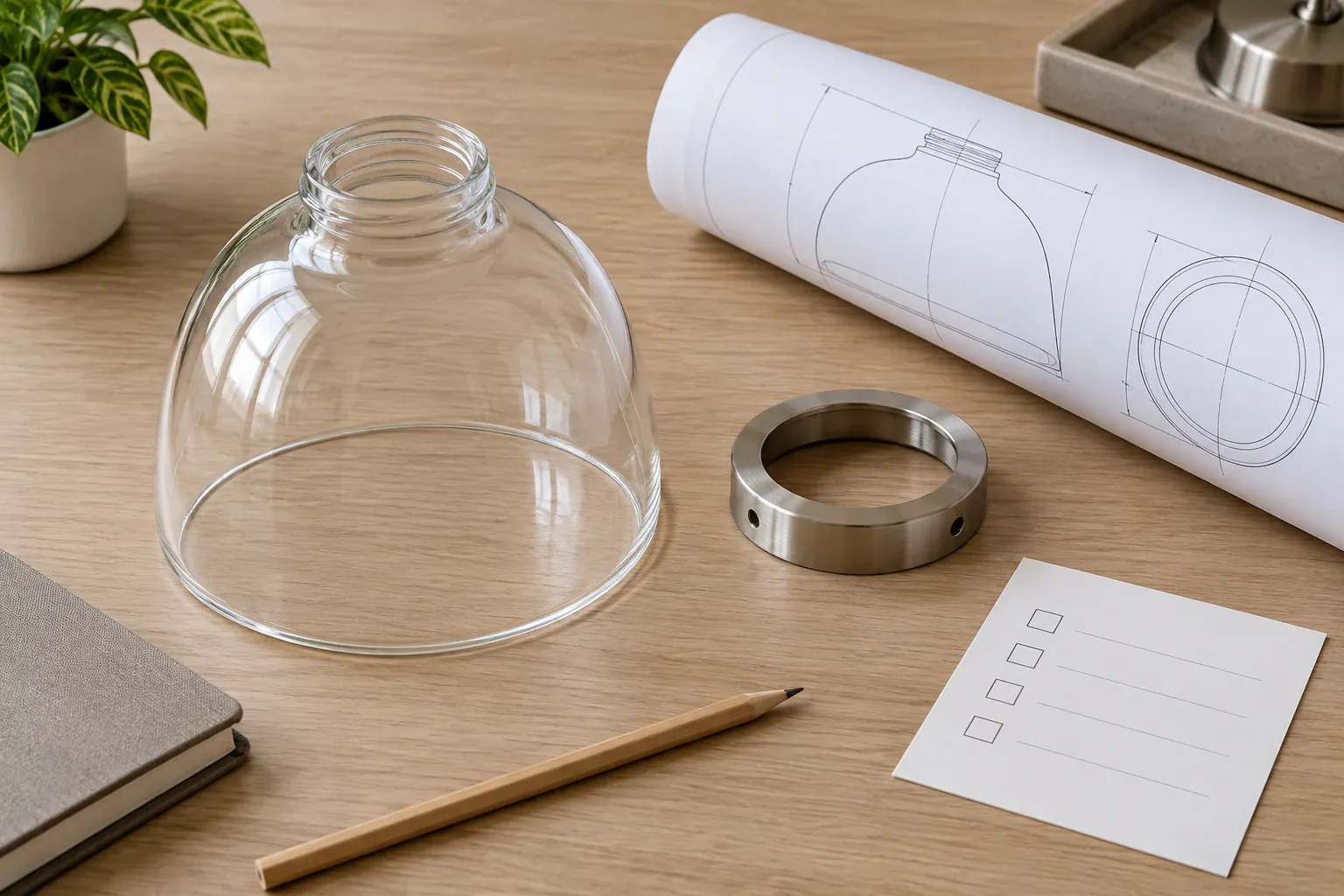
How should glass be identified and quality-checked?
You cannot reliably identify borosilicate or soda-lime glass by appearance alone. Ask for the grade declaration and supporting manufacturer documentation. For a production order, connect that information to the approved sample and drawing revision, and agree how substitutions will be controlled.
Incoming and sample checks can cover dimensions, weight, thickness, edge finish, visual defects, fit in the mating ring, and appearance under the specified source. Add thermal or impact tests only when the application requires them, using a defined method and acceptance rule. A material certificate is evidence about the material it names; it is not proof that the completed luminaire passed a test.
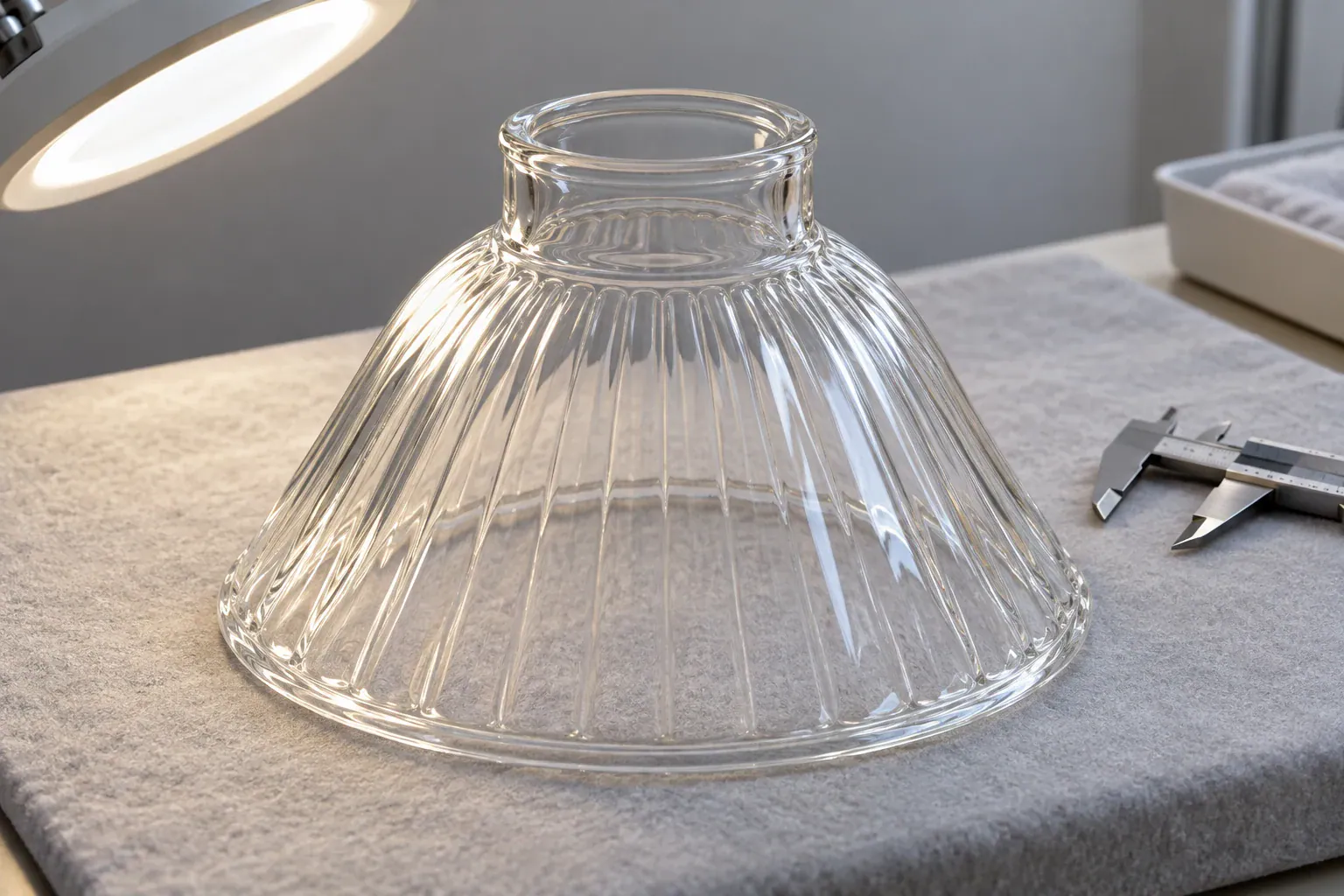
Ask for a drawing and material review
For a custom or repeat-order glass lamp shade, send the drawing or physical sample with the glass grade, fixture conditions, mounting dimensions and any thermal-cycle requirement. JX Lampshade’s custom-shade route supports drawing and RFQ review; the requested material, forming method, tooling, MOQ and lead time need project-specific confirmation. Do not assume every glass grade or shape is available before the technical review.
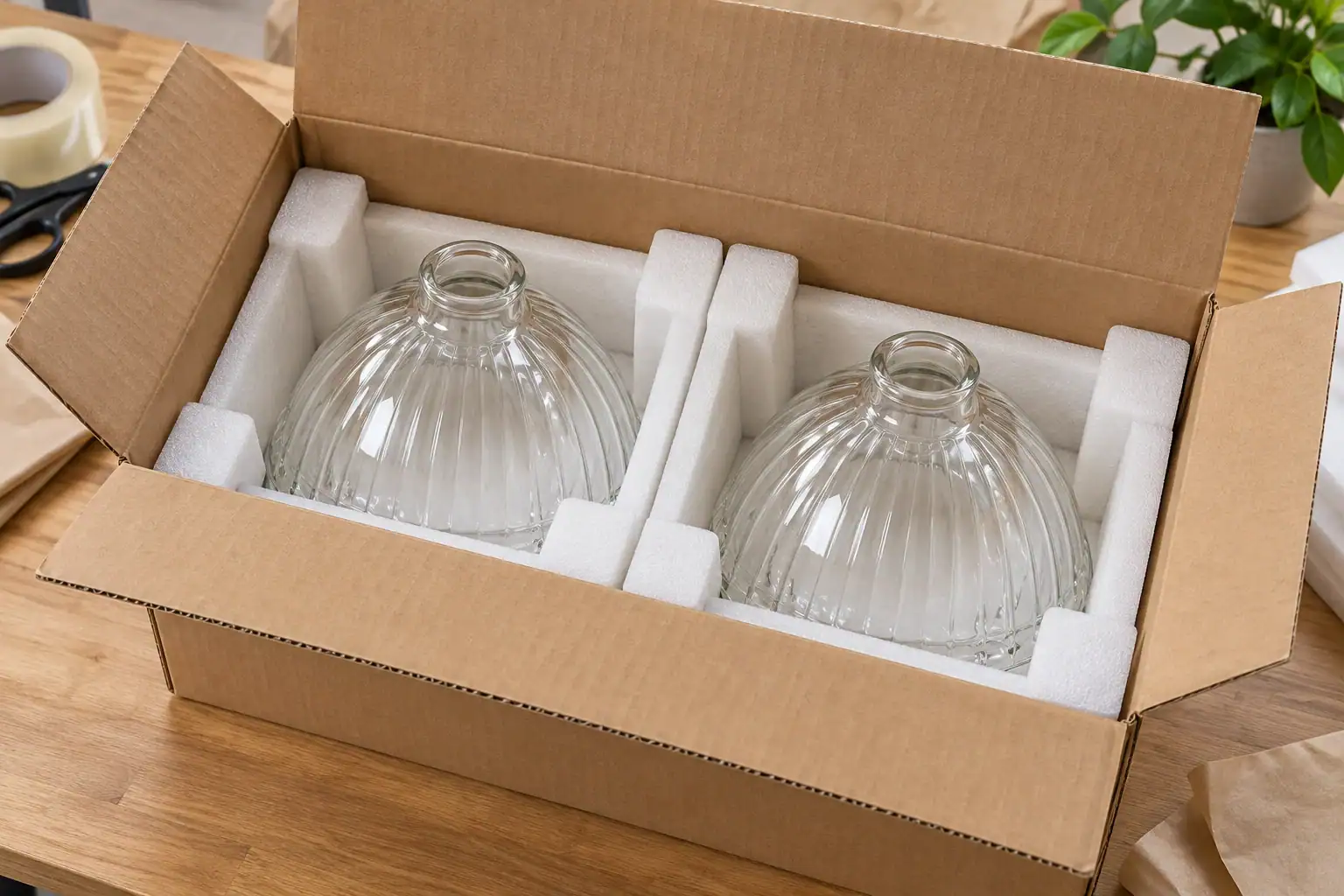
Utilisez la page du fabricant de verrines personnalisées pour lampes to send the drawing for review. Include the annual quantity and destination so the quote can address the required sample, production and packaging details.
Buyer questions about borosilicate and soda-lime glass
What are the disadvantages of soda-lime glass?
Compared with the two specific SCHOTT grades cited here, AR-GLAS has a higher listed thermal expansion coefficient than BOROFLOAT 33. That can matter when the shade sees a large or uneven temperature change. It does not mean all soda-lime shades are unsuitable; the grade and finished design still need to meet the use case.
Is soda-lime glass high quality?
It can be suitable for a lamp shade when the specified grade, forming quality, annealing, dimensions and finish meet the drawing and test requirements. “High quality” is not a material family. Define the inspection criteria that matter to the project.
How can I tell whether a lamp shade is borosilicate or soda-lime glass?
Ask the manufacturer for the glass designation and supporting documentation. Clear appearance, weight or a simple visual check cannot reliably confirm the composition of a finished shade.
Which glass is better for outdoor lighting?
There is no universal answer. Choose from the defined thermal cycle, mounting, impact exposure, water path, finish and luminaire requirements. Borosilicate may be a candidate when lower expansion addresses a verified thermal-gradient risk; it does not make the fixture weatherproof by itself.
Does borosilicate glass prevent a lamp shade from cracking?
No glass family guarantees that. Lower expansion can help with some thermal-shock conditions, but damage can still result from impact, edge chips, restraint, flaws, uneven heating or unsuitable mounting. Validate the production-representative assembly.
Does a glass supplier’s maximum operating temperature set the lamp’s safe wattage?
No. The material limit in a product sheet does not establish the safe operating limit for a complete lamp. The bulb, socket, shade geometry, airflow, wiring, coatings and applicable luminaire requirements also matter.
Specify the grade, then validate the assembly
Compare named grades and use expansion data only for the glass it describes. Test the shade in its intended mounting and lighting conditions. Record the approved drawing, sample, glass designation and acceptance criteria so production can be checked against the same specification.