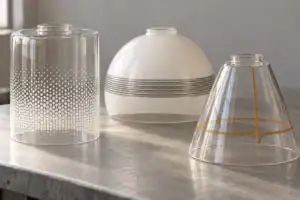
To measure a replacement glass lamp shade, identify the fitting type first (spider, uno, or gallery ring), then measure the fitter inner diameter (the collar opening — controls fit), globe maximum width, and shade height. Fitter size is the only dimension that determines whether the shade physically seats on the fixture.
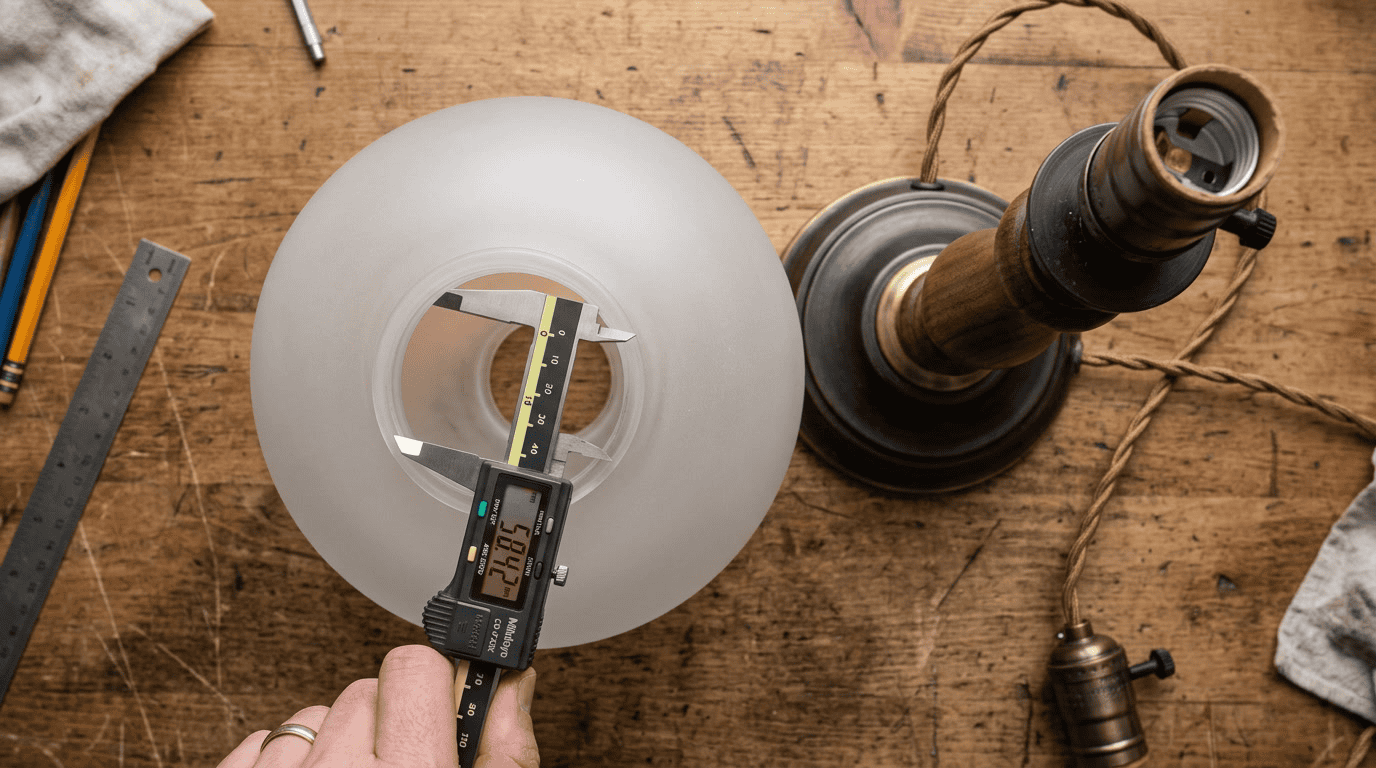
A glass lamp shade breaks and you reach for a tape measure. Wrong first step. The most common reason replacement glass lamp shades don’t fit is that buyers measured the wrong thing — the outside of the collar instead of the inside, or the shade’s overall width instead of the fitter diameter that actually determines fit.
Measuring correctly for a replacement glass lamp shade requires identifying the fitting type first, then taking the right measurements at the right reference points. This guide covers the complete measurement process for all residential glass shade fitting types — spider, uno, and gallery ring — with the tools and technique for each.
Step 1: Identify the Fitting Type
Before measuring anything, identify how the shade attaches to the lamp. This determines what you measure and what specification you order.
Gallery Ring (Fitter) Shades
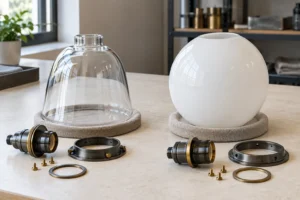
Gallery ring shades are the most common glass shade mounting for residential pendant fixtures, ceiling fans, and some table lamp designs. The glass shade has a smooth collar at the top (called the fitter); a metal gallery ring grips this collar with two or three set screws.
How to identify: Look at the lamp’s holder ring — if it has a ring with set screws that tighten against a glass collar, it uses a gallery ring system. The critical measurement is the fitter inner diameter.
Spider Fitting Shades
Spider fitting shades mount on a lamp harp via wire arms (the spider). These are primarily used with fabric shades, but some glass table lamp shades use a spider or wire cage system where the glass shade body hangs inside a metal wire frame that attaches to the harp.
How to identify: If your lamp has a tall metal arch (the harp) above the socket with a washer-shaped saddle at the top, it uses a spider fitting. Glass shades for spider fittings often come with the wire cage included — order by outside shade dimensions, not fitter size.
Uno Fitting Shades
Uno fitting shades have a threaded ring that screws directly onto the lamp socket collar. No harp required. Common on pharmacy lamps and some accent lamp designs.
How to identify: If the shade attaches to the lamp by screwing or clipping directly onto the socket ring (not via a separate harp and saddle system), it uses an uno or slip-uno fitting.
Step 2: Take the Critical Measurements
Once you know the fitting type, take the appropriate measurements with the correct tools.
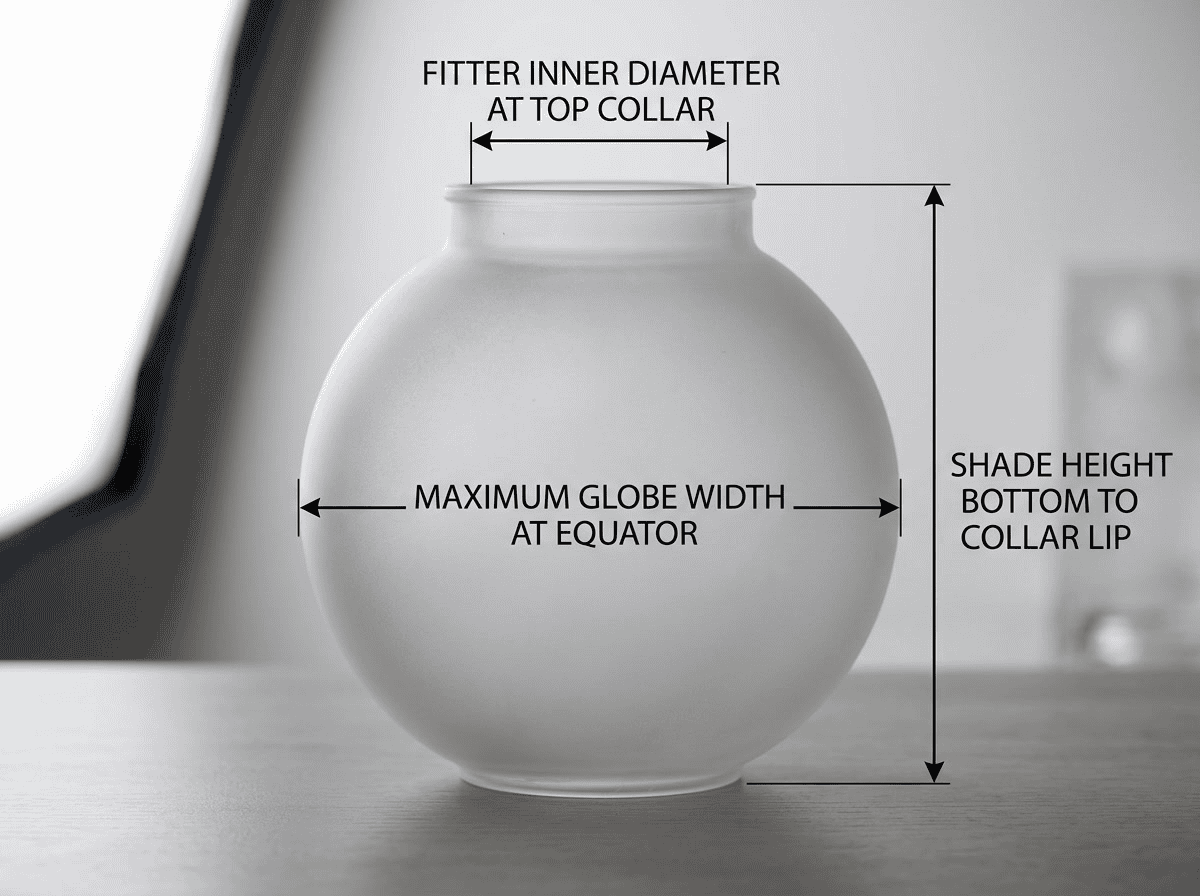
For Gallery Ring Shades: Fitter Inner Diameter
The fitter inner diameter is the inner clear span of the glass collar opening — measured inside to inside, not outside to outside.
Tool: Digital calipers (preferred) or a rigid ruler laid flat across the opening.
Technique: With the shade upright (collar facing up), open the calipers and place the measuring faces inside the collar opening. Expand until each face contacts the inner glass wall on opposite sides. Read the measurement.
Standard residential fitter sizes:
– 1⅝ inch (42 mm) — small chandelier shades, Victorian slip-cup shades
– 2¼ inch (57 mm) — small glass globes, pendant lights, some table lamp adapters
– 3¼ inch (83 mm) — vintage fixtures, some antique lamp designs
– 4 inch (102 mm) — standard pendant globes, ceiling fan shades
– 6 inch (152 mm) — large pendant globes, some torchiere applications
If the measurement falls between standard sizes, the fixture may use a non-standard fitter. Measure the inner diameter of the holder ring on the fixture itself — this gives the required fitter size directly.
Critical warning: Never measure the outside of the collar. The outer collar diameter is 10–16 mm larger than the fitter inner diameter (depending on glass wall thickness). Ordering by outside collar diameter gives you a shade that is oversized and won’t seat in the holder ring.
Globe Maximum Width (All Fitting Types)
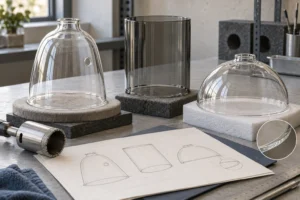
The globe diameter is the widest horizontal measurement across the shade body. For spherical globes, this is at the equator. For bell or dome shapes, it is the widest horizontal point of the shade body.
Tool: A rigid ruler or flexible tape measure.
Technique: Hold the ruler across the outside of the glass at the widest point. Record the outer diameter.
This measurement affects visual proportion — a globe that is significantly narrower or wider than the original looks wrong even if it fits. For matched sets (two identical table lamps with paired shades), globe diameter must match the surviving original shade within ±5 mm.
Shade Height (All Fitting Types)
Height is measured from the base of the fitter collar lip (the point where the collar sits on the holder ring) to the lowest point of the shade.
Tool: A ruler.
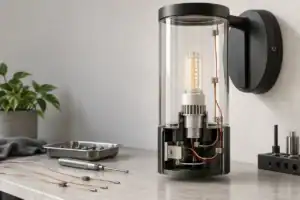
Technique: For gallery ring shades, measure from just below the fitter collar flange (the point of contact with the ring) to the bottom of the globe. For enclosed fixtures (where the shade sits inside a housing), also measure the internal fixture clearance from the holder ring seat to the top of the socket before ordering.
Step 3: How to Measure When the Original Shade Is Gone
The original shade broke and was discarded before you could measure it. Three approaches work:
Approach 1: Measure the holder ring (most reliable for fitter size)
The inner diameter of the fixture’s holder ring equals the fitter size of the correct replacement shade. Remove any gasket from the ring, then measure the inner clear span of the ring using digital calipers. Compare to standard fitter sizes.
Approach 2: Use fixture documentation
Find the lamp or fixture model number (often stamped on the base of a table lamp, or on a label inside a ceiling fixture housing). Use the model number to find the manufacturer’s replacement shade specification online or by contacting the manufacturer’s customer service.
Approach 3: Use the surviving shade in a paired set
If the broken shade was one of a matched pair, measure the surviving shade. Record all three dimensions from the surviving shade. Order an identical replacement.
Step 4: Measuring Spider-Fitting Table Lamp Shades
Spider-fitting glass table lamp shades require different measurements than gallery ring shades.
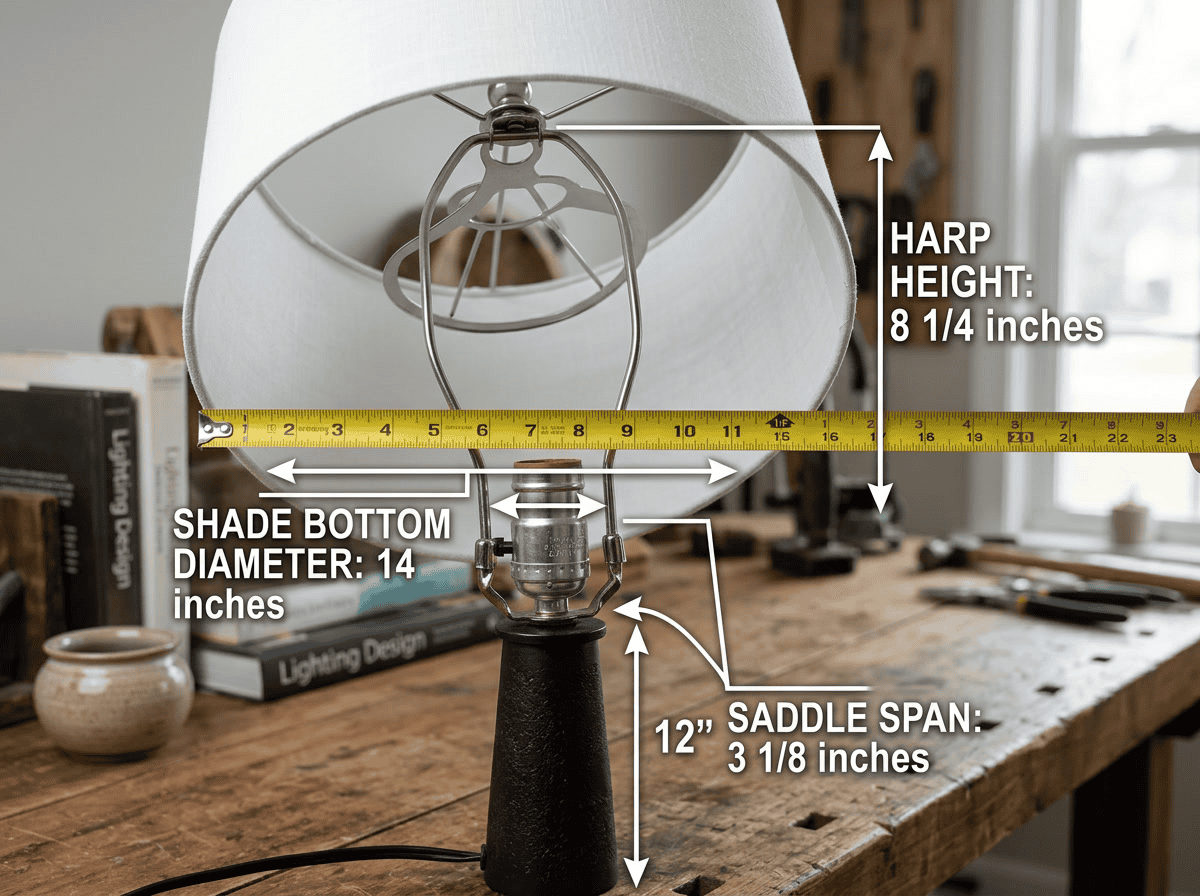
For spider-fitting glass shades (where the glass shade body hangs inside a wire cage that attaches to the harp):
Harp height: Measure the height of the lamp harp from the saddle (the flat washer where the finial attaches) to the base where the harp clips into the harp holder above the socket. Most table lamps use standard 7-inch, 8-inch, 9-inch, or 10-inch harps. The shade should clear the bottom of the lamp base — typically the shade bottom edge should be approximately 1 inch above the lamp base bottom when assembled.
Shade diameter: For table lamp glass shades, the shade diameter should be approximately two-thirds to three-quarters of the lamp base height for balanced proportion. A 24-inch table lamp base typically takes a 16–18 inch shade diameter. Most glass globe table lamp shades are 10–14 inches in diameter for standard residential table lamps.
Shade height: For spider-fitting shades, shade height affects proportion and the position of the shade’s widest point relative to the lamp base. The shade should be tall enough that the widest point (for bell or empire shapes) is above the lamp base’s visual midpoint.
Per the Illuminating Engineering Society’s residential luminaire design guidance, decorative table lamp shade proportions follow established visual conventions: the shade width typically equals 1.5–2x the base diameter at the base’s widest point, and the shade bottom should be at or slightly above eye level when seated.
Measurement Reference Guide by Shade Type
Different glass shade shapes present different measurement challenges:
| Shape | Critical Measurement | Common Error |
|---|---|---|
| Globe (spherical) | Fitter inner diameter | Measuring outside collar |
| Dome (truncated sphere) | Fitter diameter + dome depth | Ignoring depth for enclosed fixtures |
| Cylinder | Fitter diameter + height | Not checking enclosed height clearance |
| Tulip/flare | Fitter diameter + max width | Max width is below center — measure correctly |
| Bell/empire | Saddle span + bottom diameter | Measuring top diameter (wrong proportion reference) |
Common Measurement Mistakes for Glass Lamp Shades
Mistake 1: Measuring collar outside diameter instead of inside
This produces a fitter measurement 10–16 mm too large. The shade ordered from this measurement will not seat in the holder ring.
Mistake 2: Assuming globe diameter equals fitter size
A 10-inch globe can have a 2¼-inch fitter; a 12-inch globe can also have a 2¼-inch fitter. Globe size and fitter size are independent measurements. Never order fitter size based on globe diameter assumption.
Mistake 3: Using a flexible tape measure for fitter inner diameter
A flexible tape bends slightly across the curved collar opening, measuring a shorter chord than the true inner diameter. For fitter measurements, use rigid calipers or a rigid steel rule held flat and perpendicular across the opening.
Mistake 4: Not checking enclosed fixture clearance
For ceiling fan shades and some pendant shades that sit inside a housing, the shade must fit within the fixture’s internal height. A shade 10 mm too tall prevents the fixture from closing. Measure the fixture’s internal clearance before ordering for any enclosed application.
Mistake 5: Forgetting the gasket adjustment
Gallery ring shades seat on a rubber or foam gasket between the glass collar and the ring. The gasket compresses slightly under installation — a shade measured on the ring without the gasket may appear to fit but feel loose once the gasket is added. Always test-seat with the gasket in place.
According to ASTM standards for glass product dimensional tolerances, residential glass lamp shades are manufactured to fitter diameter tolerances of ±0.5 mm — meaning a shade specified at 4.00-inch fitter may measure anywhere from 3.98 to 4.02 inches. This is within the seating tolerance of standard holder rings.
Measuring for Chandelier Glass Shades
Chandelier glass shades are measured differently from pendant and table lamp shades — they are small, numerous, and use vintage or non-standard fitter sizes more often than any other residential application.
Chandelier shade fitter sizes are often 1⅝ inch (42 mm) slip-cup style — the glass shade slips onto a socket-mounted cup rather than into a gallery ring. For these:
- Measure the inner diameter of the slip-cup (the cup on the socket that the glass shade slides over)
- The glass shade’s collar opening must be wider than the cup outer diameter by 2–4 mm for clearance
- Chandelier shade height is typically 4–6 inches — measure the distance from the slip-cup top to the chandelier arm to confirm clearance
Per the NEMA residential luminaire hardware standards, slip-cup chandelier shade holders are specified by the cup outer diameter and shade inner fitter diameter as a matched pair — order replacement glass shades from the chandelier manufacturer for the best dimensional match, as proprietary slip-cup sizes are common.
Frequently Asked Questions
How to measure replacement glass shade?
Identify the fitting type first (spider, uno, or gallery ring). For gallery ring shades: measure the fitter inner diameter (inside the collar opening using calipers), globe maximum width, and shade height. The fitter inner diameter is the critical fit dimension. Standard sizes are 2¼ inch, 4 inch, and 6 inch for most residential applications.
How do I measure fitter size for a glass shade?
Using digital calipers, measure the inner clear span of the glass collar opening — from the inner glass wall on one side to the inner glass wall on the opposite side. Never measure the outside of the collar. The result will be close to a standard size (2¼ inch, 4 inch, or 6 inch); if it falls between standard sizes, also measure the inner diameter of the holder ring on the fixture for confirmation.
What is a glass shade fitter size?
The fitter size is the inner diameter of the glass collar at the top of the shade — the measurement that determines whether the shade seats correctly in the fixture’s holder ring. Standard residential fitter sizes are 1⅝ inch (chandelier slip-cup), 2¼ inch, 3¼ inch (vintage), 4 inch, and 6 inch. The fitter size controls fit; globe diameter and height control proportion.
Can I measure for a replacement glass shade without the original shade?
Yes. Measure the inner diameter of the holder ring on the fixture — this gives the required fitter size. For globe diameter and height, use the fixture’s model number to find the manufacturer’s replacement specification, or use the surviving shade in a matched pair as the measurement reference.
Why doesn’t my replacement glass shade fit even though the diameter looks right?
Most likely the fitter size was measured incorrectly — outer collar instead of inner collar, or a tape measure was used that curved and produced a shorter reading than the true inner diameter. Remeasure with digital calipers inside the collar opening. Also confirm the fitting type matches — a shade with a 4-inch gallery ring fitter will not work on a fixture with a different mounting system regardless of globe diameter.
How do I measure a replacement shade for a ceiling fan light kit?
Ceiling fan light kit glass shades often use proprietary fitter sizes specific to the fan brand. Measure the inner diameter of the fan’s shade holder ring using calipers. If the measurement matches a standard size (4 inch is the most common for ceiling fan light kits), a standard replacement shade will work. If the measurement is non-standard, search by fan brand and model number for the manufacturer’s replacement shade.
What is the height of a glass lamp shade measured from?
Height is measured from the base of the fitter collar lip (the underside of the collar where it contacts the holder ring) to the lowest point of the shade. This is not the same as the overall height of the glass piece including the collar above the seating surface — use the seating surface (collar lip underside) as the starting reference to match how the shade sits in the fixture.
Conclusion
Measuring a replacement glass lamp shade correctly requires two things most buyers skip: identifying the fitting type before measuring, and measuring fitter inner diameter with calipers rather than estimating from the collar’s outside appearance. The fitter inner diameter is the fit-controlling dimension — every other measurement is about proportion and clearance.
When the original shade is already gone, the holder ring inner diameter gives the fitter size directly. For everything else (globe size, height), the fixture manufacturer’s documentation or a surviving shade in a matched pair provides the reference.
For glass lamp shade replacements in the full range of standard fitter sizes — including table lamps, floor lamps, pendants, and ceiling fans covered in our home lamp shades guide — 2¼ inch, 4 inch, and 6 inch — in frosted, opal, clear, and seeded glass for residential pendant, ceiling fan, and table lamp applications, our glass lampshade product line at jxlampshade.com provides verified fitter dimensions and material documentation.