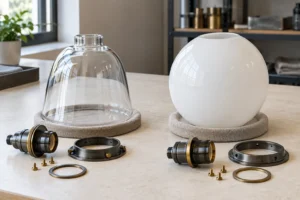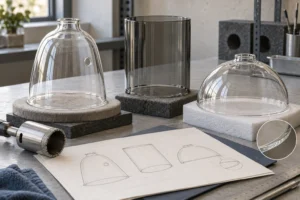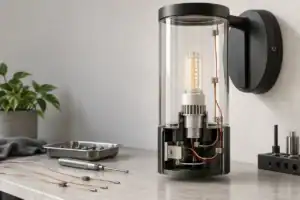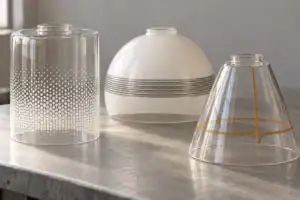
Home glass lamp shades include table lamp globes, torchiere uplighter bowls, pendant globes, ceiling fan domes, and Tiffany-style stained glass panels — selected by fixture type first, then fitter size (2¼-inch, 4-inch, or 6-inch standard), then glass type and opacity to match the room’s lighting goal.
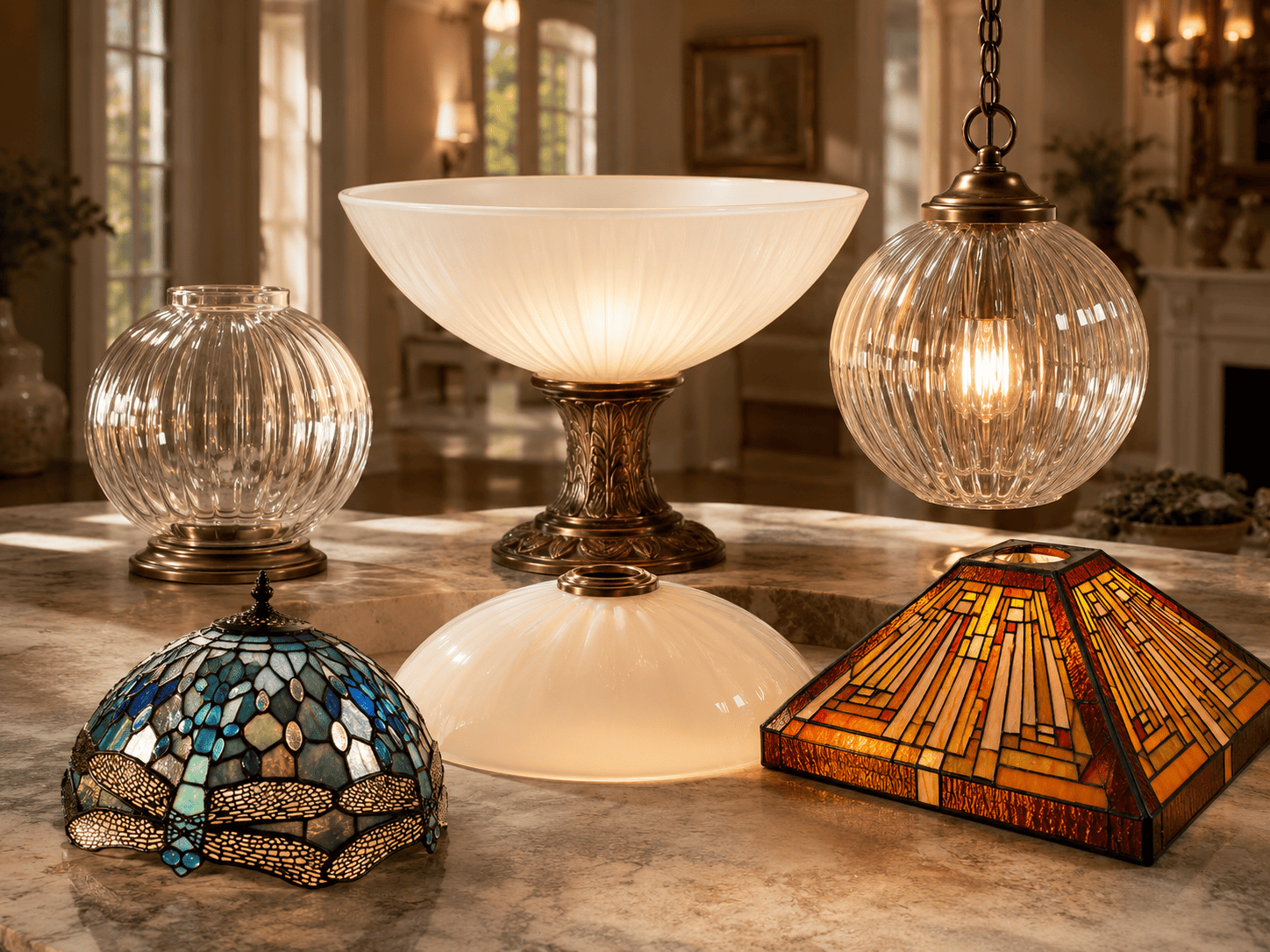
The glass shade is the most visually prominent part of any lamp. It determines whether the light in a room feels warm and diffused or bright and directed. It defines the era — Victorian, Art Nouveau, mid-century, industrial, contemporary. And when it breaks, finding a replacement that actually fits and looks right takes more thought than most buyers expect.
This guide covers the full range of home glass lamp shades — from the classic table lamp globe to the torchiere bowl, the pendant, and the Tiffany-style panel shade — with the practical details on types, measurements, glass properties, and style coordination that the product listing pages don’t provide.
Types of Home Glass Lamp Shades by Fixture
The starting point for choosing any home glass lamp shade is the fixture it must fit — because the fitter size, mounting system, and shade geometry are all determined by the fixture type.
Table Lamp Glass Shades
Table lamp glass shades sit on a lamp harp or slip onto a uno-fitter or keyless fitting directly on the lamp socket. Standard fitter types for table lamps:
- Spider fitting (harp + saddle): The most common residential fitting. A wire spider with three or more arms sits on the lamp harp and is secured at the top by a finial through the shade’s center hole. Shade diameter 12–18 inches is typical for standard table lamps.
- Uno fitting: A threaded ring on the shade body screws directly onto the lamp socket, eliminating the harp. Common on pharmacy lamps and some contemporary designs.
- Slip-uno fitting: Similar to uno but with a clip that snaps over the bulb rather than threading onto the socket.
Glass table lamp shades are less common than fabric shades for standard floor-level illumination (where fabric diffuses light more warmly) but are the correct choice for lamps used as accent, task, or period-authentic fixtures. A clear or frosted glass shade on a table lamp produces significantly more light output per watt than an equivalent fabric shade — relevant when the lamp serves as the primary task light for reading or detail work.
Torchiere and Uplighter Bowl Shades
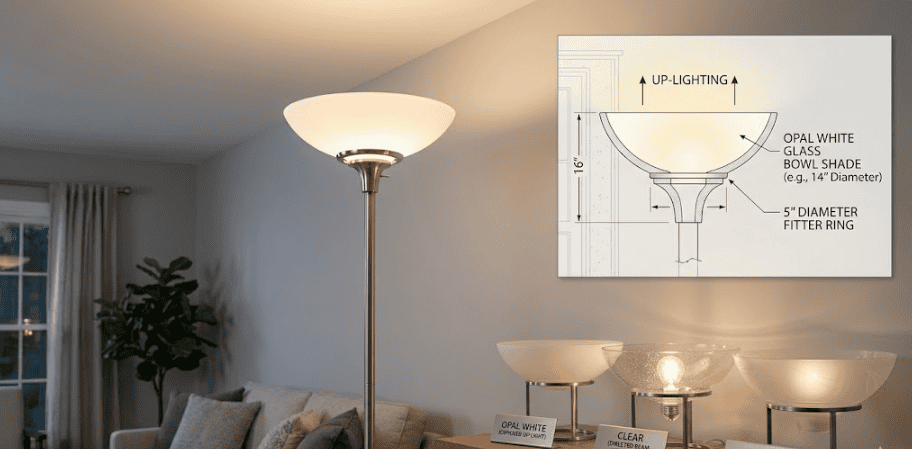
Torchiere floor lamps direct all light upward through a large glass bowl or dish at the top of the lamp post. The glass bowl is the shade — it diffuses and directs the upward-facing light that bounces off the ceiling to illuminate the room indirectly.
Torchiere bowl shades are typically 12–17 inches in diameter and shaped as shallow bowls or inverted domes. The glass type is critical for torchiere applications:
– Opal white glass: the dominant choice — diffuses the lamp source uniformly so the ceiling receives an even wash of light without a visible bright spot from the bulb
– Clear glass: produces a more directed upward beam with the bulb visible; appropriate for decorative torchiere designs where the lamp itself is visible from above
– Frosted glass: intermediate diffusion; appropriate when opal glass produces too opaque an appearance for the lamp design
Torchiere bowl shades fit via a large fitter ring at the bowl’s rim — typically 5–6 inch diameter for standard torchiere fixtures.
Pendant and Chandelier Glass Shades
Pendant fixtures hang from the ceiling and use glass shades in two configurations:
Individual glass globe pendants — a single glass globe suspended from a pendant cord with a gallery ring or fitter collar. Common in kitchen islands, dining tables, and industrial-style interiors. Globe diameters of 8–14 inches are typical for residential pendant applications. Fitter sizes are standard (2¼, 4, or 6 inch) and the shade mounts via set-screw gallery ring.
Chandelier glass shades — multiple small glass shades (typically 3–5 inch diameter) on the individual arms of a chandelier fixture. These use very small fitters (often 1⅝ inch or 2¼ inch) and glass types chosen for sparkle (cut crystal, seeded glass) or period authenticity (opal Victorian slip-cup shade).
Ceiling Fan Glass Shades
Ceiling fans with light kits use glass shades on downward-facing lamp sockets below the fan motor. Ceiling fan glass shades are often proprietary to the fan brand — the fitter may not match standard 2¼, 4, or 6 inch sizes. Standard ceiling fan glass shade shapes:
- Dome/globe: round or slightly flattened glass globe, 5–8 inch diameter
- Tulip: flared opening at the bottom, narrower at the fitter
- Bowl: wide shallow bowl below the fan motor for upward light diffusion
When replacing a ceiling fan glass shade, search by fan brand and model number as the first step — manufacturers sell replacement shades that are guaranteed to fit.
Tiffany-Style Stained Glass Shades
Tiffany-style stained glass shades are constructed from individual pieces of colored art glass joined with solder and copper foil — the technique developed by Louis Comfort Tiffany in the 1890s. The authentic Tiffany studio pieces are museum collection items; the market for residential use is dominated by high-quality reproductions and Tiffany-style handmade shades.
Tiffany-style shades typically use a spider fitting with a wider-than-standard saddle configuration — the weight of the glass panels requires a larger contact area than standard wire spiders provide. These shades are always decorative glass, not functional diffusers — the stained glass creates dramatic color effects when illuminated but reduces total light output by 40–60% compared to clear glass of equivalent size.
Glass Types for Home Lamp Shades
The glass type determines how the shade looks both lit and unlit, and how much light it delivers to the room.
Clear Glass
Clear glass transmits 88–92% of the bulb’s output. Lit, the bulb is fully visible through the glass — which is part of the design appeal for decorative filament LED bulbs (Edison-style), where the visible glowing filament is a deliberate aesthetic choice. Unlit, clear glass shows the bulb and any wiring inside, which can look cluttered on larger or more complex fixtures.
Clear glass home lamp shades work best:
– On pendant fixtures where filament LED bulbs are used
– On table lamps used primarily for task light where maximum lux matters
– In industrial or contemporary interior styles where the visible bulb is intentional
Frosted Glass
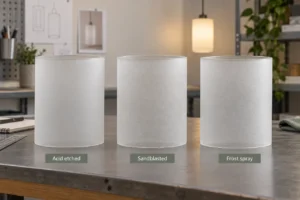
Frosted glass (acid-etched or sandblasted) transmits 75–82% of the bulb’s output and eliminates direct bulb visibility. Lit, the glass glows uniformly without a visible hot spot. Unlit, it appears a consistent translucent white.
Frosted white glass is the most common replacement choice for residential home glass lamp shades precisely because it looks correct lit and unlit, and because most factory-original shades on mid-market residential fixtures are frosted white.
Opal (Milk) Glass
Opal glass — also called milk glass — contains scattering agents in the glass body (calcium phosphate or tin oxide) that produce a dense, creamy white appearance. Opal glass transmits less light than frosted (typically 60–75%) but produces the most uniform, glare-free light output of any clear glass variant. It also looks more substantial than frosted glass when unlit — more opaque, crisper.
Opal glass is the historically authentic material for Victorian and Edwardian lamp shades, and for torchiere bowls where maximum visual uniformity of the upward-directed light is valued. The Corning Museum of Glass documents the development of opal glass formulations from the 19th century — the calcium phosphate opal glass used in period lamps has a distinctly warmer cream tone than modern tin oxide opal glass, relevant for authentic period restoration.
Seeded and Textured Glass
Seeded glass (air bubbles suspended in the glass body), hammered glass, and rain-pattern glass all provide moderate diffusion with visual texture. These are the correct choice for craftsman, arts-and-crafts, and cottage interior styles where the glass surface itself contributes to the room’s character.
Seeded glass transmits 65–78% of the bulb’s output. The air bubbles create a random pattern of light and shadow on the surrounding surfaces — more character than frosted glass, but less predictable in direction.
Colored and Tinted Glass
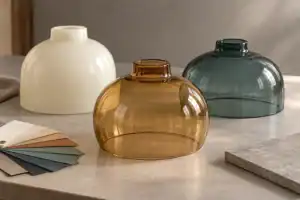
Amber, green, blue, and ruby tinted glass shades shift the color temperature of the emitted light — amber glass produces warm, candlelight-like illumination; green glass (as used in banker’s lamps) produces a distinctive cool-green cast that became the visual shorthand for early 20th century office and library lighting.
Tinted glass transmits less total light (amber 50–65%, ruby and deep blue even less) and is appropriate for accent and decorative fixtures rather than task lighting.
Art Glass and Hand-Blown Glass
Hand-blown glass lamp shades — whether clear, opal, or colored — have a visual softness that machine-produced glass cannot replicate: slight surface ripples, thickness variations, and color shifts within the glass body. These characteristics are particularly visible when the shade is lit.
According to the Illuminating Engineering Society’s guidance on decorative luminaire design, hand-produced glass components create a “warm, non-uniform luminance distribution” that is specifically cited as desirable for residential hospitality and lounge applications — confirming what interior designers already know about why hand-blown glass shades feel different from production glass.
How to Choose Home Glass Lamp Shades by Room and Style
The right home glass lamp shade for a room depends on three overlapping factors: the fixture’s function (ambient, task, or accent), the interior style, and the color temperature of the light source.
Living Room
Living room lamps serve primarily ambient and accent functions — you want flattering, diffused light that makes faces look warm and the room feel inviting. Opal or frosted glass shades with warm-white LED sources (2700K) are the most reliable choice.
For contemporary interiors with pendant fixtures over a coffee table or seating area, a clear glass globe with a visible filament LED creates the right “casual industrial” feel. For traditional living rooms with table lamps, opal glass or frosted glass with a fabric shade over the glass creates a layered warmth that works across most decor styles.
Dining Room
Dining room lighting is performance lighting for social occasions — the glass shade choice affects how food looks on the table and how people at the table look to each other. Warm-white light at the table surface is the design goal.
Pendant glass shades over the dining table are standard: a 12–16 inch frosted or seeded globe hung 30–36 inches above the table surface produces warm, even table illumination. For chandeliers, small clear or crystal glass shades on each arm create sparkle without reducing lux significantly — chandeliers typically have multiple bulbs that compensate for individual shade opacity.
Kitchen
Kitchen task lighting requires maximum lux at the counter surface — clear glass is often the functional preference for under-cabinet or pendant task fixtures. That said, pendant glass shades over a kitchen island serve both task and aesthetic roles: frosted glass prevents glare when working at the island while maintaining the visual clarity of an open kitchen design.
For kitchen ceiling fixtures with glass bowl shades, opal glass is standard — it distributes light broadly across the ceiling to illuminate the full kitchen without task shadows.
Bedroom
Bedroom lighting is the most forgiving context for glass lamp shade selection because multiple fixtures serve different roles: bedside table lamps for reading, accent lamps for ambiance, and ceiling fixtures for general illumination.
For bedside reading lamps, a frosted or lightly opal glass shade with a warm-white LED provides adequate task light without the harsh directional quality of a clear glass shade at close range. For accent and decorative table lamps in a bedroom, seeded, colored, or art glass shades can be chosen purely for visual character.
Study and Home Office
Study and home office lighting is task-dominant — maximum lux at the desk surface, minimum glare, good color rendering for reading paper and screen simultaneously. Clear or lightly frosted glass shades on desk and floor lamps maximizes available lux.
The U.S. Department of Energy’s guidance on residential task lighting recommends 400–800 lux at desk surfaces for reading and computer work — a 15-watt LED with a frosted glass shade provides approximately 500 lux at 18 inches in a focused desk lamp application.
How to Measure Home Glass Lamp Shades for Replacement
Replacement is where most glass lamp shade purchases go wrong — buyers order by visual impression and receive a shade that doesn’t fit. Three measurements determine a correct fit.
Measure 1: Fitter Size
The fitter is the glass collar at the top of the shade — the opening that sits on the fixture’s holder ring. Measure the inner diameter of this opening using digital calipers or a rigid ruler held flat across the inside of the collar.
Standard fitter sizes for home glass lamp shades:
– 1⅝ inch (42 mm) — small chandelier shades, Victorian slip-cup
– 2¼ inch (57 mm) — standard small globe shades, many table lamp globes
– 4 inch (102 mm) — standard pendant globes, ceiling fan shades
– 6 inch (152 mm) — large globes, torchiere applications
For torchiere bowls, measure the rim diameter — the bowl’s outer edge that sits in the torchiere ring — which is a much larger dimension than standard fitter sizes (typically 12–16 inches).
Measure 2: Globe Diameter (Maximum Width)
The widest horizontal measurement across the shade body — not at the collar. For spherical globes, this is the equatorial diameter. This dimension affects visual proportion and must be measured when matching a replacement to a surviving original shade in a paired lamp set.
Measure 3: Shade Height
From the fitter collar lip base (where it contacts the holder ring) to the lowest point of the shade. Match the original within ±10 mm for aesthetic consistency.
When the original shade is already gone: Measure the inner diameter of the holder ring on the fixture using digital calipers. This gives the fitter size directly. For globe diameter and height, use the fixture’s model number to find the manufacturer’s replacement shade specification.
Caring for Home Glass Lamp Shades
Glass is durable, but household glass lamp shades accumulate dust, cooking vapor residue (in kitchens), and the silicone oxidation residue from cleaning products used elsewhere in the room that settles on glass surfaces.
Routine Cleaning
Remove the shade from the fixture (follow installation steps in reverse — loosen set screws or lift off the harp for spider fittings). Wash in warm water with a small amount of dish soap — 10–15 minutes of soaking dissolves most residue. For stubborn deposits (particularly calcium scaling from hard water), a 50/50 solution of white vinegar and water applied with a soft cloth is effective without scratching.
Never use abrasive pads on frosted, seeded, or opal glass — the surface texture is easily damaged. Dry thoroughly before reinstalling — water inside a glass shade around a warm bulb creates thermal stress.
Per ASTM C1036 standards for flat glass quality, glass surfaces treated with abrasives develop micro-scratches that scatter light and reduce effective transmittance — relevant for frosted shades where the original surface treatment is part of the optical performance.
Handling and Installation
Most home glass lamp shade breakage happens during installation and removal — not in use. Two rules prevent most of it:
1. Never overtighten set screws on fitter-style holders. Hand-tight plus one quarter-turn is the correct torque. Overtightening creates stress concentration at the contact point that eventually fractures the collar.
2. Let the glass cool before removing it for cleaning. A warm glass shade handled cold creates thermal shock at the points of finger contact.
Vintage and Antique Home Glass Lamp Shades
The market for vintage and antique home glass lamp shades spans several distinct collecting and restoration categories.
Victorian and Edwardian oil lamp shades (1870s–1910s): Hurricane shades (tall cylinder chimneys that protected oil lamp flames from drafts), student lamp shades (opal and colored glass domes on adjustable-arm lamps), and gas shade globes. These use very specific fitter sizes — often 3¼ inch or non-standard sizes that require adapter rings for use with modern E26 socket hardware.
Arts and Crafts and Mission period (1900s–1920s): Leaded glass panels, seeded glass, and opal glass in strong geometric patterns. Reproduction Arts and Crafts shades are widely available; authentic period pieces from makers including Dirk van Erp and Gustav Stickley’s United Crafts are museum-level collectibles.
Art Deco (1920s–1940s): Pressed glass panels in geometric patterns, often in amber, jade green, or black with clear accents. Art Deco glass lamp shades frequently use chrome or Bakelite fittings that require period-authentic hardware.
Mid-century (1950s–1970s): Plastic and glass both appear in mid-century lamp designs; genuine mid-century glass shades use opal glass in clean, minimal shapes. The Smithsonian’s Cooper Hewitt design collection documents the lighting design evolution of this period, which is useful context for identifying period-authentic shades versus reproductions.
Related searches suggest strong buyer interest in vintage glass lamp shades for table and antique lamps — this is a growing segment of the home glass lamp shade market as period interior design revival continues in 2026.
Trends in Home Glass Lamp Shades for 2026 and Beyond
Mouth-blown glass revival. Machine-produced glass shades dominated the mid-market for decades. Consumer demand for handmade aesthetics — the slight texture variation, gentle thickness irregularity, and color warmth that only hand-production creates — is driving a recovery of artisan mouth-blown glass lamp shades in the premium residential segment.
LED filament aesthetic. The visible LED filament bulb — developed to replicate the aesthetic of incandescent Edison bulbs — has revived interest in clear glass home lamp shades that show the lamp source. A clear glass globe that looked cold and bare with a standard LED now looks warm and inviting with a filament LED at 2200K.
Color resurgence in glass. After two decades of predominantly white and clear glass domination in residential lighting, colored home glass lamp shades are returning — amber, sage green, smoked grey, and cobalt blue are all gaining ground in design-forward residential and hospitality applications.
| Trend | Glass Response | 2026 Market Direction |
|---|---|---|
| Artisan aesthetics | Mouth-blown glass revival | Growing in premium residential |
| LED filament bulbs | Clear glass globe resurgence | Steady growth |
| Color in interiors | Amber, green, smoked glass | Growing in design-led projects |
| Vintage revival | Period reproduction shades | Growing, especially mid-century |
| Dark-sky compliance (outdoor pendants) | Amber glass, downward distribution | ~18% of new covered outdoor installs |
Frequently Asked Questions
What are the different types of home glass lamp shades?
Home glass lamp shades include: globe shades for table lamps and pendants, torchiere bowl shades for uplighter floor lamps, ceiling fan dome shades, chandelier cup shades for multi-arm fixtures, and Tiffany-style stained glass panel shades. Each type is sized and fitted differently — a table lamp globe uses a spider or uno fitting, a pendant globe uses a gallery ring, and a torchiere bowl sits in a rim mount. Identify your fixture type before selecting a shade.
How do I find the right size glass shade for my table lamp?
For table lamps, identify the fitting type first (spider/harp, uno, or slip-uno). For spider fittings, the shade size is measured by the saddle opening at the top — a standard saddle fits most replacement shades. For uno and slip-uno fittings, measure the inner diameter of the lamp socket ring that the shade must seat on. Globe diameter and height are proportion choices — match the original shade’s dimensions for best visual result.
What glass shade fits my ceiling fan?
Ceiling fan glass shades are frequently proprietary to the fan manufacturer. Search by fan brand and model number for replacement shades — most major manufacturers (Hunter, Hampton Bay, Westinghouse) sell branded replacement glass kits. If ordering a universal replacement, measure the inner diameter of the fan’s shade holder ring (not the shade itself) and confirm the fitter size matches before ordering.
What is the difference between frosted and opal glass lamp shades?
Frosted glass has a surface treatment (acid-etch or sandblasting) that scatters light at the surface — transmittance 75–82%, appearing translucent white. Opal glass contains scattering particles throughout the glass body — transmittance 60–75%, appearing dense white and opaque. Opal glass produces more uniform light output and a more opaque, premium appearance; frosted glass is lighter-weight and slightly more luminous. For most residential replacements, frosted glass is the correct match to the factory original.
Can I use a glass shade from one fixture on a different fixture?
Only if the fitter size and fitting type match. A spider-fitting table lamp shade cannot go on a gallery-ring pendant fixture regardless of diameter. Within the same fitting type, any shade that matches the fitter diameter will seat correctly. Globe diameter is a proportion choice that doesn’t affect fit — a 10-inch globe and a 12-inch globe can use the same 4-inch gallery ring fitter.
How do I clean foggy or yellowed glass lamp shades?
Fog on the inside of a glass shade is usually mineral deposit from steam or cooking vapor — a 50/50 white vinegar and water soak for 20 minutes dissolves most deposits. Yellowing of the glass surface itself indicates UV or heat degradation — this is irreversible and the shade should be replaced. Yellowing inside the glass (not on the surface) indicates the glass itself has changed — also irreversible. Frosted surfaces should be cleaned with soft cloths only; abrasive pads scratch and permanently reduce light output.
What glass shade looks good with a filament LED bulb?
Clear glass globes are the best choice for filament LED bulbs — the visible LED filament is part of the design, and clear glass allows it to be fully visible. A frosted shade over a filament LED obscures the filament and produces the same appearance as any other LED source, negating the aesthetic purpose of the filament bulb. For pendants and table lamps where the filament LED is used decoratively, choose a clear glass globe with a globe diameter proportional to the fixture design — 6–8 inches for table lamps, 8–12 inches for pendants.
Conclusion
Home glass lamp shades range from the simple frosted globe on a bedside table lamp to the complex leaded stained glass of a Tiffany-style pendant. The selection sequence is the same regardless of style: fixture type and fitting first, fitter size second, glass type and opacity third, aesthetic style last.
The measurement that matters most is always the fitter size — the inner diameter of the glass shade’s collar opening, measured with calipers rather than estimated. Globe diameter and height are proportion choices; fitter size determines whether the shade fits at all.
For replacement home lamp shades in frosted, opal, clear, seeded, and colored glass in the full range of standard fitter sizes for table lamps, pendants, ceiling fans, and torchiere floor lamps, our glass lampshade product line at jxlampshade.com covers both standard replacement sizes and custom manufacturing for specialty home lighting applications.