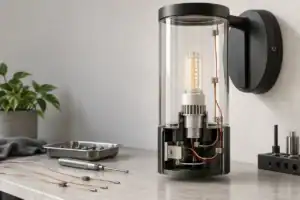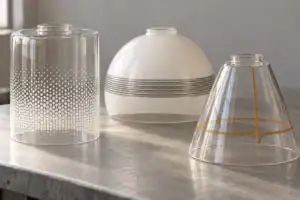
Hotel lamp shades in quality hospitality settings are purpose-built light-diffusing components — glass versions preferred for durability, consistent batch appearance, easy cleaning, and controllable light transmission that fabric cannot match across a large property.
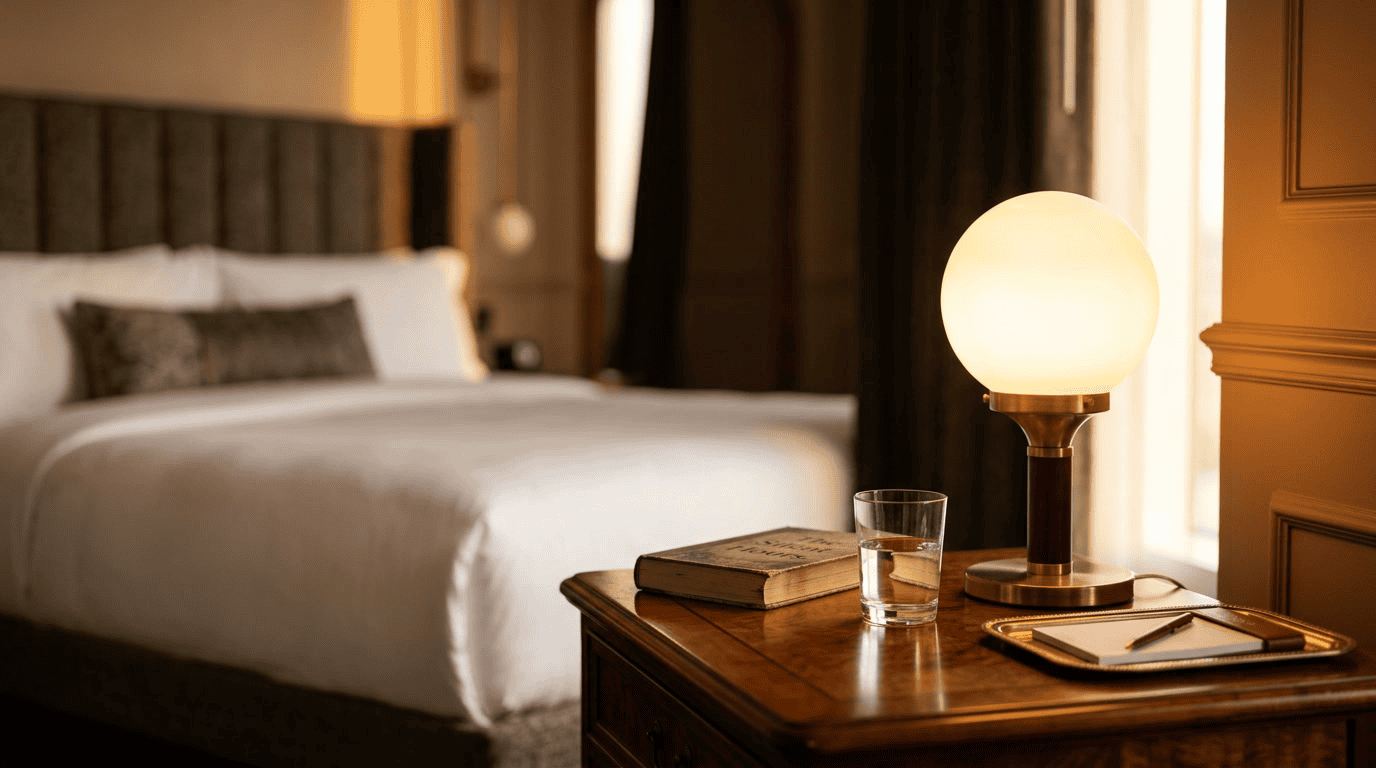
Walk into almost any four-star guestroom and you will notice the light before you notice the shade. The lamp on the nightstand glows warm amber, no glare, no harsh hotspot — just a soft pool of light that tells your body to slow down. That effect does not happen by accident. It comes from a carefully chosen hotel lamp shade that controls exactly how light leaves the fixture, how much of the bulb is visible, and how the warmth reads against the wall color.
This guide covers everything procurement managers, interior designers, and hospitality buyers need to know about hotel lamp shades in 2026: what distinguishes them from residential alternatives, why glass has become the preferred material in most professional installations, how to match shade type to room area, how to size and specify for your fixture inventory, and what the procurement process looks like when ordering at hotel scale.
What Are Hotel Lamp Shades?
Hotel lamp shades are the primary light-control component on any table, floor, or wall lamp in a hospitality environment — their job is to diffuse the light source, prevent direct glare, protect the bulb, and contribute to the room’s visual identity.
That sounds simple. In practice, hotel lamp shades carry responsibilities that residential shades do not. A bedside shade in a private home gets handled by one person, cleaned occasionally, and replaced whenever the owner decides. A bedside shade in a hotel guestroom gets touched by hundreds of guests per year, wiped down by housekeeping every day, exposed to occasional impact, and expected to match every other shade in a block of identical rooms for five to ten years.
Function: What a Hotel Lamp Shade Actually Does
According to the Illuminating Engineering Society, lamp shades serve four distinct functions in a lighting installation:
- Diffusion — scattering light from a point source into a soft, wide field. A bare bulb creates harsh shadows and visible glare. A shade spreads the light more evenly across the surface it illuminates.
- Direction — shaping where the light goes. A shade with a narrow base projects light mostly downward. A wide-open drum shape sends light up and down roughly equally. This determines whether a bedside lamp reads as a reading light or an ambient glow.
- Protection — shielding the bulb from accidental contact and reducing the fire risk from material getting too close to a hot source.
- Decoration — communicating the room’s design language. The color, texture, and silhouette of hotel lamp shades signal whether a property is contemporary minimalist, warm boutique, or grand classical.
In a residential setting, most buyers prioritize decoration and price. In hospitality, function and durability come first — the aesthetic comes second, as a constraint, not an override.
Hotel-Grade vs. Residential Lamp Shades
The physical difference between hotel lamp shades and residential shades is less about shape and more about material specification, dimensional precision, and production consistency.
Table 1 — Hotel-Grade vs. Residential Lamp Shades: Key Differences
| Specification | Hotel-Grade | Residential |
|---|---|---|
| Material priority | Durability and cleanability first | Appearance first |
| Batch consistency | Matched within ΔE ≤ 2–3 across 500+ units | Single unit or small set |
| Fitter tolerance | ±0.5 mm for retrofit interchangeability | Loose — buyer adjusts |
| Expected service life | 5–10 years under daily hotel use | 2–5 years typical |
| Cleaning method | Daily wipe-down, chemical-safe surface | Occasional dust removal |
| Typical material | Glass (4- and 5-star), fabric (budget properties) | Fabric, paper, or glass |
The single most visible consequence of ignoring these differences: a hotel that replaces lamp shades in batches — buying a new lot three years after the original — gets shades that are a visibly different color from the surviving originals because fabric and paper dyes drift batch to batch. Glass, when specified with consistent cullet composition and annealing, holds its optical character far more reliably.
Types of Hotel Lamp Shades — Shapes and Materials
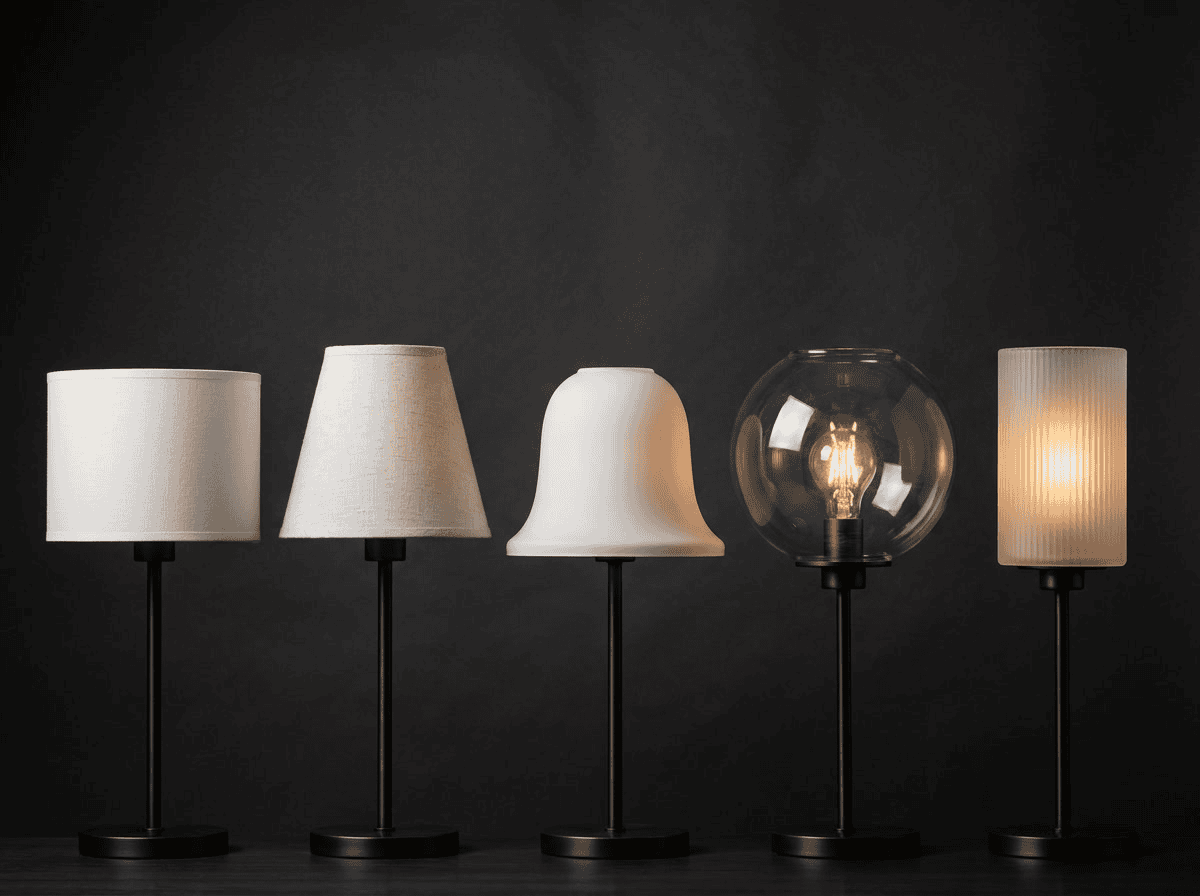
There are five primary shapes and three main material categories for hotel lamp shades — the right combination depends on fixture type, room function, and the property’s design language.
Understanding both dimensions before you specify prevents the most common hotel procurement mistakes: ordering a shade whose fitter doesn’t fit the existing fixture base, or specifying a shape that creates glare in a space where guests recline.
Shape Guide: The Five Standard Hotel Shade Forms
Drum shades are cylinders — equal diameter top and bottom. They distribute light evenly upward and downward and read as clean and modern. Used extensively in hotel lobbies, corridor sconces, and contemporary guestrooms. The straight sides make them easy to manufacture consistently in glass.
Empire shades taper from a smaller top to a wider base. They concentrate downward light, making them ideal for reading lamps on desks and bedside tables. The classic silhouette works well in traditional and transitional hotel interiors. Glass empire shades in opal or frosted finish are a staple of four-star European hotel rooms.
Bell shades are a softer version of the empire — the taper curves rather than going straight. They read as slightly more casual and decorative, often used in boutique hotels with a residential-inspired design direction. In glass, a bell shade with a ribbed or seeded texture adds visual warmth.
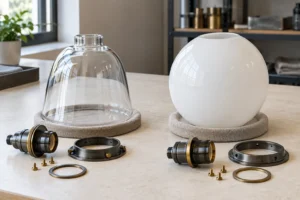
Globe shades are spherical or near-spherical. They distribute light in all directions and create a distinct decorative presence. Often seen on wall sconces, pendant clusters in hotel bars, and bathroom vanity fixtures. Opal glass globes have been a consistent choice in luxury hotel bathrooms since the mid-twentieth century.
Cylinder shades are tall and narrow — more column than drum. They appear on floor lamps and tall table lamps, particularly in contemporary and industrial-influenced hotel design. Clear or lightly frosted glass in a cylinder reads as architectural rather than decorative.
Glass Hotel Lamp Shades: The Material Breakdown
Glass is the dominant material for hotel lamp shades at the four- and five-star tier for one simple reason: it holds its appearance. A white frosted glass shade bought in 2026 will be the same color in 2031. The same cannot be said for most woven or paper options. As Wikipedia’s overview of lampshade history notes, glass shades have been the reference standard for quality interior lighting since the late nineteenth century — and their core advantages have not changed.
The relevant glass types for hotel lamp shades are:
- Clear glass — maximum light transmission (typically 88–92%). Every detail of the bulb is visible. Used where design intentionally exposes the light source, or in fixtures with decorative vintage filament bulbs. Hotel bars and restaurants use clear glass shades to display the warm glow of Edison-style LEDs.
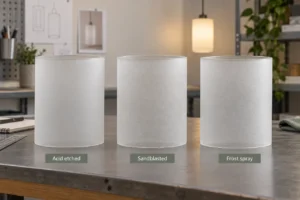
- Frosted glass — acid-etched or sand-blasted surface scatters light and makes the bulb invisible. Transmission drops to roughly 65–75% depending on the etching depth. This is the most common hotel lamp shade choice for guestroom tables and floor lamps because it controls glare without cutting too much brightness.
- Opal / milk glass — a dense white glass that diffuses light very evenly across the entire shade surface. Transmission is lower (35–55%) but the visual effect is a smooth, even glow. Opal glass shades are preferred in applications where the shade itself is meant to be a luminous object — hotel lobbies, bathroom globes, feature pendants.
- Ribbed / fluted glass — the textured surface breaks light into directional patterns that add visual interest. Common in boutique hotels trying to differentiate from standardized brand properties. Ribbed glass also partially conceals the bulb, though less completely than frosted.
- Borosilicate glass — a thermally stable glass composition with better resistance to thermal shock than standard soda-lime glass. Borosilicate glass, as described in its technical literature, expands and contracts less dramatically with temperature changes, making it appropriate for hotel fixtures near heat sources, outdoor-rated wall lamps, and installations where temperature cycling is significant.
Fabric vs. Glass: The Hospitality Comparison
Fabric hotel lamp shades are cheaper to produce and offer a warmer, more residential feel. For budget properties and motels, that trade-off makes sense. At the full-service hotel tier, the maintenance reality consistently favors glass.
Table 2 — Hotel Lamp Shade Shape × Hotel Area × Recommended Glass Type
| Shape | Best Hotel Areas | Recommended Glass | Light Effect |
|---|---|---|---|
| Drum | Lobby, corridors, desk lamps, sconces | Frosted or opal | Even upward/downward distribution |
| Empire | Bedside tables, reading lamps | Frosted or clear | Directional downward reading light |
| Bell | Boutique guestrooms, lounge areas | Opal or ribbed | Soft ambient, decorative presence |
| Globe | Bathroom vanities, bar pendants | Opal or clear | Omnidirectional glow or bulb display |
| Cylinder | Floor lamps, contemporary lobbies | Frosted or clear | Column of light, architectural feel |
Choosing Hotel Lamp Shades by Area
The correct hotel lamp shade for each area is determined by three variables: the required light level, the viewing angle of guests, and the design tone of the space.
A guestroom has different needs from a lobby bar, and a lobby bar has different needs from a corridor. Getting these right saves both energy and complaints — a shade that’s too open in a bedside lamp creates the glare that Cornell University’s hospitality research consistently identifies as one of the top factors in negative guestroom light quality ratings.
Guestroom Bedside and Desk Lamps
Guestroom hotel lamp shades need to perform two jobs simultaneously: provide enough light for reading and working while not creating glare when a guest is lying down or watching television.
The key decisions here:
Glass type: Frosted glass is the standard choice. It conceals the bulb, softens the light into a uniform field, and remains easy to clean daily. Opal glass works for an even softer effect but reduces output noticeably — consider it only if the room has supplemental lighting from ceiling or wall sources.
Shape: Empire or drum for bedside. The directional taper of an empire shade keeps light below the horizontal, reducing the chance a lying guest sees the bulb directly. Drum shades are more contemporary and suit rooms with higher ceilings where the shade is well above eye level when reclined.
Color temperature pairing: Frosted and opal glass shades transmit warm light well — they do not shift the color temperature of the bulb significantly. In guestrooms, a 2700–2900K LED paired with a frosted glass shade produces the amber warmth guests associate with quality hotels. Avoid clear glass with cool-white (4000K+) LEDs in guestrooms — it reads clinical rather than comfortable.
Size: The shade diameter should be roughly 2× the lamp base diameter for visual balance. For a standard hotel table lamp with a 15 cm base, a 28–32 cm drum shade is typically correct. Too small and the shade looks pinched; too large and it overwhelms the nightstand.
Hotel Lobby, Corridors, and Public Areas
Lobbies and public corridors have a different problem from guestrooms: scale and visual consistency across many fixtures in a large space.
A hotel lobby may have 20 identical table lamps, 40 wall sconces, and 6 floor lamps — all needing visually consistent hotel lamp shades. Any color variation between batches will be immediately visible under the ambient light of a large space. This is where batch color consistency in glass manufacturing becomes commercially significant. Specifying frosted or opal glass from a single production run, with documented ΔE tolerance, is standard practice for hotel renovation projects above 100 rooms.
For corridors, drum glass shades on wall sconces are the most maintainable choice. They are simple to remove and wipe, hard to damage, and visually neutral enough to work across extended corridor runs.
For lobby statement pieces — large floor lamps, feature pendants above the reception desk — opal or ribbed glass shades in larger formats (40–60 cm) create visual presence without the maintenance problems of decorative fabric alternatives.
Hotel Restaurant, Bar, and Event Spaces
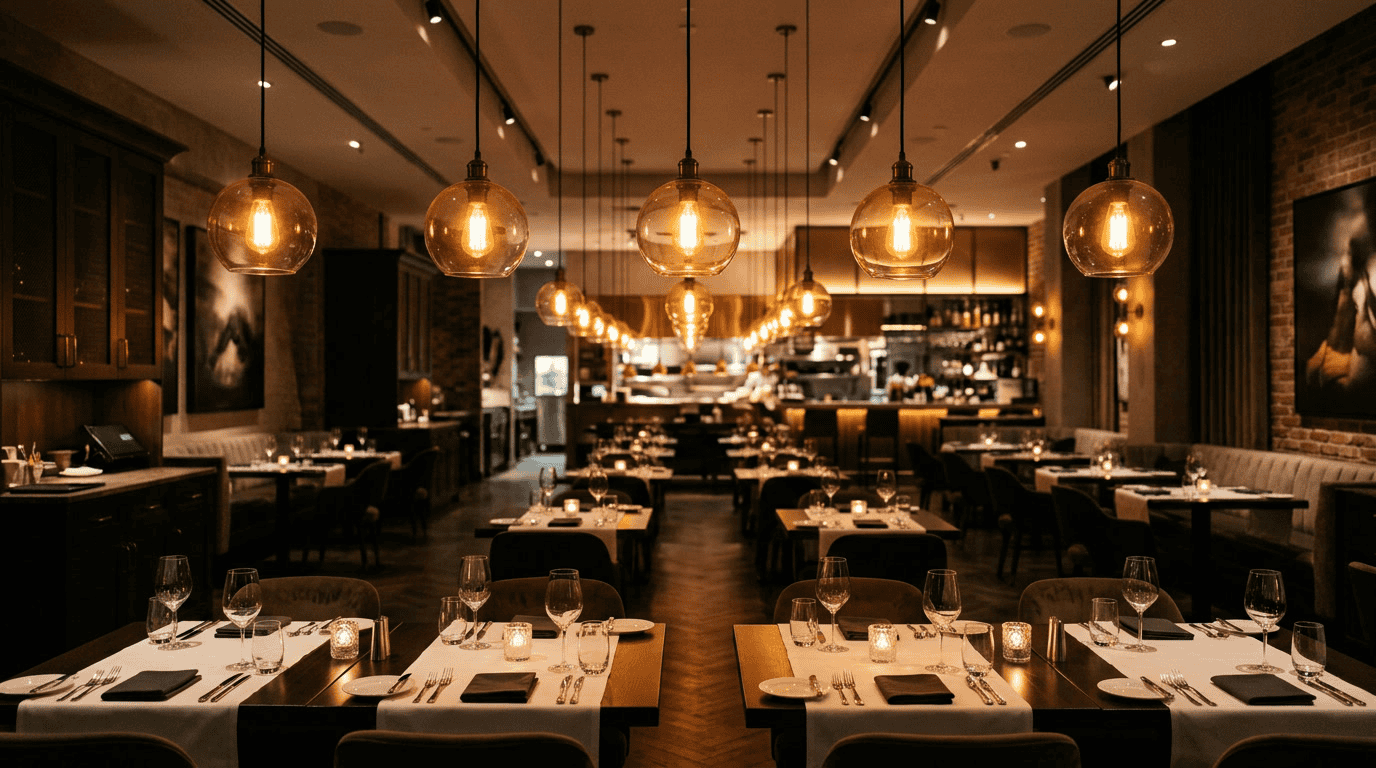
Food and beverage areas in hotels have the most demanding aesthetic requirements for hotel lamp shades. Guests spend longer in these spaces, lighting is central to the experience, and the trend in hospitality F&B design has moved firmly toward visible glass fixtures rather than concealed fabric ones.
Restaurant ambient lighting: Opal globe shades hung as pendants over tables produce the warm, even glow that flatters both food and guests. The key specification is light output — at table level, 150–200 lux is the typical target for a main dining room. Opal glass at 40% transmission with an appropriately powerful LED source achieves this without forcing an uncomfortable wattage.
Bar and lounge: Clear glass shades with exposed Edison filament LEDs have become a signature of contemporary hotel bar design. The visual contrast between the amber glow of the filament and the clear glass produces a warm industrial aesthetic at low cost. Ribbed glass is a useful alternative when the designer wants some visual softening without losing the decorative bulb display.
Event spaces: Flexibility is the priority. Drum or empire glass shades on adjustable floor lamps allow housekeeping to reconfigure spaces between events. Borosilicate glass is worth specifying in event spaces near kitchen access or high-humidity areas adjacent to pool facilities.
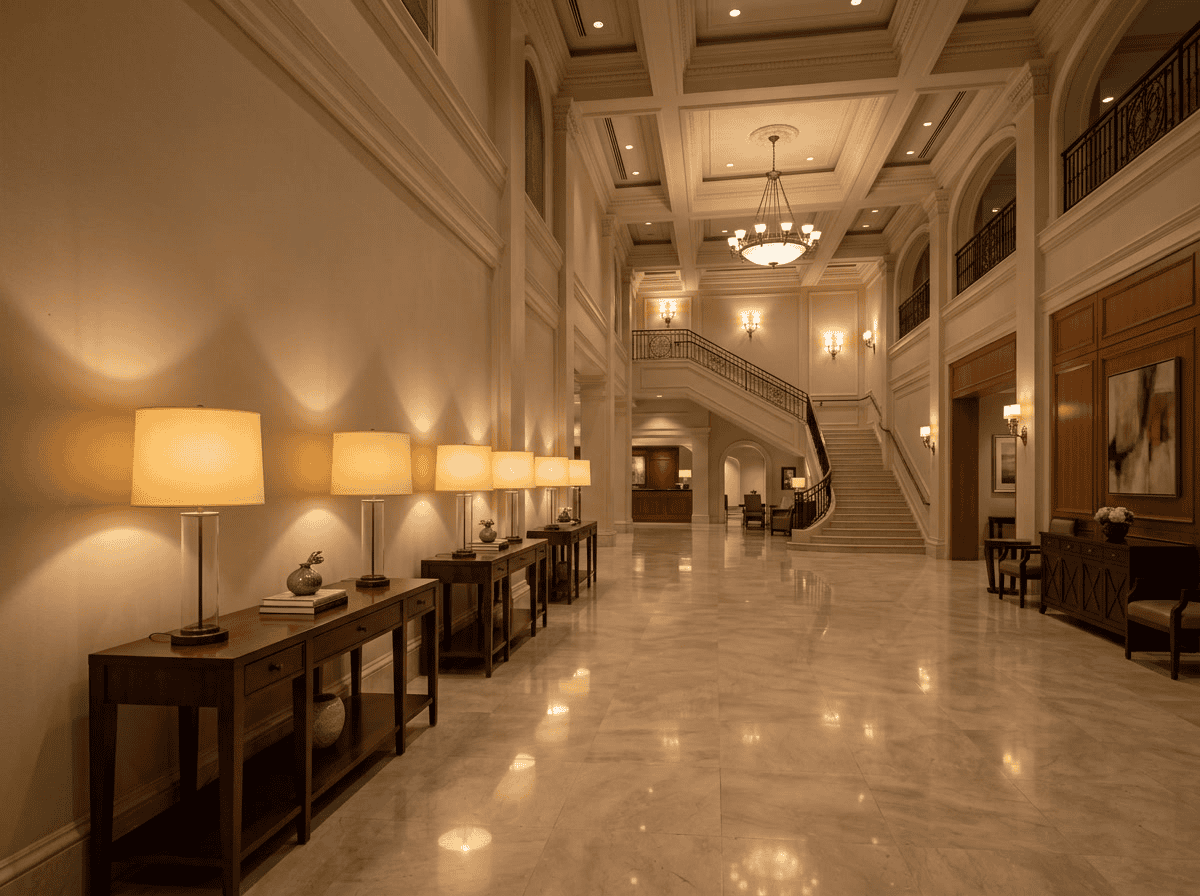
Table 3 — Hotel Area × Glass Type × Recommended Light Effect × Color Rendering Guidance
| Hotel Area | Recommended Glass | Shade Shape | Target Color Temp | Key Consideration |
|---|---|---|---|---|
| Guestroom bedside | Frosted | Empire or drum | 2700–2900K | Glare control when guest is reclined |
| Guestroom desk | Frosted or clear | Empire | 3000K | Sufficient task light for working |
| Lobby statement | Opal | Globe or drum | 2700K | Batch consistency across all units |
| Corridor sconces | Frosted | Drum | 2700–3000K | Easy daily cleaning, visual neutrality |
| Restaurant pendants | Opal | Globe | 2700K | Light output at table level |
| Bar / lounge | Clear or ribbed | Globe or cylinder | 2700K | Decorative bulb visibility |
| Event spaces | Frosted or borosilicate | Drum | 3000K | Flexibility and heat tolerance |
Specifying and Ordering Hotel Lamp Shades
Correct specification of hotel lamp shades covers four variables: fitter type and diameter, overall shade dimensions, glass thickness, and finish — getting any one wrong results in either shades that don’t fit the fixture or a finished installation that doesn’t match the design intent.
Sizing and Fitter Compatibility
The fitter is the opening at the top of the shade that attaches to the lamp fixture. Hotel fixtures typically use one of three fitter types:
- Spider fitter — a cross-brace that sits on a lamp harp. Most common in American hotel markets. The fitter diameter must match the harp saddle width.
- Uno fitter — a ring that threads directly onto the lamp socket. Common in UK and European hotel fixtures. The inner diameter of the uno ring must match the socket diameter precisely — typically 27 mm or 28 mm.
- Clip-on / bulb-clip fitter — clips directly over the bulb. Used in decorative and wall sconce applications. The bulb base size determines the clip diameter — B22 and E27 bulbs have different clip requirements.
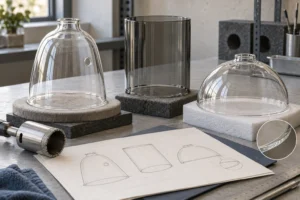
When specifying hotel lamp shades for an existing property, always measure the fitter inner diameter with a caliper to ±0.5 mm before ordering. Hotel refurbishment projects have historically been derailed by ordering shades with the wrong fitter size — the shades arrive and don’t fit, requiring re-order at cost and schedule impact.
The overall shade dimensions — height, maximum diameter, and minimum opening at the base — determine both the light distribution and the visual proportions relative to the lamp base. For standard hotel bedside table lamps (30–40 cm base height), shade heights of 20–28 cm and maximum diameters of 28–36 cm are typical.
Wall thickness in glass hotel lamp shades is usually 2.5–4 mm for standard production. Thicker glass (5–8 mm) is available and appropriate for protective covers in high-traffic areas, though it reduces light transmission and adds weight.
Bulk Ordering and OEM/Custom Hotel Lamp Shade Manufacturing
Hotels and hospitality procurement teams ordering hotel lamp shades at scale have three main sourcing options:
1. Standard catalog sizes from a glass manufacturer. The fastest and lowest-cost route for properties where standard dimensions match the existing fixture inventory. Lead time is typically 2–4 weeks for stock items.
2. Custom-dimension glass shades from an OEM manufacturer. Required when the property has non-standard fixtures, when the design brief specifies a particular silhouette that isn’t available in catalog, or when a hotel chain needs every property in a portfolio to use the same proprietary shade shape. Custom mold development for glass adds 3–5 weeks to the lead time, but all subsequent production runs hit the same dimensions.
3. Exact reproduction of existing shades. The most technically demanding scenario — common in hotel renovation and listed-building restoration projects. The original shade must be measured precisely (diameter, height, opening, wall thickness, neck structure) and the glass color and finish matched to the surviving originals. The Hospitality Design industry has documented increasing demand for this type of matched-shade reproduction as older hotels undergo mid-life renovation without full rebrand.
For bulk orders — typically 500+ units of a single specification — a factory needs the following information before quoting:
- Fixture type and fitter type/diameter
- Glass shape with dimensions (height + max diameter + base opening)
- Wall thickness
- Glass type (clear, frosted, opal, ribbed, borosilicate)
- Quantity and expected reorder frequency
- Packaging requirements (EPE foam, carton strength, pallet spec for sea freight)
- Destination country and delivery schedule
Batch Color Consistency for Hotel Chains
Multi-property hotel groups have a specific requirement that single-property buyers don’t: every shade across all properties in a brand portfolio needs to be visually indistinguishable. A guest transferring between properties of the same brand should not notice the shades are different.
Glass color and transmission consistency is controlled through production batch management and cullet composition control. In practice, a competent glass lampshade manufacturer can hold ΔE ≤ 2.5 across a single production run — visible difference in laboratory conditions but not to normal vision in a hotel room. For a chain requiring ongoing supply over multiple years, agreeing a master sample (an approved shade held by both buyer and manufacturer) and specifying tolerance against it in every purchase order is the professional standard.
For glass lamp shades specifically, partnering with a glass lampshade manufacturer specialising in hotel projects simplifies this process considerably — OEM production locks shade dimensions, finish, and fitter type to your exact fixture drawings, and mold archiving enables reorder consistency across multi-year refurbishment cycles.
Glass vs. Fabric — The Hospitality Maintenance Reality
For full-service hotels, glass hotel lamp shades outperform fabric on every maintenance metric that matters — cleaning time, chemical compatibility, color stability, and replacement interval.
Cleaning Cycles and Chemical Compatibility
Hotel housekeeping uses disinfectant cleaning solutions daily. Most fabric lampshades are not chemical-compatible with standard hotel cleaning agents — the dyes fade, the adhesive backing softens, and the surface texture traps particulates that can’t be wiped clean. Within 12–18 months under daily cleaning cycles, many fabric hotel lamp shades look noticeably degraded.
Glass surfaces are chemically inert to almost all cleaning agents. A frosted glass hotel lamp shade can be wiped with the same disinfectant solution used on the nightstand surface, dried, and it looks the same as day one. In high-turnover hotel environments (urban business hotels doing 90%+ occupancy), this is not a marginal benefit — it measurably reduces replacement frequency.
Breakage and Service Life
Glass breaks; fabric doesn’t. That is the common objection to glass hotel lamp shades in procurement discussions. In practice, breakage rates for properly specified glass shades in guestroom table lamp installations are lower than many buyers expect — typically under 1% per year per unit in non-resort environments where guests are adults rather than families with young children.
Fabric shades, by contrast, suffer from a different type of degradation: they don’t break, but they deteriorate continuously. Staining, yellowing, warping in humid environments (near pools or in warm climates), and color-batch drift on reorders mean that the practical replacement cycle for quality fabric hotel lamp shades is often 3–4 years. Quality glass hotel lamp shades, in the same environment, routinely last 8–12 years without replacement outside of breakage events.
The net cost per shade over a 10-year property lifecycle typically favors glass by 20–35% once replacement labor and shade cost are factored together — even accounting for the higher unit price of glass versus entry-level fabric.
Future Trends in Hotel Lamp Shades — 2026 and Beyond
Two design and technology directions are actively reshaping what hospitality designers specify for hotel lamp shades in 2026 — both favor glass over alternative materials.
Biophilic Design and Textured Glass
Biophilic design — the integration of natural patterns, textures, and organic forms into interior spaces — has moved from a trend into mainstream hotel design specification over the past several years. As documented in recent Hospitality Design industry coverage, biophilic elements in guestroom design consistently test positively in guest satisfaction research.
For hotel lamp shades, this translates to increased specification of textured glass: seeded glass with visible air bubble inclusions, hand-blown glass with slight surface irregularity, ribbed patterns that suggest natural forms. These glass finishes introduce organic visual warmth that flat fabric shades cannot replicate — and they photograph well in the era of social media hotel reviews, where a distinctive lamp is a shareable moment.
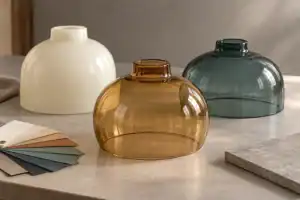
Amber and smoked glass hotel lamp shades — not entirely new, but historically associated with period interiors — are now appearing in contemporary boutique hotels as a way to differentiate from the clean-white aesthetic that dominated hotel design from 2010 to 2022. The warmth a genuinely amber glass shade adds to a guestroom at night has measurable impact on perceived room quality.
LED Compatibility and Opal Glass Diffusion
The full transition to LED light sources in hotel rooms is essentially complete in new construction and well underway in renovation. LED technology introduced a new problem for hotel lamp shades: LEDs are point sources with directional output profiles, and early LED bulbs produced a harsh bright spot visible through any diffuse material.
Opal glass has emerged as the most technically effective solution to LED hotspot diffusion. Unlike frosted glass (which scatters light but doesn’t fully eliminate hotspot visibility), true opal glass — with its dense body diffusion rather than surface etching — fully homogenizes LED output across the entire shade surface. The result is a smooth, even glow that reads identically to what a hotel guest remembers from incandescent-era visits. According to the American Lighting Association, the combination of a warm-CCT LED (2700K) with a quality opal diffuser is the current industry benchmark for guestroom table lamp specification.
Hotels moving to higher-efficacy LED packages (which produce more visible blue in their spectral output) can use opal glass hotel lamp shades to soften that blueness without significant light loss, since opal glass absorbs slightly more at the blue end of the spectrum. This is a technical edge over fabric diffusers, which do not have consistent spectral selectivity.
FAQ — Hotel Lamp Shades
What size are standard hotel lamp shades?
For bedside table lamps, the most common hotel lamp shade sizes are 28–36 cm in diameter and 18–25 cm in height. This range works across the majority of standard hotel table lamp bases (30–40 cm base height). The exact size depends on lamp base diameter — the shade should be approximately 2× the base diameter for visual balance. Lobby and floor lamp shades run larger, typically 40–55 cm in diameter.
What material is best for hotel guestroom lamp shades?
Frosted or opal glass is the strongest choice for hotel guestroom lamp shades at the four- and five-star level. Glass cleans faster, holds its color indefinitely across multiple replacement batches, and lasts significantly longer than fabric in daily hotel use. Budget properties and motels with limited cleaning protocols may retain fabric for cost reasons, but properties with professional housekeeping standards consistently find glass more cost-effective over a full renovation cycle.
Can I order custom hotel lamp shades in bulk from a factory?
Yes — custom glass hotel lamp shades in bulk are a standard product category for OEM glass lampshade manufacturers. Standard custom programs begin around 500 pieces per specification, with custom mold development for unique shapes adding 3–5 weeks to the initial order timeline. Subsequent production runs on an established mold proceed faster. The minimum specification information required: fitter type, diameter, height, glass type and finish, wall thickness, destination country, and packaging requirement.
Why do luxury hotels use frosted or opal glass shades?
Frosted and opal glass shades hide the bulb entirely, eliminating glare that a lying or reclining guest would experience from a visible light source. Beyond glare control, both finishes produce the warm, even ambient glow that higher-tier hotel brands spend considerable interior design budget achieving. Opal glass specifically creates a shade that appears as a luminous surface rather than a glass container — a distinction that photographs and reviews well.
How long do glass hotel lamp shades last compared to fabric?
In standard hotel guestroom use, glass hotel lamp shades typically last 8–12 years; quality fabric shades typically need replacement every 3–4 years. The glass advantage comes entirely from resistance to cleaning chemical damage, color stability under UV exposure (from sunlight through windows), and the absence of the staining and yellowing that affects fabric in high-humidity hotel environments like pool-adjacent rooms or tropical locations.
What fitter types are standard on hotel table lamps?
The three standard fitter types on hotel table lamps are the spider fitter (USA and Canada), the uno fitter (UK and Europe), and the clip-on bulb fitter (wall sconces and decorative pendants worldwide). Spider fitter dimensions are standardized around the lamp harp width. Uno fitter inner diameters are typically 27–28 mm. Before ordering replacement hotel lamp shades, always measure the fitter with a caliper — replacement shades ordered by shade shape alone frequently arrive with an incompatible fitter.
Are glass hotel lamp shades easy for housekeeping to clean?
Glass hotel lamp shades are easier to clean than fabric by a significant margin. The surface is non-porous, compatible with standard hotel disinfectant solutions, and can be wiped dry in seconds. Housekeeping staff do not need specialized cleaning products or techniques. Frosted glass specifically has a slightly textured surface that resists visible fingerprints and water marks better than high-polish clear glass — which is one reason frosted is the default choice rather than clear in guestrooms where staff access is daily.
How do I match replacement hotel lamp shades to existing ones?
Match replacement glass hotel lamp shades by providing a master sample from the original batch and requesting documented tolerance (ΔE ≤ 2–3) against it in the new production run. Color drift between glass production batches is real but manageable if specified correctly. Supply the manufacturer with one or two original shades, confirm dimensions with a caliper, specify the glass composition (clear, frosted, opal — and the etching depth for frosted), and request a pre-production sample before committing to full volume. Hotels that have done this correctly replace shades invisibly; those that skip the tolerance step frequently end up with visible mismatches in the corridor or room block.
Conclusion
Hotel lamp shades are one of the smallest physical elements in a hospitality interior and one of the most consequential for how guests experience the space at night. The difference between a room that feels expensive and one that feels adequate is often nothing more than a frosted glass shade that eliminates glare versus a yellowing fabric shade that doesn’t.
Glass — frosted, opal, ribbed, or clear depending on the application — is the material that delivers consistent results at hotel scale: it cleans without degrading, matches reliably across batch orders, lasts through multiple full housekeeping cycles, and performs predictably with modern LED sources. Whether you are specifying hotel lamp shades for a 30-room boutique renovation or a 400-room full-service property project, the specification framework is the same: determine the fitter type, confirm the dimensions against the existing fixture, choose the glass finish based on the area’s lighting function, and source from a manufacturer who can hold batch tolerance across the volume you need.
For custom glass hotel lamp shades — including non-standard dimensions, proprietary shapes for hotel chains, or matched-batch replacement programs — a specialist OEM glass lampshade manufacturer can handle the full cycle from drawing review through sample approval to bulk production and export packaging. The key step is providing precise specifications upfront; the more complete the brief, the faster and more accurately the first samples will meet the project requirement.