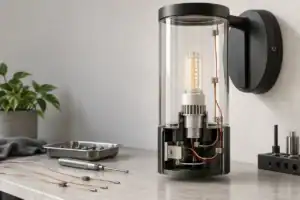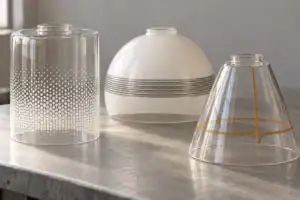
A lampshade chandelier is a multi-arm ceiling fixture fitted with individual shades on each candelabra arm. Shades soften glare, add decorative weight, and can be retrofitted onto most existing chandeliers using clip-on or candelabra-screw fitters. The key decisions are shade style, mini shade size, fitter type, and buying the correct number to match your fixture’s arm count.
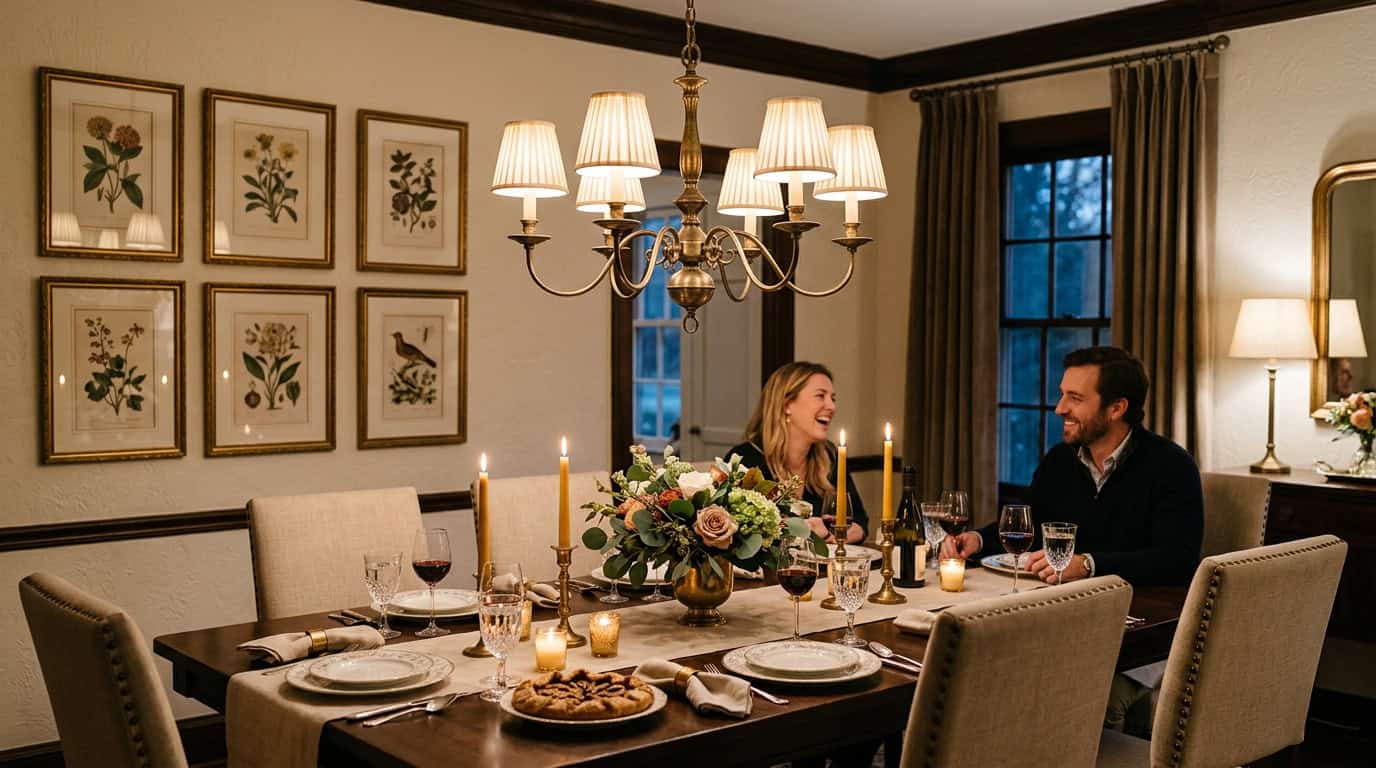
There are two chandelier problems. The first is a bare-bulb chandelier in a room that cannot carry it: exposed filament bulbs that looked intentional in the showroom read as harsh and unfinished once installed, and the glare from six or eight unshaded candelabra bulbs hits every reflective surface in the room. The second is the opposite: an oversized lampshade chandelier in a room without the ceiling height or furniture mass to support it, where the shade bulk reads as heavy and dated rather than grand.
Both problems have the same solution: understanding what chandelier lampshades actually do, and matching the shade choice to the fixture, the room, and the visual effect you want. A lampshade chandelier done correctly is one of the most transformative lighting choices available for dining rooms, entryways, and bedrooms. Done incorrectly, it is one of the most expensive decorating mistakes to undo.
This guide covers every variable: shade types, fitter types, sizing, retrofitting an existing fixture, buying matched sets, and room-by-room styling.
What is a lampshade chandelier?
A lampshade chandelier is a chandelier where each candelabra arm carries its own individual lampshade, typically a mini version of a standard shade form: drum, empire, bell, or pleated cone. The shades are small by floor lamp or table lamp standards, usually 10 to 20 cm across the bottom, but collectively they transform both the visual weight and the light quality of the fixture.
Bare chandelier vs. shaded chandelier: what actually changes
The functional difference between a bare chandelier and a lampshade chandelier is more significant than most buyers anticipate. A bare chandelier with visible bulbs distributes light in every direction simultaneously: upward, sideways, and downward from each exposed source. The light quality is even but often harsh, particularly when Edison-style filament bulbs are used, where the visible element creates multiple point-source glare spots visible from anywhere in the room.
A lampshade chandelier redirects light. Each mini shade captures the upward and sideways light from its bulb and directs it primarily downward and outward through the shade walls. The shade walls themselves become secondary light sources, producing a softer, diffuse glow rather than a direct point source. The overall effect is a chandelier that provides directional illumination below the fixture while eliminating most of the harsh upward glare.
The second change is decorative weight. A bare crystal or brass chandelier reads as skeletal: the visual interest is in the metalwork, the crystal drops, the finish. A lampshade chandelier shifts the visual mass toward the shade fabric or glass, making the fixture appear fuller and substantially more substantial in the room. In a room with high ceilings and heavy furniture, this added visual weight is an asset. In a room with low ceilings or light, minimal furniture, it becomes a liability.
What chandelier lampshades actually do for a room
The primary function most buyers notice first is glare reduction. According to Wikipedia’s overview of chandelier design and history, decorative shades were historically added to candlelit chandeliers specifically to reduce eye-level glare at the dining table, where guests would otherwise be looking directly into flame or bulb. The same logic applies to electric chandeliers: shades placed at eye level for seated diners or standing guests significantly reduce the discomfort of looking across the room toward the fixture.
The secondary function is thermal management. Chandelier lampshades direct heat downward rather than allowing it to dissipate in all directions, which matters for rooms where the chandelier is the primary heat source in winter months, and matters in the opposite direction for summer cooling efficiency.
| Chandelier type | Best shade style | Best room application |
|---|---|---|
| Ornate brass or crystal (traditional) | Pleated silk or ivory fabric mini empire | Dining room, entryway, formal living room |
| Wrought iron (farmhouse, transitional) | Linen drum or cotton bell | Kitchen, breakfast room, casual dining |
| Bronze or dark metal (period) | Glass scavo or frosted glass dome | Study, library, bar area |
| Polished nickel (contemporary) | Tight drum in white or neutral | Modern living room, master bedroom |
| Antique gold (eclectic, maximalist) | Mixed fabric with fringe or pleating | Maximalist living room, boudoir |
Types of chandelier lampshade
There are four main categories of chandelier lampshade by form and material: mini drum shades, pleated and empire mini shades, glass chandelier shades, and applied-trim shades. Each category suits different chandelier styles and rooms, and each uses different fitter types.
Mini drum shades
Mini drum shades are the most commonly specified chandelier lampshade in residential interiors produced since 2010. The drum silhouette (straight sides, equal top and bottom diameter) is the cleanest contemporary form: it sits horizontally on each candelabra arm, directs light downward evenly, and photographs well. In a set of six or eight on a polished nickel or brass chandelier, mini drum shades give a chandelier a strongly contemporary profile that reads as updated rather than replaced.
Mini drum shades for chandeliers typically run 10 to 15 cm across the bottom diameter. The small scale means that any variation in shade diameter or height across the set reads as a mistake rather than an intentional choice. When ordering multiple drum shades, always order from the same production batch if possible: dye lots in fabric shades can vary enough between batches to produce a visible mismatch under the same chandelier.
Pleated and empire mini shades
Pleated and empire mini shades are the traditional chandelier lampshade form. The pleated cone (fabric gathered into vertical folds, gathered at the top and bottom) has been the dominant chandelier shade style for formal settings since the Victorian era. Empire mini shades (sloped sides, wider bottom than top) are slightly more relaxed in character and suit both traditional and transitional chandeliers.
Both styles work best with period-appropriate chandeliers: ornate brass, crystal, French gold, aged bronze. On a contemporary chandelier with clean lines and minimal metalwork, pleated shades read as a style mismatch. On a formal dining room chandelier with crystal drops and an aged brass finish, they are the correct choice by almost every styling convention.
Pleated chandelier lampshades are typically made in silk, faux-silk, or polyester: the gathering of the fabric requires a material with enough drape to form clean folds. Stiff linen or cotton does not pleat well at chandelier mini-shade scale.
Glass chandelier shades
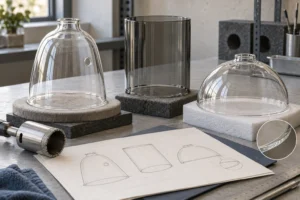
Glass shades for chandeliers are a distinct category from fabric shades and suit a specific set of chandelier types and design aesthetics. The most common glass chandelier shade forms are:
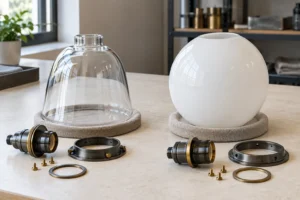
Scavo glass (a matte, slightly textured surface treatment on clear or tinted glass): warm and period-appropriate, commonly found on antique brass and bronze chandeliers in Arts and Crafts or Mediterranean styles. The textured surface diffuses light without coloring it significantly.
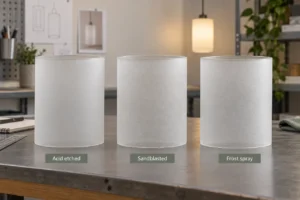
Frosted glass domes and cylinders: clean and contemporary, suited to polished nickel and chrome chandeliers in modern or transitional settings. Frosted glass provides good glare reduction without the visual softness of fabric.
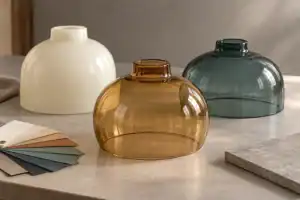
Colored art glass: the most decorative option, and the most demanding in terms of fixture compatibility. A set of amber art glass shades on a brass chandelier is a strong decorative statement; the same set on a polished chrome contemporary fixture looks like a parts mismatch.
Our glass lampshade collection includes chandelier-compatible glass shades in frosted, colored, and scavo finishes, produced in batch-consistent sets for matching across multi-arm fixtures.
Fitter types: clip-on, candelabra-top, and candelabra-screw
The fitter is the mechanism that attaches the shade to the chandelier arm. Getting this wrong means the shade will not fit, will tilt, or will fall. There are three main types used in chandelier applications:
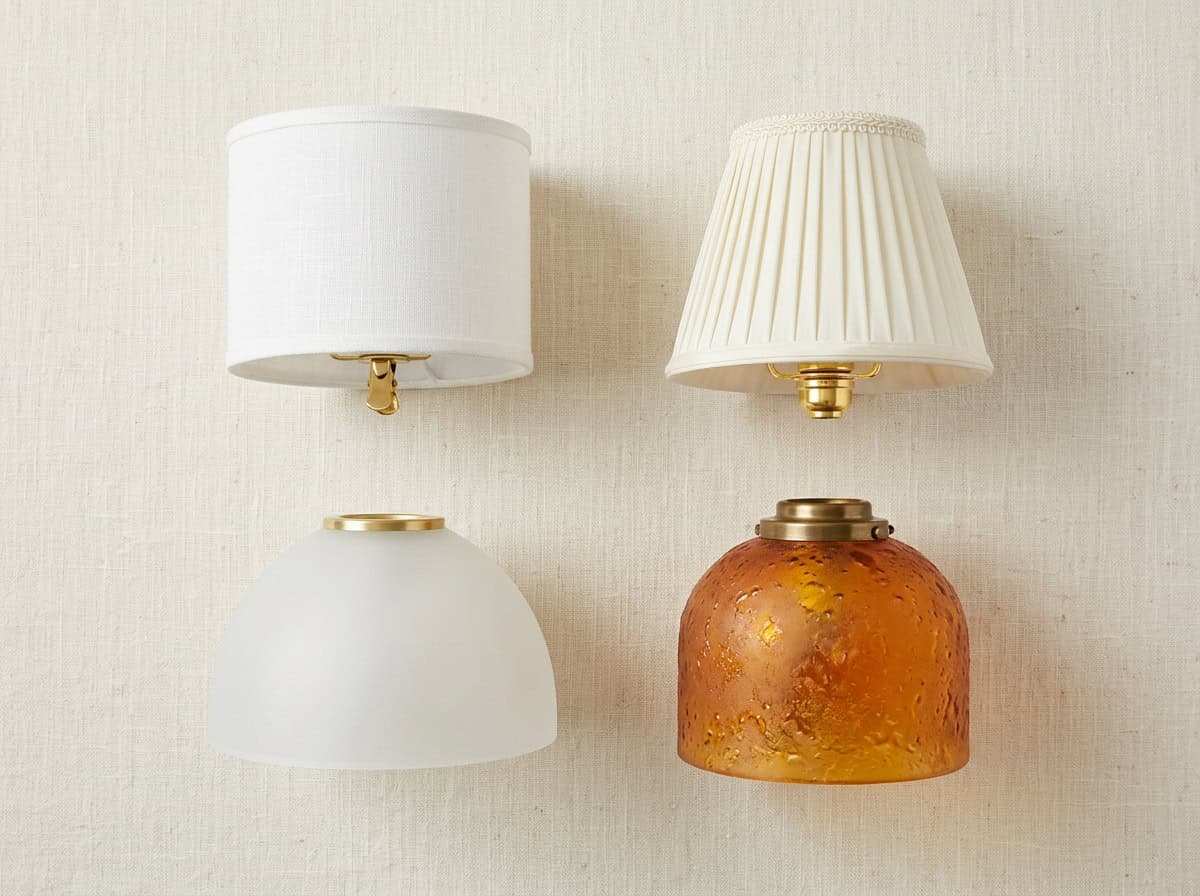
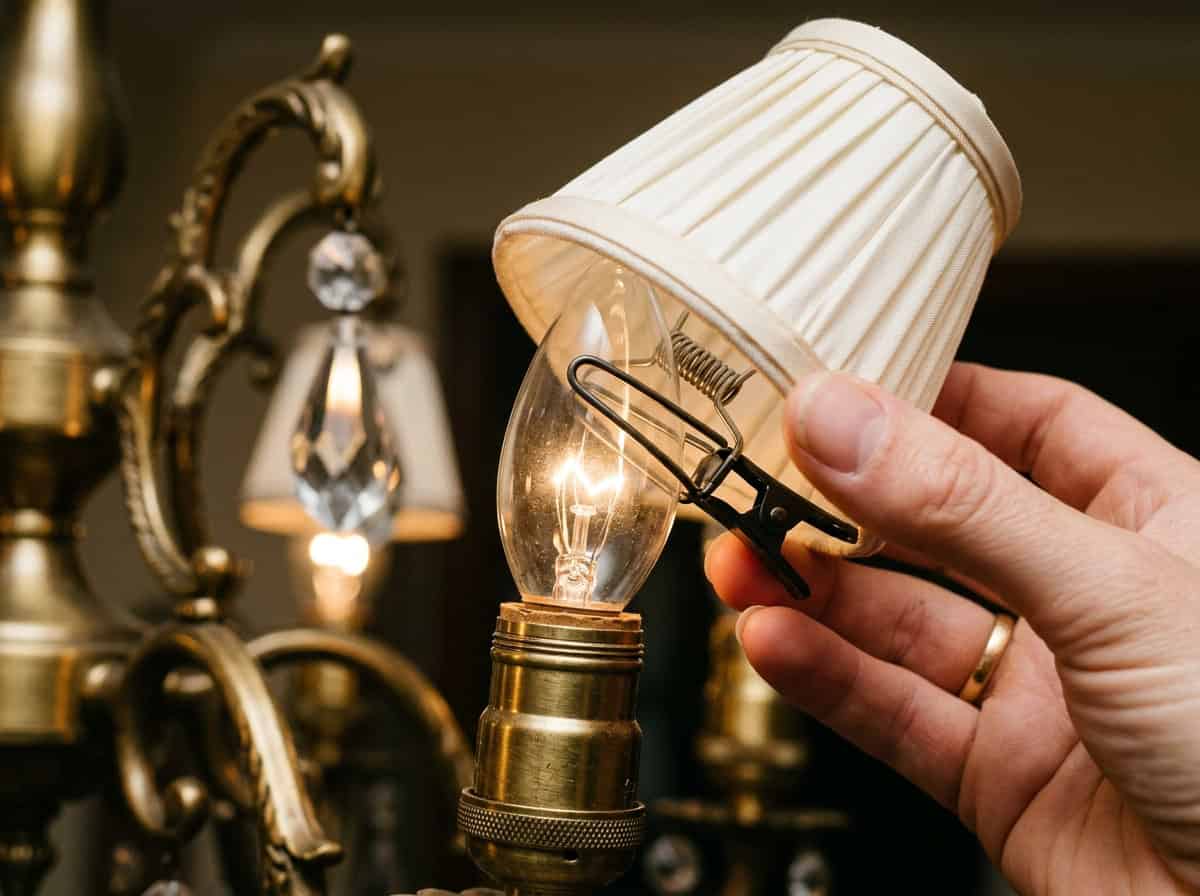
Clip-on fitters grip directly onto the candelabra bulb itself. The shade has a small spring-loaded clip at its top opening that clips over the bulb’s glass dome. Clip-on fitters work on any chandelier regardless of arm configuration, require no modification to the fixture, and are the standard retrofit method for adding shades to a bare chandelier. The limitation: the shade is only as stable as the bulb grip, and heavier glass shades should not use clip-on fitters.
Candelabra-top fitters (also called flame-top or bulb-clip fitters): a variant of clip-on where the clip is designed specifically for the narrower top of flame-tip or torpedo-tip candelabra bulbs. These are more secure than standard clip-on fitters on flame-tip bulbs and are the preferred option for pleated silk shades, which benefit from a more stable connection.
Candelabra-screw fitters (or “washer” fitters): the shade sits on a small metal washer that threads onto the candelabra bulb base. This provides a more secure, stable mount than clip-on and suits heavier glass shades. It requires that the chandelier arm’s bulb socket be accessible for the washer to thread on, which is not always possible in enclosed arm designs.
How to add lampshades to a chandelier
You can add lampshades to most existing chandeliers, but not all chandeliers are equally suited to receiving shades. The main variables are arm design, bulb orientation, and fixture weight capacity.
Can you retrofit any chandelier with shades?
Most candelabra-arm chandeliers can accept clip-on lampshades with no modification. The requirement is a standard E14 (small Edison screw) candelabra bulb in an upright position (bulb tip facing up). If your chandelier has downward-facing candelabra sockets (where the bulb tip points toward the floor), clip-on shades will not sit correctly, as the clip is designed for upright bulbs.
Chandeliers with enclosed arms, where the socket is recessed inside a decorative sleeve, may not accept standard clip-on fitters if the sleeve extends above the bulb dome. In these cases, a candelabra-screw washer fitter may work if there is enough thread exposed below the sleeve.
As Wikipedia’s technical overview of lampshade design notes, fitter compatibility is the most commonly misunderstood aspect of lampshade purchasing, and the most common cause of returned products. Measure the fitter opening of any shade against the diameter of your bulbs before ordering, particularly for glass shades where the fit is less forgiving than fabric.
Retrofitting with clip-on fitters: what to check
Before ordering a clip-on chandelier lampshade set, check:
- Bulb orientation: upward-facing tip is required for clip-on fitters. Mark any arm where the bulb faces sideways or downward and plan to exclude it or modify the lamp arm’s socket angle.
- Bulb diameter at dome: clip-on fitters are calibrated for standard E14 candelabra bulbs with a dome diameter of roughly 35 to 45 mm. Unusually narrow or wide bulbs may not grip securely.
- Clearance above the bulb: the shade’s top opening clips onto the bulb, so there must be no decorative arm element (bobèche, bobeche collar, crystal strand attachment point) above the bulb that would prevent the shade from seating correctly.
- Chandelier arm count: count your arms carefully, including any that may be partially blocked by a center column or decorative element at the fixture’s core. You need one shade per lit arm, no more and no less.
- Combined shade weight: clip-on fitters can each support approximately 200 to 400 grams depending on design. A set of eight heavy glass shades may exceed the cumulative weight capacity of the chandelier’s mounting plate. Fabric shades at 50 to 150 grams each are rarely a concern.
When adding shades makes a chandelier worse
Not every chandelier benefits from lampshades. Crystal chandeliers designed for sparkle and refraction rely on visible light sources to illuminate the crystal drops. A fully shaded crystal chandelier loses most of its visual identity: the drops no longer catch and scatter light, and the fixture reads as a bulk of shades rather than a piece of sparkle engineering. On crystal chandeliers, partial shading (shades on alternate arms, or a single shade style on the outer arms only) tends to work better than full coverage.
Minimalist contemporary chandeliers with visible Edison bulbs as a design feature should not be shaded. The visible filament is the aesthetic; shading it eliminates the fixture’s reason for existing.
Choosing a chandelier lampshade set
Chandelier lampshades must be purchased as a matched set. Even minor variations in shade height, diameter, or fabric tone across the set are visible from anywhere in the room because the shades are displayed simultaneously at the same eye-level plane.
Matching sets: 3, 5, 6, and 8 arm chandeliers
The number of shades required is simply the number of lit arms on your chandelier. Standard residential chandeliers come in 3, 5, 6, 8, and 12 arm configurations. Most specialty shade suppliers sell sets in these standard quantities. Buying a set of 6 for a 5-arm chandelier leaves you one spare (useful if you damage one during installation); buying exactly 5 for a 5-arm chandelier means a broken shade during installation requires a second order, which risks a batch mismatch.
When ordering custom or semi-custom shades, always order at least one extra shade per fixture. Production colour matching between batches, even for the same shade specification from the same supplier, is imperfect.
Critical sizing: top diameter, bottom diameter, slant height
Chandelier mini shades have three key dimensions:
Top diameter (the opening that the fitter passes through, or the clip seats into): this must match the fitter type. Clip-on fitters require a top opening of approximately 30 to 40 mm to grip the bulb correctly. Too large and the shade will tilt; too small and it will not seat.
Bottom diameter (the widest point of the shade): this determines how much visual mass each shade contributes and whether adjacent shades on the chandelier arms will overlap or crowd. On a chandelier with arms close together, a 15 cm bottom diameter shade may crowd neighboring shades; a 10 cm shade will leave clean spacing.
Slant height (the depth of the shade from top to bottom along the slanted surface, not the vertical drop): this determines how much of the bulb is concealed and how the shade sits relative to the arm’s decorative elements (bobèche, drip cups, crystal pendants below the arm).
For a detailed breakdown of sizing methodology, including how to measure top and bottom ring diameters and calculate slant height, our lampshade sizing guide covers chandelier mini shade dimensions specifically.
Intentional mismatching
One design direction that has grown in popularity is the intentionally mismatched lampshade chandelier: a single chandelier frame with shades in slightly different patterns, colors, or even forms on each arm. Done deliberately, this reads as eclectic and collected; done accidentally (by ordering from different sources), it reads as disorganized. The key difference is consistency of intention: a chandelier with six shades all from the same color family but in different botanical prints reads as designed; a chandelier with six shades from three different suppliers in shades that almost match reads as a mistake.
| Chandelier arm count | Standard shade set | Recommended spare | Notes |
|---|---|---|---|
| 3 arms | Set of 3 | + 1 extra | Odd number; one spare covers breakage and matching |
| 5 arms | Set of 5 | + 1 extra | Less common; order early as sets of 5 may not be stock |
| 6 arms | Set of 6 | + 2 extra | Most common configuration; widest set availability |
| 8 arms | Set of 8 | + 2 extra | Check arm spacing before ordering: 15 cm+ shades may crowd |
| 12 arms | 2× set of 6 | + 2 extra | Order both sets from same batch; verify dye-lot match |
Chandelier lampshade styles by room
The right lampshade chandelier for a dining room is almost never the right choice for a bedroom, and vice versa. Room function, ceiling height, furniture scale, and wall color all affect which shade type, scale, and material works correctly.
Dining room chandeliers
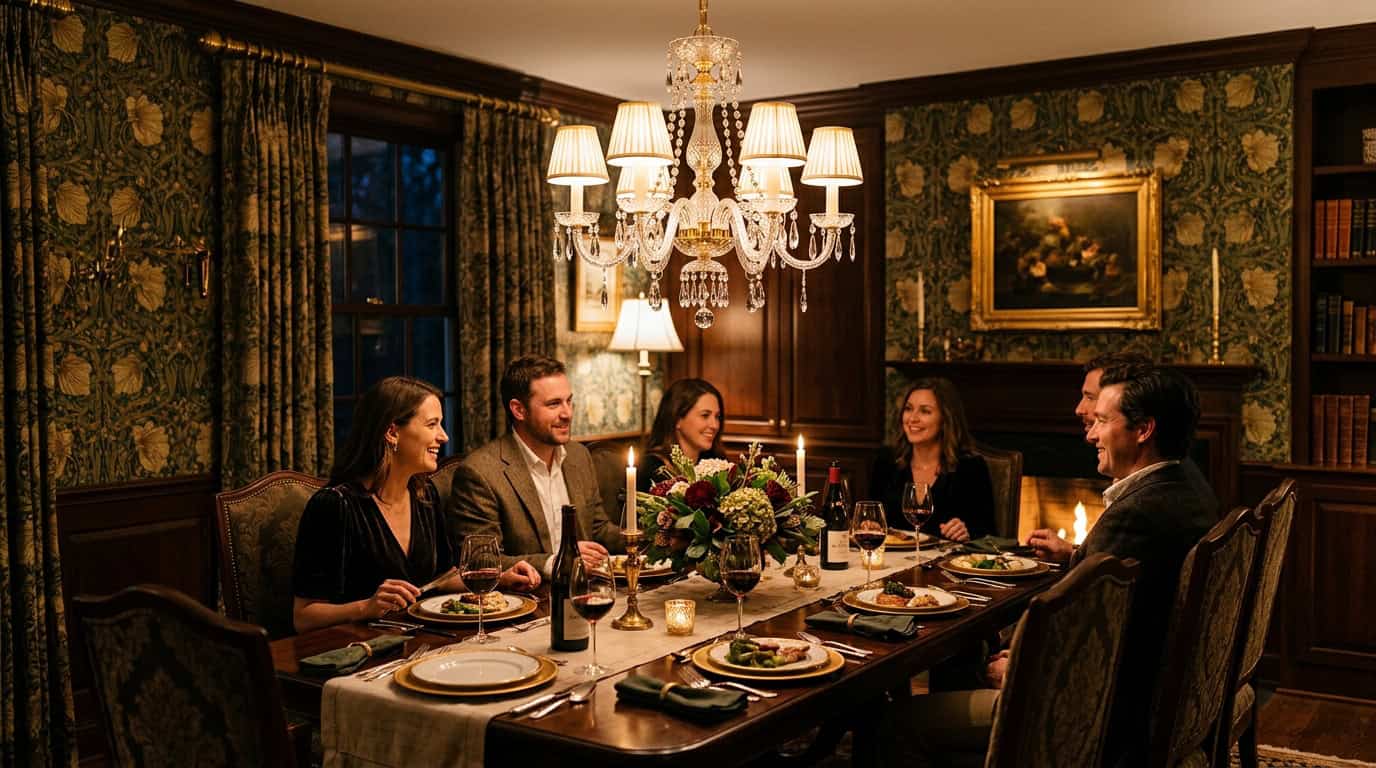
The dining room is where the lampshade chandelier has its longest tradition and strongest functional logic. Seated diners look directly toward the chandelier; shades reduce the eye-level glare that bare bulbs create. The chandelier is typically the room’s primary decorative focal point, so shade weight and detailing matter as decorative statements.
Pleated silk shades on a formal brass or crystal chandelier are the traditional dining room choice: they add substantial visual mass, suit the scale of an 8 to 10 person dining table, and read as deliberately luxurious. Linen drum shades on a wrought-iron or transitional chandelier suit a less formal dining room and photograph cleanly. According to House Beautiful’s dining room lighting guidance, the shade bottom diameter for dining room chandelier shades should be proportional to the dining table dimensions: a table seating 8 or more needs shades at least 12 cm in diameter to read at room scale.
Living room chandeliers
Living room lampshade chandelier choices are driven more by style intent and ceiling height than by the functional glare-reduction that governs dining room choices. In a high-ceilinged formal living room, a full-coverage lampshade chandelier with pleated or fabric shades on all arms reads as appropriately grand. In a standard-height (2.4 to 2.7 m) living room, the same fixture risks feeling oppressive.
Drum shades in white or neutral linen are the most versatile living room choice: they reduce glare, add decorative weight, and suit the widest range of chandelier styles and interior palettes. As Architectural Digest’s residential lighting coverage notes, the shift toward maximalist interiors in 2025 and 2026 has driven a strong return to shaded chandeliers in formal living rooms, specifically as a counterpoint to the bare-bulb trend that dominated contemporary interiors for the prior decade.
Bedroom chandeliers
Bedroom lampshade chandeliers require the smallest shade scale and the softest materials. A bedroom chandelier is rarely the primary light source (most bedrooms supplement with bedside lamps) and its shade choice should prioritize visual softness and scale appropriateness over dramatic decorative impact.
Mini empire shades in soft silk or faux-silk, or small frosted glass globes, are the strongest bedroom chandelier choices. The low wattage required for bedroom ambiance (typically 3 to 5W LED per arm) means light output through the shade is minimal; the shade’s function is primarily decorative and glare-reducing rather than illumination-focused. According to U.S. Department of Energy guidance on residential LED lighting, candelabra LED bulbs in the 3 to 5W range (equivalent to roughly 25 to 40W incandescent) are the standard bedroom chandelier specification and produce sufficient warm ambient light through fabric chandelier shades without heat risk.
For a full breakdown of shade silhouettes and how they interact with different chandelier arm configurations, our lampshade shapes guide covers mini shade forms including clip-top empire, bell, drum, and pleated cone profiles.
| Room | Ceiling height | Recommended shade type | Recommended bottom diameter |
|---|---|---|---|
| Formal dining room | 2.7 m+ | Pleated silk or ivory fabric empire | 12 to 18 cm |
| Casual dining / kitchen | 2.4 to 2.7 m | Linen drum or cotton bell | 10 to 14 cm |
| Formal living room | 3 m+ | Pleated or drum in fabric/glass | 12 to 16 cm |
| Standard living room | 2.4 to 2.7 m | White/neutral drum, small scale | 10 to 12 cm |
| Master bedroom | 2.4 m+ | Mini empire silk or frosted glass | 8 to 12 cm |
| Entryway | High (2 storey+) | Full-scale pleated or glass | 14 to 20 cm |
Are chandeliers with lampshades in style in 2026?
Yes, firmly. The short version: the bare-bulb minimalist chandelier trend has peaked, and the dressed chandelier is coming back strongly. The longer version is more nuanced.
The maximalism wave and the return of dressed chandeliers
The decade from roughly 2010 to 2020 was dominated by industrial and minimalist lighting aesthetics: exposed Edison bulbs, bare-metal chandeliers, visible wire and hardware. Lampshade chandeliers, particularly those with traditional pleated silk shades, were associated with dated grandeur and fell out of mainstream favor.
The current maximalism wave has reversed this. Botanical, jewel-toned, pattern-layered interiors demand lighting that matches their decorative ambition, and a bare brass chandelier with visible bulbs reads as visually insufficient in a fully dressed maximalist room. The lampshade chandelier, particularly in silk, linen, and art glass, has re-entered mainstream design vocabulary as the correct choice for formal and semi-formal spaces.
Glass chandelier shades have benefited particularly strongly from this shift. A chandelier fitted with scavo glass or amber art glass shades reads as Art Deco-adjacent in a way that suits the maximalist aesthetic precisely. Our glass lampshade options include small-scale chandelier-compatible shades in several glass finishes suitable for this application.
Where bare-bulb chandeliers still work
The bare-bulb chandelier remains the correct choice in three specific contexts: industrial and workshop-adjacent spaces (kitchens with exposed brick, loft dining rooms, open-plan spaces with concrete finishes), spaces where the chandelier’s metalwork is the decorative point (a complex geometric brass frame where shades would obscure the structure), and spaces with very low ceilings where any added shade bulk would make the fixture feel intrusive.
In these contexts, adding lampshades would be the wrong move regardless of trend. For everything else, the dressed chandelier is the stronger choice in 2026.
FAQ
Are chandeliers with shades out of style?
No. Chandeliers with lampshades were perceived as dated during the peak industrial-minimalist decade (roughly 2012 to 2022), when exposed bulbs dominated residential lighting aesthetics. That trend has peaked. In 2026, shaded chandeliers are firmly back in style for dining rooms, formal living rooms, entryways, and bedrooms, driven by the maximalism movement and the return of decorative detailing in residential interiors. The caveat is style-specific: a heavily pleated silk shade chandelier looks dated in a Scandinavian-minimal room regardless of broader trends, because the style mismatch is the problem rather than the shaded chandelier concept itself.
Can you add lampshades to a chandelier?
Yes, to most candelabra-arm chandeliers. The simplest method is clip-on lampshades: small mini shades with a spring clip at the top opening that clips directly onto the candelabra bulb. This works on any upward-facing candelabra socket with a standard E14 bulb and requires no modification to the fixture. For downward-facing sockets, or for heavier glass shades, candelabra-screw washer fitters provide a more secure mount. Crystal chandeliers designed for sparkle and refraction are the main exception: shading all arms removes most of the fixture’s visual character.
What size lampshade do I need for a chandelier?
Chandelier lampshades are classified as mini shades, typically 8 to 20 cm in bottom diameter. The right size depends on the chandelier’s arm count and arm spacing (closer arms need smaller shades to avoid crowding), the room’s ceiling height (higher ceilings support larger shades), and the visual scale of the chandelier’s metalwork. A standard 6-arm dining room chandelier with medium arm spacing typically takes shades in the 12 to 15 cm range. Bedroom chandeliers typically use smaller shades in the 8 to 12 cm range. For specific measurement methodology, our fabric lampshades guide includes mini-shade dimensions for common chandelier configurations.
What fitter type do chandelier lampshades use?
Three fitter types are common in chandelier applications. Clip-on fitters grip directly onto the candelabra bulb’s glass dome and require no fixture modification; they work on upward-facing E14 sockets and are the standard retrofit option. Candelabra-top (flame-tip) clip fitters are a variant designed for flame-tip or torpedo-tip bulbs, providing a more stable grip on the narrower bulb profile. Candelabra-screw or washer fitters thread onto the bulb base and provide a stable mount for heavier glass shades. The fitter type must be specified when ordering; it is not interchangeable between clip-on and screw-on categories.
How many lampshades does a chandelier need?
One shade per lit arm. A 6-arm chandelier needs exactly 6 matching shades; an 8-arm needs 8. The key word is lit: some chandeliers have decorative arms that do not hold bulbs, and these do not receive shades. Count bulbs, not arms. When ordering, always add one or two extra shades to the set size: shade production involves dye lots, and a replacement shade ordered weeks later from a different production run may not match the rest of the set exactly.
What material is best for chandelier lampshades?
The best material depends on the chandelier’s style and the room’s function. Silk and faux-silk pleated shades suit formal brass and crystal chandeliers in dining rooms and entryways; they produce a warm, soft glow and hold a crisp pleated form at small scale. Linen and cotton drum shades suit transitional and contemporary chandeliers and are more durable and easier to clean. Glass shades (frosted, scavo, or art glass) suit period fixtures and high-humidity rooms (glass does not absorb cooking or bathroom moisture the way fabric does); they also allow the fixture to be cleaned by wiping rather than dry-brushing. For a side-by-side comparison of fabric types and their performance under different conditions, our fabric lampshades guide covers the material trade-offs in detail.
Can I replace just one chandelier lampshade?
Technically yes, but in practice it is very difficult to match a single replacement shade to an existing set. Fabric shades are produced in dye lots, and the same shade specification ordered months or years after the original purchase will frequently show a color difference visible under the same chandelier. If you are replacing one damaged shade, your best option is to contact the original supplier and ask if stock from the same production batch is available. If not, replacing the full set is often the cleaner solution visually. For glass chandelier shades, individual replacement is more reliable: glass color is more stable between production runs than fabric dye lots, and small scavo or frosted glass shades from a reputable manufacturer tend to be consistent within the same glass color specification.
Getting the right lampshade set for your chandelier
The decision tree for a lampshade chandelier is shorter than it looks. Start with the chandelier style and arm count. That narrows the shade form (pleated for traditional, drum for contemporary, glass for period and industrial). Then settle the fitter type based on your bulb configuration. Then size the shade using the arm spacing and ceiling height as limiting dimensions. What remains after those three decisions is style and material preference within a defined set of compatible options.
For most residential chandeliers in the 5 to 8 arm range, a fabric mini shade in a neutral or period-appropriate material is the most versatile starting point. Ivory pleated silk is the traditional standard for a reason: it suits the widest range of brass, bronze, and crystal chandeliers, works in rooms from dining to bedroom, and ages without deteriorating visibly the way printed fabrics do.
For glass chandelier shades, particularly for period fixtures, commercial installations, or rooms where fabric maintenance is impractical, the batch-consistency question is critical. Our team works directly with buyers on chandelier shade sets, including custom glass colors and finishes, matched sets for 12 or more arm fixtures, and replacement matching for existing sets. The glass lampshade collection shows the available off-the-shelf range as a starting point.
Related Articles
Lampshade Shapes: The Complete Visual Glossary (12 Glass Shade Types)
How to Size a Lampshade for a Lamp: The Complete Sizing Guide
Fabric Lampshades: Types, Materials & How to Choose Right
Glass Lampshade Solutions — Browse the Full Collection
Flower Lampshade: Types, Styles & How to Choose or Make One
Black Lampshade: Types, Materials & How to Choose the Right One