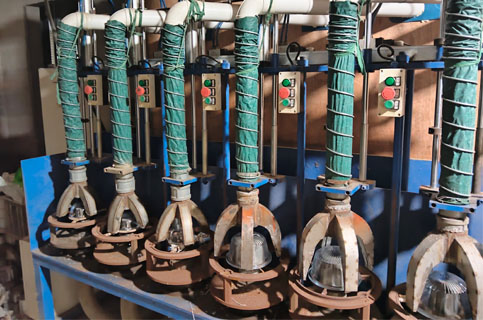
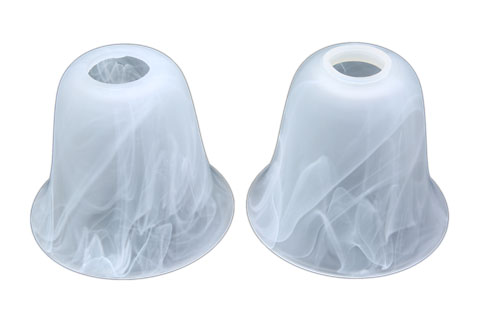
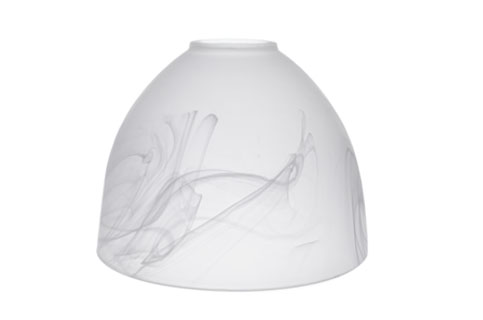
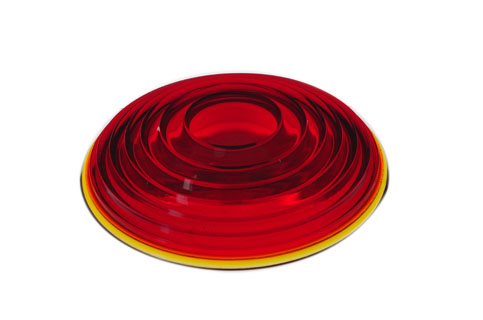
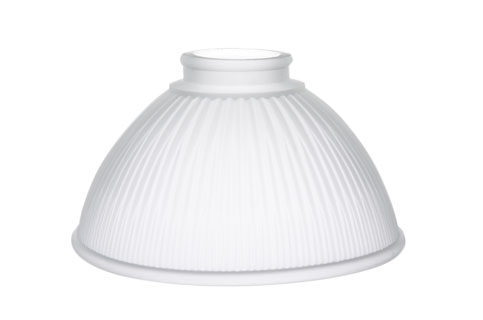
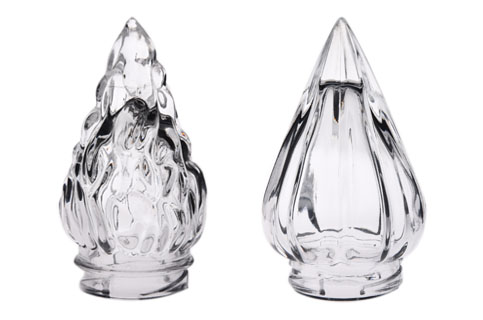
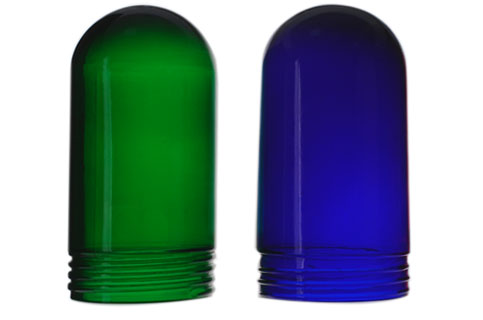
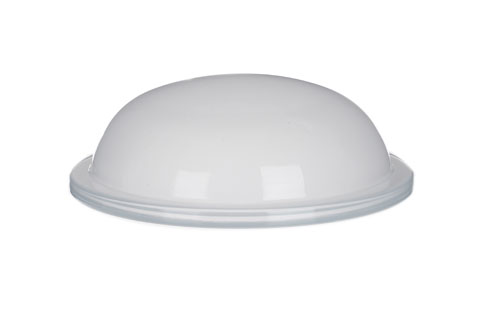
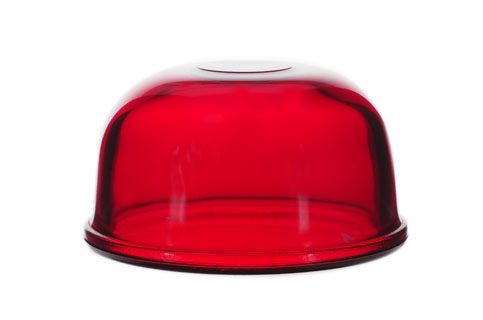
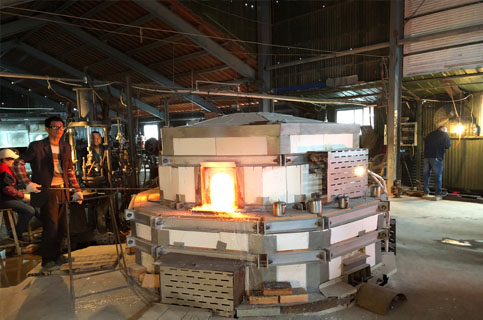
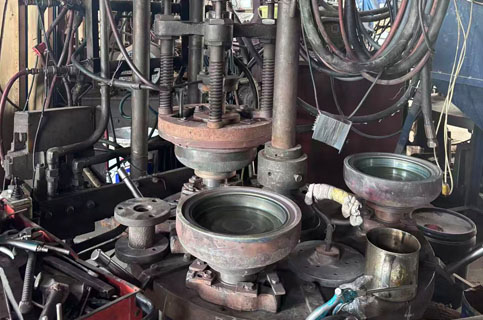
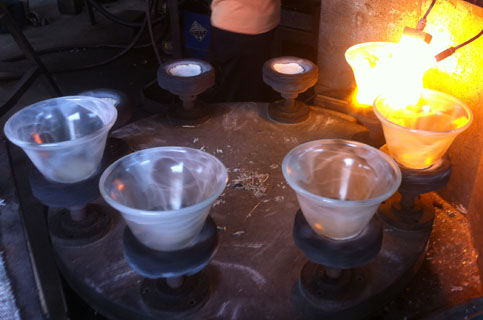
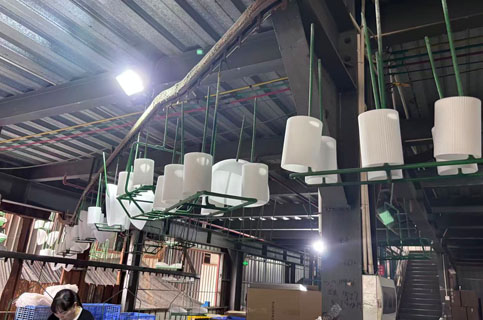
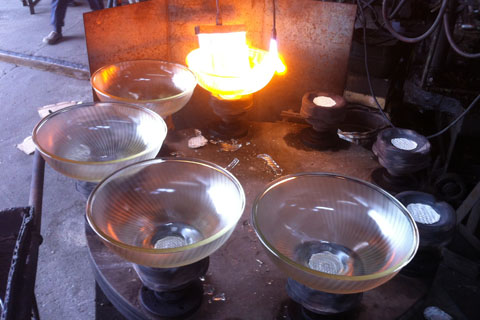
Machine pressing is a high-volume glass forming technique where a measured gob of molten glass at approximately 1100C is dropped into a steel or cast-iron mold, then compressed by a plunger that forces the glass to fill the mold cavity and take its final shape in approximately 4-6 seconds. The technique was developed in the 1820s-1830s and revolutionized glass manufacturing by enabling mass production at costs far below traditional blowing methods. Modern automated press machines produce 800-1500 pieces per shift with consistent dimensional tolerances of +/-0.3mm. After pressing, shades pass through an annealing lehr (a temperature-controlled tunnel oven) for 30-60 minutes to slowly cool the glass and relieve internal stress, preventing later cracking. Machine pressing is the standard production method for lamp shades requiring large volumes, dimensional consistency, and competitive pricing, accounting for roughly 70% of global commodity lampshade production.
Standard MOQ for machine-pressed glass lamp shades is 500 pieces per design using an existing mold from our catalog, or 1,000-3,000 pieces per design when developing a new custom mold. Stock-mold orders ship within 25-35 days from deposit payment, while custom-mold orders require 40-65 days total including mold development (typically 25-40 days for mold design, machining, and trial pressing). New mold development cost ranges from $800 for simple straight-walled shades to $3,500 for complex multi-cavity molds with internal patterns. For very high volume buyers (50,000+ pieces annually per design), we can develop multi-cavity progressive molds that increase production rate to 2,000+ pieces per shift, reducing per-piece cost by 15-25% compared to single-cavity tooling. Ocean freight transit time adds 25-40 days to the production lead time depending on destination port.
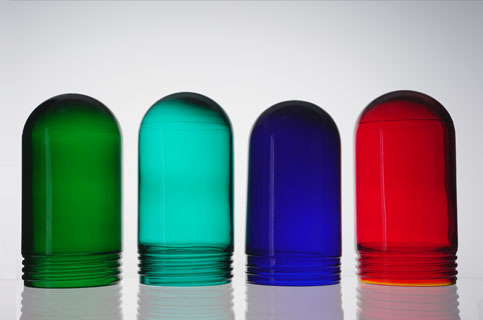
Color consistency across large machine-pressed orders is maintained through batch-controlled glass melting and continuous quality monitoring. Each color is produced from a master batch formula with metal-oxide pigments weighed to +/-0.5% accuracy and mixed thoroughly before charging into the furnace. The furnace runs continuously at 1450-1480C with consistent residence time of 12-18 hours to ensure full pigment dissolution. During production, our QC team measures color using a spectrophotometer on samples taken every 30 minutes, comparing against the master color reference standard with acceptable Delta-E variance of 1.5 (imperceptible to the human eye). Pieces falling outside specification are diverted before packing. For multi-shipment projects requiring color match across separated production runs, we retain master color samples and batch documentation for 5 years, supporting reorders that match the original specification within Delta-E 2.0 across years.
Machine-pressed glass lamp shades are typically produced in wall thicknesses from 3mm to 8mm, with 4-5mm being the most common production range for general lighting applications. Wall thickness selection balances structural strength, weight, light transmittance, and per-piece cost. Thinner walls (3mm) reduce material cost by 15-20% and produce slightly better light transmittance, but offer lower impact resistance suitable mainly for decorative pendants in low-risk locations. Thicker walls (6-8mm) provide premium appearance with substantial edge refraction, higher impact resistance, and longer service life under heat exposure – typical choices for commercial lighting and high-end residential. Press machines can produce variable wall thickness within a single shade by designing the mold cavity accordingly, allowing thicker bases for stability with thinner top sections. We provide thickness recommendations based on bulb wattage, fixture mounting, and intended environment during the design consultation phase.
Yes, machine-pressed lamp shades can be tempered after the initial pressing and annealing cycle to provide 4-5x impact strength improvement over standard annealed glass. Tempering involves reheating the pressed shade to 620-650C and then rapidly cooling the surface with controlled air jets, creating compressive surface stress that resists impact and thermal shock. Tempered machine-pressed shades meet IK08 to IK10 impact ratings depending on wall thickness and shade geometry, suitable for vandal-resistant outdoor luminaires, school cafeterias, gymnasiums, transit shelters, and any installation with elevated impact risk. Tempered shades cost approximately 25-40% more than annealed equivalents due to the additional heat treatment cycle. When broken, tempered glass fragments into small rounded granules rather than sharp shards, significantly reducing injury risk. Tempered shades cannot be modified after tempering – all drilling, cutting, and edge finishing must be completed before the tempering process.
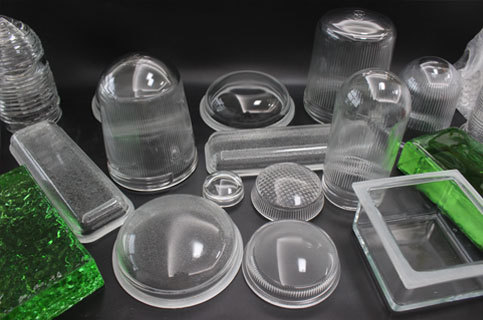
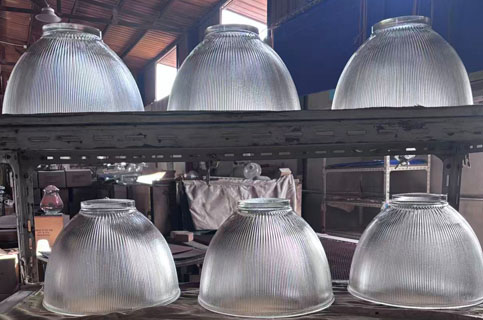
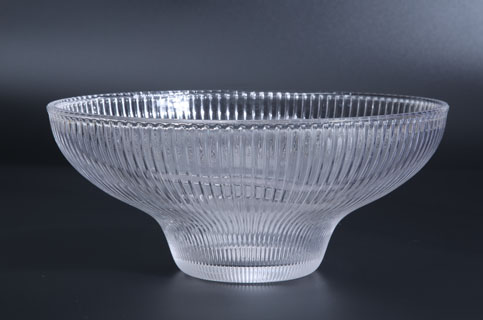
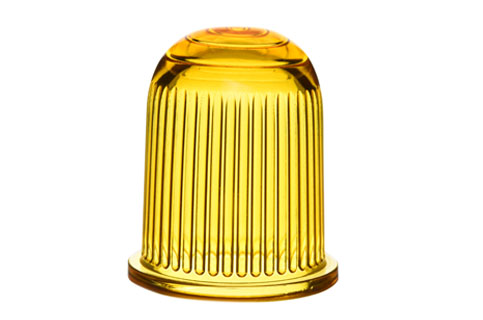
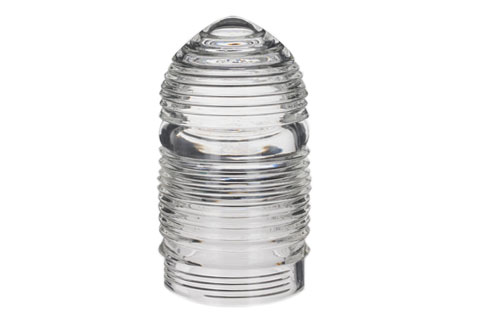
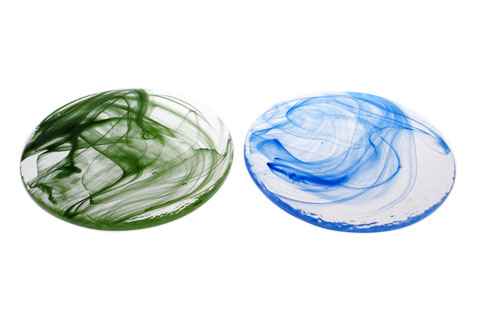
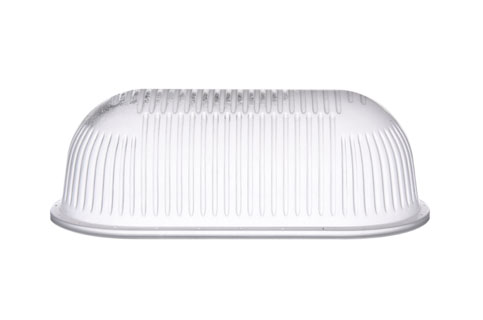
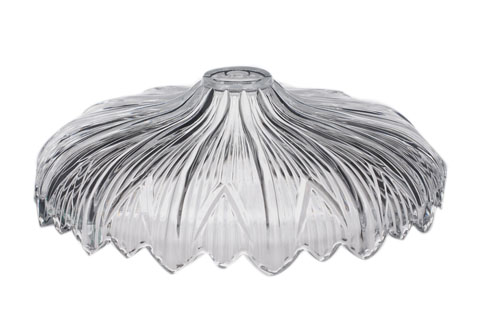
Machine pressing produces extensive surface finishes and patterns directly from the mold design, eliminating need for secondary surface treatment. Common pattern options include vertical and spiral ribbing, hexagonal and diamond faceting, prismatic light-refracting patterns, decorative reliefs (florals, geometrics, custom logos), pebbled textures, and integrated brand markings such as logos and SKU codes. The pattern is permanently formed into the glass surface during pressing and never wears off, unlike acid-etched or sandblasted alternatives. Surface finish options include polished glossy (default for clear glass), satin matte achieved by sandblasting after pressing, and acid-etched frosted finishes for diffused light effects. For multi-color decorative effects, machine-pressed shades can be partially painted, screen-printed with ceramic inks, or dipped in colored glaze coatings. Each surface treatment is applied as a separate production step after the pressing and annealing cycles.
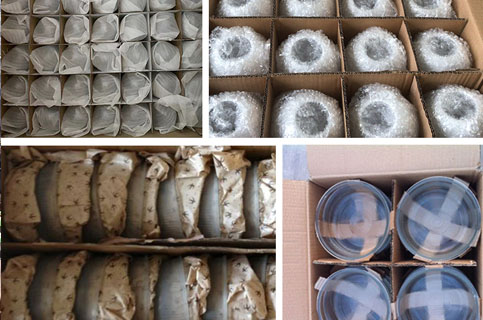
Machine-pressed shades are packaged using a standardized three-layer protection system optimized for high-volume export shipments. Each piece is individually wrapped in 3-5mm EPE foam, placed in die-cut corrugated cells holding 12-48 pieces per inner carton, then loaded into 5-ply export master cartons typically holding 4-12 inner cartons depending on shade size. Master cartons include corner reinforcement and bottom padding, and are palletized in standard 40HQ or 20GP container dimensions for optimal shipping density. This packaging system has kept our machine-pressed shade breakage rate below 0.3% across more than 15,000 export shipments. For retail-ready packaging, we offer printed color boxes with barcodes, instruction inserts, and shrink-wrap finishing suitable for direct sale through Amazon FBA, eBay, brick-and-mortar lighting stores, and home improvement chains. Retail packaging adds approximately $0.40-$1.20 per piece depending on design complexity.
Our machine pressing operation has production capacity of approximately 3.2 million pieces per year across multiple press lines, with individual single-cavity press machines producing 800-1500 pieces per 8-hour shift. For high-volume orders (10,000+ pieces per design), production typically schedules within 30-45 days from deposit and runs 12-18 days through the press and annealing cycles, followed by 5-7 days for quality inspection and packing. Very large orders exceeding 100,000 pieces per design may be split across multiple shipments to optimize container loading and buyer warehouse capacity. We can dedicate specific press lines exclusively to large customers’ production for extended periods, allowing predictable delivery scheduling and tighter quality control. Annual purchase agreements above 500,000 pieces unlock preferential capacity allocation, priority production scheduling during peak season (March-August), and volume-tier pricing typically 15-25% below standard wholesale rates.
Yes, machine-pressed shades can be produced to meet glass component requirements for UL 1598 (US luminaire standard), UL 153 (portable lamps), CE EN 60598 (European luminaire standard), CCC (China Compulsory Certification), CB Scheme certification (IEC 60598), and various country-specific standards. The glass material itself complies with general lighting industry requirements without modification – certification primarily concerns the complete fixture assembly. We provide glass component test reports covering thermal endurance per IEC 60068, dimensional conformity, and material composition documentation. For luminaire manufacturers integrating our shades into UL or CE certified fixtures, we supply technical files including drawings, batch traceability data, and material certificates of analysis required for their certification audits. Test reports from accredited third-party labs (SGS, Intertek, TUV) are available at additional cost of $300-$800 per test category. We have supplied glass components to luminaire brands with active UL, CE, and CCC certifications for over 12 years.
Machine pressing offers four advantages over hand-blowing: cost (typically 60-75% lower per-piece pricing for equivalent designs), dimensional consistency (+/-0.3mm versus +/-3mm for hand-blown), production capacity (800-1500 pieces per shift versus 30-60 per craftsman per day), and predictable lead times due to standardized process steps. Trade-offs include lack of organic character that hand-blowing provides (each press-pressed shade is nearly identical), limited design flexibility for asymmetric or compound-curve shapes, and minimum order quantities required to amortize mold tooling investment. For commodity lighting applications (volume retail, building developer projects, hotel chain rollouts), machine pressing is the standard choice due to its cost-quality balance. For boutique designer brands, luxury residential projects, and one-off artistic installations where each piece’s individual character contributes to the design narrative, hand-blowing remains preferred despite the cost premium. Most successful lighting brands use both techniques across their product range.