Direct answer: Vintage amber glass lamp shades are tinted honey-to-deep-amber glass shades from the 1920s–1970s that produce exceptionally warm, low-glare light. They range from Depression-era pressed amber to Hollywood Regency cased amber, and pair with brass, bronze, and gold hardware. Both genuine period originals and quality reproductions are available.
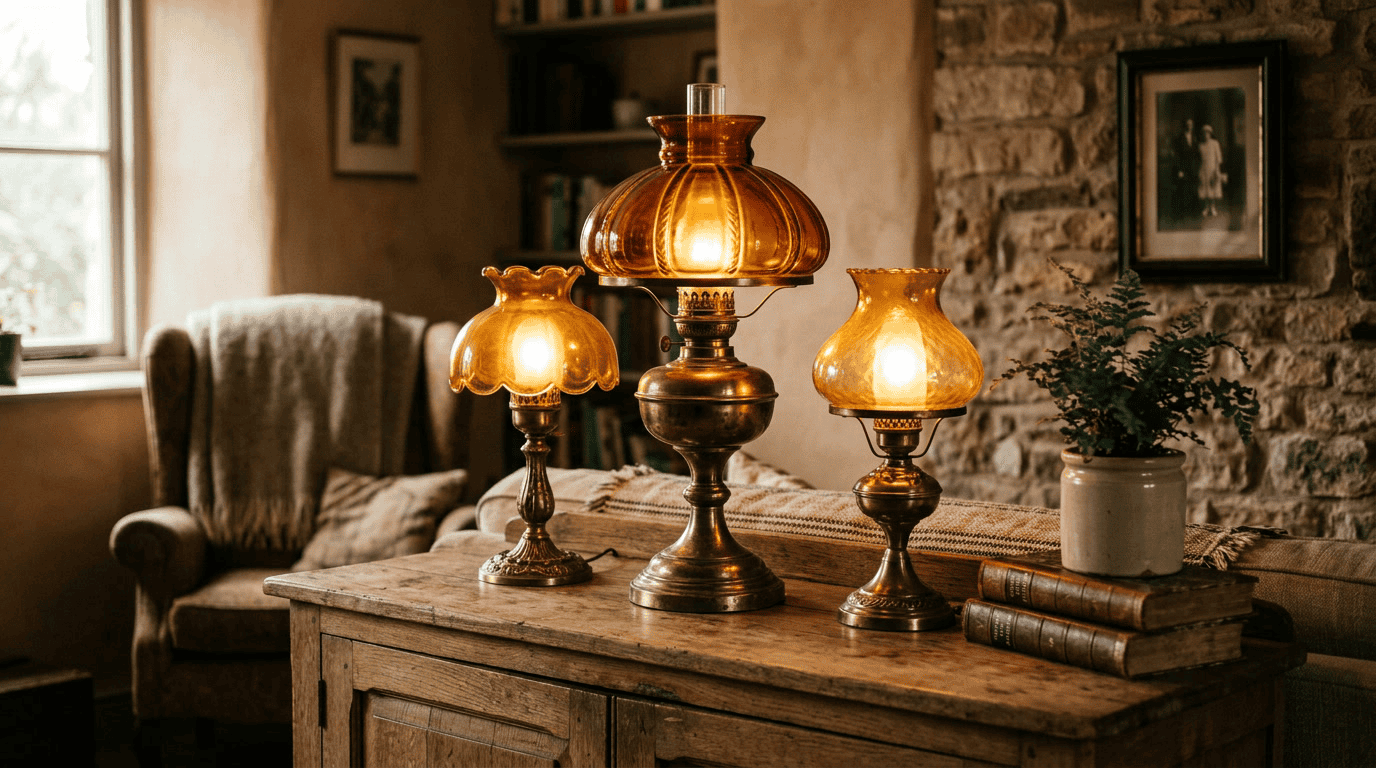
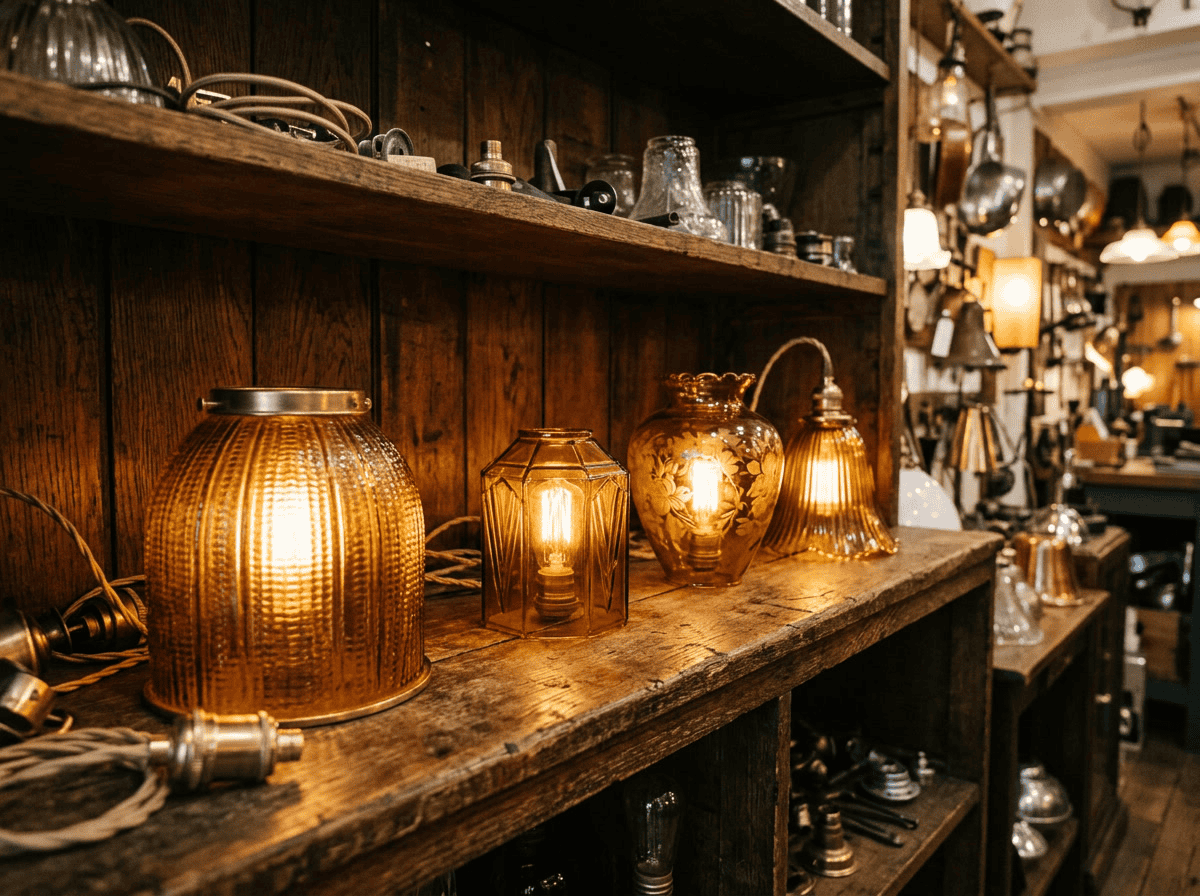
There is a specific quality of light that only amber glass produces — a warmth that reads less like artificial lighting and more like late-afternoon sun through a window, or the glow from a wood fire. It’s not just color temperature; it’s the particular way amber glass shifts the spectrum. Under amber glass, skin looks warm, wood looks richer, and the room feels smaller and more intimate in the best possible sense.
Vintage amber lamp shades have carried this quality for a hundred years across wildly different design eras — from the muted tawny ambers of Depression glass to the deep saturated caramels of Hollywood Regency. Understanding which amber you have, want, or need is the key to using it well.
For the broader vintage glass lamp shade category, see our vintage glass lamp shades hub.
The Amber Spectrum: Not All Vintage Amber Is the Same
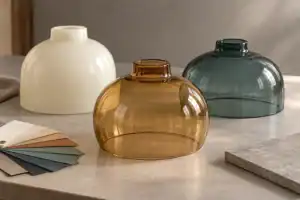
“Amber” describes a range from pale golden honey to deep brownish-orange. In vintage glass production, three distinct amber types were in common use:
Depression-era amber (1920s–1940s): Pale to medium amber, produced by adding iron sulfide compounds to the glass batch and formed via pressed glass techniques. The resulting color is warm honey — not deeply saturated. Pressed glass with ribs, panels, or geometric patterns. Lightweight (2–2.5mm walls). Transmission is relatively high (~60–70%), so light output is good.
Mid-century cased amber (1950s–1970s): Two-layer construction — an amber inner glass gather covered by a clear outer layer. Richer, more saturated amber color with visual depth. Transmission lower (~45–55%) but light quality warmer and more even. This is the amber most associated with the 1960s–1970s lamp market.
Hollywood Regency amber (late 1960s–1980s): Deep, saturated amber or cognac-toned glass, sometimes with the same iridescent surface treatments seen on carnival glass, in heavy forms — thick-walled globes, heavy bell shades, crystal-cut faceted surfaces. Sometimes so dark that they appear almost brown in daylight and glow deep orange under a bulb. Transmission can be as low as 30–40%.
Knowing which amber type you’re working with matters for: light output planning (pale Depression amber needs a lower-lumen bulb to avoid overdriving the room; deep Hollywood Regency amber needs a high-lumen bulb to compensate for absorption), color harmony (pale amber reads as warm gold; deep amber reads as cognac/brandy), and historical accuracy for lamp restorations.
Five Classic Vintage Amber Shade Forms
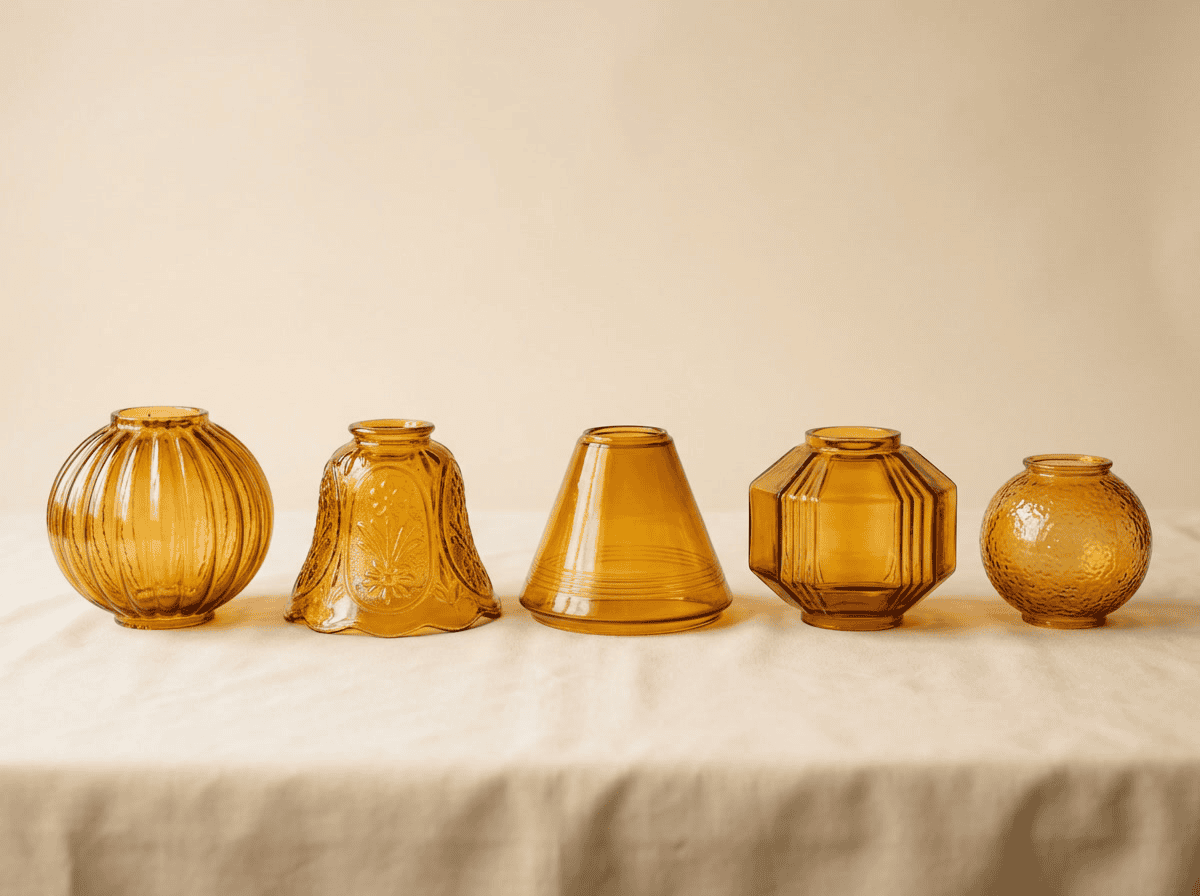
Ribbed pressed amber bell (1920s–1940s): Depression-era amber in classic bell form with vertical ribbing. The ribbing breaks the bulb image into discrete warm highlights. Light, inexpensive, widely available as both originals and reproductions. Pairs with simple chrome or early electric lamp bases.
Smooth cased amber globe (1950s–1960s): Round globe form in two-layer cased amber. Even diffusion with warm amber wash. No visible bulb image. Standard uno or spider fitter. The most versatile amber shade form for residential table lamps.
Amber cylinder/drum (1960s–1970s): Straight-sided cylinder in cased amber. Clean modern geometry, consistent amber wash on room surfaces. Often found on teak-base mid-century lamps.
Crystal-cut amber bell (1970s–1980s): Deep amber or cognac glass with cut facets on exterior surface, the late-period heir to the Streamline Moderne aesthetic. Spectacular light-refracting quality at night. Heavy construction. Pair with heavy brass or gold lamp bases.
Amber swirled/art glass (1900s–1920s): Early amber hand-blown glass with visible swirl patterns from the blowing process. More translucent than later production. Rare; primarily found on antique oil lamp conversions.
Why Amber Glass Produces the Warmest Residential Light
The physics of amber glass lighting is worth understanding, because it explains why amber shades look different from warm-white LED bulbs even when the bulb itself is 2700K.
A warm-white 2700K LED emits a broad-spectrum warm-white light. When this light passes through amber glass, the glass selectively absorbs the blue and green components, transmitting primarily the red-orange-yellow end of the visible spectrum. The result is effectively a shift of the apparent color temperature from 2700K to approximately 2200–2400K — noticeably warmer than the bulb specification.
This means amber glass does something no LED can do on its own at standard 2700K: it shifts the apparent warmth past the range of standard warm-white LEDs. For fireplace-adjacent lamps, bedroom reading lights, or any application where maximum visual warmth is the goal, amber glass produces a result that is genuinely different from any other approach.
The physics of light transmission through colored glass is covered in Wikipedia’s article on stained glass and glass colorants, which explains the selective spectral absorption that makes amber glass function the way it does.
Light Output Planning for Amber Shades
Because amber glass absorbs 30–70% of incident light depending on density, bulb selection matters more for amber shades than for frosted or opal shades.
| Amber shade type | Approximate transmission | Recommended LED lumen output | Effective room lumens |
| Pale Depression amber (ribbed) | 60–70% | 600–800 lm | 360–560 lm |
| Standard cased amber globe | 45–55% | 800–1000 lm | 360–550 lm |
| Deep cased amber (Hollywood Regency) | 30–45% | 1000–1200 lm | 300–540 lm |
| Crystal-cut deep amber | 30–40% | 1100–1300 lm | 330–520 lm |
For a bedside reading lamp where you want warm ambient light but also need adequate task illumination, a deep amber shade at 30% transmission needs a 1200-lumen bulb to deliver 360 effective lumens — still comfortable for reading. Always pair with a dimmer so you can adjust for mood vs. task use.
The U.S. Department of Energy’s LED efficiency page explains that modern LED bulbs are available in lumen outputs from 250 to 1600+ for standard A19 base sizes, giving you full flexibility to compensate for any shade absorption factor.
Matching Amber Glass to Hardware and Interior Palette
Amber glass works with hardware and interior contexts that its chemistry reinforces. The three natural matches:
Brass hardware (all shades of brass): Amber and brass are color-complementary in both daylight (the warm gold-on-gold relationship) and nighttime (amber light enhances the warm yellow sheen of brass). This is probably the most commercially successful lamp combination in the vintage market for good reason.
Oil-rubbed bronze: The warm dark brown of oil-rubbed bronze pairs with medium amber — the contrast between dark hardware and warm amber glass creates more visual drama than brass/amber.
Warm wood bases (walnut, teak, cherry): Mid-century teak or walnut lamp bases with cased amber shades are one of the best-resolved lamp combinations of the 20th century. The amber light reflects off the wood grain in a way that makes both materials look better.
Rooms to use amber shades:
- Bedrooms and reading rooms — maximum warmth, minimum glare
- Living room side tables — warm ambient layer
- Library/study — warm, low-glare task lighting
- Restaurant and hospitality settings — warmth flatters food and people
Rooms where amber shades underperform:
- Kitchens and workspaces — amber distorts food and material colors
- Bathrooms — makes skin tones inaccurate for grooming
- Home offices — reduces task light quality
How to Buy Vintage Amber Glass Lamp Shades
Buying originals
For Depression-era amber pressed glass: antique markets and estate sales are productive. Common forms (ribbed bell, paneled cone) appear frequently and at reasonable prices ($10–35 for typical pieces). Check the fitter rim for chips — Depression glass is thin and chips easily at the fitter opening.
For cased amber globes and mid-century forms: lighting restoration specialists and online marketplaces (Etsy, Chairish, eBay). Prices vary widely ($20–120 depending on size and rarity). Always request fitter dimension confirmation before purchasing online.
The Corning Museum of Glass collection database is a useful reference for comparing cased and pressed amber forms against documented period pieces. For Hollywood Regency crystal-cut amber: specialist dealers and higher-end auction platforms. Prices can reach $50–200+ for quality heavy-glass examples.
Buying reproductions
Current production amber glass shades are widely available. Quality varies significantly. Key indicators of a quality reproduction:
- Glass weight: Cased amber should feel substantial — 3–4mm wall thickness is correct
- Color consistency: Hold to a light and check for even color distribution throughout the wall thickness
- Fitter rim finish: Should be smooth and even — fire-polished or ground, not rough-cut
- Transmission check: Look through the shade at a light source. Consistent amber transmission with no clear patches or uneven density is the goal
Ask any supplier for a lit photo of the shade before committing.
For our range of amber and vintage-style glass shades, our vintage glass lamp shades collection shows current production amber options with custom dimension and fitter specifications available. If you’re sourcing for table or floor lamps specifically, see our vintage glass lamp shades for table lamps guide and vintage floor lamp glass shades guide. And if amber doesn’t end up being the right fit for your room, our vintage milk glass lamp shades guide covers the most common alternative.
Pairing Amber Shades with Other Shade Types
In a multi-lamp room, amber shades work as accent pieces rather than the primary ambient source. The effective pattern:
Primary ambient (opal, milk glass, or frosted): Two or three table lamps or floor lamps in opal, milk glass, or frosted glass provide the room’s general ambient level. These are the workhorses.
Statement pendant (clear or ribbed): One overhead clear or ribbed pendant over the coffee table or dining area provides the “designed” focus point.
Amber accent (1–2 lamps): One or two amber-shaded table lamps — typically the reading lamp by the sofa and a corner lamp — add the warmth layer that makes the room feel complete at night.
This pattern is more effective than trying to light an entire room in amber, which produces enough amber cast to make neutral surfaces look stained.
For a comprehensive comparison of amber against other glass types, amber vs clear vs smoke glass shades covers the full decision matrix. If you’re not sure whether your existing shade is genuine vintage amber or a later reproduction, our guide to identifying vintage glass lamp shades walks through the diagnostic steps.
Frequently Asked Questions
What causes the warm glow of vintage amber glass lamp shades?
Amber glass selectively absorbs blue and green wavelengths, transmitting primarily the red-orange-yellow spectrum. This shifts the apparent color temperature of the light below the bulb’s rated temperature — a 2700K bulb behind dense amber glass appears closer to 2200K, producing the characteristic firelit warmth.
Are vintage amber glass shades fragile?
Depression-era pressed amber glass (thin walls, 2–2.5mm) is relatively fragile — more so than mid-century cased amber or Hollywood Regency heavy forms. Handle at the fitter rim, not the shade body. For daily-use lamps, a quality reproduction in cased amber glass (3–4mm walls) is more durable than a period original. The Smithsonian’s glass care guidance recommends handling any vintage glass shade by the fitter rim rather than the body, regardless of wall thickness.
Can I use any LED bulb color temperature in an amber shade?
Warm white (2700K) is strongly recommended. Using a 3000K or 4000K bulb behind amber glass produces a less warm result — the amber glass shifts the cooler starting point to a less-warm endpoint. For maximum warmth, pair deep amber glass with 2700K LED on a dimmer.
Do amber shades work well in bedroom reading lamps?
Yes — one of the best uses. The warm, low-glare quality is ideal for pre-sleep reading: high enough contrast to read comfortably, low enough glare to not strain night-adapted eyes. Use a higher-lumen bulb (1000–1200 lm) on a dimmer to give yourself range between task and ambient mode.
What’s the difference between single-layer amber tint and cased amber glass?
Single-layer amber tint has colorant added to the entire glass batch — the color runs through the wall but at lower saturation than cased glass. Cased amber has a white or colored inner gather and a clear outer gather; the amber layer is a sandwich. Cased amber has richer, more consistent color, better visual depth, and is more durable. For quality replacement shades, specify cased construction.
Will amber lamp shades look yellow or discolored during the day?
In daylight when the lamp is off, amber glass reads as warm golden honey — visually intentional and attractive in the right interior. Rooms with warm wood tones, brass accents, and earth-palette textiles absorb the amber glass as a natural material element. In very minimalist or cool-palette rooms, amber glass can read as a strong color statement — consider the room palette before committing.
What interior styles work best with amber glass lamp shades?
Mid-century modern (with teak and walnut furniture), Hollywood Regency (with brass and lacquer), traditional and colonial interiors (with mahogany and oil-rubbed bronze), and warm contemporary (with plaster walls and warm-toned materials). Amber glass is less at home in Scandinavian minimalist, industrial, or very cool-toned contemporary interiors.
Related Reading
- Vintage Glass Lamp Shades: Full Buying Guide
- Vintage Glass Lamp Shades for Table Lamps
- Vintage Milk Glass Lamp Shades: History, Styles & Buying Guide
- How to Identify Vintage Glass Lamp Shades
Conclusion
Vintage amber glass lamp shades produce a quality of warm light that no LED technology fully replicates on its own — the spectral shift through amber glass creates genuine firelit warmth that makes rooms and people look better. The choice between Depression-era pale amber, mid-century cased amber, and Hollywood Regency deep amber is a decision about intensity: how warm, how dramatic, how much light absorption you can accept in exchange for that quality.
The practical starting point for most buyers: one or two cased amber table lamp shades in the rooms where warmth matters most. The room responds immediately, and you can build from there.