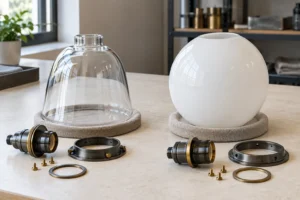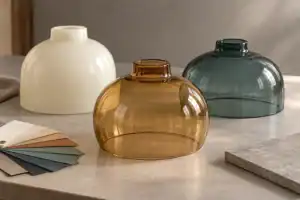
Direct answer: Vintage milk glass lamp shades are opaque or semi-opaque white glass shades produced from the 1930s through 1970s, prized for their soft diffuse light, warm white tone, and period aesthetic. They come in bell, cone, globe, and drum forms with uno or spider fitters, and are widely available as both genuine period originals and current-production reproductions.
Milk glass has been producing soft, warm, diffuse light in American and European homes for over a century — and it never really went out of production. What changed is who buys it and why. In the 1940s, a milk glass shade was simply the standard residential shade. Today it’s a deliberate aesthetic choice, sought by interior designers building period rooms, collectors completing antique lamp sets, and homeowners who’ve discovered that milk glass produces some of the most flattering residential lighting available.
This guide covers what milk glass actually is (the chemistry matters for identifying originals), the major production periods and their distinct visual signatures, how to buy correctly, and how to use milk glass shades effectively in a modern home.
For the broader vintage glass lamp shade category, see our vintage glass lamp shades hub.
What Is Milk Glass? The Chemistry Behind the Color
Milk glass is a broad term for glass that appears white or near-white, either opaque or translucent. The whiteness is created chemically — not by painting or coating, but by adding compounds to the glass batch before glassblowing or pressing, causing microscopic internal scattering of light. Different formulas produce very different visual results.
Bone ash milk glass (pre-1900 to early 1900s): Calcium phosphate from calcined animal bones added to the soda-lime batch. Creates a warm, slightly translucent white with a faintly cream or ivory tone. Victorian-era milk glass was produced this way. The translucency means a bulb image is partially visible — the shade glows rather than blocks the bulb.
Fluoride-opacified milk glass (1920s–1950s): Fluoride compounds (sodium fluoride, cryolite) replaced bone ash. Creates a denser, cooler-toned opacity. Fenton, Westmoreland, and other American glasshouses produced enormous quantities of fluoride-opacified milk glass from the 1930s onward. This is the “classic” milk glass most people picture — dense white, sometimes with slight blue undertone.
Cased milk glass (1950s–1970s): Two-layer construction — a white inner gather (containing opacifiers) covered by a clear outer gather. Produces full opacity on the exterior, consistent color throughout the wall thickness, and a slight depth of surface. More expensive to produce than single-layer; used in higher-end fixtures.
Modern reproductions: Use titanium dioxide or zirconium silicate as opacifiers — safe, consistent, and producing a similar visual result to fluoride glass. The specific warmth of vintage fluoride milk glass is difficult to exactly replicate, but for practical use the visual match is close.
Understanding which formula your shade uses helps with: authenticating period originals, understanding why the color looks slightly different between two vintage pieces, and specifying the closest match when ordering reproductions.
Major Production Periods and Their Signatures
Depression era and early electric (1930s–1940s)
Early mass-produced milk glass shades were simple pressed glass forms — ribbed or paneled cones, simple bells. Wall thickness was relatively thin (2–2.5mm). The glass color was often warmer white with slight cream undertones. Fitter types from this era were less standardized; measure carefully before buying.
Visual signature: slight warm cream tone, visible mold seams, relatively light weight, may have slight surface texture from the mold.
Mid-century production (1950s–1960s)
The golden era of American milk glass. Fenton Glass, Westmoreland Glass, Indiana Glass, and many smaller manufacturers produced dozens of shade forms in dense white milk glass. Forms ranged from simple cones and bells to more decorative shapes with hobnail patterns, crimped edges, or paneled surfaces.
Visual signature: denser white (cooler than Depression-era), thicker walls (2.5–3.5mm), cleaner surface finish, more consistent color. Fitter sizes increasingly standardized to uno and spider.
Late MCM and transitional (1965–1975)
Milk glass remained popular through the late 1960s but began to compete with smoked glass and amber glass in the Hollywood Regency style. Late-period milk glass shades tended toward cleaner cone and drum forms with less surface decoration — more Scandinavian influence.
Visual signature: cleanest form language, consistent wall thickness, very white (few warm undertones), often paired with brushed brass or chrome lamp hardware.
The Five Classic Milk Glass Shade Forms
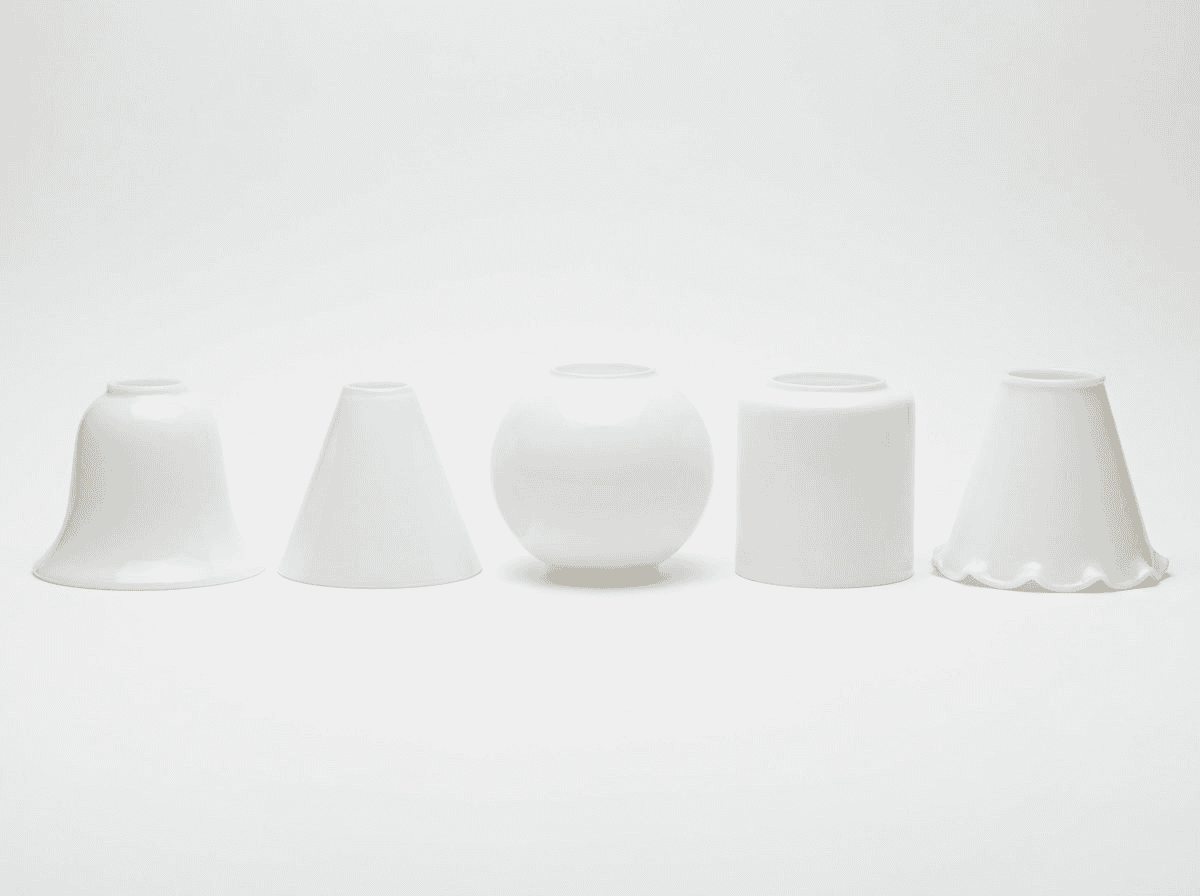
Bell: The widest, most recognizable milk glass form. Flares outward from fitter to a wide lower opening, creating the characteristic silhouette. Bell shades spread light widely and look period-correct on almost any lamp from the 1930s–1960s.
Cone / Empire: Straight-sided taper from narrow top to wider bottom. Cleaner geometry than the bell. Empire is a taller, more dramatic version of the cone. Strongly associated with mid-century modern.
Globe: Rounded spherical or near-spherical form. Produces even 360° diffusion. Common on ceiling fixtures and pendant lamps; less often used on table lamps. When used on a table lamp, creates a balanced upward and downward light distribution.
Drum: Straight-sided cylinder with equal top and bottom diameter. The cleanest, most modern milk glass form. Associated with late MCM and Scandinavian-influenced design.
Paneled and hobnail decorated: Depression-era and mid-century forms with surface patterns pressed into the glass — hobnail (raised dots), diamond patterns, or panel ribbing. These are the most collectible milk glass forms and the most distinctive visually.
Identifying Period Originals vs. Reproductions
The vintage milk glass market includes genuine period originals, quality reproduction manufacturing, and low-cost mass-produced imports that simply look white. Telling them apart matters for collectors; for practical use, what matters is glass quality.
Signs of a genuine period original:
- Visible mold seams that weren’t fully polished off
- Slight wall thickness variation (heavier at base, lighter at top)
- Color that is genuinely warm white with slight cream or ivory undertone
- Weight: period milk glass is heavier than most modern reproductions
- Fitter rim that may be slightly non-standard in diameter
- When held to a strong light source, slight translucency visible at thinner points (not present in very dense fluoride glass)
Signs of quality current reproduction:
- Consistent wall thickness throughout
- Clean, smooth surface with no mold seams
- Bright white color — consistent through full wall thickness
- Standard fitter dimensions (uno or spider)
Signs of low-quality import:
- Thin walls — the shade flexes or feels fragile
- Uneven color (visible cloudiness or clear patches when held to light)
- Rough fitter rim edge that hasn’t been fire-polished or ground smooth
- Very light weight
According to Wikipedia’s entry on milk glass, the material’s history extends to 16th century Venice, making it one of the longest-continuous glass production traditions — the Corning Museum of Glass holds examples spanning that full history. The American Depression and mid-century production was a specific mass-market chapter in that history.
Buying Milk Glass Shades: New vs. Vintage
For most practical purposes, quality current-production milk glass shades outperform genuine vintage originals in every way except period authenticity:
| Factor | Vintage original | Quality reproduction |
| Fitter size accuracy | Variable, often non-standard | Consistent, standard sizes |
| Glass quality | Variable, depends on age/storage | Consistent, controlled |
| Color consistency | May vary between pieces | Matched within production batch |
| Price (single unit) | $15–60 for common forms | $20–80 depending on form |
| Multiple matching units | Nearly impossible | Available to order |
| Lead time | Hunt until you find it | 3–6 weeks from manufacturer |
For a single antique lamp you’re completing, a genuine original has appeal and you can often find one. For a pair of matching table lamps, a bedroom set, or a hospitality specification across multiple rooms, reproductions are the only practical answer — see our vintage glass lamp shades for table lamps guide for sizing across matched sets.
Our vintage glass lamp shades collection includes milk glass bell, cone, and globe forms in standard fitter sizes with custom dimensions available.
Using Milk Glass Shades in Modern Interiors
Milk glass is currently experiencing its strongest design moment in decades. Interior design trends in 2026 are running heavily toward warm-toned, layered, historically-referential rooms — exactly the context where milk glass performs best.
With traditional and antique bases: Milk glass is period-appropriate for almost any American lamp from the 1930s onward. For Victorian-era bases, bone-ash-style opalescent glass is more accurate than dense milk glass.
With modern and contemporary bases: Unlike frosted glass, milk glass is fully opaque rather than translucent, which is part of why it works as an unexpected material contrast in otherwise minimal rooms. A dense white milk glass globe on a matte black cylindrical base, or a cone form on a brushed brass column, creates material tension that reads as deliberately considered.
With warm-toned bulbs: Milk glass needs warm-white LEDs (2700K) to look right. Under 4000K or daylight bulbs, milk glass looks cold and institutional. Under 2700K warm white, it glows with a quality that is genuinely difficult to achieve with any other material.
Light output planning: The diffuse reflection properties of milk glass mean a standard shade (depending on opacity and thickness) absorbs 30–50% of incident light. A 1000-lumen LED behind a milk glass shade delivers 500–700 lumens to the room. Plan bulb selection with this absorption factor in mind. The U.S. Department of Energy’s LED efficiency guidance provides current LED lumen output ranges for standard bulb sizes.
Sizing Guide for Milk Glass Table Lamp Shades
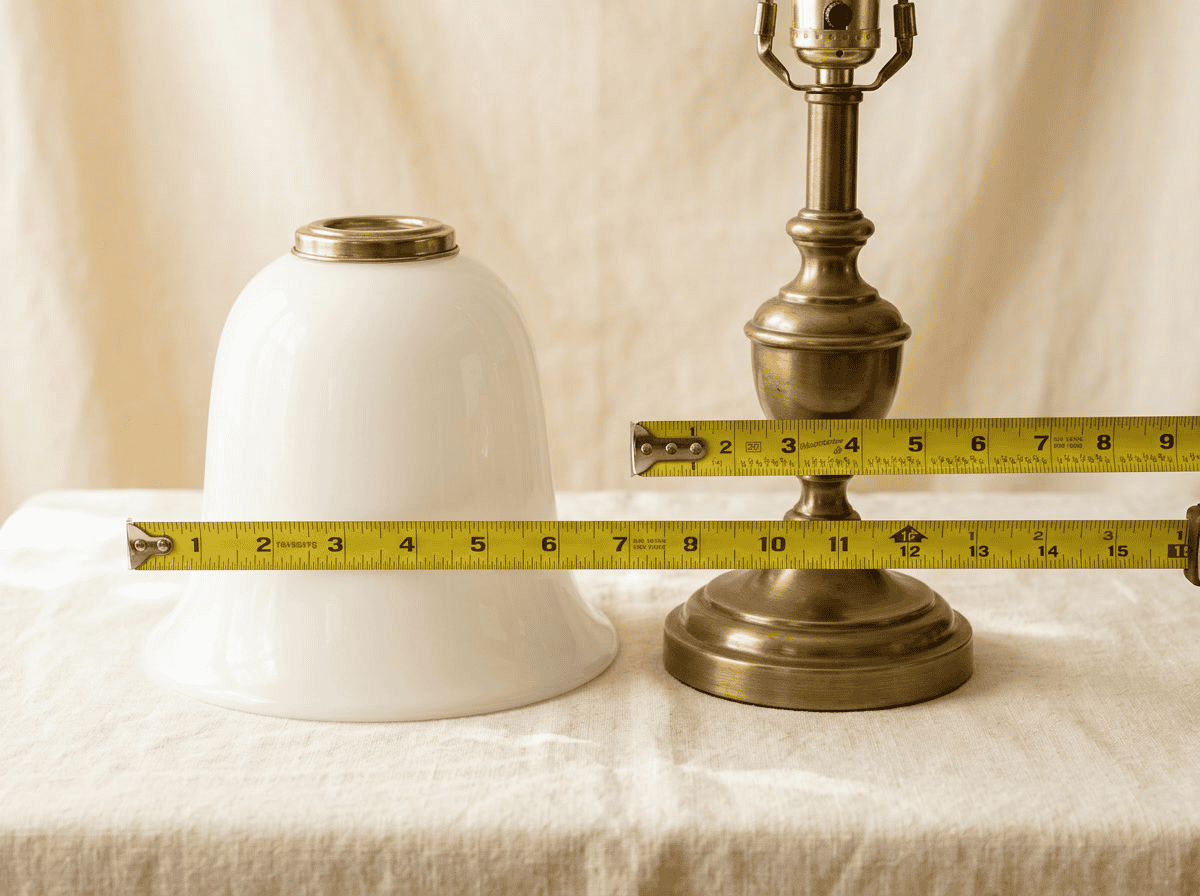
The classic proportion rule: shade outer diameter ≈ lamp base height. A 14″ lamp base wants a 14″ wide shade. This applies to bell and empire forms; cone and drum forms can run slightly narrower.
| Lamp base height | Milk glass shade diameter | Best form |
| 8–10″ | 10–12″ | Bell or wide cone |
| 10–12″ | 12–14″ | Bell or cone |
| 12–16″ | 14–16″ | Cone or empire |
| 16–20″ | 16–20″ | Empire or drum |
For measuring the fitter, remove the old shade and check: uno fitter (7/8″ threaded socket collar), spider fitter (1 5/8″ saddle on wire harp), or legacy ring support (measure inner ring diameter). Full procedure at how to measure a replacement glass lamp shade.
Cleaning Vintage Milk Glass
Milk glass collects and shows dust more visibly than any other shade type because its white surface provides maximum contrast against dust particles. Monthly cleaning is practical.
Standard cleaning:
- Remove shade from lamp and place on a padded surface
- Microfiber cloth with warm water + small amount of dish soap
- Wipe interior and exterior surfaces gently
- Rinse cloth, wipe again with clean damp cloth
- Air dry completely before replacing
For yellowed vintage milk glass:
A very dilute hydrogen peroxide solution (3%, standard pharmacy grade, room temperature) can lighten yellowing in genuine period milk glass. Soak for 15–30 minutes, rinse thoroughly, air dry. Do not use on painted or decorated surfaces.
What to avoid:
- Ammonia-based glass cleaners — can affect any decorative enamel or surface treatment
- Abrasive cloths — milk glass scratches at ~5.5 on the Mohs scale
- Submerging shades with metal fitter hardware — hardware can rust
The Smithsonian’s care guidance for glass objects covers long-term preservation for genuine antiques. If your shade is in a floor lamp rather than a table lamp, our vintage floor lamp glass shades guide covers the larger fitter sizes typical of those fixtures, and if you’re unsure whether your shade is genuinely milk glass or a different opal formula, our guide to identifying vintage glass lamp shades covers the diagnostic steps.
Frequently Asked Questions
Is vintage milk glass safe to use with modern LED bulbs?
Yes. LED bulbs produce 70–90% less heat than the incandescent bulbs vintage milk glass shades were designed around, so thermal stress is not a concern. Choose warm-white LEDs (2700K) for period-appropriate light quality.
Why does my vintage milk glass look slightly yellow?
Two possible causes: (a) The glass was exposed to decades of incandescent heat, which can cause irreversible yellowing in fluoride-opacified glass; (b) the specific formula used had a warm cream undertone by design. Historical milk glass was often intentionally warmer-toned than modern reproductions. LED use going forward will stop further yellowing.
How do I tell Depression-era milk glass from later production?
Depression-era milk glass (1929–1939) typically has warmer cream undertones, slightly thinner walls, visible mold seams, and lighter weight. Post-war milk glass (1945–1970) is denser, whiter, heavier, and more uniform. Side-by-side comparison in daylight is the most reliable method.
Can I mix different milk glass shade forms across multiple lamps in the same room?
Yes, with one rule: keep the glass density consistent. Mixing a very opaque mid-century milk glass shade with a more translucent Depression-era opalescent shade on adjacent lamps will produce noticeably different light quality from each lamp, which reads as unintentional. Either match the period (all similar era) or accept and plan for the variation.
What wattage LED should I use in a milk glass shade?
An 800–1000 lumen LED (roughly equivalent to 60–75W incandescent) is the right range. Milk glass absorbs 30–50% of light; starting with 1000 lumens behind a standard milk glass shade delivers roughly 500–700 lumens to the room — comfortable ambient for a table lamp. Choose warm white (2700K) for the correct period aesthetic.
Are hobnail milk glass shades more valuable than plain forms?
For collectors, yes. Hobnail (raised dot) pattern milk glass from identified manufacturers like Fenton commands a significant premium over plain forms in the vintage market — similar to how iridescent carnival glass patterns command premiums from the same makers. For practical lighting use, the difference is aesthetic only — hobnail texture adds visual interest but doesn’t change the light quality meaningfully.
Where can I buy quality milk glass lamp shades new?
Glass lamp shade manufacturers and specialty lighting suppliers. For a single replacement shade, expect to pay $20–60 for a standard bell or cone form from a quality producer. For bulk orders (10+ shades), direct manufacturer pricing is significantly lower. Our glass lamp shade collection includes current-production milk glass options with standard and custom fitter specifications.
Related Reading
- Vintage Glass Lamp Shades: Full Buying Guide
- Vintage Glass Lamp Shades for Table Lamps
- Vintage Amber Glass Lamp Shades: Warm Light, Period Styles & Buying Guide
- How to Identify Vintage Glass Lamp Shades
Conclusion
Vintage milk glass lamp shades are the most practical and widely-available period glass shade type. They diffuse light better than most alternatives, pair with almost any lamp base style from the 1930s onward, produce warm ambient light that flatters people and rooms, and are available as quality reproductions when originals are unavailable or impractical.
The three decisions that determine whether a milk glass shade works: glass density (opaque vs. semi-opaque), form (bell vs. cone vs. globe for the lamp type), and fitter dimension (measure before buying). Get those three right and a milk glass shade is almost impossible to choose wrong.