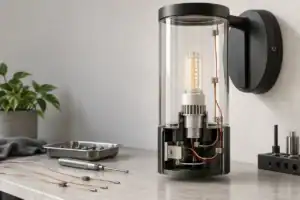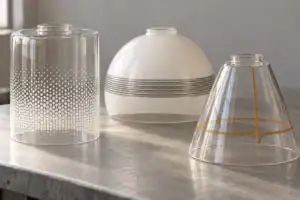
Direct answer: To identify vintage glass lamp shades, examine four elements: glass type and color formula (which narrows the era), surface treatment (hand-blown vs. machine-pressed), fitter type and diameter (which varied by period), and any maker’s marks or mold numbers on the fitter rim. These four indicators together usually narrow a shade to within a 10–20 year production window.
Most vintage glass lamp shades arrive without documentation. An estate sale, an inherited lamp, a flea market find — the shade comes with no label, no receipt, and no story. Identifying it correctly is partly detective work, partly materials science, and partly knowing which questions to ask.
The good news: glass is remarkably informative. The formula, the production method, the fitter dimensions, and the surface treatment all encode information about when and where the shade was made. This guide teaches you to read that information systematically.
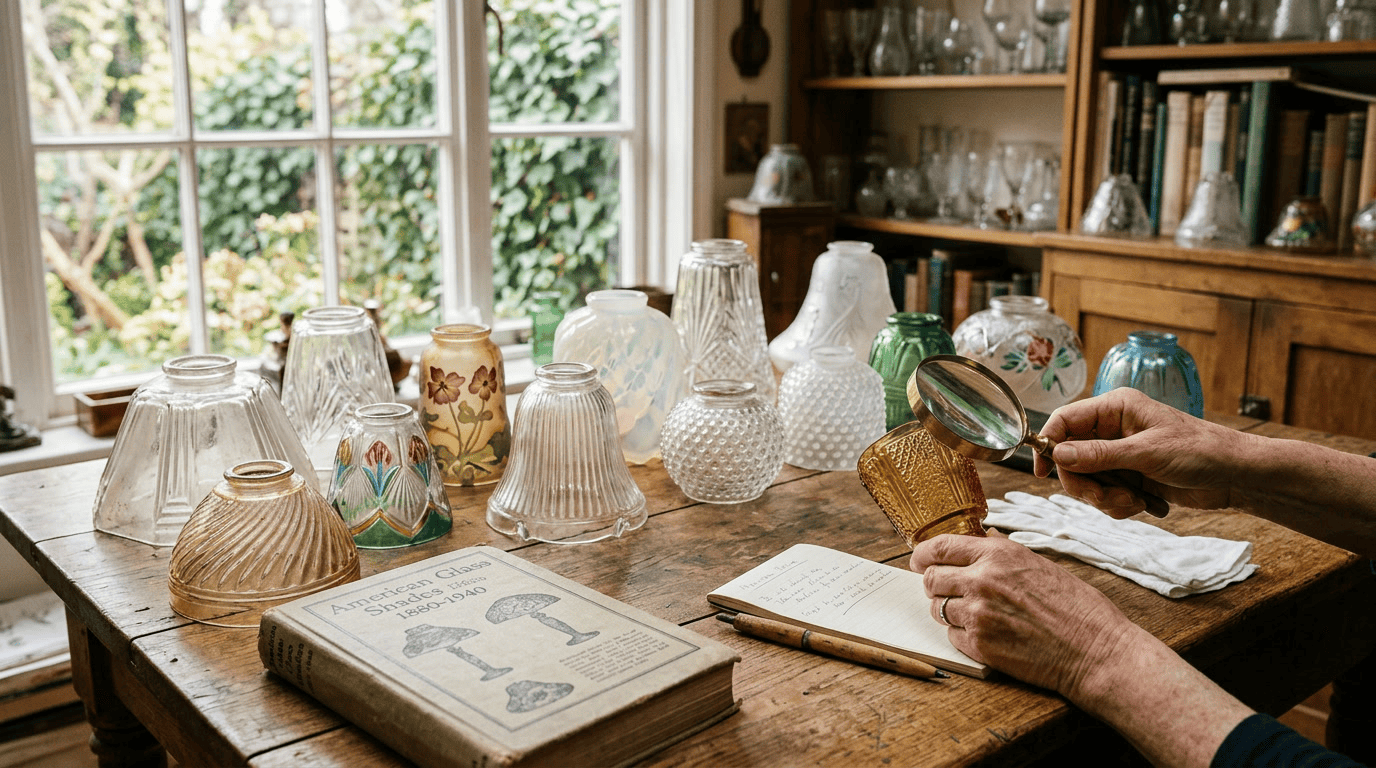
For the broader vintage glass lamp shade category, see our vintage glass lamp shades hub.
The Four-Step Identification Framework
Step 1: Glass Type and Color Formula
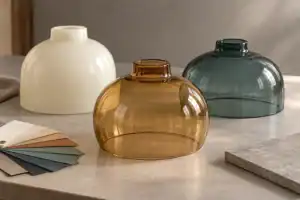
The starting point for any vintage glass shade identification is the glass itself — whether it’s milk glass, cased amber, or opalescent. Different eras used distinctly different formulas, and the visual result is diagnostic even without chemical analysis.
Hold the shade up to a bright light source (natural daylight is best) and observe:
| What you see | Glass type | Era range |
| Warm cream/ivory translucency, slight yellow undertone | Bone ash opalescent | Pre-1920, Victorian/Edwardian |
| Dense white, no translucency, slight blue-white tone | Fluoride milk glass | 1920s–1960s |
| Dense white through entire wall thickness, very consistent | Titanium dioxide glass (modern reproduction) | Post-1970 |
| Amber with visible depth, two distinct layers in wall cross-section | Cased amber glass | 1940s–1970s |
| Pale amber, uniform through wall, lighter saturation | Single-layer tinted amber | 1920s–1950s |
| Pink with slight salmon undertone | Selenium-tinted Depression glass | 1929–1939 |
| Green with chrome/uranium green tone | Chrome-tinted or uranium Depression glass | 1929–1939 |
| Grey-to-brown neutral tint, uniform | Smoked glass | 1960s–1980s |
| Clear with visible slight impurities or bubbles | Early hand-blown clear glass | Pre-1940 |
| Clear, perfectly uniform, no bubbles | Modern machine-blown or pressed clear | Post-1940 |
Cased amber glass — visible as two distinct layers in the wall cross-section, a hallmark of cased glass technique — and the selenium pink and uranium green of Depression glass are particularly diagnostic — the specific color undertone (salmon-pink, not bubblegum; chrome-green, not emerald) is difficult to confuse with later production.
Step 2: Production Method — Hand-Blown vs. Machine-Pressed
Hand-blown glass characteristics:
- Visible wall thickness variation — thinner at the top of the shade, heavier at the bottom
- Slight surface waviness when viewed at a low angle against a light source
- Possible small air bubbles within the glass wall
- Asymmetry — one side of the shade may be very slightly different in profile from the opposite side
- Pontil mark at the top of the shade (a rough or polished circular mark from where the blowing rod was attached)
- If decorated: brush marks visible in any painted areas; slight texture variation in enameled surfaces
Hand-blown glass was standard before roughly 1920–1930 and continued in higher-end production well after mass mechanization. Finding hand-blown characteristics strongly suggests pre-1940 production or post-1980 artisan revival.
Machine-pressed glass characteristics:
- Consistent wall thickness throughout
- Mold seams — visible lines running vertically where mold sections met
- Smooth, mathematically consistent surface (no waviness)
- No air bubbles
- Sharper detail on any surface pattern (ribs, panels, hobnail) — pressed pattern is more defined than blown
Machine-pressed glass dominated American production from the 1920s onward. Depression glass is almost entirely machine-pressed.
Step 3: Fitter Type and Dimensions
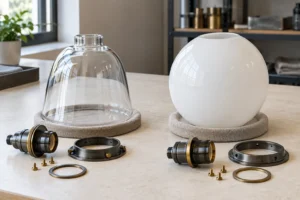
The fitter is the most mechanically diagnostic element because fitter standards changed over time:
| Fitter type | Inner diameter | Era of common use |
| Non-standard ring support | 3″–5″ (custom to lamp) | Pre-1920 |
| 2¼” gallery | 2.25″ | 1910s–1940s |
| 3¼” gallery | 3.25″ | 1920s–1960s, torchiere and larger |
| Uno (threaded socket) | 7/8″ (22mm thread) | 1930s–present |
| Spider/harp | Saddle width 1 5/8″ | 1940s–present |
| Clip-on | Bulb-fitted | 1950s–present |
If the shade has a non-standard fitter diameter that doesn’t match any of these common sizes, it’s likely pre-1920 or a custom/European production piece.
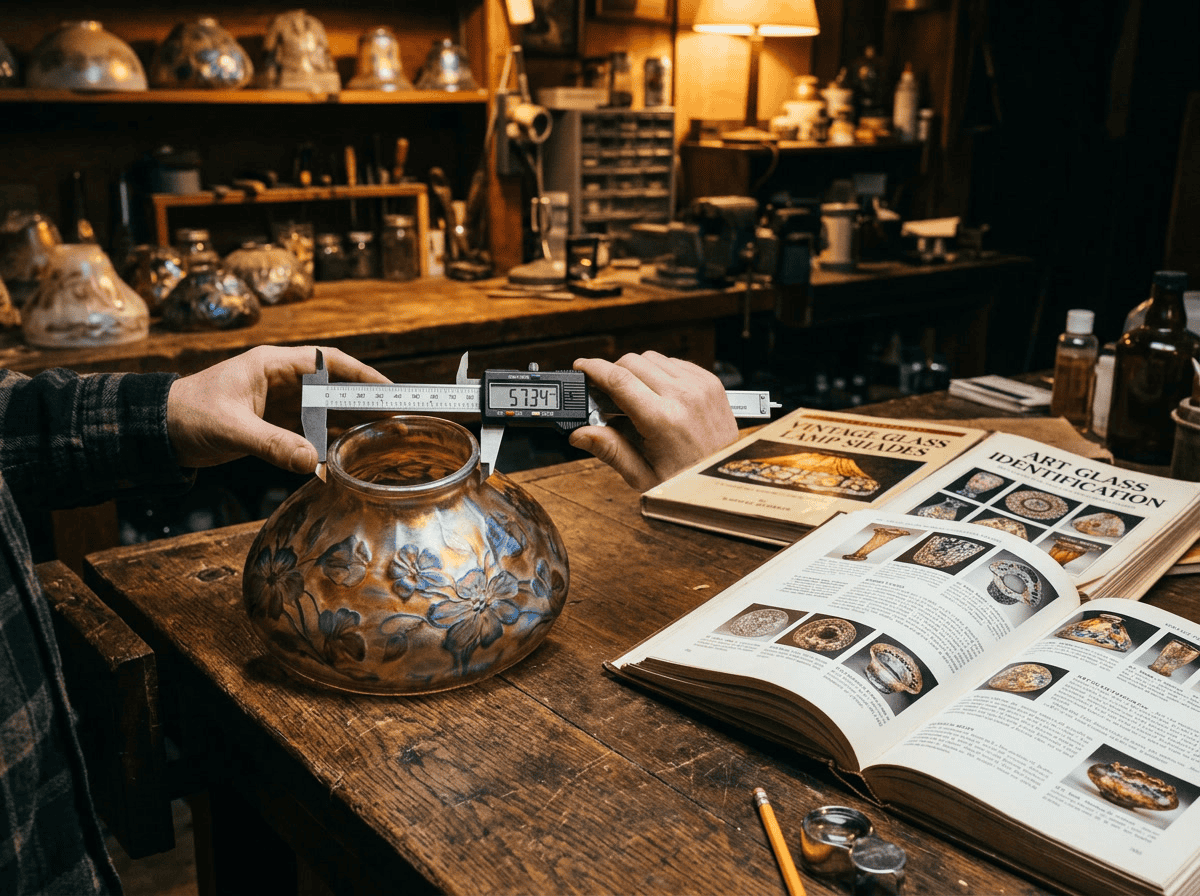
Measure fitter inner diameter with calipers if possible, or use a small ruler. A fitter rim showing significant hand-finishing (uneven grinding, slight irregularity) suggests earlier production; a smooth fire-polished fitter rim with consistent diameter suggests mass production.
Step 4: Maker’s Marks and Mold Numbers
Many American glass houses marked their production — look on the fitter rim interior or on the outer glass surface near the fitter. Common marks:
- Fenton Art Glass: “Fenton” in script, or a stylized “F” with an oval. Used from 1970 onward; earlier Fenton pieces often unmarked.
- Westmoreland Glass: “WG” monogram, or a shield/keystone mark on some pieces.
- Indiana Glass: Less frequently marked; identified more by pattern and color.
- L.G. Wright Glass Co.: Reproductions from the 1930s–1990s; “LGW” mark on some pieces.
- Mold numbers: Pressed glass often has a number or letter molded into an inconspicuous area. This identifies the mold but not always the maker without reference materials.
Unmarked pieces are the majority. Use the glass type, production method, and fitter dimensions to date them rather than relying on marks.
According to Wikipedia’s article on American glass manufacturers, Fenton Art Glass Company is one of the most documented producers and began marking pieces in 1970, which gives a useful binary: marked Fenton = post-1970; unmarked piece with Fenton-characteristic glass = likely earlier.
Identifying by Era: Visual Quick Reference
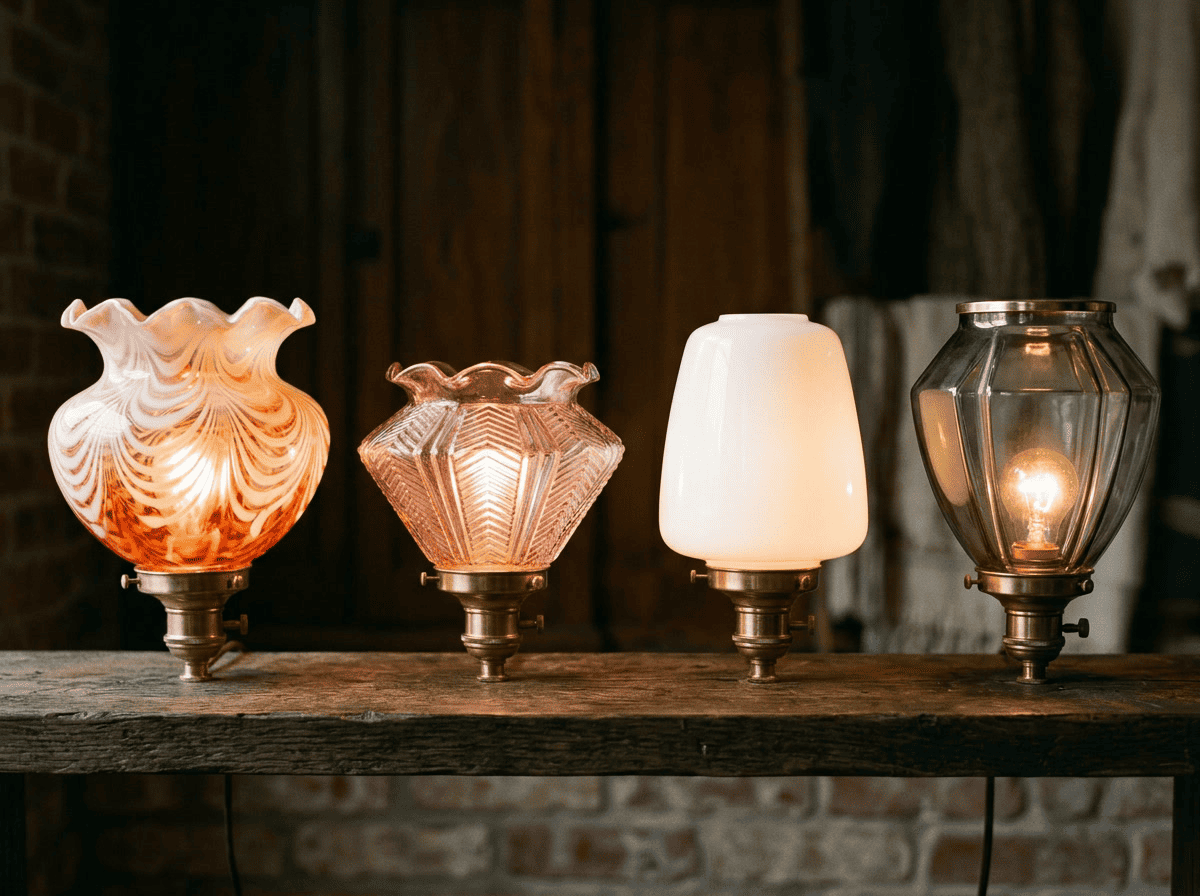
Victorian and Edwardian (1880–1910)
Visual: Warm cream/ivory white, slight translucency, possible ruffled or crimped rim, painted floral or transfer decoration common. Hand-blown with visible asymmetry.
Fitter: Non-standard ring support or early 2¼” gallery.
Weight: Heavier than later pressed glass of same diameter.
Lit appearance: Warm golden glow through translucent body with faint visible bulb silhouette.
Arts & Crafts and Art Nouveau (1900–1920)
Visual: Leaded glass panels (if true Arts & Crafts style), or single-color amber/green/white glass in organic forms. Hand-blown.
Fitter: 2¼” gallery or non-standard ring.
Distinctive: Organic form (non-geometric), absence of mold seams, color that shows depth when lit.
Depression era (1929–1939)
Visual: Machine-pressed geometric forms (ribbed, paneled, honeycomb) in pink, green, amber, or clear. Thin walls, visible mold seams, light weight.
Fitter: 2¼” gallery or early 3¼”.
Distinctive: The specific salmon-pink or chrome-green color not reproduced exactly in later periods.
Lit appearance: Even amber/pink/green wash with slightly visible ribbing.
Mid-century modern (1945–1970)
Visual: Clean white opal glass in cone, drum, or bell forms. Minimal or no surface decoration. Spider fitter on harp standard.
Fitter: Spider/harp or 3¼” gallery.
Distinctive: Very clean geometry; any deviation from perfect symmetry suggests hand production.
Lit appearance: Pure even white glow, zero bulb visibility in quality opal.
Hollywood Regency and late Moderne (1960s–1980)
Visual: Smoked grey/brown, deep amber, or clear crystal-cut. Heavy construction. Often large diameter.
Fitter: Spider/harp or 4″ gallery.
Distinctive: Glass weight — Hollywood Regency shades are noticeably heavier than earlier styles.
Common Identification Mistakes
Assuming all white glass is milk glass: Victorian opalescent and mid-century milk glass look similar in daylight but behave completely differently when lit. Hold the shade up to a strong single light — opalescent shows a warm glow with slight transparency; dense milk glass blocks the light source entirely.
Confusing reproduction Depression glass with originals: Reproductions have been produced since the 1960s. The tell: color tone (reproductions often have more saturated, less nuanced color than originals), and the specific depression-era mold patterns (originals have patterns made for the specific glass type; some reproductions transpose patterns between colors anachronistically).
Dating based on style alone: A pink ribbed shade might be a 1930s original or a 1990s reproduction. Style dating alone is unreliable; combine it with fitter dimension, glass formula, and production method evidence.
Assuming hand-blown = Victorian: Artisan glass production never stopped. Hand-blown glass shades were produced in small quantities throughout the 20th century and are produced today. Post-1980 artisan revival pieces can look Victorian at first glance. Check the glass formula — modern artisan glass rarely uses bone ash or fluoride opacifiers.
Practical Tools for Identification
UV light (blacklight): Some period glass formulas fluoresce under UV. Uranium glass (Depression-era green, often associated with iridescent carnival glass) fluoresces bright yellow-green. Manganese-decolorized clear glass (pre-1940) fluoresces pale lavender/blue. Non-fluorescing under UV suggests post-1940 production for clear or green glass. A basic UV flashlight ($10–15) is one of the most useful identification tools for Depression and Victorian glass.
Calipers: For precise fitter dimension measurement. Critical for replacement matching; also useful for dating (non-standard dimensions = likely pre-1940).
Weight comparison: If you have two shades for comparison, weight relative to size is informative. Victorian hand-blown glass tends to be heavier than same-size machine-pressed; some mid-century milk glass is notably heavier than modern reproductions.
Care and handling: The Smithsonian’s guidance on glass object care covers safe handling practices that apply equally to identification work — minimizing risk to fragile vintage pieces while examining them.
Reference books: Gene Florence’s Collector’s Encyclopedia of Depression Glass covers pattern identification for Depression-era pressed glass. Margaret and Kenn Whitmyer’s Fenton Art Glass documents Fenton production. For general American art glass, Carl Luckey’s Identification Guide to Early American Pattern Glass covers the pre-Depression period.
The Corning Museum of Glass maintains an extensive online collection database that includes maker and period identification for American and European glass, useful for cross-referencing unusual pieces.
When to Ask an Expert
Three scenarios where professional assessment is worth the cost:
Potential signed or documented pieces: If the shade shows any mark that might be associated with a known designer or studio (early Tiffany Studios, Steuben, Carder-era glass), professional appraisal before buying or selling is essential.
Insurance or estate valuation: For estate purposes, documentation of vintage glass value requires professional appraisal, not online research.
Authentication for high-value reproduction purchase: If you’re paying premium prices for a piece claimed to be a specific manufacturer or period, authentication from a qualified appraiser or the relevant collector society protects your investment.
For practical lighting replacement purposes — finding a shade that fits and looks right — expert identification isn’t necessary. The four-step framework above is sufficient.
Once you’ve identified the glass type and era, our format-specific guides cover sizing and fitter matching for table lamps, floor lamps, and pendants. If your shade turned out to be milk glass or amber-toned, see our dedicated guides to vintage milk glass lamp shades and vintage amber glass lamp shades. And if the geometric pressed forms point to the 1920s-1940s, see our Art Deco glass lamp shades guide.
Frequently Asked Questions
How do I tell if a milk glass shade is genuinely old?
Check for: slight cream/ivory undertone (older fluoride milk glass) vs. bright white (modern titanium dioxide); visible mold seams with slight irregularity (period pressed glass) vs. very clean seams (modern production); weight (heavier for same diameter usually means older glass formula); and fitter rim finish (slightly irregular or polished by hand vs. machine-consistent).
Does vintage glass glow differently from modern reproductions?
Often yes. Period glass formulas — particularly fluoride milk glass and bone-ash opalescent — produce a subtly different light transmission quality than modern titanium dioxide or zirconium glass. The warm cream undertone of fluoride glass gives a slightly warmer lit appearance. Side-by-side in person, most people notice the difference; in photographs it’s harder to detect.
Can I identify Depression glass colors reliably?
Yes, for common colors. Depression pink has a distinctive salmon undertone; Depression green has a chrome-olive quality; Depression amber is a warm honey-amber. The challenge is that reproductions have been produced since the 1960s using slightly different colorant chemistry, so the exact tone differs. UV test helps: genuine Depression glass with uranium colorants (some green and yellow) fluoresces brightly; selenium-tinted pink does not.
What does a pontil mark tell me about age?
A pontil mark (rough or polished circular mark at the top of the shade from the blowing rod) confirms hand-blown production. Hand-blown glass production was standard before ~1920 for decorative shades and continued in smaller-quantity higher-end production after that. A pontil mark doesn’t prove Victorian-era, but it rules out mass machine-pressed production.
Are maker’s marks reliable for dating vintage glass shades?
Partially. Some makers (Fenton post-1970) are reliably dated by their marks. Others used marks inconsistently across production years. Unmarked pieces are the majority of vintage glass. Marks are one piece of evidence to combine with glass type, fitter dimensions, and production method.
How can I tell if a vintage glass shade is worth significant money?
Red flags that suggest routine commercial production (typically $10–50 value): machine-pressed construction, standard Depression-era patterns in common colors, standard fitter dimensions. Green flags that suggest potentially significant value: hand-blown construction, documented manufacturer’s mark, unusual color or pattern, association with a specific lamp style. For anything where significant value is possible, consult a qualified appraiser.
Is it safe to use UV light to test vintage glass?
Yes. UV flashlights used for glass identification emit low-level UV at standard blacklight frequencies — safe for brief residential use. The exposure required for fluorescence testing is a few seconds. Don’t stare directly into the UV source; otherwise standard handling precautions apply.
Related Reading
- Vintage Glass Lamp Shades: Full Buying Guide
- Vintage Milk Glass Lamp Shades: History, Styles & Buying Guide
- Vintage Amber Glass Lamp Shades: Warm Light, Period Styles & Buying Guide
- Art Deco Glass Lamp Shades: Geometric Styles, Materials & Sourcing Guide
Conclusion
Identifying vintage glass lamp shades is a systematic process, not a guessing game. The glass formula narrows the era; the production method (hand-blown vs. pressed) confirms it; the fitter dimensions provide mechanical dating; and maker’s marks (when present) add specificity. For most practical purposes, the four-step framework narrows any shade to a production decade with confidence.
For replacement matching — finding the right replacement for a broken shade — identification accuracy is important primarily for fitter sizing and glass-type matching. Period accuracy matters if you’re completing a documented antique lamp for display; it matters less if you’re replacing the shade on a grandmother’s floor lamp for daily use. Either way, the identification process is the right first step.