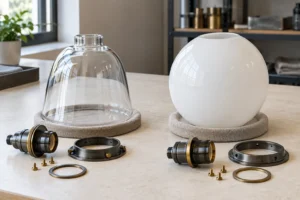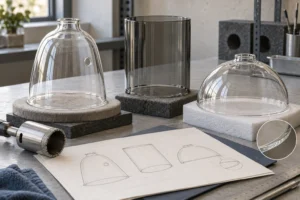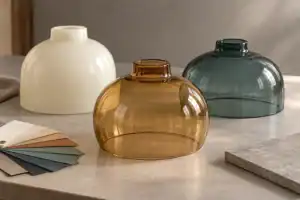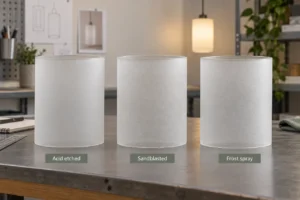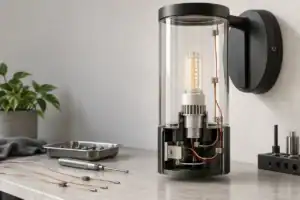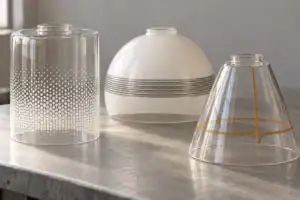
Direct answer: Vintage glass pendant light shades are period-appropriate glass covers for hanging pendant fixtures — ranging from Victorian hand-blown globes and Art Deco geometric forms to mid-century opal drums. They attach via neckless fitter (held by thumb screws), gallery ring, or slip-on collar, and are available in milk glass, amber, clear ribbed, and opalescent types.
Pendant lights occupy a different role in a room than table or floor lamps. They’re overhead, often clustered, and typically serve as both functional light sources and visual anchors in the ceiling plane. When pendant shades are wrong — whether in scale, period style, or glass quality — the problem reads from every angle in the room. When they’re right, they define the room’s character.
Vintage glass pendant shades have the advantage of genuine period character. A hand-blown opal globe over a kitchen island, a cluster of amber glass globes in a dining room, a set of ribbed clear pendants in a hallway — each of these communicates something specific about the space that generic modern pendants rarely achieve.
Pendant-Specific Considerations for Glass Shade Selection
For the broader vintage glass shade category covering table and floor lamps as well, see our vintage glass lamp shades hub.
Pendant shades differ from table and floor lamp shades in three important ways:
Above-eye viewing angle: Most pendant shades are viewed from below, often at an upward angle. This means the interior of the shade is visible — and any quality or diffusion issues on the inside surface will be apparent. For pendants, both interior and exterior glass finish matter.
Multiple-fixture clustering: Pendants are often specified in groups of 3, 5, or more. Consistency between shades matters more than for a single table lamp. Machine-pressed shades offer better consistency between units than hand-blown; for hand-blown clustered pendants, accept and specify the natural variation.
Heat management: Pendant shades often enclose the bulb more completely than table lamp shades, reducing ventilation. With modern LEDs, heat is minimal; with older halogen fixtures, ensure any glass shade has adequate ventilation at the top fitter opening.
Five Classic Vintage Pendant Glass Shade Forms
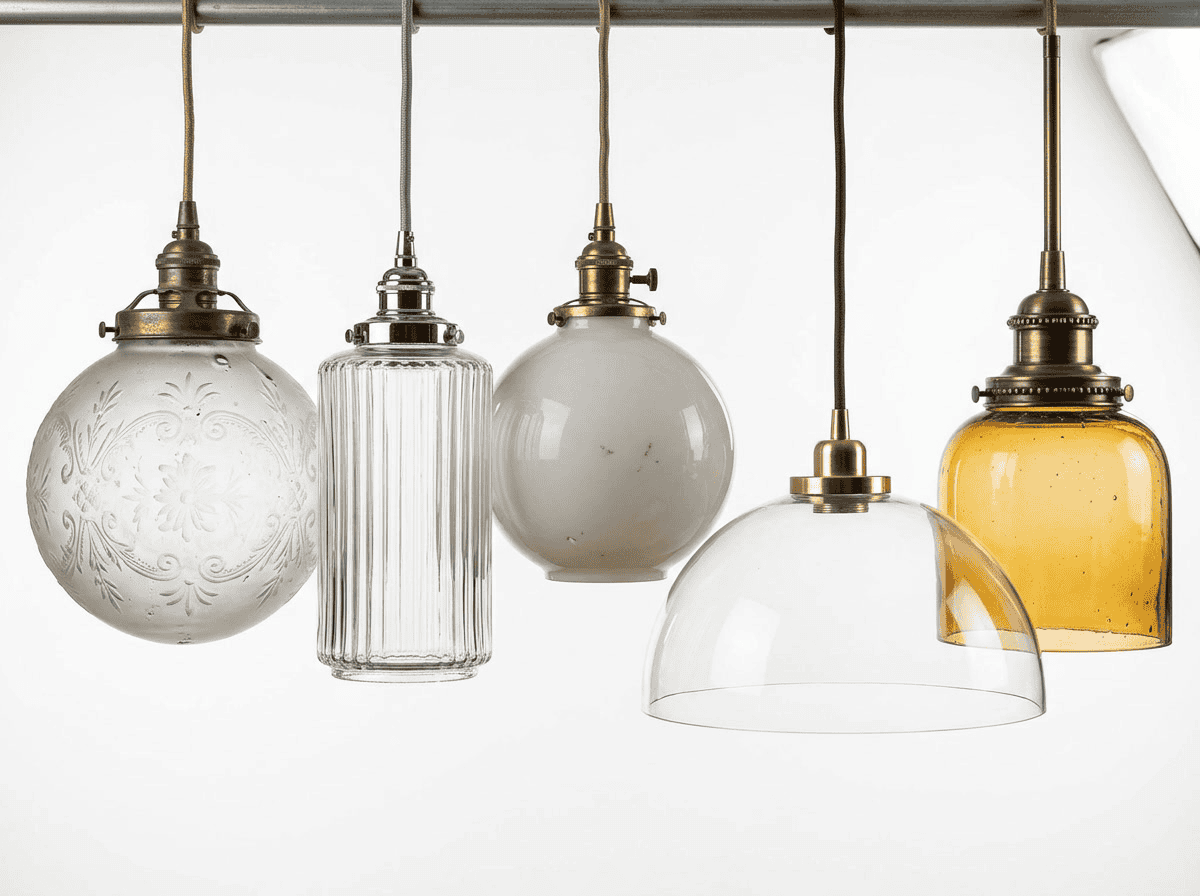
Victorian/Edwardian hand-blown globe (1880–1920): Spherical or near-spherical opalescent glass globe in warm cream/ivory white. Held by a three-arm fitter or rests in a gallery ring. Slight color and surface variation from hand-blowing. Still reproduced; originals distinguished by slight asymmetry and bone-ash glass warmth.
Art Deco ribbed cylinder or lantern (1920–1940): Pressed geometric glass in amber, clear, or frosted. Vertical ribbing on cylinders; stepped geometric patterns on lantern forms. Gallery ring or slip fitter. These appeared in hallways, stairwells, and dining rooms of interwar homes.
Depression-era pressed globe (1930–1945): Machine-pressed glass globes in milk white, amber, green, or clear. Standard gallery ring fitters in 2¼” or 3¼”. Light, inexpensive, widely available as originals.
Mid-century modern opal glass globe or dome (1950–1970): Clean white opal glass in globe, half-sphere, or shallow dome forms. Neckless fitter with thumb screws. Pure white diffusion. These are the most commonly replaced vintage pendant shades because mid-century fixtures are ubiquitous in older homes.
1970s amber or smoked globe (1965–1980): Amber or smoked glass, sharing the warm-toned palette of carnival glass from earlier decades, in globe or teardrop form. Often with a decorative brass collar or ring. The warm amber quality was the design statement — the shape was secondary. Heavy construction.
Fitter Types for Vintage Pendant Shades
Pendant shades use fitter types that differ somewhat from table lamp standards — and the fitter often reflects how the glass itself was formed, whether pressed or hand-blown:
| Fitter type | Description | Common on |
| Neckless (thumb screw) | Circular opening held by 3–4 thumb screws | Mid-century ceiling fixtures, modern reproduction hardware |
| Gallery ring | Shade rests in a circular ring, held by its own weight or spring tension | Victorian, Art Deco, Depression-era fixtures |
| Slip-on collar | Shade slides over the socket collar and is secured by set screws | Some mid-century and later industrial-style fixtures |
| Chain/cord attached | Shade has an integral cord or chain — decorative rather than standard fitter | 1960s–1970s decorative pendants |
For mid-century ceiling fixtures with neckless fitters, the critical measurement is the fitter opening inner diameter — typically 2¼” or 3¼” for standard sizes. For gallery-ring Victorian fixtures, measure the inner ring diameter.
Measurement guidance: how to measure a replacement glass lamp shade.
Sizing Pendant Glass Shades
Pendant shade sizing follows a proportional rule relative to the surface below:
| Surface below pendant | Pendant shade outer diameter |
| Kitchen island or bar (per pendant in a 3-pendant cluster) | 8–12″ |
| Single pendant over breakfast nook or small table | 12–16″ |
| Dining table up to 1.2m wide | 14–18″ |
| Dining table 1.2–1.8m wide | 16–22″ or cluster of 3 smaller |
| Entryway/foyer single pendant | 12–16″ depending on ceiling height |
Hanging height: the bottom of the pendant shade should sit 700–900mm (28–36″) above the surface of a dining table, and 1700–1900mm (67–75″) above a kitchen floor for an island pendant.
Glass Type Selection for Pendants
The above-eye viewing angle changes the glass type logic for pendants. The physics of diffuse reflection explains why opal and frosted glass eliminate visible hotspots while clear glass does not:
Milk glass / opal: The best default for most pendant applications. Pure diffusion means no hotspot visible from below at any angle. Looks clean in daylight, glows evenly at night.
Clear ribbed or fluted: A middle ground between clear and frosted glass — works well for kitchen islands and utility-focused spaces where you want directional light output plus visual texture. The ribbing breaks the bulb image into patterns that read as designed rather than as bare-bulb glare.
Amber: Very effective in dining room applications where warmth is the priority. The amber wash at table level (from overhead) is flattering to food and people. Less effective in kitchens where task accuracy matters.
Smoked grey: Moody and architectural. Works in industrial/loft contexts. The low transmission (30–50%) means you need high-lumen LED to compensate for task use.
Clear smooth: Appropriate only when the pendant is specifically designed to show a decorative filament LED bulb as the visual feature. Over a dining table at normal height, a clear globe with a filament LED is a common and effective design choice. Ensure the fixture puts the visible filament at a pleasing angle.
For the light physics behind these choices, glass light diffusion explained covers diffusion principles in detail.
Replacing Vintage Pendant Glass Shades: Step-by-Step
If you are not yet sure what era or glass type your existing pendant shade is, our guide to identifying vintage glass lamp shades covers construction and maker clues before you order a replacement.
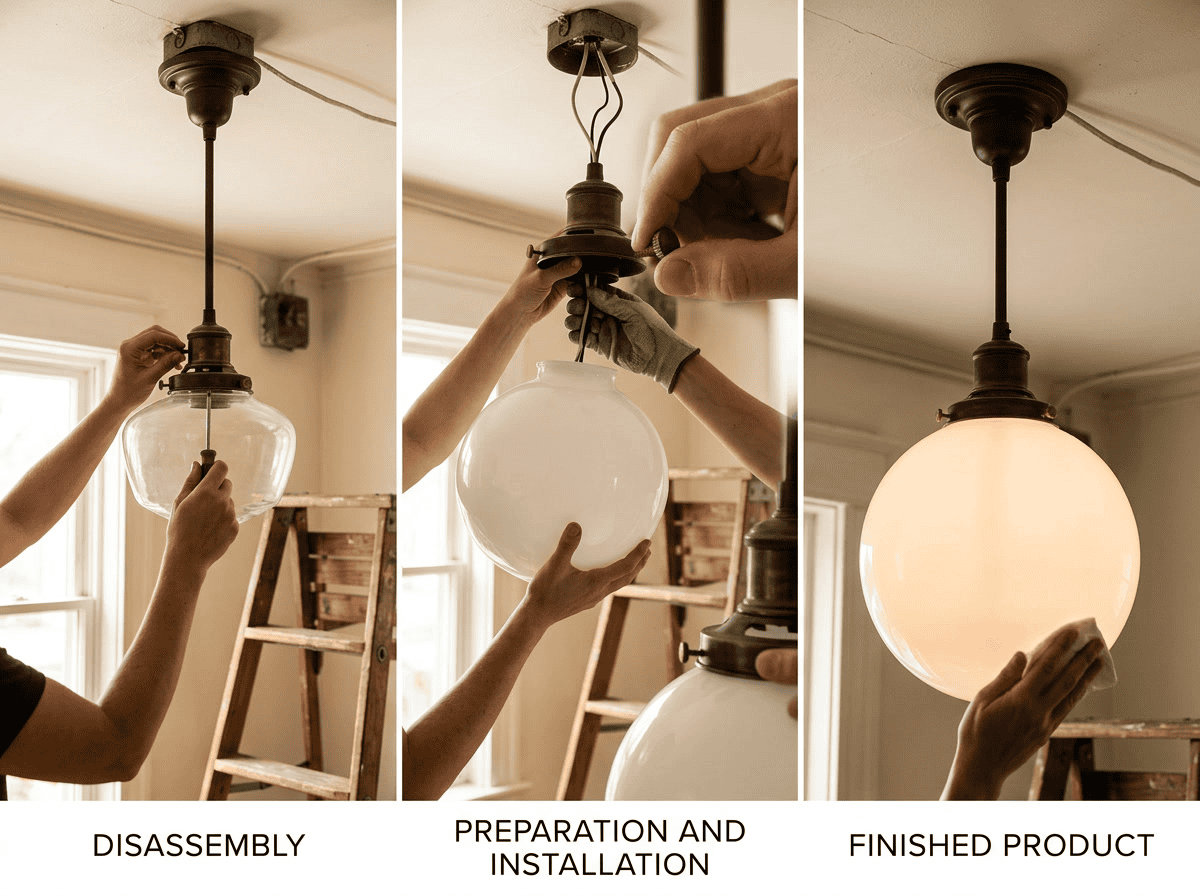
Step 1: Turn off power at the circuit breaker. Not just the switch — pendants are ceiling-mounted and require power-off before any work.
Step 2: Identify fitter type and remove old shade.
- Neckless fitter: loosen 3–4 thumb screws around the fitter collar, shade drops
- Gallery ring: lift shade straight up and out of ring
- Slip-on collar: loosen set screws, slide shade off
Step 3: Measure fitter opening. Inner diameter with calipers or ruler. For neckless fitters, also measure the outer diameter of the collar the shade slips over.
Step 4: Confirm hanging height. Before ordering a replacement, confirm the shade’s outer diameter at the chosen size doesn’t exceed the visual proportional target for the surface below.
Step 5: Order and install. Reverse the removal steps.
For clustered pendants replacing multiple shades simultaneously: order all from the same production batch to ensure glass color and density consistency.
Vintage Pendant Shades in Kitchen and Dining Applications
Kitchen islands and dining rooms are the primary application for vintage glass pendant shades in modern homes, and both contexts benefit from period glass in specific ways.
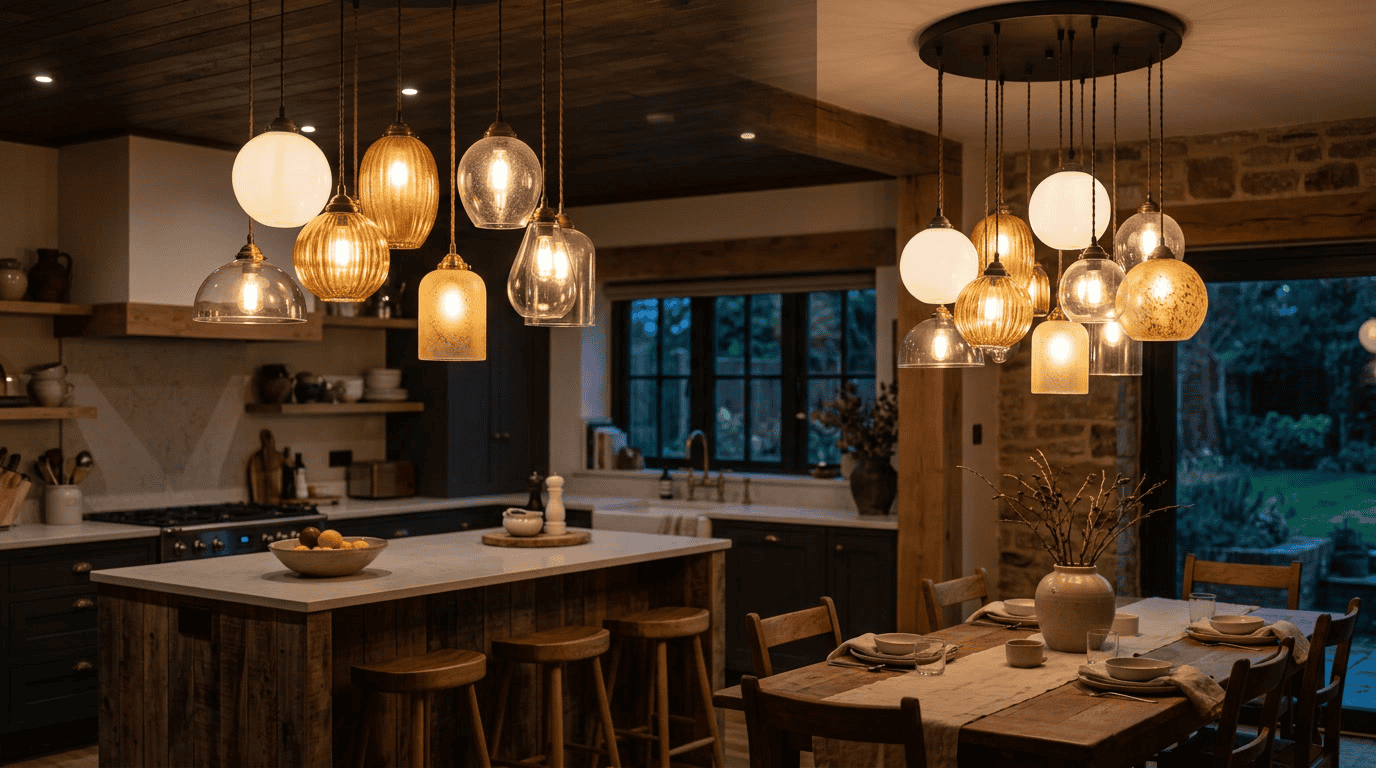
Kitchen island: The need here is functional light plus visual character. Clear ribbed or opal globe pendants at 8–10″ diameter in a 3-pendant cluster over a 1.8m island is the standard vintage specification. The ribbed glass provides directional downward light for counter tasks; the opal option provides soft ambient. According to Wikipedia’s article on kitchen lighting, task lighting over work surfaces requires 50–100 foot-candles (500–1000 lux) — achievable with 800–1000 lumen LEDs behind standard glass pendants.
Dining room: Warmth and scale matter more than task output. A single 16–20″ amber or opal globe pendant, or three smaller amber globes in a cluster, creates the intimate warmth that makes a dining room feel used and welcoming. The vintage glass lamp shades collection includes globe and dome forms suited to both applications. If your fixtures are table or floor lamps rather than pendants, see our vintage glass lamp shades for table lamps guide and vintage floor lamp glass shades guide, and for warm amber tones specifically our vintage amber glass lamp shades guide.
Frequently Asked Questions
What is a neckless fitter and how does it work?
A neckless fitter is a mounting system where the glass shade has no rim or collar — it’s a complete glass globe or dome that slips over the socket cluster and is held by 3–4 small thumb screws that grip the glass exterior. The screws are tightened gently to secure the shade. Most common on mid-century ceiling fixtures.
Can I replace a single pendant shade in a cluster if I can’t find an exact match?
For practical use, yes. For visual perfection, consider replacing all shades in the cluster simultaneously from the same batch. The color and density variation between two periods of production of “the same” shade can be visible in a cluster when all shades are lit side by side.
What wattage LED is appropriate for a 12″ opal pendant globe?
According to the U.S. Department of Energy’s LED guidance, an 800–1000 lumen LED (60–75W incandescent equivalent) is appropriate for most pendant applications. Over a dining table, 800 lumens provides good ambient; over a kitchen island work surface, 1000 lumens is better for task use. Use 2700K warm white for vintage glass shades.
Are vintage pendant glass globes fragile?
More so than table lamp shades because they’re ceiling-mounted and their removal/installation involves more handling. Depression-era pressed glass is the most fragile (thin walls); mid-century milk glass and heavy 1970s amber globes are more durable. For kitchens and high-traffic areas, a quality reproduction rather than a fragile original is practical.
How do I choose between clear ribbed and opal pendant shades for a kitchen island?
Use clear ribbed if: the kitchen has strong ambient light from other sources and you want directed task light from the pendants. Use opal if: the pendants are the primary light source in the kitchen and you want soft, even illumination across the island surface. In most kitchens, opal is the safer choice.
Can vintage pendant glass shades be used outdoors?
Not without protection. Glass shades require an enclosed or covered outdoor installation. Standard soda-lime glass will survive temperature variation but not rain ingress directly onto the fitter hardware. For covered porches and sheltered outdoor dining areas, glass pendants work well; for exposed outdoor use, specify a shade designed for IP-rated fixtures.
Where can I find vintage glass pendant globes to match mid-century ceiling fixtures?
Lighting restoration suppliers, vintage lighting specialists, and glass shade manufacturers. For mid-century opal neckless globes in standard 2¼” and 3¼” openings, current production is widely available. For unusual diameters or colors, a glass shade manufacturer can produce custom samples. Our vintage glass lamp shades page lists available pendant forms.
Related Reading
- Vintage Glass Lamp Shades: Full Buying Guide
- Vintage Glass Lamp Shades for Table Lamps
- Vintage Floor Lamp Glass Shades: Styles, Sizes & Replacement Guide
- How to Identify Vintage Glass Lamp Shades
Conclusion
Vintage glass pendant light shades are one of the highest-impact lighting choices in a home because they’re overhead, they’re often clustered, and they define the room’s ambient quality from every viewing angle. The key decisions are all proportional and mechanical — fitter type, opening diameter, shade outer diameter relative to the table or surface below — and the glass type decision follows the function: opal for soft ambient, ribbed for task character, amber for warmth.
For replacements and new specifications alike, quality current-production glass pendants in period styles represent the practical choice for daily-use spaces. For display and collector quality, original period glass is available from specialist sources but requires careful measurement work before purchase.