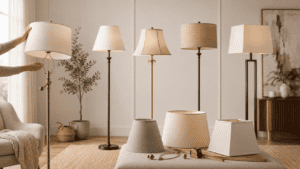
Measure the lamp base, body, harp, and fitter, then choose a shade with compatible hardware and balanced width and height.
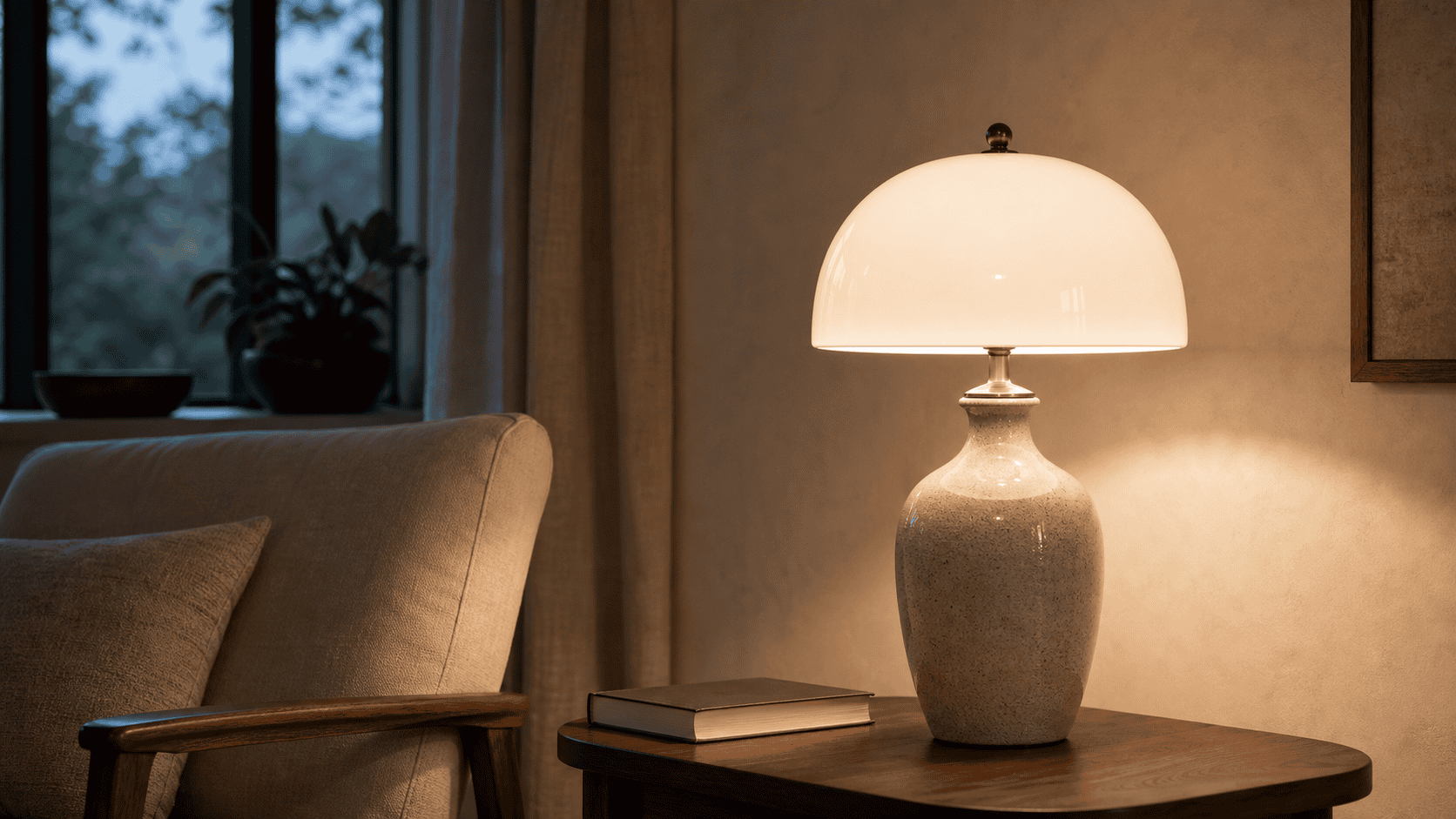
The old shade is broken, missing, or simply looks wrong. You have a tape measure, but the lamp gives you several possible heights and widths. Which ones matter? Learning how to measure a lamp for a lampshade comes down to two separate decisions. First, the shade must physically attach to the lamp. Second, its width and height must look balanced while hiding the bulb and socket from normal viewing angles. A shade can pass one test and fail the other.
This process takes about five minutes for a normal table lamp. Vintage lamps, glass replacement shades, and project orders need a little more care because a few millimeters at the fitter can determine whether the shade seats securely. By the end, you will have a usable size range and a measurement record you can send to a retailer or manufacturer.
The four measurements you need before buying
Record the base width, lamp body height, harp height, and fitter type or diameter before comparing shades.
Most sizing mistakes start with the wrong reference point. Someone measures the full lamp from the foot to the finial, multiplies that number by a rule found online, and orders a shade. The result may look reasonable in a product photo, yet sit too high, expose the socket, or refuse to attach.
Keep proportion and fit separate. Base width and body height control proportion. Harp height controls the shade’s vertical position. The fitter controls compatibility. That separation is the foundation of how to measure a lamp for a lampshade without turning one vague overall dimension into an equally vague purchase.
| Measurement | Start and stop points | What it controls | Useful precision |
|---|---|---|---|
| Base width | Straight across the lamp body’s visual widest point | Shade bottom diameter | Nearest 1/4 inch or 5 mm |
| Lamp body height | Bottom of the base to the top of the socket | Shade height range | Nearest 1/4 inch or 5 mm |
| Harp height | Harp saddle to the top loop | Where a spider shade sits | Nearest 1/4 inch or stamped size |
| Fitter | Type plus internal opening or neck diameter | Whether the shade attaches | Nearest 1/16 inch or 1 mm |
Base width is visual width
For a round ceramic, glass, or metal base, measure straight across the widest part. Do not wrap the tape around the circumference. You want the diameter. A square base needs a second check: measure one side, then measure diagonally from corner to corner. A 6-inch square has an 8.5-inch diagonal, so it often reads wider than a 6-inch round base.
For an oval base, use the long axis. For an urn, gourd, or sculptural base, measure the widest part and the visual center of mass. Those may not be the same. If a decorative foot extends far beyond a slim lamp body, do not automatically use the foot width. Stand back six feet and note which part of the base your eye reads as its main volume.
Practical check: use the widest body measurement for the first calculation, then compare the result with the neck and overall silhouette. A strict 2:1 rule applied to a broad foot plate can produce an oversized shade.
Lamp body height stops at the socket
Measure from the surface under the lamp to the top of the socket, where the bulb screws in. Remove the shade first. Do not include the finial, and record the harp separately.
The body height tells you how much shade height the lamp can carry visually. The harp determines where a spider fitter positions that shade. If the proportions are good but the socket is visible, a different harp may solve the problem without changing the shade. Retail guides sometimes use “lamp height” without saying whether that includes the harp, shade, or finial, which is why two formulas can appear to disagree.
Harp height changes the position, not the shade diameter
A harp is the U-shaped metal support around the bulb. Measure from the saddle at the bottom to the flat top loop where the finial passes through. Many harps have a stamped size, but check it with a tape if the lamp is old or the hardware has been replaced.
A harp that is one inch too tall can expose the socket even when the shade dimensions are otherwise correct. A harp that is too short can bury the lamp neck and make the shade look heavy. Spider shades are forgiving because harps are replaceable. Uno and ring-fit shades give you less vertical adjustment.
Identify the fitter before choosing a shape
The fitter is the part that connects the shade to the lamp. In practice, the attachment type and opening diameter matter as much as the outside dimensions.
Look under the current shade or around the socket:
- Radiating wires meeting at a center ring indicate a spider fitter that rests on a harp.
- A single ring that attaches at the socket indicates an uno fitter or ring fitter.
- Spring wires gripping the bulb indicate a clip-on fitter.
- A molded neck held by set screws indicates a glass fitter neck.
Do not assume “standard” means universal. The IEC maintains extensive standards for lamp caps and holders to support interchangeability, as described in the IEC 60061 database, but the shade attachment still varies by fixture, market, and manufacturer. Measure what is in front of you.
How to measure a lamp for a lampshade in seven steps
Measure in a fixed order so you do not mix visual proportion, mounting hardware, and bulb-clearance checks.
Use a sequence, not one ratio, when deciding how to measure a lamp for a lampshade. Set the lamp on the furniture where it will be used. A bedside lamp judged on a workshop floor can look different once it sits beside a mattress.
1. Make the lamp safe and clear the hardware
Unplug the lamp. Let the bulb cool, then remove the bulb, finial, and existing shade. Put the small parts in a cup so the finial does not roll under the furniture.
If the shade is missing, photograph the bare lamp from the front and side before measuring. The side view often reveals a socket extension, swivel, or bracket that the front view hides.
2. Identify and photograph the fitter
Take one close photo looking down at the socket and another from the side. Record spider, uno, clip-on, ring, or glass neck. If you are uncertain, do not guess from the lamp’s country of origin. Hardware is frequently replaced during repairs.
For an uno or glass neck, use calipers if possible. Measure the internal diameter at two directions, rotate the caliper 90 degrees, and compare the readings. Old metal rings and hand-finished glass necks can be slightly out of round.
3. Measure the base width
Hold the tape level and measure across the widest meaningful part of the base. Record the number in inches and millimeters if you may order internationally. NIST states that one inch is exactly 25.4 millimeters, so a 9-inch base is 228.6 mm.
For square bases, record side and diagonal. For oval bases, record long and short axes. For irregular bases, add a photo with the tape visible. One number rarely describes a sculpture-shaped lamp well enough for remote advice.
4. Measure the lamp body height
Run the tape from the bottom of the base to the top of the socket. Keep it parallel to the lamp’s centerline. Do not follow a curved body with a flexible tape, because that measures surface distance rather than height.
Record any exposed neck between the main body and socket. A long neck may need deeper shade coverage or a lower harp so the metal does not show.
5. Measure the harp or socket position
For a spider setup, measure the harp from saddle to top loop. Also note whether the saddle is removable. For an uno setup, record the distance from the top of the lamp body to the shade-support ring. For a glass fitter, measure the holder opening, screw positions, and available seating depth.
The seating depth is easy to miss. A glass neck may have the right nominal diameter but bottom out before the set screws reach the intended groove. For a replacement shade, record both the outer neck diameter and the height of the neck section.
6. Calculate a starting size range
For a common table lamp, start with:
- Shade bottom diameter: about 1.5 to 2 times the base width.
- Shade height: about 60 to 75 percent of the lamp body height.
- Shade bottom edge: low enough to hide the socket and most of the harp saddle.
These are screening ranges. They help you reject a clearly undersized or oversized shade, but they do not override fitter compatibility, bulb clearance, furniture scale, or viewing angle.
7. Test the outline before ordering
Cut a rectangle or tapered profile from cardboard using your target width and height. Hold it where the shade will sit, then view the lamp from the doorway, from a chair, and from standing height.
Check four things:
- The shade is at least as wide as the visual mass of the base.
- The bottom edge hides the socket and the bottom of the harp.
- The bulb does not glare into your eyes at the normal viewing position.
- The shade does not crowd a wall, headboard, shelf, or walking path.
This crude mock-up catches problems that a calculator cannot. It is particularly useful for deep drums, wide coolie shades, and floor lamps viewed from below.
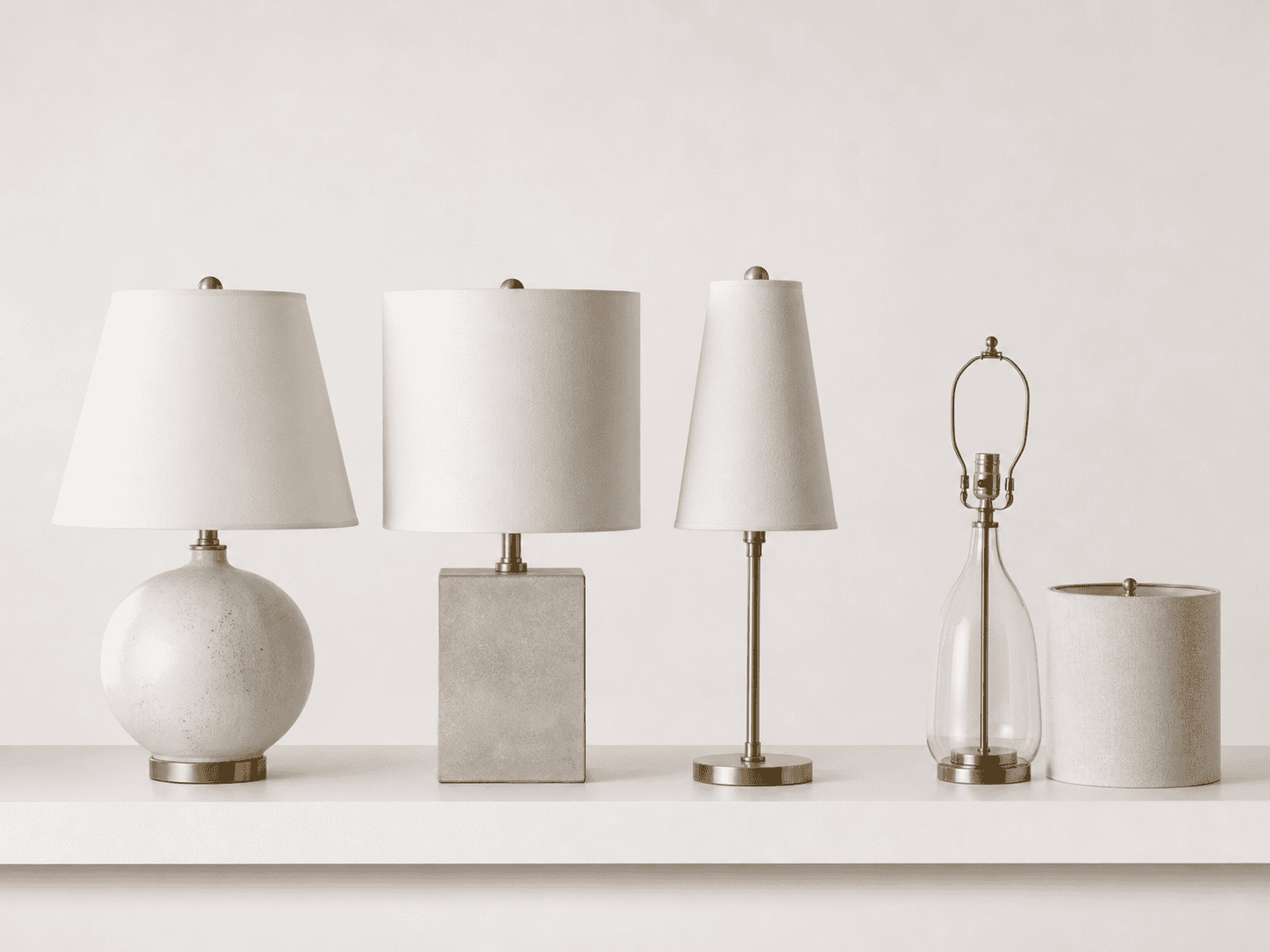
Calculate the lampshade size from your measurements
Use proportional ranges to create two or three viable sizes, then choose among them by fitter, shape, sightline, and available space.
People searching how to measure a lamp for a lampshade often want one formula. A range works better because a 9-inch round ceramic base and a 9-inch slim column do not carry visual weight in the same way.
The Lowe’s measurement guide also recommends measuring the lamp base when replacing a shade. That matters when the old shade was never correct. Copying a bad shade only repeats the original mistake.
Start with the bottom diameter
Multiply base width by 1.5 and 2. The result is your first shade-bottom range.
For a 9-inch base:
- Lower end: 9 × 1.5 = 13.5 inches.
- Upper end: 9 × 2 = 18 inches.
- Practical retail candidates: 14, 16, and 18 inches.
A slim column usually tolerates the wider end. A heavy urn often looks better near the lower or middle end. If the lamp sits on a narrow nightstand, furniture width may cap the shade before the proportion formula does.
Estimate shade height
Multiply lamp body height by 0.60 and 0.75. If the lamp body measures 14 inches to the socket, the starting shade-height range is 8.4 to 10.5 inches.
Check how the retailer states height. A tapered empire or bell shade is commonly listed by slant height, measured along the angled side. Its straight vertical height will be shorter. A drum has nearly vertical sides, so its slant and vertical measurements are close. If a seller lists only “height,” ask whether it means slant or vertical. A one-inch difference can expose the socket or lower the shade enough to interfere with the lamp switch.
Worked example for a 26-inch lamp
“26-inch lamp” is ambiguous. It may mean the bare lamp to the socket, or the finished lamp including its shade and finial. Do not order from that number alone.
Assume a finished table lamp target of about 26 inches with these measured components:
- Base width: 8 inches.
- Lamp body height to socket: 15 inches.
- Harp height: 8 inches.
- Fitter: spider.
The width calculation gives 12 to 16 inches. The height calculation gives 9 to 11.25 inches. A sensible first trial is a shade around 14 to 16 inches at the bottom and 9 to 10 inches high, followed by the cardboard and sightline checks.
If the 26 inches refers to the bare lamp body alone, that recommendation changes substantially. A 16-inch shade may be too short. This is why the practical answer to “what size lampshade for a 26 inch lamp?” starts by defining where the 26-inch measurement stops.
Worked example for a 36-inch lamp
A 36-inch lamp is often a tall buffet lamp or a shorter floor lamp. Both need a narrower shade than a broad ceramic table lamp of the same height.
Assume:
- Base width: 9 inches.
- Lamp body height to socket: 25 inches.
- Harp height: 10 inches.
- Fitter: spider.
- Location: console table against a wall.
The general diameter range is 13.5 to 18 inches. Because the lamp is tall and the console is shallow, start around 14 to 16 inches rather than forcing an 18-inch shade. A shade height of 13 to 16 inches may work, but the seated sightline and wall clearance decide the final number.
| Lamp situation | Bottom diameter starting point | Shade height starting point | Final check |
|---|---|---|---|
| Standard table lamp | 1.5 to 2 × base width | 60 to 75% of body height | Hide socket and harp saddle |
| Bedside lamp | 1.5 to 1.8 × base width | 55 to 70% of body height | Avoid headboard and eye glare |
| Buffet lamp | 1.3 to 1.7 × base width | 55 to 70% of body height | Keep a narrow vertical profile |
| Floor lamp | Use body, room, and traffic path | Depends on seated viewing height | Bulb must stay hidden from below |
| Glass replacement | Match fitter first | Match original envelope or drawing | Confirm neck diameter and seating depth |
For quick comparisons, the site’s lamp shade size reference provides common dimensions by shade and lamp type. Use those ranges as a reasonableness check, not a substitute for measuring your own lamp.
Match the fitter before you choose the shade shape
A proportional shade still fails if its fitter type, opening diameter, or seating depth does not match the lamp.
Check the fitter before choosing color, fabric, glass finish, or silhouette.
The basic definition of a lampshade fitter is the hardware that connects the shade to the lamp. Identifying that hardware is a required part of how to measure a lamp for a lampshade, not an optional check after sizing.
Spider fitter and harp
A spider fitter has several arms that meet at a small center washer. It rests on the top of a harp and is secured with a finial. This setup is common on North American table and floor lamps.
Record:
- Harp height.
- Diameter of the center opening.
- Finial thread compatibility.
- Whether the spider is recessed below the shade top.
Recess matters. A deeply recessed spider lowers the shade relative to the harp, while a flush spider places the shade top near the finial. Two shades with the same outside dimensions can sit differently because of this internal position.
Uno and ring fitters
An uno fitter uses a ring near the socket and does not rest on a harp. Some screw onto a threaded socket shell. Others sit over the socket and are trapped by a retaining ring.
Measure the clear internal opening, not the outside of the metal ring. Note whether it is threaded. A caliper reading of 28 mm and one of 42 mm describe very different systems even when the shades look similar in a product image. Bulb-holder codes can add confusion: E26, E27, and B22 describe lamp caps and holders, while spider, uno, and glass neck describe shade attachment. The site’s lamp holder and bulb cap size chart separates those two specifications.
Clip-on fitters
A clip-on fitter grips the bulb. It is normally used on small chandelier, sconce, or accent shades. Record whether the clip is designed for a candelabra bulb or a standard A-shape bulb.
Check heat and clearance. The fitter places the shade close to the light source. Lower-input LED options can be more practical in close shade assemblies, but you must still follow the fixture and shade wattage limits.
Glass fitter necks
A glass shade may have a narrow neck that enters a holder and is retained by three or four set screws. Common nominal neck sizes are helpful for browsing, but a replacement order needs the actual diameter.
Measure:
- Outside neck diameter at the contact area.
- Neck height or seating depth.
- Distance from neck edge to any groove or shoulder.
- Maximum outside diameter of the shade.
- Overall height and opening diameter.
Do not tighten a set screw against unsupported thin glass. The screw should contact the intended neck area, usually through a protective tip or evenly spaced retaining system. If the old shade cracked around the neck, photograph the fracture pattern before discarding it. Concentrated screw pressure or poor seating may have caused the failure.
| Fitter | How to identify it | Measurement to record | Common failure |
|---|---|---|---|
| Spider | Arms meet at a center washer; uses a harp and finial | Harp height, washer opening, spider recess | Shade sits too high or low |
| Uno | Single ring mounts at the socket | Internal diameter, thread, ring position | Ring will not seat on socket |
| Clip-on | Spring wires grip the bulb | Bulb shape and clip span | Wrong bulb size or excess heat |
| Glass neck | Molded glass collar enters a holder | Neck diameter, neck height, seating depth | Wobble, set-screw stress, or no fit |
Adjust the proportions for different lamp types
Table-lamp ratios are only a starting point; floor, buffet, vintage, arc, and pendant lamps require different viewing and clearance checks.
The phrase how to measure a lamp for a lampshade covers several products that behave differently in a room. Use the same measuring discipline, then adjust the decision to the lamp’s job.
Standard and bedside table lamps
A standard table lamp is usually viewed from the side, so base-to-shade balance matters. The shade bottom should generally be at least as wide as the base’s visual mass. A slightly wider shade looks settled; a noticeably narrower shade often makes the base appear heavy.
For a bedside lamp, check the view from a reclining position. A shade that hides the bulb when you stand may expose it when your eyes are level with the mattress. Also measure the distance to the headboard and the usable width of the nightstand. If a 16-inch shade overhangs a 15-inch nightstand, a mathematically “correct” proportion creates a daily nuisance.
Buffet and candlestick lamps
Buffet lamps are tall and narrow. Applying the full 2:1 width rule to the narrow stem can still produce a shade that looks too wide for the intended vertical silhouette. Start with the lower end of the diameter range, then confirm that the shade covers the socket.
Pairs need extra discipline. Measure both lamps. Handmade ceramic or vintage bases may differ by a quarter inch, and replacement harps may not match. Record each one before ordering matching shades.
Floor and arc lamps
Floor lamps are often seen from below while the viewer is seated. Bulb glare becomes the main check. A deeper shade, lower harp, diffuser, or opaque glass can control the sightline.
Arc lamps introduce overhang. Measure the shade envelope as well as the fitter so the shade does not hit a wall, cabinet, or person walking past. The base width tells you little about the scale needed over a sofa or reading chair.
Pendants and hanging shades
A pendant is sized to the fixture, ceiling height, and surface below it rather than to a portable lamp base. The fitter, cord set, and opening still need precise measurement, but dining-table width and hanging height control visual scale.
Use the separate hanging light lampshade guide for pendant spacing and glare checks. Do not apply a table-lamp formula to a pendant over an island.
Vintage and converted lamps
Vintage lamps may combine old bases with later sockets, harps, or electrical conversions. Measure the current hardware, not the age or style name. A lamp sold as “Art Deco” tells you nothing reliable about its present fitter.
If glass is missing, measure the holder at several points and make a paper rubbing or profile sketch. The antique glass lamp shade replacement guide covers gallery fitters, necks, and period references in more detail.
Common measurement mistakes and fast fixes
Most wrong purchases come from copying the old shade, measuring the wrong height, or treating fitter compatibility as an afterthought.
Once you know how to measure a lamp for a lampshade, troubleshooting becomes much faster because each symptom points to a specific measurement.
The shade is proportional but sits too high
Look at the harp and spider recess before replacing the shade. A shorter harp lowers a spider shade. A deeper recessed spider can have a similar effect.
Do not lower the shade until it touches the bulb. Maintain the clearance specified by the lamp and shade manufacturer. If the shade’s bottom edge already hides the socket, lowering it further may only reduce airflow.
The shade sits too low
A taller harp may help if the shade uses a spider fitter. Check the finial thread and saddle before buying a replacement harp. If the shade uses an uno fitter, its position is tied to the socket and may require different hardware or a different shade.
The bulb is visible from a chair
Repeat the cardboard test from the seated position. You may need a taller shade, a lower harp, a deeper bottom opening, or a diffuser. On a floor lamp, increasing diameter without increasing depth can make glare worse because the viewer sees more of the underside.
The shade looks too small despite matching the formula
Recheck visual base width. A square base may need its diagonal considered. A sculptural base may read wider at its upper mass than at the foot. Dark, dense shapes also carry more visual weight than slim transparent ones.
Move up one standard diameter and mock it up. Do not change height and width at the same time, or you will not know which adjustment solved the problem.
The shade looks oversized
Check furniture and neck width. A shade can meet the 2:1 rule and still overwhelm a narrow lamp neck or small side table. Move toward 1.5 to 1.7 times base width, or choose a lighter profile such as an empire rather than a full drum.
The fitter is close but not exact
Stop. Do not force it.
A slightly undersized metal ring can damage threads. An oversized glass neck can fail to seat, while an undersized neck may wobble under set screws. Record the actual opening and ask whether an approved adapter or reducer exists.
Slant height was confused with vertical height
Place the shade on a level surface. Measure straight up for vertical height, then along the side for slant height. Record both if the listing is unclear.
For a drum, the numbers may be nearly the same. For a steep empire shade, the slant can be noticeably longer. That difference is large enough to change bulb coverage.
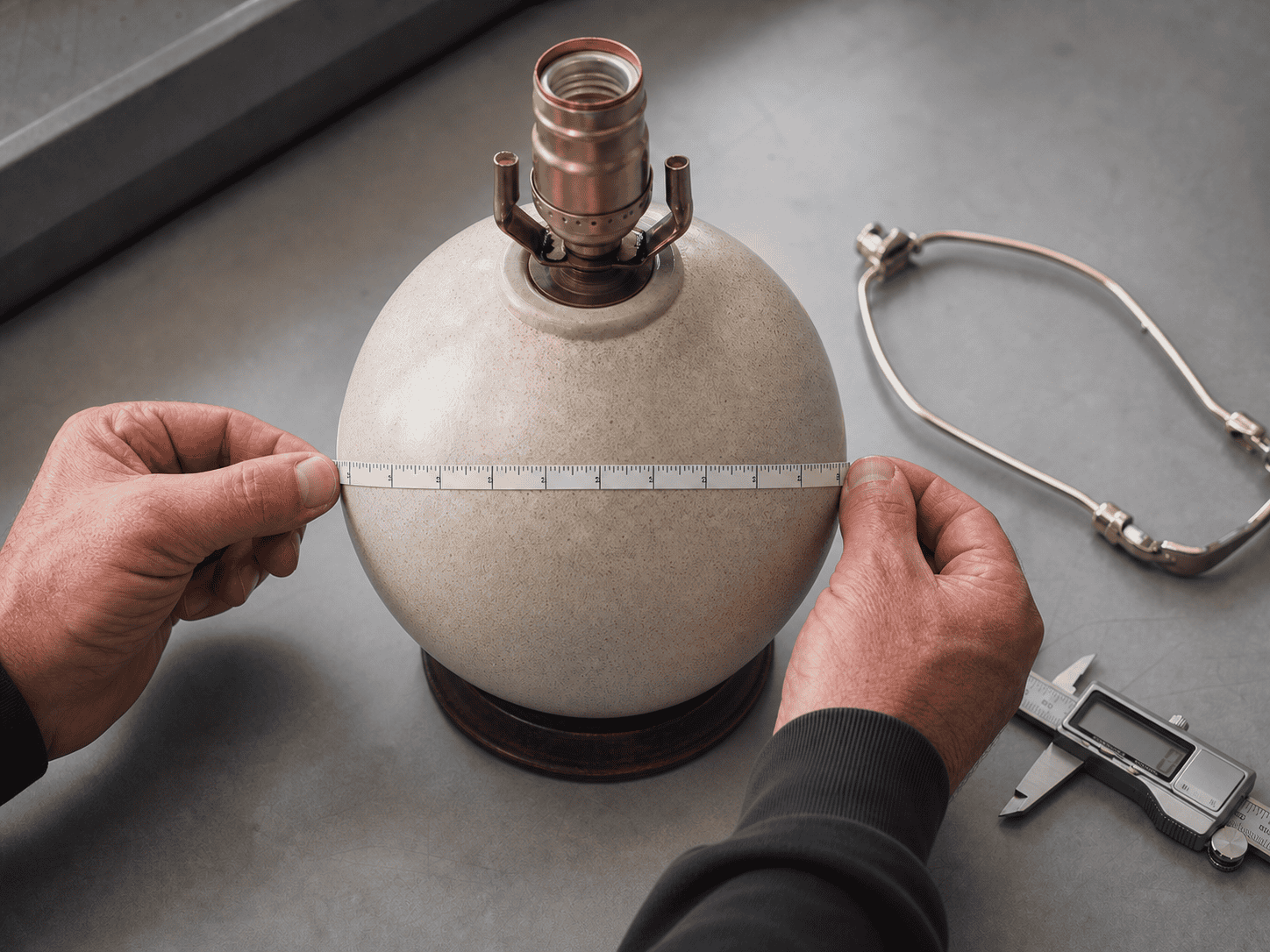
Document measurements for a replacement or custom order
Send the supplier dimensions, fitter details, clear photos, material requirements, quantity, and tolerance instead of a single overall size.
Homeowners can write these details on one page. Hotels, lighting brands, distributors, and project buyers should assign a lamp model or location code so measurements do not become detached from the correct fixture.
For procurement teams, how to measure a lamp for a lampshade is also a documentation problem. The same measurement must stay attached to the correct fixture, room, finish, and quantity.
A one-lamp replacement record
Include:
- Full front and side photos with the lamp standing level.
- Close photos of the socket, holder, and fitter.
- Base width and lamp body height.
- Harp height or socket-to-support position.
- Fitter type and measured diameter.
- Target shade bottom diameter and height range.
- Bulb type, maximum permitted wattage, and normal viewing position.
- Available clearance to walls, furniture, and walking paths.
Place a ruler in at least one close photo. It provides scale, but it does not replace written dimensions because camera perspective can distort size.
A commercial or hotel replacement record
Add fields that support repeat orders:
- Property, room type, or fixture ID.
- Quantity by lamp model.
- Dimensions in inches and millimeters.
- Glass or shade material, color, finish, and thickness requirement.
- Neck profile, screw contact area, and tolerance.
- Sample approval requirement.
- Packaging and labeling requirements.
- Required delivery date and destination.
Do not invent a tolerance. A decorative outer diameter may allow more variation than a fitter neck that must enter metal hardware. Ask the manufacturer to confirm production tolerance after reviewing the fixture, drawing, or sample.
When a drawing or physical sample is necessary
Simple fabric shades can often be ordered from top diameter, bottom diameter, slant height, and fitter. Molded glass replacements may need a section drawing that shows neck diameter, shoulder radius, wall thickness, and seating depth.
Use a physical sample when the profile has compound curves, hand-cut details, or an irregular ground rim that is hard to capture with basic tools. For a damaged sample, keep every piece until the supplier confirms which reference points are usable. Buyers who need a made-to-spec glass part can send this record to the custom and replacement glass lamp shade range. Ask for confirmed MOQ, sample lead time, production lead time, inspection method, and packaging based on the actual drawing and quantity.
Measurement tools and digital sizing in 2026 and beyond
A tape measure handles proportions, while calipers, calculators, and structured photo records reduce errors in replacement and bulk orders.
A soft tape is quick for base width and body height. A rigid ruler helps with straight openings. Digital calipers are the right tool for fitter necks and ring openings where one millimeter matters. Modern tools do not change the core method for how to measure a lamp for a lampshade; they make the record easier to repeat and check.
Online calculators can narrow the choices, but they need honest inputs. If you enter full height including the finial when the calculator expects body height to the socket, the output will be wrong with impressive precision. The site’s lampshade sizing guide and formulas show the measurements behind the calculation.
Use the same front view, side view, fitter close-up, ruler position, and fixture ID for every lamp. Consistent photo records make remote review faster and give the buyer a reference for later replacements.
Bulb choice also affects a close-fitting shade. The U.S. Department of Energy reports that LEDs use up to 90 percent less energy and can last up to 25 times longer than incandescent lighting. Those figures do not cancel the fixture’s wattage and clearance limits, but they explain why LED compatibility now belongs on a replacement-shade record.
| Tool | Best use | Typical risk | Better practice |
|---|---|---|---|
| Soft tape | Base width and body height | Following a curved surface | Keep the tape straight and level |
| Steel ruler | Openings and straight edges | Reading from a worn edge | Start at a clear graduation |
| Digital caliper | Fitter rings and glass necks | Excess pressure on glass | Use light contact and measure twice |
| Size calculator | Creating a starting range | Entering the wrong height definition | Match each input to its stated endpoint |
| Phone camera | Remote review and fixture records | Perspective distortion | Include written dimensions and a scale reference |
Frequently asked questions
The right lampshade size comes from component measurements, fitter compatibility, and a visual test, not from overall lamp height alone.
These answers address the questions people ask after learning how to measure a lamp for a lampshade and finding that a single ratio still leaves room for judgment.
How do you determine what size lampshade a lamp needs?
Measure the base width and body height, identify the fitter, then test a shade 1.5 to 2 times the base width.
Measure the lamp body from its bottom to the socket. Start shade height around 60 to 75 percent of that body measurement. Check that the bottom edge hides the socket and that the fitter matches. This is the shortest reliable version of how to measure a lamp for a lampshade because it covers both proportion and attachment.
When learning how to measure a lamp for a lampshade, keep these as ranges rather than exact promises. Base shape, furniture width, and viewing position can move the final selection up or down. Calculate two or three candidates, then mock them up before ordering.
What is the lampshade rule?
A common starting rule is a shade bottom 1.5 to 2 times the base width and a height near two-thirds of the lamp body.
The rule applies best to standard table lamps. Buffet lamps often need narrower shades. Floor lamps need a seated sightline check, and pendants are sized to the room and surface below.
The fitter remains a separate requirement. Use the ratio to judge proportion, then verify attachment and bulb coverage.
What size lampshade fits a 26-inch lamp?
A 26-inch overall lamp often takes a shade near 14 to 16 inches wide, but component measurements must confirm it.
First find out whether 26 inches includes the shade and finial. Measure the base width, body to socket, and harp. An 8-inch base suggests a 12 to 16-inch bottom diameter, while a 15-inch body suggests roughly 9 to 11 inches of shade height.
If 26 inches describes the bare body, the shade will need a different scale. Do not order from “26 inches” until you know where that measurement starts and stops.
What size lampshade fits a 36-inch lamp?
A 36-inch buffet or floor lamp often starts with a 14 to 18-inch shade, adjusted for base width and sightline.
A tall lamp does not automatically need a very wide shade. Measure its base, furniture, and available wall clearance. For a 9-inch base on a narrow console, a 14 to 16-inch bottom may look better than the full 18-inch result from a 2:1 rule.
Check bulb visibility from the normal seated position. Treat 14 to 18 inches as a trial range, not a guaranteed fit.
Do you measure lamp height with or without the shade?
Measure without the shade and record body height, harp height, and total bare-lamp height as separate numbers.
The body measurement stops at the socket. The harp measurement runs from saddle to top loop. Exclude the finial. These separate values prevent confusion when a sizing formula uses “lamp height” without defining it. Separating these numbers is essential to how to measure a lamp for a lampshade when the old shade is missing.
Use the component measurements instead of one overall height.
Should a lampshade be wider than the lamp base?
Usually yes; the shade bottom should be at least as wide as the base’s visual mass and often 1.5 to 2 times wider.
There are exceptions. Buffet lamps use narrow profiles, and a wide decorative foot may not represent the visual body. Furniture can also limit overhang.
Start wider than the base, then check the lamp and furniture together.
How do I know which lampshade fitter I have?
A harp points to a spider fitter, a socket-mounted ring suggests uno, bulb clips indicate clip-on, and set screws often hold a glass neck.
Photograph the hardware after removing the bulb and shade. Measure the opening or neck rather than relying on the fitter name alone. Regional names vary, and old lamps are often modified.
Identify the attachment and record its diameter before shopping.
Do I measure lampshade height straight down or along the slant?
Retail shade dimensions often use slant height, but you should record both slant and vertical height when the listing is unclear.
Measure slant along the outside edge from top rim to bottom rim. Measure vertical height straight up from a level surface. A drum gives similar values; a tapered empire shade does not.
Match your measurement method to the seller’s specification before comparing sizes.
Turn four measurements into the right shade specification
Identify the fitter first, then record base width, body height, and harp or socket position before checking proportion and sightlines.
That order is the reliable answer to how to measure a lamp for a lampshade. It prevents a familiar frustration: receiving a shade that looks right on the screen but cannot mount on the lamp, or one that attaches correctly while exposing the bulb.
For a one-off replacement, send clear photos and the four measurements to the seller. For a custom or bulk order, add the material, finish, tolerance, quantity, sample requirement, packaging, and delivery target. A drawing or physical sample is worth the extra step when a glass neck, shoulder, or curved profile must match existing hardware.
Send Your Lamp Measurements for Review if you need a custom glass shade or a repeatable replacement specification.