A glass lamp shade cost breakdown should connect the approved component to the work required to make, finish, inspect, and pack it. Material, glass mass, forming method, secondary operations, acceptance limits, and production quantity can all affect the result. There is no reliable universal percentage for each item, and a lower raw-material requirement does not translate directly into the same reduction in the supplier’s price.
For a product manager, the useful question is which design decision can reduce cost while retaining the shade’s function and appearance. To review a cost target, the supplier needs the drawing revision, process, quantity, and acceptance conditions behind it. This guide helps structure that conversation before the design is frozen.
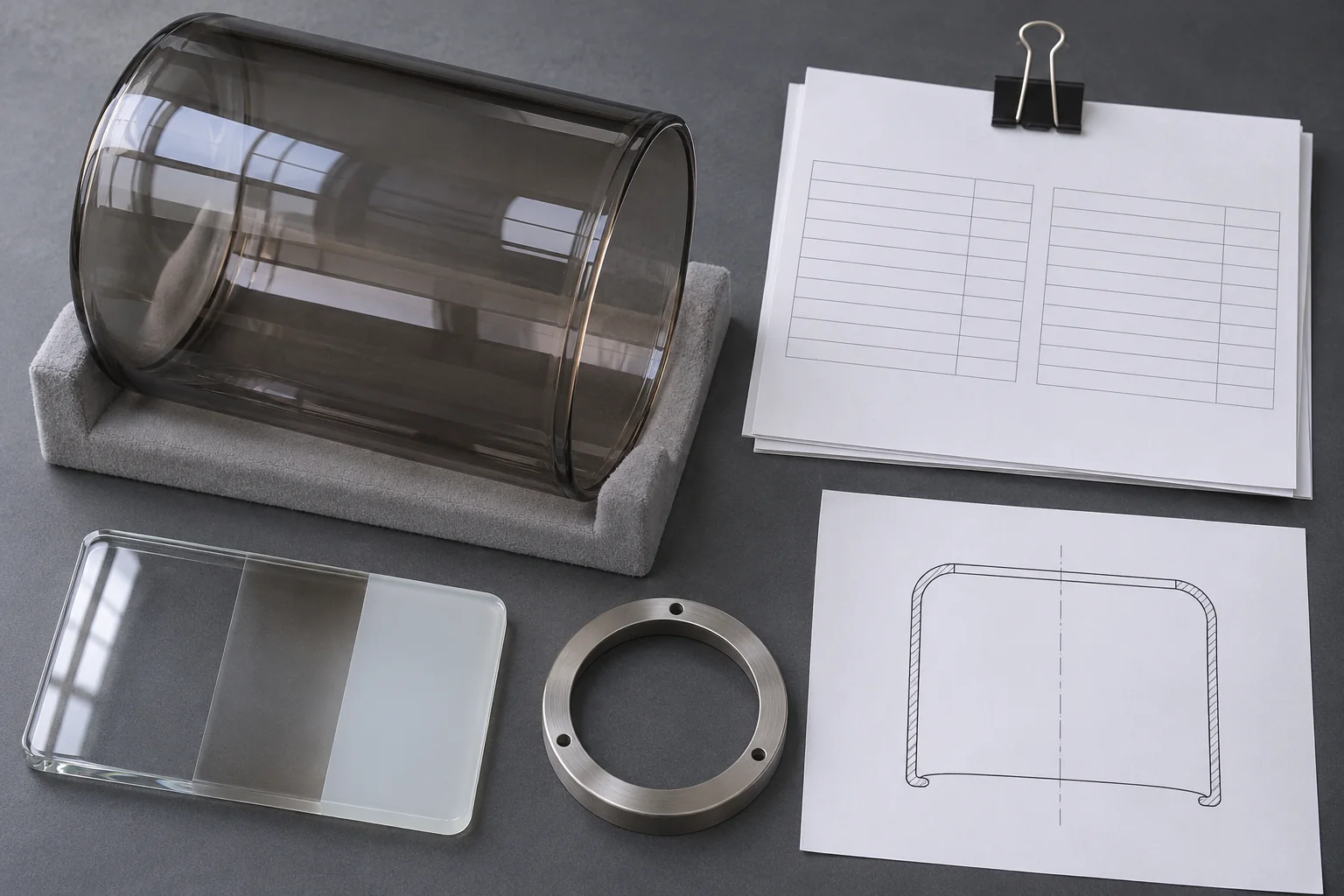
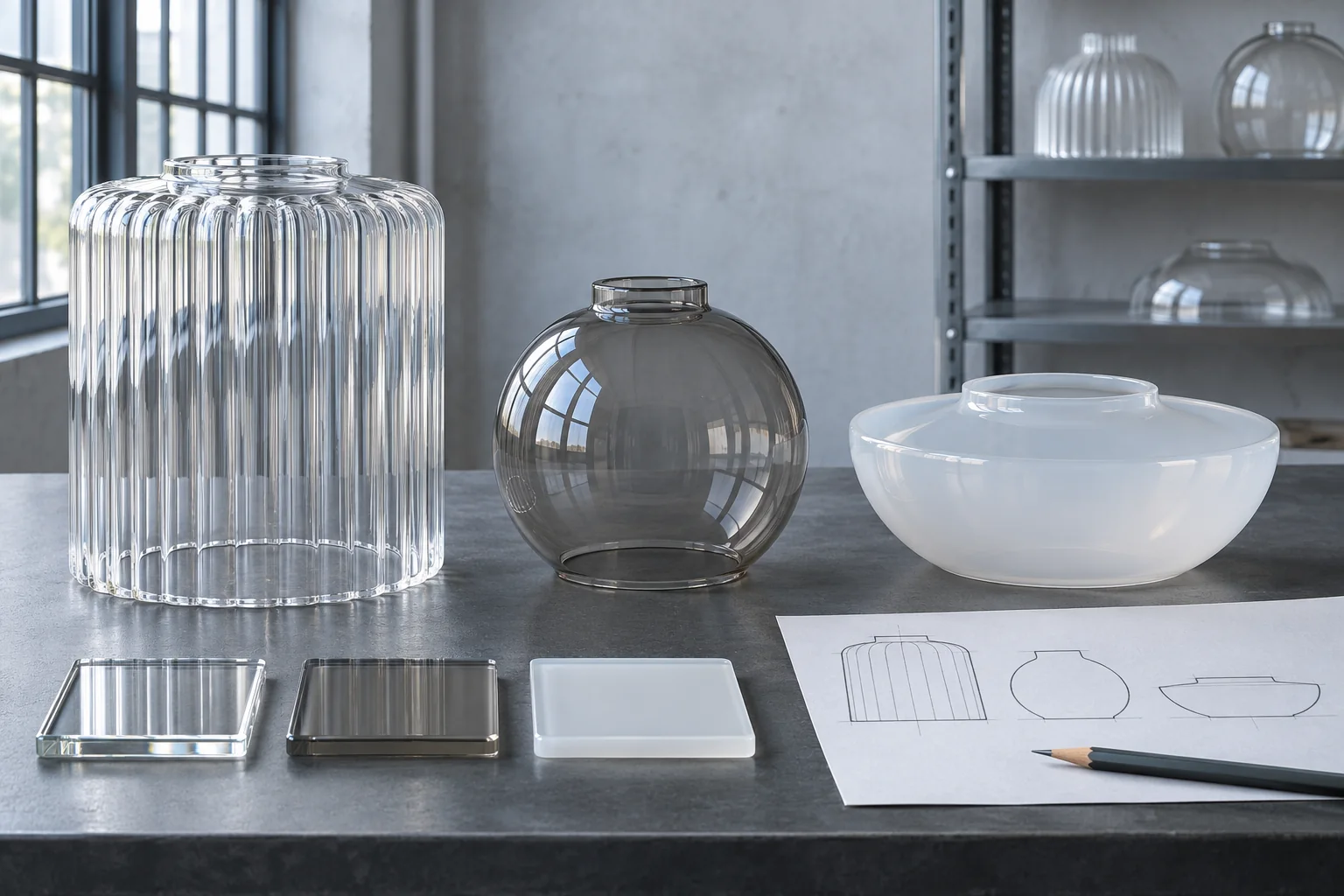
All visuals here are original AI-generated illustrations of cost-review concepts. They are not photographs of JX products, equipment, inspection results, or customer projects.
Define exactly what the cost covers
A glass component price and a complete fixture price answer different questions. Start by stating whether the scope includes only the finished shade, or also hardware, assembly, individual protection, carton packing, and delivery. List development work separately from recurring supply.
Use the same boundary for the target and the supplier’s response. If the target excludes transport while the quotation includes it, changing the glass design may not resolve the apparent gap. Likewise, a prototype cost should not be treated as the expected repeat-order unit price.
| Cost category | Record before reviewing the design |
|---|---|
| Recurring component work | Glass, forming, finishing, inspection, and the agreed packing scope |
| One-time work | Development, trials, drawings, fixtures, or other separately quoted setup |
| Commercial additions | Delivery basis, taxes, duties, payment costs, and other stated exclusions |
| Buyer-side work | Engineering review, qualification, assembly changes, and stock replacement |
Keep the discussion tied to the stated cost boundary. A buyer does not need to reconstruct the supplier’s confidential accounts. A supplier can explain the effect of a design change without disclosing every internal rate. For comparing quotations already received, use the existing glass-shade quote comparison guide.

Start with material requirements, not a material price ranking
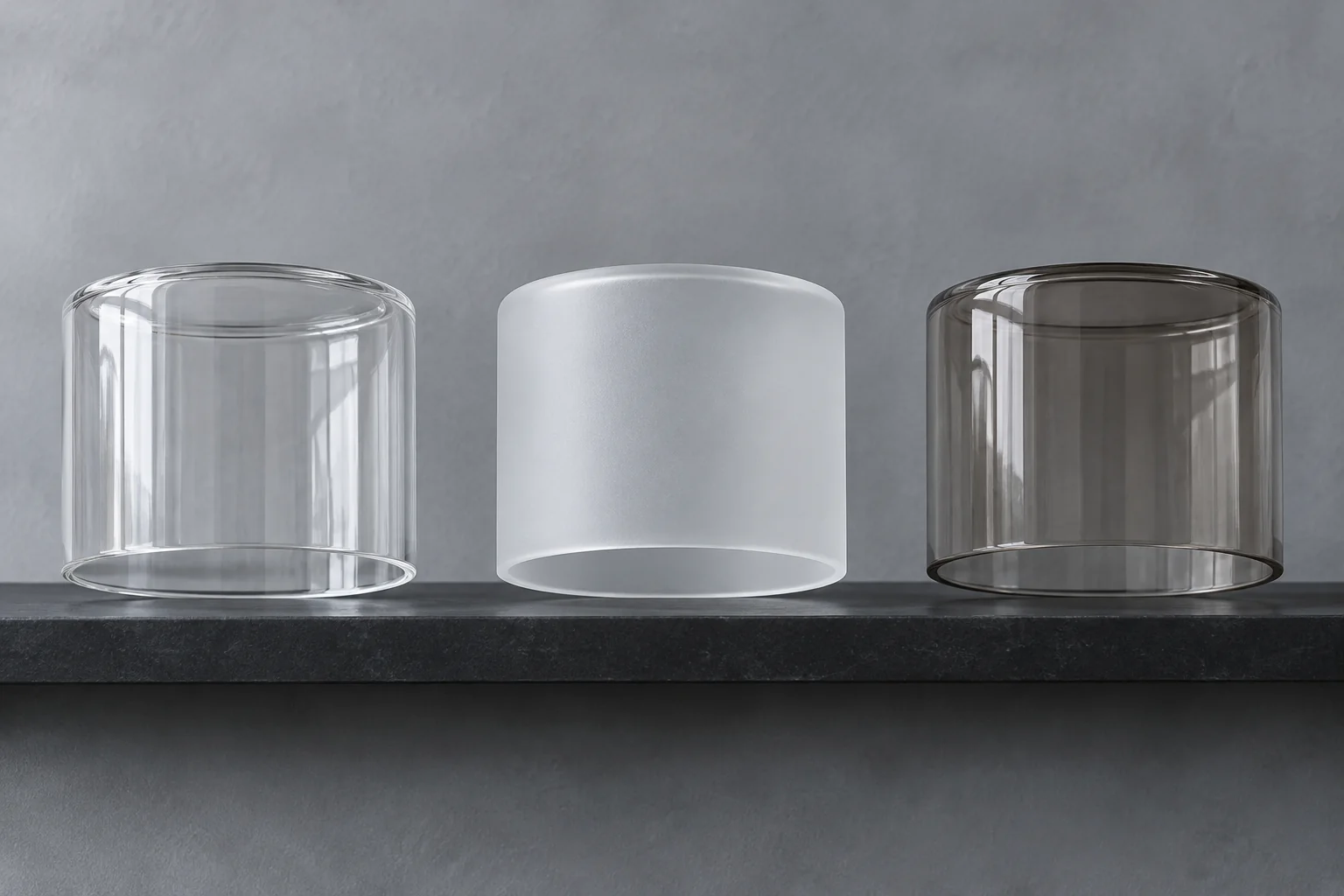
Specify what the glass must do before asking which material is cheapest. The operating environment, light-source arrangement, appearance, forming route, and required documentation affect the selection. A clear sample and an opal sample are appearance references; their photographs do not establish composition or equivalent performance.
Ask the supplier to identify the proposed glass family and the reason for using it. Then ask which alternatives could meet the same approved requirements. A material substitution is hard to price fairly when the forming and finishing requirements remain unclear.
Avoid simple rules such as “borosilicate always costs twice as much” or “opal is a fixed premium over clear.” Those ratios need a defined component and a current quotation. Glass Alliance Europe’s manufacturing overview describes a range of glass compositions and production routes; it does not establish a universal price relationship between lighting components.
For a design review, record the property or visual requirement that prevents substitution. If nobody can explain it, mark it for technical review rather than silently removing it.

Less glass does not mean the same percentage off the price
Glass mass can affect material use, handling, thermal processing, and shipment weight. It is still only one input. A thinner or smaller component may need different forming control, finishing, protection, or validation, so the saving cannot be read from weight alone.
Consider a deliberately simplified sensitivity exercise. Suppose a hypothetical accepted shade weighs 300 g, and a proposed revision weighs 240 g. That is a 20% mass reduction. Now assume, solely for the calculation, that a mass-proportional glass charge represents 20% of the baseline component price, with every other cost unchanged.
The modeled effect on the whole price is 20% × 20% = 4%. It is not 20%. The assumed cost share is not a measured JX value or an industry benchmark. Real prices may use different allocations, and additional work could offset the modeled benefit.
Use this exercise to challenge a savings estimate, not to instruct the supplier to reduce wall thickness. Preserve the features that control mounting, optical appearance, handling, and application suitability. Request a revised sample and a revised price for the same accepted delivered quantity before accepting a saving.

Choose the forming route before pricing decorative detail
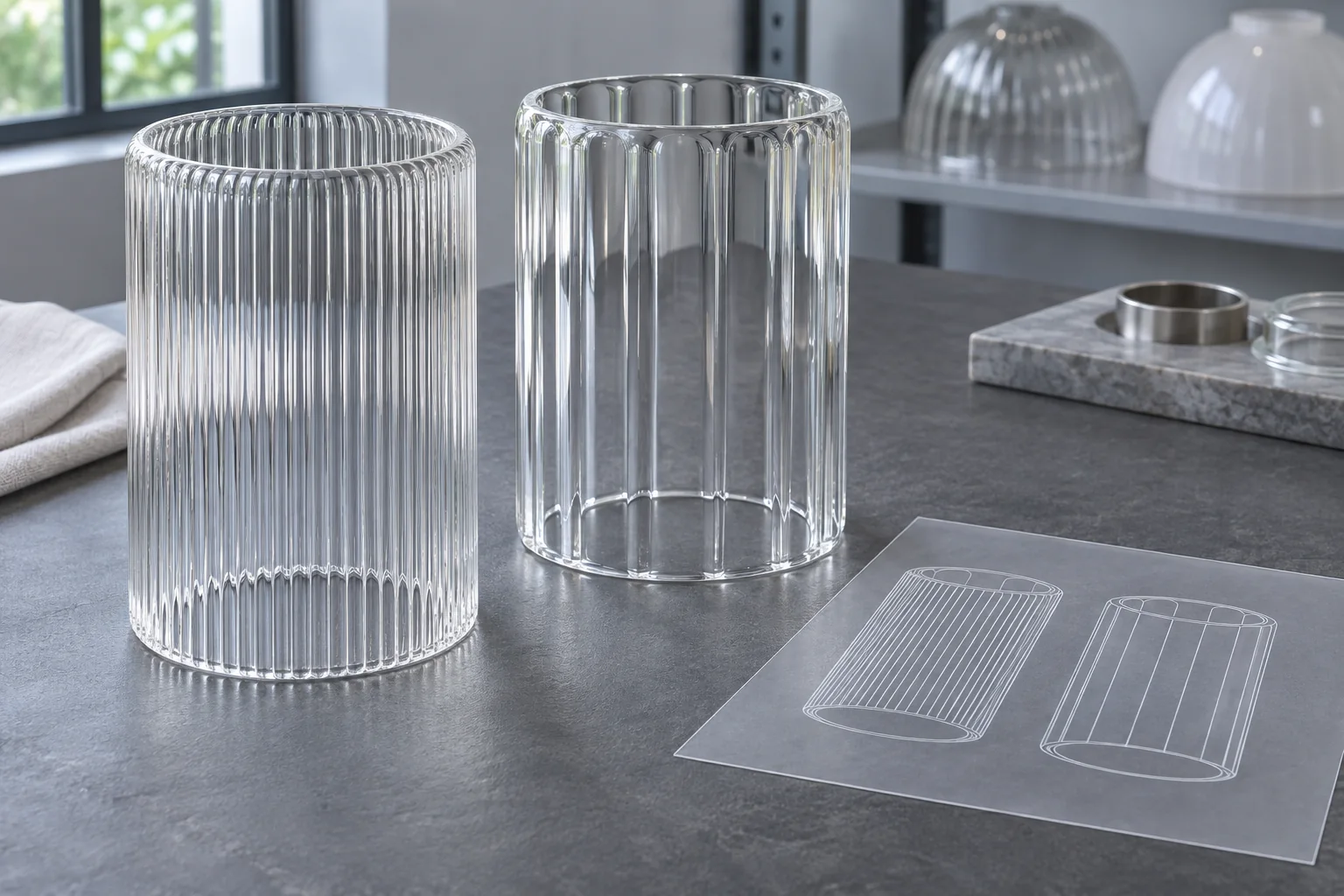
Several forming methods may produce a similar-looking shade, with different work and costs behind each option. Mouth blowing, pressing, lampworking, and other methods involve different tooling, labor, scheduling, and geometric constraints. The suitable route depends on the actual part.
Describe the feature that matters to the collection: a rib pattern, an organic profile, a particular opening, or a controlled assembly surface. Ask how the proposed route creates it and what work remains afterward. A render can conceal a difficult release direction or an opening that needs substantial finishing.
An existing mold may remove some development work if it produces a suitable part. It does not establish that the material, finish, interface, and inspection requirements are already covered. For detailed tool geometry and trial questions, continue to the glass lamp shade mold design guide.
Decide whether the feature adds enough value to justify the work it requires. A subtle decorative detail that is barely visible on the installed fixture deserves a different review from a rib that defines the product’s appearance.

Count the operations after forming
Two shades with similar silhouettes can require different work after the body is formed. Cutting an opening, grinding a rim, polishing an edge, drilling a hole, or creating a mounting feature may add separate handling and checking steps.
Write the operation sequence next to the relevant drawing feature. State which surfaces remain visible and which control assembly. A polished decorative rim and a concealed seating surface may need different acceptance criteria. Ask the supplier what each operation achieves and whether a simpler design can achieve the same function.
Avoid adding precision to features that do not need it, but do not remove an operation simply because it looks minor. A small edge treatment may be necessary for the specified contact or finish. The glass-shade drilling and machining guide covers how to review this work without treating a process name as proof of repeatability.

Price the approved finish rather than its color name
“Smoke,” “white,” or “frosted” is not a complete production instruction. Ask whether the intended appearance comes from the glass itself, a surface treatment, a coating, or another proposed route. Record which surfaces receive treatment and how the finished shade will be judged.
Selective treatment can add work that a fully treated surface does not require. Examples to discuss include masking, a clear border, a controlled transition line, or a decorative pattern that must align with the mounting interface. These are questions for the specific process, not automatic price premiums.
Compare approved physical references under consistent conditions. A finish that looks acceptable unlit may reveal differences when illuminated. Before requesting a cheaper alternative, identify what must remain visually equivalent and what the buyer is willing to change. The glass color-matching guide helps separate the design reference from the appearance that can actually be approved on glass.
Apply tight tolerances where the assembly needs them
Set a tolerance around the requirement it needs to protect. The fitter, seating surface, hole position, or contact area may need a clear limit and an agreed measurement method. An overall decorative profile may be judged differently, particularly where controlled handmade variation is part of the design.
Ask the fixture engineer to identify the consequence of each critical dimension being outside its limit. Then ask the glass supplier how that feature will be made and checked. This connects inspection cost to a practical acceptance decision instead of applying the same tight tolerance across the drawing.
Do not trade away a functional requirement for an unvalidated saving. UL Solutions’ indoor lighting guidance describes evaluation of lighting products for safety and performance. A lower-cost glass revision still needs whatever component or assembly assessment the responsible fixture team determines is applicable; appearance approval alone is insufficient.
Where the cost is uncertain, ask for two clearly defined options: the current requirement, and an alternative reviewed by the responsible engineer. The alternative needs its own approval rather than an informal note to “make it cheaper.”

Ask how rejected work is treated in the quoted price
Manufacturing cost includes work that may not become an accepted delivered component. The buyer needs to know how that risk is handled commercially, without inventing a factory’s reject rate.
If the quoted price already covers the agreed accepted quantity and ordinary production losses, adding another assumed reject allowance to that same supplier charge would count it twice. Buyer-side reserves for installation damage or later replacement are separate assumptions and should remain separately identified.
Define the acceptance conditions before comparing a proposed saving. If a lower price depends on accepting a wider visual range, it represents a change in the purchased result. It may be reasonable, but the design owner must approve it explicitly.
Ask for the inspection record or sample evidence needed to assess the concern. A process photograph cannot establish production yield. Use the existing glass-shade quality inspection checklist for the detailed inspection discussion.

Treat heat and furnace loading as process constraints
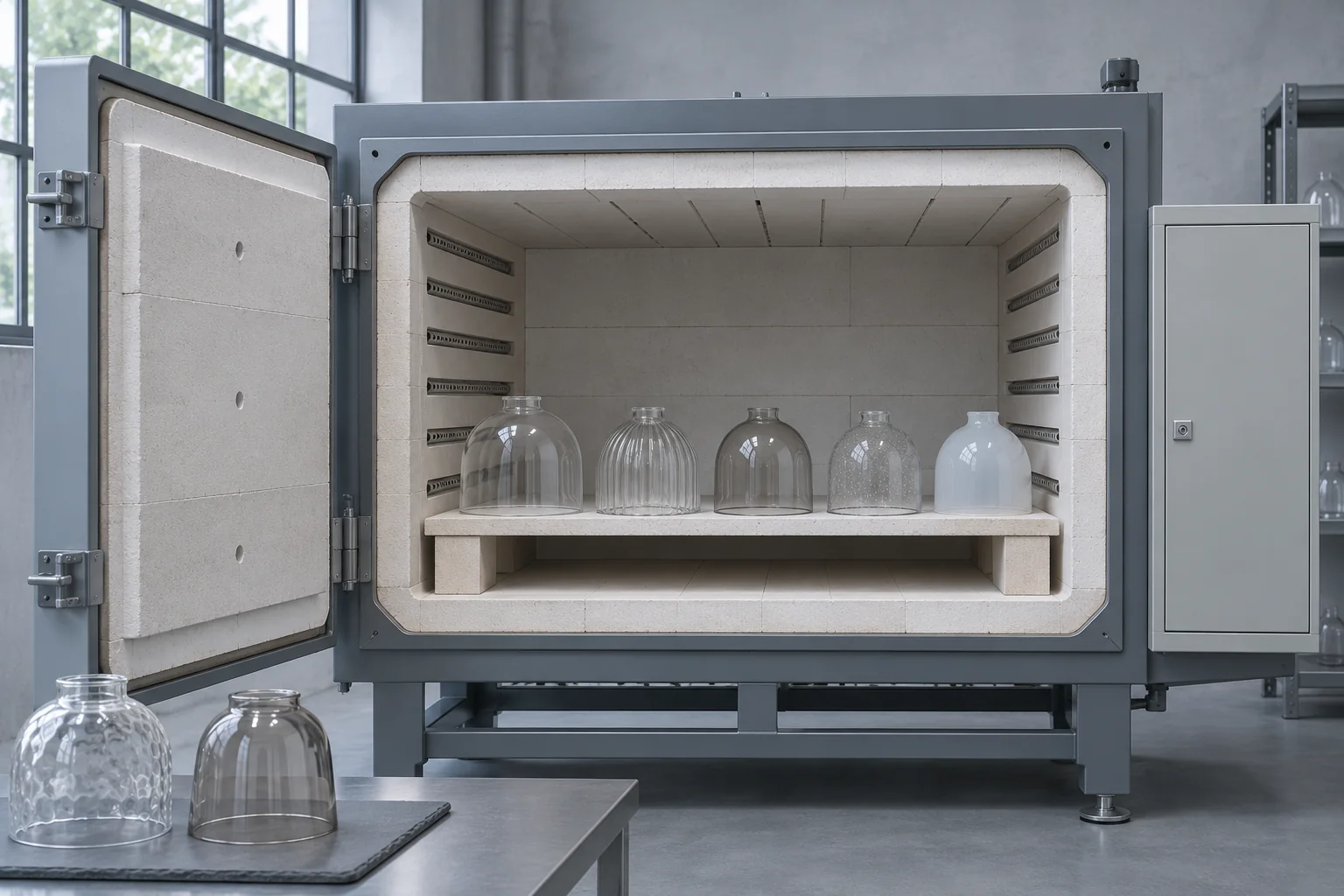
Glass manufacture requires thermal processing, and the route matters. The U.S. Energy Information Administration’s 2013 glass-industry overview identifies melting and several downstream processes as energy users. It is historical industry context, not a current energy-cost breakdown for JX or a particular shade.
Ask how the proposed geometry, material, and order schedule fit the supplier’s process. A change that reduces one input may affect loading or another operation. Avoid assigning a universal fuel percentage to every quotation.
Annealing should be discussed as a technical requirement. Penn State’s heat-treatment explanation distinguishes controlled cooling to reduce internal stress from tempering, which intentionally creates surface compression. A buyer should not assume that shortening a heat-treatment schedule preserves the approved result.
Ask which process arrangement can deliver the specified shade at an acceptable cost. Ask the supplier to propose and validate that arrangement. Do not substitute a buyer’s guessed cycle time for the manufacturer’s qualified process.
Compare quantities at the actual release and packing level
A quoted annual forecast is not automatically a production release. Record the pieces ordered at one time, the number of finish groups, delivery phases, and the conditions under which a larger quantity receives a different price. Keep a nonbinding forecast separate from the purchase commitment.
Packing also belongs in the design review. A larger body, projecting neck, or sensitive surface may change the protective arrangement and the number of pieces per carton. Reducing glass weight alone does not establish a freight saving if carton dimensions or other shipment charges control the price.
ISTA’s design and testing guidance connects packaging decisions to the product and distribution environment. Confirm the packing configuration and any required evaluation when a revision changes the protected part. A lighter carton or thinner insert is not a verified saving until the agreed protection requirement is retained.
For collections with many variants, the small-batch collection guide addresses how the order divides into separate references. Use that planning work before treating the whole collection total as one quantity band.

Approve a cost change against its full revision bill
Compare the current design and the proposed design using the same cost boundary and accepted quantity. Ask for a written explanation of what changes, what stays fixed, and what evidence is needed before release.
Here is a hypothetical decision exercise, not a JX quotation or an example of a measured customer saving. Assume the buyer needs 1,000 accepted shades. A revised decorative feature lowers the quoted recurring price from $14.00 to $13.20. Separate sample and qualification work for the revision costs $650. Both recurring prices are assumed to cover the same packing and accepted-delivery scope.
| Hypothetical decision item | Calculation |
|---|---|
| Current recurring order value | 1,000 × $14.00 = $14,000 |
| Revised recurring order value | 1,000 × $13.20 = $13,200 |
| Recurring saving on this order | $800 |
| Separate revision work | $650 |
| Modeled saving after that work | $150 |
After the assumed revision bill, the $0.80 unit reduction saves only $150 across the planned order. Additional engineering time, discarded stock, packing changes, delivery disruption, or unsuccessful trials could change the decision. Future orders may improve the result only if their quantities and prices actually materialize.
Keep appearance and performance approval as release conditions. A positive calculation does not authorize a different mounting interface or a finish the customer has not accepted. If the margin is narrow, a product manager may reasonably keep the current design and reconsider the change with the next planned revision.
Questions product managers ask about glass shade cost
How much do glass lamp shades cost?
A usable manufacturing price needs a defined shape, material, finish, interface, quantity, acceptance scope, and delivery basis. A retail replacement price is not an OEM cost benchmark. Ask for a quotation against the controlled component rather than applying a generic market range.
Why are some lamp shades much more expensive than others?
They may involve different materials, forming routes, finishing work, production quantities, acceptance requirements, distribution costs, or retail positioning. Product appearance alone cannot reveal which factor explains a particular price difference. Compare the stated scope before attributing the difference to glass quality.
Is pressed glass always cheaper than hand-blown glass?
No universal rule settles a specific order. Tooling suitability, geometry, volume, finish, and required appearance affect the comparison. Request feasible routes for the same approved component and quantity instead of using a fixed multiplier between methods.
Does a 20% weight reduction give a 20% price reduction?
No. Only part of the price may vary with glass mass, while other work remains or changes. The sensitivity example above gives a 4% modeled effect under explicit assumptions; it is not a supplier commitment or a recommendation to reduce wall thickness.
Can tighter inspection requirements change the price?
They can change the measurement work and the definition of an accepted part. Identify the inspection method, critical features, visual limits, and required records. Ask the supplier which requirements affect the price, and keep functional requirements subject to engineering approval.
Should a buyer request a full confidential factory cost sheet?
The buyer can request a transparent commercial scope and an explanation of cost-changing options. A supplier may provide those without disclosing confidential internal rates. The decision needs a verifiable component, a comparable revised price, and evidence that the result still meets the brief.
What is the safest starting point for a cost reduction review?
Identify features with little demonstrated value, duplicated operations, unclear acceptance language, or avoidable variant changes. Ask the supplier to review one controlled proposal at a time. Preserve the current specification until the alternative has passed its technical and appearance approvals.
Send a controlled design for a cost review
JX’s OEM glass-shade program for lighting brands covers custom component discussions around the fixture interface, glass appearance, process selection, sampling, and RFQ inputs. Use the defined product as the starting point and state how the cost target was set.
Send the drawing revision, current sample reference, material or property requirements, finish, ordered quantity per release, critical dimensions, acceptance rules, packing basis, and required documents. Identify the features you are willing to reconsider and those that must remain fixed. If available, include the current quotation with its commercial scope.
Ask for a feasible alternative, its revised price, the work needed to qualify it, and any effect on timing or packing. Final material, MOQ, tooling, tolerance, testing, price, and delivery terms remain project-specific and need confirmation in the supplier’s reply.
Request a Glass Shade Cost Review