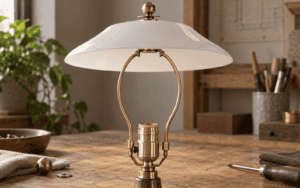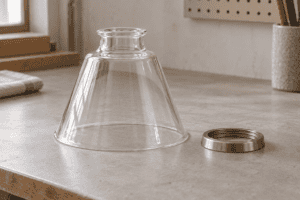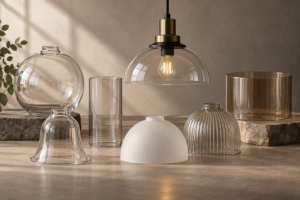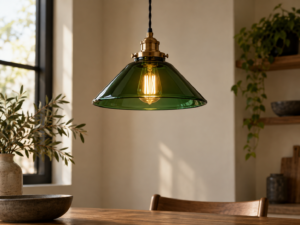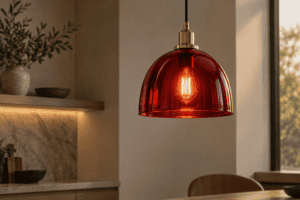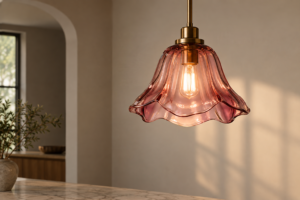
A hanging light lampshade is a shade for a pendant or ceiling-suspended fixture, available in glass, fabric, metal, and rattan. It attaches by fitter type, cord-set, or socket ring depending on the fixture, and shade size should scale to the room and the surface below it.
You have a bare bulb dangling from a cord, or a pendant whose shade finally cracked, and you want to fix it. The shops that rank for hanging light lampshade are all product grids: hundreds of shades, no guidance on which one actually fits your fixture or your room. This guide fills that gap. We cover every type of hanging light lampshade, how they attach (this is where most people get stuck), how to size one correctly over a table or island, and how to avoid the mistakes that leave you with a shade that doesn’t fit or looks wrong.
What is a hanging light lampshade?
A hanging light lampshade is any shade designed for a light fixture suspended from the ceiling, rather than one sitting on a table or floor lamp. The category covers pendant lights, single-cord drops, and shades fitted to ceiling-mounted cord sets.
Pendant, ceiling, and cord-set shades
The terminology overlaps a lot, so here is the practical breakdown:
Pendant shade: a shade on a fixture that hangs from a single cord, rod, or chain from a ceiling canopy. The most common form of hanging light lampshade. Pendant shades range from small focused shades over a counter to large statement shades over a dining table.
Ceiling shade: sometimes used interchangeably with pendant, but can also mean a shade close to the ceiling (semi-flush). For a true hanging light lampshade, the fixture drops below the ceiling on a cord or rod.
Cord-set shade: a shade fitted to a simple plug-in or hardwired cord set — a bare cord with a socket, onto which a shade attaches. This is the DIY-friendly version, popular for adding a shade to an exposed bulb.
The defining feature across all of them is that the shade hangs and the light source is above or inside it, projecting down and outward. This changes how you choose the shade compared to a table lamp: the bottom of a hanging light lampshade is at or near eye level when seated, so what the underside reveals (the bulb, the socket, the inner surface) matters far more than on a table lamp.
How hanging shades differ from table lamp shades
The key differences that affect your choice:
- The underside is visible. When seated under a pendant, you often look up into the shade. A bare bulb glaring down is the most common complaint. Shades with a diffuser, a deep profile, or an opal glass inner surface solve this; shallow open shades don’t.
- Attachment is to a fixture, not a harp. Table lamp shades sit on a harp or clip a bulb. Hanging shades attach to the pendant fixture’s hardware, which varies by fixture type.
- Scale is room-driven, not base-driven. A table lamp shade is sized to its base. A hanging light lampshade is sized to the room and the surface it lights (table, island, entry).
| Feature | Hanging light lampshade | Table lamp shade |
|---|---|---|
| Mounting | Pendant fixture / cord set | Harp, uno, or clip-on |
| Underside visibility | High (seen from below) | Low |
| Sized to | Room + surface below | Lamp base |
| Glare control | Diffuser or deep/opal shade | Less critical |
| Typical materials | Glass, metal, rattan, fabric | Fabric, glass |
Types of hanging light lampshades
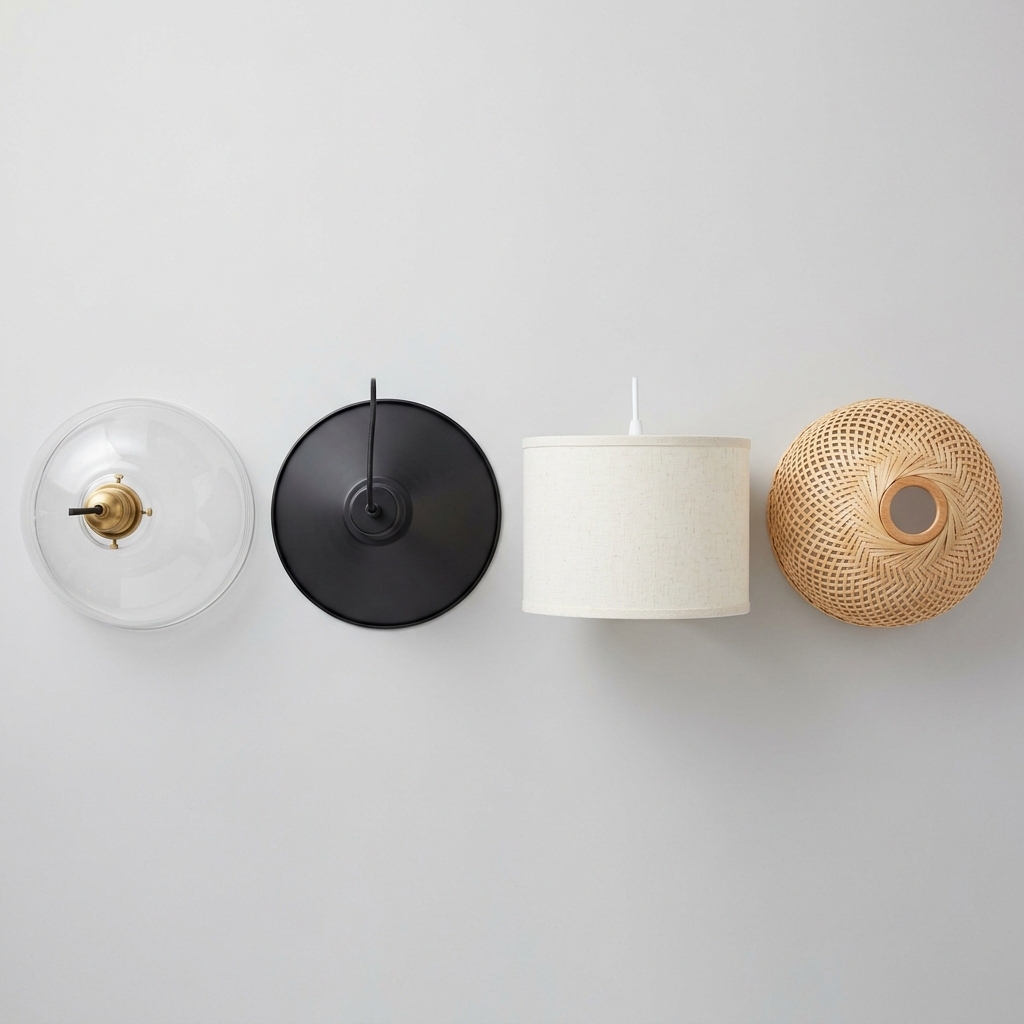
Hanging light lampshades come in glass, metal, fabric, and natural materials, each producing a different light quality and suiting a different interior style. The material choice is the biggest single decision.
Glass pendant shades
Glass is the classic hanging light lampshade material, and for good reason: it’s durable, easy to clean, and produces a range of light effects depending on the glass type. Clear glass shows the bulb and casts bright, sparkly light — best with a decorative filament bulb. Opal or milk glass diffuses the light into a soft even glow and hides the bulb completely. Frosted and seeded glass sit between the two.
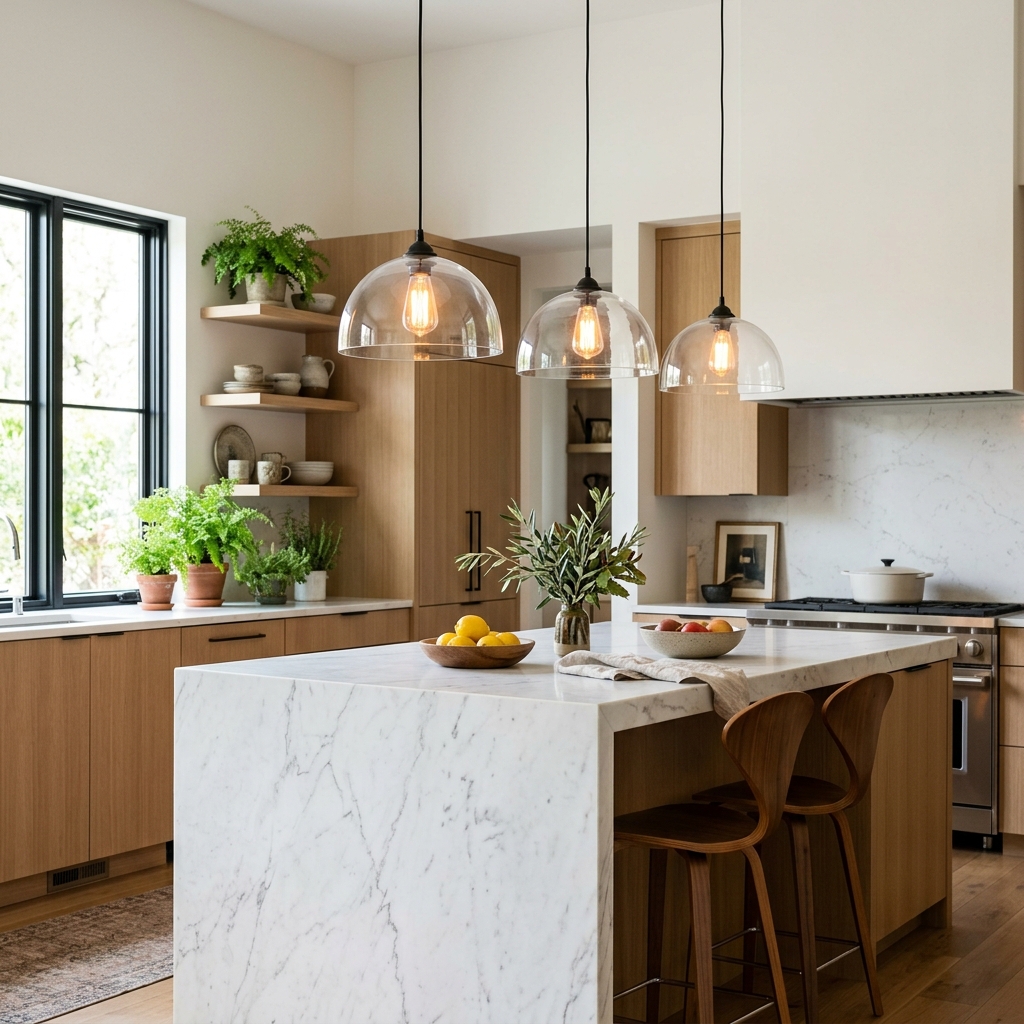
Glass pendant shades dominate kitchen islands, dining tables, and entryways. A row of clear glass pendants over an island is a near-universal contemporary look. For a softer effect, an opal or frosted glass shade diffuses the light without the glare of a bare bulb. Glass also handles heat and humidity better than fabric, which matters over a kitchen or in a bathroom.
Metal and industrial shades
Metal hanging shades — steel, brass, copper, aluminum — produce a directional downlight. The opaque shade blocks light from escaping sideways and pushes it straight down, which makes metal pendants good task lighting over a work surface. The industrial and farmhouse looks both rely heavily on metal pendant shades, often in matte black, aged brass, or galvanized finishes.
The trade-off: metal shades give zero ambient glow. All the light goes down in a focused cone, so a room lit only by metal pendants can feel dim everywhere except directly under the lights. Pair them with other light sources.
Fabric drum and empire shades
Fabric hanging shades — usually drum-shaped — give a soft, diffused light and a warmer, more residential feel than glass or metal. A large fabric drum pendant over a dining table is a common transitional and contemporary choice. Fabric shades usually have an open bottom, sometimes with a diffuser disc to hide the bulb and soften the downlight.
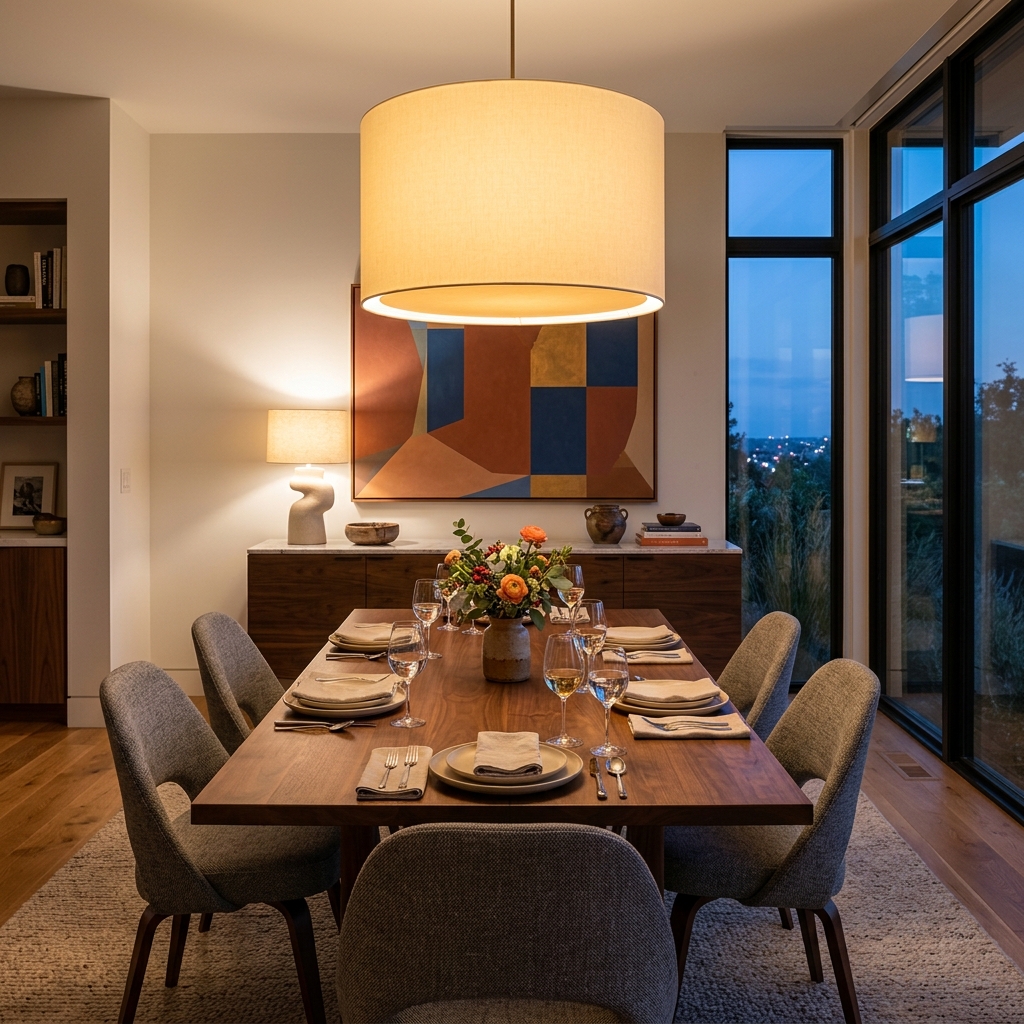
Fabric is the most room-warming option but the least suited to kitchens (grease and moisture) and high-humidity spaces. For a dining room, living room, or bedroom, a fabric drum hanging light lampshade is often the most comfortable choice.
Rattan, bamboo, and natural materials
Natural-material shades — rattan, bamboo, woven seagrass, paper — have become a dominant trend in coastal, boho, and Scandinavian interiors. They cast patterned, textured light through the weave and read as warm and organic. The light behavior is similar to a pierced metal shade: the pattern of the weave is projected onto surrounding surfaces.
The caution with natural materials is the same as fabric: they collect dust, can’t handle moisture or grease, and should be kept away from heat. With an LED bulb the heat issue is minimal, but a rattan shade over a stovetop is still a poor idea.
| Material | Light quality | Best room | Avoid in |
|---|---|---|---|
| Clear glass | Bright, sparkly, bulb visible | Island (with filament bulb), entry | — |
| Opal / milk glass | Soft, even, bulb hidden | Kitchen, bath, dining | — |
| Metal | Directional downlight | Task areas, industrial spaces | Rooms needing ambient glow |
| Fabric drum | Soft, diffused, warm | Dining, living, bedroom | Kitchen, bathroom |
| Rattan / natural | Patterned, textured, warm | Coastal, boho, dining | Kitchen, high-humidity |
How hanging light lampshades attach to fixtures
The attachment method is where most people get stuck, because hanging light lampshades use several different systems depending on the fixture. Identify your fixture’s hardware before buying a shade.
Fitter types for glass pendant shades
Glass pendant shades attach through a fitter, just like glass table lamp shades, but the common sizes differ:
- Large fitter (often called a “neckless” or “fitter” shade): the shade has an opening at the top that seats into a holder on the pendant fixture, secured by a thumbscrew ring or a threaded collar. Common neck/fitter diameters for pendants are 1⅝”, 2¼”, and larger custom sizes.
- Schoolhouse fitter: a specific style where a glass shade with a wide neck seats into a fixture with a matching cast holder, secured by set screws. The classic “schoolhouse” globe.
- Threaded neck (flush fitter): the glass shade has a threaded glass neck that screws directly into the fixture.
The fitter or neck diameter must match the fixture’s holder exactly. This is the single most common source of failed pendant shade purchases — ordering a beautiful shade that won’t seat on the fixture. Measure the holder opening before buying. Our guide to measuring a glass lamp shade covers how to measure a fitter opening accurately, and the method applies to pendant fitters as well as table-lamp shades.
Cord set and socket ring mounting
For DIY pendant setups and many fabric or rattan shades, the shade mounts via a socket ring or a shade ring on the cord set. The cord drops from the ceiling canopy to a socket; a threaded ring or washer on the socket holds the shade in place. Many modern pendant cord sets use an E26 (standard) socket with a shade ring sized to grip a drum or globe shade.
This system is the most flexible because it works with a wide range of shade styles, but it requires matching the shade’s top opening to the socket ring’s grip diameter. Cord sets sold for DIY pendant projects usually specify which shade opening sizes they accept.
UNO and spider fitters on hanging shades
Some hanging light lampshades — particularly fabric drum shades converted from or shared with table-lamp use — use uno or spider fitters adapted for pendant mounting. A uno-fitter drum shade can hang from a pendant cord whose socket accepts a uno ring. These are less common than dedicated pendant fittings but appear on convertible shades sold for both table and pendant use.
Expert tip: before buying any hanging light lampshade, photograph your fixture’s mounting hardware from directly below and measure the holder or socket ring diameter. Bring those to the purchase. Nine out of ten fitting problems come from skipping this two-minute step.
How to size a hanging light lampshade
Sizing a hanging light lampshade depends on what it’s lighting: a table, an island, an entry, or general room light. Each has a different formula, and hanging height matters as much as shade diameter.
Sizing over a dining table or island
For a single pendant or a fabric drum over a dining table, the shade diameter should be roughly one-half to two-thirds the width of the table (the narrow dimension). A 36″ wide table suits a pendant or drum around 18″–24″ in diameter.
For multiple pendants over an island, the common approach is two or three smaller pendants (10″–14″ each) spaced evenly, with the outermost pendants set in from the island ends by 12″–18″. As a starting point, space multiple pendants so their centers are about 24″–30″ apart over a standard island.
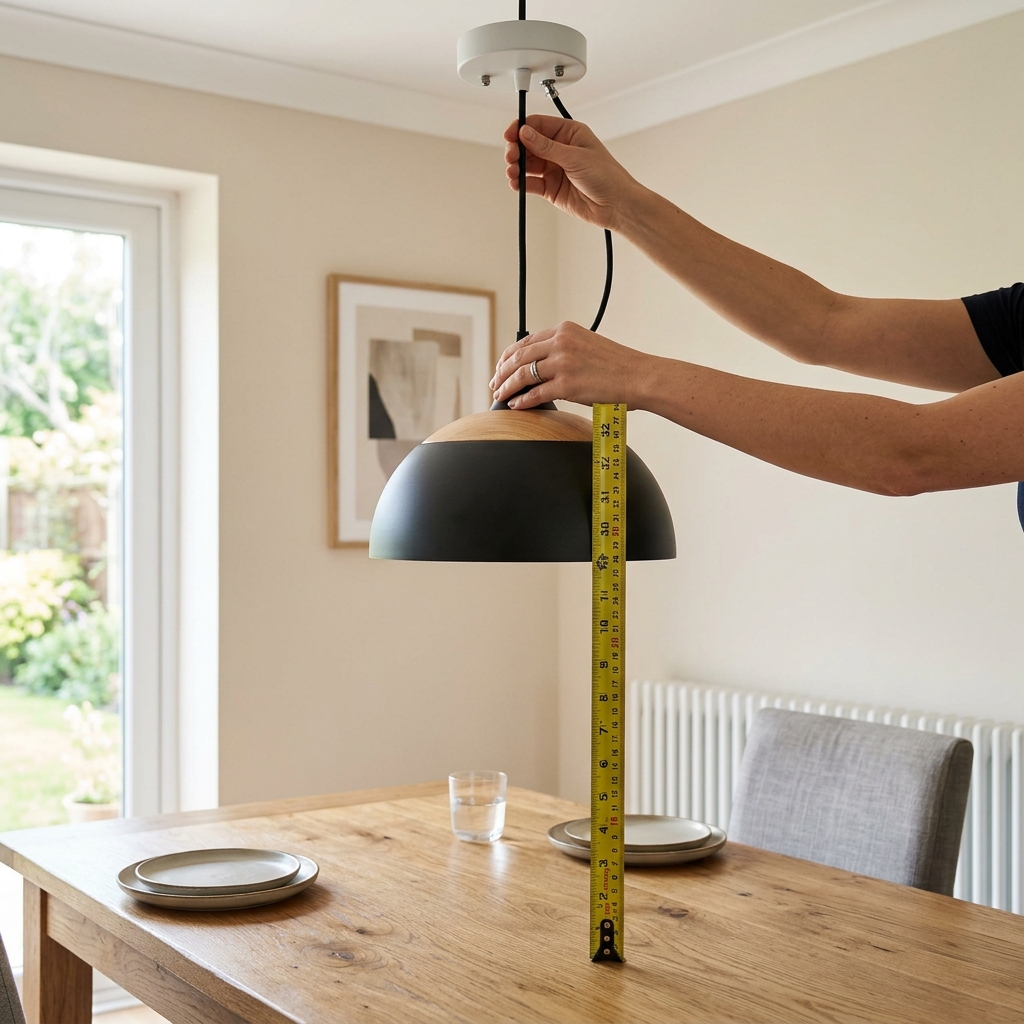
Hanging height over a table or island: the bottom of the shade should sit roughly 30″–36″ above the surface. Lower (30″–32″) for task focus and intimacy over an island; higher (34″–36″) over a dining table where people sit across from each other and need clear sightlines. The room’s ceiling height adjusts this — add about 3″ of drop for every foot of ceiling above the standard 8 feet.
General room and entryway sizing
For a hanging light lampshade providing general light in a room (not over a specific surface), a rough rule sums the room’s dimensions in feet and converts to inches for the fixture diameter. A 12′ × 14′ room sums to 26, suggesting a pendant or chandelier roughly 26″ in diameter. This is a guideline for visual proportion, not a lighting-output calculation.
For entryways and over stairwells, the bottom of the fixture must clear head height — at least 7 feet above the floor in a walkway, and 7 feet above the highest point a person could stand on a stair.
| Location | Shade diameter | Hanging height (bottom of shade) |
|---|---|---|
| Over dining table | ½–⅔ of table’s narrow width | 34″–36″ above tabletop |
| Over kitchen island | 10″–14″ each (multiple) | 30″–34″ above counter |
| General room light | Sum of room dimensions (ft) → inches | 7’+ above floor in walkways |
| Entryway | Proportional to space | 7’+ above floor minimum |
Common sizing mistakes
The most common mistake is hanging the shade too high. A pendant tucked up near the ceiling over a dining table looks lost and lights the table poorly; the 34″–36″ rule exists because that height puts the light where it’s useful and the shade where it reads as intentional.
The second mistake is undersizing. A small shade over a large table or island looks like an afterthought. When in doubt between two sizes over a table, the larger one almost always looks better — undersized pendants are the more common error by far.
A third: ignoring the underside. A clear-glass or open-bottom shade hung at eye level over a dining table puts a glaring bulb directly in diners’ sightlines. Either use a diffused/opal shade or a decorative filament bulb that’s pleasant to look at.
Where hanging light lampshades work in the home
Hanging light lampshades suit almost every room, but the right material and size shift by location and how the light is used. Match the shade to the job the light does in that space.
Kitchens and dining areas
The kitchen island and dining table are the two most common homes for a hanging light lampshade. Over an island, durability and easy cleaning point to glass or metal: clear glass with a filament bulb for a decorative look, opal glass for soft even task light, or metal for focused downlight over a prep area. Fabric and rattan are poor island choices because of grease and moisture.
Over a dining table, where the atmosphere matters more than task lighting, a fabric drum or a large opal glass pendant gives a warmer, more flattering light. The dining table is the one spot where a fabric hanging light lampshade often beats glass.
Living rooms, bedrooms, and hallways
In living rooms and bedrooms, hanging light lampshades function as ambient or accent light rather than task light. Fabric drums, rattan, and opal glass all work, with the choice driven by the room’s style. A large fabric pendant can anchor a seating area; a pair of small pendants can flank a bed in place of table lamps, freeing the nightstands.
Hallways and entryways need shades that clear head height and suit a transitional space. Smaller glass or metal pendants work well; the entryway is also a place where a single statement hanging light lampshade sets the tone for the home.
Outdoor and covered spaces
Covered porches, patios, and pergolas increasingly use hanging light lampshades rated for damp or wet locations. The shade material must tolerate moisture and temperature swings — glass, powder-coated metal, and weather-rated synthetic rattan are the realistic options. Natural rattan and fabric will not survive outdoors. The fixture itself must be rated for the location (damp-rated for covered areas, wet-rated for exposed). With LED bulbs, which the U.S. Department of Energy notes run far cooler and last far longer than incandescent, outdoor pendant maintenance drops considerably.
FAQ
What is the difference between a pendant light and a hanging light lampshade?
A pendant light is the complete fixture — cord or rod, canopy, socket, and shade. A hanging light lampshade is just the shade component that attaches to that fixture. People often buy a replacement shade for an existing pendant, or a shade to add to a bare cord set. So a hanging light lampshade is one part of a pendant light, the part you most often replace or upgrade without rewiring the fixture.
How do I know what size hanging lampshade to buy?
It depends on what it lights. Over a dining table, choose a shade about half to two-thirds the table’s narrow width. Over an island, use multiple 10″–14″ pendants spaced 24″–30″ apart. For general room light, sum the room’s dimensions in feet and use that number in inches as the diameter. When unsure between two sizes over a table, the larger almost always looks better — undersizing is the more common mistake.
How high should a hanging light lampshade hang?
Over a dining table, the bottom of the shade should sit 34″–36″ above the tabletop. Over a kitchen island, 30″–34″ above the counter. In walkways and entryways, the bottom must clear at least 7 feet above the floor. Add roughly 3″ of drop for every foot of ceiling height above the standard 8 feet. Hanging too high is the most common error — it leaves the table poorly lit and the shade looking stranded.
Can I put any lampshade on a hanging light?
No. Hanging light lampshades attach through fitter rings, socket rings, or threaded necks specific to pendant fixtures, and the opening must match the fixture’s hardware. A table-lamp shade with a spider fitter won’t attach to most pendant cord sets without an adapter. Before buying, measure your fixture’s holder or socket ring diameter and confirm the shade is sold for pendant or cord-set mounting in that size.
What is the best material for a hanging light lampshade over a kitchen island?
Glass or metal. Glass (clear with a filament bulb, or opal for soft diffused light) is durable, easy to wipe clean, and unaffected by kitchen grease and moisture. Metal gives focused downlight ideal for task areas. Avoid fabric and natural rattan over an island — they absorb grease and moisture and are difficult to clean. Opal glass is the most forgiving all-rounder for island task lighting.
How do I replace just the shade on a hanging pendant light?
First identify the mounting: a thumbscrew/fitter ring, a socket shade ring, or a threaded glass neck. Turn off the power, remove the old shade by loosening the screws or unthreading it, and measure the fitter opening or socket ring diameter. Order a replacement hanging light lampshade in the matching size and mounting type, then reverse the steps. Most shade swaps need no rewiring and take a few minutes.
Conclusion
A hanging light lampshade is a single component with outsized impact: it shapes the light, hides or reveals the bulb, and anchors the room visually. The decisions that matter are the material (glass and metal for kitchens, fabric and rattan for living and dining spaces), the attachment method (match the fitter or socket ring to your fixture), and the size and hanging height (scale to the surface below, hang at 34″–36″ over a table).
Get the fitting right first — measure your fixture’s holder before you buy anything — then choose material and size for the room. For kitchen, dining, and entryway pendants where durability and easy cleaning matter, a glass shade is usually the safe choice; our cut glass lamp shades collection covers pendant-suitable glass shades across standard fitter sizes, and the vintage glass lamp shades guide is the starting point for period-style pendant shades.