Designing for Replaceability: Standard Fitters as a Brand Strategy
A replacement glass shade program for brands starts with controlled mounting interfaces, approved fixture compatibility and identifiable service parts. Standard fitters can support that program, but a nominal size alone cannot establish interchangeability. Before launch, define which shade fits which fixture revision, how closely a replacement must match, and how it will remain available.
A customer breaks one shade from a multi-light pendant. The collection is still recognizable, yet its product name has changed and the holder has been revised. Your support team needs a released part number and a clear substitution decision. A similar-looking globe is not enough to identify the correct part.

Set the service promise before drawing the collection
Decide what the customer should be able to replace: one glass component, a complete shade with retaining hardware, or a matched set. Each option creates a different purchasing and support obligation. Record the markets, sales channels and fixture families covered by the policy, plus the person who can authorize an exception.
The service record needs separate answers to three questions:
- Mechanical compatibility: the released shade and hardware can be used on the identified fixture revision under the approved conditions.
- Appearance acceptance: color, texture, silhouette and illuminated appearance meet the brand’s replacement policy.
- Service availability: a stocked part, scheduled reorder or agreed redevelopment route exists for that request.
A spare may pass one decision and fail another. A clear globe could share a mounting interface with an opal globe while changing the collection’s appearance. An exact approved part could be out of stock. Record the failed approval or supply restriction so support can explain it.
Choose a service horizon that the brand can support commercially, then negotiate the supplier scope. Avoid promising indefinite availability before agreeing tooling access, minimum reorder quantities and responsibility for inventory.
What does a standard fitter mean for a lighting brand?
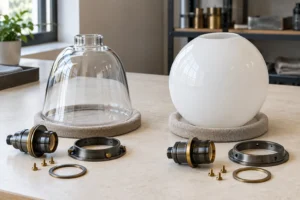
Treat a standard fitter as a controlled interface family within your own product system. Its definition should include a drawing, revision and approval record. A catalogue label is a useful search term; it is not a complete production specification.
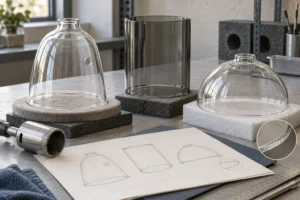
Define the mating surfaces, glass opening, neck or lip geometry, engagement depth, retaining method and permitted contact areas. Add drawing tolerances, hardware references and the intended installation orientation. Record the approved body envelope and weight limits established by your fixture review. Leave unknown limits open for engineering approval rather than inserting a generic number.
The lamp cap and glass mounting interface are also different systems. IEC 60061 covers lamp caps, lampholders and associated gauges. An E26 or E27 lamp designation does not, by itself, specify the glass neck, gallery or shade-retaining arrangement.
Use the glass shade fitting specification guide for the detailed measurement vocabulary. In the brand program, the key deliverable is a named interface family linked to the actual fixture and holder revisions.

Keep the interface stable while the visible design changes
Collection differentiation can happen away from the mounting zone. Consider retaining an approved neck arrangement while exploring a different body profile, rib pattern or finish. This gives product development a specific question to investigate: which details can change without requiring a new service interface?
Decide what the collection will share. Different shades can share an interface family while remaining separate service parts. Alternatively, several fixtures can use the same approved shade part. Only the second arrangement reduces the number of glass service SKUs directly.
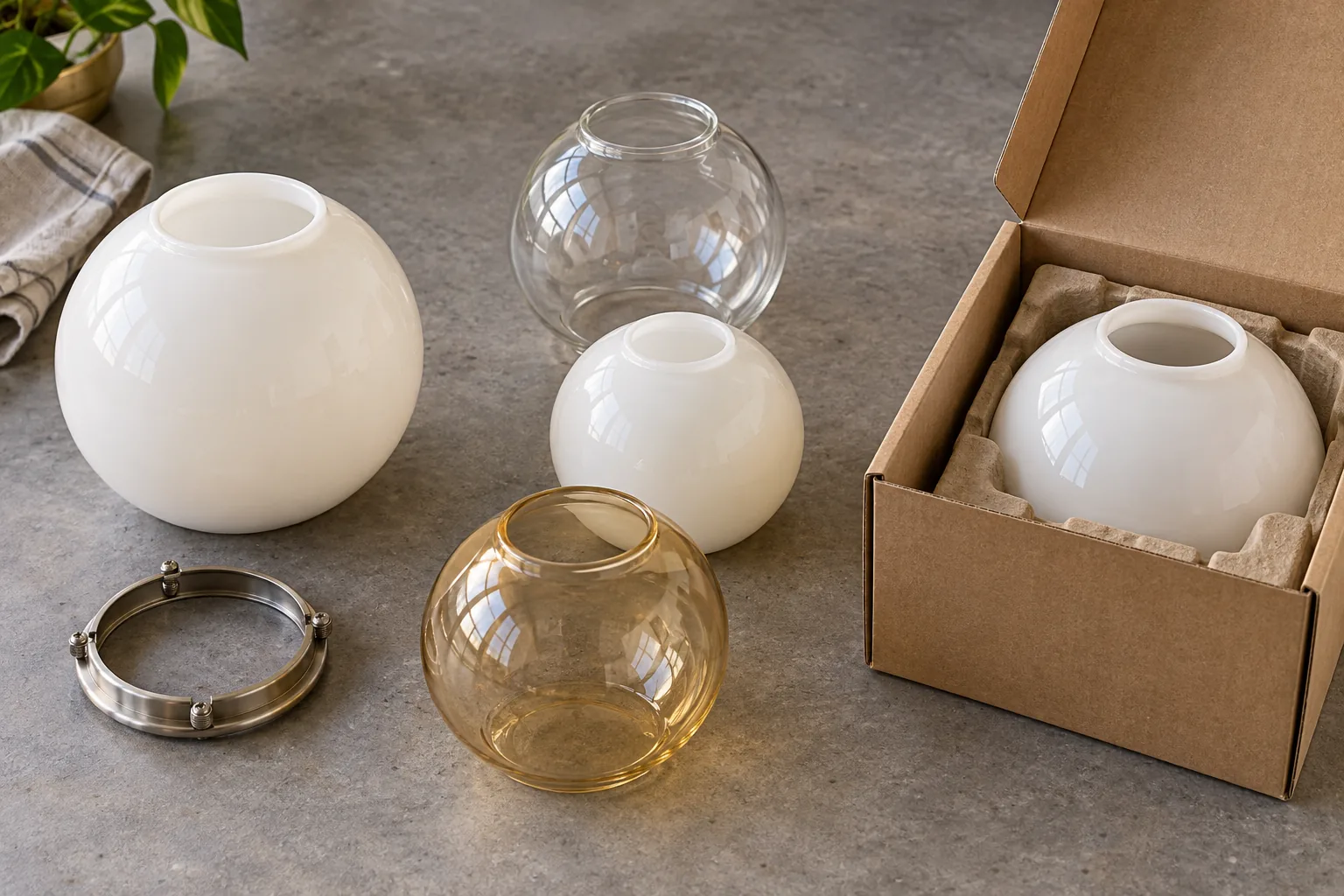
For example, a hypothetical collection might use a smooth opal globe and a ribbed clear bell on related holders. Even if both are approved for the same interface family, they need separate finish and appearance records. They should not silently become replacements for one another.
Some designs deserve a separate family. A larger body, different support method or changed installation direction may justify dedicated hardware and testing. Keep that exception visible in the collection brief. Forcing every new shape onto one interface can restrict the design or create an unsupported compatibility assumption.

Approve compatibility for each fixture and revision
Build a compatibility register before the replacement catalogue goes live. Every entry should connect a fixture model and revision to a shade part, shade revision, hardware set and approval reference. A short status field keeps an unfinished review from becoming a sales promise.
- Approved: the specified combination has completed the brand’s required review and can be released for the stated use.
- Under review: evidence or samples are incomplete; support must escalate the request.
- Not released: do not offer the combination, including visually similar alternatives without approval.
Review the assembled fixture with the proposed shade. Relevant checks can include seating, retention, contact with edges, installation access, body clearance, orientation and the intended light source. Have the responsible fixture engineer or conformity specialist determine the applicable safety evaluation and whether a change affects existing certification.
UL’s lighting safety services cover fixtures, lamps, components and systems. That scope is a reason to review the assembly appropriately, not evidence that a loose shade or this proposed program carries UL certification.
Keep dated results and sample references with the register. Photographs help identify a combination, but they do not replace a drawing or a documented release decision.

Make every service part traceable
Give the replacement item a service part number that support and purchasing can use. Link it to the sales model names customers recognize, including retired names. If a fixture changed during production, record how to identify the relevant version from its label, order history or approved distinguishing detail.
A usable service record contains:
- Shade part number, drawing revision and interface family.
- Compatible fixture models, revisions and required hardware.
- Glass color, surface treatment and approved appearance reference.
- Reference photographs, packaging version and supplied kit contents.
- Approval status, superseded references and current supply route.
There is a practical market example in Hubbardton Forge’s 0066 replacement glass listing, which identifies a base item and separate glass options. Make the orderable variant just as explicit in your own service record. It does not establish compatibility with another manufacturer’s fixture.
Where a channel requires trade item identification, GS1 describes the GTIN as an identifier for an orderable, priced or invoiced trade item. Maintain the compatibility register alongside that identity. A barcode or internal SKU can retrieve the record; neither substitutes for its engineering content.

Give customer support a short identification path
Design the support process around evidence a customer can provide without dismantling an energized fixture. Ask for the fixture model label or order reference first, followed by an overall photograph. A glass close-up alone may hide the mounting arrangement or confuse two collection variants.
The support sequence can be simple:
- Identify the fixture model and revision using the approved record.
- Retrieve the released shade part and any required hardware.
- Check the requested appearance and current supply status.
- Confirm the kit, installation information and order route, or escalate an unresolved match.
Avoid asking the customer to force a similar shade into place, alter the glass or improvise retaining hardware. Installation information should come from the fixture owner, with appropriate isolation and handling instructions.
For an unidentified legacy item, use the replacement shade matching guide to collect the starting evidence. Keep unverified legacy matches out of the approved catalogue. A part becomes an authorized replacement only after the responsible team completes the relevant review.

Price the service program as a separate scope
Bulk production pricing does not describe the full cost of supporting individual replacements. Ask the supplier to separate the glass price from development, stockholding and dispatch responsibilities. Picking, repacking and dispatch can cost more than purchasing expects when it looks only at the glass price.
Request cost lines for drawings and sample approval, new or retained tooling, inspection references, service labels, individual protective packaging and storage where offered. Then establish who handles small orders, picking, outbound freight, damage claims and obsolete stock. Confirm any replenishment MOQ and scheduling restrictions for the selected process and finish.
Keep bulk carton protection separate from the pack needed to send one shade to one customer. A master carton arrangement may rely on neighboring pieces and dividers; its assumptions may not apply to a single-piece parcel. Approve the actual dispatch pack for the intended route.
Compare supplier offers against the same responsibility list. A lower glass quotation can leave the brand paying for repacking, record maintenance and individual dispatch elsewhere. That may still be the right arrangement, provided purchasing can see the whole scope before committing.

How much replacement stock should a brand hold?
Start with observed requests for the service part and a credible replenishment lead time. For a new collection, state the forecast assumptions and review them after real orders arrive. A fixed percentage of production can hide differences between popular collections, fragile distribution routes and rarely requested finishes.
For an illustrative calculation, assume a brand expects 24 requests per year for one part and replenishment takes eight weeks. Under steady demand, expected consumption during replenishment is 24 × 8 ÷ 52 = 3.69 pieces, or about four. Those four pieces cover the assumed average consumption only. They are not a recommended stock target or a safety-stock allowance.
The buyer still needs to consider demand spikes, forecast error, rejected or damaged incoming pieces, usable stock already on hand and order batching. Assign a review date and a person responsible for changing the forecast.
Finished stock and the ability to manufacture again need separate records. An available mold does not mean glass, finish capacity or an economical small production run is immediately available. If the brand promises rapid dispatch, it needs an inventory arrangement capable of supporting that promise.

Control changes and plan for discontinuation
Define change triggers in the development agreement. A holder revision should reopen affected compatibility entries. A glass finish change should reopen appearance approval. A packaging change should reopen the relevant packing review. Do not let a new purchase order overwrite the old service record silently.
A supersession record should identify the earlier part, the fixture revisions that accept its replacement, any extra hardware and the person who approved the change. If there is no approved substitute, say so internally and give support an escalation route.
Before discontinuing a collection, review outstanding service commitments and the cost of a final production run. Ask about tooling condition, retention terms, access rights and notice of disposal. These are commercial terms to agree, not automatic rights attached to buying the original glass.
If a finish cannot be matched closely enough on a visible multi-light fixture, the brand may consider a matched-set option after review. Explain the appearance trade-off and cost to the customer. Do not describe a merely similar shade as an exact match.

Release the replacement kit with the new collection
Include service readiness in the collection launch review. Before the collection enters the catalogue, support should be able to identify its approved replacement, purchasing should know how to reorder it, and the packing team should know what ships in the service kit.
Release the kit contents and installation information together. A shade-only service item and a kit containing a shade plus retaining components must be distinguishable in the order record. Confirm whether instructions apply to customer replacement or require a qualified installer for that fixture.
For supplier review, send the collection’s fixture list, interface drawings, shade variants, compatibility status and proposed service policy. Add sample and annual volume assumptions, target dispatch markets, packaging requirements and the requested launch window. Identify unresolved fields before requesting a firm quotation.
The glass shade technical drawing checklist helps organize dimensions and references. The additional brand task is to connect that drawing to the service identity, approval history and replenishment plan.

Questions buyers ask about replacement shade programs
Can one fitter family cover every shade in a collection?
Only where the specific combinations are approved. Shared neck geometry is a starting point. Different body dimensions, mass, installation direction or lamp clearance can require additional review or a separate interface family.
Should the spare glass have the same SKU as the complete light?
Use a separately orderable service reference linked to the complete fixture. The record should distinguish glass variants and kit contents so an order cannot accidentally request a full light or the wrong finish.
Can we begin without historical replacement demand?
Yes, with an explicitly provisional forecast and an agreed review date. Document the installed population assumptions and supply restrictions. Avoid presenting the opening stock quantity as a proven demand estimate.
Does keeping the mold guarantee future replacements?
No. Confirm its condition, ownership or access terms, retention period and manufacturing route. Future supply also depends on the required glass and finish, production availability and an agreed order quantity.
What if an old fixture has no readable model label?
Collect order history, overall fixture photographs and mounting details through the support process. Escalate identification to the responsible team. Do not release a substitute from visual resemblance alone.
Can the factory hold service stock for our brand?
Ask for a project-specific stockholding proposal. Agree ownership, quantities, storage charges if applicable, inspection, release instructions and disposal responsibility. Do not assume stockholding is included in a bulk glass quotation.
Can a replacement shade preserve the fixture’s certification?
Have the fixture’s responsible engineering or conformity team review the proposed change against the applicable certification and installation conditions. Appearance or nominal fitter size alone cannot answer that question.
Approve the replacement path before the collection launches
The program is ready when support can retrieve the fixture identity, approved glass reference, compatibility decision, appearance target and supply route. Review that trail when developing a new collection and whenever the holder, glass or service policy changes.
JX’s glass shade development service for lighting brands covers custom collection work and replacement or legacy SKU development. Start a program discussion with the fixture interface, shade drawing or old sample, finish target, expected quantities and packing destination. Include the brand’s proposed part and revision references so the quotation can address the intended service scope.
Ask for the sample route, tooling questions, MOQ, lead time and packaging to be confirmed for the selected design and order. Any stockholding, long-term tooling retention or single-piece dispatch arrangement needs its own agreement. An initial RFQ can define those questions before the brand commits to its customer-facing replacement policy.
Prepare a Replacement Shade RFQ