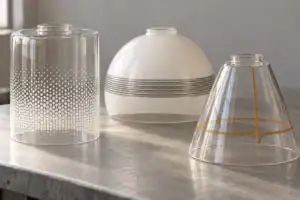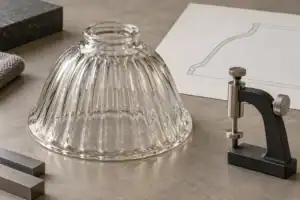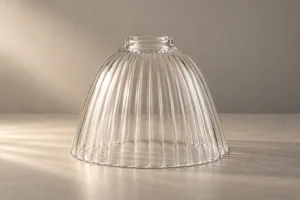
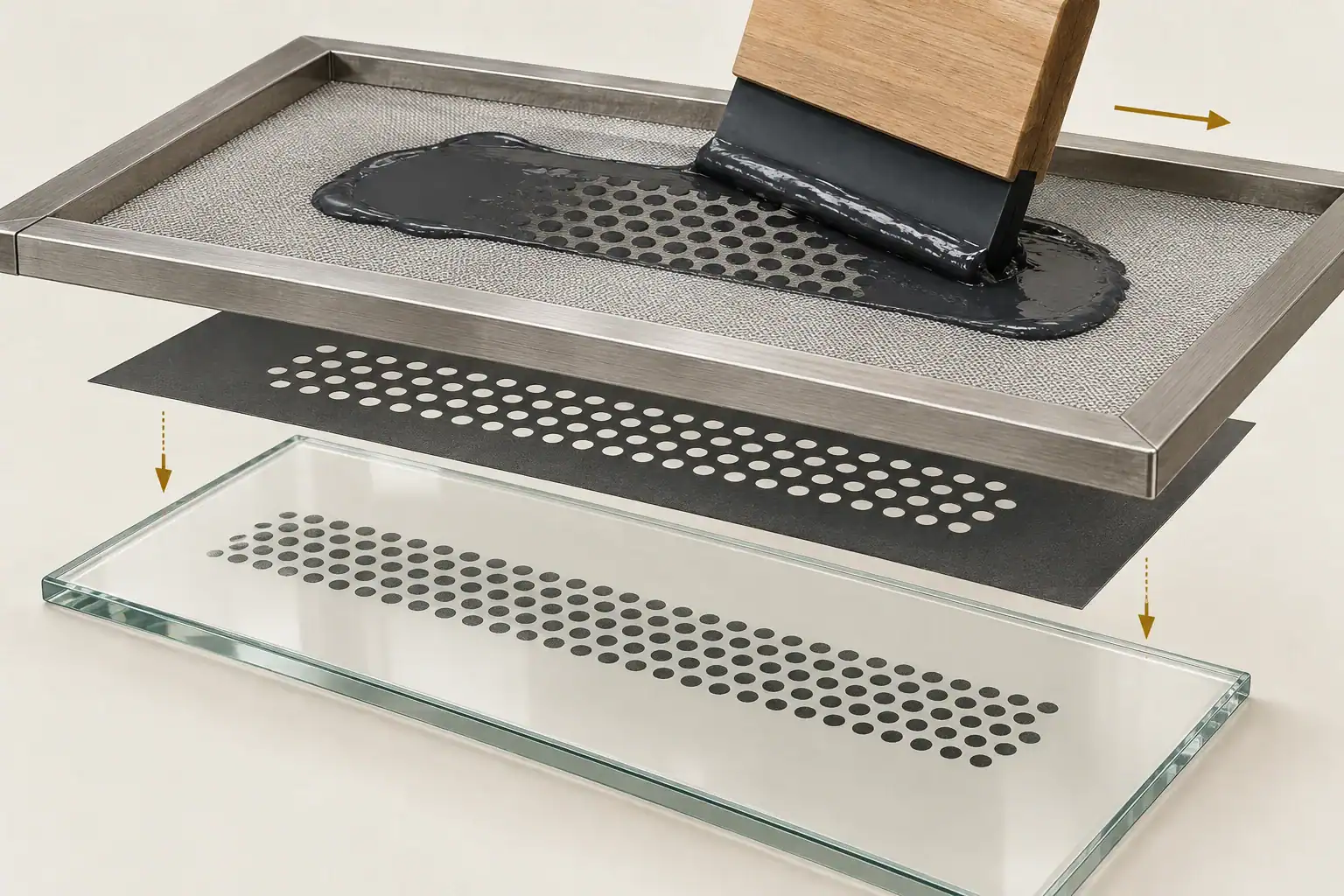
Screen printing on glass transfers ink through a patterned mesh onto the glass surface. For a lamp shade, choose the ink system for the actual glass, operating temperature, cleaning regime and exposure; then qualify print position, adhesion and appearance with the light switched on. A sharp-looking print alone is not enough to release a production batch.
A repeated dotted band or logo can be straightforward on a cylindrical shade and difficult on a hand-blown dome. The artwork may be identical, but the contact geometry, glass variation and lighting result are different. This guide is for lighting production managers and engineers specifying printed glass components, rather than photo prints or a home craft project.
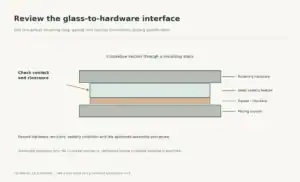
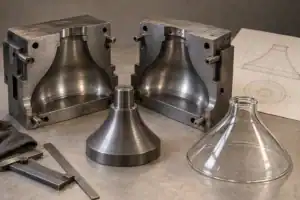
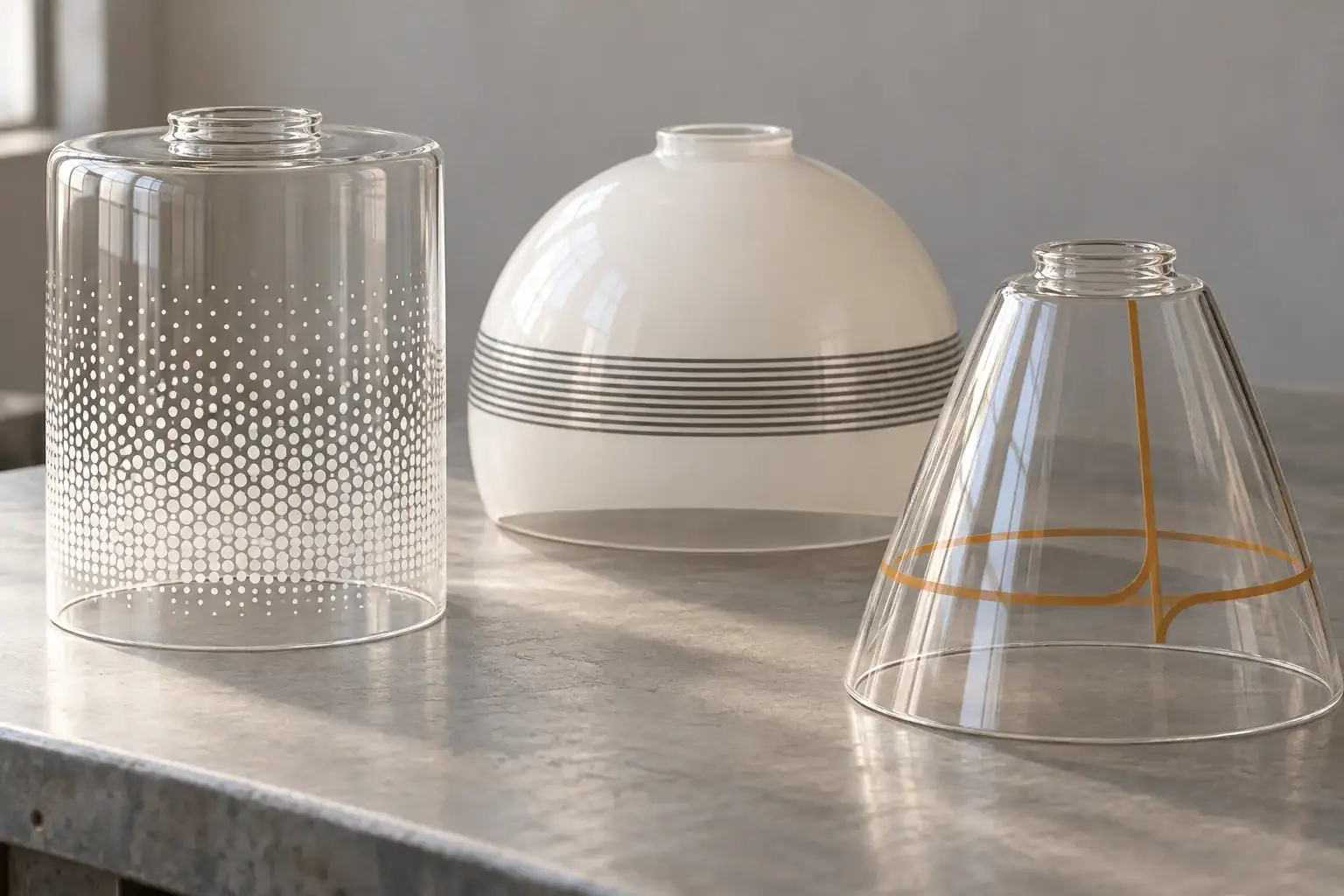
The original AI-generated illustrations below explain specification and inspection concepts. They are not factory photographs, measured optical results or evidence of a particular production capability.
When is screen printing the right glass printing method?
Screen printing is worth evaluating when the design repeats, the color palette is controlled and the shade provides an accessible printing surface. A bold border, a dot pattern, an obscuring patch or a recurring brand mark can justify dedicated screens and locating fixtures. Each added color brings another registration requirement and, usually, another setup or pass.
The equipment manufacturer Inkcups compares screen, pad and digital glass printing and identifies simple repeat designs as a useful screen-printing application. For shade production, the additional question is whether the machine can follow the selected profile without losing contact or loading a fragile rim.
- Consider screen printing: repeated spot-color motifs, controlled coverage and a geometry that can be supported consistently.
- Evaluate pad printing: a small local mark on a curved or irregular surface where a full screen pass is awkward.
- Evaluate direct digital printing: frequent artwork changes, images, multiple colors or personalization, subject to the printer’s shape and ink limits.
- Evaluate a decal: artwork that needs to be transferred to a difficult profile, with its own application and firing or curing requirements.
These are starting points for trials, not universal production rankings. Screen printing, digital printing and pad printing describe how the image is applied. They do not, by themselves, identify the chemistry or durability of the final decoration.
Which ink should be used for screen printing on glass?
Specify the ink family and the product grade separately from the printing method. “Glass ink” is too broad for a purchase order. A suitable system must adhere to the supplied surface and remain acceptable through the intended thermal, cleaning and environmental conditions.
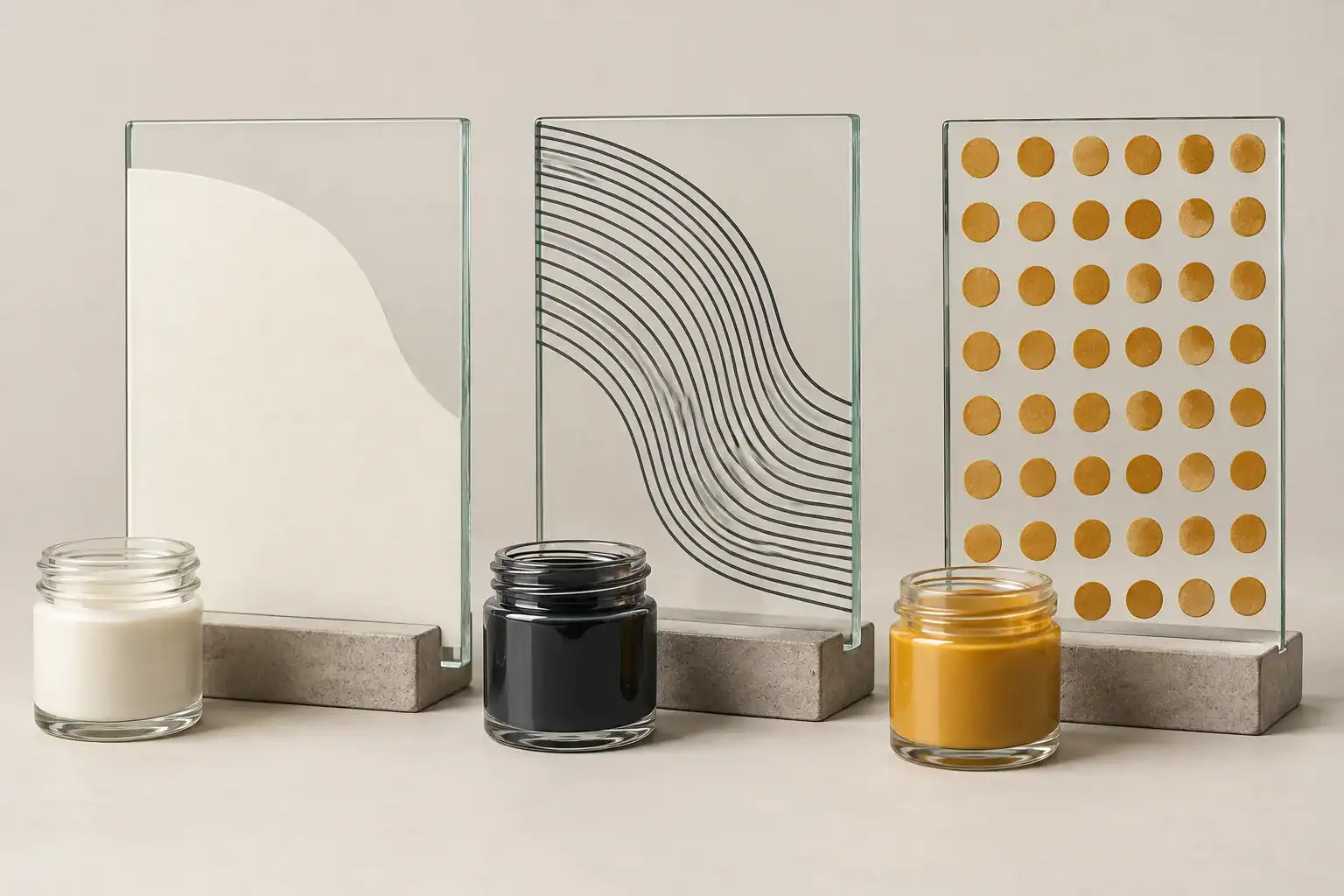
Organic solvent-based systems
These leave an organic coating on the glass and may use a hardener, heat-assisted cure or another product-specific schedule. Record mixing, usable working time and cure conditions from the selected technical data sheet. A print that feels dry may still be short of its required cure.
Do not assume every glass ink can serve an outdoor light. For example, Marabu’s Glass Ink GL data sheet excludes permanent outdoor use and direct indoor UV exposure. That limitation belongs to this ink grade; it should not be generalized to every organic system.
UV-curable organic systems
A UV-curable ink requires a compatible curing source and a validated exposure process. On a curved shade, the wall facing away from the source can receive different exposure from the wall facing it. Ask how the process reaches the full printed area, and how cure will be verified on the actual part.
“UV-cured” identifies a curing mechanism. It does not establish outdoor weather resistance, a maximum service temperature or acceptable behavior near the intended lamp.
Fired ceramic enamel systems
These use a glass-based decorative system that develops its final condition during firing. Compatibility includes the base glass and its geometry, as well as the enamel and firing cycle. A process suitable for a flat architectural panel cannot simply be assigned to a thin blown shade.
Vibrantz’s glass materials portfolio illustrates how specialized these formulations can be across glass applications. Ask the material supplier to confirm the intended substrate and process. “Ceramic” does not automatically mean lead-free, suitable for every glass composition or approved for a finished luminaire.
Useful purchasing rule: select a proposed ink grade only after the supplier has the glass specification and use conditions; release it only after trials on representative shades. A printed flat coupon can help isolate a process variable, but it does not replace the finished-part trial.
How does shade shape affect print position and repeatability?
Separate the glass geometry from the artwork. Cylinders, tapered shades and domes require different ways to bring the surface into contact with the printing system. Compound curves make a wide continuous motif particularly demanding. A small local pattern may be a more realistic starting point than a full wrap.
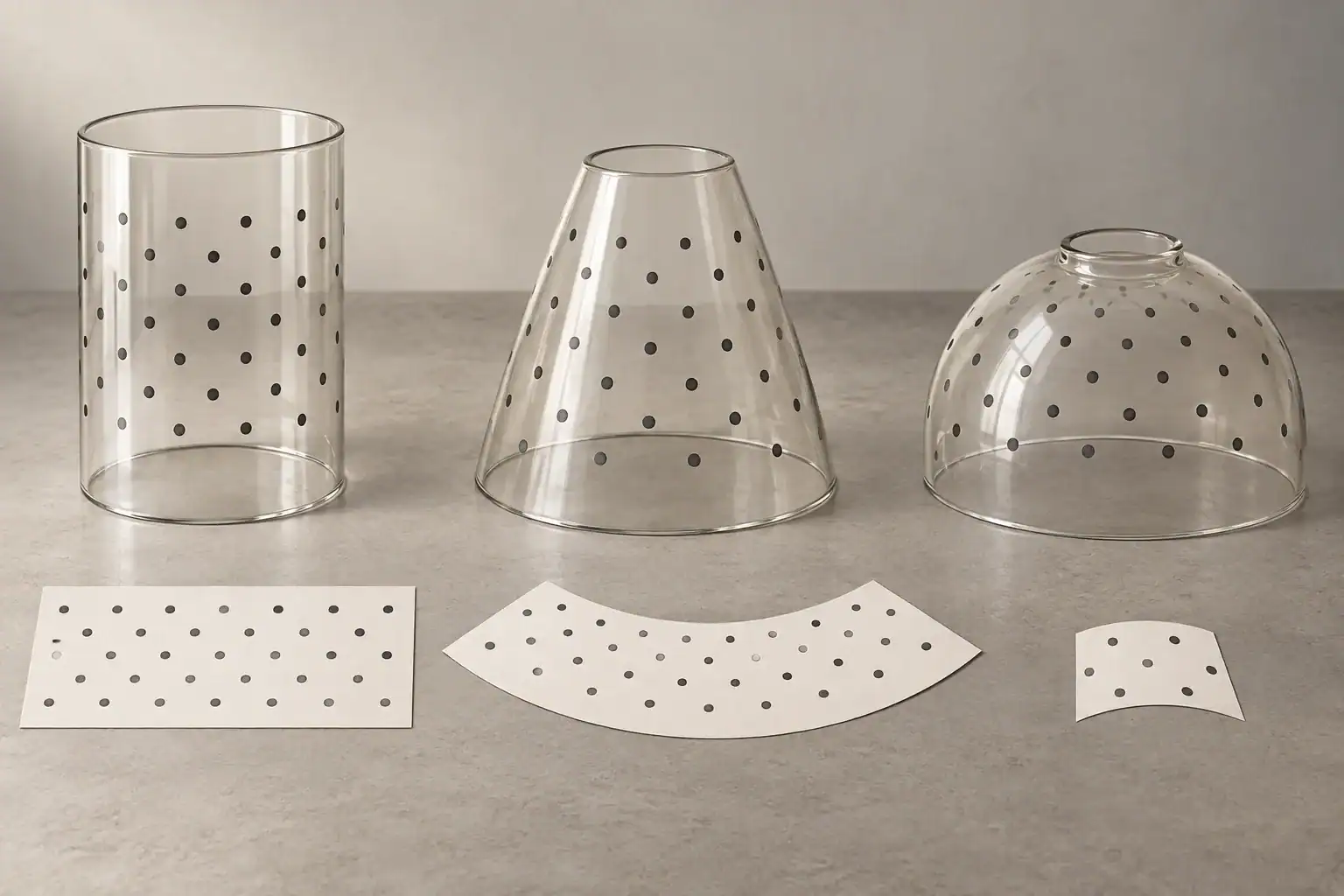
For a cylindrical wrap, circumference changes directly with outside diameter. Hypothetical example: a nominal 100 mm outside diameter corresponds to approximately 314.2 mm circumference, using C = πD. If actual diameter spans 99–101 mm, circumference spans approximately 311.0–317.3 mm. That is a 6.3 mm range for the same nominal shade size.
This calculation is a geometry illustration, not a proposed glass tolerance. It shows why a fixed artwork repeat can leave a gap or overlap when diameter changes. Measure the real print band, define the seam treatment and have the printer establish its artwork allowance. A tapered shade also needs attention to diameter at different heights.
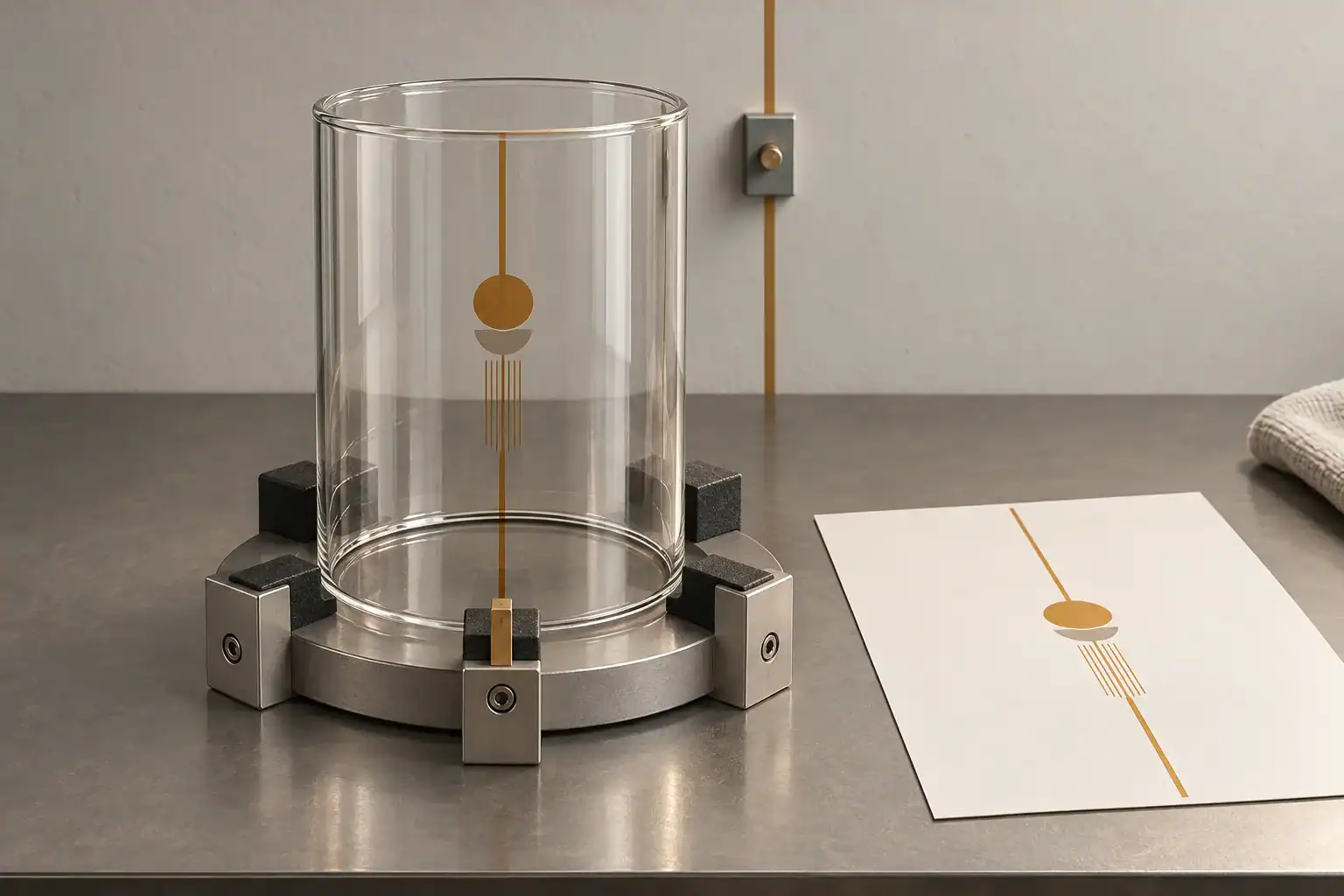
Choose a repeatable locating reference, or datum: a qualified seating face, rim or other agreed feature. State how far the motif sits from that reference and how its rotation is set. On an asymmetric shade, “center the logo” is incomplete unless the drawing identifies the front.
Do not use tighter artwork positioning to conceal an unstable glass profile. If the supported shade tilts or rocks, first resolve the support and part variation. The glass lamp shade drawing checklist helps connect the decorative specification to the physical component.
What must the artwork and shade drawing define?
Supply both a part drawing and a print file. A decorative reference photograph helps communicate the idea, but it cannot establish scale, viewing side or acceptance limits.
- Printed side: inside or outside, with a clearly marked viewing direction. Reverse-side lettering may require mirrored artwork.
- Artwork: revision, scale, spot colors, line widths, repeat direction, registration and treatment of a wrap seam.
- Location: distance from an agreed datum, orientation on the mounted fixture and permitted positional variation.
- Coverage: decorative area, clear zones, opacity target and whether a white backing layer is part of the design.
- Conditions: glass specification, surface finish, intended light source, operating environment and cleaning method.
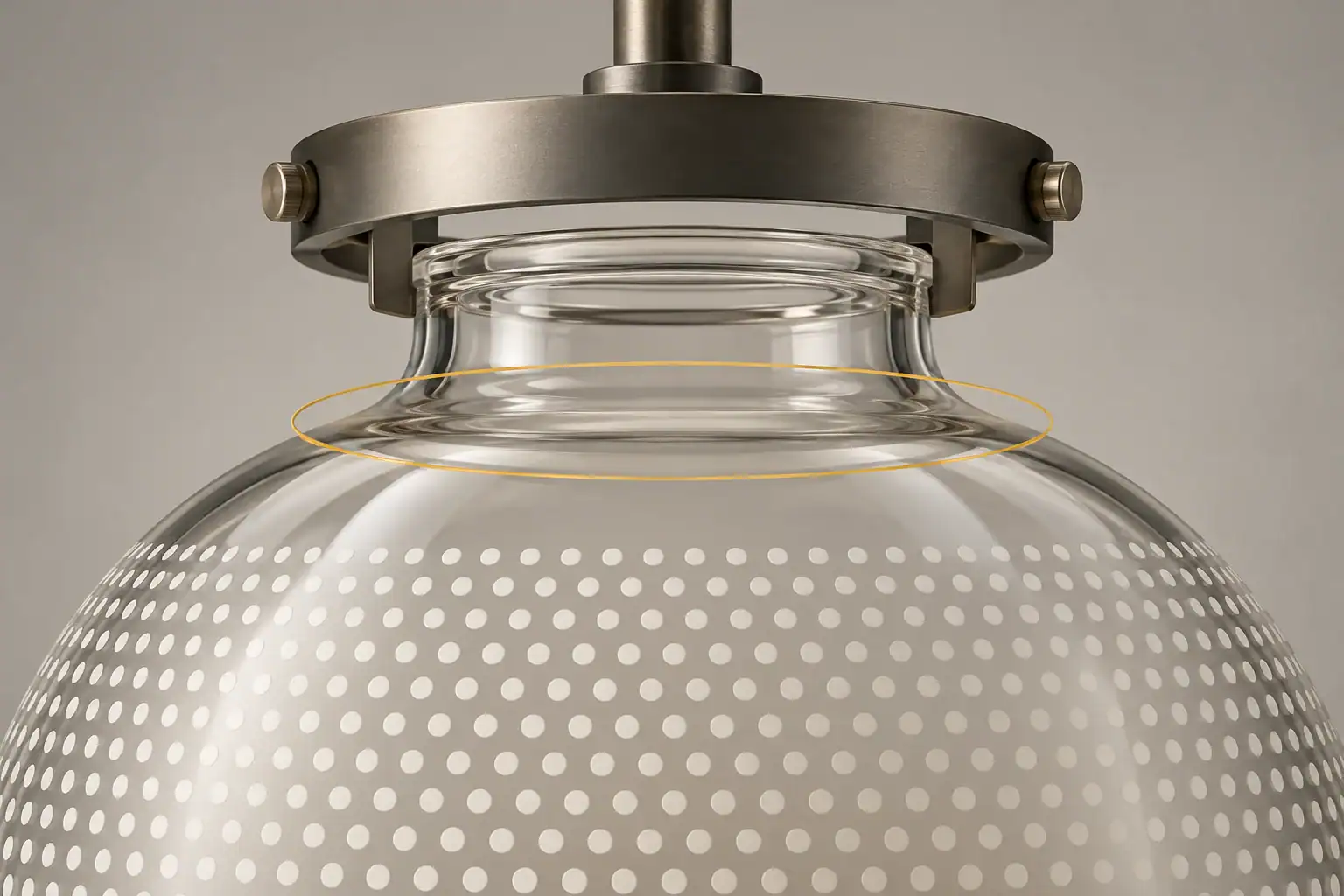
Define unprinted zones around seating faces, threads, contact areas and any surfaces that require clear glass. A coating on a working interface can change its effective size or be damaged during assembly. The necessary clearance belongs on the drawing; there is no universal keep-out distance for every fitter.
For inside printing, confirm access for application, inspection and cleaning. Moving the print inside may reduce direct handling, but it can put the decoration closer to the light source. The choice must be evaluated with the fixture arrangement.
Control the process before judging the finished print
A workable process sheet links each operation to the approved glass and ink combination. It should be detailed enough for a second operator to reproduce the approved sample without relying on memory.
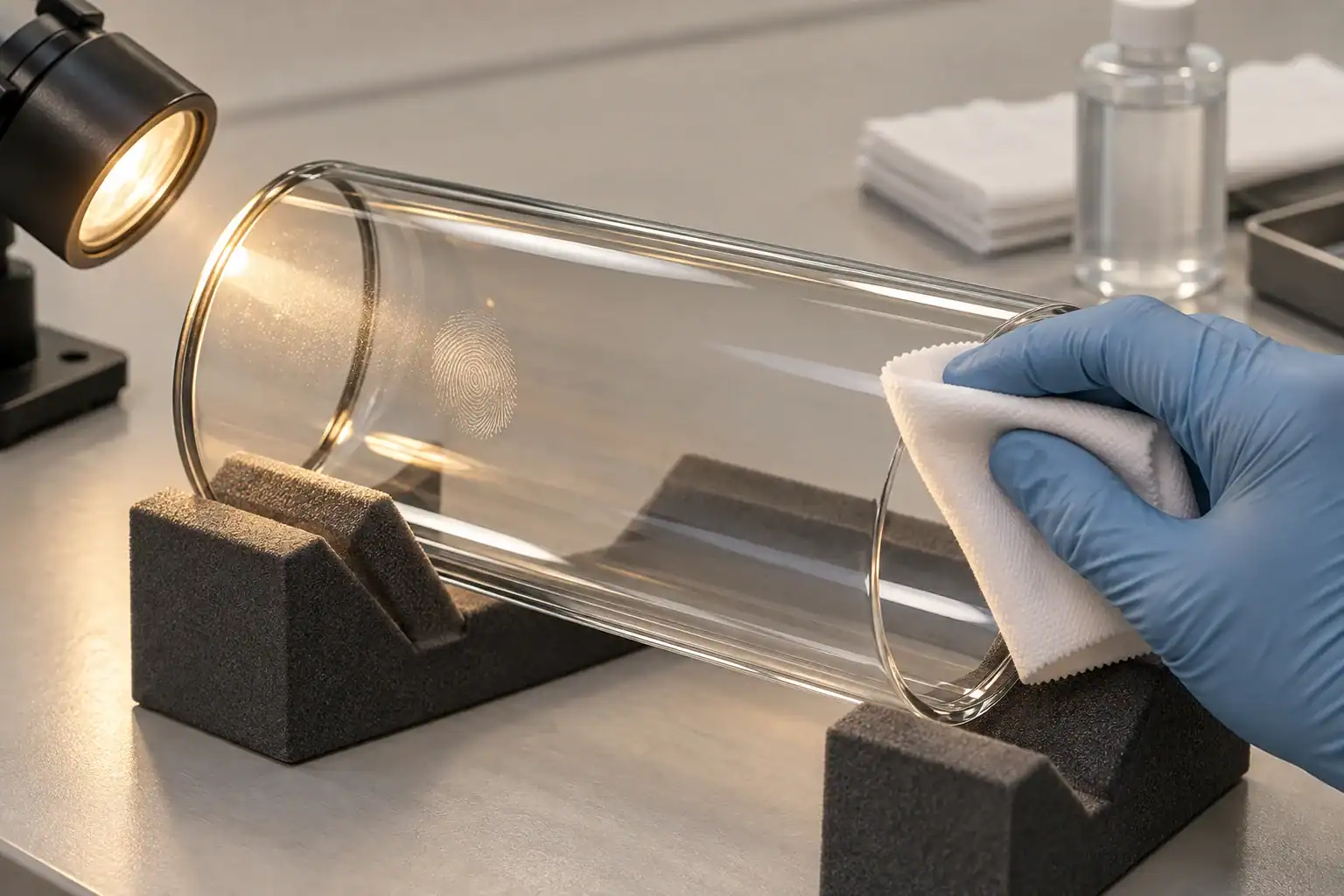
- Identify and inspect the glass. Verify the relevant drawing revision, surface condition and support features before decoration adds cost.
- Prepare the surface. Use the material supplier’s cleaning and pretreatment instructions. Keep fingerprints, dust and incompatible residues away from the print area.
- Prepare the print system. Record the screen, stencil, ink lot and adjustment instructions. Control hardener addition and working time where applicable.
- Locate and print. Support the shade without forcing it into shape. Confirm alignment with a first piece and repeat the check at agreed intervals.
- Cure or fire. Follow the qualified schedule for that system and part. Record what the process actually delivered.
- Condition and inspect. Wait the required interval before handling or performance checks; separate unlit appearance from lit approval.
The Mara Glass MGL technical sheet specifically calls for a clean surface and preliminary suitability trials. Its detailed recipe applies to that product. Copying a mixing ratio or treatment from a different glass ink can invalidate the intended process.
For a fired decoration, agree when dimensional and stress-related checks occur after the thermal cycle. Successful ink firing and acceptable residual stress are different questions. Neither should be inferred from the other.
Approve the shade with the light off and on
Use two appearance gates. Unlit approval addresses color, edge definition, pattern position and surface defects. Lit approval addresses visible light leaks, pattern contrast, source visibility and the appearance of the assembled fixture. Record both against a retained master.
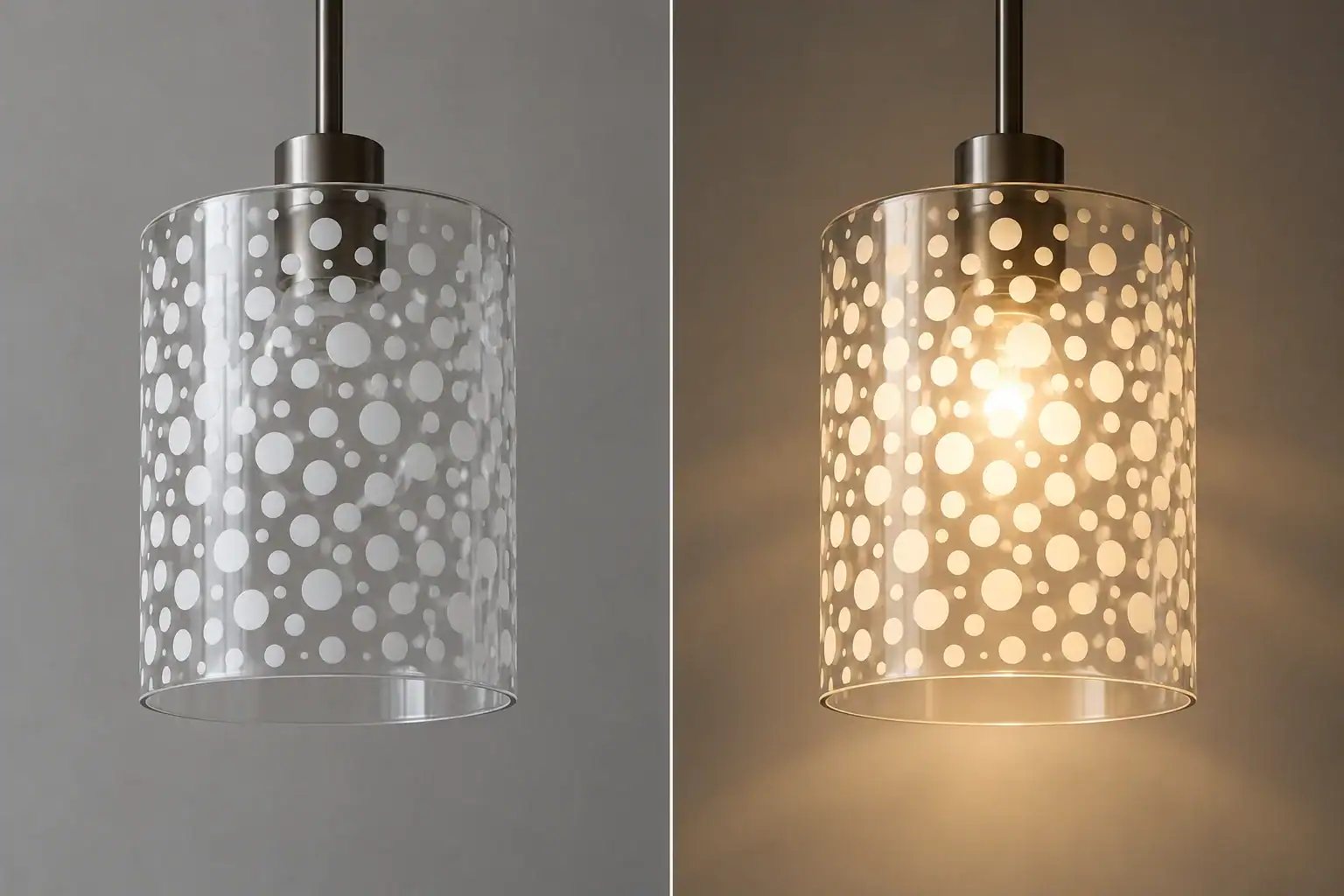
A white printed patch can look even on a dark inspection bench while showing thin regions when backlit. A dark motif can become more dominant when the background lights up. Those effects depend on the actual coating and fixture, so photographs of an unlit sample cannot settle the decision.
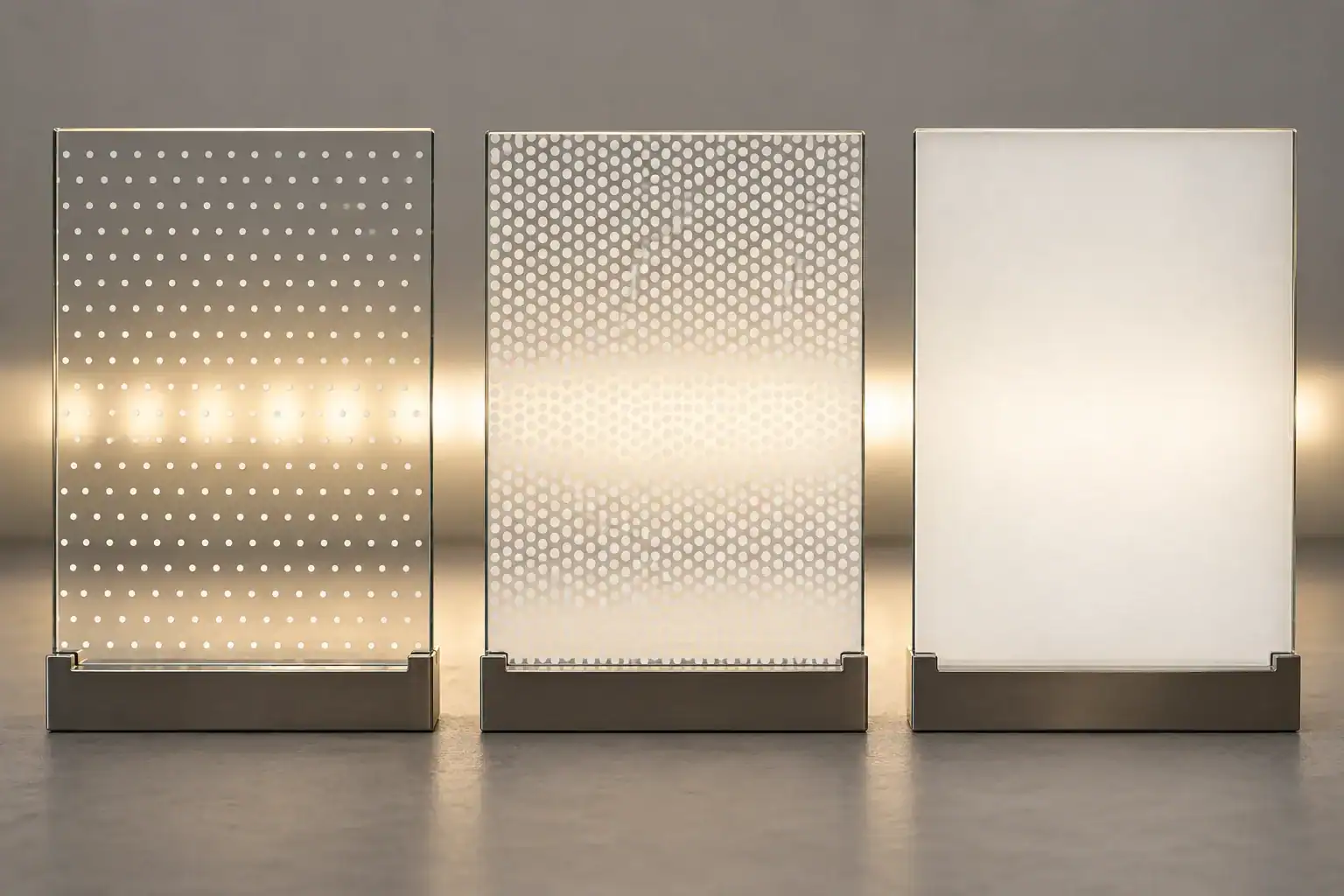
Fix the lamp or LED module, output setting, source-to-glass distance, viewing direction and ambient conditions for comparison. If photographs are part of approval, keep their exposure and white balance consistent. Use measured optical criteria when the application needs them; a camera image alone is not a transmittance measurement.
A dot-pattern area percentage also is not the same as whole-shade light transmission. Ink transmission, glass transmission, reflections and source geometry still contribute. If diffusion is the real requirement, compare the printing proposal with the material options in the clear, frosted and opal shade guide.
What defects should production inspection investigate?
Classify the observed defect before changing the process. Similar symptoms can have several causes. The following checks are investigation prompts, not a diagnosis of a particular shipment.
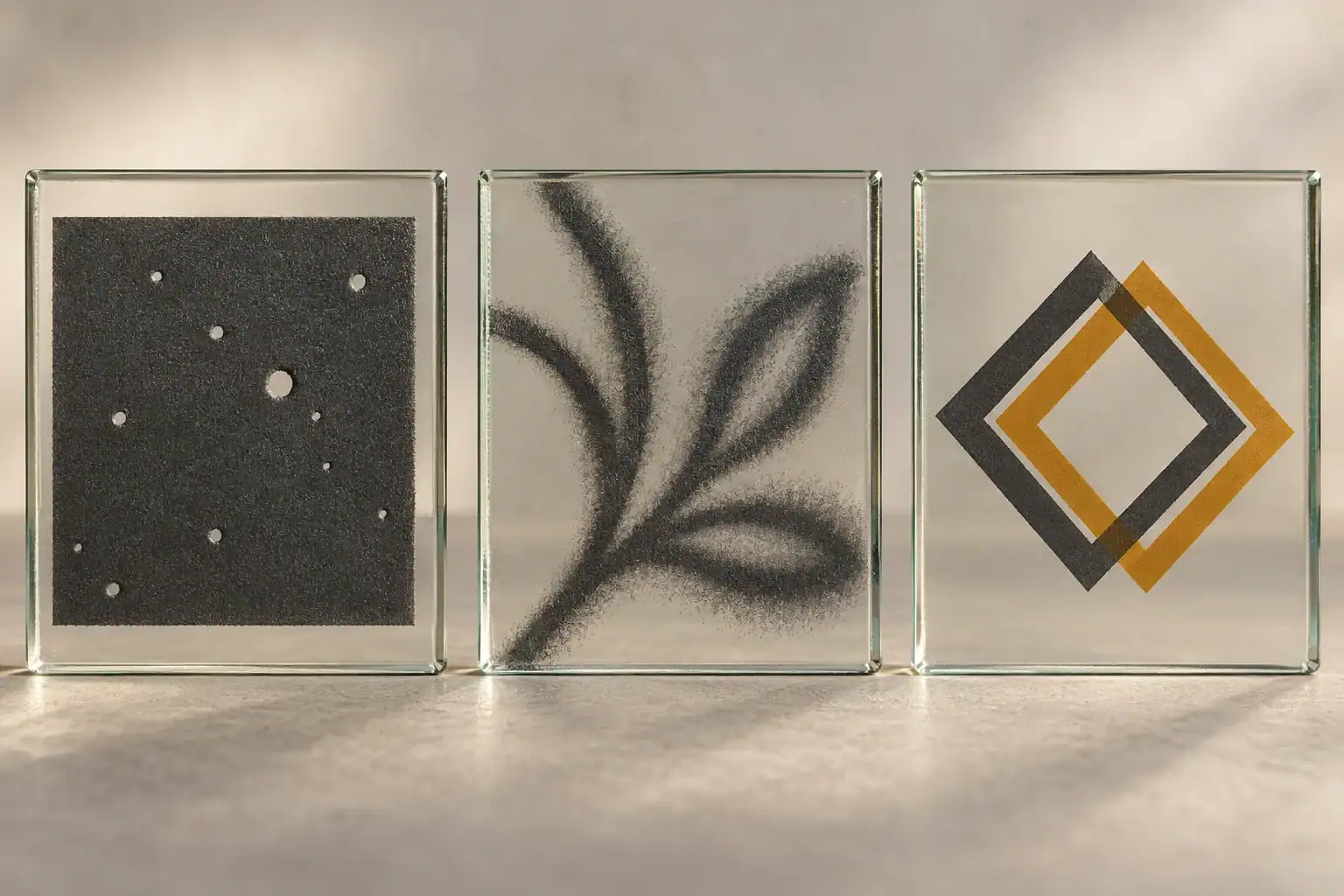
- Pinholes or isolated light leaks
- Compare reflected and transmitted views. Investigate contamination, film coverage and the qualified print settings. Decide whether the defect lies in the ink film or the glass itself.
- Blurred edges or filled fine gaps
- Check the artwork against the approved stencil, then review ink condition, contact and printing settings. A fine feature that works on a flat proof may need a separate curved-part trial.
- Misregistration or a wandering band
- Check the datum, fixture location, glass profile and alignment between passes. Separate whole-image movement from movement of one color relative to another.
- Unexpected gap or overlap at the wrap seam
- Measure the actual print-band diameter and examine the approved seam allowance. Do not correct a geometric mismatch by stretching artwork without rechecking the motif.
- Rub-off, lifting or surface damage
- Hold affected parts and investigate substrate preparation, material identity, cure history and handling. A cosmetic touch-up does not establish restored adhesion.
How should adhesion and service durability be qualified?
Agree the test method, specimen, conditioning, exposure and pass criteria before approving the sample. Include the contacts the component will actually see: handling, packaging, installation, cleaning and operation in the intended fixture. A successful dry rub does not establish resistance to a cleaning chemical.
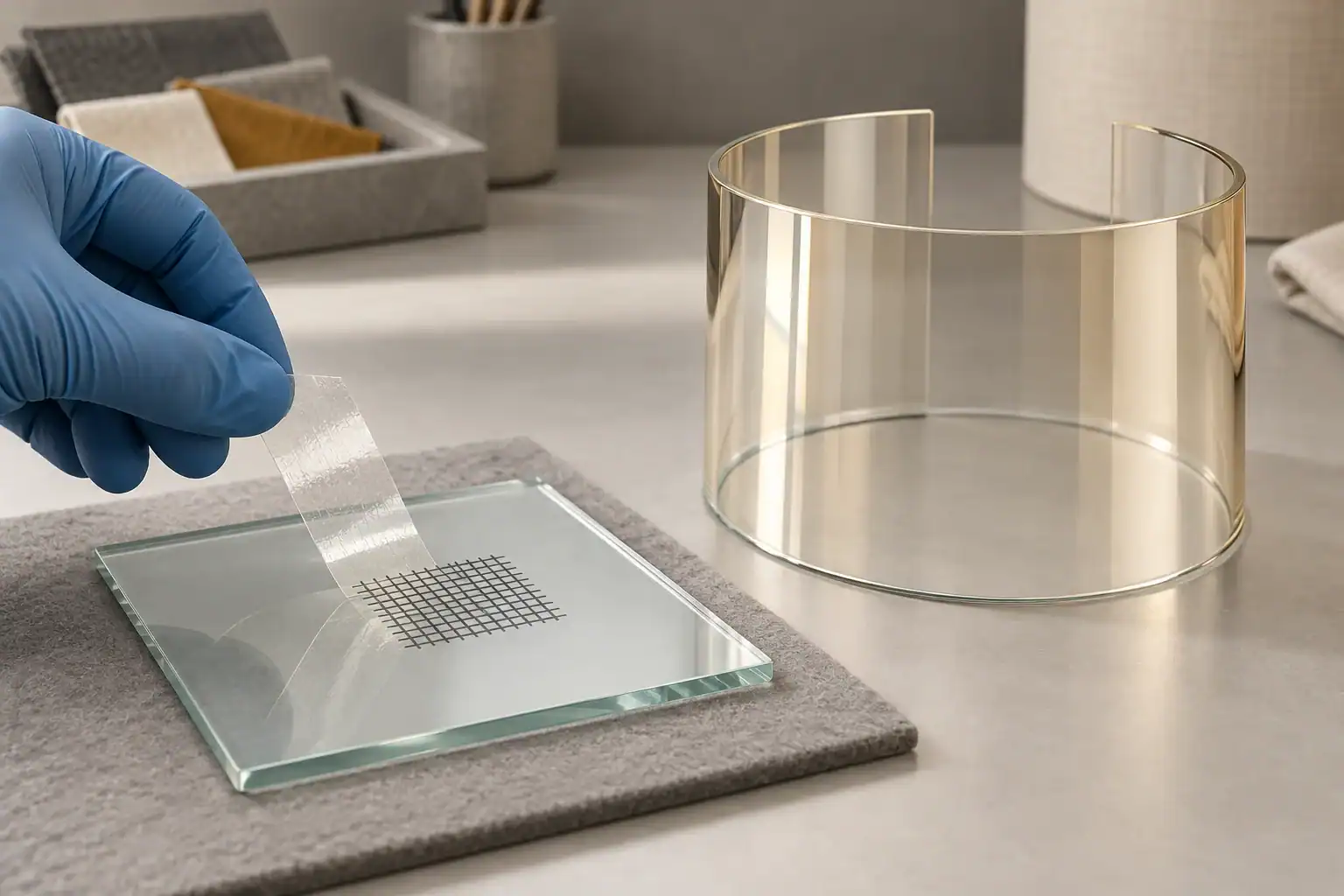
ASTM D3359-23 addresses tape-test ratings for relatively ductile coatings on metallic substrates. Its published scope and notes limit how the result can be interpreted for nonmetallic substrates. An improvised tape pull on a curved glass shade must not be reported as an unqualified ASTM D3359 compliance result.
Have the supplier or laboratory determine an appropriate protocol for the particular coating and shape, document any adaptation and keep results traceable. A representative flat coupon can help compare preparation or cure; finished shades are still needed to assess access, curvature, assembly contacts and local exposure.
For outdoor use, obtain evidence relevant to the proposed ink grade and actual exposure. For thermal evaluation, use conditions established for the complete luminaire. An ink data sheet or decorated shade alone does not certify the electrical, mechanical or thermal safety of the assembled light.
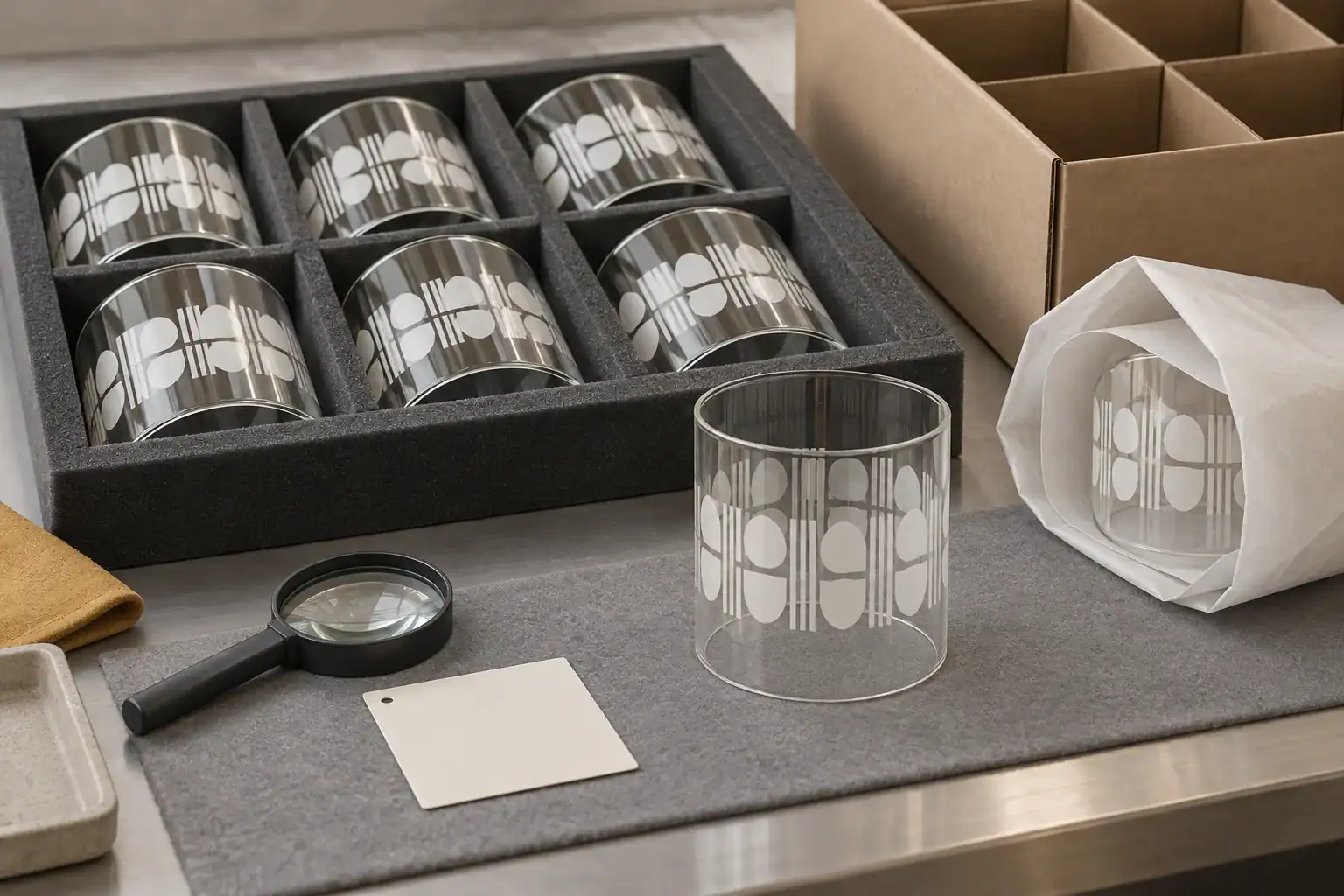
For batch release, retain the artwork revision, material lots, process record, sample identification and inspection results. Set the sampling and rejection rules by agreement. Avoid a generic “zero defects” promise without defining what is inspected, under which conditions and on how many parts.
How do printing choices affect unit cost and yield?
Compare the cost per accepted shade, including setup, decoration, qualification and rejects. More colors, more artwork versions or a difficult profile can change the economics even when the printed area is small.
Hypothetical costing example: suppose a decoration setup costs $200 and the decoration operation costs $0.80 per processed shade. For 500 processed pieces with 95% accepted yield, decoration cost per accepted piece is ($200 + 500 × $0.80) ÷ 475, or approximately $1.26. At 85% yield, the same spend divided by 425 accepted pieces becomes approximately $1.41.
These figures are invented planning assumptions, not JX pricing or measured yield. They exclude the glass body, freight and other costs. If rejected printed shades also consume paid glass bodies, the full cost effect is larger. Ask quotations to separate screens, locating fixtures, artwork changes, trial pieces, testing, production decoration and packing.
Send a specification that can be reviewed for production
A useful request starts with the shade and fixture, then adds decoration. Include the part drawing or sample, holder interface, artwork file, print location, desired appearance when lit, order quantities, use environment and cleaning requirements.
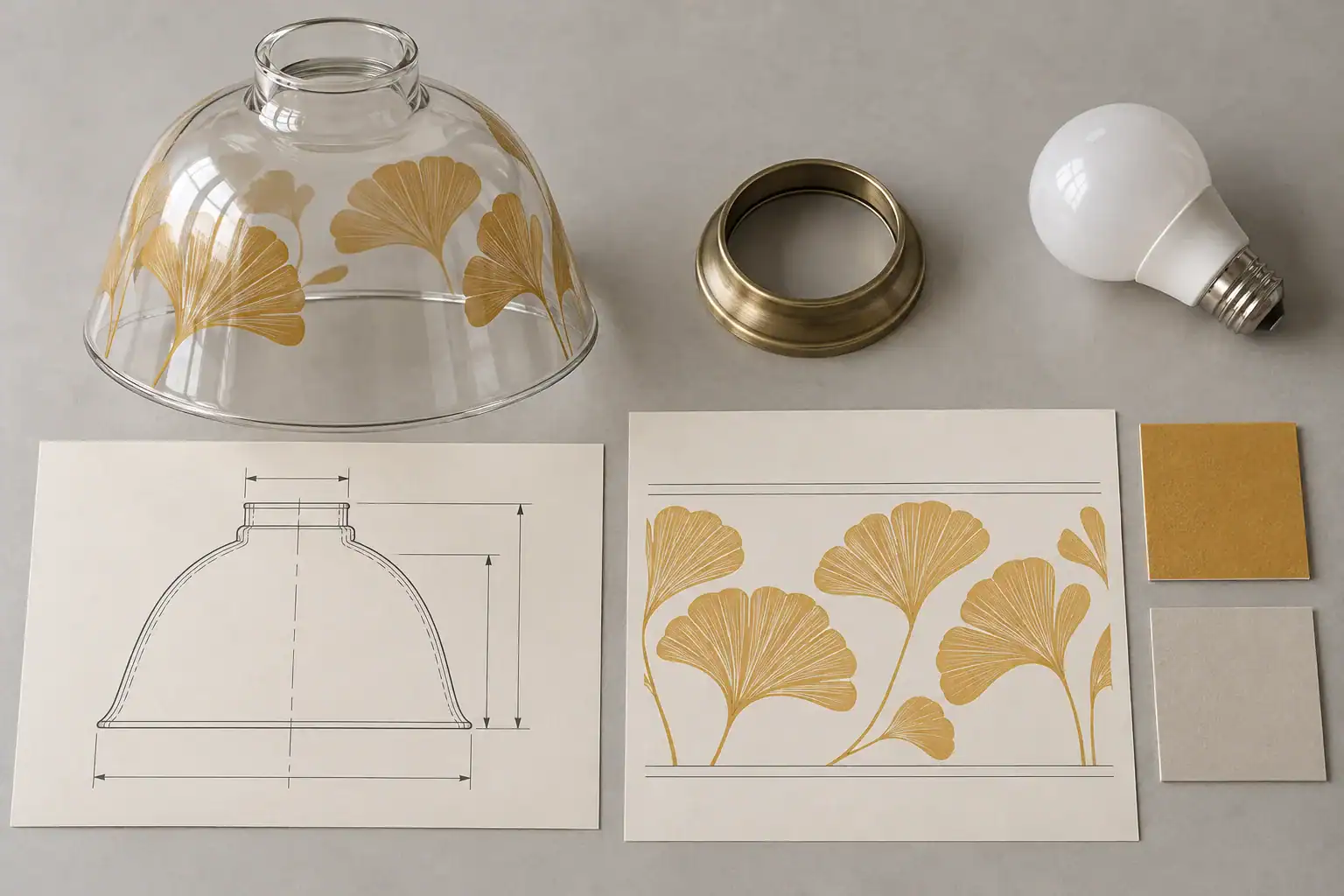
For example: “Review a one-color white dot pattern on the outside of this cylindrical glass shade. The attached drawing marks the unprinted mounting zone and the artwork start position. Please propose the ink system and sample qualification plan for the supplied LED fixture and cleaning conditions.” That gives the reviewer a technical task instead of an undefined request for “durable glass printing.”
JX’s custom glass lamp shade manufacturing page provides the broader route for a drawing-based project. Use the custom lampshade RFQ builder to organize the part and application details, and request confirmation of printing feasibility and the proposed production arrangement. A quote request should not assume a particular ink brand or printing process is available.
Questions about screen-printed glass lamp shades
Is silk-screen printing different from screen printing?
In this context, the terms describe the same stencil-and-mesh transfer method. “Silk-screen” does not identify the current mesh material, ink chemistry or cure process. Those still need to be specified.
Does UV printing work on glass?
Compatible UV printing systems can decorate glass after the required preparation. “UV printing” may describe digital inkjet application or a screen-applied UV-curable ink. Confirm the application method, glass compatibility, cure and required service resistance for the actual component.
Can a glass lamp shade have a full 360-degree print?
A suitable geometry and printing system may allow a wrap, but the seam and the part’s dimensional variation need approval. Cylindrical examples do not establish feasibility for domes, deep bells or compound curves.
Is ceramic enamel always the best choice?
No single system fits every shade. Fired enamel requires compatibility with the glass and thermal process. Compare it with qualified organic alternatives against the actual appearance, service conditions, geometry and production plan.
What is the minimum order for printed glass shades?
It depends on the shape, tooling, decoration route and number of artwork versions. Request a project-specific sample and production quote. A fixed MOQ cannot be inferred from the printing method alone.
Can printed glass replace opal glass for diffusion?
A printed coating or pattern can change the visible light distribution, but it is not automatically equivalent to opal glass. Approve the assembled lighting result and measure the optical properties needed for the application.
Release the decoration as part of the shade specification
Keep the glass drawing, artwork, ink system, process and acceptance record together. Approve the mounted sample with the light off and on, then make batch checks refer to the same conditions. When the next order arrives, that record is more useful than a photograph and a color name.
Send your shade drawing and artwork for feasibility review.
Related articles
- Glass Lamp Shade Technical Drawing Checklist: 12 Details Buyers Should Send for a Quote
- Glass Lamp Shade Quality Inspection Checklist: 20 Checks Before Shipment
- How to Compare Glass Lamp Shade Supplier Quotes: FOB, Tooling, Samples, Packaging and Reorder Costs
- Clear vs Frosted vs Opal Glass Lamp Shades: Which to Choose in 2026
- Acid Etching vs. Sandblasting Glass Lampshades: The Complete Technical Guide for Lighting Manufacturers
- Custom Glass Lamp Shades Manufacturer: OEM/ODM Process Explained