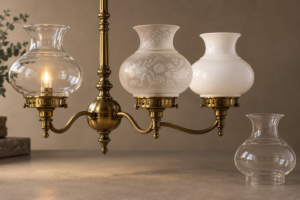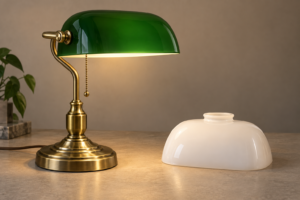
Quick answer
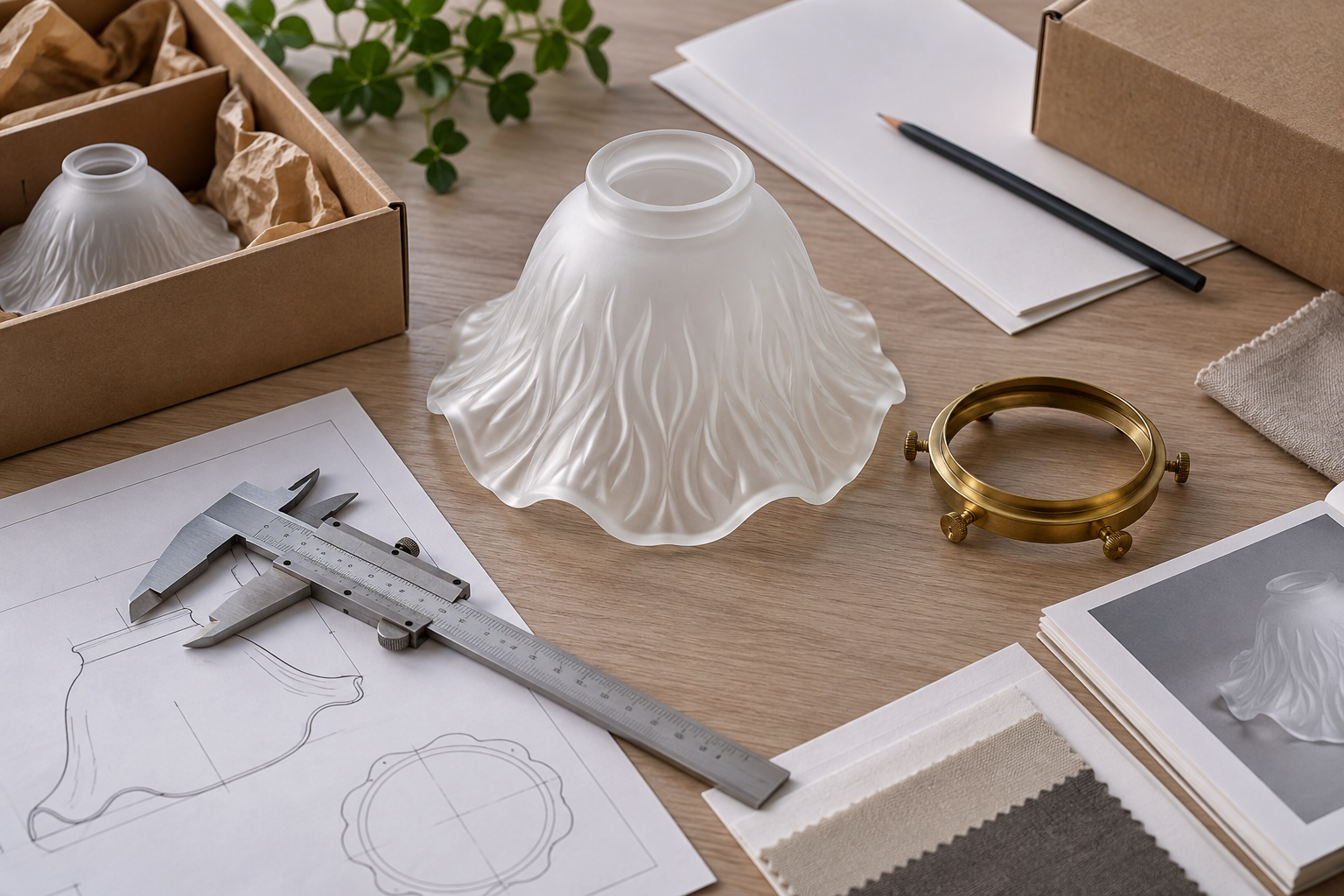
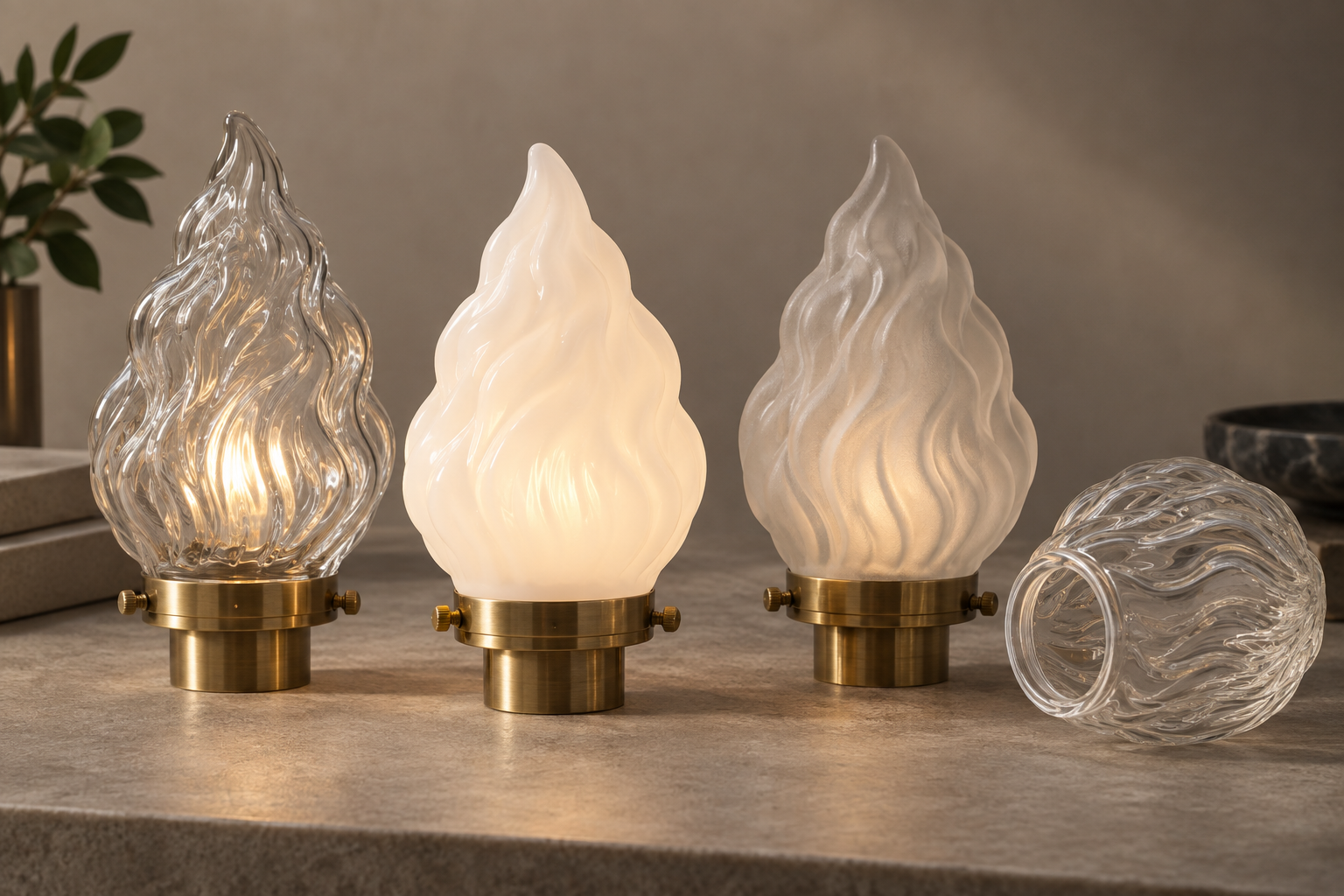
A flame glass lamp shade is a curved glass shade with a tapered or pointed upper profile and a fuller lower body. It is used on period inspired pendants, chandeliers, wall fixtures, restoration projects and custom lighting. The name describes the visible silhouette, not a universal fitter standard. A reliable replacement must match the original shade profile, fitter opening, lip or neck, holder, outside diameter, height, glass finish and light source clearance.
For a replacement, photograph the complete fixture and measure the surviving gallery or socket hardware before ordering. For an OEM project, send a drawing or sample, target dimensions, glass color, finish, edge treatment, expected order pattern and packaging requirements. JX can review those details with the engineering team and identify a suitable glass process, sample route, tolerance discussion and quotation basis.
This guide is written for lighting manufacturers, lighting brands, restoration suppliers, distributors, wholesalers, product designers and procurement managers. It explains how to identify a flame profile, compare it with similar glass shapes, measure a replacement and prepare a practical OEM RFQ.
What is a flame glass lamp shade?
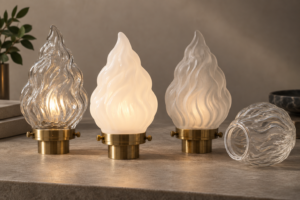
The phrase flame glass lamp shade usually refers to the outline of the glass. From the side, the body may taper upward toward a smaller neck, curve outward through the shoulder and widen toward the lower opening. Some versions have a pointed top, while others use a softer flame inspired curve. The profile can be clear, etched, frosted, opal, milk, colored, seeded or lightly patterned.
The term is useful for product discovery, but it does not identify every dimension that makes a shade fit. Two shades can both be called flame shades while having different neck diameters, fitter openings, body widths, rim shapes or overall heights. Retail titles also combine the profile with words such as vintage, antique, pendant, replacement, 3 1/4 inch fitter or satin glass. Those phrases should be treated as starting points for identification, not as a substitute for measurement.
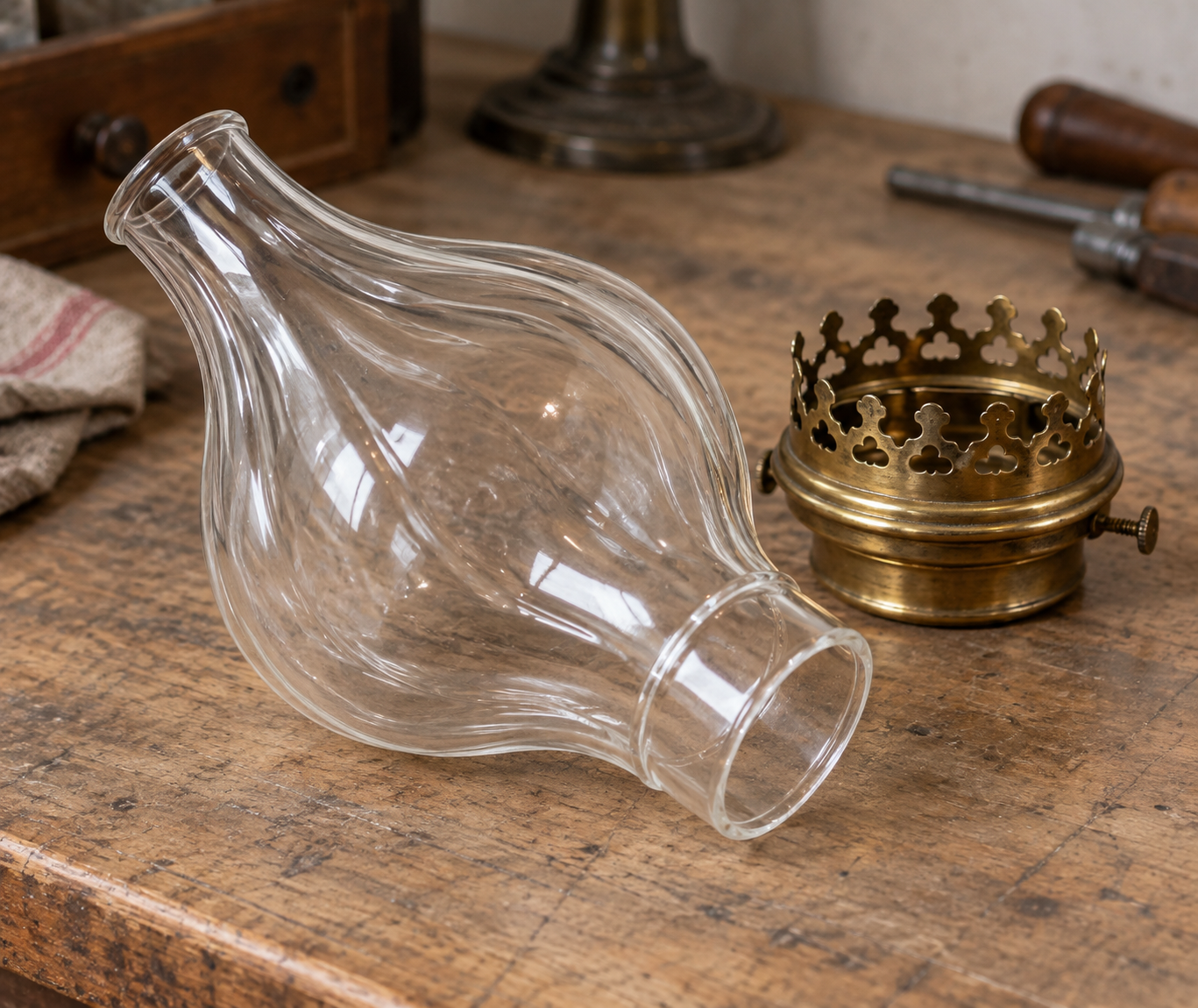
For a useful technical description, record the following:
- the shade profile from the side and from the bottom;
- the fitter opening, neck or lip that enters the holder;
- the outside diameter at the widest body point;
- the overall height from the seat to the opposite end;
- the edge condition, such as ground, polished, rolled or covered by a holder;
- the glass body, translucency, color and surface pattern;
- the retaining method, including a gallery, ring, clip, screw or socket holder;
- the lamp type and the clearance required around the light source.
If the original shade is broken, send photographs of the metalwork from several angles. The gallery or holder often preserves more reliable evidence than a retail name.
How to identify the flame shape
Start with the silhouette rather than the finish. Place the surviving shade on a protected surface and photograph it upright, from the side and from the fitter end. If only fragments remain, photograph the largest curved piece next to a ruler and keep every fragment in case the original radius can be reconstructed.
Flame profile compared with bell, globe and flared shades
A flame shade commonly has a directional, tapered outline. A bell shade normally expands from a smaller fitter into a broad lower skirt with a comparatively simple bell curve. A globe shade is more evenly rounded. A flared shade may open quickly from the neck without the fuller lower body or pointed upper movement associated with a flame profile.
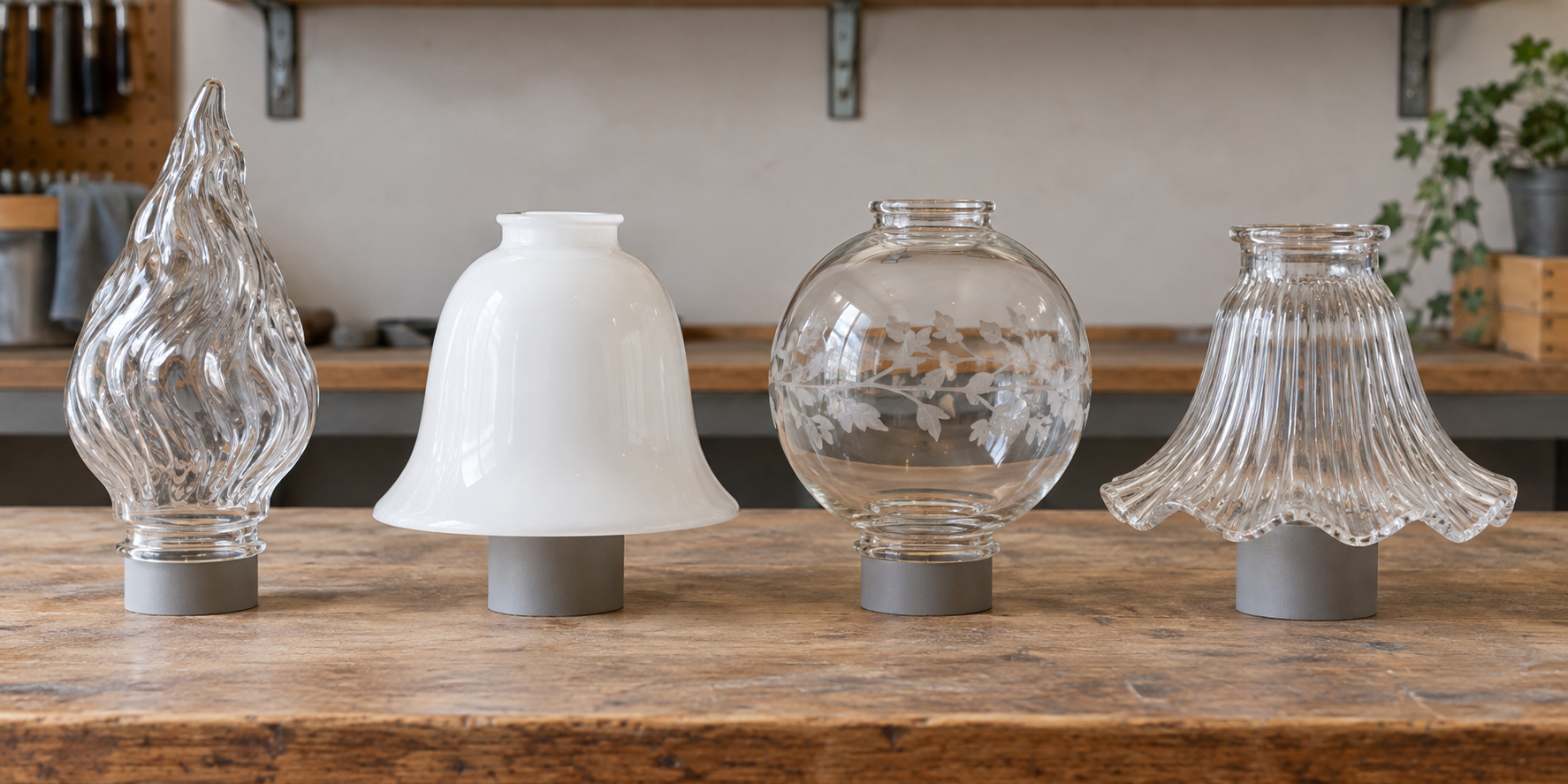
The differences are not always obvious in a catalog photograph. Use the following identification questions:
- Does the glass become visibly narrower toward one end while the body keeps a fuller curved section?
- Is the shoulder gradual, angular, ribbed or decorated with an etched pattern?
- Does the lower edge form a wide open mouth, a small aperture or a holder covered by a metal ring?
- Is the upper end closed, necked, open or shaped to meet a gallery?
- Does the fixture require the shade to hang from the fitter, sit on a lip or be retained by a ring?
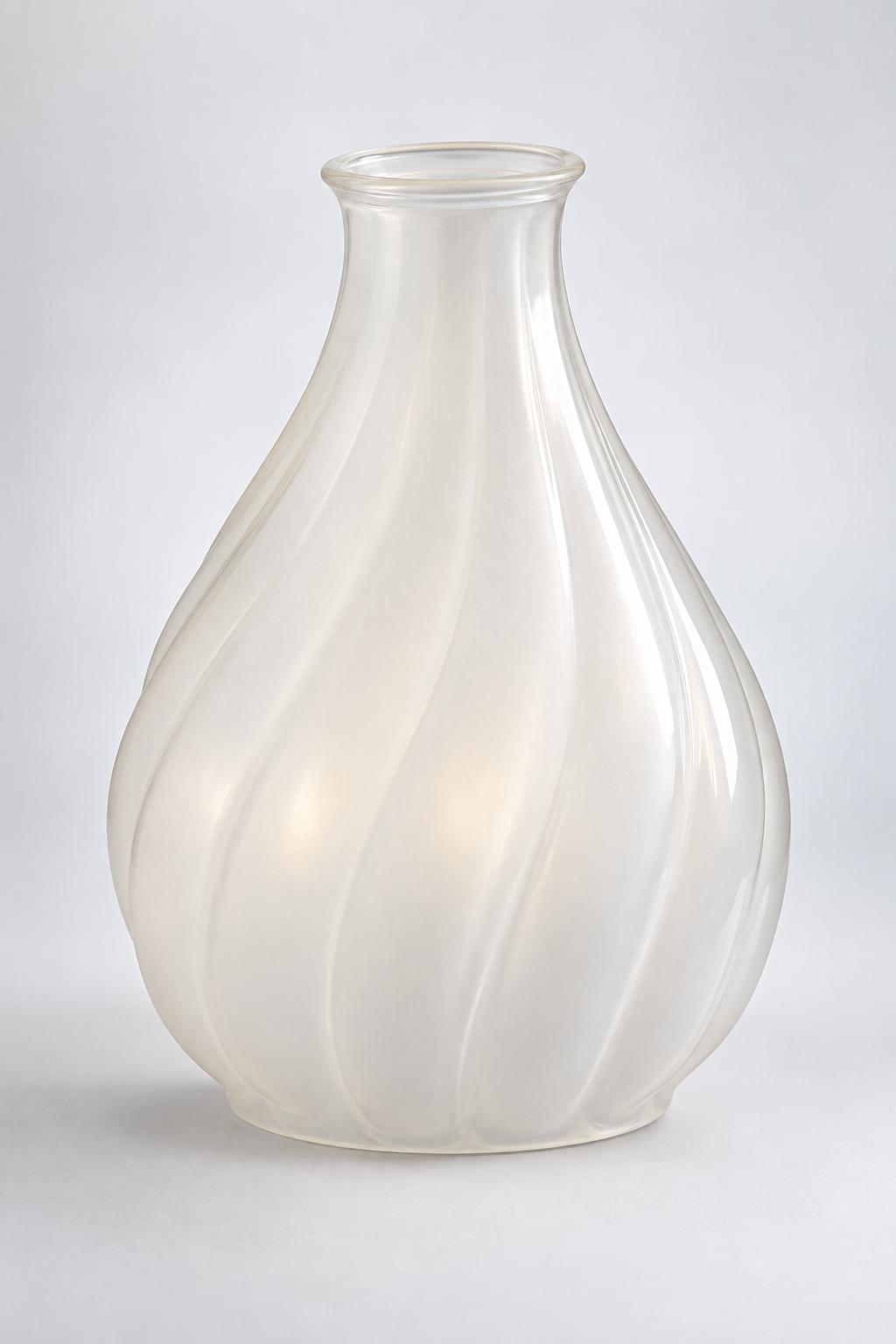
If the answer to the first question is yes but the other dimensions are unknown, describe the item as a flame profile shade pending fitter confirmation. This wording is more useful for a supplier than assuming that every flame shade uses the same holder.
Common applications
Flame glass lamp shades can support several lighting applications. The correct application description helps a manufacturer understand the expected visual scale and fitting environment.
- Period restoration: Replacing a damaged shade on an antique style pendant, chandelier, sconce or gas style fixture.
- Hospitality and residential collections: Developing a period inspired glass shade for a lighting brand or interior project.
- Decorative pendants: Combining a flame profile with a ceiling canopy, stem or suspension system.
- Wall and ceiling fixtures: Using a fitter and retaining ring to keep the glass aligned with the backplate or gallery.
- Custom lighting programs: Developing one approved sample and repeating the profile across several finishes or sizes.
- Restoration supply: Providing a repeatable replacement when an original glass shade is no longer available.
The application affects more than appearance. A ceiling mounted shade may need a different retaining strategy from a hanging shade. A narrow neck can change the position of the light source. A deeply colored or opal body may change the perceived brightness. Confirm the complete fixture design before finalizing the glass.
Flame glass shade size chart
There is no single universal size chart for flame glass shades. The following ranges are a quotation planning framework, not a promise that every holder accepts every size. Confirm the original sample, the metalwork and the intended lamp before selecting a nominal size.
| Planning group | Typical use | Body diameter to record | Overall height to record | Fitter information needed |
|---|---|---|---|---|
| Small flame profile | Sconce, small pendant or compact restoration fitting | Widest outside diameter | Seat to top or seat to lower rim | Opening or neck, seat depth and retaining method |
| Medium flame profile | Decorative pendant, chandelier arm or general replacement | Widest outside diameter and shoulder width | Full glass height and visible glass height | Holder diameter, lip or ring relationship |
| Large flame profile | Statement pendant, high ceiling fixture or larger restoration fitting | Body diameter, mouth diameter and clearance | Full height, suspension position and light source position | Gallery size, support points and load path |
| Custom proportion | New collection, matched family or unusual historic glass | Drawing controlled dimensions | Drawing controlled dimensions | Full interface drawing and approved sample |
Record the widest point, not only the lower mouth. A shade can fit through a holder opening and still collide with a gallery, socket, arm or nearby shade because its shoulder is too wide. Record the height with the shade resting on its actual seat. Measuring from the wrong edge can shift the light source relative to the glass.
Fitter size comparison: 4 inch and 6 inch lip references
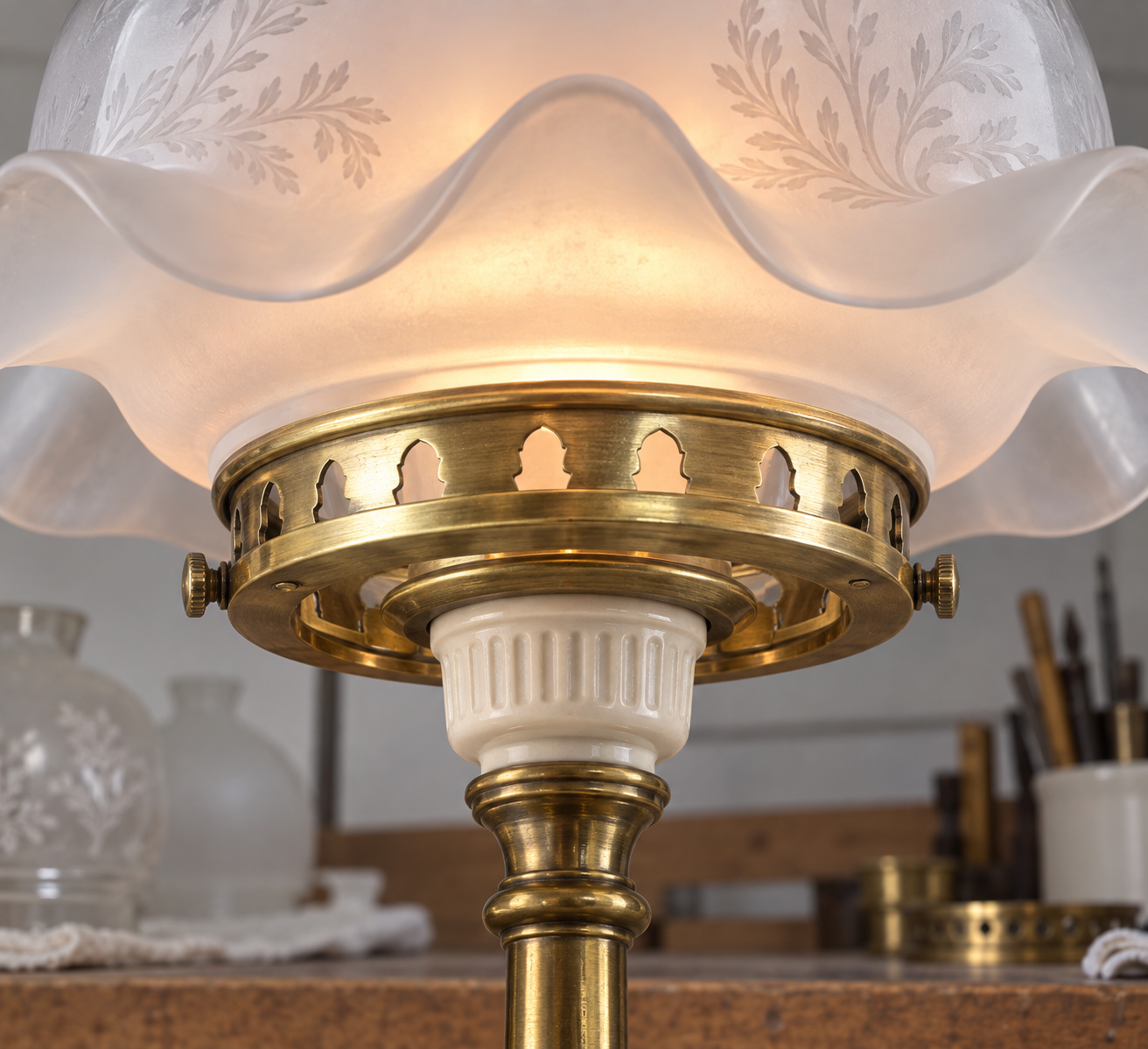
Buyers often search for 4 inch or 6 inch lip fitter glass shades. These phrases may refer to the visible lip, fitter diameter, holder reference or a supplier's catalog grouping. They are not sufficient instructions for production until the exact contact surface is defined.
| Fitter reference | What the buyer may be describing | What must be verified | Common quotation mistake |
|---|---|---|---|
| 4 inch lip or fitter reference | A smaller holder or a nominal lip dimension used in a catalog | Whether the measurement is inside diameter, outside diameter, lip diameter or seat diameter | Treating the catalog number as the glass opening without checking the holder |
| 6 inch lip or fitter reference | A larger gallery, collar or visible support reference | Holder geometry, glass wall contact, retaining ring and clearance | Ordering a larger body because the visible lip is larger |
| Neck fitter | A glass neck inserted into a gallery or ring | Neck outside diameter, shoulder location, neck length and edge finish | Measuring the outer body instead of the neck |
| Lip fitter | A rim or lip supported by a holder | Lip outside diameter, underside seat and retaining method | Ignoring the underside seat and rim thickness |
| Custom interface | A nonstandard or historic holder | Full drawing, sample hardware and installation photographs | Guessing from a similar retail title |
For a precise definition, write the measurement name beside every number. For example, say “holder inside diameter” or “glass neck outside diameter,” not simply “6 inch fitter.” Send a cross section if the glass seats inside a ring. The engineering team can then confirm which dimensions control the fit.
How to measure a replacement flame glass shade
Measure the fixture first if the original glass is missing. If the original glass is available, measure both the glass and the hardware because a previous replacement may not have been the correct size.
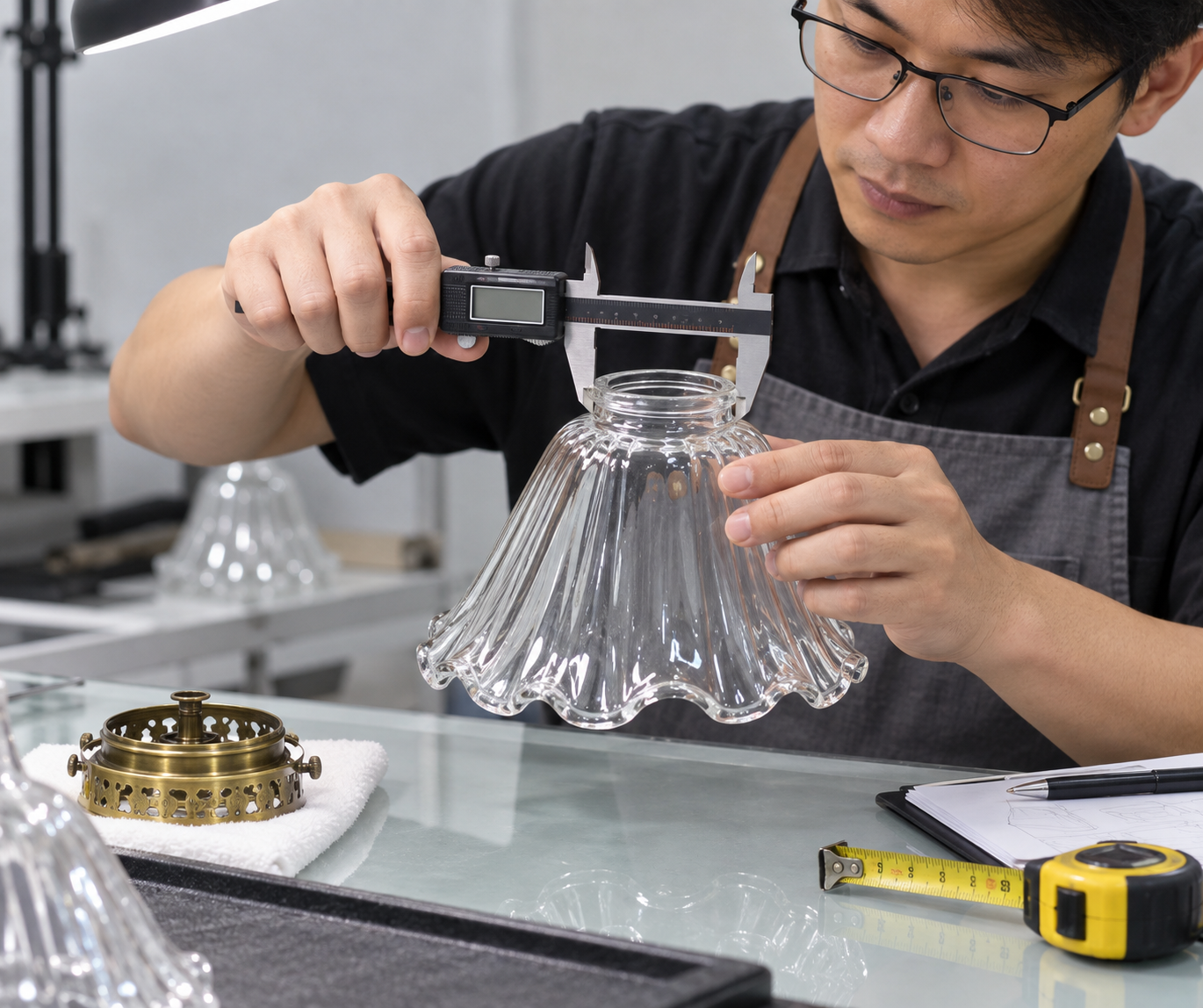
Measurement sequence
- Photograph the assembly. Take front, side, bottom and close interface photographs. Include an unmarked ruler or a known reference object for scale, but do not rely on a photograph alone for final production.
- Measure the fitter opening. Record the inside diameter and outside diameter separately. If the opening is oval, record both axes.
- Measure the seat. Note the depth, shoulder position, lip width and any point where a retaining ring contacts the glass.
- Measure the body. Record the widest outside diameter, the mouth diameter, the shoulder diameter and the distance between those points.
- Measure the height. Measure from the actual seating line to the opposite end. Note whether the top is open, closed or necked.
- Inspect the edge. Describe whether the edge is ground, polished, rounded, rolled or hidden by hardware. Photograph chips, wear or heat marks.
- Record the light source. Identify the socket, lamp type and position. Confirm clearance requirements with the fixture designer or responsible engineer.
- Send a sample when possible. A broken original, a metal gallery or a 3D profile can resolve uncertainties that numbers alone cannot.
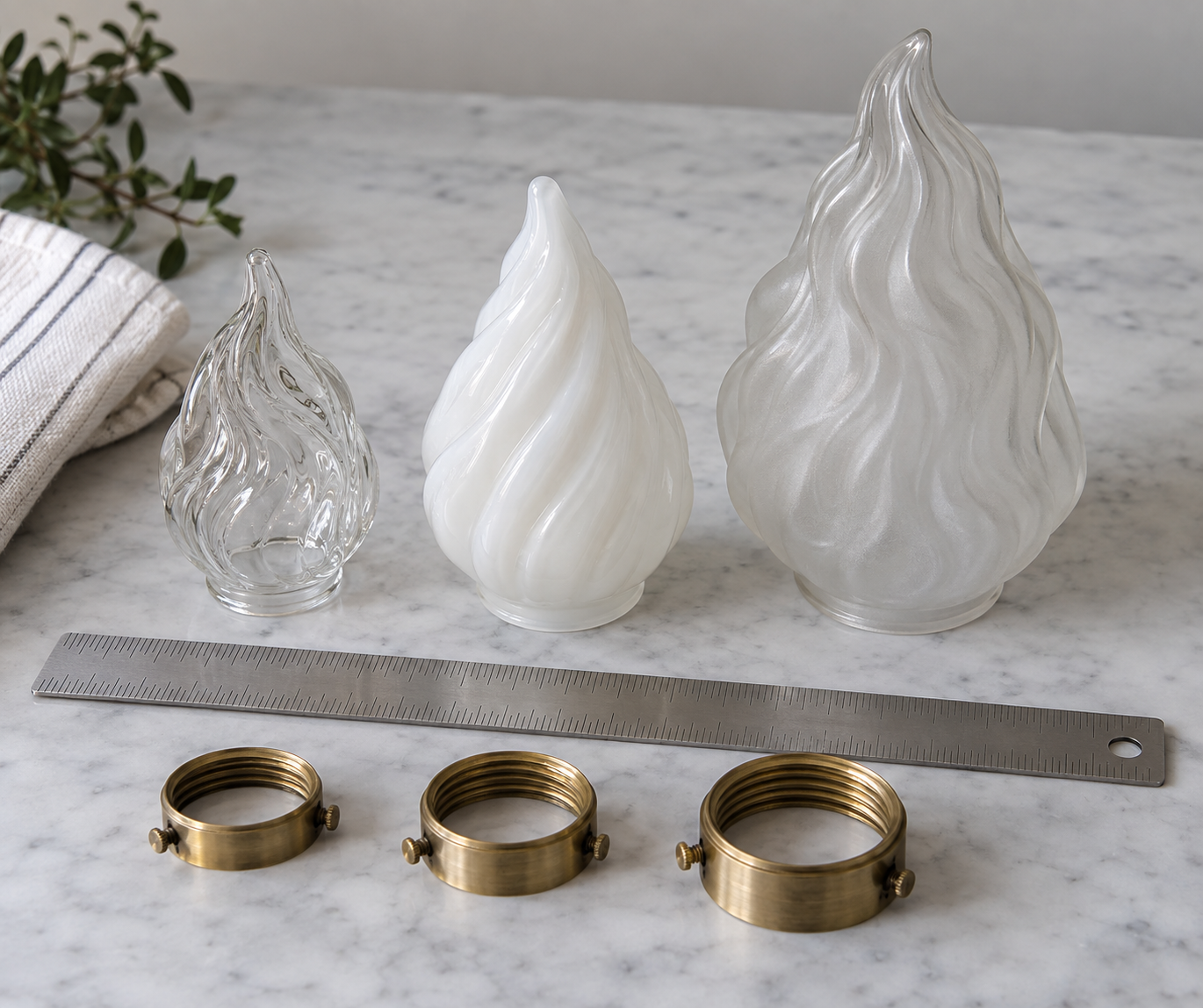
Do not press a metal caliper hard against a fragile edge. If the shade is cracked, use a noncontact measurement where possible and ask the supplier how to package the sample. Confirm final dimensions from a drawing or approved sample before mass production.
Glass finishes and light diffusion
Finish changes the way a flame shade is seen when the lamp is off and how the light is distributed when it is on. It also changes the visual relationship between the glass and the fixture metal.
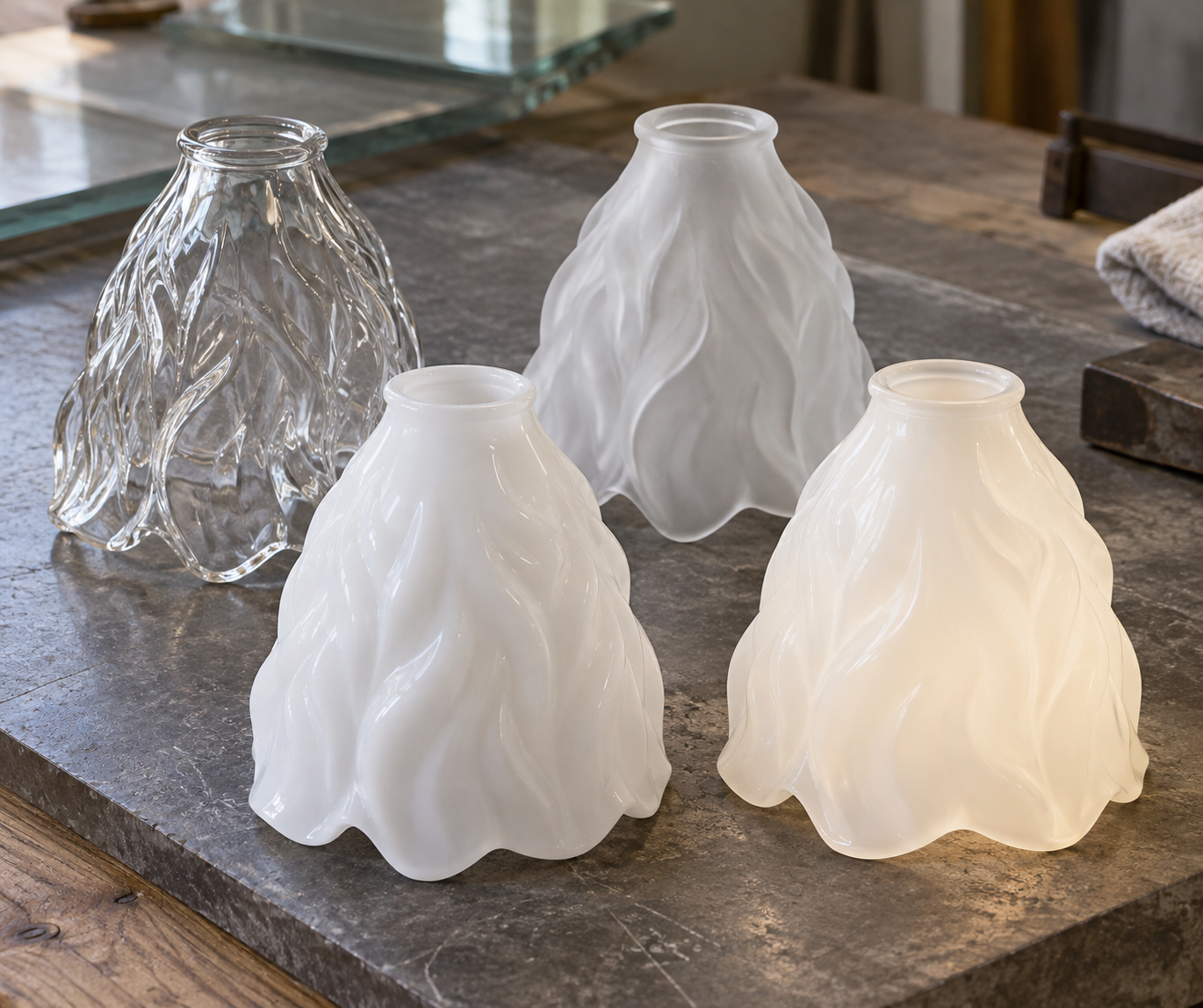
| Glass finish | Visual appearance | Light diffusion tendency | Typical buyer question |
|---|---|---|---|
| Clear | Transparent body with strong view of the lamp and hardware | Higher transmission and more visible bright points | Will the fixture and light source remain visually exposed? |
| Frosted or satin | Softened surface with reduced reflection | More even appearance than clear, with moderate diffusion | Is the surface texture consistent across the visible body? |
| Opal | White or softly translucent body | Strong diffusion and reduced view of the source | How much opacity and color neutrality does the collection need? |
| Milk glass | Dense white appearance, often with a vintage visual association | Soft ambient effect, with the exact result depending on body and finish | Does the replacement match the existing milk glass tone? |
| Seeded | Small bubbles or texture intentionally visible in the glass | Diffusion and sparkle vary with thickness and seed distribution | Is the pattern repeatable enough for a production batch? |
| Colored or iridescent | Transparent, translucent or surface colored body | Depends on color density, coating and body transmission | Is the color specified by a physical sample or a target reference? |
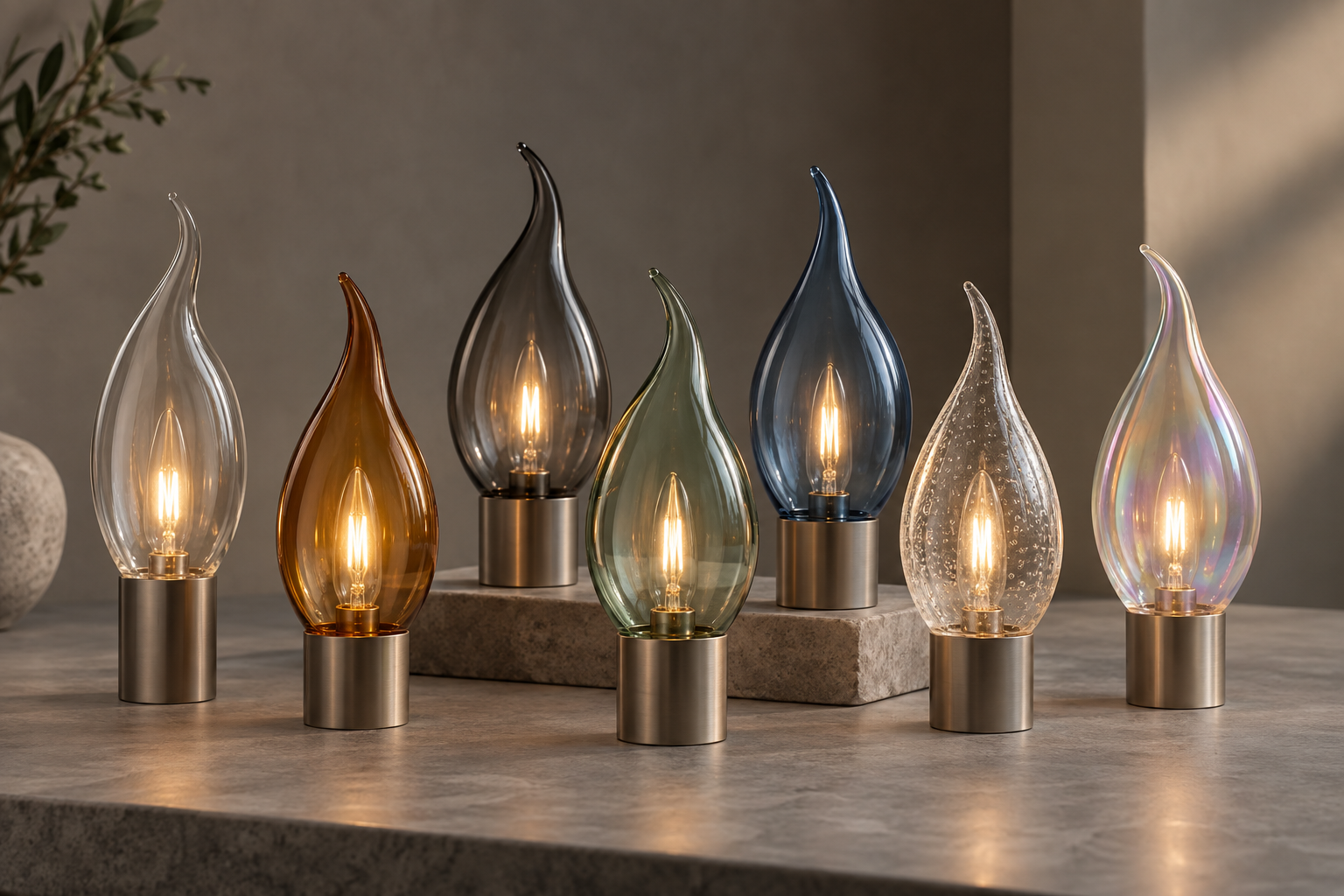
Light diffusion comparison
A clear shade usually shows the lamp and holder more directly. A frosted or satin shade softens the view while preserving some glass character. Opal and milk glass can produce a more uniform visual field, but they may reduce the visibility of the filament or LED source. Seeded glass adds texture and can break up reflections, while colored glass changes the perceived warmth and output.
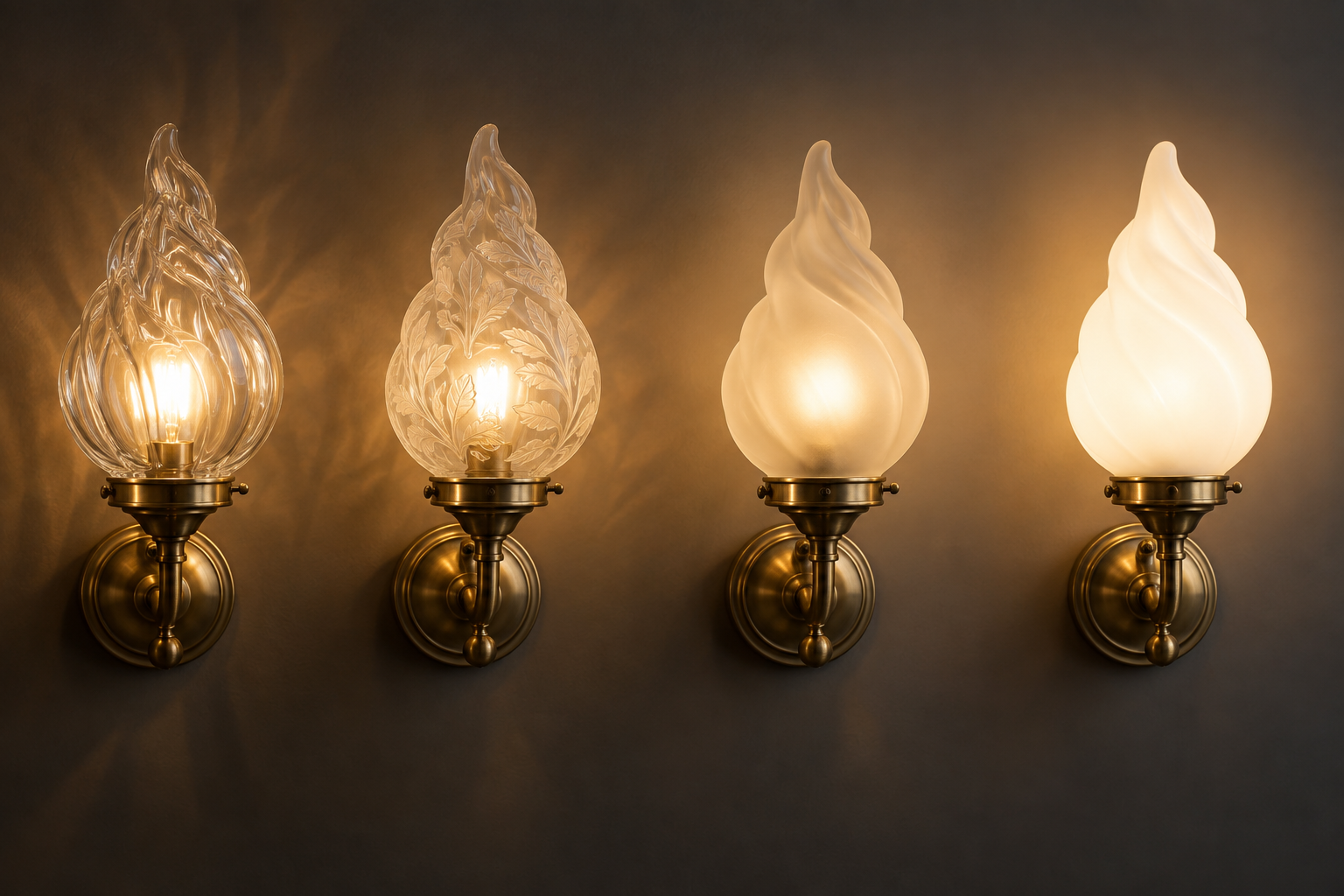
These descriptions are qualitative. They are not photometric test results. If a project has a target for glare, transmission, luminance or color, the buyer should define the test method and confirm the result with the responsible lighting engineer. The production team can review the glass type, thickness, finish and sample conditions before giving a manufacturing recommendation.
Mouth blown versus machine pressed flame shades
The production method influences the way a flame profile is developed, repeated and inspected. Neither route is automatically correct for every order.
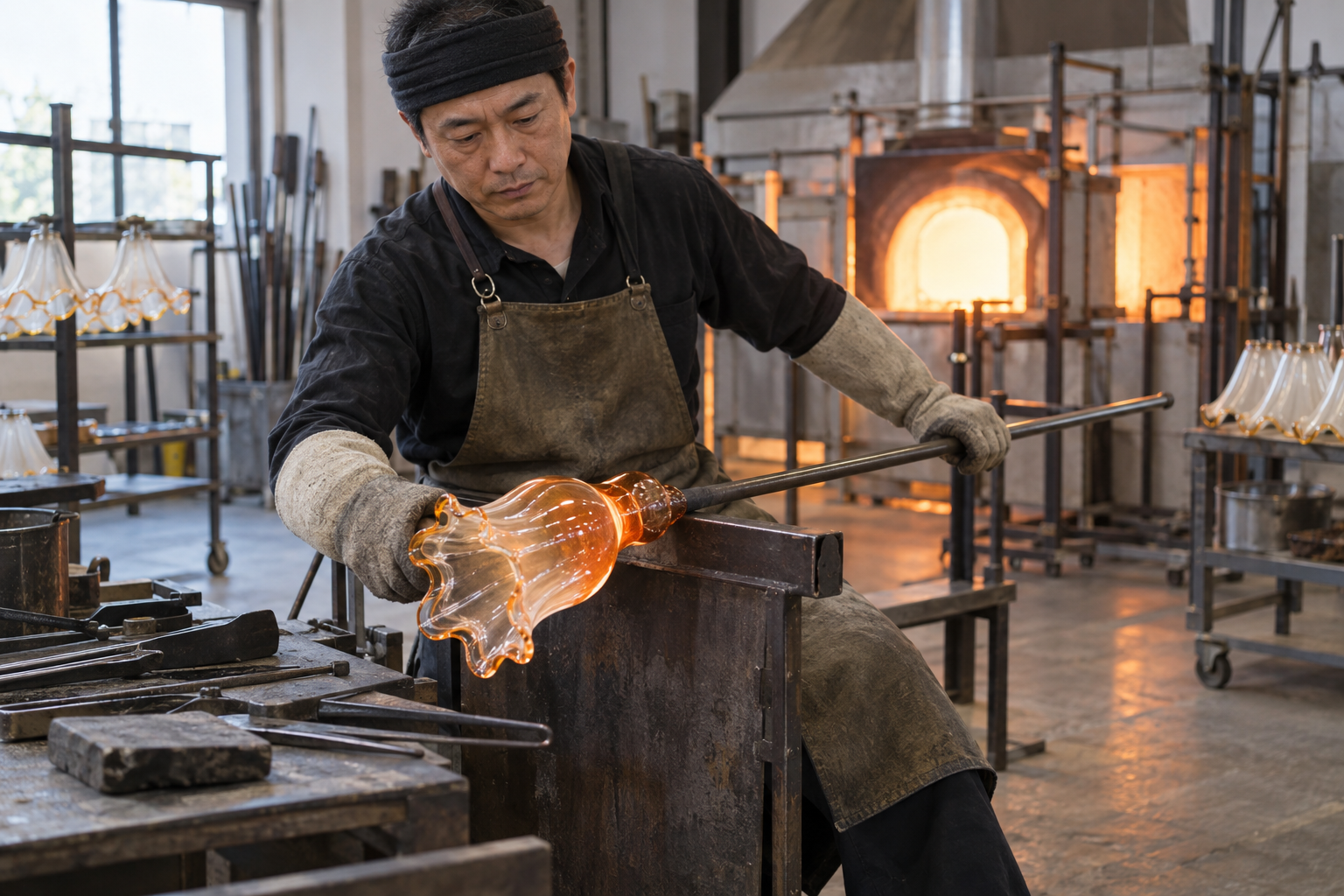
| Production route | Useful when | Strengths to discuss | Questions to resolve before quotation |
|---|---|---|---|
| Mouth blown glass | The design needs a hand formed appearance, a variable profile or a restoration match | Flexible forming, hand controlled shaping and suitability for certain one off or small series projects | What variation is acceptable, how is the profile checked and which areas must remain consistent? |
| Machine pressed glass | The design is repeatable and the order benefits from a controlled mold route | Repeatable cavity shape, organized batch production and efficient reproduction after tooling approval | What mold investment is required, how are shrinkage and cooling considered and what inspection points control the batch? |
| Hybrid development | The buyer needs a hand developed sample followed by repeatable production | A physical sample can guide a production mold and approval sequence | Which sample dimensions become controlled drawing dimensions and which visual features remain finish dependent? |
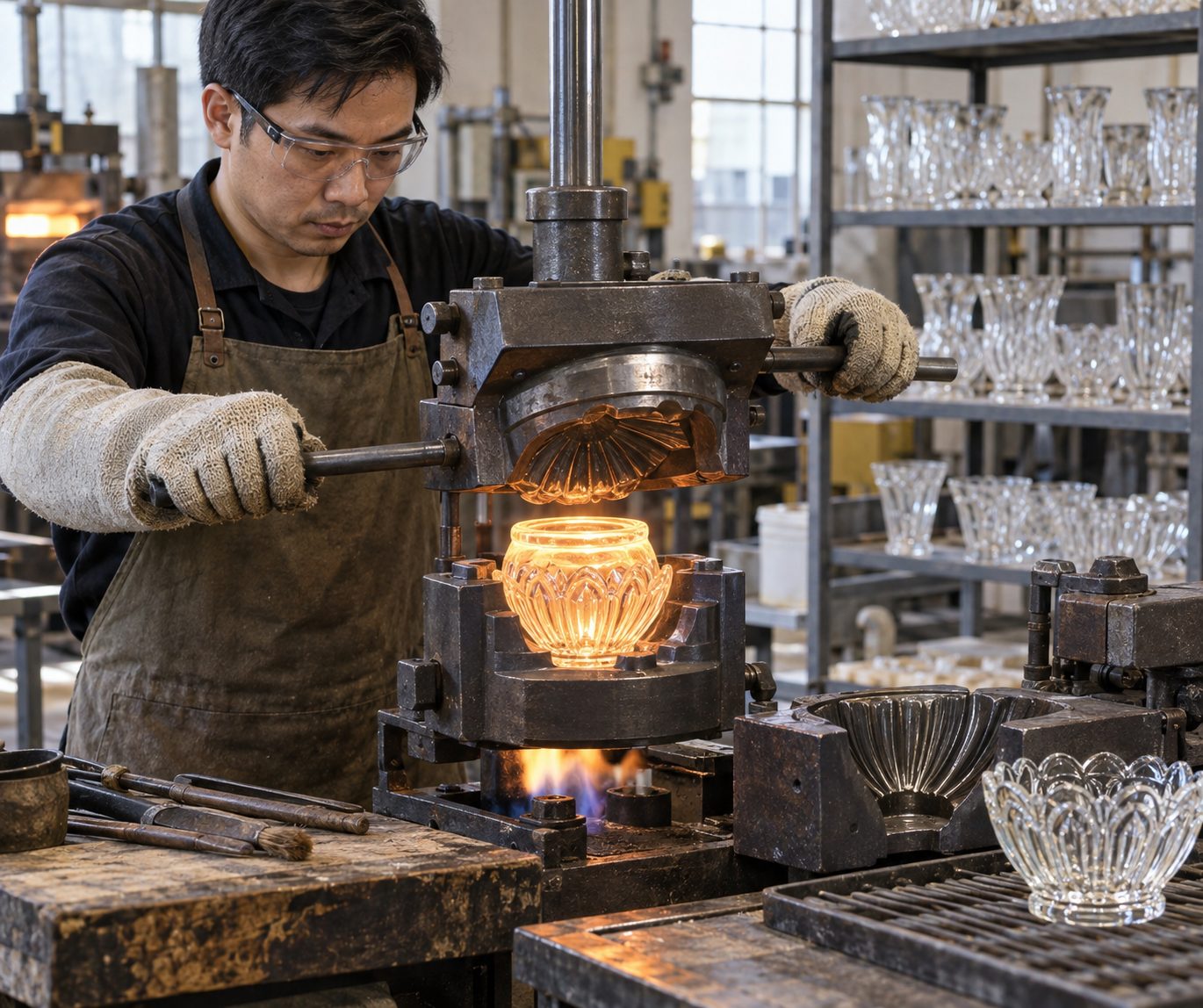
The best route depends on profile complexity, quantity, finish, variation allowed, tooling investment and the buyer's long term replacement plan. JX can discuss mouth blown and machine pressed options from the drawing, sample and expected order pattern. The final route should be confirmed after engineering reviews the actual profile rather than selected from a product name alone.
Custom mold development and dimensional control
Custom mold development starts with a usable definition of the part. A supplier needs more than a front photograph. Provide a dimensioned drawing, sample, profile section or fixture hardware, then identify the dimensions that control installation.
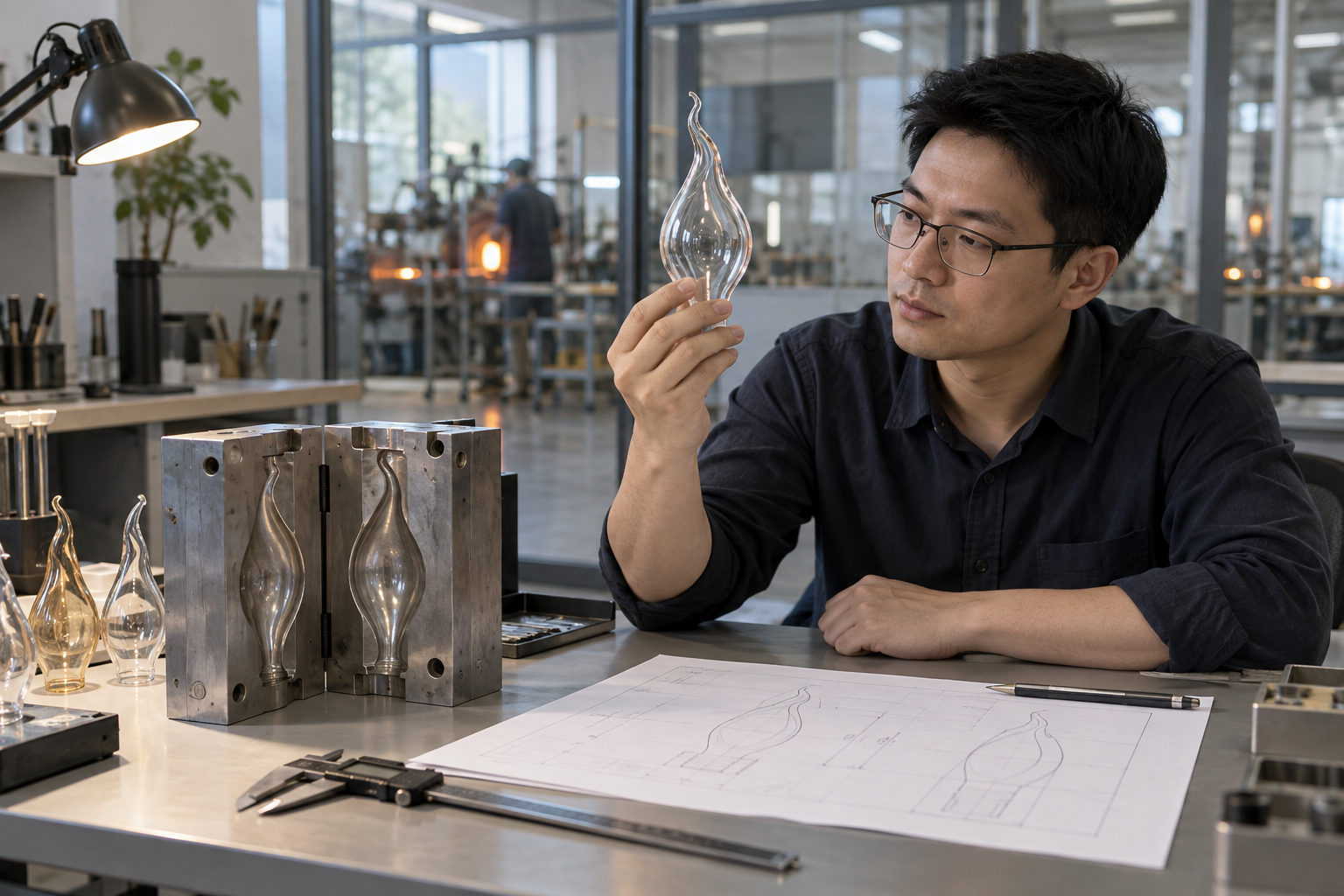
Mold development questions
- Is the flame curve rotationally symmetrical or intentionally directional?
- Does the lower mouth need a circular, oval or shaped opening?
- Which dimensions control the holder interface?
- Which surface features must remain visible after cooling and finishing?
- Is the shade a one size item or part of a family with shared proportions?
- Does the buyer need a physical approval sample before tooling is finalized?
- Will the same mold be used for clear, opal, colored and textured versions?
Dimensional tolerance must be agreed against the drawing, material, wall thickness, forming route and inspection method. A narrow fitter or a retaining ring may need more controlled dimensions than a decorative outside curve. Do not copy a tolerance from another glass item. A workable tolerance should be confirmed after engineering reviews the drawing, glass type and production method.
Glass thickness and edge finishing
Glass thickness affects weight, appearance, thermal behavior, edge strength and the visual clarity of the profile. The practical target depends on the glass body, forming route, mold, annealing and finishing process. A single thickness number should not be promised before the design is reviewed.
The edge may be ground, polished, rounded, rolled or designed to sit inside a metal holder. The correct finish depends on whether the edge is visible, touched during installation or hidden by a gallery. Include an edge cross section in the drawing when the fitter opening is critical. Ask the supplier to identify any edge that cannot be inspected after assembly.
Quality inspection for flame glass shades
Inspection should connect the buyer's drawing with the function of the finished shade. A practical inspection plan may include:
- identity of the approved sample, drawing and finish reference;
- fitter opening, neck or lip dimensions;
- overall height, body diameter, mouth diameter and shoulder position;
- edge finish, chips, cracks, sharp areas and visible grinding marks;
- color, opacity, satin level, seed pattern or etched coverage;
- surface defects that are visible from the normal viewing distance;
- seating on the actual gallery, holder or a controlled gauge;
- appearance under the intended electric light source;
- quantity, packing count and carton identification;
- photo records or retained samples if the program requires them.
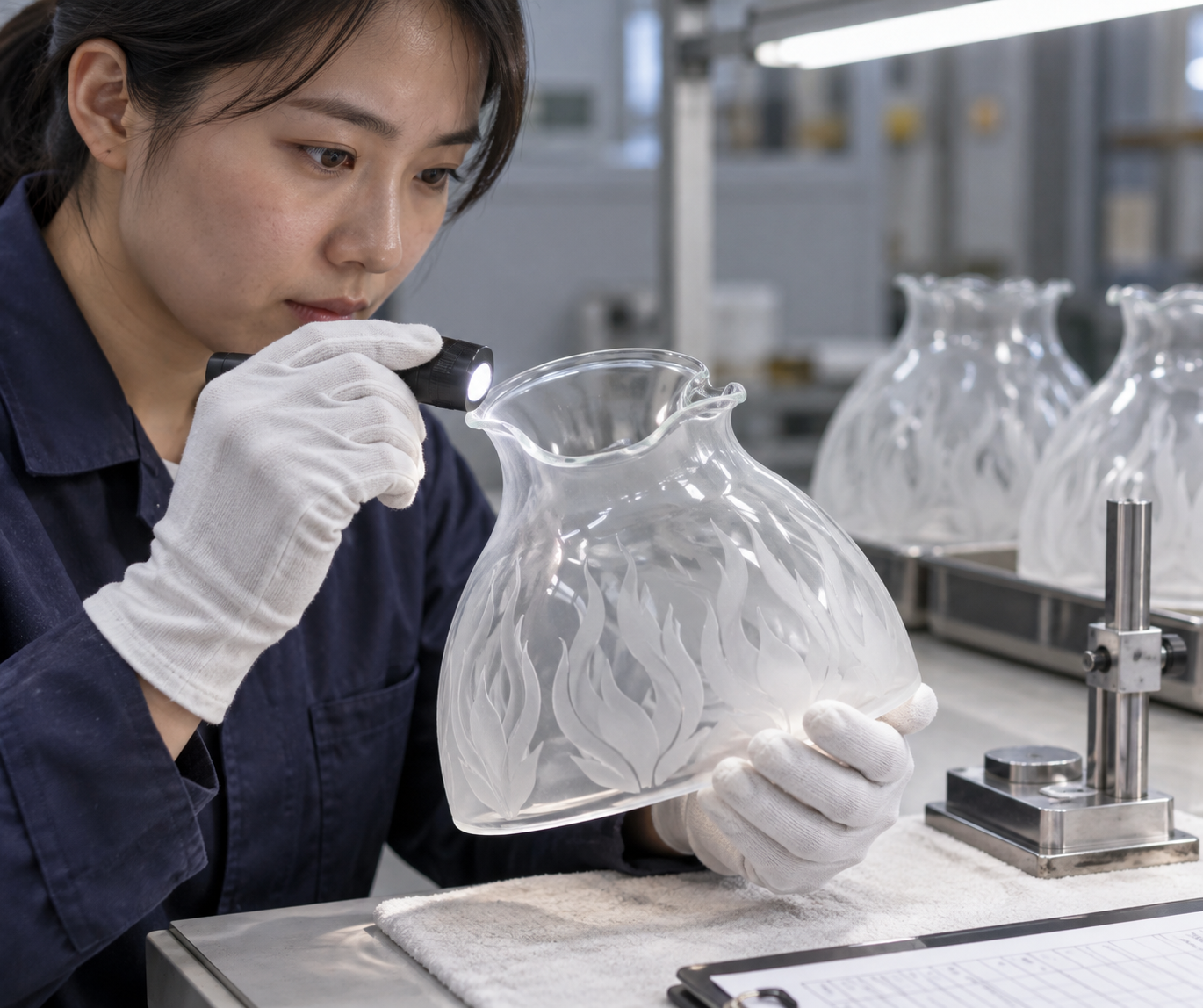
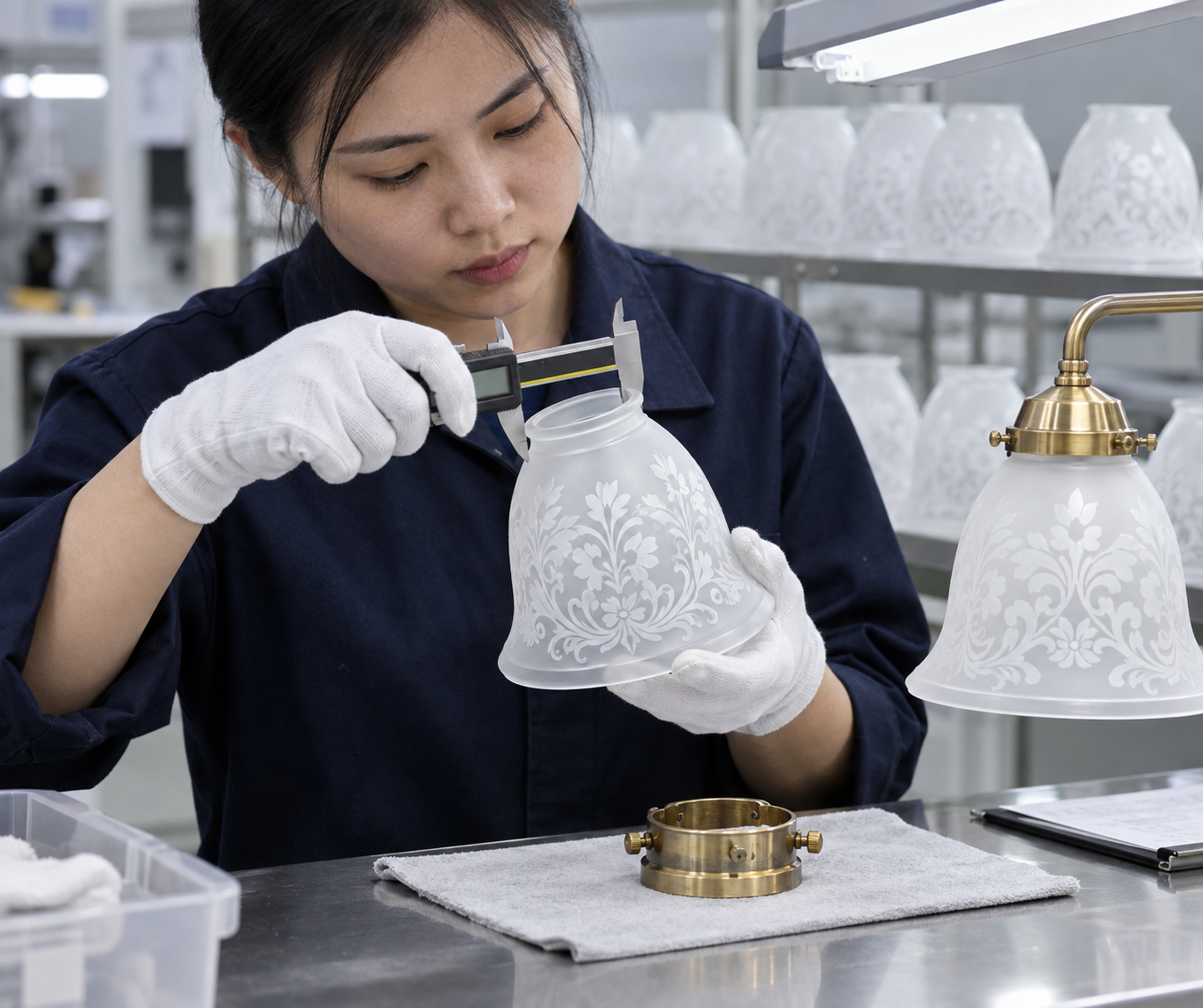
Inspection does not replace a clear specification. Mark critical dimensions on the drawing, state how finish differences will be judged and decide whether the sample or a written standard controls the batch. If the project requires a formal inspection record, ask what record format the supplier can provide before placing the production order.
Packaging and international shipping
Glass shades often fail during handling because the rim, neck or shoulder is not isolated from impact. A packing plan should protect the most fragile feature and prevent pieces from touching each other during vibration.
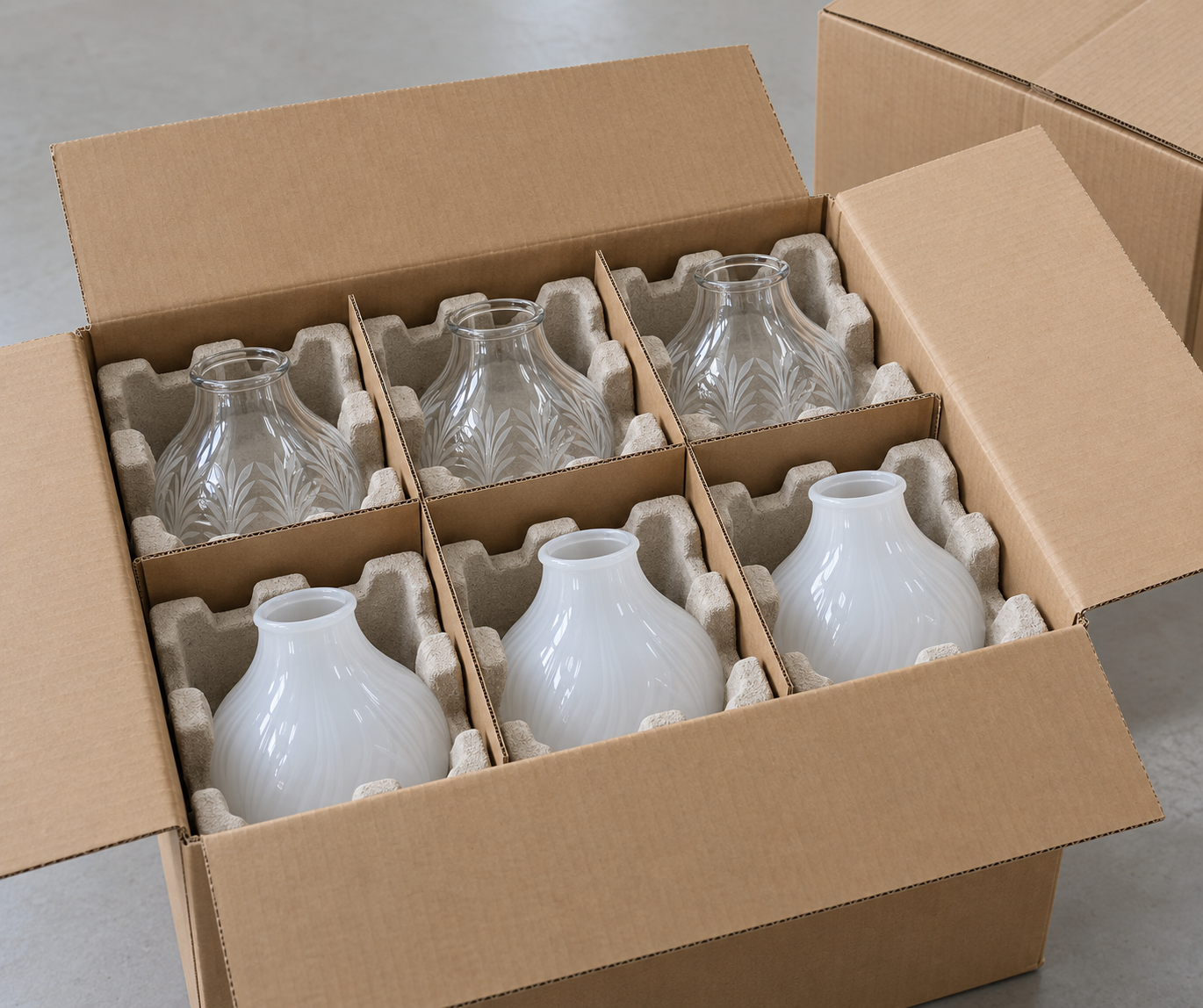
Discuss these points before the first shipment:
- individual wrapping or molded protection around each shade;
- separators that prevent glass to glass contact;
- clearance around the rim, neck and widest body point;
- carton strength and internal movement control;
- packing count per carton and outer carton dimensions;
- drop, vibration or handling expectations specified by the buyer;
- spare pieces or replacement policy for a fragile project;
- carton photographs and packing approval before mass shipment.
The correct packing design depends on shade geometry, quantity, destination, transport route and buyer handling. A package that works for a small clear shade may not protect a large opal shade with a wide shoulder. Request a packing recommendation based on the actual approved sample.
Replacement project versus new OEM project
The sourcing path is different when a buyer has one broken shade and when a lighting brand is launching a new collection.
| Project type | Main evidence | Main risk | Best first request |
|---|---|---|---|
| One replacement shade | Original glass, holder, photographs and measured dimensions | A similar profile has the wrong fitter or seat | Compatibility review and a replacement sample quotation |
| Restoration batch | Several original samples, fixture photographs and finish references | Historic variation is mistaken for a production defect | Sample comparison and agreed acceptable variation |
| New OEM collection | Drawing, 3D profile or design sample, finish target and forecast | The visual concept is not translated into controlled dimensions | Engineering review and custom mold feasibility discussion |
| Multi-size product family | Shared design intent plus separate size drawings | Sizes look related but do not share a repeatable interface | Family review with a common fitter strategy where possible |
| Distributor stock program | SKU list, order pattern, packaging and replacement demand | Stock is mixed with near-identical but incompatible shades | Approved samples, SKU identification and carton plan |
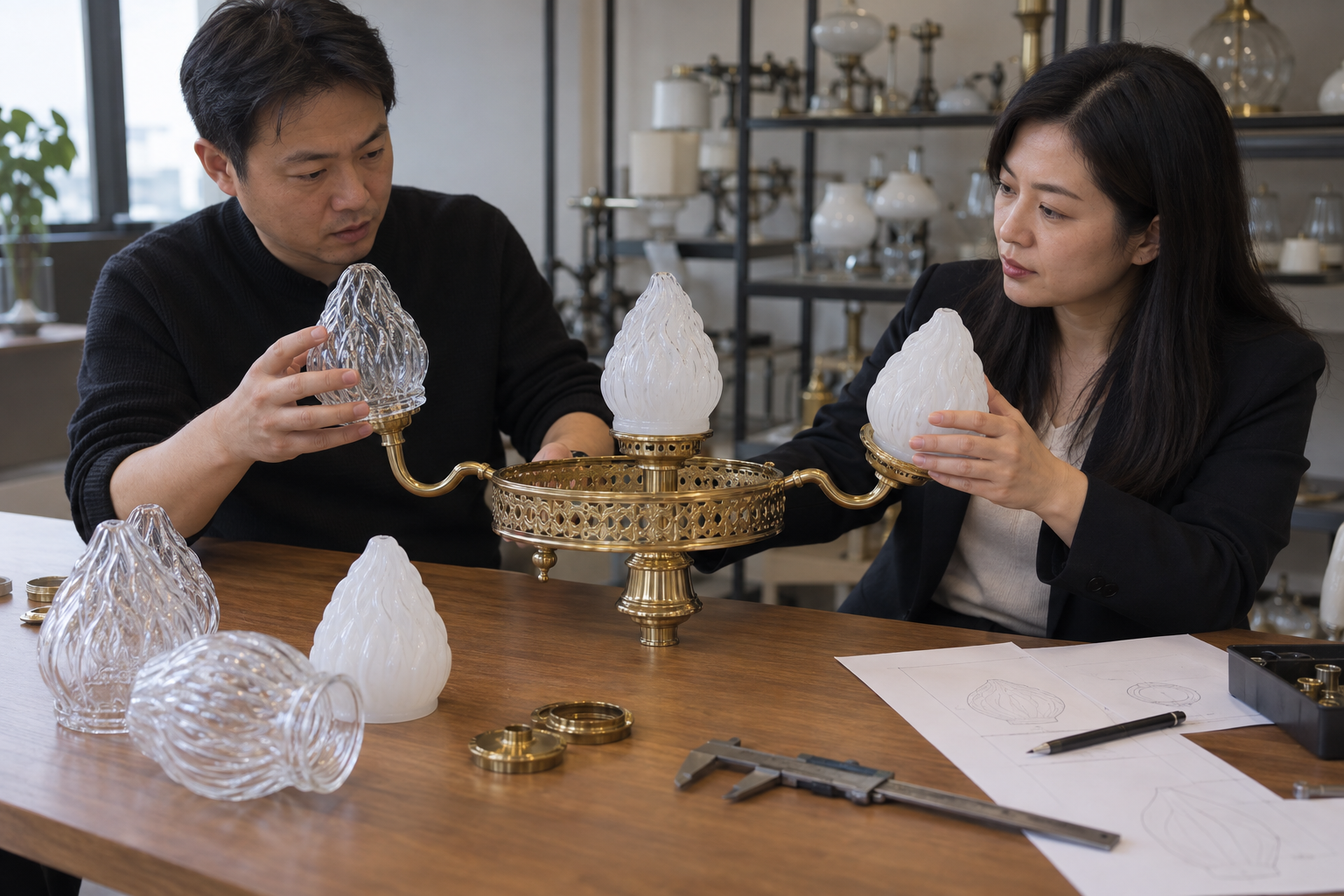
For either project, do not approve only the front view. Turn the shade upside down, place it on the holder, inspect the rim and compare it under the intended light source. A sample that looks correct on a table may fail when the fitter is installed.
MOQ, sampling and mass production considerations
MOQ, sample timing, production timing and tooling cost depend on the glass type, forming route, finishing steps, mold status, inspection requirements and order pattern. These details should be confirmed for each project rather than copied from a general catalog page.
A practical sourcing sequence
- Send the measurement set, photos, sample or drawing.
- Confirm whether the requirement is replacement, restoration, new OEM or a product family.
- Review the proposed glass type, profile, fitter and edge treatment.
- Confirm the sample route, tooling requirement and approval points.
- Approve the sample against the fixture or gauge, not only a product photograph.
- Confirm production inspection, packing method and shipment configuration.
- Release mass production only after the controlled drawing and approved sample are aligned.
If the project needs a specific MOQ, lead time, tooling charge or monthly output, include the expected order pattern in the RFQ. The engineering and sales teams can confirm those commercial details after reviewing the drawing, selected glass and proposed forming route.
Flame glass shade buyer RFQ checklist
| RFQ item | Information to provide | Why it matters |
|---|---|---|
| Product identity | Flame profile description, application and target market | Separates restoration, decorative and OEM requirements |
| Fitter interface | Inside and outside diameter, lip or neck, seat depth, retaining method | Controls installation compatibility |
| Body dimensions | Height, widest diameter, mouth diameter, shoulder location | Controls proportion and clearance |
| Glass specification | Clear, frosted, satin, opal, milk, seeded, colored or iridescent target | Controls appearance and light diffusion |
| Edge treatment | Ground, polished, rounded, rolled or holder covered | Controls handling and visible finish |
| Process preference | Mouth blown, pressed or open for engineering recommendation | Helps evaluate tooling and repeatability |
| Sample evidence | Original glass, metal gallery, profile drawing or 3D file | Reduces guesswork and speeds review |
| Quantity pattern | Sample quantity, first order, repeat order and forecast | Supports MOQ and production planning discussion |
| Inspection | Critical dimensions, finish standard, gauge and record needs | Defines acceptance before production |
| Packaging | Individual protection, carton count, destination and handling concerns | Reduces breakage risk in transport |
| Commercial request | Target price basis, Incoterm if known and quotation deadline | Makes the quotation actionable |
Attach photographs with a ruler, a cross section of the fitter and the fixture hardware whenever possible. If a detail cannot be measured safely, mark it as unknown instead of guessing. A supplier can then list the assumptions that need confirmation.
Why work with a glass lamp shade manufacturer?
A manufacturer can connect a catalog style name with the production details that make the item repeatable. For a flame glass lamp shade, that connection includes the curved profile, the fitter interface, the glass body, the finish, the mold or forming route, the inspection plan and the packing method.
JX works with glass lamp shade requirements for OEM and custom projects. The most useful starting material is a drawing, sample or fixture hardware set with clear measurements. You can also review the existing fitter compatibility guide and antique replacement guide before sending an inquiry. For process context, read the pressed glass reference together with the mouth blown glass reference.
Project specific dimensions, tolerances, glass thickness, MOQ, sample timing, lead time, inspection records and shipping details should be confirmed after the drawing, glass selection and forming route are reviewed. This protects both sides from treating a general product phrase as a finished specification.
Frequently asked questions
What is a flame glass lamp shade?
A flame glass lamp shade is a curved shade with a tapered or pointed upper movement and a fuller lower body. It may be used on decorative, period inspired, restoration or custom lighting. The profile name does not define a universal fitter size.
Are flame glass lamp shades the same as bell shades?
No. They can share a neck or lower opening, but a flame profile usually has a more directional tapered silhouette and a distinct shoulder. Measure the body and the fitter rather than assuming that a bell shade will be interchangeable.
How do I measure a flame glass shade replacement?
Measure the fitter opening, seat depth, neck or lip, overall height, widest body diameter, mouth diameter and shoulder position. Photograph the holder and send the original sample or a drawing when possible.
What does a 3 1/4 inch fitter mean?
It may describe a nominal neck or holder reference, but the measurement name must be confirmed. Ask whether the number is the glass opening, neck outside diameter, holder inside diameter or another catalog dimension.
Is a 4 inch or 6 inch lip fitter universal?
No. A 4 inch or 6 inch reference can describe different parts of a holder or shade depending on the supplier. Confirm the actual contact surfaces, seat, retaining method and cross section before ordering.
Which finish gives the softest light?
Opal and milk glass usually give a softer visual field than clear glass, while frosted or satin glass sits between clear and opaque appearances. The actual result depends on glass body, thickness, finish and light source, so approve a physical sample when the appearance is important.
Should a flame shade be mouth blown or machine pressed?
The choice depends on profile complexity, quantity, acceptable variation, tooling investment and finish. Mouth blown forming can suit certain hand formed or small series designs. Pressed glass can support repeatable profiles after mold approval. Confirm the route with the engineering team.
Can a manufacturer make a custom flame glass shade mold?
A custom mold may be suitable when the buyer has a controlled drawing, sample or profile and expects repeatable production. The supplier should review shrinkage, cooling, wall thickness, edge finishing and inspection points before tooling is finalized.
What should I send for an OEM flame glass shade quotation?
Send the application, photos, drawing or sample, fitter measurements, body dimensions, glass and finish target, edge treatment, quantity pattern, packaging destination and inspection needs. State unknown dimensions clearly so assumptions can be listed and confirmed.
Request a flame glass shade quotation
Send the original shade, gallery, profile drawing or fixture photographs for a technical review. Include the fitter opening, seat, body dimensions, glass finish, sample requirement and expected order pattern. JX can then review the project for replacement compatibility or OEM development and confirm the next quotation step with the engineering team.