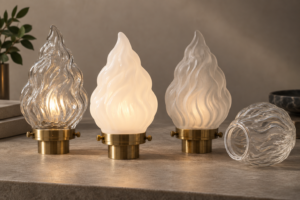
Quick answer
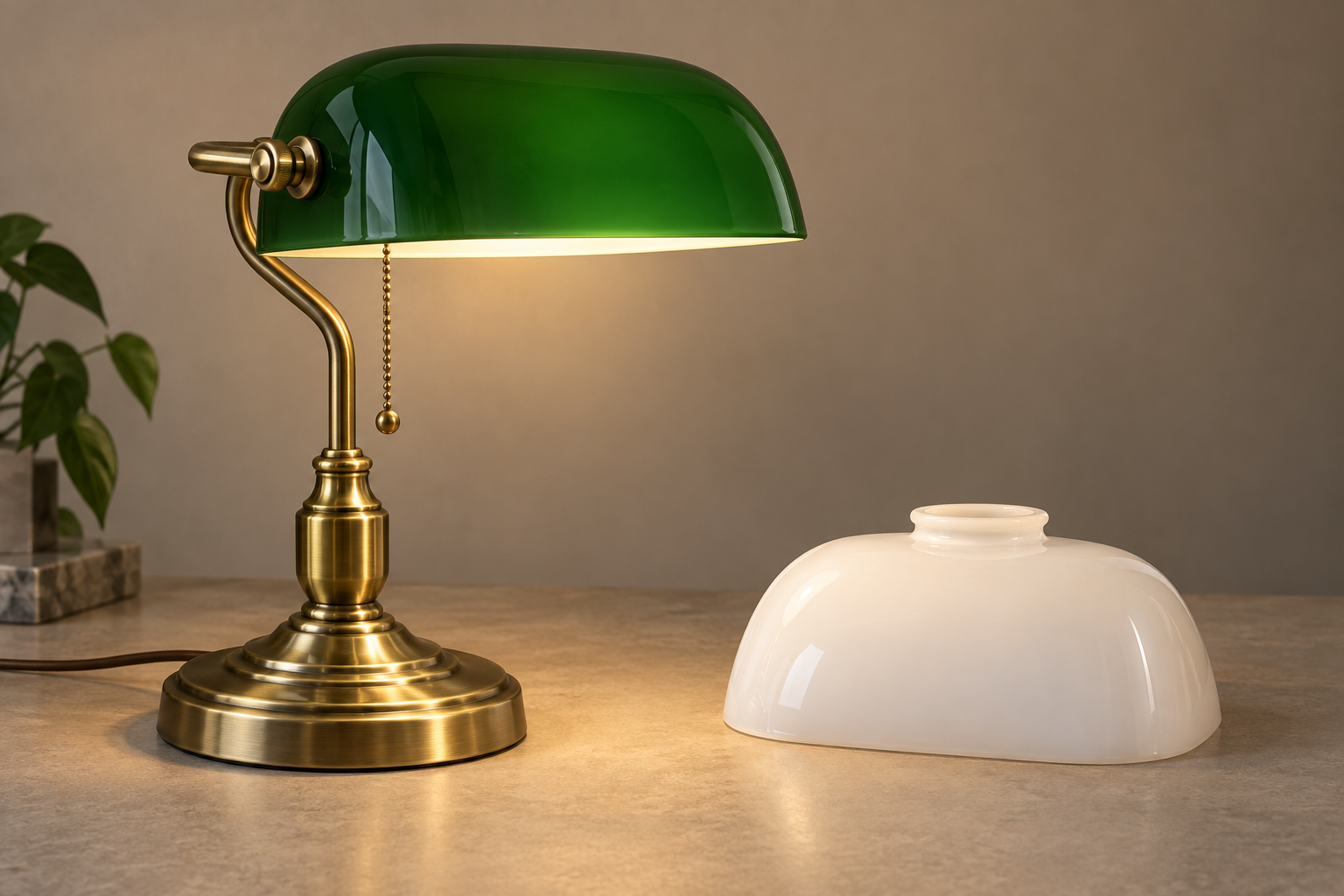
A student lamp shade is the glass cover used on a classic student, banker or library-style lamp. It is usually a shallow or gently elongated shade supported by a holder, lip, neck or retaining ring rather than by a standard fabric-shade harp. For a replacement, record the shade's largest outside diameter, overall height, fitter opening, neck or lip profile, holder dimensions and retaining method before asking for a price. For an OEM project, add the glass color, surface finish, wall thickness, drawing, sample standard, inspection points, packing method and expected order pattern.
The names “7-inch student lamp shade” and “10-inch student lamp shade” are useful starting points, but they are not universal standards. The same nominal size can vary in height, opening, rim shape and holder compatibility. A good quotation therefore matches the glass profile to the fixture interface, not just to a catalog label.
This guide is written for lighting manufacturers, restoration suppliers, distributors, wholesalers, product designers and OEM buyers. It explains how to identify a student shade, compare common sizes and finishes, measure replacement glass, choose a production route and prepare an RFQ that a glass engineering team can review.
What is a student lamp shade?
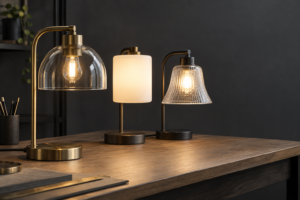
A student lamp shade is a fixture-specific glass shade associated with traditional reading, library and banker lamps. The classic assembly often has a metal stem or base, a socket or light source, a shade holder and a glass cover that extends horizontally or slightly downward from the holder. Green glass is strongly associated with the style, but student shades can also be made in opal, milk, clear, frosted, seeded and other controlled finishes.
The useful manufacturing definition is not the lamp's age or color. It is the combination of shape and interface:
- A relatively low-profile body that controls the direction and softness of light.
- An opening, lip, neck or holder seat that determines whether the glass can be installed.
- A rim and wall section that must survive handling and repeated fitting.
- A surface and color choice that changes the appearance of the fixture when it is switched off and when it is illuminated.
Student lamp shades are often confused with generic desk-lamp globes. A globe may have a round body and a different fitter. A pendant shade may hang from a neck or gallery. A student shade may sit in a holder with a broad horizontal shoulder. These parts can look similar in a photograph while requiring different glass geometry.
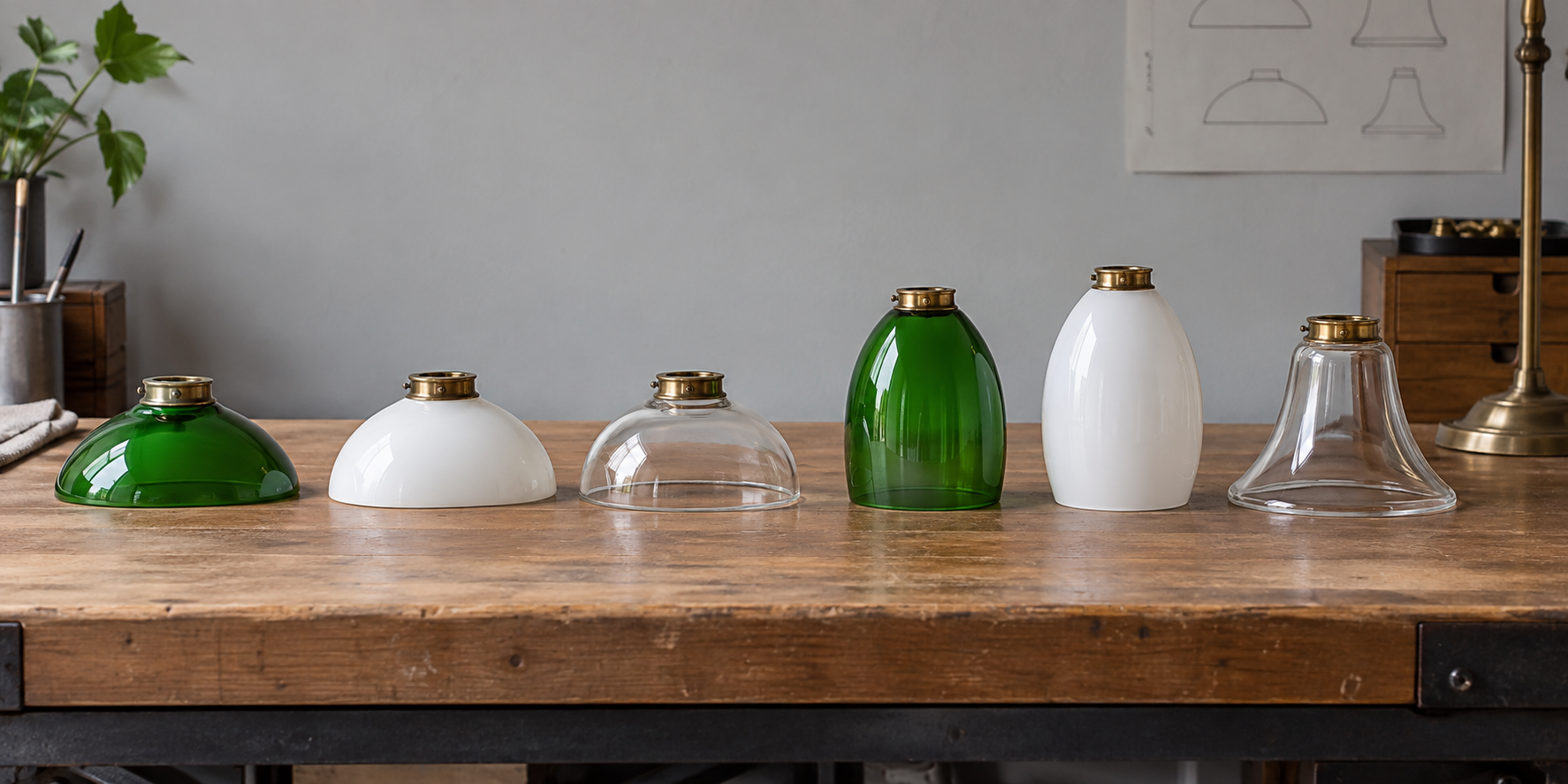
For a replacement project, the original shade is the best starting evidence. For a new product, the fixture drawing and intended light source matter more than the historical name. If the name and the measured interface disagree, the interface should control the quotation.
Student lamp applications and fixture anatomy
The same student-style shade can serve several commercial contexts, but the buyer's acceptance criteria are different in each one.
| Application | Buyer priority | Common risk | Useful quotation evidence |
|---|---|---|---|
| Banker or library lamp | Historic silhouette, glare control and holder fit | A visually similar shade sits too high or leaves the bulb exposed | Side profile, holder photo and fitter measurements |
| Reading or study fixture | Comfortable distribution and safe clearance | The shade transmits too much source brightness | Light source details, finish sample and illuminated photo |
| Restoration replacement | Matching the original profile and hardware | A nominal size does not fit the old ring | Original shade, holder, rim and dimensional sketch |
| Hospitality or institutional lamp | Repeatability across a series | Small variations create visible height differences | Approved sample, tolerance notes and packing plan |
| Lighting brand collection | Appearance, repeatability and packaging | A sample looks right but the production route cannot hold it | Drawing, color target, process recommendation and inspection plan |
| Distributor or wholesale program | Clear variants and predictable replenishment | Similar items are mixed under one catalog description | Variant matrix with diameter, height, fitter and finish |
The fixture should be treated as an interface system. The holder supports the glass. The fitter opening or neck transfers load into the glass. The retaining ring, clips or spring may control movement. The socket and bulb determine the available space and the heat context. A shade that matches only the outside diameter can still fail at installation.
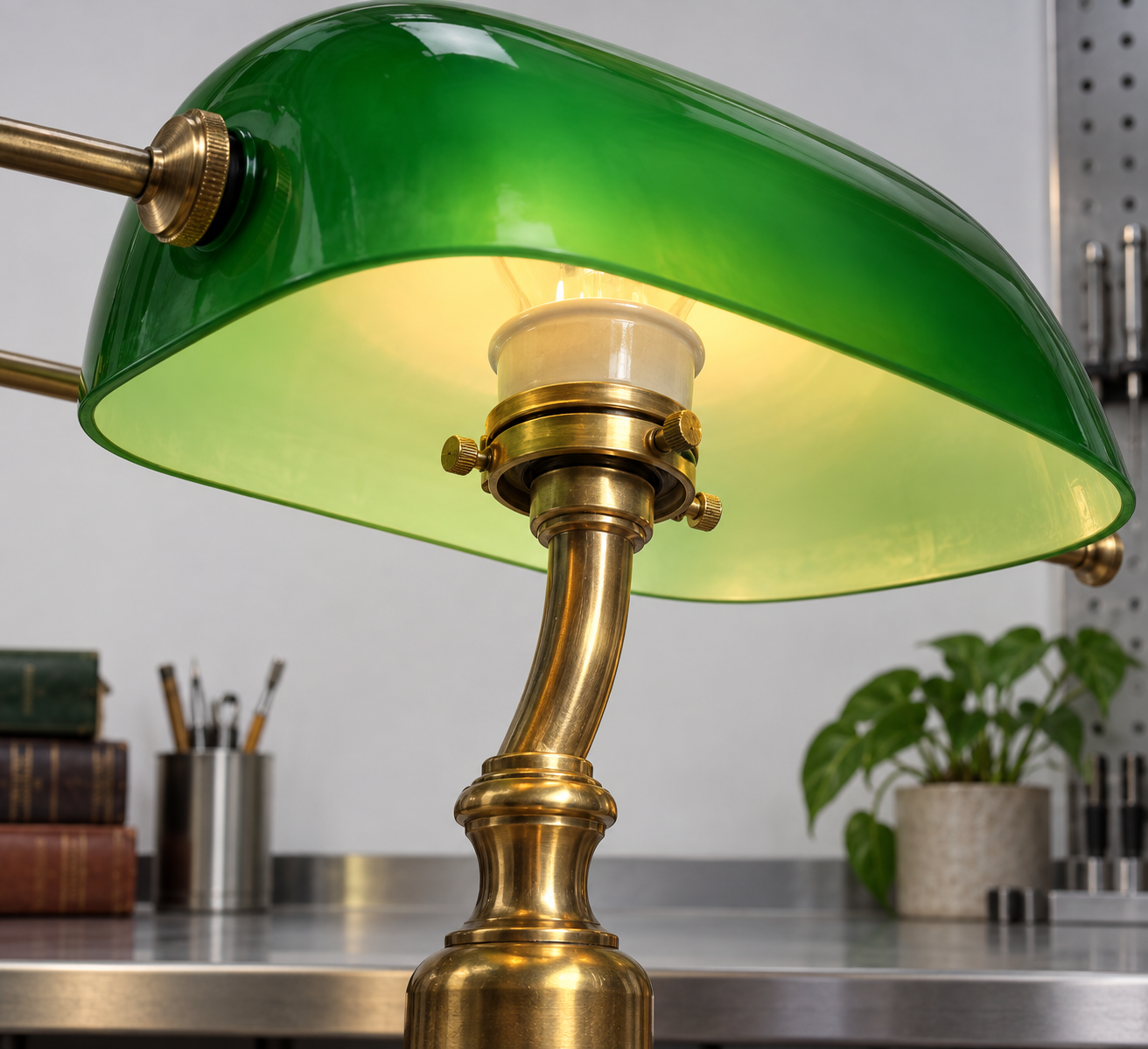
Before replacing a shade, photograph the fixture from the side and below. Include the holder with the glass removed if it can be removed safely. Photograph the original rim, the hardware that contacts it and the space around the light source. These images help a supplier separate a true student-lamp interface from a similar-looking globe or reflector.
Student lamp shade sizes: 7-inch, 10-inch and custom profiles
Search results often group student lamp shades around nominal 7-inch and 10-inch families. Those labels can be useful for finding a starting sample, but they do not establish the complete specification. Different suppliers may measure the outside diameter, the widest body, the fitter opening or another reference point. Always ask what the nominal dimension means.
| Nominal family | Typical use in a sourcing conversation | Dimensions that still need confirmation | Best next step |
|---|---|---|---|
| 7-inch family | Compact student or library fixture, smaller visual footprint | Outside diameter, height, opening, lip or neck and holder seat | Send the original shade or a dimensioned profile |
| 10-inch family | Larger traditional fixture or a wider reading shade | Body diameter, overall height, opening, wall thickness and clearance | Approve a physical sample on the target fixture |
| Custom profile | Brand-specific, restoration-specific or unusual holder | Every interface and optical dimension | Provide a drawing, sample or controlled photo set |
| Twin or paired fixture | Two shades that must match visually and mechanically | Matching height, diameter, color and rim finish | Define pair matching and inspection method |
The largest diameter is not always the advertised size. A shallow shade may have a broad shoulder but a smaller opening. A taller profile may be sold under the same nominal diameter. For replacement work, measure the existing piece. For OEM work, define the target envelope from the fixture and light source.
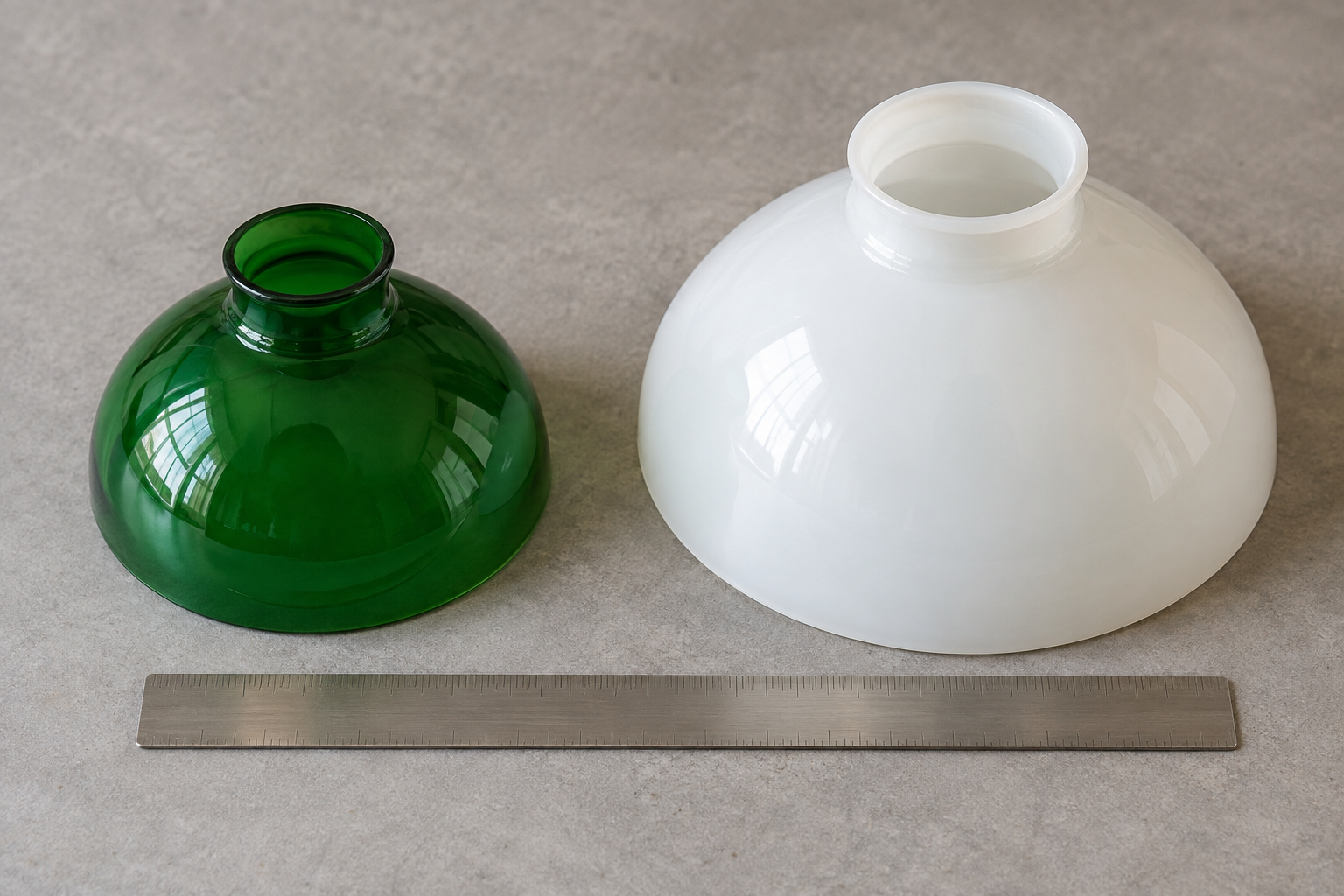
For general size terminology, the site's lamp shade size guide can help organize the dimensions. A student-lamp RFQ still needs fixture-specific measurements because a general size chart cannot tell a factory which lip, neck or holder geometry to make.
How to measure a replacement student lamp shade
Measure before cleaning, polishing or discarding the broken shade. Even a damaged part can preserve the most useful evidence. If the glass is unsafe to handle, photograph it in place and measure the fixture hardware instead.
- Record the widest outside diameter of the glass body. Measure across the widest point, not only across the opening.
- Record the overall height from the lowest visible edge to the highest point that enters or rests on the holder.
- Measure the fitter opening or neck. Take the inside diameter and outside diameter when the edge is accessible.
- Describe the lip, bead, flange or shoulder. A profile sketch is more useful than a single diameter.
- Measure the holder or retaining ring that contacts the glass. Note whether the glass sits on top, inside or below the ring.
- Record the distance from the holder to the bulb and any clearance restriction around the socket.
- Photograph the shade from the side, top and underside with a ruler or caliper visible. Keep the camera square to the part for the profile image.
- Identify the glass finish and color in both unlit and illuminated conditions. Green glass can be transparent, opalized, satin, flashed or otherwise modified.
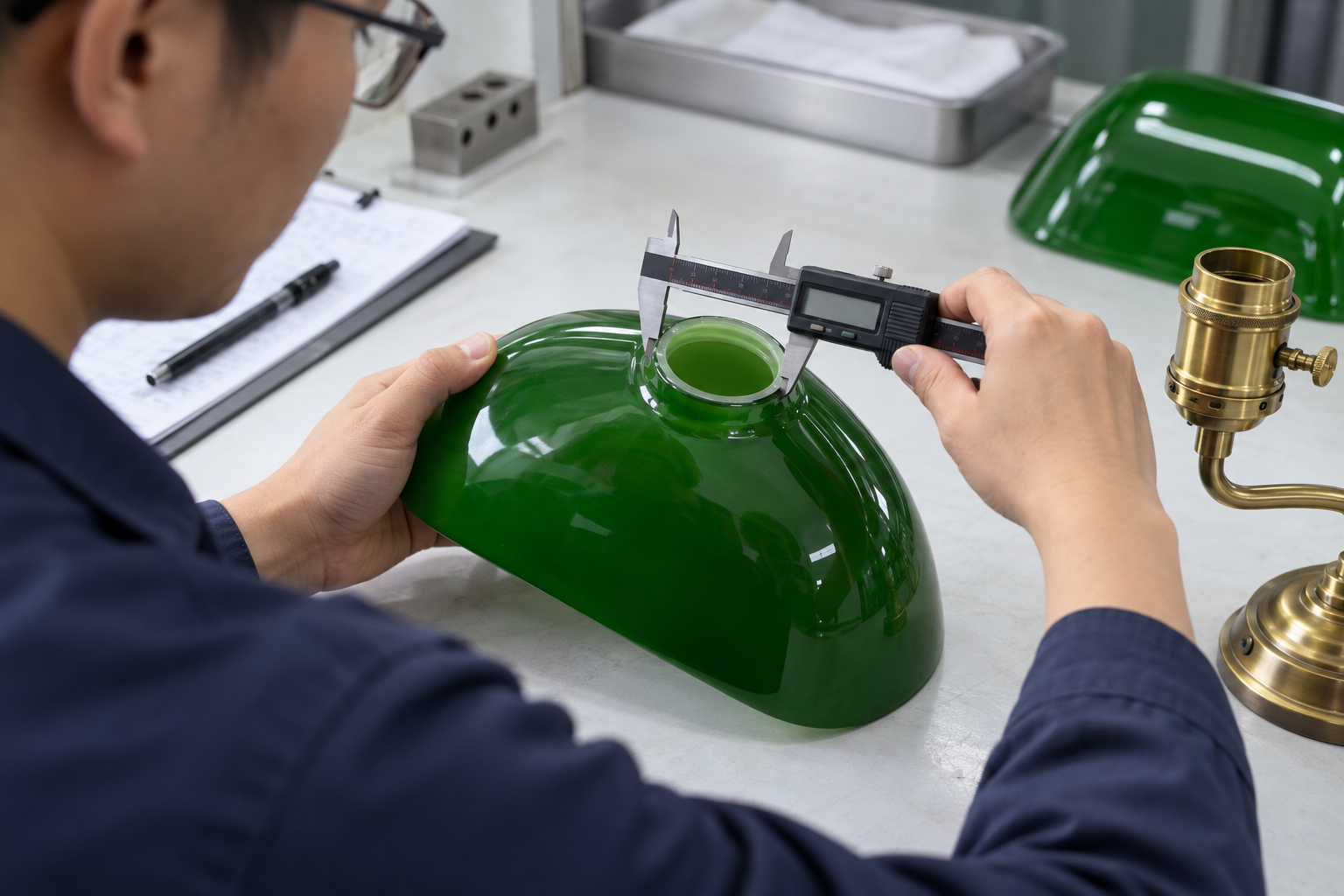
The most useful replacement package contains a dimension list, a side profile, a close image of the rim, a close image of the holder and the destination fixture information. A photo alone can identify the style, but it rarely establishes a production fit. The quotation should state which dimensions are measured, which are estimated and which will be confirmed by a sample.
Fitter and holder compatibility
Student lamp shades can be supported in several ways. The common pattern is a shade that rests in or on a holder, but the exact glass edge may be a lip, a neck, a bead, a flared opening or a smooth seat. The metal holder may use a retaining ring, clips, spring pressure or a matching shoulder.
| Interface type | How the glass is supported | What to measure | Typical failure if misunderstood |
|---|---|---|---|
| Lip or flange fitter | A defined glass lip rests on a ring or holder | Lip diameter, thickness, seat diameter and body height | Glass rocks, sits too low or cannot pass through the ring |
| Necked opening | A narrower neck enters the holder before the body expands | Neck outside diameter, neck length and shoulder position | Shade appears correct but will not enter the holder |
| Holder-supported bowl | The holder carries a broad lower surface | Contact circle, rim thickness and body slope | Point loading creates chips or an unstable fit |
| Retaining-ring arrangement | A ring or clip controls vertical movement | Ring inside diameter, glass outside diameter and clearance | Ring cannot close or squeezes the rim unevenly |
| Custom bracket or restoration hardware | Hardware was made for one historical profile | All contact points and the original hardware | A generic replacement changes the fixture height or angle |
The glass lamp shade fitter guide explains broader fitter terminology. Use that guide to identify the interface family, then send the student-lamp-specific profile and holder dimensions for a quotation.
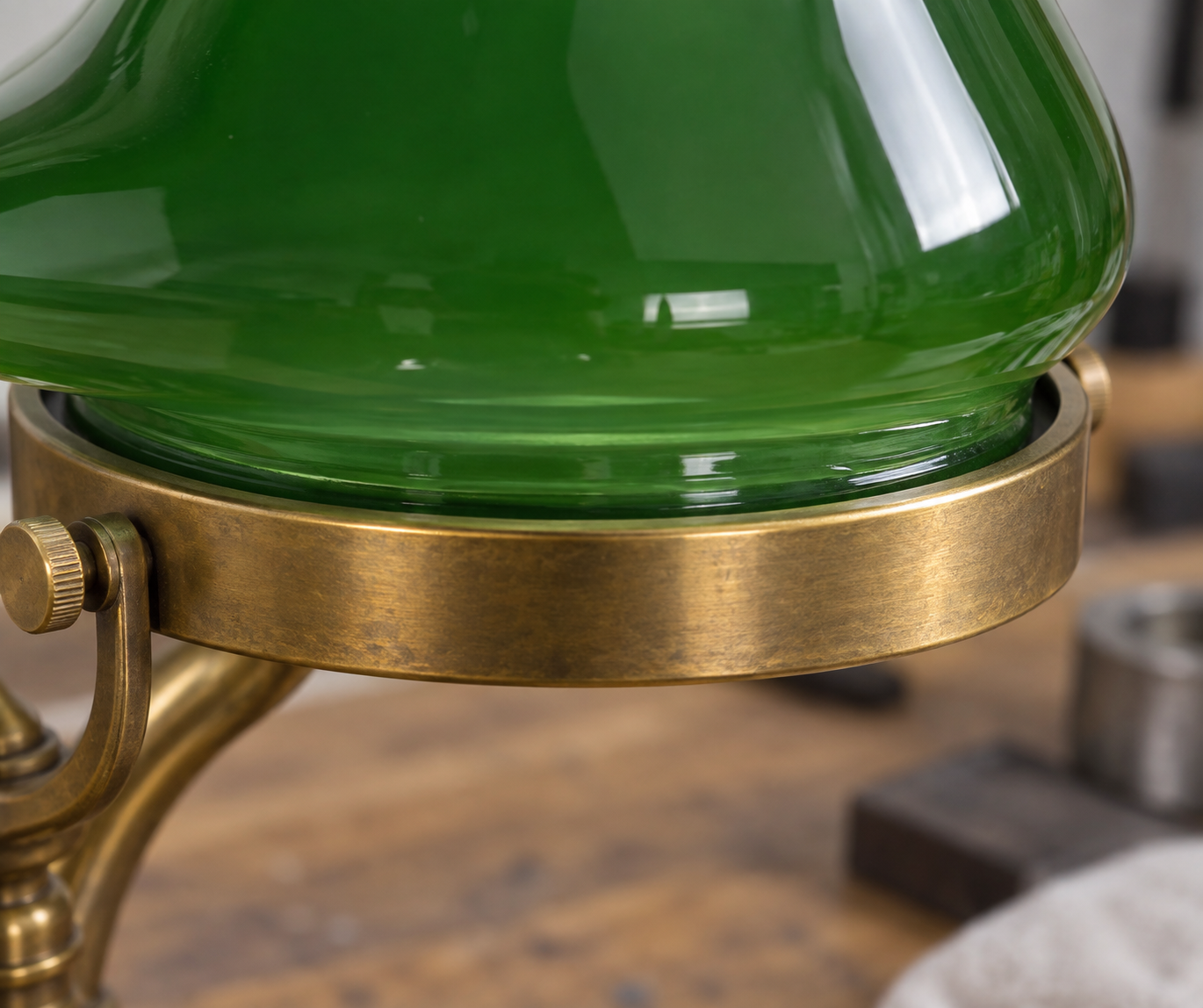
Do not assume a fitter is interchangeable because two openings look close. Glass thickness, rim radius, holder depth and the retaining method all affect the fit. If a replacement is intended for a restoration series, keep the original holder with the approved sample so later production checks use the same reference.
Green, opal, milk, clear, frosted and seeded glass choices
Green student lamp shades are popular because the color is strongly associated with banker and library fixtures. The correct green is not defined only by a paint chip. It depends on the base glass, wall thickness, transmission, surface treatment and light source. A sample that looks correct on a workbench can look darker or more yellow when illuminated.
| Glass choice | Appearance when unlit | Light behavior | Procurement point |
|---|---|---|---|
| Green transparent glass | Recognizable classic color with visible depth | Transmits colored light and can keep a clear visual edge | Specify shade of green, body thickness and illuminated reference |
| Opal glass | Soft white or colored translucent appearance | Spreads the source and reduces visible hotspots | Approve opacity under the intended light source |
| Milk glass | More solid, historic or porcelain-like appearance | Strong diffusion with less direct source visibility | Confirm whether the effect comes from the glass body or coating |
| Clear glass | Bright, transparent and hardware-forward | Higher direct transmission and sharper source visibility | Check glare, bulb appearance and surface quality |
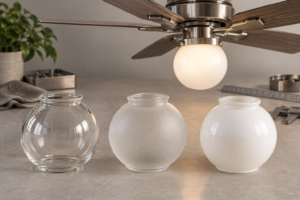
| Frosted or satin glass | Matte surface with reduced reflection | Softens highlights while retaining a lighter body | Define one-side or two-side treatment and coverage |
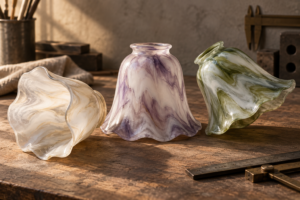
| Seeded glass | Small bubbles or texture create visual movement | Diffusion varies with seed density and wall thickness | Agree the acceptable range and do not use random pieces as the only standard |
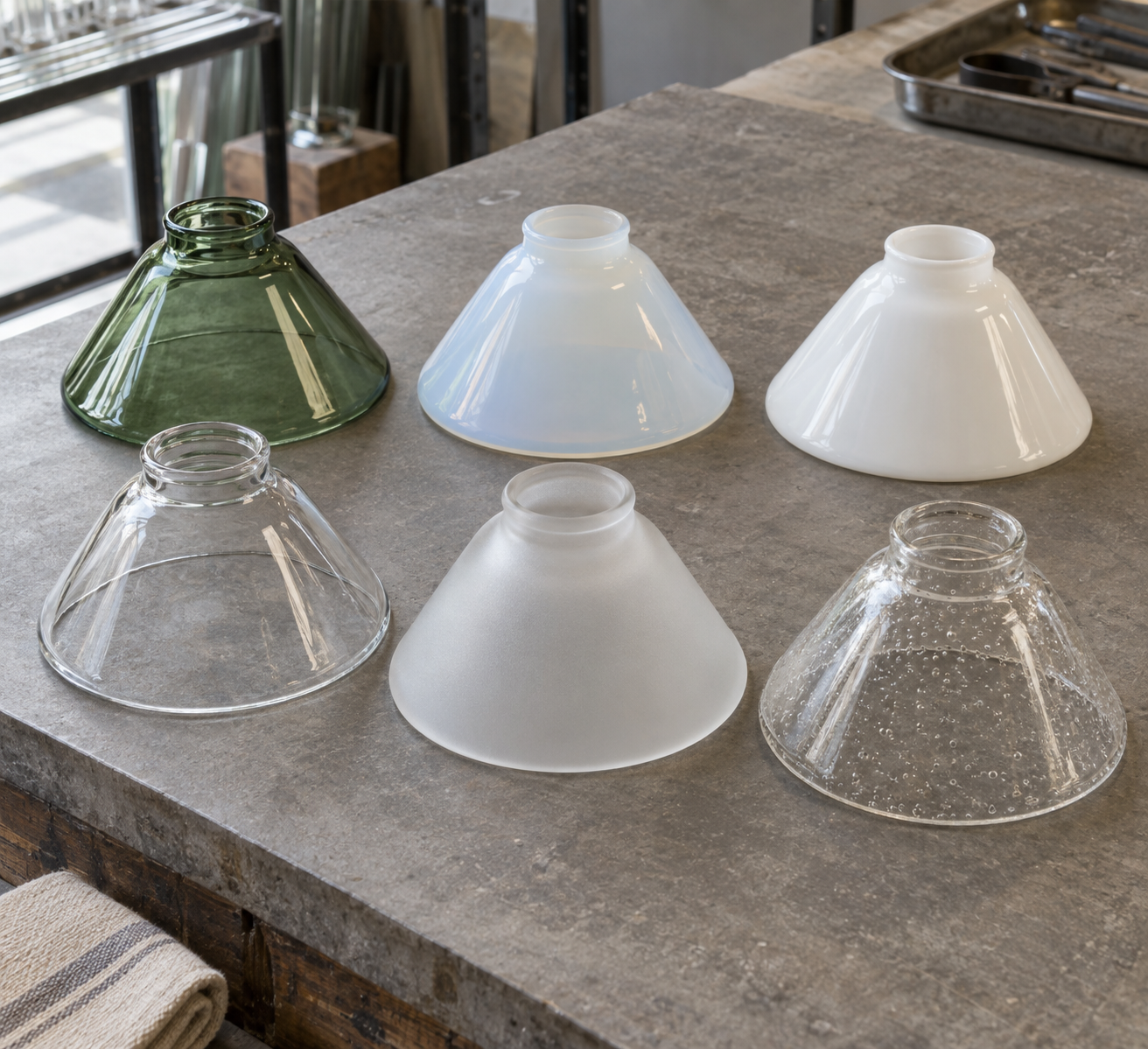
The site's glass material selection guide provides a broader comparison of glass choices. For a student lamp program, add a physical color or finish standard, a lighted sample and an agreement on acceptable variation. This is especially important when a shade will be supplied in pairs or across a large fixture collection.
Light diffusion and visual comfort
The shade's color is only one part of the visual result. Diffusion is affected by source brightness, distance from the glass, glass thickness, opacity, surface treatment and the shape of the shade. A green transparent shade may create a strong classic appearance but still reveal a bright source. Opal or milk glass may reduce the hotspot while changing the fixture's historic character.
| Design variable | More direct transmission tends to provide | More diffusion tends to provide | Buyer question |
|---|---|---|---|
| Clear versus opal body | Brighter source and sharper shadows | Softer source and less visible glare | Is the priority historic transparency or visual comfort? |
| Green color depth | Stronger colored appearance | Lower apparent source brightness in some areas | Does the shade need to match a reference when lit? |
| Frost or satin coverage | Controlled reflection and softened highlights | More uniform glow | Is the finish on one surface or both surfaces? |
| Seed density | Texture and small variations in transmission | Irregular but attractive diffusion | What variation is acceptable from piece to piece? |
| Wall thickness | More direct light at thinner sections | More absorption or diffusion at thicker sections | What practical thickness can the process hold? |
| Body curvature | Focused or directional light in some zones | Broader light spread in other zones | Does the fixture need a defined reading area? |
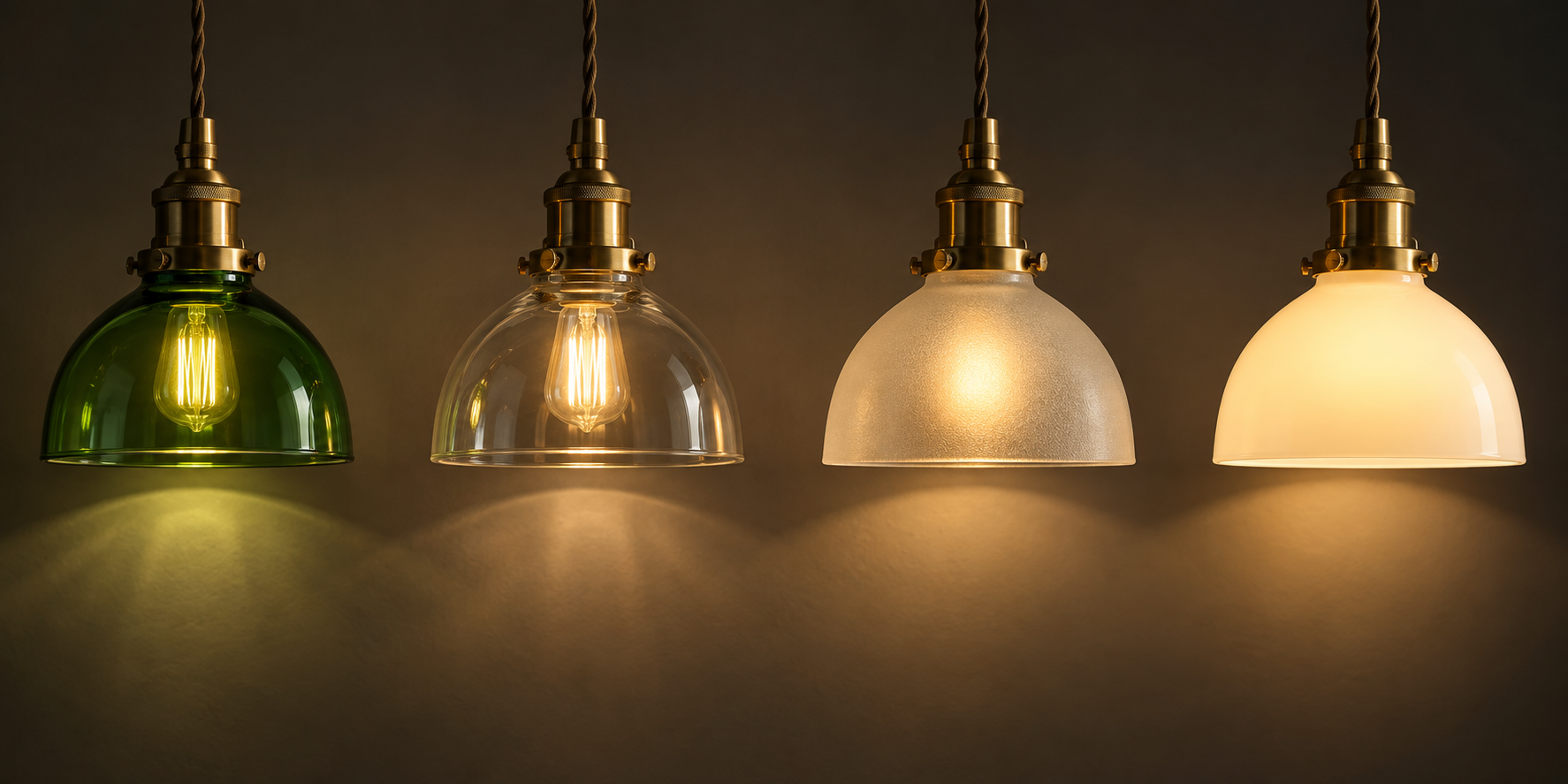
For more technical background, see the site's glass lampshade light diffusion and optical performance article. A supplier should not promise a specific photometric result from a product name alone. If the buyer has a lighting test requirement, provide the source, operating condition, sample geometry and acceptance method before production.
Student shade manufacturing methods
The best production method depends on the profile, quantity, surface treatment, repeatability requirement and development budget. A historical shape may be reproduced by mouth-blown forming, machine pressing or a combination of forming and secondary finishing. Each route changes the way a buyer should control dimensions and variation.
| Route | Strength | Trade-off | Suitable buyer situation |
|---|---|---|---|
| Mouth-blown forming | Flexible profile development and a craft-like surface character | More operator influence and a greater need for sample standards | Restoration, low-volume custom work or a design that benefits from hand forming |
| Machine-pressed forming | Repeatable profile after tooling is approved | Requires suitable mold development and process control | Repeat programs, stable geometry and larger planned volumes |
| Pressed body with secondary finish | Combines a repeatable body with frost, satin or color treatment | Adds another process and another acceptance checkpoint | Brands that need a controlled surface over a stable base shape |
| Tubular or cut-and-finished route | Useful for specific open profiles or straight sections | May not reproduce a deep curved student shade | Special profiles confirmed by engineering review |


The choice should be made after comparing the drawing, order pattern and acceptance criteria. A factory should confirm the practical route with its engineering team based on the drawing, glass type and production method. “Handmade” and “pressed” are not quality grades by themselves. The relevant question is whether the selected route can hold the required profile, finish and interface consistently.
Custom mold development, dimensions and tolerances
An OEM student lamp shade usually needs more than a product photograph. The development package may include a side profile, section through the fitter, body diameter, overall height, wall thickness target, rim treatment, glass color, finish coverage and the relationship to the holder. If the profile has a historical reference, include a physical sample or a controlled scan when possible.
The mold conversation should cover:
- Which dimensions define the fixture interface and cannot move.
- Which surfaces are appearance-driven and may have an agreed visual range.
- Where draft, parting lines or tool marks can appear.
- Whether the shade is formed directly to a metal mold or finished after forming.
- How the rim and fitter opening will be measured.
- Whether a single mold serves all variants or whether each size needs a separate tool.
- What sample is the approved master for production comparison.
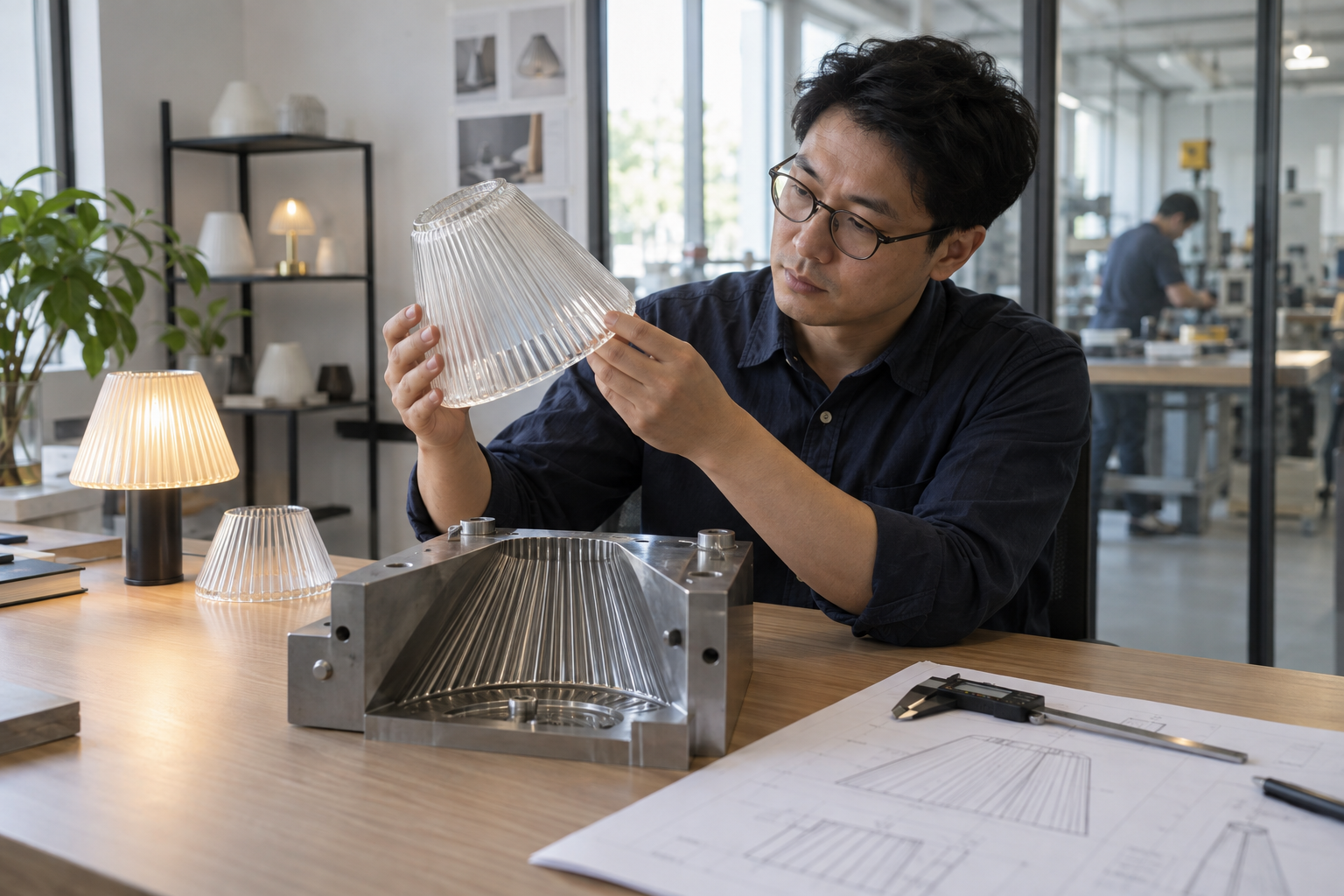
Dimensional tolerances should be treated as project values, not generic promises. The practical range depends on shape, glass type, forming route, wall thickness, finishing and measurement method. Confirm with the engineering team based on the drawing, glass type and production method. If a buyer has a narrow fitter requirement, make that dimension a critical inspection point instead of leaving it inside a broad overall tolerance.
Edge finishing, inspection and packaging
The rim is a functional surface. A polished, ground, seamed or otherwise finished edge changes how the shade contacts the holder and how it feels during handling. The correct finish depends on whether the edge is visible, supported, retained or enclosed. The supplier should also define how chips, sharp edges, uneven contact and visible process marks are evaluated.
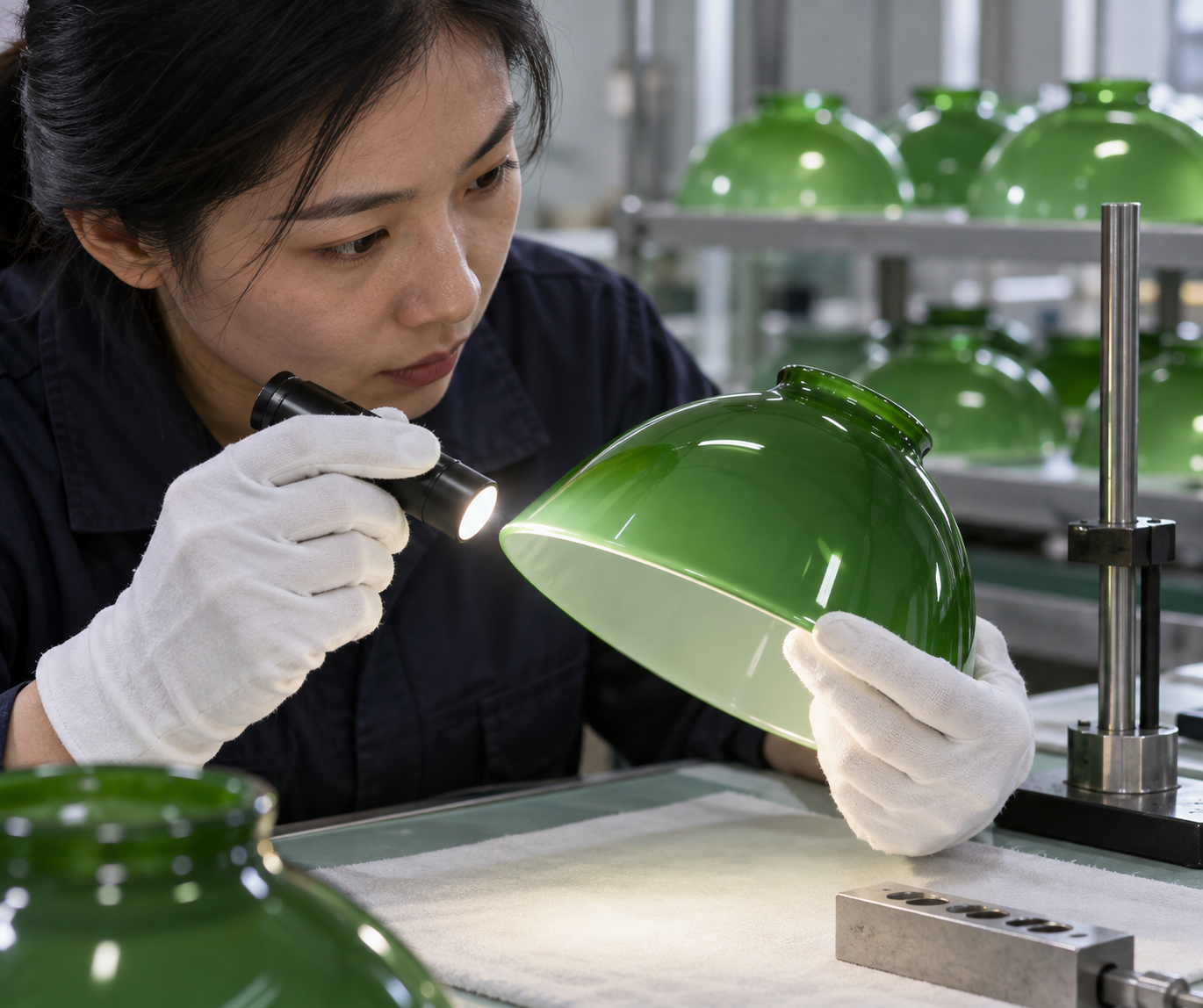
Quality inspection for a student lamp shade can include:
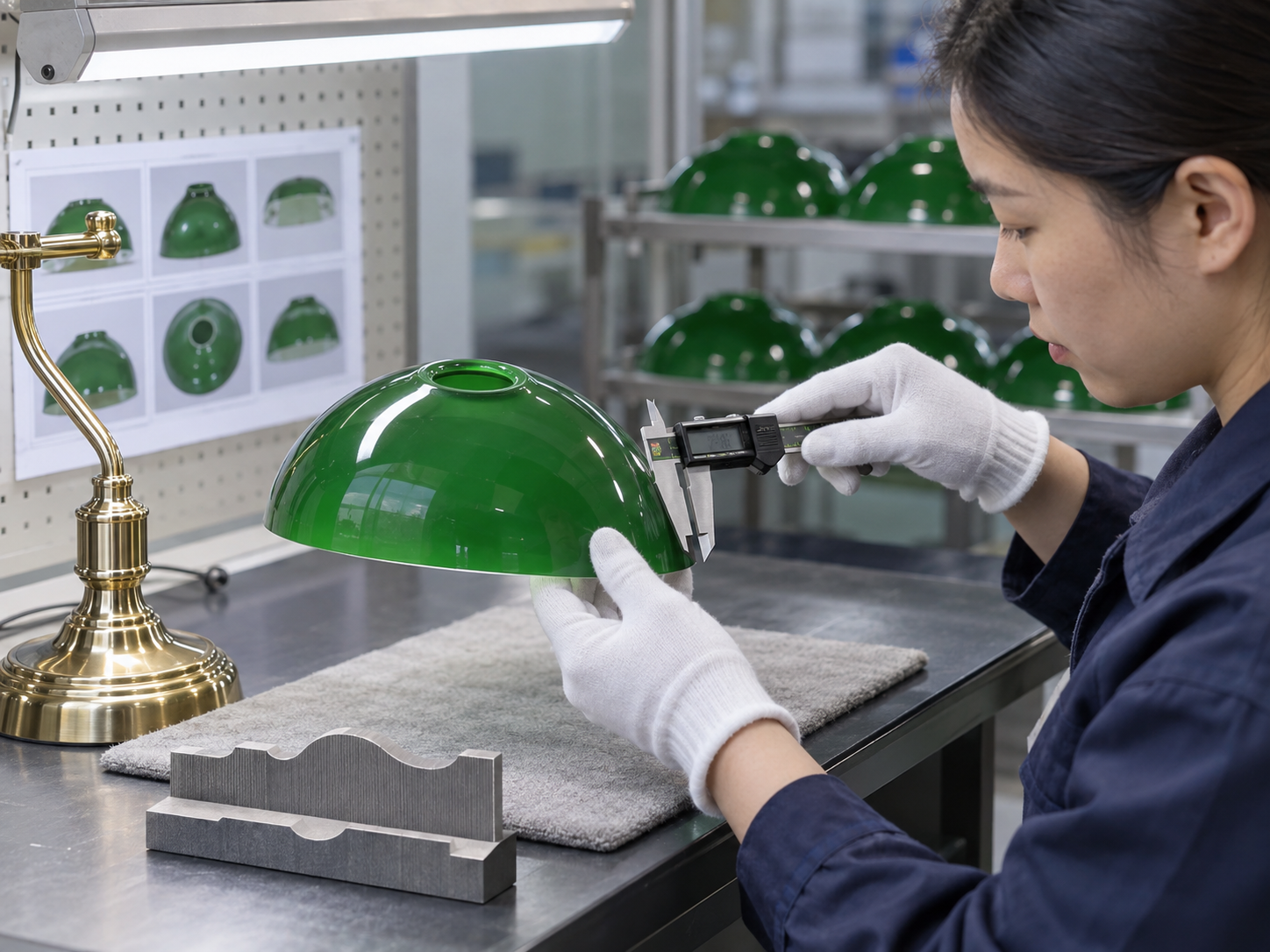
- Profile and height comparison against the approved sample.
- Largest diameter and fitter opening measurement.
- Rim or neck thickness at the holder contact area.
- Visual inspection for cracks, chips, sharp edges, unacceptable bubbles or surface marks.
- Color and finish comparison in an agreed lighting condition.
- Trial fit on the reference holder for a replacement or OEM sample.
- Pair or batch matching when two shades appear on one fixture.
Packaging is part of the product specification. Student shades have curved bodies, vulnerable rims and surfaces that can rub against one another. A buyer should ask how each shade is separated, how the rim is protected, how cartons are labeled internally and how the packing design will be tested or reviewed for the shipping route.
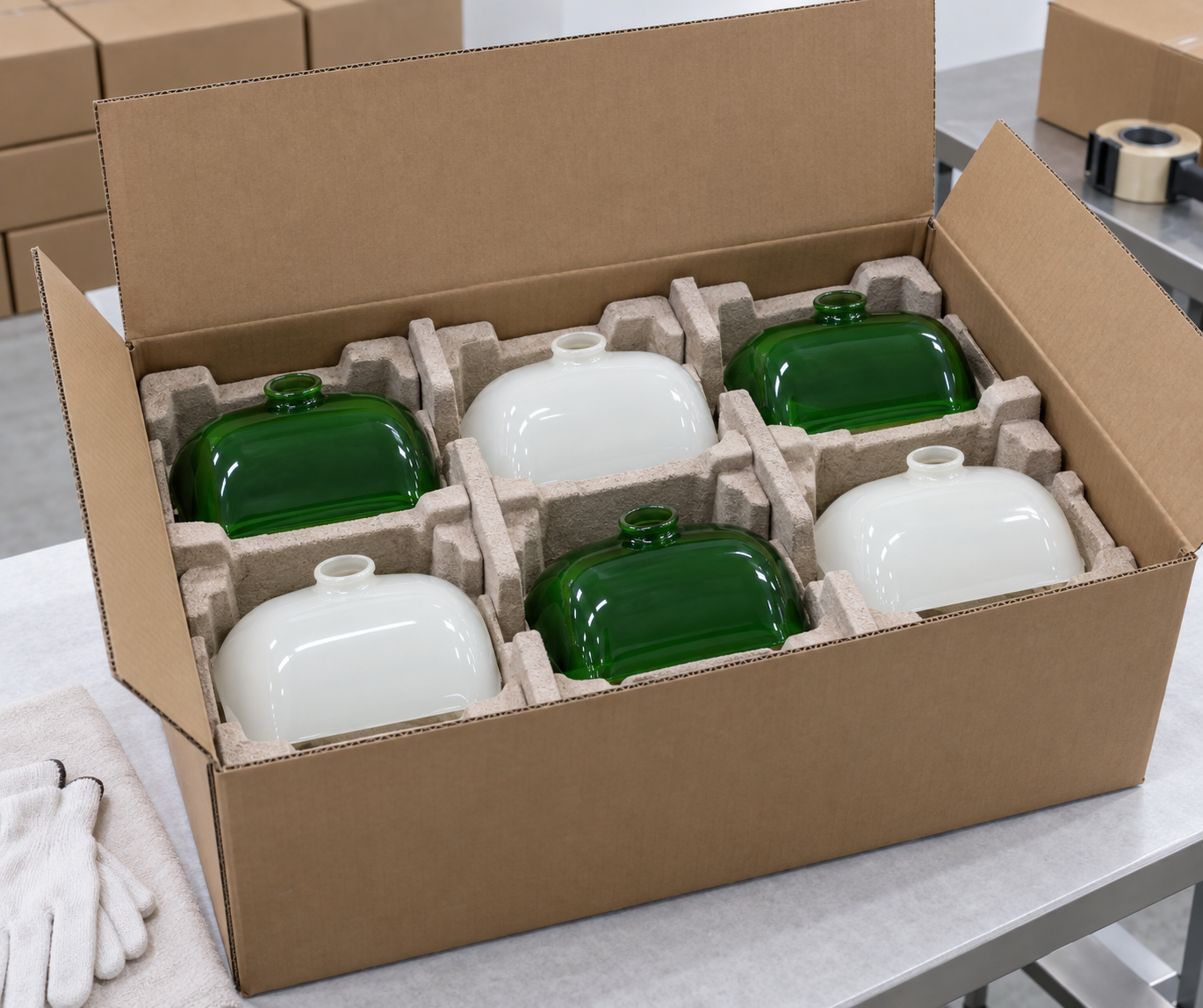
Do not approve packing from a carton photograph alone. Ask for an internal packing view, the number of pieces per carton, the protection around the fitter and the method used to prevent movement. Exact packaging, carton quantity and shipping recommendations should be confirmed for the final glass size and destination.
Replacement project versus new OEM program
Replacement and OEM projects use many of the same measurements, but the decision process is different. A replacement buyer starts with an existing fixture and wants a compatible part. An OEM buyer is defining a repeatable product that may be sold through a brand or distribution channel.
| Project stage | Replacement student shade | New OEM student shade |
|---|---|---|
| Starting evidence | Original shade, holder and fixture photos | Drawing, concept, approved sample or target profile |
| Main decision | Will the part fit and look close enough? | Can the design be made repeatedly at the required cost and quality? |
| Critical dimensions | Fitter, lip, height, diameter and retaining method | Interface plus every controlled body and finish dimension |
| Sample purpose | Confirm fit and visual match | Confirm design, process, color, inspection and packaging |
| Tooling question | Can an existing route reproduce the replacement? | Is a new mold or process development justified? |
| Repeatability | Match the reference part | Match the approved master and documented tolerance |
| Commercial input | Quantity of replacement pieces and urgency | Forecast, variants, sample stages and replenishment pattern |
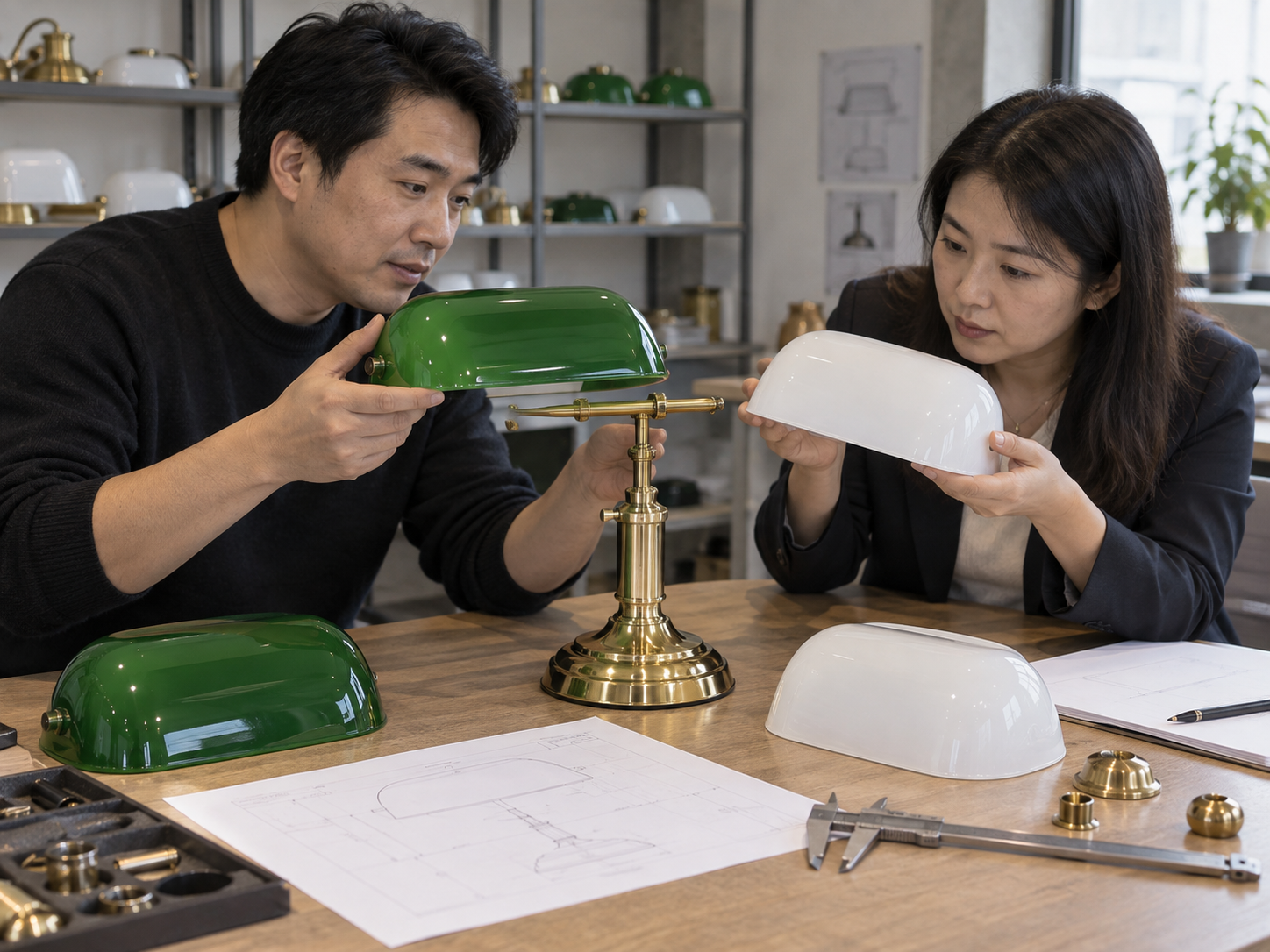
For either project, separate confirmed facts from assumptions. If the buyer only has a marketplace photograph, state that the first quotation is preliminary. A supplier can recommend a sample path, but the final fit and finish should be approved against the target holder and light source.
MOQ, sampling and mass-production considerations
Student lamp shade programs vary widely. A one-time restoration order, a distributor replenishment program and a lighting brand launch should not be quoted from the same assumptions. Before discussing MOQ, sampling cost or lead time, define the profile, finish, tooling status, variant count, packing level and destination.
A practical project sequence is:
- Review the drawing, photos, existing shade or concept sample.
- Confirm the glass type, color, surface finish and interface dimensions.
- Recommend a forming and finishing route.
- Agree the sample scope and what the buyer will inspect.
- Review the sample on the target fixture or reference holder.
- Confirm the production specification, packaging and inspection record.
- Release the approved configuration for a quotation based on the expected order pattern.
MOQ, sampling fees, tooling charges, lead time and mass-production capacity are project-specific. Confirm them with the engineering and commercial team based on the drawing, glass type, production method and order information. A product photograph cannot establish those values.
What buyers should send for a student lamp shade quotation
The fastest RFQ is not always the longest one. It is the one that separates required dimensions from preferences and provides enough evidence to identify the fixture interface.
| RFQ field | What to provide | Why it affects the quotation |
|---|---|---|
| Fixture application | Banker, library, reading, restoration, hospitality or brand product | Sets the fit, appearance and light-control priorities |
| Shade profile | Side view, section sketch, original sample or controlled photos | Identifies the body shape and opening relationship |
| Dimensions | Largest diameter, height, opening, neck or lip, wall thickness target | Determines forming, finishing and holder compatibility |
| Holder details | Ring, clip, bracket, socket and retaining method | Prevents a visually similar but unusable replacement |
| Glass appearance | Green, opal, milk, clear, frosted, seeded or custom color | Changes light transmission, visual match and process choice |
| Light source | Bulb type, wattage or operating condition when relevant | Helps review clearance, glare and illuminated appearance |
| Quantity pattern | Sample quantity, first order, annual estimate and variants | Supports a suitable tooling and production discussion |
| Quality standard | Critical dimensions, visual defects, color reference and fit test | Turns a preference into an acceptance method |
| Packing and destination | Individual protection, carton needs and shipping country | Affects packing design and quotation scope |
| Commercial request | Target price basis, Incoterm or quotation format if known | Helps the supplier return a usable commercial proposal |
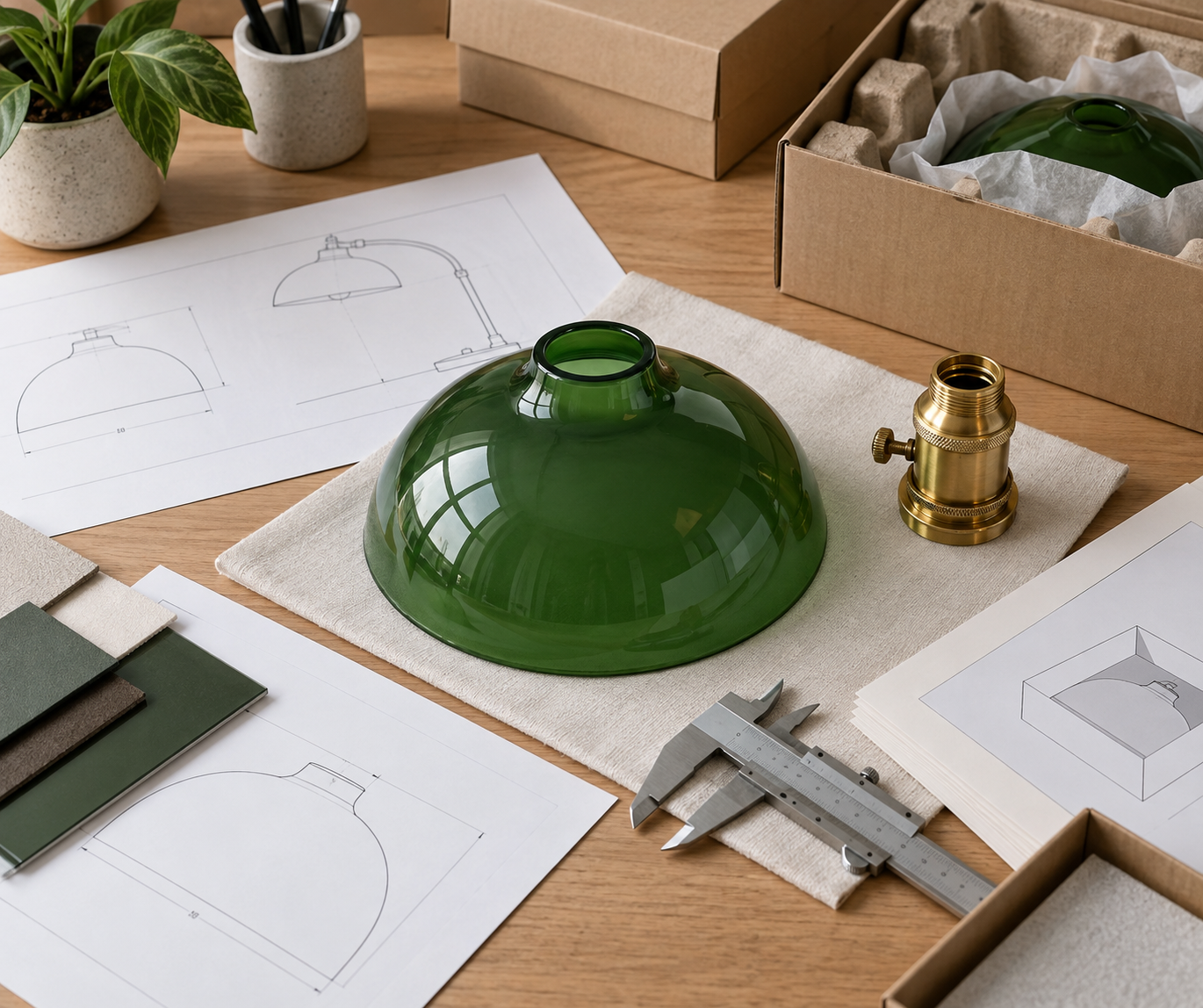
For an OEM or wholesale request, start with the custom glass lamp shade manufacturer page and the glass lampshade manufacturing overview. Include the drawing or photos in the first message. If the project is a replacement, also include the holder and retaining hardware so the engineering review does not depend on the shade name alone.
Buyer questions
What is a student lamp?
A student lamp is a traditional reading, banker or library-style fixture that commonly uses a glass shade supported by a dedicated holder. The term identifies a fixture family, not one universal shade dimension. The glass profile, holder and fitter must be checked together.
Are student lamp shades standardized?
They are not standardized by the name alone. Suppliers may group products under nominal 7-inch or 10-inch families, but diameter, height, opening, neck, lip and rim details can vary. Use the nominal family to find a sample, then verify the actual dimensions.
Is a 7-inch student lamp shade the same across suppliers?
No. The 7-inch reference may describe the widest body, an approximate outside dimension or a product family. Ask for the measurement definition and compare height, opening and holder compatibility before ordering a replacement.
How do I measure replacement student lamp glass?
Measure the widest outside diameter, overall height, fitter opening, neck or lip, holder seat and retaining hardware. Add side, top and underside photos with a ruler or caliper visible. If the original glass is damaged, photograph and measure the fixture hardware instead.
What glass color is best for a student lamp shade?
Green glass is a familiar choice for banker and library fixtures, while opal or milk glass can provide broader diffusion. Clear glass shows more of the source and hardware. The best option depends on the reference appearance, glare goal, light source and required repeatability. Approve a lighted sample when color matters.
Can a student lamp shade be made from a custom mold?
Yes, a custom mold may be appropriate when the profile, fitter or body dimensions are not available from an existing route. The decision depends on the drawing, glass type, quantity pattern and required repeatability. Confirm the mold route with the engineering team before treating it as a fixed quotation assumption.
Is mouth-blown or pressed glass better for a student lamp shade?
Neither route is automatically better. Mouth-blown forming can support flexible profile development and a controlled craft character. Pressed forming can support repeatable geometry after tooling is approved. The right route depends on the accepted variation, order pattern, tooling plan and finish.
Can you produce student lamp shades for OEM or wholesale orders?
An OEM review should be based on the drawing, sample or controlled photos, glass appearance, fixture interface, quantity pattern and packing requirement. Send those details for a project-specific assessment. Confirm production method, MOQ, tolerance and lead time with the engineering and commercial team.
What should I send for a student lamp shade quote?
Send the fixture application, profile or original sample, largest diameter, height, opening, holder details, glass finish, light source, quantity, inspection requirements, packing needs and destination. A clear side profile and a close image of the fitter usually reduce the number of clarification rounds.
Start with the fixture interface, then approve the appearance
The most reliable student lamp shade specification starts with the holder and fitter, continues through the glass profile and finish, and ends with a sample that is checked in the intended fixture. For a replacement, send the original part and measurements. For an OEM program, send the drawing, finish target, quantity pattern and acceptance points.
For a manufacturing review, use the contact page to send the student lamp shade details. The team can confirm the appropriate quotation path with the drawing, glass type and production method rather than relying on a nominal size or a product photograph alone.