To measure a lamp for a new lamp shade: measure the lamp base width — the shade bottom diameter should be 1.5–2× that width. Measure total lamp height from foot to harp top — shade height should be 40–50% of that figure. Then identify and measure the fitter opening diameter: fitter type and diameter determine whether the shade physically mounts, regardless of how well the body proportions match.
The shade arrives. It’s the right style, right color, exactly the finish you specified — and it won’t stay on the lamp. Wrong fitter diameter. The fit failure wasn’t visible in any product photo; there’s no “fitter diameter” field on most retail listings; and none of the measurement guides you read mentioned it before you placed the order.
Most lamp shade guides teach you to measure the shade. This one teaches you how to measure a lamp for a new lamp shade — starting from the lamp itself, working outward to the three measurements that govern both fit and proportion. Get all three right and the replacement shade installs in under a minute.
The Three Measurements That Determine Fit
When learning how to measure a lamp for a new lamp shade, start by understanding which numbers actually matter. Three dimensions govern fit: the shade body proportions (bottom diameter and height relative to the lamp base), the fitter type, and the fitter opening diameter. The first two control how the shade looks on the lamp. The third determines whether it physically mounts at all.
Most ordering errors come from treating those three as a single problem. They’re not. A shade can have perfect body proportions and still be impossible to install because the fitter ring is 4 mm too large for the harp saddle. Conversely, the fitter can match exactly but the shade can look wrong — too squat, too tall, too wide — because the body proportions weren’t checked against the lamp. Measure all three, in order.
Why Fitter Diameter Is the Critical Measurement
The fitter is the mounting hardware built into the top of every lamp shade. It’s the point of physical contact between shade and lamp, and it comes in four incompatible types: spider, uno, clip-on, and threaded neck. Within each type, the opening diameter varies — spider fitters alone range from 55 mm to 76 mm depending on the manufacturer and country of origin.
According to the Wikipedia overview of lampshade construction, fitter types were never globally standardized, which is why a shade purchased in one country often won’t fit a lamp purchased in another even when body dimensions match. Measure the fitter before you evaluate body proportions.
Tools You Need
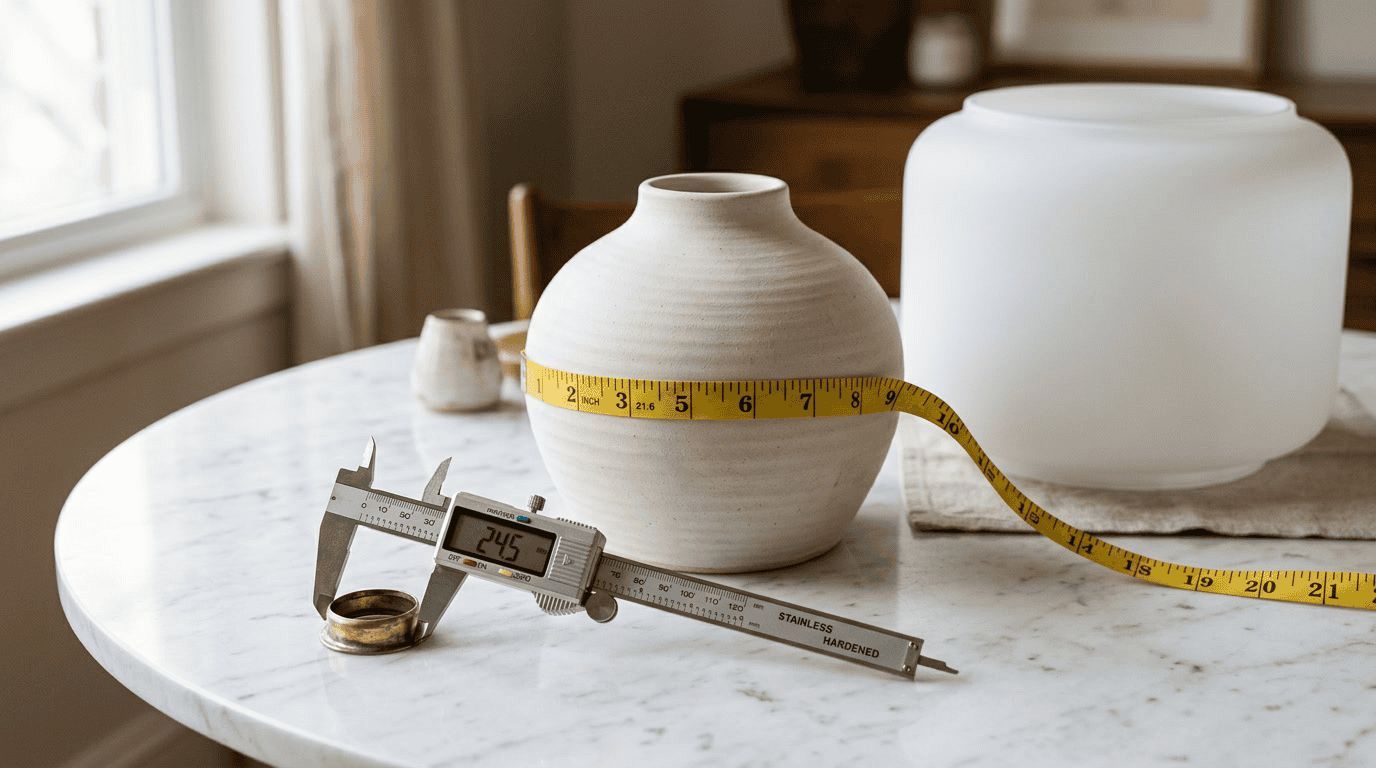
Two tools and one reference: a flexible tape measure (fabric or fiberglass, not a rigid metal builder’s tape), a pair of digital calipers accurate to 0.1 mm for fitter measurement, and the lamp itself in front of you. A phone camera helps document the fitter geometry before the original shade is removed. No specialty tools required.
| Dimension | What It Controls | Typical Range — Table Lamp | Typical Range — Floor Lamp |
|---|---|---|---|
| Shade bottom diameter | Visual proportion to base | 25–50 cm | 40–60 cm |
| Shade height | Visual proportion to total lamp | 18–35 cm | 28–45 cm |
| Fitter opening diameter | Physical mounting fit | 55–76 mm | 55–76 mm |
| Fitter type | Mounting mechanism | Spider (USA/CA), Uno (EU) | Spider (USA/CA), Uno (EU) |
How to Measure the Lamp Base for Shade Proportions
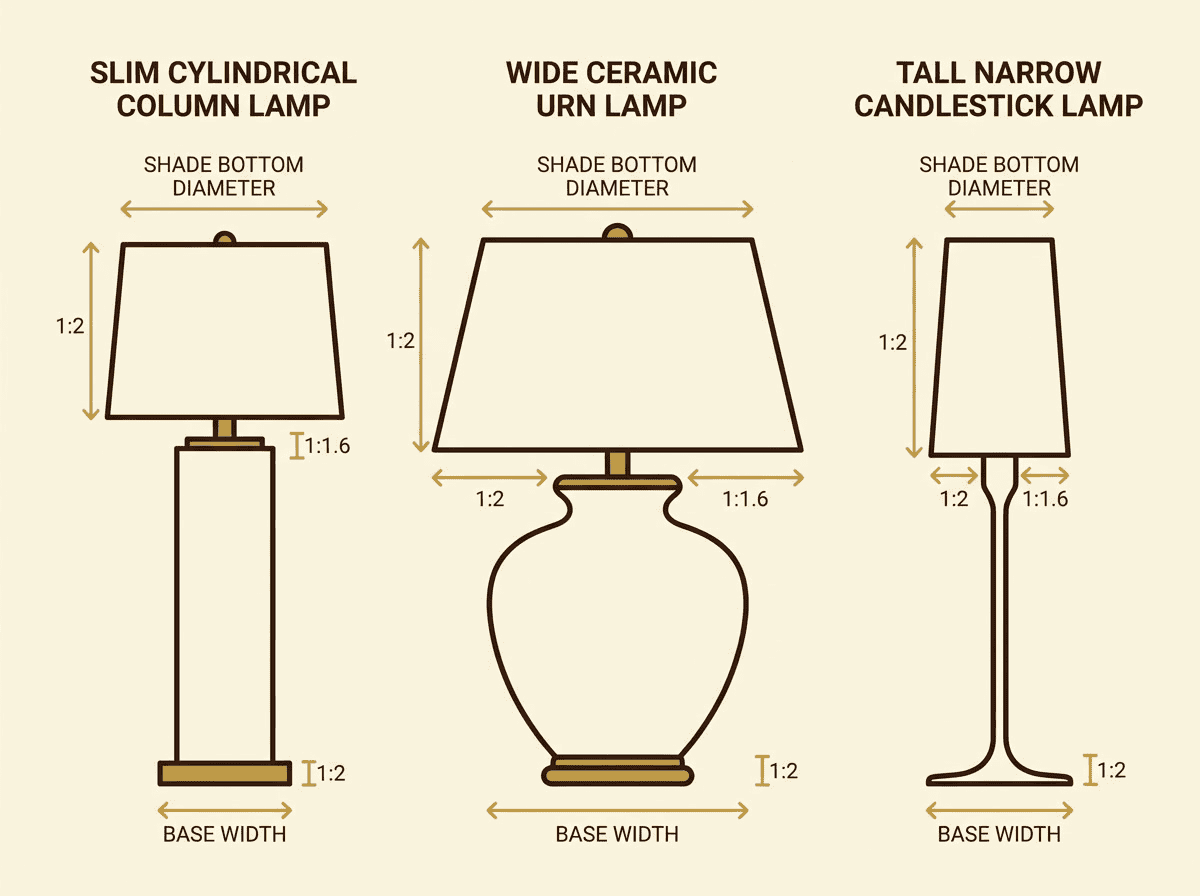
Measuring the lamp base is the first practical step in how to measure a lamp for a new lamp shade. Measure the widest point of the lamp base with a flexible tape measure, keeping the tape level and perpendicular to the lamp’s central axis. The shade bottom diameter should be 1.5–2× that base width. For a lamp base that’s 20 cm at its widest, that means a shade with a bottom diameter between 30 cm and 40 cm — where you land within that range is a stylistic choice, but staying inside the ratio keeps the lamp visually balanced.
Then measure total lamp height: from the foot of the base to the top of the installed harp (the metal U-frame that holds the shade, if present), or to the top of the socket on direct-mount lamps. Shade height should be 40–50% of that total.
Measuring Base Width — The 2× Rule Explained
The 2× proportion rule has a practical basis, not just an aesthetic one. A shade bottom diameter less than 1.5× the base width creates a top-heavy silhouette — the base visually overwhelms the shade. More than 2× and the shade looks unstable, as if the lamp might tip. The rule holds across base styles from slim columns to wide urns, though urns benefit from staying closer to 1.5× because their visual mass is already substantial.
When measuring base width on lamps with a decorative foot plate, measure the lamp body itself — the ceramic, glass, or metal column — not the foot plate. The foot plate often adds 3–5 cm to each side and isn’t part of the visual “base” the shade needs to proportion against.
Measuring Total Lamp Height — Where to Stop the Tape
Total lamp height for shade proportion is measured from the bottom of the foot to the top of the harp saddle — the U-shaped metal bracket the shade rests on. Don’t measure to the finial tip. The finial sits above the shade and doesn’t contribute to the height the shade needs to balance against.
On lamps without a harp (uno-fitter lamps, clip-on designs), measure to the top of the socket. The shade height target of 40–50% still applies, but the relationship between shade and socket will be slightly different at the mounting point.
Adjusting Proportions by Lamp Style
Slim column lamps — cylindrical ceramic or metal rod styles — look best with shades at the higher end of the diameter range, 1.8–2× the column width. Wide urn-base lamps carry shade diameters at 1.5–1.7× the urn’s widest point more elegantly. Candlestick lamps with very narrow bodies (under 8 cm diameter) use a modified rule: the shade bottom should be at minimum 24 cm to cover the socket and distribute light usefully, regardless of the strict 2× calculation.
How to Identify and Measure the Fitter
The fitter is the single most important element in how to measure a lamp for a new lamp shade, and it’s the measurement most guides skip entirely. Fitter type and diameter are not visible in product photos, rarely mentioned in retail listings, and not standardized across manufacturers.
Get this wrong and the shade either won’t install at all (spider shade on a uno-fitter lamp) or it will install but wobble, tilt, or fall under vibration (wrong-diameter spider ring on the correct harp saddle). The Illuminating Engineering Society notes that lamp assembly tolerances are set by individual manufacturers rather than industry-wide standards — meaning “standard fitter” is not a reliable specification without the actual measured diameter.
Spider Fitter — Radiating Arms + Harp (USA/Canada Standard)
A spider fitter has visible radiating arms — three or four — connecting to a central ring that rests on the harp saddle. The shade is secured by a finial screwed onto the harp post through the central ring. Remove the finial, lift the shade off, and look at the underside of the shade top: if you see a wheel-spoke pattern of metal arms meeting a ring, it’s a spider fitter.
To measure: use digital calipers to measure the internal diameter of the central ring — the opening that slides over the harp post. Standard spider fitter ring diameters run from 55 mm to 76 mm, with 58 mm and 65 mm being the most common in US and Canadian residential lamps. Record this number before ordering.
Uno Fitter — Single Ring That Screws onto Socket
A uno fitter has a single threaded ring that screws directly onto the lamp socket’s threaded collar, eliminating the harp entirely. Look at the underside of the shade top: if you see a single ring with a threaded interior and no radiating arms, it’s a uno fitter.
Measure the internal thread diameter with calipers. Most uno fitters in European lamps use a 26 mm or 27 mm thread, matching the Edison screw socket standard used in those markets. Some US table lamps also use uno fitters, particularly pharmacy-style and mid-century modern designs — don’t assume spider just because the lamp was purchased in North America.
Clip-On and Threaded Neck Fitters
A clip-on fitter has spring clips that grip the bulb directly — no harp, no socket thread. Common on chandeliers, wall sconces, and small decorative table lamps. Measure the clip opening diameter to match the replacement: clips are typically 28 mm for intermediate-base bulbs and 38 mm for standard A19 bulbs.
A threaded neck fitter has an integral neck with external thread on the shade body itself. Used primarily on bathroom vanity sconces and ceiling pendants where the shade seals against moisture ingress. Measure the neck outside diameter and thread pitch with calipers before ordering — these are less standardized than spider or uno.
| Fitter Type | Visual Description | How to Identify | Common Application | Typical Diameter |
|---|---|---|---|---|
| Spider | Radiating arms + central ring | Wheel-spoke pattern under shade top | USA/Canada table lamps | 55–76 mm ring |
| Uno | Single threaded ring, no arms | Smooth ring with internal thread | Europe + some US lamps | 26–27 mm thread |
| Clip-on | Spring clips grip bulb | No ring, clips inside shade top | Chandeliers, small decorative | 28–38 mm clip |
| Threaded neck | Integral neck with external thread | Neck projects from shade top | Bathroom sconces, pendants | Varies by fixture |
Measuring Fitter Diameter — Why Calipers Beat a Tape Measure
A flexible tape measure flexes and rebounds inside a small ring, making readings unreliable for openings under 100 mm. Digital calipers provide direct inside-jaw measurement accurate to 0.1 mm — available for under $20 at any hardware store, and worth having before any shade replacement where the original spec is unknown.
When measuring with calipers, take three readings across different diameters of the ring. If the values vary (a ring reading 62 mm in one orientation and 64 mm in another is slightly oval), use the smallest value — that’s the constraining dimension for fitment.
How to Measure an Existing Shade for Direct Replacement
When replacing a damaged shade with an identical specification, measuring the existing shade — or a surviving intact shade from the same installed set — is faster and more reliable than working back from the lamp alone. The process of how to measure a lamp for a new lamp shade expands here to include the shade body itself.
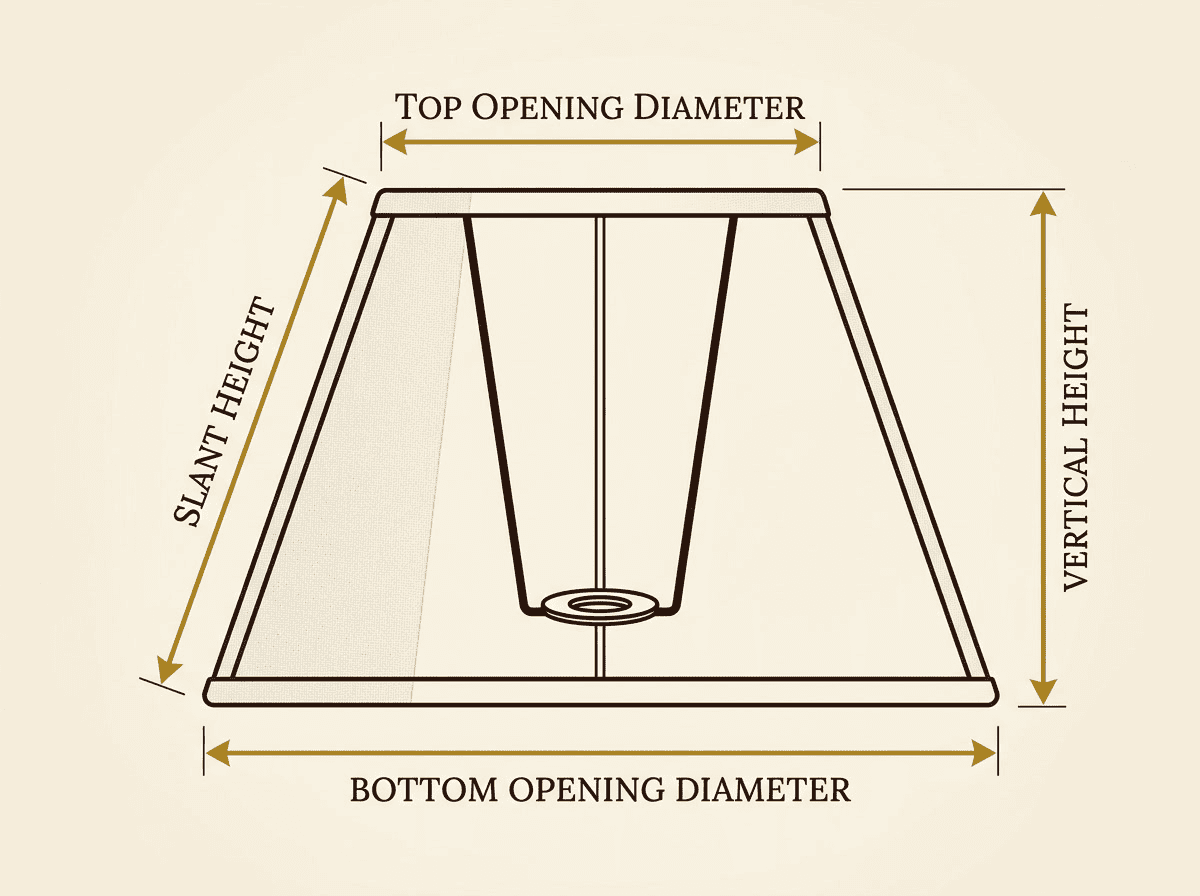
Four body dimensions appear on manufacturer spec sheets and must be recorded for a spec-for-spec replacement: top diameter, bottom diameter, slant height, and vertical height.
Top Diameter and Bottom Diameter — Why Both Matter
Measure the top opening of the shade with a tape measure across the widest interior diameter. Measure the bottom opening the same way. Both dimensions matter because shade profile — whether it’s a straight drum (top and bottom equal), a tapered empire (bottom significantly wider than top), or a modified bell — is defined by the ratio between them.
A shade described as “38 cm drum” may have a top diameter anywhere from 35 to 38 cm depending on manufacturer. “Drum” describes the silhouette, not the exact dimensions. For direct replacement, you need both the top and bottom numbers, not just the descriptor.
Slant Height vs. Vertical Height — The Spec Sheet Confusion
Slant height is measured along the slope of the shade’s side, from top rim to bottom rim. Vertical height is the straight-down distance between those same two rims. On a straight drum shade, they’re equal. On any tapered shade — empire, bell, coolie — they diverge, sometimes by 3–8 cm on a steeply tapered profile.
Spec sheets and product listings are inconsistent about which “height” they report. The safest practice when measuring for replacement: record both values separately and provide both to the supplier. It takes ten additional seconds and eliminates a common source of “it looked the same online” returns.
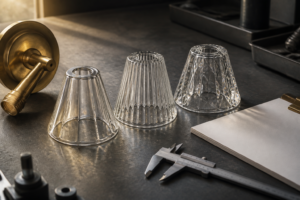
Measuring Glass Shades — Closed Tops and Ribbed Surfaces
Glass shades with closed tops (globes, cylinders, some drum designs) require measuring the fitter opening rather than a conventional top diameter. The fitter neck or ring is integral to the shade — measure its internal diameter for mounting fit and its outside diameter for clearance within the lamp body.
On ribbed glass shades, the tape measure can’t lie flat against the surface. Pull the tape taut across the ribs and measure the outer envelope diameter at the widest point (typically the bottom). This corresponds to the product specification’s listed diameter. Note the rib depth separately if it’s significant — it affects clearance in close-fitting fixture housings.
Lamp Shade Size Charts by Lamp Type
Standard size ranges by lamp type provide a sanity-check on measurements before placing an order. If your measured dimensions fall significantly outside these ranges, re-measure — the error is usually in reading total lamp height (foot included vs. excluded) or in measuring outer diameter at the ribs rather than the nominal opening.
Table Lamp Shade Size Chart
For table lamps on nightstands, desks, console tables, and sideboards:
| Base Width (widest point) | Shade Bottom Diameter | Shade Height | Typical Fitter |
|---|---|---|---|
| 10–14 cm (small accent) | 20–25 cm | 14–18 cm | Spider 58 mm |
| 15–20 cm (standard table) | 28–35 cm | 20–28 cm | Spider 58–65 mm |
| 21–28 cm (large table) | 38–50 cm | 28–35 cm | Spider 65–76 mm |
| 8–12 cm (candlestick) | 24–30 cm | 18–24 cm | Spider 58 mm or clip-on |
Nightstand table lamps in hotel and residential settings typically fall in the 15–20 cm base width category. For these, a 28–35 cm shade bottom diameter keeps the shade above a reclining guest’s sightline while staying proportional to standard bedside furniture. For a full position-by-position breakdown of glass shade selection for hotel environments, see our glass lamp shades for hotel rooms guide.
Floor Lamp and Torchiere Size Chart
Floor lamps carry larger shades and the proportion logic shifts because the lamp’s visual presence in the room operates differently from a table lamp:
- Standard pole floor lamp (140–175 cm tall): shade bottom diameter 40–55 cm, shade height 28–40 cm
- Arc floor lamp (shade overhangs seating): shade bottom diameter 45–60 cm, shade height 32–45 cm — deep enough that the bulb isn’t visible from seated eye level below the arc
- Torchiere (upward-pointing bowl): ring opening 30–45 cm, bowl height 15–25 cm
- Tripod floor lamp (wide footprint base): shade bottom diameter 45–55 cm to balance the visual spread of the tripod legs
Floor lamp shades typically use the same spider fitter sizes as table lamps. The 65 mm and 76 mm spider ring is more common at floor lamp scale because the larger shade weight benefits from the wider seating surface of the larger ring.
Common Measurement Mistakes and How to Avoid Them
Understanding how to measure a lamp for a new lamp shade means knowing where measurements go wrong. Three errors account for the majority of return shipments and reorders: ignoring the fitter while getting the body dimensions right, confusing slant height with vertical height, and measuring the base at the wrong reference point.
Fitter Mismatch — The Number One Return Reason
The most common lamp shade ordering failure is specifying body dimensions correctly but skipping fitter type and diameter. A shade with perfect proportions but a 76 mm fitter ring will wobble on a harp saddle designed for a 58 mm ring — the ring doesn’t engage the saddle and the shade rocks or tips under any contact.
When sourcing glass shades from overseas manufacturers, fitter type confusion is amplified by regional defaults: a Chinese factory producing for the European market ships uno-fitter shades as standard; the same factory producing for North America ships spider fitters. If you don’t specify the fitter type and internal ring diameter explicitly on every order, you’ll receive the factory’s regional default — which may not match your lamp.
Measuring the Wrong “Height” on Tapered Shades
A lamp shade listed as “28 cm high” with no clarification about slant vs. vertical height can represent two physically different shades. A 28 cm slant-height empire shade has a vertical height of roughly 24–25 cm. The visual difference is noticeable on the lamp — the shade with the 28 cm vertical height sits substantially taller. When the original shade is unavailable for direct measurement, contact the original supplier with the lamp model number. If that’s not possible, photograph the lamp with a known-height reference object alongside it and calculate the shade height from the image proportions.
Measurement Documentation for Commercial and Hotel Replacement
For hotel properties and commercial facilities managing multiple lamp models across hundreds of rooms, how to measure a lamp for a new lamp shade is as much a documentation process as a physical measurement task. A complete spec record eliminates re-measurement on every reorder cycle.
Building a Shade Spec Record
A complete shade spec record for commercial use requires six fields per specification type:
- Fitter type (spider / uno / clip-on / threaded neck)
- Fitter opening diameter in mm (measured with calipers)
- Shade bottom diameter in mm
- Shade top diameter in mm
- Shade vertical height in mm
- Shade slant height in mm (equals vertical height for drums; differs on tapered shades)
Store one physical master sample per specification type alongside the spec record. This is more reliable than measurements alone for color-matching and glass finish verification on reorders. Color matching on glass lamp shade replacements — including how to specify ΔE tolerances — is covered in detail in the hotel lamp shade replacement guide.
Sending Measurements to a Glass Shade Manufacturer
When ordering custom or reproduction glass shades, a factory needs all six spec record fields plus the following: glass type (opal, frosted, clear, ribbed, borosilicate), nominal glass wall thickness in mm, and a physical sample or spectrophotometric color target for finish matching. Fitter dimensions are especially critical — glass molds are fixed at production, and a fitter ring cast 2 mm too wide cannot be corrected after the mold is made.
The International Commission on Illumination (CIE) publishes the measurement standards used by glass shade manufacturers for dimensional tolerances and colorimetric specifications. When a supplier quotes color difference in ΔE values, they’re using CIE-defined measurement protocols — a specification reference worth citing in your purchase order.
Once the spec record is complete, submit it directly to a glass lampshade manufacturer serving hotel and hospitality procurement — OEM production to your exact measurements, in custom finishes and fitter configurations, is typically more cost-effective than off-the-shelf sourcing when ordering at hotel-refurbishment quantities.
FAQ — How to Measure a Lamp for a New Lamp Shade
What is the most important measurement when replacing a lamp shade?
Fitter type and opening diameter. All other measurements govern how the shade looks; the fitter measurement governs whether it installs at all. Before taking any body dimension, identify the fitter type (spider, uno, clip-on, or threaded neck) and measure the opening diameter with digital calipers. A fitter error means a shade that won’t mount regardless of how well the body proportions match. The practical bottom line: measure fitter first, body proportions second.
How do I measure a lamp shade size in inches?
Use a flexible tape measure for three body dimensions: (1) bottom diameter rim to rim across the widest point of the shade opening, (2) top diameter the same way, and (3) vertical height straight down from top rim to bottom rim. Standard US residential table lamp shades run 10–20 inches bottom diameter; floor lamp shades run 16–24 inches. To convert from millimeters, divide by 25.4. Always record fitter opening diameter in millimeters — fitter ring sizes are not typically expressed in fractional inches by manufacturers.
What does “the shade should be half the lamp height” actually mean?
It means shade height should be 40–50% of total lamp height, where total height is measured from the foot of the base to the top of the harp saddle — not the finial tip. A 60 cm total lamp height calls for a shade 24–30 cm tall. The practical purpose: this proportion prevents the shade from making the lamp look either top-heavy (tall shade) or spindly (short shade). Staying within the 40–50% range is more important than hitting exactly 50%.
How do I know what fitter size I need?
Remove the existing shade and examine its underside. If you see radiating metal arms meeting a central ring, it’s a spider fitter — measure the internal ring diameter with calipers. If you see a smooth single ring with an internal thread and no arms, it’s a uno fitter — measure the thread diameter. If the shade clips onto the bulb with no ring, it’s a clip-on. Once you know the type, the replacement shade’s fitter must be the same type and within ±1 mm of the same opening diameter for a stable mount.
How do I measure a drum shade for replacement?
Drum shades have equal or near-equal top and bottom diameters. Measure bottom diameter, top diameter, and vertical height. Because drum sides are straight or nearly so, slant height and vertical height are identical or differ by under 2 mm — no need to measure both separately. For glass drum shades, measure the fitter opening separately: the fitter ring is often recessed into the shade top and not visible at a glance. Record all four values anyway; they’ll be required if you ever order from a factory that needs a formal spec.
What is slant height vs. height on a lamp shade?
Slant height is measured along the sloping surface of the shade from top rim to bottom rim. Vertical height is the straight-down distance between those same two rims. On drum shades, they’re equal. On empire and bell shades, slant height is always longer — sometimes by 4–8 cm on a steeply tapered profile. Most online product listings report slant height; most physical spec sheets and factory order forms report vertical height. When in doubt, ask which dimension the supplier is quoting, and always provide both values when ordering glass shade replacements from a factory.
Can I use a spider fitter shade on a uno fitter lamp?
No — not without modification. Spider fitters require a harp; uno fitters screw directly onto the socket collar with no harp present. To use a spider shade on a uno lamp, you’d need to add a harp and saddle, which requires replacing or adapting the socket saddle. The reverse (uno shade on a spider lamp) is equally incompatible. If you’re replacing a shade on an imported lamp of unknown fitter type, measure before ordering rather than assuming the USA/Canada spider standard.
How do I measure a floor lamp for a new shade?
Measure total lamp height from foot to harp saddle (not finial), then target shade height at 40–50% of that. Measure the harp width — the U-opening between the two harp arms — to confirm the replacement shade’s spider ring diameter will clear it without binding. Floor lamp shades typically use 65–76 mm spider fitters. For arc floor lamps, verify shade depth: the shade must be deep enough that the bulb isn’t visible from a typical seated sightline below the arc. A shade that works visually from standing height can expose the bulb to anyone seated beneath it.

Conclusion
How to measure a lamp for a new lamp shade is a three-step sequence that takes under five minutes with the right tools: measure the lamp base width and total lamp height to establish body proportion targets, then measure fitter type and opening diameter to confirm the shade will physically mount.
The proportion measurements — shade bottom at 1.5–2× base width, shade height at 40–50% of total lamp height — give you a search range. The fitter measurement narrows it to shades that will actually install. For direct replacements, add the four body dimensions of the original shade (top diameter, bottom diameter, slant height, vertical height) and you have a complete spec that can be sent to any manufacturer or supplier without follow-up questions.
Start with the fitter. Record all six numbers. The shade that arrives will fit.