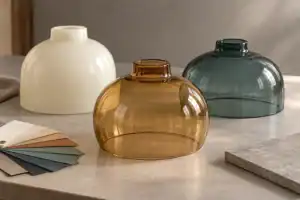
A green lampshade filters light through a tinted surface, shifting a room’s ambient tone toward calm and nature-adjacent warmth or drama depending on the shade of green. Available in sage, emerald, forest, and olive across fabric, glass, and paper, the right green depends on your room palette, lamp base, and whether the shade should recede or command attention.
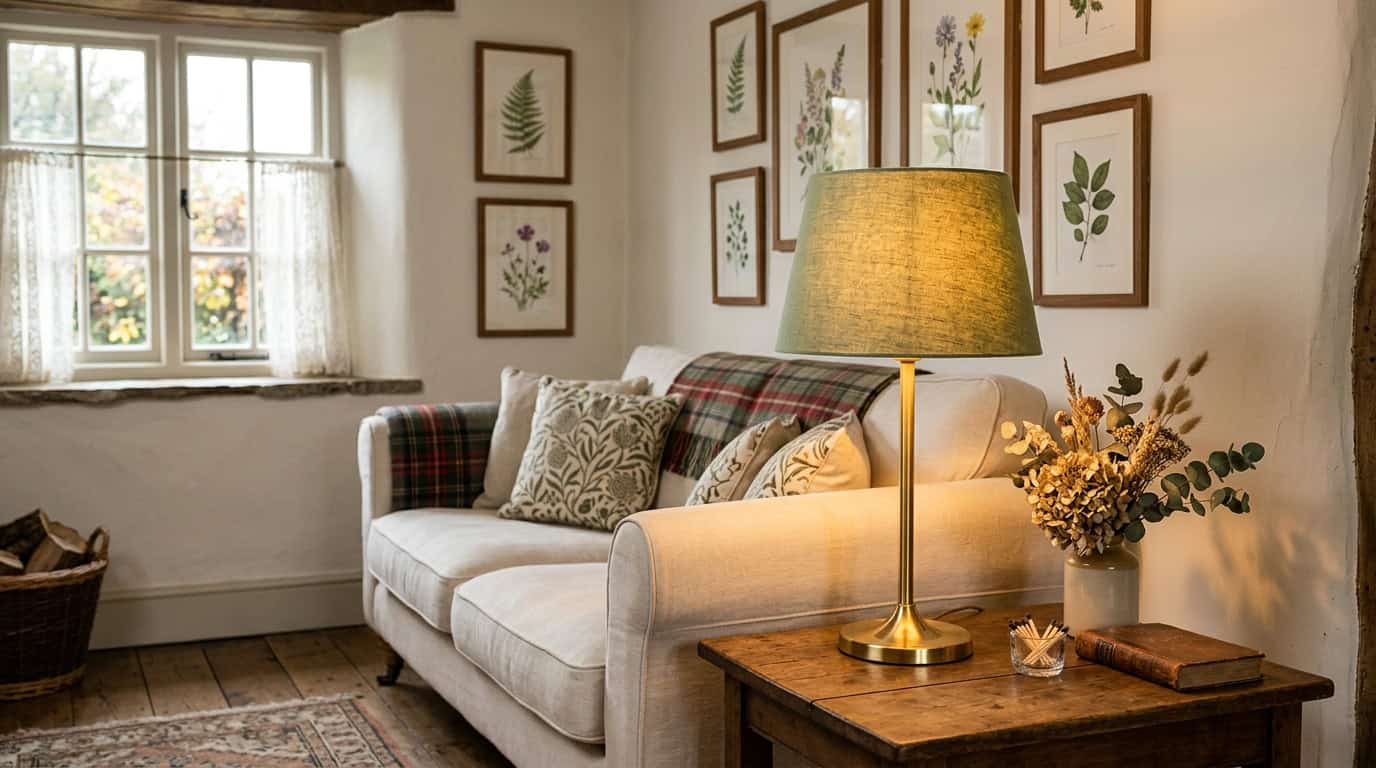
Green is one of the most requested lampshade colors, and also one of the most frequently regretted. Not because green shades are difficult to find (the market is saturated with them), but because “green” covers an enormous territory. The sage green that looks perfect in a product listing can arrive and feel flat against a warm-toned room. The emerald green that would anchor a library feels loud and wrong in a bedroom. The forest green that photographs beautifully can make a small living room feel like a cave.
The difference between a green lampshade that transforms a room and one that dominates it or disappears into it usually comes down to three things: the specific tone of green, the material the shade is made from, and the lining color on the inside. This guide works through all three, along with material types, vintage options, and the questions that trip most buyers up.
What is a green lampshade?
A green lampshade is any shade where green is the primary color characteristic: tinted glass, dyed or printed fabric, or colored paper. The range is wider than most buyers expect, and within that range, two fundamentally different types serve different design purposes.
Green-tinted vs. green-patterned: the distinction that matters
A green-tinted lampshade carries the color in its material: the glass is colored, the fabric is dyed, the paper is pigmented. The green is structural. Light passing through the shade picks up a green cast that affects the entire room, not just the shade itself.
A green-patterned lampshade uses a standard shade form and applies green as part of a surface pattern: green botanical prints on a cream drum shade, green stripes on a white empire, green floral embroidery on a linen base. The green is decorative rather than structural. Light output through the shade walls stays neutral or warm, and the green reads as design detail rather than color cast.
Most buyers who want a “green lampshade” are looking for the tinted version: a shade that reads as green from across the room. Most who walk away disappointed bought the patterned version thinking it would serve the same purpose. Worth being clear about which one you want before purchasing.
How a green lampshade changes ambient light
When light passes through a green-tinted shade, it picks up a green cast that changes how everything in the lit area looks. Warm yellow-green tones (olive, chartreuse-adjacent) tend to flatter wood surfaces and natural materials. Cool blue-green tones (teal-adjacent, sage at the cooler end) can make skin tones look slightly muted. True mid-green tones are neutral in terms of flattery and read as natural rather than artificial.
As Wikipedia’s overview of lampshade design notes, the shade’s primary optical function is light diffusion and directional control. In colored shades, the color transmission adds a secondary layer of environmental effect that most buyers significantly underestimate until they see it in their own space.
| Green tone | Light character through shade | Room mood produced | Best room application |
|---|---|---|---|
| Sage (muted yellow-green) | Warm, soft, amber-adjacent | Calm, organic, earthy | Bedroom, reading nook, cottage living room |
| Emerald (saturated mid-green) | Cool-bright, jewel-like glow | Rich, bold, formal | Library, dining room, home office |
| Forest/hunter (dark blue-green) | Deep, directional, minimal diffusion | Dramatic, intimate | Study, bar cart, bedside for readers |
| Olive (warm yellow-green) | Warm, slightly gold-cast | Nostalgic, 1970s, earthy | Living room with wood tones, kitchen accent |
| Mint (light cool-green) | Bright, even, neutral | Fresh, airy, playful | Children’s room, bathroom, small accent lamp |
Shades of green: which tone works where
The most important decision in choosing a green lampshade is not the shape or material. It is the specific tone of green. Getting this wrong cannot be fixed by moving the lamp to a different corner.
Sage green
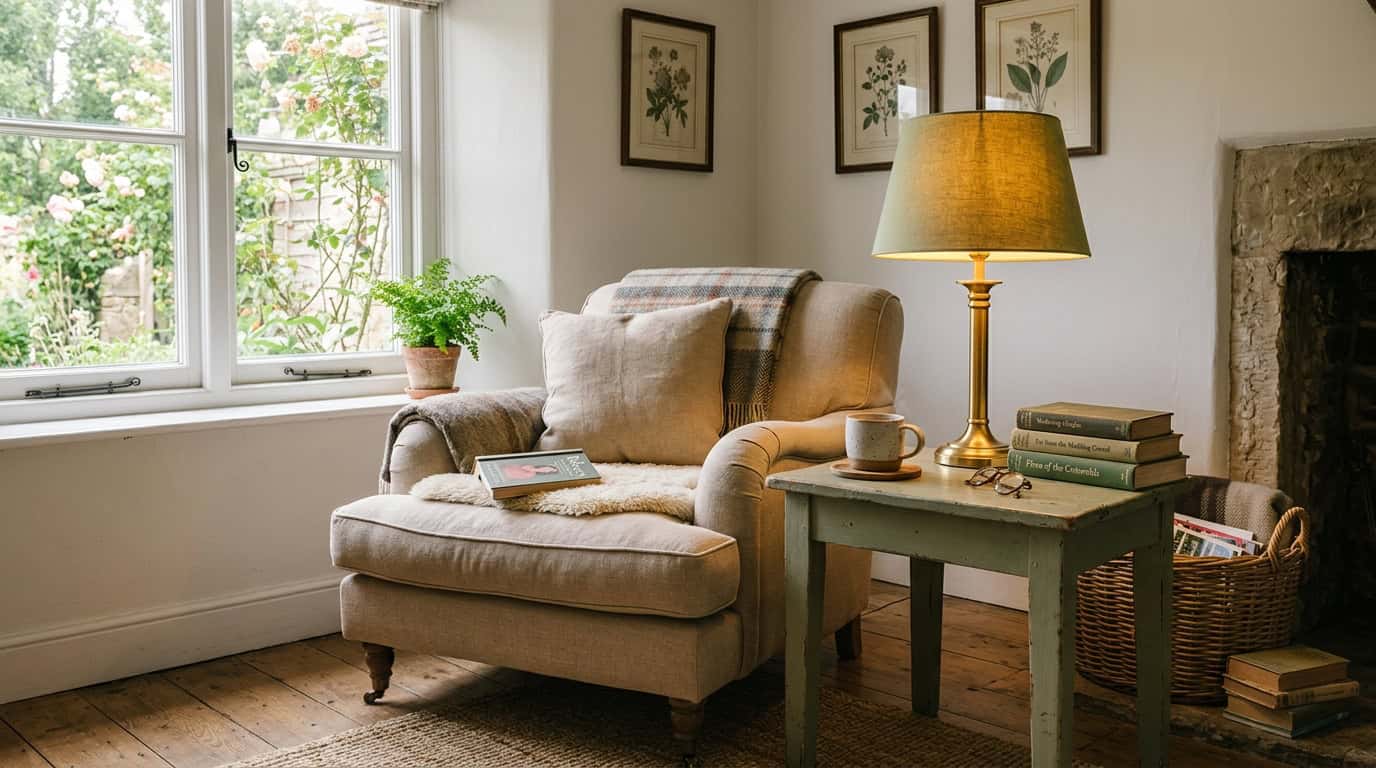
Sage is the dominant green lampshade tone in residential interiors in 2026. It is a muted, slightly grayish yellow-green: warm rather than cool, quiet rather than assertive. Sage green lampshades work across a wider range of room types than any other green because the gray content softens the color’s natural intensity. They do not demand attention. They integrate.
The strongest pairings for sage green lampshades are rooms with natural linen, raw wood, rattan, and terracotta. These materials share sage’s earthy, slightly desaturated quality. Sage lampshades placed against very white or very bright rooms tend to look dull rather than sophisticated. The muted quality that makes sage versatile in warm rooms becomes a liability in cool, high-contrast spaces.
Emerald and jewel green
Emerald is fully saturated mid-green with strong blue undertones. It is a demanding color that reads as luxurious when used deliberately and garish when used carelessly. An emerald green glass pendant over a dining table reads as Art Deco grandeur. The same shade on a small bedside lamp in a softly furnished bedroom reads as a mistake.
The rooms that handle emerald best have rich, warm companions: deep wood, brass hardware, burgundy or navy upholstery, dark-toned walls. Emerald fails in neutral or light-toned rooms. It needs context to read as intentional rather than misplaced.
Forest and hunter green
Forest green is the darkest commonly available lampshade tone: deep, blue-adjacent, barely transmitting light. A forest green shade functions more like a directional lamp than an ambient light source. It sends light downward and outward but produces minimal room fill. This is a feature, not a limitation, in the right setting.
Library and study applications are where forest green lampshades belong. The classic banker’s lamp in green glass (a design that has remained in continuous production since the late 19th century) is the canonical example: a shade designed to focus light on a work surface without flooding the room with ambient light. The effect is intentionally intimate and focused.
Olive and yellow-green
Olive is warmer and more yellow than sage, and carries clear 1970s visual associations. This used to count against it; in 2026, it increasingly works in its favor. The 1970s design revival has rehabilitated olive as a sophisticated choice rather than a dated one, and its warm yellow cast flatters wood-heavy interiors in a way that cooler greens do not.
Olive green lampshades work best in rooms leaning into the 1970s revival aesthetic: warm wood floors, macramé, ceramic lamp bases in earth tones, and natural fiber rugs. They struggle in rooms with cool-toned palettes where the yellow undertone reads as muddy rather than warm.
Types of green lampshade
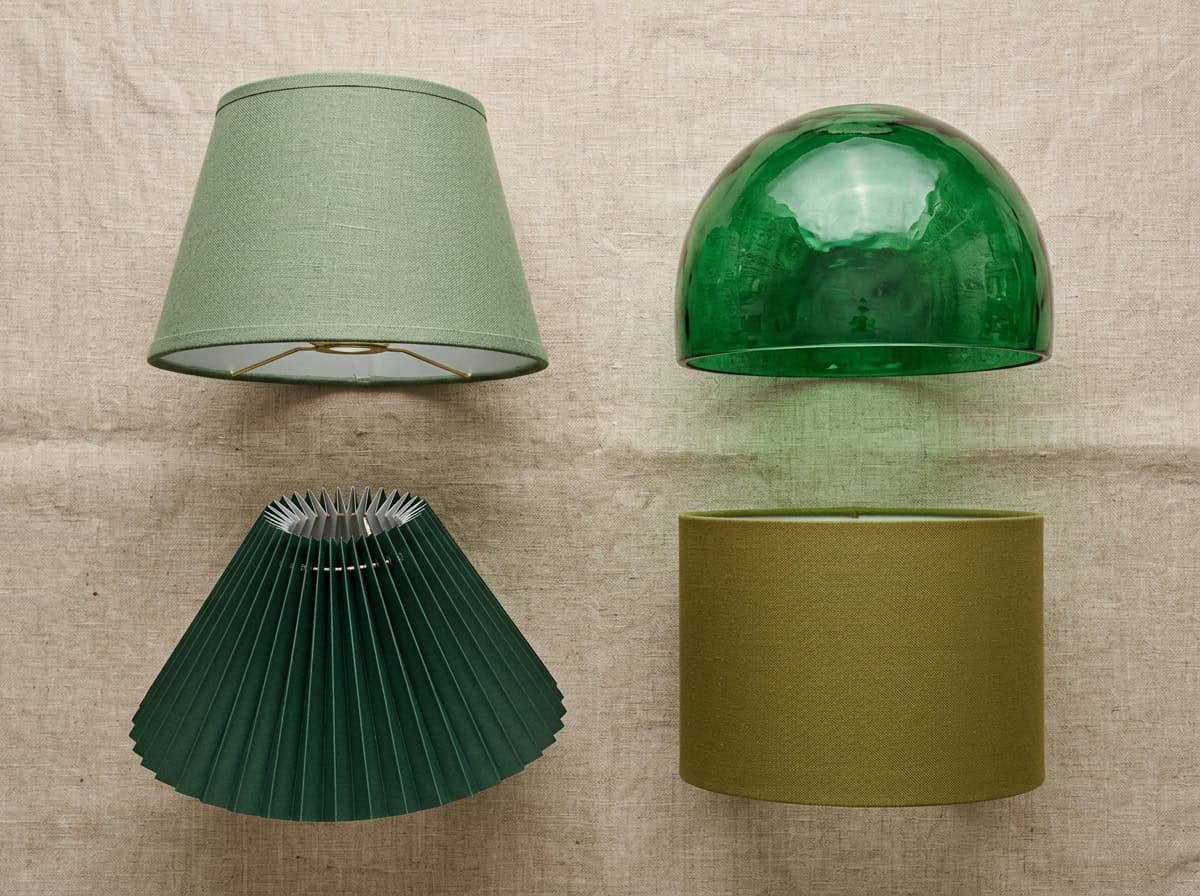
There are four main types of green lampshade by material: glass, fabric, silk, and paper. Each handles the green color differently and suits different lamp types and room applications.
Glass green lampshades
Glass is the only material where green becomes fully structural in the optical sense. Light does not pass through colored glass the way it passes through fabric. It transforms through it. The result is a color quality that fabric cannot replicate: depth, clarity, and a glow-from-within effect that changes completely when the lamp is lit.
The green glass lampshade tradition runs through Art Nouveau and Arts and Crafts design. The most celebrated examples are the Tiffany Studios leaded glass shades produced from the 1890s through the 1930s, many featuring botanical motifs in greens ranging from pale apple to deep malachite. As Wikipedia’s documentation of Tiffany lamp production explains, genuine Tiffany Studios glass achieves its color through mineral pigments fused into the glass during manufacture; not surface coating, not paint. That is why examples from 130 years ago retain their color with no fading.
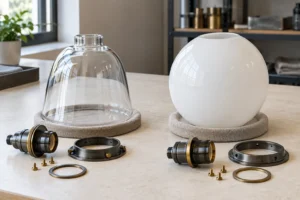
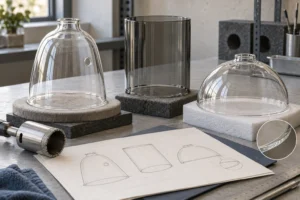
Contemporary glass green lampshades range from hand-blown borosilicate pieces with applied color to factory-produced pressed glass shades in standard sizes. Our glass lampshade collection includes kiln-fired green options in dome, globe, and cylindrical profiles suited for pendant, table, and floor lamp applications, where the glass color is fired into the surface rather than painted on.
Fabric and linen green lampshades
Fabric covers the widest range of green lampshade options by volume. Cotton, linen, silk, and synthetic blends are all available in every tone of green, with printed patterns adding botanical and geometric options beyond solid-dyed grounds.
Solid-dyed linen and cotton green lampshades are the strongest performers for most residential applications. Linen handles green dye particularly well: the slight texture of the weave breaks up the color at close range, preventing the flat, painted appearance that can make solid-color fabric shades look cheap. Our fabric lampshades guide covers material and weave density in detail, including how to assess light transmission before buying.
Paper and pleated green shades
Paper and pleated green lampshades tend toward lighter tones (mint, pale sage, light olive) because dark greens in thin paper produce very little light transmission. They suit accent lamp applications where decorative effect matters more than output, and are the most DIY-accessible type if you want to make your own.
| Material | Color depth | Light through walls | Durability | Best green tones |
|---|---|---|---|---|
| Colored glass (kiln-fired) | Maximum: glows from within | Low to medium (directional) | Very high | All tones; strongest in forest/emerald |
| Solid-dyed linen/cotton | Strong, even | Medium-warm | High | Sage, forest, olive |
| Printed fabric | Surface pattern only | Medium | High | Sage, botanical prints |
| Real silk | Luminous, angle-dependent | Medium-high | Low | Emerald, sage, pale green |
| Paper/pleated | Light, translucent | High (thin material) | Low | Mint, pale sage |
How to choose a green lampshade
Choosing the right green lampshade requires matching three variables at once: the green tone to the room palette, the material to the lamp type and usage, and the size and fitter to the lamp base. Getting any one of these wrong produces a beautiful shade in the shop that does not work in the space.
Matching green tone to your room palette
The most reliable approach is to identify the undertone of the dominant colors already in the room, then choose a green with a compatible undertone.
Warm rooms (dominated by beige, cream, rust, terracotta, warm wood tones, gold, or brass) pair best with warm greens: sage, olive, yellow-green. The warm undertone in these greens harmonizes with the existing palette rather than conflicting with it.
Cool rooms (dominated by gray, white, navy, black, or slate) handle cooler greens better: forest green, emerald, blue-green. These greens share the cool undertone that unifies the room. Warm greens, olive especially, tend to look muddy or discordant against cool palettes.
Neutral rooms have the most flexibility. In a truly neutral room, a single green lampshade can function as the entire room’s accent color. That gives it more authority than it would have in a busier room, and more responsibility if it’s wrong.
Sizing, shape, and fitter types
Standard sizing rules apply: the shade’s bottom diameter should roughly match the lamp base height. A 40 cm base calls for a 38–45 cm bottom diameter shade. Going significantly smaller makes the shade look tentative; going too large makes the lamp look unstable.
For silhouette choices (drum, empire, bell, coolie), our lampshade shapes guide covers how each form distributes light differently, which matters for colored shades where light direction affects color cast. For sizing specifics and fitter compatibility (spider, uno, clip-on), the lampshade sizing guide covers measurements for common lamp base heights.
Interior lining color and light quality
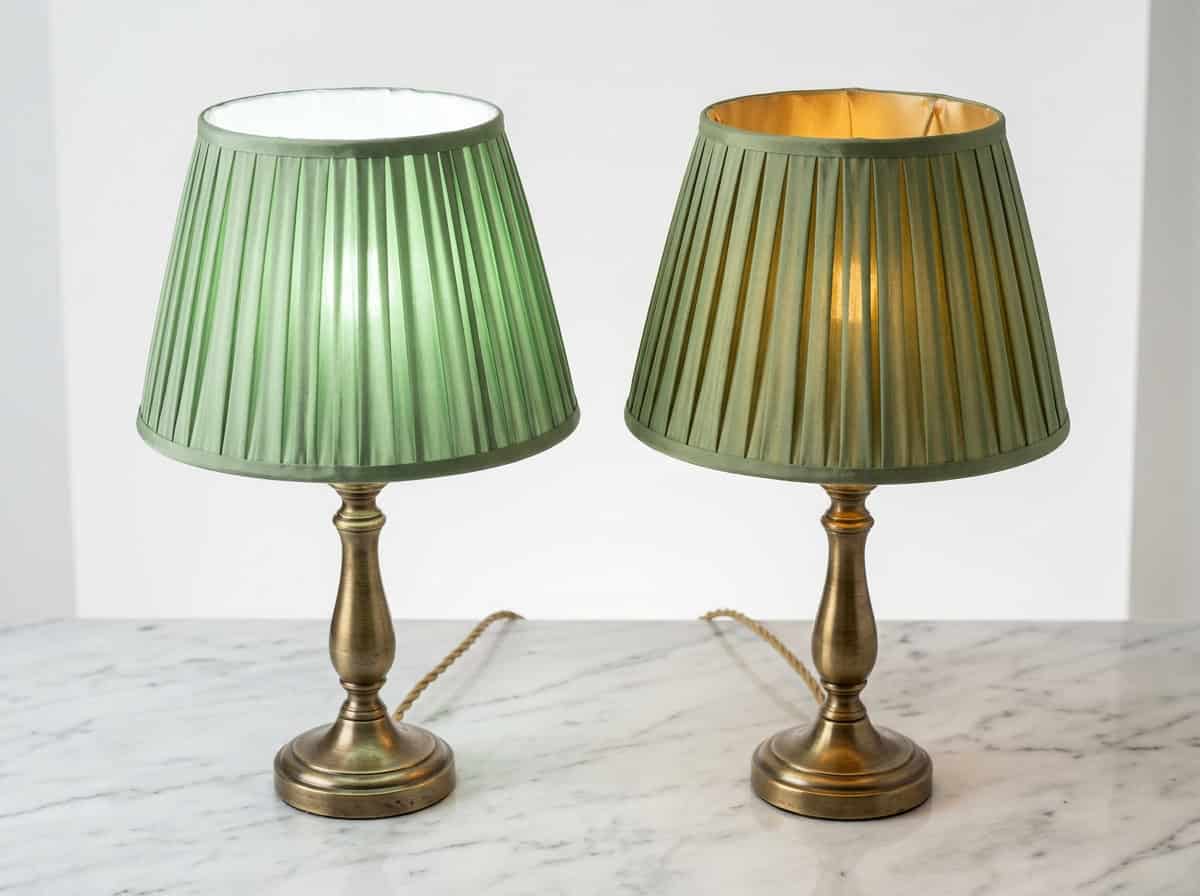
The inside lining of a green lampshade significantly affects the light it produces. A white or silver lining maximizes output and produces cleaner, cooler light through the green outer layer. A gold or ivory lining absorbs some of the light but warms it, adding an amber quality to the green-tinted output.
For bedside and reading lamps where warm light is the priority, a green shade with a gold interior lining tends to produce more comfortable illumination than the same shade with a white lining. The difference is visible: one reads as warm and restful, the other as bright and slightly clinical despite the green exterior.
Vintage green lampshades
Genuine vintage green lampshades are among the most sought-after lampshade categories. The materials and techniques used before 1960 produced color depth and construction quality that modern mass production has largely not matched economically.
Art Nouveau and Tiffany glass (1890s–1910s)
The most celebrated vintage green lampshades are the leaded glass botanical shades from Tiffany Studios and their contemporaries. The green glass in these pieces was produced by adding metallic oxides to molten glass during manufacture: chromium for cooler greens, iron for warmer olive tones, copper for blue-adjacent teals. Each piece of glass was hand-cut, wrapped in copper foil, and soldered into place. A large peony or wisteria shade might contain over 1,000 individual glass pieces.
The color in authentic Art Nouveau green glass has a quality that no modern resin or coated-glass reproduction has successfully replicated: variation within the glass itself, where the color shifts slightly from area to area because of the handmade nature of the original glass. This reads as richness rather than inconsistency.
The Art Nouveau period also produced hand-blown and painted green glass shades outside the Tiffany tradition. Austrian and Bohemian glassmakers working in the same period produced green art glass in botanical forms that are collectible in their own right, often at prices well below authenticated Tiffany pieces.
Mid-century and the 1970s olive revival
The postwar period produced green lampshades in different materials: pressed glass in standard shapes, wicker and rattan frames painted green, and mass-produced fabric shades in olive and avocado colorways. These mid-century and late-century green shades are the most accessible vintage option by price and availability.
The specific olive and avocado greens popular from the late 1960s through the mid-1970s fell out of favor so completely in the 1980s and 1990s that genuinely period examples can often be found at estate sales at prices that underestimate their current relevance. The 1970s revival in interior design is steadily pushing these back toward mainstream desirability.
How to identify genuine vintage vs. reproduction
The most reliable indicator of a genuine vintage green lampshade is the interior: pre-1960 fabric shades have hand-stitched linings with slight irregularities; mass reproduction linings are machine-sewn and perfectly even. For glass shades, check the glass itself for small bubbles or slight surface irregularities indicating hand-manufacture. Perfectly flat, perfectly clear glass without any surface variation almost always means modern production.
Green lampshade trends (2026)
Green is the single most discussed color in interior design heading into 2026. The conversation runs across multiple distinct sub-trends simultaneously, which means green lampshades fit into more current design vocabularies than any other colored lampshade option.
Sage green in cottagecore and Scandi interiors
Sage green has been rising for several years and has not peaked. In 2026, sage appears in cottagecore, Scandi, and transitional interiors as a soft neutral that replaces beige in rooms that want more character without the commitment of a saturated color. Sage green lampshades in linen or cotton on ceramic or rattan bases are one of the defining objects of this aesthetic.
As House Beautiful’s 2026 interior design coverage notes, the shift toward botanical maximalism and nature-adjacent color palettes has made sage green one of the most requested colors in soft furnishings and decorative accessories across all price points. Lampshades are one of the fastest and least expensive ways to introduce this color into a room.
Dark green maximalism and the library aesthetic
The other strong green trend in 2026 is its opposite: deep, saturated forest and hunter green in maximalist, heavily layered interiors. The library and dark academia aesthetics, characterized by rich colors, heavy materials, and an abundance of brass and leather, have elevated dark green lampshades from niche to mainstream.
As Architectural Digest’s trend coverage has documented, demand for fixtures referencing the 19th-century study is driving a banker’s lamp revival. Forest green is central to all of it. The practical result: forest green lampshades in glass, pleated fabric, and painted metal are all performing strongly in the market right now.
| Trend | Why it’s rising in 2026 | Best lamp base pairing |
|---|---|---|
| Sage green (cottagecore/Scandi) | Nature-adjacent palettes replacing neutral beige | Rattan, ceramic, light wood, brushed brass |
| Dark green (library/academia) | Rich-interior maximalism; banker’s lamp revival | Antique brass, dark wood, black iron |
| Emerald (Art Deco revival) | 1920s–1930s interior references in maximalist rooms | Polished gold, smoked glass base, white marble |
| Olive (1970s revival) | Retro-contemporary mix; warm earth palettes | Turned wood, ceramic earth-tone base, woven fiber |
| Botanical green print | Pattern-forward maximalism; Morris-style florals | Classic candlestick, painted wood, turned ceramic |
FAQ
What does a green lampshade symbolize?
Green carries associations with nature, growth, calm, and restoration across most cultural contexts. In an interior setting, a green lampshade brings a nature-adjacent quality into the room that is specific to green and difficult to replicate with other colors: it reads as organic rather than constructed, restful rather than stimulating. In more specific design vocabulary, deep green lampshades (forest, emerald) carry associations with intellect, tradition, and formal settings, drawing on their long history in library and study lamps. Sage and olive read as informal, comfortable, and contemporary. Practically: green lampshades tend to make rooms feel calmer than red, warmer than blue, and more grounded than yellow.
What shade of green lampshade suits a bedroom?
Sage green is the safest and most versatile bedroom choice. It is muted enough to recede into the room rather than dominating it, warm enough to produce comfortable light through the shade walls, and compatible with the widest range of bedroom palette choices. Forest green works well in bedrooms with dark, moody palettes and minimal ambient light requirements; it functions more as a focused reading lamp than an ambient source. Emerald is the highest-risk bedroom choice: it suits deliberately bold, maximalist rooms and looks out of place in soft, neutral bedrooms. AvoAvoid cool mint green in bedrooms where relaxation is the goal. The cool tone produces a clinical rather than restful atmosphere.
Do green lampshades make a room look smaller?
Dark green lampshades (forest, hunter, deep emerald) do reduce the sense of room size by absorbing light rather than diffusing it. The effect parallels painting a wall dark: the room feels more intimate and enclosed. Whether that is a benefit or a problem depends entirely on what you want the room to feel like. In a large, high-ceilinged room that feels impersonal, a dark green lamp can make it feel inhabited. In a small room that already feels cramped, it will make the problem worse. Sage green and light olive green lampshades in fabric do not significantly reduce the perception of room size because they still transmit a good quantity of warm, diffuse light.
What color bulb works best under a green lampshade?
Warm white LED bulbs in the 2700K–3000K range produce the most comfortable light through green shades. The warm color temperature slightly counteracts the cooling effect of green glass or fabric, producing a combined light quality that reads as natural and neutral rather than strongly green-tinted. Daylight or cool white bulbs (5000K+) amplify the green cast and produce an atmosphere that feels clinical in residential settings. According to U.S. Department of Energy guidance on residential lighting, LED bulbs in the warm-white range use up to 90% less energy than incandescent equivalents; for paper and fabric green lampshades specifically, LED is the only safe choice since incandescent and halogen bulbs run hot enough to discolor light fabrics and degrade paper over time.
Are green lampshades in style in 2026?
Yes, strongly, and across multiple distinct design aesthetics simultaneously. Sage green is central to the cottagecore and Scandi-naturalist aesthetics that have dominated residential interior design through the mid-2020s. Dark forest and hunter green are key to the library and dark academia aesthetics. Emerald green is a supporting color in Art Deco revival and maximalist rooms. Olive green is prominent in the 1970s revival. It is more accurate to say that green lampshades are in style in 2026 than that green is a trend; they have embedded themselves across several persistent design directions rather than peaking and declining as a single wave.
Can I use a green lampshade in a kitchen?
Yes, with caveats. Green-cast light can make food look less appetizing directly under the lamp; it affects how meat, fruit, and some vegetables appear. For task lighting directly over a food preparation area, a neutral or warm-white shade is more practical. Green lampshades work well in kitchens as accent lighting over an island or bar cart where atmosphere matters more than task visibility, or as hanging pendants over a kitchen dining area. Olive and warm sage greens are the most forgiving in kitchen settings because their yellow undertones are closer to neutral warm white than the cooler blue-adjacent greens.
What lamp base pairs best with a green lampshade?
The base material should complement the specific tone of green. Brass (polished or antique) pairs with every shade of green, particularly emerald and forest green where the gold-warm metal reads as historically appropriate and visually rich. Ceramic bases in neutral tones (white, cream, earth tones) pair well with sage and olive and keep the shade as the room’s color statement. Dark wood or ebonized wood suits forest and hunter green. Chrome and polished nickel are technically compatible with cool-toned greens but produce a modern, spare aesthetic that most green lampshades do not naturally reinforce. Rattan and natural fiber bases pair best with sage and olive, reinforcing the nature-adjacent quality those greens already carry.
Choosing the green lampshade that works for your space
Three decisions determine whether a green lampshade succeeds in a room: the specific tone of green, the material, and the lining color. Get one wrong and the other two cannot rescue it.
For most buyers, the answer that covers the widest ground is a solid-dyed linen or cotton shade in sage green, in an empire or drum silhouette, with an ivory or gold interior lining. This combination works in more rooms than any other green lampshade choice: it integrates with warm and neutral palettes, produces comfortable warm-cast light, and reads as considered without being demanding.
For glass green lampshades, where color depth, durability, and the specific quality of colored-glass light matter most, the choice of tone and form depends on the application. Pendants and feature lamps suit deeper greens (forest, emerald) where directional light and color depth can be appreciated at distance. Table and reading lamps suit mid-tones (sage, olive) that produce enough ambient fill to be practical. For specifics on what is available off the shelf, or to discuss custom glass color options for commercial or batch orders, the glass lampshade collection is the right starting point.
Related Articles
Flower Lampshade: Types, Styles & How to Choose or Make One
Black Lampshade: Types, Materials & How to Choose the Right One
Lampshade Shapes: The Complete Visual Glossary (12 Glass Shade Types)
How to Size a Lampshade for a Lamp: The Complete Sizing Guide