A flower lampshade is a shade featuring floral motifs, either shaped like a flower, printed with botanical patterns, or decorated with applied blooms. Available in fabric, glass, and paper for table, floor, and pendant lamps, the right choice depends on whether the floral element is the silhouette, the surface, or both.
People come to flower lampshades from two directions. The first is purely decorative: they’re building a room with a botanical theme, or they found a brass lamp base at an estate sale and want something that honors its era. The second is sentimental: a grandmother’s floor lamp had a faded silk floral shade that finally gave out, and now the hunt is on for something that matches the memory if not the exact style.
Both paths lead to the same question: which kind of flower lampshade do you actually want? Because “flower lampshade” covers a surprisingly wide range. A sculptural paper petal shade, a hand-painted Tiffany-style stained glass dome, and a printed chintz cotton shade are all technically flower lampshades, and they have almost nothing in common beyond the floral reference.
Types, materials, vintage identification, room-by-room styling, DIY approaches, and the questions that trip most buyers up: all covered below.
What is a flower lampshade?
A flower lampshade is any shade where the floral element is central to its design, not incidental. That distinction matters because it breaks into two fundamentally different things: a shade shaped like a flower, and a shade decorated with floral patterns. The first is about silhouette; the second is about surface. They suit different rooms, different lamps, and different buyers.
Flower-shaped vs. floral-patterned: the key distinction
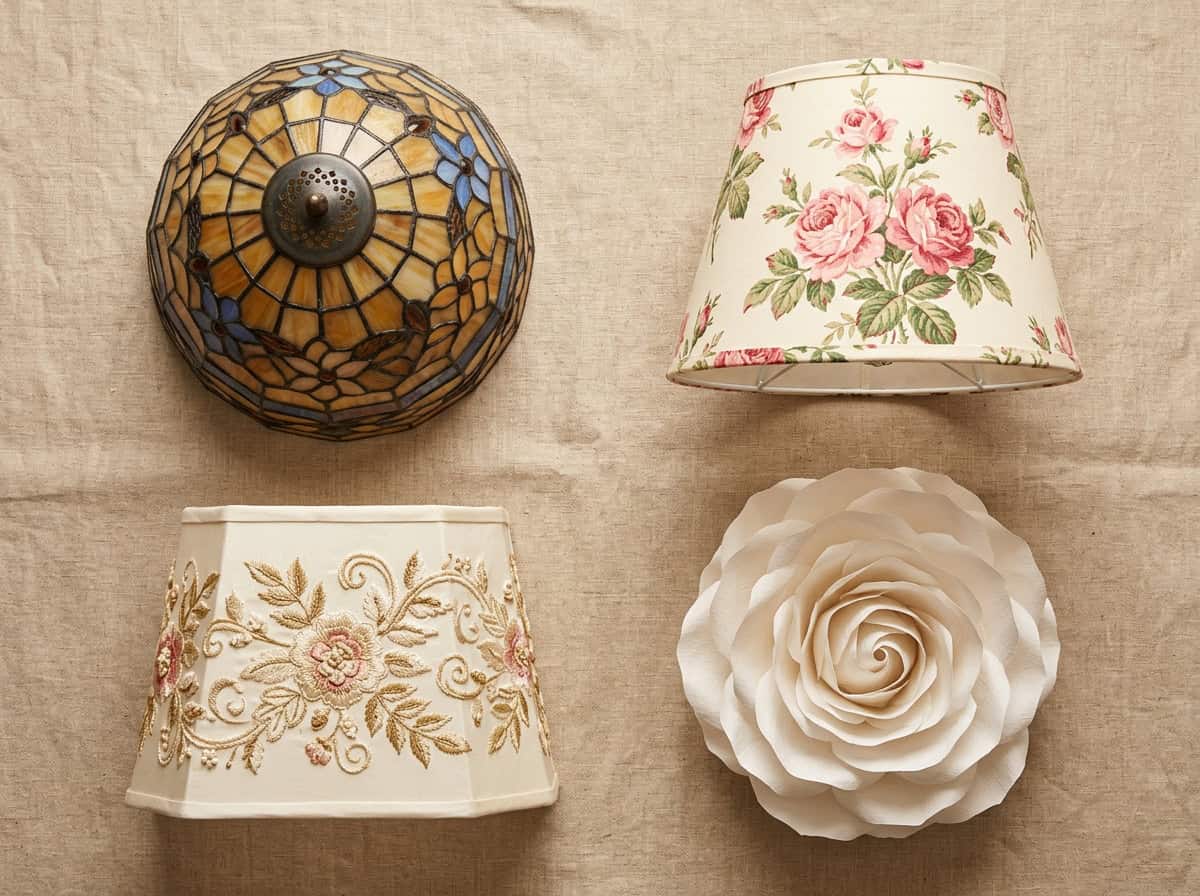
A flower-shaped lampshade takes its silhouette from a bloom: petals that curve outward from a central point, sometimes layered, sometimes stylized into a cone or dome with petal-like panels. Lotus, lily, tulip, and peony forms in paper, glass, or fabric. These shades make the floral reference structural, visible from every angle even when the lamp is off.
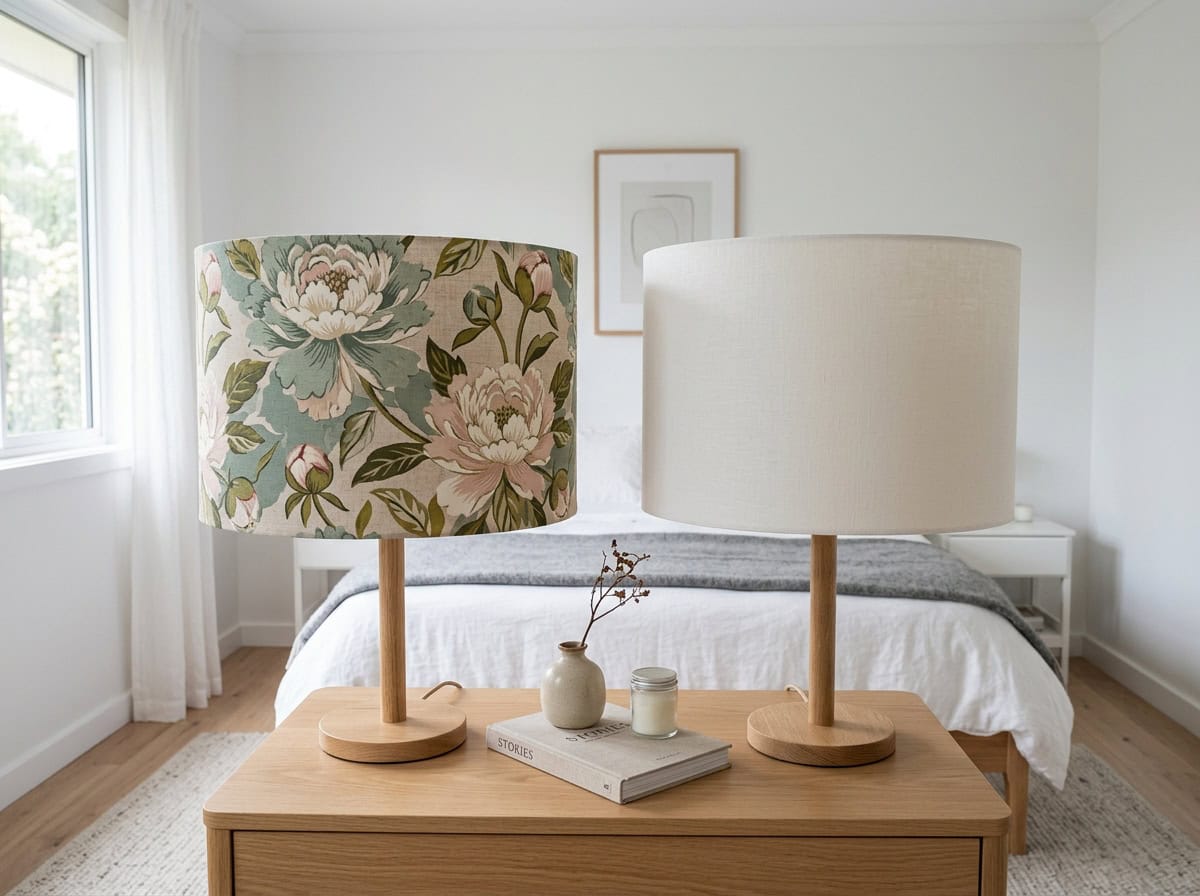
A floral-patterned lampshade uses a conventional shade form, drum, empire, or bell, and applies botanical imagery to the surface via print, embroidery, or applied decoration. The silhouette is standard; the flowers appear in the fabric or printed paper. A chintz-covered empire shade, a hand-painted cotton drum, or an embroidered silk shade with roses at the hem all fall into this category.
Both are legitimate flower lampshades. The shaped variety tends to make a stronger decorative statement and is harder to integrate without it dominating the room. The patterned variety is more versatile. It can anchor a room’s botanical theme without becoming the sole focus of the space.
How a flower lampshade changes a room
A flower lampshade does something most plain shades cannot: it carries a visual theme independent of the lamp base it sits on. In a maximalist room, a floral shade ties together a mix of textures and patterns. In a minimal or neutral room, a single flower lampshade on a bedside table can function as the room’s only decorative risk, one deliberate choice that stops the space from feeling sterile.
As Wikipedia’s overview of decorative lampshade design notes, the shade’s primary role is light control, but in practice most buyers choose shades primarily for aesthetics, particularly for accent and bedside lamps where task lighting is secondary. A flower lampshade leans fully into that reality.
| Design type | Common materials | Light through walls | Best room application |
|---|---|---|---|
| Flower-shaped (petal silhouette) | Paper, fabric, glass | Medium to low | Accent lamp, statement table lamp |
| Floral-patterned (printed/embroidered) | Cotton, linen, silk | Medium | Bedroom, living room, entryway |
| Applied floral decoration | Fabric base with silk flowers or trim | Low to medium | Vintage or cottage lamp, boudoir light |
| Stained glass floral (Tiffany-style) | Art glass, copper foil | Low (through color) | Feature lamp, library, dining room |
Types of flower lampshades
There are four main types of flower lampshade: glass (Tiffany and art glass), fabric and silk, paper and sculptural, and applied floral trim. The four types behave differently enough that choosing the wrong one for your lamp or room can leave you with something beautiful in the shop that looks wrong in the space. Each type has a specific set of applications where it excels.
Glass flower lampshades: Tiffany-style and art glass
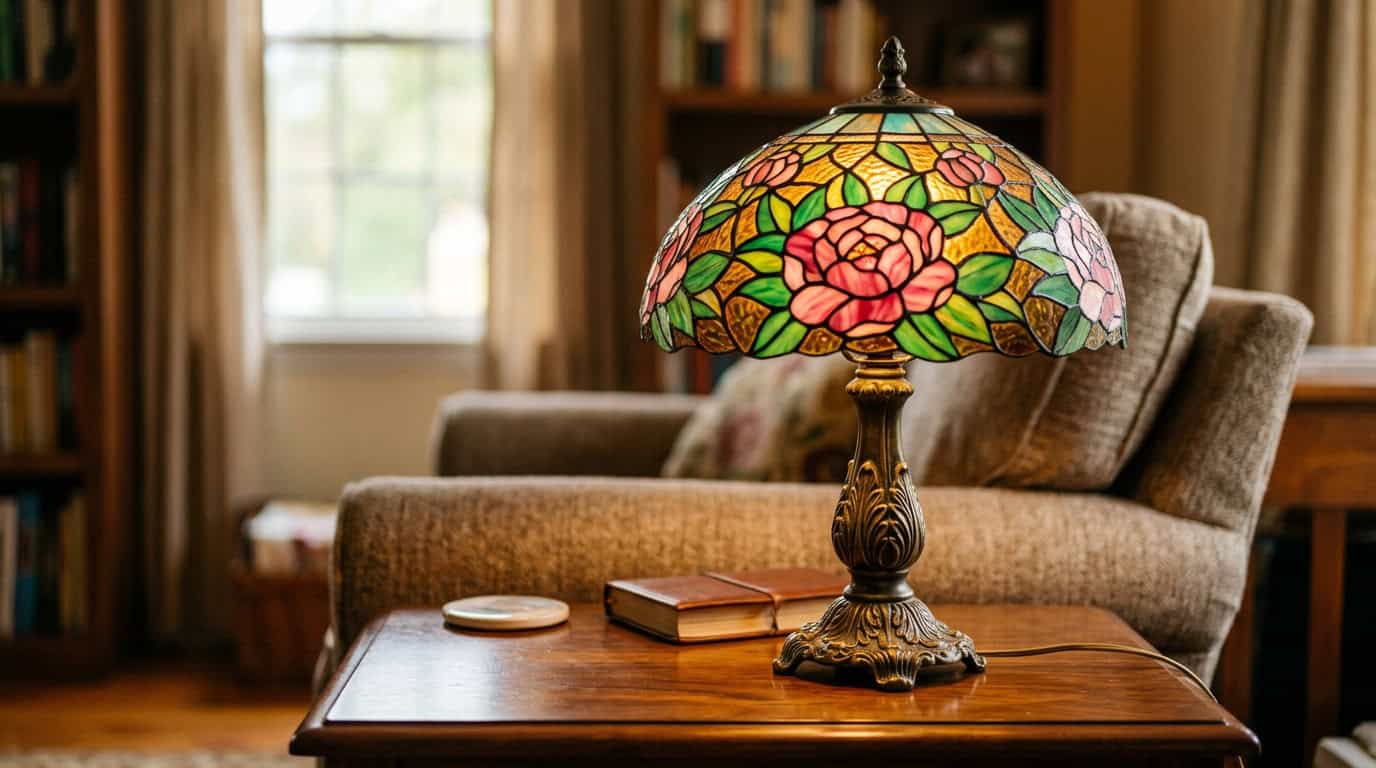
The most celebrated flower lampshades in the world are made of glass. Louis Comfort Tiffany’s studios produced leaded stained-glass shades in the late 19th and early 20th centuries. The Wisteria, Peony, and Rose Panel patterns are among the most sought-after. Each shade was assembled from hundreds of pieces of hand-cut colored glass soldered with copper foil, designed so the lamp’s light transforms the floral imagery from opaque daytime decoration into glowing color at night.
Authentic Tiffany Studios pieces are museum objects at this point. The Victoria and Albert Museum’s decorative arts collection holds multiple examples, and auction prices for signed originals regularly exceed $50,000. What most people mean by “Tiffany flower lampshade” today is a reproduction: either a factory-made replica using the same copper foil technique, or a similar piece produced by independent glass artists working in the tradition.
For practical purposes, the distinction is between soldered leaded glass (the traditional method: heavy, expensive, produced in small batches by craftspeople or small studios) and resin-imitation glass, which is mass-produced and mimics the stained-glass look at a fraction of the cost but lacks the color depth and structural weight of the original technique. Both produce a flower lampshade. Only one produces a piece that improves with time.
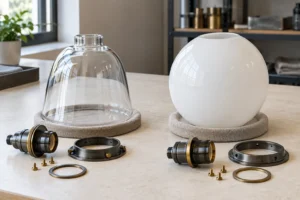
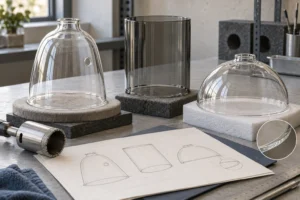
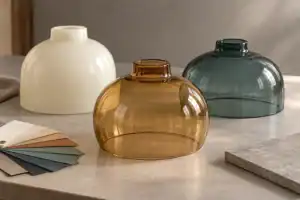
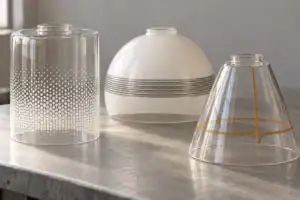
Glass flower lampshades in our glass lampshade solutions range include hand-applied color glass and kiln-fired ceramic-coated options that achieve the botanical motif effect in durable borosilicate glass, suited for pendant applications where fabric shades deteriorate from heat over extended periods.
Fabric and silk floral lampshades
Fabric flower lampshades are the most common type in residential settings. Fabric is lightweight, warm-glowing when lit, available in every floral pattern imaginable, and straightforward to replace.
Chintz, a glazed cotton fabric with printed floral patterns, was the dominant material for decorative lampshades from the Victorian era through the mid-20th century. A chintz flower lampshade on a ceramic or brass base is one of the defining images of English country house decor. The glazed finish gives the fabric a slight sheen that catches light; the patterns typically feature roses, peonies, sweet peas, and garden blooms in densely layered arrangements.
Silk and faux-silk flower lampshades occupy the upper tier of fabric options. Real silk transmits light with a luminosity that polyester cannot fully replicate. The colors glow slightly from within rather than just reflecting off the surface. Applied or pleated silk flower lampshades with embroidered or hand-painted blooms are common in boudoir and bedroom settings. They are delicate. Direct sunlight fades them; humidity affects the hand-sewn elements; cleaning is limited to very gentle dry-brushing. For high-traffic or frequently-lit lamps, a well-made faux-silk or linen-blend alternative is more practical and barely distinguishable at room distance.
Embroidered fabric shades bring texture into the flower motif. The blooms are raised and tactile rather than flat-printed. These work particularly well in cottage and Scandi folk-art interiors where the handmade quality is the point.
For a full breakdown of fabric materials and how they perform across different lamp types, our fabric lampshades guide covers weave density, light transmission, and durability in detail.
Paper and sculptural flower lampshades
Paper flower lampshades are the DIY-friendly end of the category, and increasingly, they are also the high-design end. Paper crafters and designers are producing sculptural petal shades that compete aesthetically with much more expensive alternatives.
The principle is straightforward: paper petals are cut, shaped with a bone folder or by curling over a pencil, and attached around a standard lampshade frame to build up a layered petal effect from the outside. The result, when lit, produces a warm diffused glow through the translucent paper petals that fabric and glass cannot quite match: a soft, candle-like effect with strong dimensional shadow play.
The main limitation is durability. Paper is not suited for high-heat bulbs, though LED bulbs run far cooler than incandescent and are safe for paper use. Paper shades do not fare well in humid rooms or direct sunlight. They are best suited to lower-traffic accent lamps in bedrooms, reading nooks, or home offices where conditions are stable.
Vintage floral lamp shades: what makes them different
A genuine vintage flower lampshade is a different object from a reproduction, in ways that go beyond price. The materials, construction methods, and design vocabulary of Victorian, Edwardian, and mid-century floral shades reflect the manufacturing constraints and aesthetic priorities of their era, and those constraints produced results that modern mass production has not been able to replicate economically.
Victorian, Edwardian, and mid-century floral styles
Victorian floral shades (roughly 1837 to 1901) were typically made in silk, cotton, or oil-painted glass. Fringe trim was nearly universal: deep, knotted, or bead-fringed hems were as important to the decoration as the floral pattern itself. Colors tended toward deep reds, forest greens, and gold on dark grounds. The overall effect was rich and somewhat heavy; these shades were designed to suit the densely furnished parlors of the era.
Edwardian floral shades (1901 to 1910) lightened up considerably. Pastel grounds, flowing botanical prints in the Arts and Crafts or Art Nouveau style, and lighter silk or paper materials replaced the heavy Victorian palette. It was during this period that Tiffany Studios reached their commercial peak. The leaded glass flower shades that define the Tiffany style were products of this aesthetic moment, when organic natural forms were elevated to high-art status in decorative objects.
Mid-century floral shades (1940s to 1960s) brought synthetic fabrics, bolder graphic patterns, and mass production to the category. Nylon and rayon replaced silk; screen-printing replaced hand-painting. The floral motifs became more stylized and less botanical: bright daisies, geometric roses, abstract blooms. These shades are the most affordable vintage option and the easiest to find at estate sales and charity shops.
How to identify genuine vintage vs. reproduction
The clearest signals of an authentic vintage flower lampshade are found in the lining and construction, not the exterior. Pre-1960s shades typically have cotton or silk linings hand-stitched to the frame; modern reproductions use machine-sewn synthetic linings that are uniformly even and lack the slight irregularities of hand finishing.
Check the wire frame through the lining at the top. Older frames were made from painted or lacquered mild steel; genuine vintage frames show oxidation or slight warping from decades of heat. Modern reproduction frames are typically straight galvanized wire with no evidence of age.
Look at the trim. Original fringe on a Victorian shade was made from silk, cotton, or glass beads hand-knotted to a cotton header. Mass-produced reproduction fringe is uniform, regular, and slightly plasticky in feel. That tactile difference is reliable even when visual differences are harder to read.
According to House Beautiful’s guidance on antique lighting, genuine pre-war decorative shades are increasingly scarce at estate sales as supply narrows. If provenance cannot be established, focus on construction quality rather than claimed authenticity: a well-made reproduction is a better investment than a poorly-documented claimed original at the same price.
| Type | Durability | Light character | Best for |
|---|---|---|---|
| Tiffany/leaded glass | Very high | Rich color glow, directional | Feature lamp, reading lamp, dining |
| Chintz/printed cotton | High | Warm-diffuse through fabric | Country cottage, bedroom, entryway |
| Embroidered silk/faux-silk | Medium | Soft, luminous | Boudoir, bedroom, formal living |
| Sculptural paper petal | Low | Soft, candle-like | Accent lamp, bedroom, low-traffic |
| Applied silk flower trim | Medium | Depends on base fabric | Vintage-inspired bedroom, boudoir |
How to choose a flower lampshade
The question is not just which flower lampshade you like. It is which one works with the lamp you have, in the room where it is going, at the light level you actually need. Getting any one of these wrong produces a beautiful object that does not function in its setting.
Matching floral style to room decor
Flower lampshades work in more rooms than most people think, but they do not work the same way in all of them.
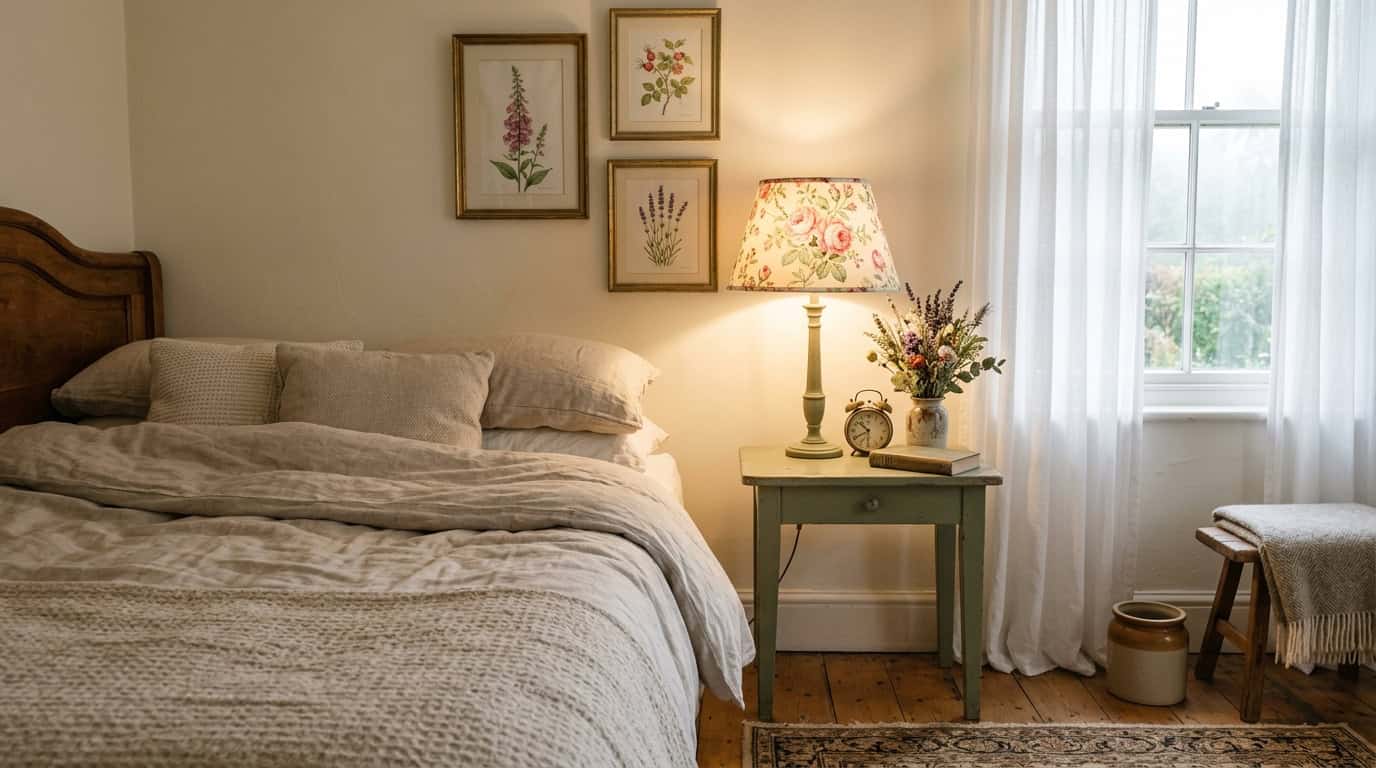
In a cottage or country bedroom, a floral lampshade is almost expected: the style codes demand it. Chintz or printed cotton on a white or cream ceramic base, empire or bell silhouette, soft warm bulb. The challenge in this room is usually scale. Going too small makes the shade look tentative. Match the bottom diameter of the shade to the height of the base and push slightly larger if the room is generous.
In a maximalist or eclectic living room, a flower lampshade can function as part of a pattern mix, but it needs to be the right weight. A large glass Tiffany-style shade has enough visual mass to hold its own next to patterned upholstery and layered textiles. A small printed cotton shade will disappear. Scale and material strength matter more than pattern matching in this context.
In a minimal or Scandinavian room, a single flower lampshade makes the biggest impact: one deliberate floral accent against a neutral ground. Paper petal and sculptural styles tend to work best here because their three-dimensional quality reads as object-as-art rather than decorative pattern. The flower shape carries the room’s only ornamental gesture, which gives it more authority than it would have in a busier room.
Sizing rules and fitter types
The same sizing rules that apply to all lampshades apply to flower lampshades. The shade’s bottom diameter should roughly match the height of the lamp base. For a bedside lamp base of 40 cm, a shade with a 38 to 45 cm bottom diameter is proportionally correct. Going significantly smaller makes the shade look pinched; going larger makes the lamp look unstable.
For detailed measurements, including how to handle Tiffany-style dome shades (which use different fitter types from standard empire shades), our lampshade sizing guide covers fitter compatibility by shade type.
One specific note for glass flower lampshades: Tiffany-style domes typically use a spider fitter or a proprietary clip system. Never force a dome shade onto a harp designed for a bell shade. The stress concentration at the fitter opening can crack the soldered joints in a leaded glass shade, and it is difficult to repair cleanly.
DIY flower lampshade: 3 approaches
Making your own flower lampshade is genuinely achievable, more so than most craft projects that promise accessible results. Three approaches suit different skill levels and material preferences.
Paper flower lampshade
The paper petal method is the most widely documented and the easiest entry point. You need a plain lampshade frame or an existing shade as the substrate, heavyweight craft paper or cardstock, scissors or a craft knife, a bone folder for shaping petals, and a hot glue gun.
Cut petals in graduated sizes: larger at the bottom, smaller toward the top. Shape each petal by curling it over a pencil or rolling pin. Attach from the bottom hem upward, overlapping each row to create a layered effect. A standard 25 cm drum shade takes roughly 200 to 300 individual petals to cover completely; expect three to four hours of work.
LED bulbs are essential here. Standard incandescent or halogen bulbs generate enough heat to discolor paper within weeks. An 8W LED (equivalent to roughly 650 lumens) gives warm, even illumination through the petals without heat risk. The Instructables community has dozens of documented variations on this method, from simple single-layer rose petal effects to complex multi-material sculptural constructions with wire reinforcement.
Fabric-covered floral shade
Recovering an existing shade with floral fabric is the highest-impact option for someone who already has a shade they like but wants a new surface. Strip the existing fabric from the frame, use the old panels as pattern pieces, cut your chosen floral fabric to match, and re-attach with fabric glue or hand-sewing.
The step most tutorials skip: bias-cutting the fabric panels for non-drum shades. Empire and bell shades have curved profiles that require the fabric panels to be cut on the bias, or the fabric will pucker along the seam lines when stretched around the frame. Straight-cut panels only work cleanly on cylindrical drum shades.
Our DIY lampshade guide covers the full recovering process with pattern-making instructions for empire, bell, and drum profiles, including how to handle tricky seams on bowed frames.
Painted glass floral shade
If you have a plain glass shade, a dome, globe, or cylinder, and want to add a floral motif, cold enamel glass paint applied with a fine brush is the most durable method. Vitrail or Gallery Glass-type transparent paints produce a stained-glass effect when the lamp is lit. Opaque ceramic-effect paints produce a printed-fabric look with crisp edges and solid fills.
The most important step: clean the glass with isopropyl alcohol before painting. Skin oils prevent adhesion and cause peeling within weeks. Allow at least 48 hours of cure time before exposing the paint to heat from the bulb.
A simple approach: trace a botanical reference image onto the glass with a soft pencil, paint the outline in black, then fill in the petals with transparent color. The result, when lit from inside, glows like a simplified Tiffany panel: not identical in depth or complexity, but recognizably in the same visual family.
Flower lampshade trends (2026)
The design trajectory for flower lampshades in 2026 is driven by two forces that do not usually push in the same direction: the rise of maximalist botanical interiors in residential design, and growing demand for statement lighting in commercial hospitality spaces. Both are creating real demand for floral shades that had been quiet for a decade.
Botanical maximalism and the return of pattern
The dominant direction in residential interiors heading into 2026 is botanical maximalism: layering of floral patterns, plant references, natural textures, and warm colors in rooms that reject the long minimalist consensus. In this context, a flower lampshade is not a decorative risk. It is almost a requirement.
The specific expressions of this in lampshade terms are large-scale botanical prints on linen shades (William Morris-scale florals, not small repeat patterns), embroidered and textured fabric shades with raised floral work, and the revival of fringe-trimmed empire shades that read as deliberately retro. The fringe-trimmed empire has been absent from mainstream retail for 20 years. It is coming back fast.
As Architectural Digest’s 2026 interior design coverage notes, the shift toward pattern-forward rooms is particularly strong in bedrooms and reading rooms, exactly the spaces where flower lampshades have always performed best.
Glass flower pendants in hospitality and retail
In commercial settings, glass floral pendants are gaining ground as a signature piece for restaurants, boutique hotels, and high-end retail environments. A glass flower lampshade reads as intentional and non-generic in a way that standard pendant shades do not, and commercial designers are using that quality deliberately.
Commercial glass pendant shades need to be durable, easy to clean, and consistent across a batch of 10 to 50 units. Custom-produced glass shades from specialist manufacturers fill this gap. At jxlampshade.com, we work with hospitality buyers on batch orders of hand-applied color glass pendants in floral silhouettes, with consistent finish and weight tolerances that off-the-shelf decorative shades cannot achieve.
| Trend | Why it’s rising | Best paired with |
|---|---|---|
| Large-scale botanical print linen | Maximalism resurgence; rejection of plain shades | Turned wood or ceramic base, warm brass fitting |
| Fringe-trimmed floral empire | Retro-revival; cottage-core aesthetic | Antique brass or painted ceramic candlestick base |
| Glass floral pendant (commercial) | Hospitality demand for non-generic statement lighting | Exposed Edison or globe LED, industrial ceiling fitting |
| Sculptural paper petal (residential) | DIY-accessible, organic aesthetic, budget-friendly | Slim metal or wire lamp base, bedside or desk use |
| Embroidered botanical drum | Craft revival; handmade quality signals | Rattan, bamboo, or light wood base |
FAQ
What room suits a flower lampshade best?
Bedrooms are the strongest fit, particularly on bedside table lamps where the shade is close to eye level and its pattern is visible from the most common viewing position, reclining. After bedrooms, entryways and reading rooms are the next strongest: both spaces where a single decorative lamp can set the room’s tone without competing with a television, practical task lighting, or a dining table. Living rooms work well for glass Tiffany-style shades, which have enough visual weight to hold their own against patterned upholstery. Open-plan kitchens and home offices are harder to work with; the functional demands tend to override the decorative gesture. A flower lampshade in a kitchen can feel either charming or misplaced depending entirely on the rest of the room’s decor. There is no safe answer there.
Are floral lampshades outdated?
No, and the framing of this question is itself slightly dated. Flower lampshades were considered passé during the peak minimalist years (roughly 2010 to 2020), but the shift toward botanical maximalism has reversed that judgment clearly. In 2026, a well-chosen flower lampshade reads as considered and deliberate rather than fussy or out of time. The caveats are style-specific: a heavily fringed Victorian reproduction looks dated in a room with midcentury or contemporary furniture, not because floral lampshades are outdated, but because the style mismatch is jarring. The flower lampshade itself is fine; the pairing is the issue.
How do I clean a fabric flower lampshade?
For printed cotton and linen shades, dry cleaning with a soft brush is the safest approach. A very lightly damp cloth can address specific spots on colorfast fabrics; test on the inside bottom edge first. Never saturate a fabric shade with water. Water pulls dyes unevenly and leaves tide marks that are worse than the original stain. For silk and embroidered shades, use only a dry brush or a hair dryer on the lowest cool-air setting to remove accumulated dust. Spot cleaning silk is possible with a barely damp cloth in very light circular motions, but if there is a significant stain, a professional textile conservator is the better call than an at-home attempt that risks a permanent ring.
What bulb wattage works best under a floral fabric shade?
Floral fabric shades with medium weave density (most printed cotton and linen shades) transmit light in the warm-diffuse range. For a bedside or accent lamp, 6 to 8W LED (450 to 650 lumens) is usually enough. For a reading lamp or a larger floor lamp shade where task lighting matters, 10 to 12W LED (800 to 1000 lumens) is more appropriate. According to U.S. Department of Energy guidance on residential lighting, LED bulbs generate significantly less heat than equivalently bright incandescent bulbs. That matters for paper and silk flower lampshades specifically, where heat exposure causes the fastest material degradation.
What is a Tiffany-style flower lampshade?
A Tiffany-style flower lampshade is a shade made in the tradition of the stained-glass shades originally produced by Tiffany Studios in New York from the 1890s to the 1930s. The technique uses hand-cut pieces of colored glass wrapped in copper foil, then soldered together to form a three-dimensional shade, historically in botanical shapes like wisteria, peony, dragonfly, and water lily. The term “Tiffany-style” now refers broadly to any shade made with this copper foil and solder technique, whether produced by an independent studio artist or a commercial manufacturer. As Wikipedia’s article on Tiffany lamps details, genuine Tiffany Studios pieces are distinguished by their lead came construction, signed bases, and documented provenance. The great majority of pieces sold as “Tiffany” today are reproductions of varying quality.
Can I use a flower lampshade on a floor lamp?
Yes, with appropriate scale. Most floor lamps accommodate shade diameters between 40 and 55 cm; anything smaller looks undersized on a full-height floor lamp. For fabric flower lampshades, torchiere-style floor lamps (open top, no enclosed shade) do not accommodate standard shade frames, but most direct-reading floor lamps with a standard harp work fine with any spider-fitter shade. For glass flower lampshades, confirm the floor lamp’s maximum shade weight. Leaded glass shades can weigh 2 to 5 kg, which exceeds the rating of many lightweight floor lamp harps, and the stress on the harp over time can deform the fitting.
Where can I find a replacement flower lampshade?
For printed fabric shades, specialist lampshade retailers and online vintage marketplaces carry the widest range. Search by material (chintz, linen, silk), shade style (empire, drum, bell), and fitter type (spider, uno, clip). For replacement Tiffany-style glass shades, the important distinction is between reproduction glass (consistent appearance, lower cost, widely available) and studio glass (handmade, inconsistent batch-to-batch, significantly more expensive). For custom flower lampshades in glass, whether for specific botanical motifs, bespoke dimensions, or batch commercial orders, our team at jxlampshade.com works directly with buyers to produce shades that are not available off the shelf.
Choosing the flower lampshade that actually fits your space
Every flower lampshade decision comes down to three things in order: which type of floral reference you want (shaped silhouette, surface pattern, or applied decoration), which material suits the lamp’s environment and usage, and whether the scale and fitter type match the lamp you are putting it on.
For most buyers in a residential setting, the answer that covers the widest ground is a printed fabric shade in a medium botanical pattern: a cotton or linen empire or drum shade with a warm ground color and a botanical print scaled to the shade size. This choice reads as considered and deliberate without the commitment of a structural flower-shaped shade, and it works across cottage, maximalist, and transitional rooms without requiring a specific supporting palette.
If you are after a genuine vintage flower lampshade, focus on construction quality over claimed provenance. Hand-sewn linings, oxidized wire frames, and real silk or glazed cotton materials are what distinguish originals from good reproductions, not labels, which are easy to fake and often missing anyway. Our vintage lampshade frames guide covers the frame construction details that most reliably indicate age and origin.
For glass flower lampshades at any scale, from a single bedside piece to a run of 40 matching restaurant pendants, the key variables are glass type, application technique, and batch consistency. Those specifics are worth a direct conversation with a specialist rather than a purchase based on a product listing.
Related Articles
DIY Lampshade: How to Make or Recover One (Step by Step)
Fabric Lampshades: Types, Materials & How to Choose Right
Vintage Lampshade Frames: Complete Guide to Styles & Restoration
Lampshade Shapes: The Complete Visual Glossary (12 Glass Shade Types)
How to Size a Lampshade for a Lamp: The Complete Sizing Guide