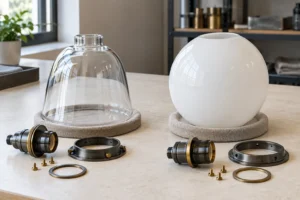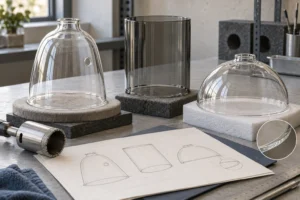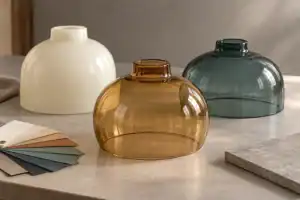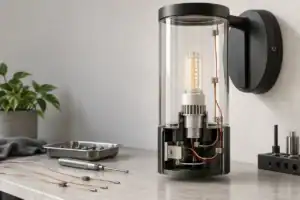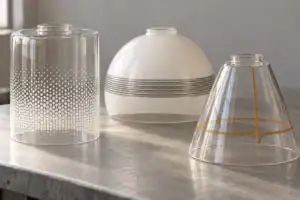
A glass ceiling light shade is the glass diffuser that covers the bulb on a ceiling-mounted fixture — flush mounts, semi-flush mounts, pendants, ceiling fans, and bathroom vanity bars. Replacement requires matching three things: fitter type (threaded neck, neckless slip, or canopy-lock), fitter opening diameter, and shade body dimensions. Get the fitter wrong and the shade won’t mount, regardless of how closely the glass matches the original.

The glass globe cracks at 2 a.m. on a Tuesday. By morning, the ceiling fan is running bare-bulb and the kitchen looks unfinished. Most glass ceiling light shades carry no brand markings, no model number, and no fitter size stamped on the glass — and the original packaging was discarded years ago.
Most replacement guides send you straight to a product listing. This one explains the underlying system: how ceiling fixture fitters differ from table lamp fitters, how to measure each type, and which glass finishes suit which fixture positions. Work through the three measurements below and the replacement shade fits first time.
Glass Ceiling Light Shade Types by Fixture
Five fixture categories use a glass ceiling light shade, and each has a different shade geometry, fitter mechanism, and glass specification. Identifying which category your fixture belongs to is the first step before any measurement.
Flush mounts sit flat or nearly flat against the ceiling — the shade is a glass bowl or dome that faces downward and encloses the bulb from below. The glass must diffuse light evenly across its entire downward-facing surface. Semi-flush mounts drop the shade 15–30 cm below the canopy on a short stem, so the glass hangs freely and is visible from more angles. Pendants suspend a single glass shade on a cord or rod at a defined drop height — the shade is visible from all sides and often the focal point of the room.
Ceiling fans mount glass globes onto each fan blade arm socket — typically 3 to 5 small globes per fixture, each with its own threaded or clip-on fitter. Bathroom vanity bars run 2 to 6 small glass shades on a single horizontal bar, each shade on its own socket, and the glass must handle bathroom humidity alongside regular cleaning with disinfectant.
Flush Mount and Semi-Flush Mount — Glass Bowl and Dome Shades
Flush mount glass ceiling light shades are typically bowl-shaped (wide at the opening, shallow depth) or dome-shaped (deep, narrowing toward the apex). The opening faces upward toward the ceiling canopy; the curved glass body faces downward into the room. These shades are the most common residential glass ceiling light shade type and generate the largest volume of replacement searches.
Bowl shades for flush mounts range from 25 cm to 55 cm in diameter. The fitter mechanism is almost always a neckless slip or a threaded neck at the shade’s upper opening where it interfaces with the ceiling canopy hardware. Opal and milk glass are the dominant finish choices — both diffuse light uniformly across the bowl surface, avoiding the hot-spot effect that clear glass produces at the bulb position directly above.
Pendant Lights — Cylindrical, Globe, and Lantern Glass Shades
Pendant glass ceiling light shades are designed to be seen from all angles — unlike a bowl shade, the entire surface is visible from seated and standing eye levels. Cylindrical pendant shades (straight-sided glass tubes, open or closed bottom) suit kitchen islands and dining tables. Globe pendant shades (spherical or near-spherical) work in living areas where a softer, more omnidirectional glow is needed. Lantern-style pendant shades combine glass panels in a metal frame for a more architectural look.
Pendant shade fitters connect to the pendant’s socket cup or canopy ring, typically via a threaded neck on the shade. Drop height — the distance from ceiling to shade bottom — is set by the pendant cord or rod length, separate from the shade itself.
Ceiling Fans and Vanity Bars — Small Globe and Tulip Shades
Ceiling fan glass ceiling light shades are small — typically 10–15 cm diameter, 10–12 cm deep — and mount onto the fan’s light kit arm sockets. The fitter is almost universally a threaded neck at 2¼” (57 mm) internal diameter, the same as many table lamp fitters, though some ceiling fan kits use a clip-on tulip fitter that grips the bulb directly. Replacing a cracked ceiling fan globe requires confirming which of these two fitter types is present before ordering.
Bathroom vanity bar shades follow the same small globe geometry and the same 2¼” threaded neck standard as most ceiling fan shades, making them the most interchangeable glass ceiling light shade category of all.
| Fixture Type | Shade Shape | Typical Glass Finish | Typical Fitter | Diameter Range |
|---|---|---|---|---|
| Flush mount | Bowl or dome | Opal, milk glass, frosted | Neckless slip or threaded neck | 25–55 cm |
| Semi-flush mount | Globe or bell | Opal, clear, etched | Threaded neck | 20–40 cm |
| Pendant | Cylinder, globe, lantern | Clear, ribbed, frosted | Threaded neck | 12–30 cm |
| Ceiling fan | Small globe or tulip | Opal, frosted, clear | Threaded neck 2¼” or clip-on | 10–15 cm |
| Vanity bar | Small globe | Opal, frosted, etched | Threaded neck 2¼” | 10–14 cm |
How to Identify the Fitter Type on a Ceiling Fixture
Ceiling fixture fitter types are categorically different from table lamp fitters. The spider fitter and uno fitter common on table lamps don’t appear in ceiling fixtures — ceiling mounting positions use three distinct fitter systems: threaded neck, neckless slip, and canopy-lock. Identifying the correct type is the critical first step in replacing any glass ceiling light shade.
According to the Wikipedia overview of lampshade hardware, fitter standards were never globally unified, which is why ceiling fixtures from different eras and manufacturers use incompatible mounting systems even when the glass body dimensions appear similar. Measure the fitter before evaluating the shade body.
Threaded Neck Fitter — Standard on Bathroom Fixtures and Ceiling Fan Globes
A threaded neck fitter has a short neck projecting from the top of the shade body, with external threads that engage a threaded ring or collar on the fixture’s socket cup. To identify: look at the top opening of the shade — if the opening has a raised neck with visible threads on the outside, it’s a threaded neck fitter.
This is the most common ceiling fan and vanity bar glass ceiling light shade fitter. The standard interior opening is 2¼” (57 mm) for small globe shades and 3¼” (83 mm) for mid-size ceiling applications. Measure the internal diameter of the threaded ring on the fixture socket (not the shade neck — measure the fixture) with calipers to confirm size before ordering.
Neckless Slip Fitter — Bowl Shades That Rest on a Holder Ring
A neckless slip fitter has no threaded neck — the shade opening is a plain rim that rests on a metal lip ring or saddle mounted to the ceiling canopy. The shade is held by three or more screws that clamp against the outside of the shade rim, or by the weight of the shade resting on the saddle. To identify: if the shade has no neck at its top opening — just a plain circular rim — it’s a neckless slip.
This fitter is standard on flush mount bowl and dome glass ceiling light shades. To measure: use calipers or a tape measure to record the interior diameter of the shade’s top opening. The replacement shade’s opening must match this diameter within ±3 mm for the holder screws to engage correctly. Neckless slip shades for flush mounts are sometimes also called “3-hole” or “4-hole” shades, referring to the number of mounting screw positions in the canopy hardware.
Canopy-Lock and Magnetic Fitters — Modern Flush Mount Systems
Canopy-lock fitters are found on contemporary flush mount fixtures: the shade clips into the ceiling canopy with a quarter-turn bayonet lock or snaps into a magnetic retention ring. These are proprietary per-manufacturer and are generally not interchangeable across brands. If your flush mount glass ceiling light shade uses a canopy-lock fitter, the safest replacement source is the original fixture manufacturer’s spare parts program — universal replacements rarely fit.
Magnetic fitter systems appear on some premium flush mounts from Scandinavian and German fixture brands. The shade is retained purely by rare-earth magnets embedded in the canopy ring. These shades are dimensionally simple (just a bowl or dome with a plain rim) but the magnetic retention system means they’re effectively proprietary.
| Fitter Type | How to Identify | Common Fixtures | What to Measure |
|---|---|---|---|
| Threaded neck | Raised neck with external threads at shade top | Ceiling fans, vanity bars, pendants | Internal thread diameter of fixture socket ring |
| Neckless slip | Plain circular rim, no neck, held by screws | Flush mount bowl/dome shades | Interior rim diameter of shade opening |
| Canopy-lock | Quarter-turn bayonet or snap-fit into canopy | Modern flush mounts | Proprietary — source from original manufacturer |
| Magnetic | No visible hardware, shade held by magnet | Premium contemporary flush mounts | Proprietary — source from original manufacturer |
How to Measure a Glass Ceiling Light Shade for Replacement
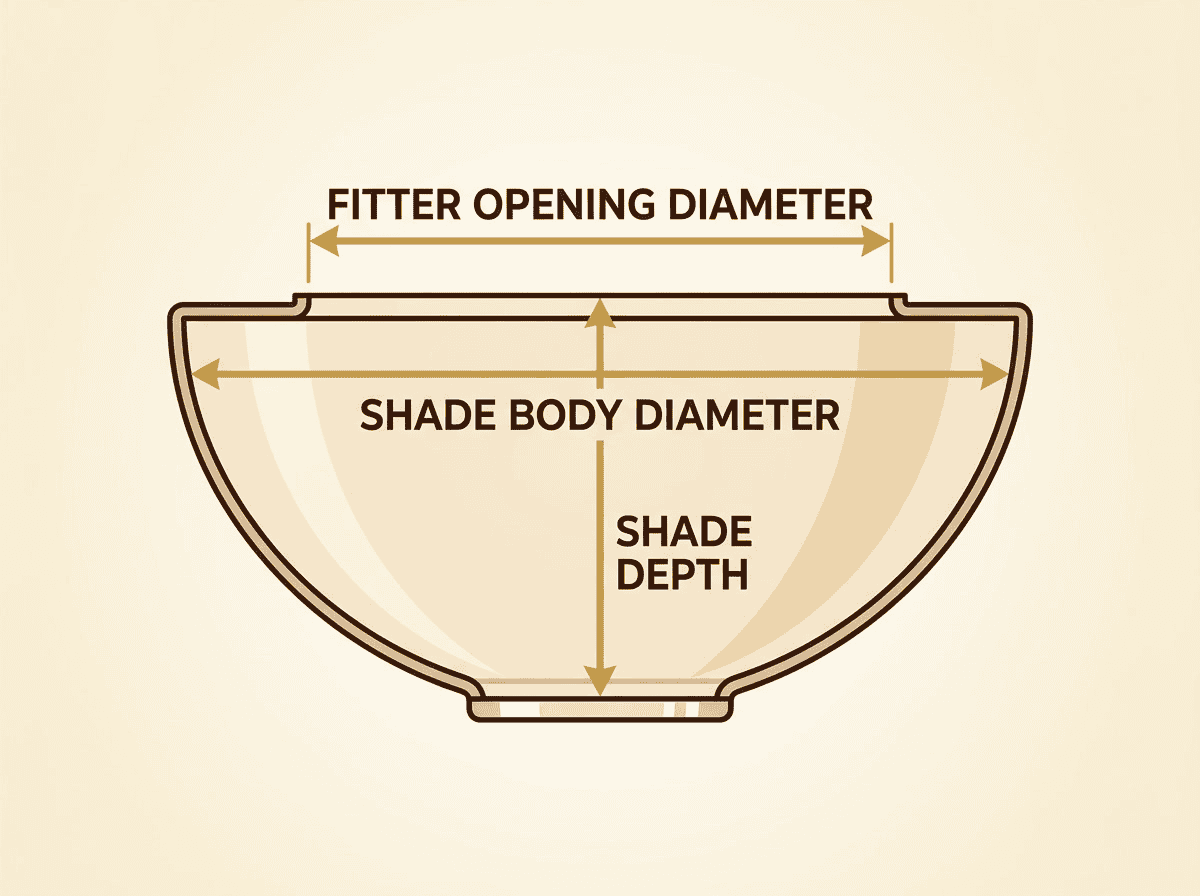
Measuring a glass ceiling light shade correctly requires three separate measurements: fitter opening diameter (the gating dimension), shade body diameter at the widest point, and shade depth (height from opening rim to the deepest or lowest point of the glass). Get all three before contacting any supplier.
The Illuminating Engineering Society classifies ceiling luminaire diffuser tolerances by fixture category — flush mount diffusers are held to tighter opening tolerances (±1.5 mm) than pendant diffusers (±3 mm) because the mounting hardware in flush mounts leaves less adjustment range.
Measuring Threaded Neck Fitter Diameter
For threaded neck fitters, measure the internal diameter of the threaded ring on the fixture socket — not the shade neck. The fixture ring is the mating surface; the shade neck must match it. Use digital calipers, taking the measurement inside the threaded ring. Common sizes are 2¼” (57 mm), 3¼” (83 mm), and 4″ (102 mm).
Important: “2¼ inch fitter” refers to the opening diameter, not the thread outer diameter. A shade listed as “2¼” fitter” will have a neck outer diameter slightly larger than 57 mm, because the threads project outward from the neck surface. Order by the fitter opening size, not the neck outer diameter.
Measuring Bowl and Dome Shade Body Dimensions
For neckless slip bowl shades and dome shades:
- Opening diameter — measure across the top opening interior rim with a tape measure or calipers. This must match the canopy holder ring.
- Body diameter — measure across the widest point of the bowl or dome exterior. On most bowl shades, this equals the opening diameter; on bell shades with a flared opening, it may be larger.
- Depth — measure from the top rim to the lowest point of the glass interior (for bowls) or the apex of the dome (for dome shades). Depth determines whether the bulb is fully enclosed.
Standard fitter sizes and typical applications:
- 2¼” (57 mm) — ceiling fan globes, vanity bar shades, small pendant shades; also crosses over to some table lamp fitters
- 3¼” (83 mm) — mid-size ceiling pendant shades, some semi-flush applications
- 4″ (102 mm) — larger pendant and semi-flush shades, commercial ceiling fixtures
- 6″–12″ — large flush mount bowl shades, neckless slip; these sizes are bowl opening diameters, not threaded fitter sizes
Glass Types and Finishes for Ceiling Light Shades
The glass type selection for a glass ceiling light shade follows different logic than for table lamp shades. A ceiling shade transmits light primarily downward into the room — the critical surface is the base of the glass, not the sides. Diffusion quality at the bottom of the shade determines whether the room gets even, comfortable light or a glaring hot-spot directly below the fixture.
Borosilicate glass is the material of choice for any ceiling glass ceiling light shade that will be used with higher-wattage sources or in close-fitting flush mount configurations where heat buildup is possible — its thermal shock resistance is significantly better than standard soda-lime glass, which can crack under repeated heating and cooling cycles in enclosed fixtures.
Opal and Milk Glass — Even Downward Diffusion, Classic Appearance
Opal glass is manufactured with mineral additives throughout the glass body, making the material itself opaque white and uniformly light-scattering at all angles. In a bowl or dome ceiling shade, this produces an even glow across the entire glass surface with no visible bulb hot spot from any angle directly below. It’s the dominant choice for residential flush mount and semi-flush glass ceiling light shades because it delivers comfortable ambient light without glare.
Milk glass — the historical term for opal glass used in decorative applications — has seen sustained demand in restoration and vintage-style applications. Modern milk glass is manufactured to the same optical specification as standard opal glass; the difference is purely in the name and the styling context. If you’re sourcing a glass ceiling light shade for a 1950s–1970s period fixture, “milk glass” and “opal glass” describe the same product.
Clear and Ribbed Glass — Decorative Texture with Sparkle Effect
Clear glass transmits light with minimal diffusion — the bulb remains visible as a bright source through the glass. In pendant applications at dining table height, this can be desirable as a decorative sparkle effect. In flush mount applications, clear glass is generally avoided because the bulb filament or LED module is visible to anyone looking directly up at the fixture.
Ribbed glass introduces vertical or horizontal linear texture that refracts light laterally and creates a prismatic sparkle effect while partially obscuring the bulb. It’s popular in kitchen pendants and vintage-reproduction ceiling fixtures. The rib depth typically runs 3–6 mm on standard ceiling pendant glass ceiling light shades.
Etched and Antique Glass — Vintage Fixture Reproduction and Period Restoration
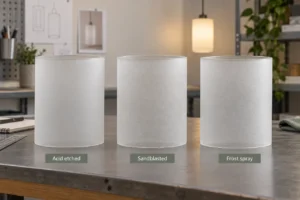
Acid-etched glass is clear glass treated with hydrofluoric acid to create a frosted surface — similar to frosted table lamp shades but applied to ceiling shade geometries. The surface scatters light without fully obscuring the bulb, producing a soft glow with a visible light source. Common in Arts and Crafts, Art Deco, and mid-century modern period fixture restorations.
Antique or seeded glass contains small air bubbles or surface irregularities deliberately introduced during manufacture to reproduce the appearance of pre-industrial handblown glass. This type of glass ceiling light shade is most common in farmhouse, traditional, and period interior styles.
Replacing a Vintage or Discontinued Glass Ceiling Shade
Vintage glass ceiling light shades — primarily from residential fixtures manufactured between 1940 and 1985 — present the most challenging replacement scenario. The fitter sizes often predate current standards; the glass finishes (hand-painted opalescent, pressed milk glass with decorative edges) were discontinued; and the shade profile (ruffled rim, ribbed dome, geometric pressed pattern) requires reproduction tooling to match.
In practice, we’ve found that the biggest obstacle isn’t the glass itself — it’s the fitter. Older US residential ceiling fixtures frequently used 2⅛” (54 mm) and 2⅝” (67 mm) threaded neck fitters that fall between current standard sizes. A shade ordered to the nearest modern standard (2¼” or 3¼”) will either be loose or won’t thread at all.
Identifying Vintage Fitter Standards
Before assuming the fitter is non-standard, measure carefully. Many apparent “odd size” fitters from older fixtures are standard sizes measured in a worn or corroded state — 2¼” fitters that have accumulated paint or mineral deposits can read 52–54 mm on calipers. Clean the threads and re-measure before concluding you have a non-standard size.
Genuinely non-standard fitters appear most often on imported European fixtures from the 1960s–1970s and on American manufacturer-specific proprietary designs (some Westinghouse and GE ceiling fan models used proprietary fitter rings through the 1980s). For these, a glass lampshade specialist with reproduction tooling is the only reliable source.
Sourcing Options: Specialty Suppliers, OEM Reproduction, Salvage
For vintage glass ceiling light shades with discontinued profiles, three sourcing paths exist. Glass lampshade specialty suppliers maintain NOS (new old stock) inventory of discontinued patterns and can often match a sample within 2–3 weeks. OEM reproduction — submitting a physical sample to a glass factory for mold development and custom production — is cost-effective for quantities of 10 or more identical shades. Architectural salvage dealers occasionally carry intact vintage glass ceiling light shades in matched sets from renovation teardowns.
For hotel and commercial properties replacing vintage ceiling glass at scale, OEM reproduction is almost always the right path: a single mold development cost, then indefinite reordering at commercial pricing. We cover the OEM reproduction process and lead times in the hotel lamp shade replacement guide.
For hospitality and commercial properties replacing a large volume of matching vintage ceiling glass shades, custom glass lampshade production for hotel and commercial projects is the most practical route — submit one intact sample, and the manufacturer can develop reproduction tooling and match the original glass finish with measurable colour-consistency targets.
Glass Ceiling Light Shade Size Reference
Standard size ranges by fixture type allow quick sanity-check of measured dimensions before ordering. If measurements fall well outside these ranges, re-measure — the most common errors are measuring the shade exterior instead of the opening interior for neckless slip fitters, and measuring the neck outer diameter instead of the interior thread opening for threaded neck fitters.
Size Chart by Fixture Type
| Fixture Type | Shade Diameter Range | Shade Depth Range | Common Fitter Size | Most Common Glass |
|---|---|---|---|---|
| Flush mount (small room) | 25–35 cm | 10–16 cm | Neckless slip 25–35 cm | Opal, frosted |
| Flush mount (standard) | 35–50 cm | 14–22 cm | Neckless slip 35–50 cm | Opal, milk glass |
| Semi-flush mount | 20–35 cm | 18–28 cm | Threaded neck 3¼”–4″ | Opal, etched, clear |
| Pendant (kitchen) | 15–25 cm | 18–30 cm | Threaded neck 2¼”–4″ | Ribbed, clear, frosted |
| Pendant (dining) | 25–40 cm | 25–40 cm | Threaded neck 3¼”–4″ | Opal, etched, ribbed |
| Ceiling fan globe | 10–15 cm | 10–14 cm | Threaded neck 2¼” | Opal, frosted, clear |
| Vanity bar | 10–14 cm | 10–14 cm | Threaded neck 2¼” | Opal, frosted, etched |
How Glass Shade Diameter Affects Light Spread
A larger glass ceiling light shade diameter increases the light-emitting surface area, spreading the illuminated glow over a wider angle. For a 12W LED in a flush mount bowl shade, a 30 cm opal bowl produces noticeably more room-filling ambient light than a 20 cm bowl of identical glass — the larger surface area emits light at lower intensity per square centimeter, reducing glare while covering more of the room’s walls and ceiling with reflected light.
The CIE (International Commission on Illumination) models ceiling luminaire light distribution using a metric called the luminous flux distribution curve. For practical ceiling shade selection, this translates to a simple rule: choose the largest diameter shade your fixture mounting hardware supports to maximize the proportion of light reaching room surfaces indirectly.
FAQ — Glass Ceiling Light Shade
How do I find a replacement glass ceiling light shade?
Start by identifying the fitter type (threaded neck, neckless slip, or canopy-lock) and measuring the fitter opening diameter with calipers. Then record body diameter and depth. With those three numbers, search by fitter size first — “2¼ inch glass globe replacement” or “neckless slip bowl shade 35 cm” — rather than by style. Fitter compatibility narrows the field to shades that will physically mount; within that subset, choose the glass finish and profile that best matches the original. Specialty glass shade suppliers carry wider fitter size ranges than general lighting retailers.
What sizes do glass ceiling light shades come in?
Fitter opening sizes follow loosely standardized increments: 2¼” (57 mm), 3¼” (83 mm), and 4″ (102 mm) for threaded neck fitters; neckless slip bowl shades range from 20 cm to 55 cm opening diameter. Body diameters for ceiling fan and vanity globes run 10–15 cm; pendant shades 12–40 cm; flush mount bowls 25–55 cm. Vintage fixtures may use non-standard fitter sizes (2⅛” or 2⅝”) — measure before ordering rather than assuming a current standard size.
How do I measure a glass bowl ceiling shade for replacement?
For a neckless slip bowl shade: measure the interior opening diameter at the top rim — this must match the canopy holder ring. Then measure the maximum body diameter at the widest point of the bowl, and the depth from the top rim to the lowest interior point of the glass. For a threaded neck bowl shade, also measure the internal thread diameter of the fixture socket ring. Provide all four numbers to your supplier. For step-by-step measurement technique, see our guide on how to measure a lamp for a new lamp shade.
What is the difference between a flush mount and semi-flush glass shade?
A flush mount glass ceiling light shade mounts directly against the ceiling canopy with no gap — the shade top sits at or within 10 cm of the ceiling surface. A semi-flush mount drops the shade 15–30 cm below the canopy on a short stem or rod. The practical difference: flush mount shades are invisible from the side (only visible looking up) while semi-flush shades are visible from standing eye level, making glass finish and profile choices more visible. Semi-flush mounts are often specified in rooms with higher ceilings (above 2.7 m) where a flush mount would look undersized.
Can I replace a plastic ceiling shade with glass?
Yes — provided the fitter type matches. Most plastic ceiling light shades use the same fitter types and sizes as glass ceiling light shades, so a direct glass replacement is usually straightforward. Verify the fitter mechanism (neckless slip vs. threaded neck) and measure the opening diameter. The main weight consideration: glass ceiling light shades are heavier than plastic — a standard opal glass bowl shade weighs 400–900 g versus 80–200 g for a comparable plastic shade. Check that the fixture’s mounting hardware (the canopy screws and holder ring) is rated for the increased weight before installing glass.
What is milk glass and why is it used for ceiling light shades?
Milk glass is an opaque white glass manufactured with fluoride or arsenate compounds that scatter light within the glass body, preventing any clear transmission. In ceiling light applications, this means the bulb is completely invisible through the shade — only a soft, even glow is visible from below. Milk glass ceiling light shades produce the most comfortable, glare-free ambient light of any glass finish, which is why they dominated residential flush mount and semi-flush mount applications from the 1940s through the 1980s and remain a popular choice in traditional and transitional interiors today.
How do I replace a glass shade on a ceiling fan?
Turn off the fan and allow any bulbs to cool completely. Most ceiling fan glass ceiling light shades are retained by a threaded ring that screws over the shade neck onto the socket cup. Unscrew this ring counter-clockwise to remove it, then lift the shade away. Measure the interior thread diameter of the socket ring on the fixture — typically 2¼” (57 mm). Order a replacement globe to that fitter size. If the shade has no neck (clip-on fitter), the clips are spring-loaded — compress them inward and the shade releases. Reverse the process to install.
Where can I order custom or reproduction glass ceiling light shades?
For standard sizes, specialty glass shade retailers carry wider ranges than home improvement stores — search for glass shade suppliers with fitter-size filtering. For reproduction of discontinued profiles, glass lampshade manufacturers in China, Eastern Europe, and the US offer custom production from physical samples: submit a sample shade, receive a pre-production sample for approval, then order in quantity. Minimum order quantities for custom glass ceiling light shade reproduction typically run 20–50 pieces. Lead time is 30–45 days production plus shipping. For OEM procurement guidance, see our glass lamp shades for hotel rooms guide.

Conclusion
A glass ceiling light shade replacement comes down to three measurements: fitter type and opening diameter (the gating dimension), shade body diameter, and shade depth. Every other choice — glass finish, profile, decorative pattern — only matters after fitter compatibility is confirmed.
For standard flush mount bowl shades and ceiling fan globes, replacement is straightforward: identify the fitter type, measure with calipers, and order by fitter size from a specialist supplier. For vintage fixtures with non-standard fitter dimensions or discontinued glass profiles, a glass lampshade specialist with reproduction capability is the correct path — and for commercial properties replacing multiple identical shades, OEM reproduction from a physical sample master is almost always more economical than retail sourcing at scale.
Measure first. The glass that fits is the glass that stays.