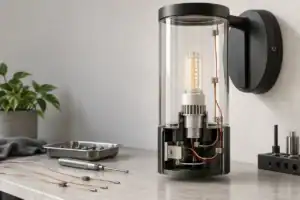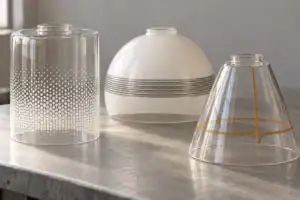
Borosilicate glass is the best glass for lawn lights in freeze-thaw climates — its low thermal expansion coefficient prevents fitter-collar cracking through 100+ seasonal cycles. Heat-tempered soda-lime glass is the cost-effective choice for mild climates with fewer than 30 annual freeze-thaw cycles.
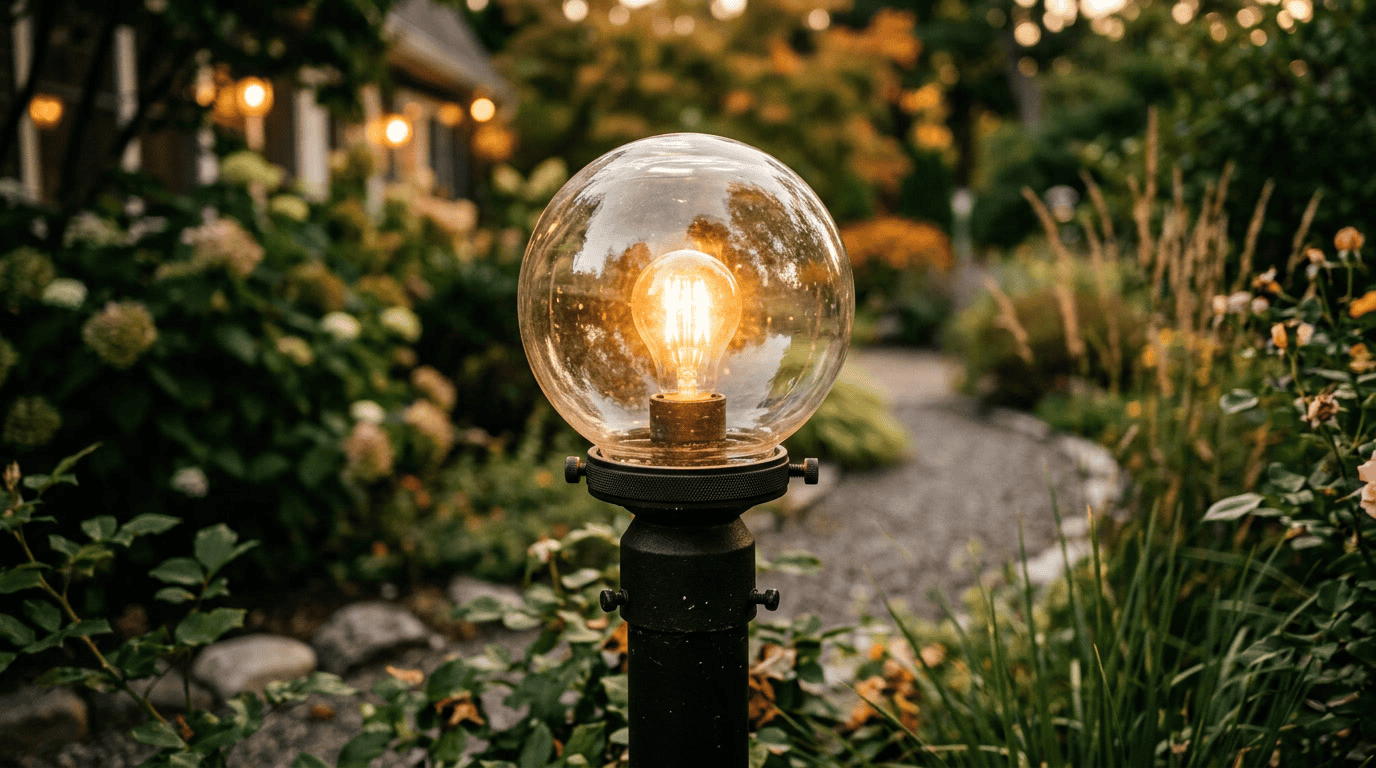
The top-ranking result for “best glass for lawn lights” is currently a white paper arguing that acrylic is better than glass for outdoor fixtures. It’s not wrong for commercial parking-lot luminaires designed to survive years of impact in high-traffic areas. But for residential post-top and bollard lawn lights — where aesthetics matter, clarity is expected to last a decade, and the fixture sits exposed to freeze-thaw cycling — glass is the superior long-term choice. The question isn’t glass versus plastic. The question is which glass type, and why.
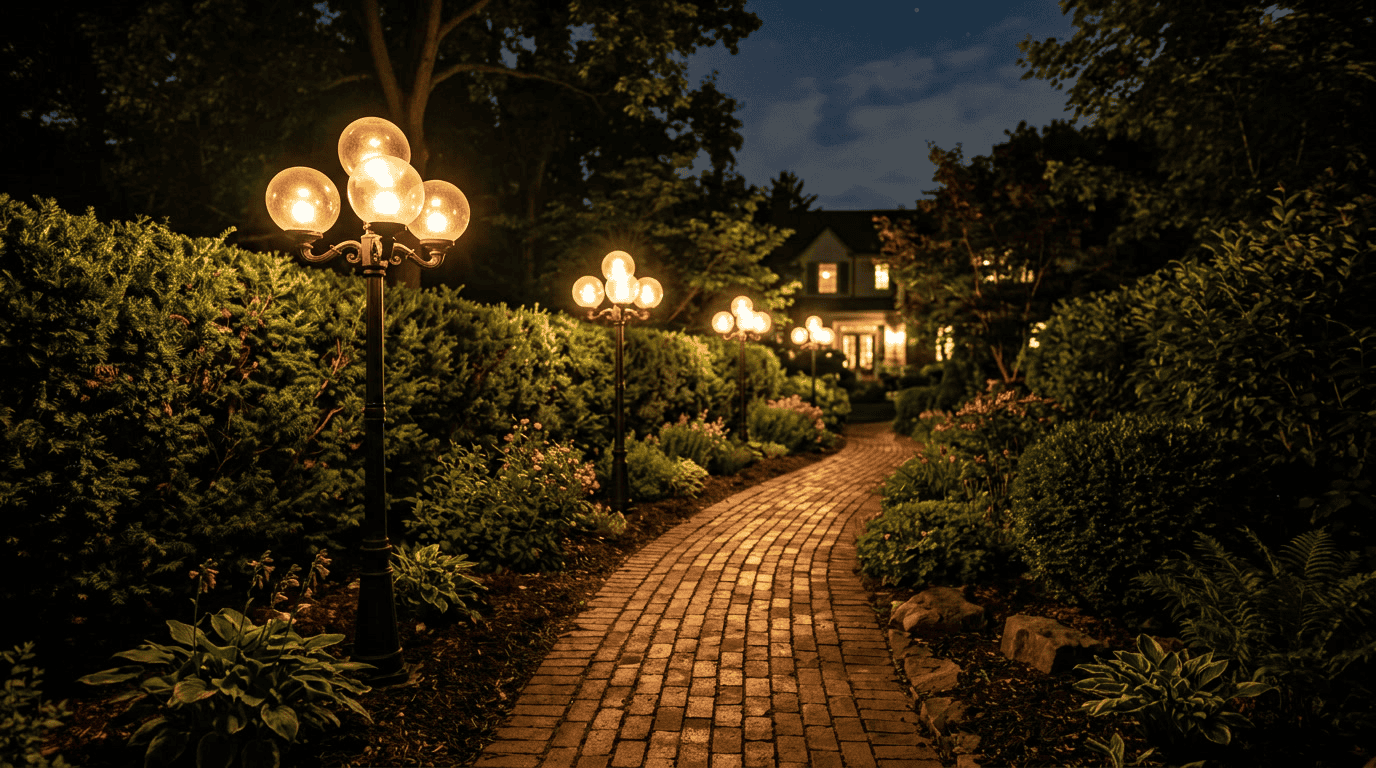
This guide covers three glass materials — borosilicate, heat-tempered soda-lime, and standard annealed soda-lime — against the specific demands of lawn light applications: outdoor temperature cycling, UV exposure from below (ground reflection) and above, irrigation spray, and the stress concentration that occurs at the fitter collar where the glass meets metal.
Why Lawn Lights Demand More from Glass Than Other Outdoor Fixtures
Lawn lights face a specific combination of environmental stresses that wall sconces, porch pendants, and ceiling fixtures don’t.
Ground-level exposure. A wall fixture has the building mass behind it providing thermal and weather buffering. A post-top lawn light stands alone in the middle of a garden or driveway, exposed on all sides. Temperature changes hit the glass simultaneously from all directions, creating uniform thermal stress rather than the one-sided stress patterns that wall-mount fixtures experience.
Irrigation spray. Many lawn light fixtures sit within reach of rotary irrigation heads. A cold glass globe hit by warm water from the irrigation system on a winter morning — or warm glass hit by cold overnight irrigation — creates a sudden ΔT that can exceed 30°C in seconds. Standard annealed glass cannot reliably absorb repeated thermal shocks of this magnitude.
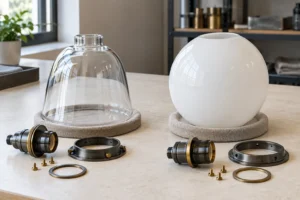
Freeze-thaw cycling at the fitter collar. The junction between the glass collar and the metal holder ring is the highest-stress point on any post-top shade. Metal expands and contracts at a different rate than glass. Over repeated thermal cycles, a mismatched expansion coefficient creates micro-stress at the contact point that eventually propagates into visible fractures — always starting at the fitter collar, not the globe body.
The acrylic counterargument. Cooper Lighting’s widely-cited comparison correctly notes that acrylic outperforms glass on impact resistance and offers better UV stability than standard soda-lime glass. What that comparison misses: UV-stabilized borosilicate glass does not yellow in the way that early acrylic formulations did, and glass provides a scratch-resistant, optically stable surface over 10–15 years that acrylic — which develops micro-scratches from cleaning and airborne abrasion — cannot match aesthetically. For decorative lawn fixtures where visual clarity matters for a decade, the right glass specification wins.
The Three Glass Types for Lawn Lights
Choosing the best glass for lawn lights starts with understanding how these three materials differ at the molecular level — not just in marketing claims.
Borosilicate Glass
Borosilicate glass contains 12–15% boron trioxide (B₂O₃) in its composition, which restructures the silica network at the molecular level and dramatically lowers the thermal expansion coefficient. Where standard soda-lime glass expands at approximately 9 × 10⁻⁶/°C, borosilicate expands at roughly 3.3 × 10⁻⁶/°C — about one-third the rate.
What this means in practice: a borosilicate globe can absorb a temperature change of 120°C or more without fracturing. Drop an ice cube into a borosilicate beaker of boiling water, and nothing happens. Do the same with a soda-lime glass and you get an immediate crack. The same physics apply to a lawn light shade caught in an early-morning irrigation spray after a cold night.
Per the ASTM C556 standard for borosilicate glass, the thermal shock endurance of borosilicate glass is defined by the maximum temperature differential it can withstand without fracture — typically 160°C for standard borosilicate construction. This far exceeds any temperature differential a residential lawn light will encounter.
Borosilicate is the correct specification for:
– Any climate with more than 30 freeze-thaw cycles per year
– Fixtures within irrigation spray range
– Locations where overnight low temperatures drop below -15°C
– Fixtures using incandescent or halogen bulbs that run the socket area noticeably warm
The premium over standard glass is typically 25–40% in material cost, which is offset by a dramatically extended replacement interval.
Heat-Tempered Soda-Lime Glass
Heat-tempered glass (also called toughened glass) is standard soda-lime glass that has been heated to approximately 620°C and then rapidly air-cooled. This process creates a compressive stress layer on the surface and a tensile stress core, which roughly quadruples the glass’s resistance to thermal shock and mechanical impact compared to annealed glass.
According to the ASTM C1048 standard for heat-treated glass, heat-strengthened glass achieves approximately twice the thermal resistance of annealed glass, while fully tempered glass achieves four times. For lawn light glass shades, fully tempered is the better specification of the two.
Heat-tempered glass is appropriate for:
– Mild to moderate climates with fewer than 30 freeze-thaw cycles per year
– Budget-conscious replacements where borosilicate’s 25–40% premium is a constraint
– Fixtures using LED bulbs that run cool (minimal socket heat contribution)
One caution: heat-tempered glass, when it does fracture, shatters into hundreds of small fragments rather than a few large shards — the “safety glass” characteristic. For a lawn light globe this means a broken shade creates cleanup complexity that a borosilicate shade (which typically cracks in a few pieces) does not.
Standard Annealed Soda-Lime Glass
Annealed soda-lime glass is the baseline — the same glass used in windows, bottles, and basic glassware. It has no special thermal treatment. Thermal shock resistance is limited to approximately 40°C differential before fracture risk becomes significant.
For lawn light applications, standard annealed soda-lime glass is the wrong specification in almost all climates. The thermal cycling alone — not even accounting for irrigation spray or impact — will produce micro-fractures at the fitter collar within 3–5 years in any location with genuine seasonal temperature change.
Where annealed soda-lime glass is acceptable: indoor decorative fixtures, mild maritime climates with stable year-round temperatures and no freeze-thaw, purely aesthetic applications where replacement is expected and budgeted.
Never specify annealed glass for post-top lawn lights. The savings over tempered or borosilicate glass are recovered by the first replacement.
Glass Properties Comparison for Lawn Light Applications
The relevant properties for evaluating glass in a lawn light shade application — thermal resistance, UV stability, optical clarity over time, and weather durability — compare as follows:
| Property | Borosilicate | Heat-Tempered Soda-Lime | Annealed Soda-Lime |
|---|---|---|---|
| Thermal expansion coefficient | 3.3 × 10⁻⁶/°C | 9 × 10⁻⁶/°C | 9 × 10⁻⁶/°C |
| Thermal shock resistance | ~160°C ΔT | ~80°C ΔT (tempered) | ~40°C ΔT |
| UV stability | Excellent (no ester linkages) | Good | Good |
| Optical clarity at 10 years | Excellent | Good | Fair (micro-scratch accumulation) |
| Fracture mode | Few large pieces | Small fragments (safety) | Irregular shards |
| Typical lifespan in freeze-thaw climate | 10–15 years | 5–8 years | 2–5 years |
| Cost premium vs annealed | +25–40% | +10–20% | Baseline |
The Illuminating Engineering Society’s outdoor luminaire guidelines specify glass enclosures for outdoor applications by their operating temperature range — and for post-top fixtures in all-season climates, the spec consistently points to borosilicate or heat-strengthened construction.
Glass Opacity and Light Output for Lawn Lights
Glass material is one decision; glass opacity is a separate one that affects lux delivery to the pathway surface. According to the U.S. Department of Energy’s outdoor lighting guidance, residential pathway lighting should deliver 1–5 footcandles at grade for safe pedestrian navigation. The glass shade you specify directly affects whether a given LED wattage meets that target.
Clear Glass
Clear glass transmits 88–92% of the bulb’s lumen output. For lawn post-top lights at ground level, clear glass maximizes path illumination but creates visible glare at eye level as pedestrians pass. Appropriate for:
– High-mount fixtures (above 5 feet) where the bulb is above eye level
– Driveways and security lighting where maximum lux takes priority
– Decorative filament LED bulbs where the lamp itself is part of the visual design
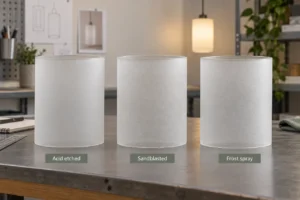
Frosted Glass
Frosted glass transmits 75–82% of the bulb’s output while eliminating visible bulb hot spots. The slight lux reduction (8–15% versus clear in the same wattage) is easily compensated by stepping up one LED wattage level. Frosted is the default specification for residential pathway lawn lights because it produces comfortable, glare-free illumination at walking height.
Seeded and Textured Glass
Seeded glass (air bubbles suspended in the glass body) and textured finishes (ribbed, hammered, rain pattern) transmit 65–78%. The visual texture diffuses light similarly to frosted glass while adding decorative interest. These are appropriate for craftsman, colonial, or cottage landscape styles but may require a higher LED wattage to compensate for the additional transmittance reduction.
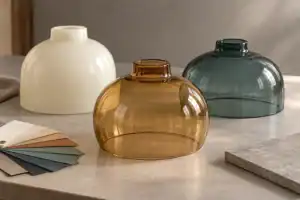
Amber and Warm-Tinted Glass
Amber glass transmits 50–65% of total lumen output and shifts the spectral output below 3000K — the threshold recommended by the International Dark-Sky Association’s certification criteria for dark-sky compliant residential outdoor lighting. For properties in or adjacent to dark-sky zones, amber glass is increasingly required. For general residential use, it is appropriate for ambiance and accent fixtures rather than pathway safety lighting.
How to Choose the Best Glass for Your Specific Lawn Light
The selection sequence is fixed: thermal specification first, then opacity, then style.
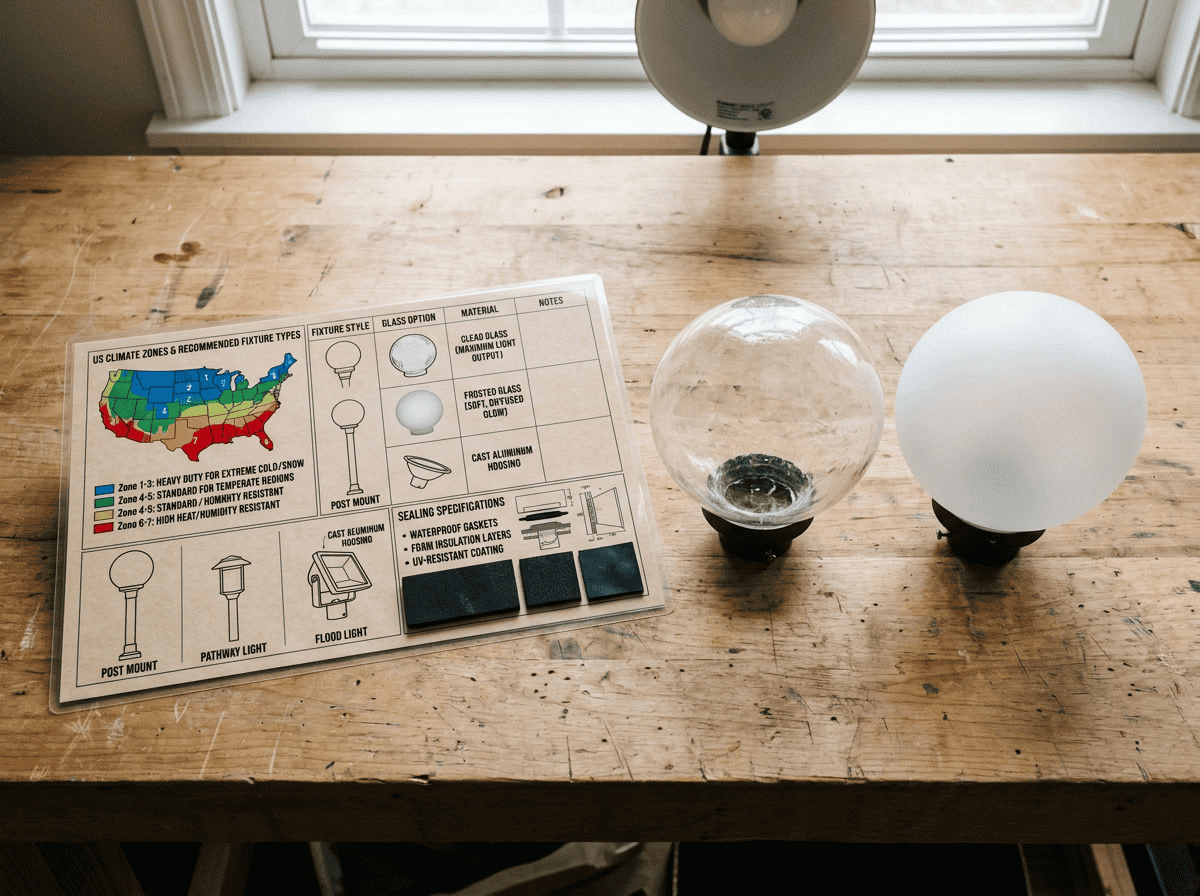
Step 1: Establish Your Climate’s Freeze-Thaw Count
- More than 50 freeze-thaw cycles/year (northern US, Canada, most of northern Europe): Borosilicate required. No exceptions.
- 20–50 cycles/year (mid-Atlantic US, Pacific Northwest, UK, central Europe): Borosilicate preferred; heat-tempered soda-lime is acceptable if cost is constrained.
- Fewer than 20 cycles/year (Deep South US, coastal California, Mediterranean climates): Heat-tempered soda-lime is sufficient. Annealed glass is still not recommended due to irrigation spray exposure.
Step 2: Check Your Irrigation Configuration
If any rotary or impact irrigation heads operate within 10 feet of the fixture, the shock risk from warm/cold water on glass that is at a different temperature adds meaningfully to the thermal cycling load. Treat as one freeze-thaw category higher when irrigation is present.
Step 3: Identify Your Bulb Type
- LED (most modern fixtures): LEDs run cool. Minimal socket heat contribution. Standard thermal specification for the climate is sufficient.
- Incandescent or halogen retrofit: These run hot. The socket area of the fixture may reach 60–80°C when the ambient temperature is near-freezing. The ΔT at the fitter collar increases substantially. Upgrade to borosilicate regardless of climate.
Step 4: Select Opacity Based on Fixture Height and Lighting Goal
| Fixture Height | Lighting Goal | Recommended Opacity |
|---|---|---|
| < 3 feet (path lights, bollards) | Pathway safety | Frosted — eliminates eye-level glare |
| 3–5 feet (standard post lights) | Pathway + ambiance | Frosted or seeded |
| > 5 feet (tall post lights) | Driveway/security | Clear or frosted |
| Any height | Dark-sky compliance | Amber tinted |
Glass vs. Acrylic for Lawn Lights: The Correct Comparison
This question comes up because commercial outdoor lighting manufacturers have historically pushed acrylic as “better” than glass. The comparison is accurate for specific scenarios and wrong for others. Here’s the honest breakdown:
Where acrylic outperforms glass:
– Impact resistance: acrylic absorbs impacts that would shatter glass — relevant for areas with foot traffic, sports activity, or risk of physical impact
– Initial cost: acrylic globes are typically 20–40% cheaper than equivalent glass for the same size
– Weight: acrylic is approximately half the density of glass, reducing wind-load stress on post connections
Where glass outperforms acrylic:
– Scratch resistance: glass maintains optical clarity over 10–15 years; acrylic develops micro-scratches from cleaning and airborne abrasion that produce a haze in 5–8 years
– UV yellowing: UV-stabilized acrylic resists yellowing for 8–12 years in outdoor conditions; borosilicate glass does not yellow at all over its lifespan
– Long-term aesthetics: a glass globe that is 10 years old looks the same as a new one (absent impact damage); a 10-year-old acrylic globe typically shows some degree of surface degradation
– Matched-set longevity: for a row of 6–8 matching lawn light globes, glass shades will maintain visual consistency over a decade; acrylic shades in the same row will begin to show differential yellowing between units replaced at different times within 5–7 years
For residential decorative lawn lights where aesthetics drive the purchase decision, the correct choice is glass — specifically borosilicate or heat-tempered, not annealed. For commercial or high-traffic applications where impact resistance is the primary requirement, acrylic is justified.
Trends in Lawn Light Glass for 2026 and Beyond
Three trends are reshaping what “best glass” means for lawn lights in 2026:
Borosilicate becoming the residential standard. Historically a laboratory and specialty specification, borosilicate glass is becoming the default specification for quality-tier residential outdoor glass shades as buyers become aware of the thermal cycling failure mode and demand material specs from manufacturers. Suppliers who cannot document borosilicate or heat-tempered construction are losing ground to those who can.
Dark-sky glass adoption growing. An estimated 18% of new landscape lighting installations in US metropolitan markets now fall under local dark-sky or light-trespass ordinances. Amber-tinted glass specifications are growing correspondingly, particularly in coastal and mountain communities.
UV-stable coatings on glass. A new generation of UV-absorbing ceramic coatings applied to the outer surface of borosilicate globes is reducing the blue-spectrum output of clear glass shades without requiring amber tinting — maintaining the clear-glass aesthetic while approaching dark-sky transmittance targets.
| Trend | Glass Response | 2026 Adoption Estimate |
|---|---|---|
| Borosilicate as residential default | Material spec documentation required | ~35% of quality-tier replacements |
| Dark-sky ordinance expansion | Amber / warm-tinted glass | ~18% of new landscape installs |
| UV-stable coating | Clear glass with ceramic UV filter | ~8% of premium replacements |
| Recycled glass content | ~15% cullet input, equivalent specs | ~12% of manufactured globes |
Frequently Asked Questions
What is the best glass type for lawn light globes in cold climates?
Borosilicate glass is the best specification for any cold climate with more than 30 freeze-thaw cycles per year. Its thermal expansion coefficient (3.3 × 10⁻⁶/°C) is approximately one-third that of soda-lime glass, which prevents the micro-fracturing at the fitter collar that ultimately causes post-top lawn light globes to crack. Heat-tempered soda-lime glass is the second-best option at a lower cost, with roughly four times the thermal shock resistance of standard annealed glass.
Is borosilicate glass worth the extra cost for lawn lights?
Yes, in most climates. The cost premium of borosilicate over heat-tempered soda-lime glass is typically 25–40% at the shade level. In a freeze-thaw climate, a borosilicate globe lasts 10–15 years versus 5–8 years for heat-tempered and 2–5 years for annealed glass. On a 10-year total-cost basis (material + labor for repeated replacement), borosilicate is almost always cheaper than standard glass alternatives.
Can I use regular window glass for a lawn light shade?
Standard annealed window glass should not be used for lawn light shades. Its thermal shock tolerance of approximately 40°C temperature differential is insufficient for any outdoor post-top fixture that experiences seasonal temperature changes, irrigation spray, or bulb heat. Fractures typically begin at the fitter collar where metal-glass contact creates a stress concentration point. Specify heat-tempered or borosilicate glass for any outdoor application.
How do I identify whether a glass shade is borosilicate?
Most product listings do not state “borosilicate” unless the glass actually is borosilicate — silence usually means soda-lime. Physical indicators: borosilicate glass viewed edge-on through sufficient thickness shows a faint neutral or very slightly blue-green tint, while soda-lime glass shows a more distinctly green tint from the iron content. The most reliable method is to ask the manufacturer for the material specification sheet — a legitimate borosilicate supplier will have one.
Does glass type affect the light output of lawn light shades?
Glass type (borosilicate vs. soda-lime) has minimal effect on light transmittance — both transmit similarly. Opacity (clear, frosted, seeded, amber) affects output significantly: clear transmits 88–92%, frosted 75–82%, seeded 65–78%, amber 50–65%. The choice of glass type affects durability; the choice of opacity affects how much light reaches the pathway.
What glass should I use for lawn lights near an irrigation system?
Borosilicate glass is the correct specification for any lawn light within 10 feet of a rotary or impact irrigation head. The risk of thermal shock — cold glass hit by warm irrigation water on a winter morning, or warm glass hit by cold overnight irrigation — is significantly higher than in non-irrigated settings. The investment in borosilicate is particularly justified here because the shock events are frequent and predictable rather than random.
How long should a good glass shade last on a lawn light?
A borosilicate glass shade in good operating conditions — no physical impact, proper gasket sealing, set screws not over-tightened — should last 10–15 years in all-season climates. Heat-tempered soda-lime glass typically lasts 5–8 years in the same conditions. Standard annealed glass in a freeze-thaw climate rarely lasts more than 3–5 years before micro-fractures at the fitter collar lead to visible cracking. These estimates assume LED bulbs; halogen or incandescent bulbs add socket heat that reduces lifespan by 20–30% for all glass types.
Conclusion
The best glass for lawn lights is not a single answer — it is a climate-matched specification. Borosilicate glass in freeze-thaw climates. Heat-tempered soda-lime in mild climates. Never standard annealed glass in any outdoor post-top application. The opacity choice (clear, frosted, seeded, amber) is secondary to the glass type decision but directly affects pathway lux delivery.
The argument for acrylic in outdoor lighting holds for commercial, high-traffic, or impact-exposed applications. For residential decorative lawn lights where visual clarity and a 10+ year matched-set appearance are the goals, correctly-specified glass wins on every aesthetic and longevity metric.
For borosilicate and heat-tempered glass globe specifications across the full range of standard fitter sizes for lawn post-top and bollard applications, our glass lampshade product line at jxlampshade.com covers residential and commercial specifications with documented material construction.