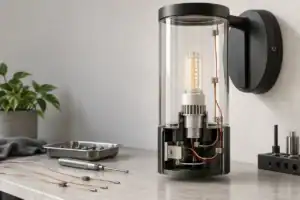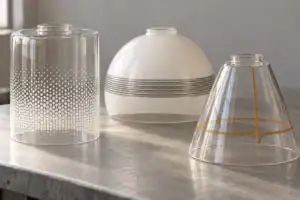
A rectangle lampshade has four flat sides, two long and two short, creating a geometric silhouette that casts focused, directional light. It mounts on table lamps, floor lamps, and wall sconces, and comes in materials from linen to glass, tapered or straight-sided.
Most people pick a lampshade by eye. The size looks about right in the store, the color seems fine under fluorescent lighting, and then it arrives and something’s off. The proportions feel wrong. The fitter doesn’t engage. Or the fabric turns the whole room orange after dark. This guide covers every decision point, from shape and style to material and fitter type, so you only have to do this once.
What is a rectangle lampshade?
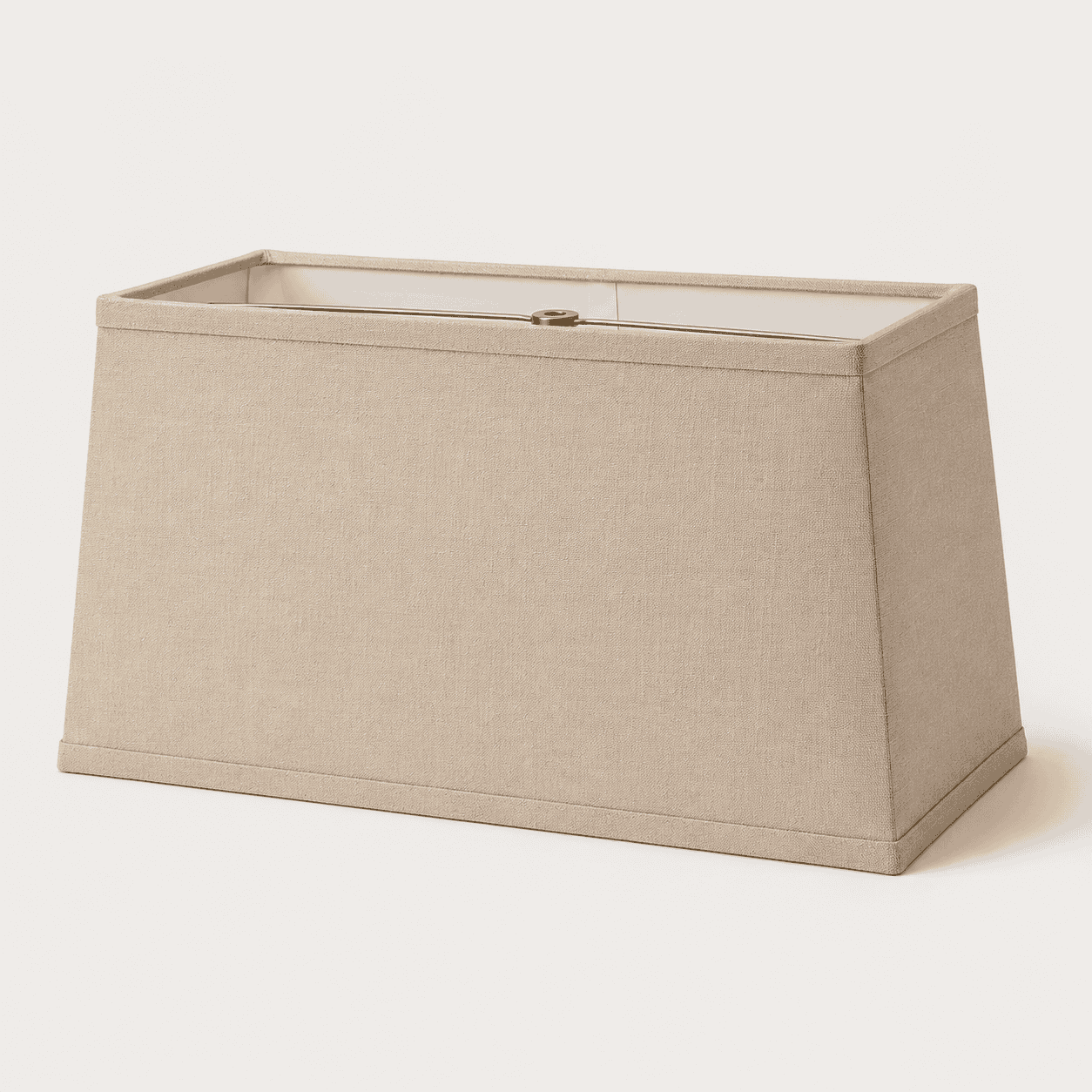
A rectangle lampshade is a four-sided shade with two longer sides and two shorter sides, forming an elongated silhouette. Unlike drum shades (circular, equally wide all around) or round empire shades (circular taper), a rectangle shade creates structured, directional light spread that works particularly well for reading, layered ambient lighting, and pairs of lamps flanking a symmetrical arrangement. The shape is deliberate. Clean corners, flat planes, geometry you chose.
Rectangle vs. square vs. drum vs. empire: the shape family
People conflate these shapes, and the confusion costs money in returns. A square shade has four equal sides and reads as bold and symmetric. It works on statement floor lamps but can feel heavy on a small table lamp base. A rectangle lampshade is asymmetric in footprint, which makes it feel more tailored and better suited to oblong bases, console lamp pairs, and horizontal wall sconces.
Drum shades are cylindrical with no taper, a circular cross-section, and omnidirectional light. They’re fashionable and versatile, but they scatter light evenly in all directions. A rectangle shade throws more light forward and back than sideways, which creates a layered, directional quality that designers use deliberately to build depth in a room.
Empire shades taper from a narrower top ring to a wider bottom. They can be round or rectangular. Many “rectangle lampshades” sold in mainstream retail are technically tapered empire rectangles. This distinction matters when you’re measuring for a replacement, because a tapered shade and a straight-barrel shade are different objects with different measurements.
| Shape | Silhouette | Cross-section | Best use | Light spread |
|---|---|---|---|---|
| Rectangle | Elongated, angular | Rectangular | Table lamps, console pairs, sconces | Directional, front/back emphasis |
| Square | Symmetric, bold | Square | Statement floor lamps, single pieces | Even across four faces |
| Drum | Clean cylinder | Circular | Pendants, ceiling fixtures, modern rooms | Omnidirectional |
| Empire (round) | Classic taper | Circular top/bottom | Traditional table lamps | Wide base coverage, downward pool |
The anatomy of a rectangle lampshade
The frame is the skeleton, usually welded wire or injection-molded plastic, and it determines the shade’s dimensions and rigidity. Most rectangle lampshades have a top ring, a bottom ring, and four corner struts connecting them. Quality frames are welded at the corners; cheaper ones flex under sustained heat and allow the covering to pull loose over time.
The covering material sits over the frame. Fabric, paper, glass, or metal: each behaves differently and produces different light. A liner, usually white or cream fabric on the inside, reflects light downward and hides the bulb from direct view. Without a liner, the bulb is visible, which changes the entire character of the light. According to Wikipedia’s overview of lampshade construction, the liner material and color directly affect both the quantity and color temperature of emitted light. Most buyers discover this after purchase rather than before.
The fitter is the attachment mechanism (more on this in the buying section). Trim, the edge tape or fabric binding at top and bottom, is both structural and decorative: it stops fraying and finishes the look. Hard-back shades have trim; soft-back shades roll the fabric under instead.
4 types of rectangle lampshades
Type refers to the shade’s profile: whether the sides are tapered, straight, curved, or pleated. Each creates a different visual effect and distributes light differently.
Tapered empire rectangle
This is the most common rectangle lampshade style. The top is narrower than the bottom, sometimes mildly (a 2-inch difference per side) and sometimes dramatically (6 inches or more). The taper directs light downward, concentrating it on the table surface or book rather than the ceiling. Tapered empire rectangles suit traditional, transitional, and many contemporary interiors. They’re proportionally forgiving. A moderate taper reads as classic without being fussy.
Straight drum or barrel rectangle
Equal top and bottom dimensions, perfectly vertical sides. This is the rectangle version of a drum shade. It’s clean and modern. No taper means no traditional hierarchy, just pure geometry. Barrel rectangles work well in Scandinavian interiors, industrial lofts, and anywhere you want the shade to feel architectural rather than decorative. Light escapes more evenly from top and bottom, which softens the ceiling wash compared to a tapered version.
Coolie rectangle
An extreme taper with a very narrow top and a wide flaring bottom. The coolie silhouette originated in Asia and appeared in mid-century Western interiors during the 1950s and 60s. A rectangle coolie is less common than a round one, but when it appears it commands attention. It floods the surface below with light while throwing almost nothing toward the ceiling. One practical note: the bulb sits close to the narrow top, and with incandescent bulbs, heat buildup is a real issue. LED-only is the correct choice for a coolie rectangle lampshade.
Pleated rectangle
The fabric is gathered into vertical folds before being attached to the frame. Pleats add texture and shadow depth, making the shade look expensive and intentional even in neutral colors. Pleated rectangle lampshades suit traditional, maximalist, and hotel-style interiors. They’re a fixture in high-end hospitality design because they photograph well and read as luxurious. The tradeoff: pleats trap dust and are harder to clean than smooth fabric.
| Style | Top vs. bottom | Side profile | Room vibe | Light character |
|---|---|---|---|---|
| Tapered empire | Narrower top | Angled inward | Traditional, transitional | Strong downward pool |
| Drum/barrel | Equal | Vertical | Modern, Scandinavian | Even top-to-bottom |
| Coolie | Very narrow top | Steep angle | Mid-century, statement | Flood table, minimal ceiling |
| Pleated | Varies | Textured vertical folds | Traditional, hotel, maximalist | Warm, diffused with shadow lines |
Rectangle lampshade materials: what actually matters
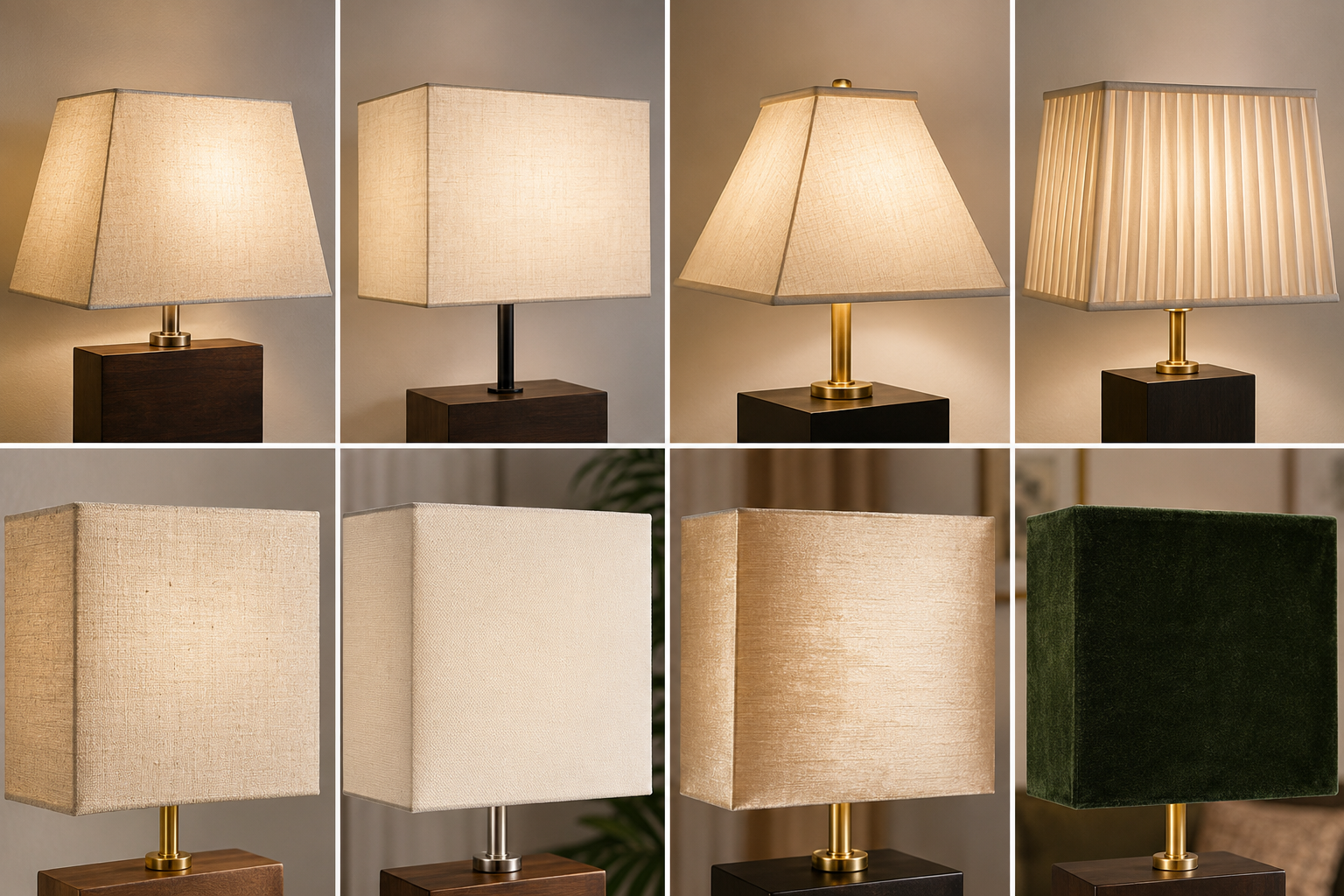
Material is where most buying decisions go sideways. People choose by color or texture under good store lighting, then discover at home that the shade bleeds orange at night or blocks so much light the room feels like a cave. Here’s what the product photos don’t show you.
Fabric: linen, cotton, silk, velvet
Linen is the dominant material for rectangle lampshades in the current residential market. It diffuses light softly, reads as natural and textural, and holds its shape well over years of use. Our linen lampshade guide covers the material in depth. The key property is opacity: natural undyed linen transmits roughly 30-40% of light, producing a warm amber glow that flatters wood tones and neutral wall colors. That amber warmth is a feature in some rooms and a problem in others. Cool white walls paired with an amber linen shade create a clash that becomes obvious after dark.
Cotton is more variable. Tightly woven cotton can be nearly opaque; open-weave cotton passes light generously. Cotton shades are less expensive than linen and softer to the touch, but they’re prone to slight yellowing over time when used with warm bulbs close to the fabric.
Silk and faux-silk shades have a sheen that bounces light in a glamorous, dimensional way. Delicate in practice: humidity causes rippling, direct sunlight fades them in months. They’re better suited to dining rooms and bedrooms than kitchens. Real silk rectangle lampshades start around $80 for small sizes; faux-silk delivers most of the visual effect at a fraction of the cost.
Velvet rectangle lampshades are for the committed. Almost no light passes through the velvet itself; illumination comes only from the top and bottom openings. Serious texture, dramatic shadow, but heavy, difficult to clean, and not suited to spaces where functional reading light is the goal.
Paper and parchment shades
Paper shades transmit more light than fabric, often 50-65%, and they do it crisply, with the light reading as white rather than amber. Parchment, whether treated paper or genuine parchment, gives a slightly warmer, aged quality. According to research from the Lighting Research Center at Rensselaer Polytechnic Institute, shade transmittance and color together significantly affect the perceived color temperature of a room, not just the raw lumen output from the bulb. This is why two lamps with identical bulbs can make a room feel completely different depending on the shade material.
The limitation of paper is durability. Paper shades dent and tear. They’re lightweight and inexpensive, which makes them good for rental apartments and situations where the shade is decorative rather than permanent. Not ideal if children are nearby.
Glass rectangle lampshades
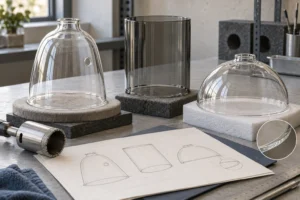
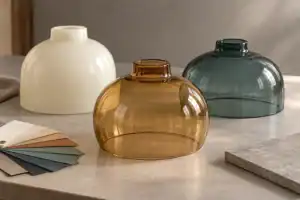
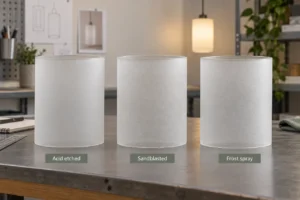
Glass changes the category entirely. A glass rectangle lampshade doesn’t diffuse light the way fabric does. It transmits light while adding refraction, texture, and a sculptural quality that no fabric can replicate. Frosted glass diffuses light softly and evenly. Clear glass lets the bulb become part of the visual composition. Opal glass (milk glass) creates an even, cloud-like glow with excellent color rendering, closer to daylight than most fabric shades produce.
The practical advantages in commercial applications are real: glass doesn’t yellow, doesn’t trap dust the way pleated fabric does, and doesn’t absorb odors. These properties matter in hospitality settings where shades need to look clean under scrutiny. Borosilicate glass handles the thermal cycling of switching on and off without micro-fracturing over time, which standard soda-lime glass does less well after years of daily use.
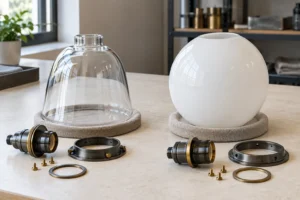
A glass rectangle lampshade typically pairs with pendant fixtures and wall sconces rather than traditional table lamps, because the weight requires a more rigid mounting solution. Browse our lampshade collection to see glass options across different profile styles.
Metal and perforated shades
Metal rectangle lampshades are directional by design. Solid metal transmits zero light through the shade body; all light exits from the top and bottom openings. Perforated metal casts pattern shadows on surrounding walls and ceiling. Striking in the evening, decorative, but sometimes impractical as task lighting. Industrial and mid-century interiors use these well. They’re ambient and accent tools, not reading lights.
How to measure a rectangle lampshade
Measurement failure is the most common reason for lampshade returns. Getting it right requires understanding three dimensions and one proportion rule.
The three key dimensions
A rectangle lampshade is described by three numbers: top dimension, bottom dimension, and height. For a rectangle shade, each dimension is itself a pair, so a complete measurement looks like this: 8″L x 5″W top, 14″L x 10″W bottom, 11″H. Retailers sometimes abbreviate this as “8/14 x 5/10 x 11” or similar. Always confirm which measurement is length (the long side) and which is width before ordering.
Height comes in two forms. Slant height is the distance from the top ring to the bottom ring measured along the sloped side, and this is the number in most product listings. True height is the vertical distance, which determines how far the shade drops below the socket. For a tapered empire rectangle, slant height is always larger than true height. For a straight barrel rectangle, they’re identical.
Our detailed how to measure a lamp for a new shade guide walks through every measurement with photographs. The critical numbers follow.
The 2:3 rule: matching shade width to lamp base height
The most useful heuristic in lampshade sizing: the shade’s bottom width should be approximately two-thirds of the lamp base height. A 15-inch base pairs with a 10-inch-wide shade bottom. A 24-inch base (typical floor lamp) pairs with roughly a 16-inch bottom width.
This is a proportion guide, not a hard rule. Heavy or visually wide bases can support a larger shade; slender or tapered bases need restraint. But when you’re starting from scratch, the 2:3 ratio gets you into the right territory without an in-person fitting.
Height matters independently. The shade should be tall enough that you cannot see the bulb socket from seated eye level. The general threshold is approximately 40-42 inches from the floor. If the socket is visible from a seated position, the shade is either too short or sitting too high on the harp.
Common standard sizes to know
Rectangle lampshades aren’t standardized the way drum shades are, but certain sizes appear consistently across manufacturers:
| Lamp base height | Shade bottom (L x W) | Shade height | Typical lamp type |
|---|---|---|---|
| 10-12 inches | 12″ x 8″ | 8-9 inches | Small bedside or accent table lamp |
| 14-16 inches | 16″ x 10″ | 10-11 inches | Standard table lamp |
| 18-22 inches | 20″ x 14″ | 12-13 inches | Tall table lamp, console lamp |
| 24-30 inches | 16″ x 12″ | 10-12 inches | Floor lamp (shade sits high on harp) |
| Wall sconce | 8-10″ x 5-6″ | 6-8 inches | Fixed sconce arm mount |
Where rectangle lampshades work best
The directional geometry of a rectangle lampshade makes it excellent in certain contexts and awkward in others. Understanding the light behavior matters more than the aesthetic alone.
Table lamps: bedside, desk, and console
This is the rectangle lampshade’s primary territory. Bedside lamps with rectangle shades direct light toward the book or phone without flooding the other side of the bed. The front-and-back directional bias is an asset here. Console lamp pairs (two identical lamps flanking a hallway table or fireplace) look particularly sharp with rectangle shades, because the elongated silhouette reads as intentional and symmetrical from straight on.
Desk lamps with rectangle shades focus light on the work surface below. The long axis of the shade should run parallel to the desk surface when positioning. This maximizes the useful light spread across the work area rather than sending most of it sideways.
Floor lamps and arc lamps
A rectangle lampshade on a floor lamp creates a reading-nook quality: focused, directional, intimate. Proportions matter more here than on table lamps, because the shade sits high, typically 72-76 inches off the floor. A narrow profile shade reads better at this height; a very wide rectangle shade can look top-heavy and visually unstable.
Arc lamps with geometric shades are a strong trend in 2026 residential design. According to Architectural Digest’s 2026 lighting feature, arched floor lamps with angular, geometric shades rank among the five dominant residential lighting preferences of the year. The arc positions the rectangle shade over a sofa or reading chair, concentrating light in the seating zone below. That’s exactly what the directional rectangle shape does well.
Wall sconces and picture lights
Rectangle lampshades on wall sconces create horizontal emphasis. The long axis typically runs horizontally, and the shade throws light both upward (ambient ceiling wash) and downward (toward floor or artwork below). For picture lighting specifically, a narrow rectangle shade with a wide downward spread illuminates artwork without creating the glare that a round shade often does. The flat, elongated profile also sits close to the wall, which keeps the sconce from projecting into the room excessively.
How to choose a rectangle lampshade without getting it wrong
Once dimensions and fitter type are confirmed, style and material selection comes down to a few specific choices.
Matching the shade to your interior style
Traditional and transitional rooms call for a tapered empire rectangle in fabric or linen, in cream, ivory, or warm white. The taper references historical lamp proportions and pairs naturally with ceramic, brass, or carved wood bases.
Modern and Scandinavian rooms work better with a straight barrel rectangle, linen or paper, in white or natural undyed fabric. Minimal trim, clean edge binding, nothing fussy.
Industrial and loft spaces suit metal or perforated shades, or glass rectangle lampshades with visible hardware. Dark finishes, minimal ornamentation.
Maximalist and traditional-luxury rooms: pleated fabric, silk, or velvet in jewel tones. Scalloped or trimmed edges. Larger scale than the base alone would suggest.
Shade color, liner color, and light output
White or off-white shades transmit the most light, typically 30-50% through fabric and more through paper, and the light reads as white. Good for task areas and rooms where accurate color rendering matters.
Cream and ivory shades warm the light slightly. Tan, camel, and kraft shades warm it significantly. The room will register several hundred Kelvin warmer. If your walls are a cool white, a warm amber shade creates a visible temperature clash after dark.
Dark shades (navy, black, forest green) block most light from passing through the shade body. Nearly all illumination exits from the top and bottom openings. A dark rectangle lampshade is an ambient tool and a mood element, not a functional reading light.
The liner color matters as much as the outer fabric, and it rarely appears in product photos. A gold or yellow liner intensifies warmth dramatically. A white liner is clean and neutral. A silver liner makes light slightly cooler and crisper. Ask about liner color explicitly when buying online.
Fitter types: spider, clip-on, uno, and washer
The fitter is how the shade attaches to the lamp, and getting it wrong means the shade won’t mount at all. Four types exist.
The spider fitter is the most common in the US. Wire arms meet at a center ring that sits on a saddle above the harp, and a finial screws down through the ring to lock everything in place. You need a harp on the lamp for this to work.
A clip-on fitter attaches directly to the bulb. No harp required. Common on smaller decorative lamps and chandeliers. The bulb needs to be physically large enough to support the clip; candelabra bulbs often cannot hold clip-on shades safely.
The uno fitter is a threaded ring that screws directly onto the socket threads. The socket must have matching threads. Uno shades sit lower than spider shades, which shifts the proportional relationship between base and shade.
Washer fitters are less common in the US but standard in some European markets. A flat washer ring sits on the socket. If your lamp has an open socket with no harp or threading, this is likely what you need.
Our glass lamp shade fitter types guide covers specifications in detail for glass applications, but the same categories apply to fabric rectangle lampshades across all materials.
Caring for your rectangle lampshade
Rectangle lampshades collect dust. In fabric versions, dust embeds in the weave, and if you leave it long enough, the light output drops noticeably as the shade gets visually denser.
Fabric and linen shade maintenance
A lint roller run lightly over the exterior every few weeks prevents buildup. For deeper cleaning, a soft-bristle brush (a clean makeup brush works well) removes embedded dust without snagging the weave. Most linen shades can handle a gentle pass with a damp cloth for spot cleaning; silk and velvet cannot.
Don’t vacuum fabric shades with high suction. It distorts the frame and can pull the fabric loose at seam points. A handheld vacuum on the lowest setting with a brush attachment is acceptable for cotton and linen. Avoid water on pleated shades; the fold structure is difficult to dry evenly and mold can develop in the creases.
Water stains are the hard problem. For linen and cotton, treat with a small amount of mild dish soap in cold water, dab (never rub), and let dry completely before reinstalling. A wet shade on an active bulb is a fire risk.
Glass shade maintenance and when to replace
Glass rectangle lampshades require minimal routine care beyond an occasional wipe with a damp cloth. The non-porous surface doesn’t accumulate dust the way pleated fabric does, and glass doesn’t yellow or absorb cooking odors over time. This is one of the clearest practical advantages for glass in commercial and hospitality settings.
Fabric shades degrade from heat, UV exposure, and cleaning cycles. When yellowing is present, a persistent odor won’t wash out, or the frame has deformed, replacement is the right call. For glass, the answer is more immediate. Replace on cracking or chipping. A structurally compromised glass shade is a safety concern, not a cosmetic issue. Our glass lamp shade replacement guide covers sizing and sourcing for common replacement scenarios.
Rectangle lampshade trends for 2026 and beyond
The lampshade market has shifted visibly over the past two years. Materials preferences, proportions, and the relationship between shades and LED technology have all moved in specific directions.
Natural fibers and oversized geometry
Linen has moved from a niche material to the dominant one. In European and North American residential retail, linen’s share of the fabric lampshade category grew by an estimated 22% in recent years, driven by the broader biophilic design movement favoring natural, textural materials indoors. According to Statista’s consumer goods trend data, interior textiles with natural-fiber aesthetics have consistently outperformed synthetic alternatives for multiple consecutive years.
Rectangle lampshades in this trend skew large: wide bottoms, generous proportions, natural undyed linen or boucle fabric. Oversized rectangle shades on paired console lamps are a recurring feature in 2026 interior editorial coverage. Boucle (the looped, textural fabric that took over furniture upholstery in 2023-2024) is now appearing in lampshade fabric choices as an extension of that same material story.
The color range is narrowing toward natural. Cream, ivory, oat, parchment, and raw linen dominate the market. Deeply saturated shades remain in the maximalist corner but have lost mainstream shelf space.
Smart-lighting compatibility and glass
Many smart LED bulbs emit light in ways that interact unexpectedly with certain shade materials. Flickering at low dim levels can be visible through thin fabric or paper shades at certain frequencies. The U.S. Department of Energy’s Solid-State Lighting program notes that high-quality dimmable LEDs should produce smooth, flicker-free output across the full dimming range, a standard that budget LED products often don’t meet.
Glass rectangle lampshades work well with smart and LED bulbs because glass doesn’t muffle or distort light output the way a dense liner can. As Zigbee, Matter, and Thread-compatible bulbs become standard household items, the demand for shades that display the quality of the light rather than hiding a cheap reflector is growing steadily. Expect more rectangle lampshades with open-bottom profiles and thinner or transparent shade materials in premium tiers through 2027 and beyond.
| Trend | Driver | Shade attribute | Timeline |
|---|---|---|---|
| Oversized natural linen | Biophilic design movement | Large dimensions, undyed natural fabric | Now, 2026 peak |
| Boucle and textured fabrics | Furniture upholstery crossover | Looped texture, soft geometry | Emerging, 2026-2027 |
| Smart-bulb compatible designs | LED and smart home adoption | Thin materials, open profiles, glass | Now and accelerating |
| Sustainable materials | ESG and consumer demand | Recycled fabric, FSC-certified frames | Growing, 2027-2028 |
| Maximalist jewel tones | Counter-trend to minimalism | Velvet, dark colors, trimmed edges | Niche but gaining |
FAQ
Q: What size rectangle lampshade do I need for a table lamp?
Match the shade’s bottom width to approximately two-thirds of your lamp base height. A 15-inch base typically pairs with a 10-inch-wide shade bottom. Height-wise, the shade should be tall enough to hide the socket from seated eye level, generally 40-42 inches from the floor. If you’re replacing an existing shade, measure the old one (top x bottom x height) and match those dimensions unless you’re intentionally resizing.
Q: What’s the difference between a rectangle and a square lampshade?
A square shade has four equal sides, reads as symmetric and bold, and works well on single statement lamps. A rectangle lampshade has two longer sides and two shorter sides, which creates a more tailored, elongated look. Rectangle shades suit oblong lamp bases, console lamp pairs, and wall sconces better than square shades do. In practice, rectangle lampshades are more common on table lamps because most table lamp bases proportionally favor a slightly elongated shade silhouette.
Q: Can rectangle lampshades be used on floor lamps?
Yes, though proportions differ from table lamp shades. Floor lamp rectangle shades typically have a narrower profile relative to height. A very wide shade on a tall floor lamp reads as top-heavy. A 16″ x 12″ bottom with an 11-inch height is a reasonable starting point for a standard floor lamp. The fitter type also matters: most floor lamps use a spider fitter with a harp, so confirm the harp size before ordering.
Q: What material is best for a rectangle lampshade?
It depends on what you need the light to do. For warm ambient lighting in living rooms and bedrooms, linen is the best all-around choice: it diffuses light warmly, holds its shape, and is durable. For bright task or reading light, use white cotton or paper, which has high transmittance and a clean neutral color. For commercial or high-use spaces, glass is the right answer. It doesn’t degrade, yellow, or trap dust. For pure decorative impact where function is secondary, pleated silk or velvet.
Q: Are glass rectangle lampshades heat-safe?
Borosilicate glass rectangle lampshades are heat-safe for standard bulb use. Borosilicate handles temperature cycling, from cold to hot and back, without micro-fracturing over years of daily use, which is why it’s the standard material for laboratory glass and cookware as well as quality lighting. Regular soda-lime glass handles heat adequately under normal conditions but is more vulnerable to sudden thermal shock. For any glass shade near a high-wattage bulb, LED is strongly preferred: an LED bulb surface reaches roughly 60 degrees C under load, versus 200 degrees C or more for an equivalent incandescent. That difference matters for glass proximity.
Q: How do I know what fitter type I need?
Check whether your lamp has a harp, the U-shaped wire above the socket. If yes, you need a spider fitter. If there’s no harp, look at the socket: threads inside the shade-mounting area mean a uno fitter. A bulb-top clip mechanism means clip-on. When in doubt, bring the harp saddle (the small piece at the lamp’s top that holds the harp in place) to a hardware store. It’s a 30-second identification. Getting the fitter type wrong means the shade won’t mount.
Choosing the right rectangle lampshade for your space
Most rectangle lampshade failures are measurement failures. People eyeball it, assume a size labeled “medium” covers their lamp, and discover that lampshade sizing isn’t standardized across manufacturers. Measure the base, apply the 2:3 proportion rule, confirm the fitter type before ordering, and choose material based on what you need the light to actually do, not just what looks good in a photo.
Style comes after fit. Once the correct dimensions are established, the choice between tapered empire and straight barrel, between linen and glass, between cream and natural, becomes a genuine aesthetic decision rather than a forced compromise. A rectangle lampshade is one of those objects where the decisions compound: the right size in the wrong material still disappoints, and the right material in the wrong fitter type doesn’t mount at all. Measure first, fitter second, size third, style fourth. Get the sequence right and the lampshade stays.