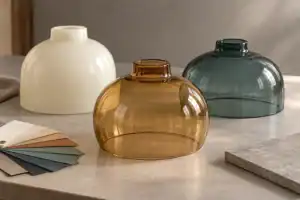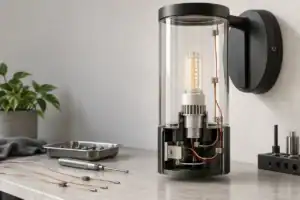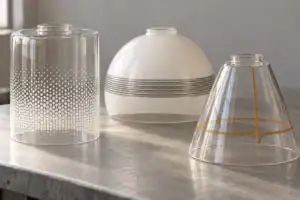
Amber glass shades transmit 50–65% of light in the warm red-orange spectrum (effective 2200–2400K — best for bars, intimate dining, and sleep-health bedroom lamps), clear glass shades transmit 88–92% with no color filtering (best for filament LED display and maximum brightness), and smoke grey glass shades transmit 35–50% with a cool-grey tint (best for dramatic cocktail lounge and high-concept atmosphere).
Three glass shade colors. Three fundamentally different light qualities. Three completely different applications. Amber, clear, and smoke glass shades are not interchangeable options in the same product category — they produce such different light that choosing between them is really choosing between three different lighting philosophies.
This guide provides the definitive comparison of amber vs clear vs smoke glass shades — with the specific transmittance data, spectral characteristics, and application recommendations that allow you to choose correctly the first time.
The Core Difference: What Each Glass Does to Light
Before application recommendations, the physics.
Amber Glass: Spectral Filtering Toward Warmth
Amber glass contains colorants (iron and sulfur compounds in the glass batch) that selectively absorb blue-wavelength light in the 400–500nm range while transmitting red and orange wavelengths (600–700nm) with much higher efficiency.
The practical effect: the light transmitted through amber glass is physically different in spectral composition from the source light. A 2700K warm-white LED has a spectral distribution that still includes meaningful blue-spectrum content. Amber glass filters out most of that blue-spectrum component, shifting the transmitted light toward red and orange — producing effective color temperatures of 2200–2400K regardless of source color temperature.
Transmittance: 50–65% of total source output. The blue-light filtering accounts for much of the transmission loss — amber glass passes the warm spectrum efficiently but blocks the cool spectrum.
Color rendering: Amber glass renders warm-colored objects (red meat, amber beverages, warm wood tones, golden skin tones) with enhanced richness. It de-emphasizes cool-colored objects (green vegetables, blue and purple foods) — not appropriate for contexts where cool food colors need accurate rendering.
According to NIH research on light spectrum and circadian biology, amber-spectrum light (below 3000K, minimal blue content) has significantly reduced melatonin-suppression effects compared to equivalent-lux white light — which is why amber glass lamp shades are increasingly specified for bedroom and late-evening environments where circadian-friendly lighting is the goal.
Clear Glass: Maximum Output, No Color Modification
Clear glass transmits 88–92% of source output with essentially no spectral modification. The light through clear glass is the light from the source, minus a small reflection loss at the glass surface.
The transmitted color temperature through clear glass equals the source color temperature. A 2700K LED through clear glass produces 2700K room lighting. A 3000K LED through clear glass produces 3000K. There is no additional warmth, no additional coolness — just the source color passed through.
Transmittance: 88–92%. The highest transmittance of any glass shade type.
Color rendering: Clear glass provides the most accurate color rendering of any glass shade — no spectral filtering means the light quality equals the LED source quality. For applications where food color accuracy, visual inspection, or color-critical work matters, clear glass with a high-CRI LED source is the correct specification.
The visible source issue: Clear glass makes the lamp source fully visible — the LED chip or filament is visible through the glass at close range. For standard LED chips (which appear as a concentrated bright point), this creates glare at close range. For filament-style LEDs (which glow across a larger, lower-luminance surface), visibility through clear glass is acceptable and often desirable.
Smoke Grey Glass: Low Output, Atmospheric Drama
Smoke grey glass contains colorants that absorb light across the full visible spectrum — reducing total transmittance without strong selective filtering in any part of the spectrum. The slight color shift is toward neutral grey-cool rather than warm or strongly tinted.
Transmittance: 35–50% of source output. The lowest transmittance of the three glass types.
Color rendering: Smoke grey glass reduces lux significantly and provides a slight cool-grey tint — not appropriate for food service or any application where adequate illuminance and color accuracy are required. It is specifically an atmosphere tool, producing dramatic, low-light, slightly mysterious illumination.
The low transmittance of smoke glass has one practical implication: achieving functional illuminance with smoke glass requires significantly higher LED wattage than frosted or clear glass. A smoke grey shade over a restaurant dining table at 30 inches would need a 25–30 watt LED to achieve the 50 footcandles recommended for comfortable dining — inefficient and expensive compared to a 12–15 watt frosted glass pendant achieving the same illuminance.
Side-by-Side Comparison
The key specifications of amber, clear, and smoke glass shades across the relevant comparison dimensions:
| Characteristic | Amber Glass | Clear Glass | Smoke Grey Glass |
|---|---|---|---|
| Transmittance | 50–65% | 88–92% | 35–50% |
| Effective color temp shift | Source − 300–500K (warmer) | None (source unchanged) | Source + 50–100K (slightly cooler) |
| Spectral filtering | Blue absorbed, red/orange passed | No filtering | Broad reduction, slight cool |
| Visible light source | No (diffuse, tinted glow) | Yes (source visible) | No (very dim, obscured) |
| Food color rendering | Excellent for warm foods | Excellent (highest accuracy) | Poor (inadequate lux) |
| Face rendering at close range | Very flattering (warm, shadow-free) | Acceptable (depends on source) | Dramatic (low-key, mysterious) |
| Best LED pairing | 2700K or 3000K (both warmer by amber) | 2200K filament or 3000K standard | 2700K (for maximum warmth) |
| Typical application | Bar, lounge, intimate dining, bedroom | Fast-casual, industrial, task | Cocktail bar, high-concept lounge |
Applications: Where Each Glass Shade Wins
Where Amber Glass Wins
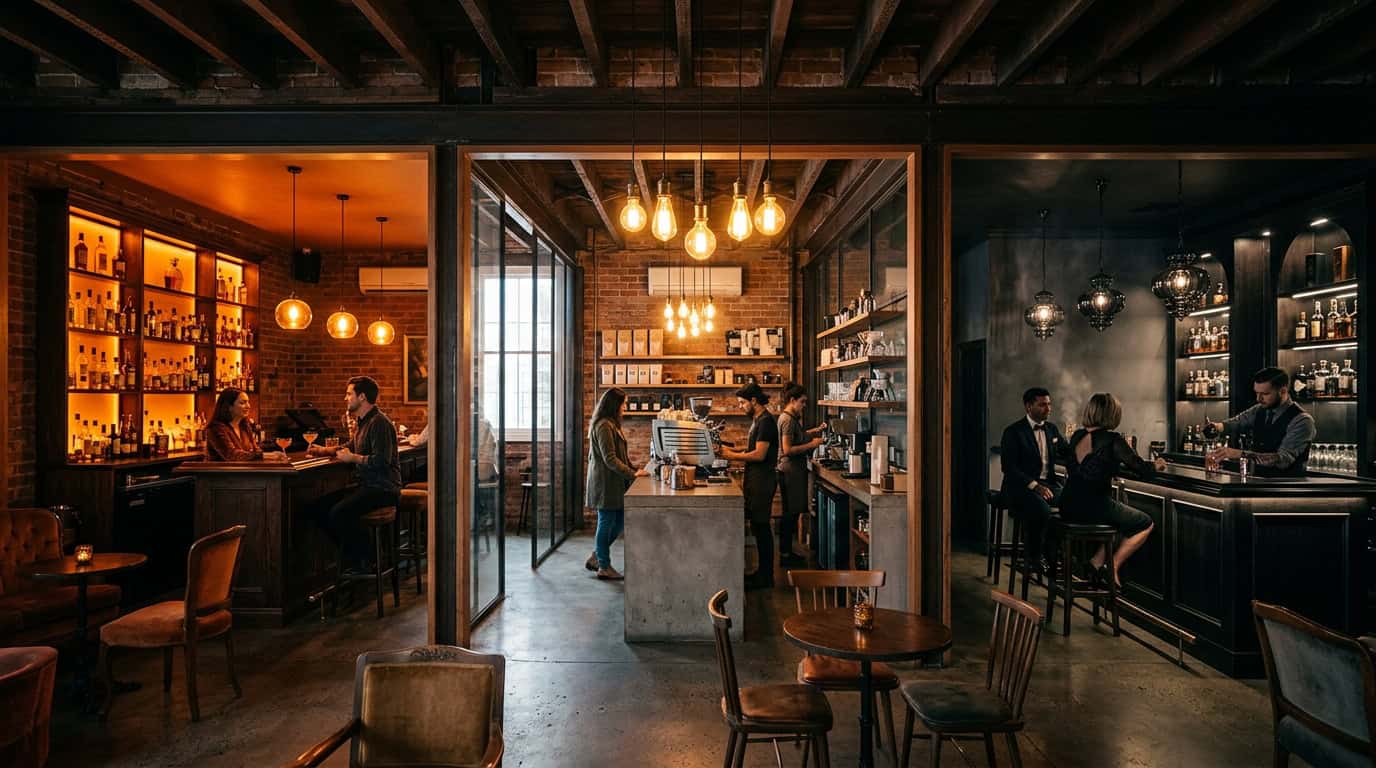
Bar and cocktail service. Amber glass is the specialist material for bar environments — no other glass shade type flatters bar seating faces and amber-colored beverages more effectively. The warm-shifted spectrum eliminates the unflattering blue-shadow effect that standard white light creates on faces at bar distances. Amber spirits (whiskey, bourbon, rum, amber beer) glow dramatically under amber-shifted light.
Fine dining intimate sections. Private dining rooms, romantic date-night restaurant sections, and any dining context where extended dwell time and high average check size are the revenue goals. The amber-spectrum light produces a physiological relaxation effect that encourages longer stays.
Bedroom and sleep-health residential. The most direct residential application of amber glass is the bedside lamp. Blue-light exposure in the two hours before sleep suppresses melatonin production; amber glass lamp shades filter blue wavelengths without requiring specialty LED bulbs. A standard 2700K LED through an amber glass bedside shade produces melatonin-compatible bedroom lighting at no additional cost over standard frosted shades.
Evening-mode residential spaces. Any residential lamp used primarily in the two hours before sleep benefits from amber glass — bedside lamps, living room accent lamps, floor lamps in the wind-down area.
Where Clear Glass Wins
Industrial and vintage-industrial restaurant/cafe aesthetics. Clear glass with a visible filament LED is the canonical visual element of the industrial hospitality interior. The visible warm glowing filament through clear glass is the “specialty coffee shop” and “craft cocktail bar” aesthetic in a single visual element.
Task and work lighting. Where maximum lux per watt is the priority — reading lamps, desk lamps, kitchen task lights, counter prep lighting — clear glass delivers the highest usable output at any LED wattage level.
Fast-casual restaurant dining areas. High-turnover dining contexts benefit from clear glass’s brightness: more light means a more energetic, less settled atmosphere that naturally supports faster table turns.
Spaces where LED source selection drives the experience. Clear glass is the correct pairing when the LED bulb choice is the creative element — filament bulbs, decorative shaped LEDs, novelty sources. Any other glass shade type obscures the bulb; clear glass displays it.
Where Smoke Grey Glass Wins
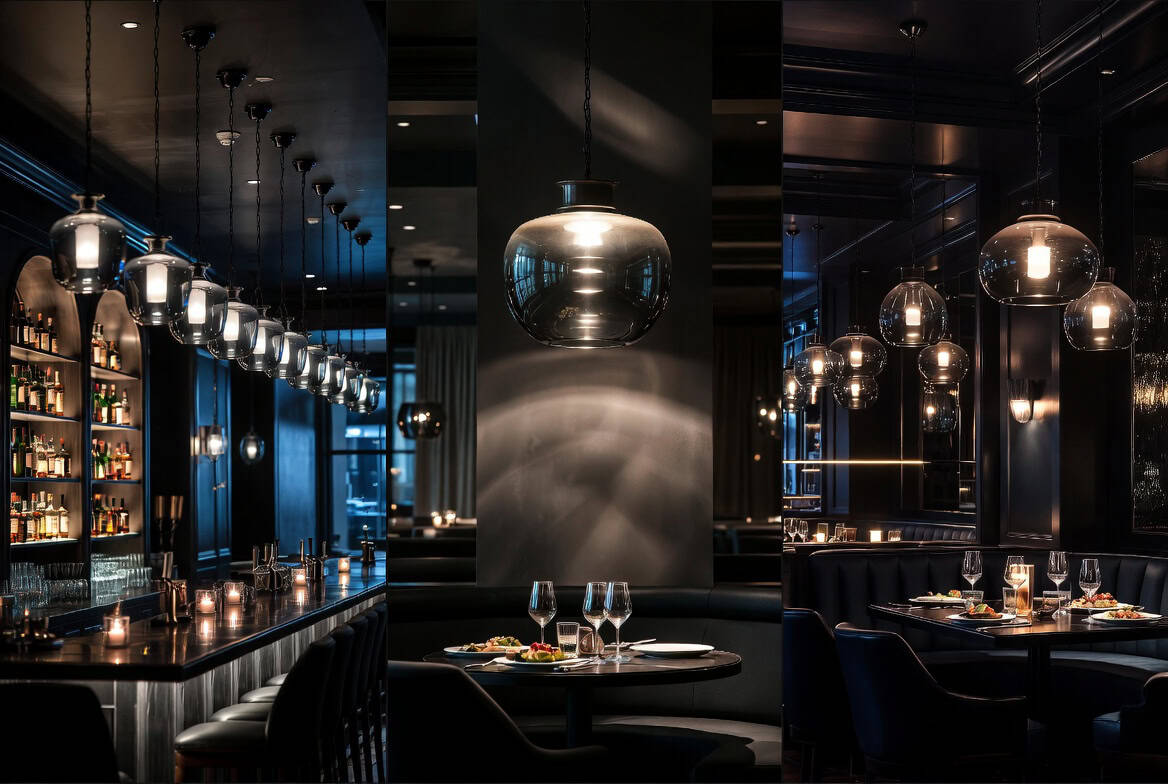
Cocktail bars and high-concept lounge seating. The primary application for smoke glass is the cocktail bar where atmosphere is the entire product — low lux, slight mystery, visual drama. Supplemental lighting (backlit spirits bottles, candles, under-bar LED strips) provides functional illuminance while smoke glass pendant shades create the overhead atmosphere.
Feature pendant positions. A single smoke glass pendant over a bar feature position or a private dining table, surrounded by brighter ambient lighting from other sources, can create dramatic visual contrast — the dark, dimly glowing pendant reads as a design object rather than a light source.
High-contrast design concepts. Black walls, dark materials, and high-contrast interiors use smoke glass shades to maintain the dark aesthetic at the overhead level while directing all functional light from lower, directed sources.
The Questions That Determine Your Choice
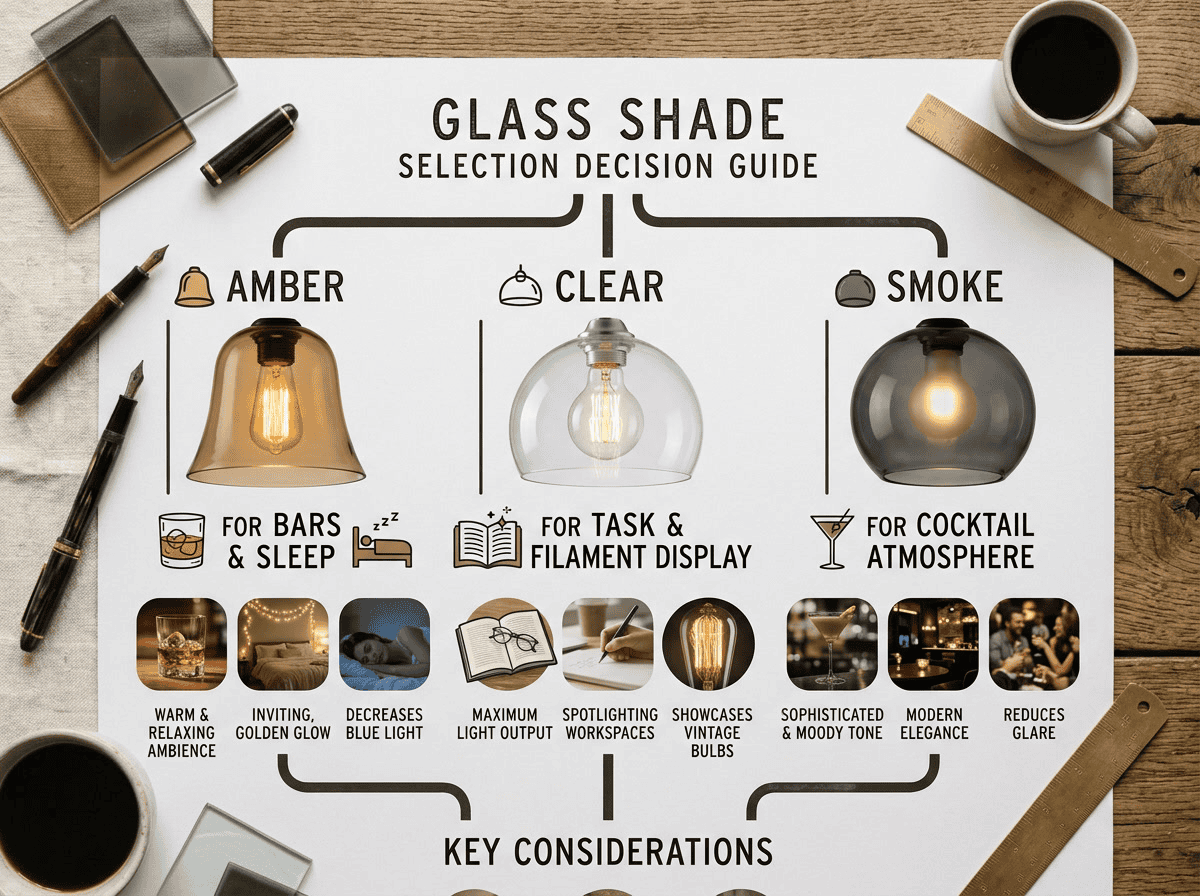
Question 1: Does the lamp serve food or a task?
– Yes → Clear glass or frosted glass. Neither amber nor smoke provides adequate color rendering or lux for food presentation or task work.
– No → All three options are in play.
Question 2: Is this a bar/lounge or a dining area?
– Bar/lounge → Amber glass for warmth and beverage enhancement; smoke glass for cocktail-lounge atmosphere.
– Dining → Amber for intimate sections and bars within the restaurant; clear for industrial/fast-casual; neither for standard dining (use frosted white instead).
Question 3: Is this residential or commercial?
– Residential bedroom, bedside → Amber glass for sleep-health benefits.
– Residential living room accent → Amber for evening use; clear with filament LED for decorative effect; frosted white for general use.
– Commercial → Application-specific as above.
Question 4: How important is lux output at the surface?
– Critical (task, dining, food service) → Clear glass (88–92% transmittance).
– Moderate (ambient residential, accent) → Amber glass (50–65% transmittance with higher-wattage LED).
– Low (atmosphere only, supplemental lighting handles function) → Smoke glass (35–50% transmittance, highest wattage required).
Per the Illuminating Engineering Society’s lighting standards for hospitality and residential applications, the relationship between transmittance, LED wattage, and illuminance at surface determines the practical efficiency of any glass shade specification — lower-transmittance glass types (amber, smoke) require proportionally higher wattage LEDs to achieve equivalent footcandle levels.
Common Mistakes When Choosing Between Amber, Clear, and Smoke Glass
Mistake 1: Using smoke glass where adequate illuminance is needed
Smoke glass at 35–50% transmittance cannot deliver adequate lux for dining, reading, or food service without very high wattage sources. Designers choose smoke glass for its atmosphere and underestimate the lux deficit — the space ends up dim and uncomfortable rather than atmospherically dark.
Mistake 2: Using clear glass at eye level without filament LED
Clear glass at dining or counter height with a standard LED chip (rather than a filament bulb) creates uncomfortable glare for anyone within the sightline of the pendant. This is the most common complaint about clear glass pendants in residential and commercial applications. The fix: filament LED only with clear glass, or switch to frosted glass.
Mistake 3: Using amber glass for food-forward dining
Amber glass desaturates cool food colors — green salads, purple beets, blue-tinted seafood, and other cool-dominant foods look less appetizing under amber light. For restaurants where the visual quality of food is the primary experience, frosted white at 2700K preserves accurate food color rendering.
Mistake 4: Mixing smoke and amber in the same zone
Amber and smoke glass produce completely different color casts — amber adds warmth, smoke adds a slight cool-grey. Mixing them in the same zone creates a confusing spectral environment. Keep amber zones and smoke zones separate.
Mistake 5: Underestimating wattage requirements for amber and smoke
Both amber (50–65% transmittance) and smoke (35–50%) require significantly more LED wattage than frosted glass to achieve equivalent surface illuminance. Plan wattage requirements before fixture specification:
– Amber: approximately 1.5× the wattage needed for frosted glass
– Smoke: approximately 2× the wattage needed for frosted glass
Frequently Asked Questions
What is the difference between amber, clear, and smoke glass shades?
Amber glass transmits 50–65% of source light after filtering out blue wavelengths, producing warm red-orange light at effective 2200–2400K — ideal for bars, lounge seating, and bedroom lighting. Clear glass transmits 88–92% with no color modification — ideal for filament LED display, industrial aesthetics, and task lighting. Smoke grey glass transmits 35–50% with a slight cool grey tint — ideal for cocktail bar atmosphere where lux is supplemented by other sources.
Is amber glass better for sleep than frosted or clear glass?
Yes, for bedside and evening lamp use. Amber glass absorbs blue-wavelength light (400–500nm) that suppresses melatonin production — the hormone that initiates sleep. Using an amber glass bedside lamp in the two hours before sleep produces lower melatonin suppression than equivalent frosted or clear glass at the same lumen output. A standard 2700K LED through amber glass achieves this benefit without specialty bulbs.
Can clear glass pendant shades cause glare in a restaurant?
Yes, when used with standard LED chips at dining and counter heights. Standard LED chips through clear glass create a concentrated bright point that is uncomfortable at close sightline range. The solution: filament-style LED bulbs (which distribute light across a longer, lower-luminance element) or switch to frosted glass. Clear glass with filament LED at bar counter heights — where the bulb is above seated eye level — is generally acceptable.
What wattage LED should I use with smoke glass shades?
Approximately 2× the wattage you would use with frosted glass for the same fixture. For a dining pendant that would use a 12-watt frosted glass shade, specify 20–25 watts for smoke glass to achieve similar table illuminance. Most smoke glass applications use supplemental lighting from other sources and accept lower ambient illuminance from the smoke glass pendant — in which case lower wattage is appropriate for the ambient contribution only.
Does amber glass look orange in daylight?
Yes — amber glass has a distinctly amber-orange appearance when viewed unlit or in daylight. This is part of its decorative character and is intentional. If the shade needs to look neutral and unobtrusive when unlit, amber glass is not the correct choice. Frosted white glass looks neutral both lit and unlit.
Can I mix amber and clear glass shades in the same space?
Yes, if they are in different zones with different purposes — amber at the bar, clear glass pendants in the dining section for example. Avoid mixing amber and clear within the same pendant row where all fixtures will be simultaneously visible — the different color casts are visible and create visual inconsistency. If visual consistency matters, choose one glass type throughout.
Is smoke glass appropriate for home use?
Smoke glass in residential use works as an accent or decorative pendant element, not as a primary light source. A smoke glass pendant over a living room coffee table, supplemented by table lamps and floor lamps providing ambient light, can be an effective design statement. Smoke glass as the only light source in a room produces inadequate illuminance for most residential activities.
Conclusion
Amber vs clear vs smoke glass shades is not a style choice — it is a functional choice about what the light should do. Amber glass for warmth, face flattery, and sleep-health applications. Clear glass for maximum lux, accurate color rendering, and filament LED display. Smoke glass for dramatic atmosphere in supplemented lighting environments.
The transmittance numbers — amber 50–65%, clear 88–92%, smoke 35–50% — drive everything downstream: the LED wattage required, the illuminance at the surface, and the character of the space the pendant creates. Choose by what the light needs to accomplish at that fixture position, then confirm the wattage specification matches the transmittance.
For amber, clear, and smoke grey glass shades in commercial and residential fitter sizes, with documented glass specifications and batch consistency for hospitality fit-outs, our glass lampshade product line at jxlampshade.com provides the full range of glass shade colors with technical transmittance data.