Quick answer
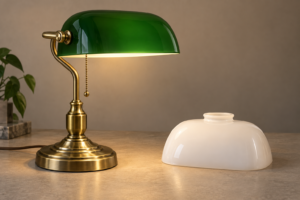
A torchiere lamp shade is usually an upward-facing glass pan, bowl or reflector fitted to the top of a floor-lamp stem. It sends light toward the ceiling instead of directing the bulb straight at a work surface. For a replacement, identify the glass profile, the opening or pan seat, the stem hardware and the retaining method before choosing a diameter. For an OEM project, provide a section drawing, glass and finish direction, lamp-source information, target quantities, inspection points and the export packing brief. A product photo alone is useful for style identification, not for confirming fit.
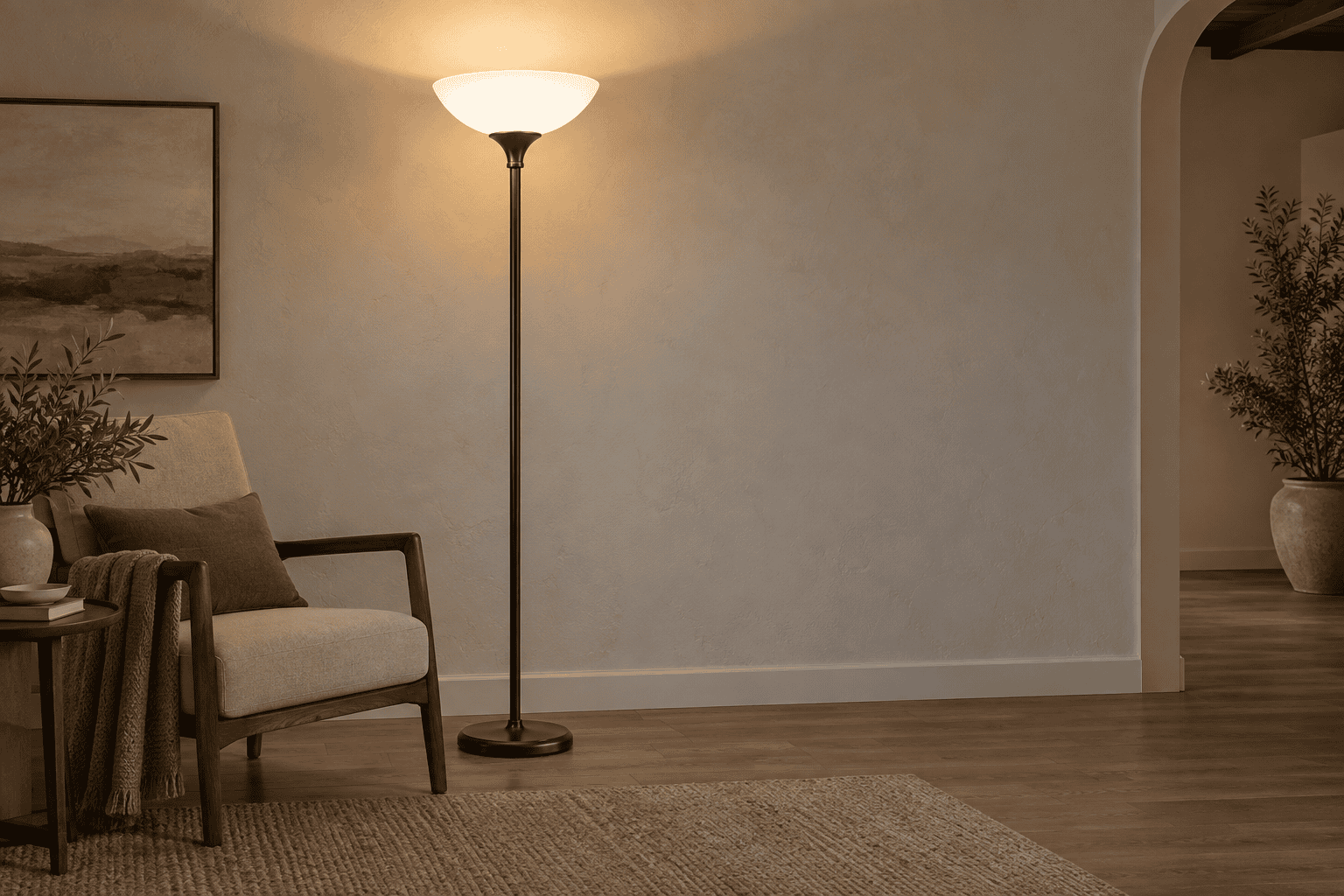
The focus here is the glass component, not the finished floor lamp. Use the guide to distinguish a torchiere shade from similar forms, measure broken or missing glass, compare finishes under upward light and prepare an RFQ for a lighting brand or restoration supplier.
What a torchiere lamp shade does
The word torchiere describes the lighting direction: the shade throws light upward, where the ceiling can spread it through the room. The glass may be shallow and open like a pan, deeper like a bowl, or shaped as a reflector. The stem, socket, gallery, finial and shade work as one assembly, but each part has its own specification.
The glass lamp shades collection shows the wider range of glass bodies available for lighting products. For a torchiere request, describe the component in four layers:
- Glass body: pan depth, bowl curve, shoulder, outer diameter and lower edge.
- Light direction: upward opening, ceiling wash, bulb visibility and shadow behavior.
- Support interface: neck, lip, seat, gallery, washer, socket carrier or stem top.
- Retention: finial, screw, clip, ring, gasket, thread or a separate support frame.
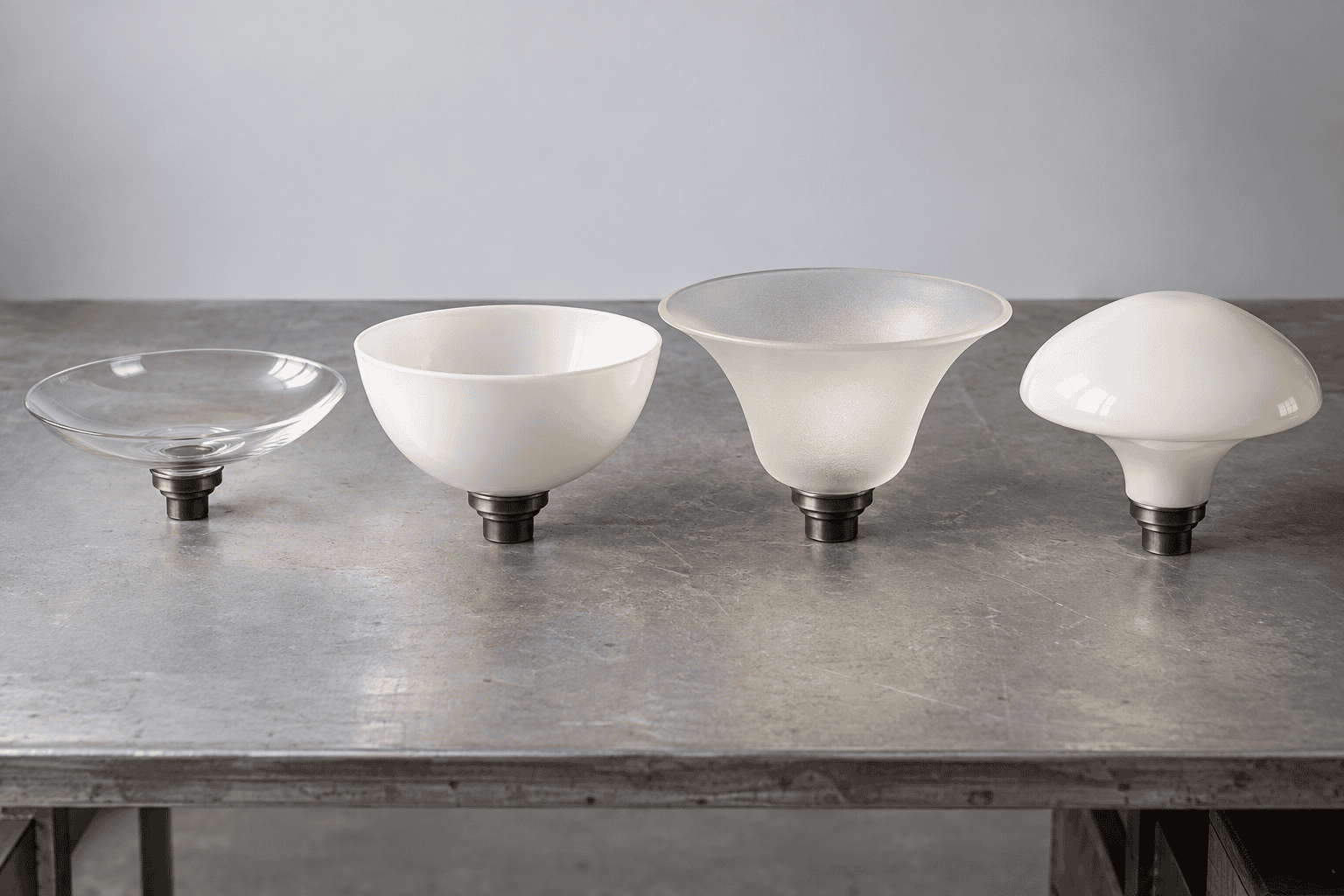
Do not put only "torchiere glass" on a purchase order. State whether the glass rests on a metal seat, passes over a stem top, is clamped by a ring or is held by a central fastener. Add the dimension's reference edge. A shade can have a large visible body and a small working opening.
How the upward-facing profile changes selection
An upward-facing shade has a different job from a pendant or table-lamp shade. The upper opening, reflective surface and relationship to the ceiling influence the choice even before the fitter is considered.
| Profile area | What to look for | Why it matters |
|---|---|---|
| Light opening | The top or inner opening faces the ceiling and may expose the lamp source | It controls the direction of the beam and the visible hotspot |
| Pan or bowl depth | A shallow pan and a deeper bowl create different ceiling spreads | It affects glare, shadow shape and the apparent height of the fixture |
| Outer rim | The rim may be rolled, ground, flared or supported by a ring | It determines contact, handling and the safe load path |
| Center opening | The stem or carrier may enter through a neck or central seat | It establishes the mechanical fit and bulb clearance |
| Reflective surface | Clear, opal, frosted or colored glass changes the upward glow | It affects how the ceiling wash looks when the lamp is operating |
A downward shade can look similar in a photograph when viewed from below. Check the installation direction, the stem connection and the surface that faces the lamp source. These details prevent a decorative bowl from being ordered for a torchiere application it cannot support.
Torchiere shade forms and common lookalikes
Retail names are not dimensional standards. Use the form names to organize a search, then use a drawing or a physical sample to define the part.
| Form | Typical visual cue | Sourcing question |
|---|---|---|
| Shallow pan | Wide, low body with a broad upward-facing surface | Does the outer rim sit on a circular gallery or a shaped stem seat? |
| Deep bowl | More vertical wall and a deeper cavity around the lamp source | Does the depth leave room for the bulb, socket and retaining hardware? |
| Reflector | Surface geometry is chosen to spread or redirect light upward | Is the reflector symmetrical, fluted, stepped or formed around a specific stem? |
| Flared glass | The wall opens outward from a smaller center region | Where does the support carry the load, and which edge is dimensioned? |
| Mushroom-like cap | Rounded dome with a narrow center connection and broad top | Is the cap a complete glass body or part of a metal-and-glass assembly? |
| Drum-like profile | More constant outside wall with a defined upper opening | Does the straight wall clear the stem and remain stable on the carrier? |
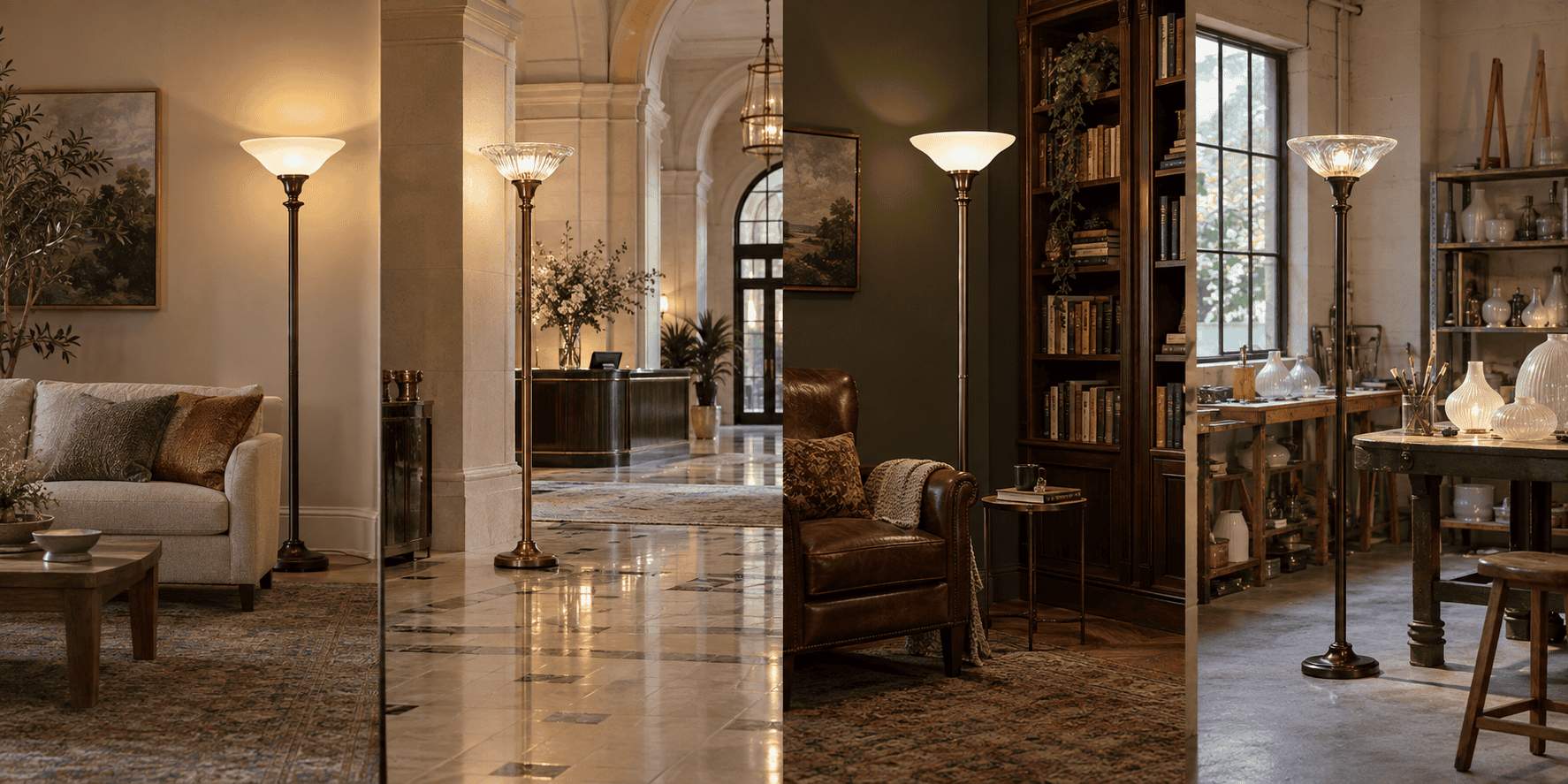
The vintage floor lamp glass shades guide can help with historical style vocabulary. It does not confirm that a vintage shade will fit a modern stem. Keep the style reference and the mechanical reference in separate fields on the RFQ.
Applications that change the glass brief
The application affects the light target, handling risk and amount of repeatability required. A one-piece restoration and a multi-fixture hospitality order should not use the same level of evidence.
| Application | Primary concern | Information a supplier needs |
|---|---|---|
| Residential floor lamp | Ceiling wash, glare and proportion beside furniture | Room clearance, lamp source, shade diameter, finish and stem photograph |
| Hotel or public area | Consistent appearance and stable retention in repeated fixtures | Quantity by size, approved sample, carrier details and packing plan |
| Reading or task corner | Comfortable indirect light without a hard hotspot | Lamp position, ceiling height, desired softness and bulb information |
| Restoration supply | Matching an old pan or bowl without assuming a modern standard | Original glass, safe fragments, stem top, photographs and measured seat |
| Distributor replacement stock | Clear selection rules for several fixture families | Size bands, fitter references, finish list and packaging photographs |
| New lighting collection | Related proportions across sizes and finishes | Master outline, size logic, tool route, forecast and inspection method |
Ask the buyer to state whether the torchiere is installed near a low ceiling, a high ceiling or a reflective architectural surface. The same glass can look very different in those conditions. If the end-use environment is unknown, approve the material with a representative fixture or a controlled sample setup.
Fitter, pan seat and retaining hardware
The lamp shade fitter compatibility guide provides general terminology. A torchiere often needs more than a fitter name because the shade may rest on a pan seat rather than hang from a neck.
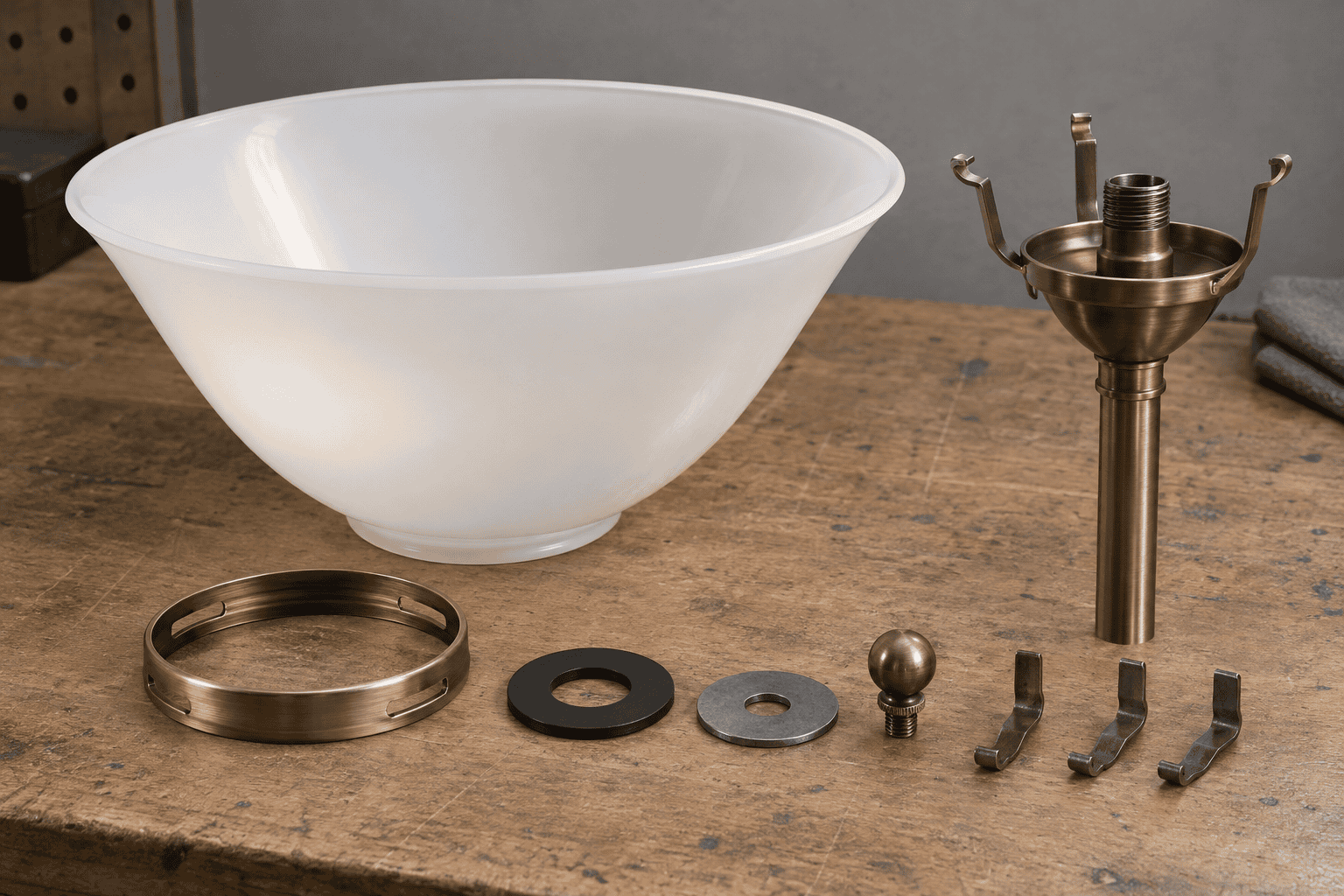
| Interface part | Glass relationship | Evidence to collect |
|---|---|---|
| Stem top or socket carrier | Supports the inner opening or center of the glass | Top view, outside diameter, stop height and bulb clearance |
| Gallery ring | Carries the pan or bowl at an annular contact surface | Ring opening, ledge width, thickness and contact marks |
| Central washer and finial | Clamps the glass through a center opening | Hole diameter, washer diameter, thread size and tightening direction |
| Outer retaining clips | Hold the glass at several points around a rim | Clip positions, rim thickness, spring direction and clearances |
| Gasket or spacer | Separates glass from metal and manages movement | Material, thickness, location and compression condition |
| Threaded stem | Connects the shade assembly to the floor-lamp structure | Thread form, outside diameter, pitch and seating length |
Measure the glass and metal parts as a pair when possible. The ring's outside diameter is not necessarily the glass opening. A central hole may be smaller than the stem seat, and a gasket may hide the true contact edge. Include a simple section sketch whenever two parts touch on more than one surface.
What 6, 8, 10 and 12 inch labels mean
Torchiere listings may use a number for the outside diameter, the opening, the gallery or the overall shade family. The labels below are planning references only.
| Nominal label | Label conversion | Confirmation needed |
|---|---|---|
| 6 inch | 152.4 mm | Is the figure the center opening, the ring seat or the outside body? |
| 8 inch | 203.2 mm | Which plane was measured, and how deep is the support contact? |
| 10 inch | 254.0 mm | Does the quoted value describe the pan rim or the maximum reflector diameter? |
| 12 inch | 304.8 mm | Can the stem and gallery support the larger body with the intended lamp source? |
Write the measurement edge on the drawing instead of relying on the number in a product name. This small step prevents a distributor's nominal reference from being treated as a universal torchiere standard.
Torchiere glass shade size chart
Use these bands to discuss early proportions and packing. They are planning references, not an interchangeable fitter standard or a fixed weight specification.
| Planning band | Approximate maximum diameter | Profile direction | Engineering review |
|---|---|---|---|
| Compact | 6 to 8 in | Shallow pan or small reflector | Central opening, stem clearance and lamp-source position |
| Medium | 8 to 11 in | Balanced pan or bowl for common floor lamps | Seat width, gallery scale, ceiling distance and case separation |
| Large | 11 to 14 in | Broad pan with a stronger outer rim | Support span, center of gravity, wall section and impact protection |
| Project size | Above 14 in | Custom reflector or architectural form | Drawing review, handling method, tool route and sample plan |
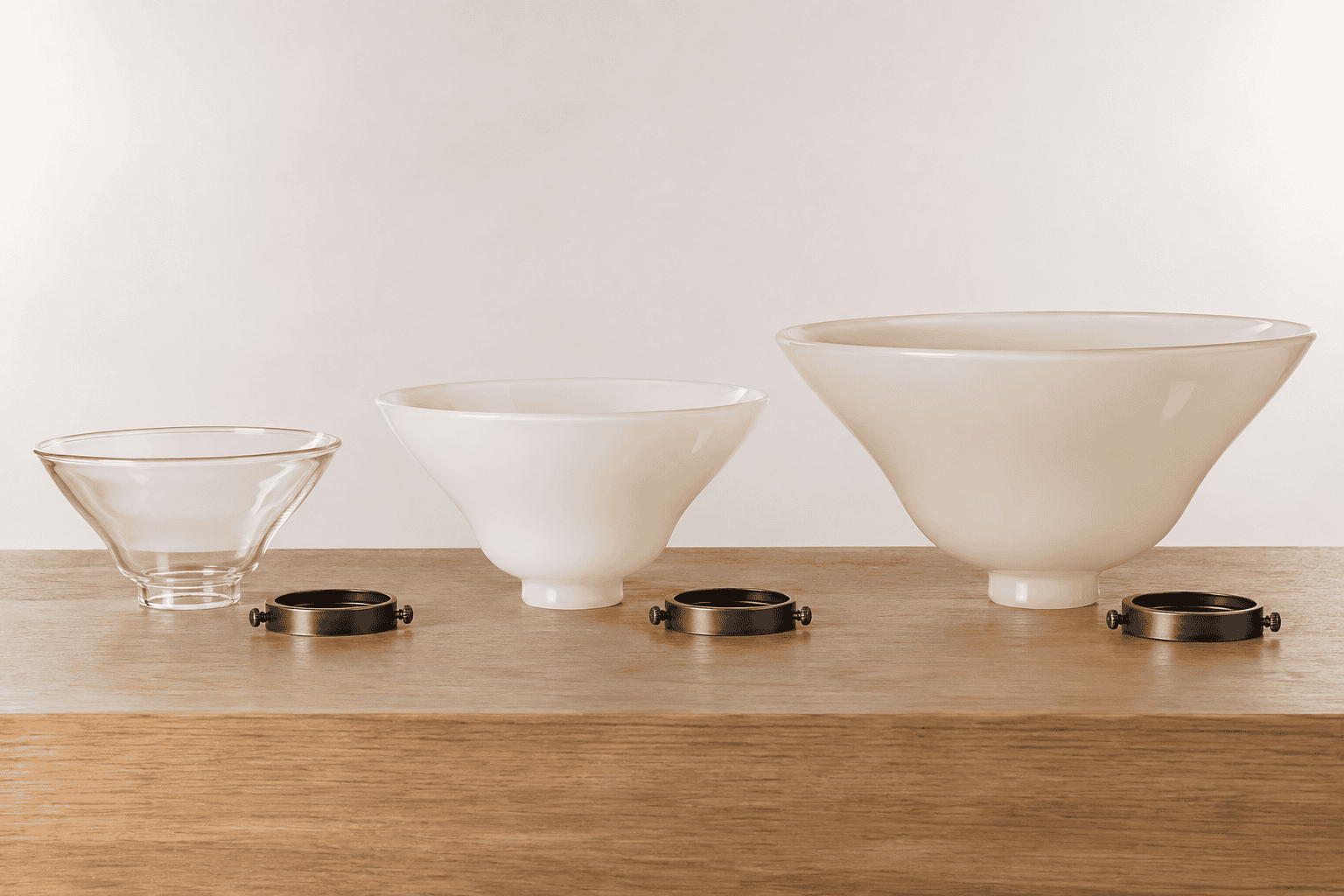
Confirm whether the diameter is taken at the widest body, the rim or the gallery. A shade with the same outside diameter can have a different depth, center opening and edge load. Those differences matter in both assembly and export packing.
How to measure a replacement torchiere glass shade
Disconnect power and let the lamp cool completely before touching the shade or stem. If the glass is damaged, keep fragments in a padded tray and measure the metal support instead of holding a sharp edge. Approve a replacement against measured evidence. A visual guess can miss the support interface.
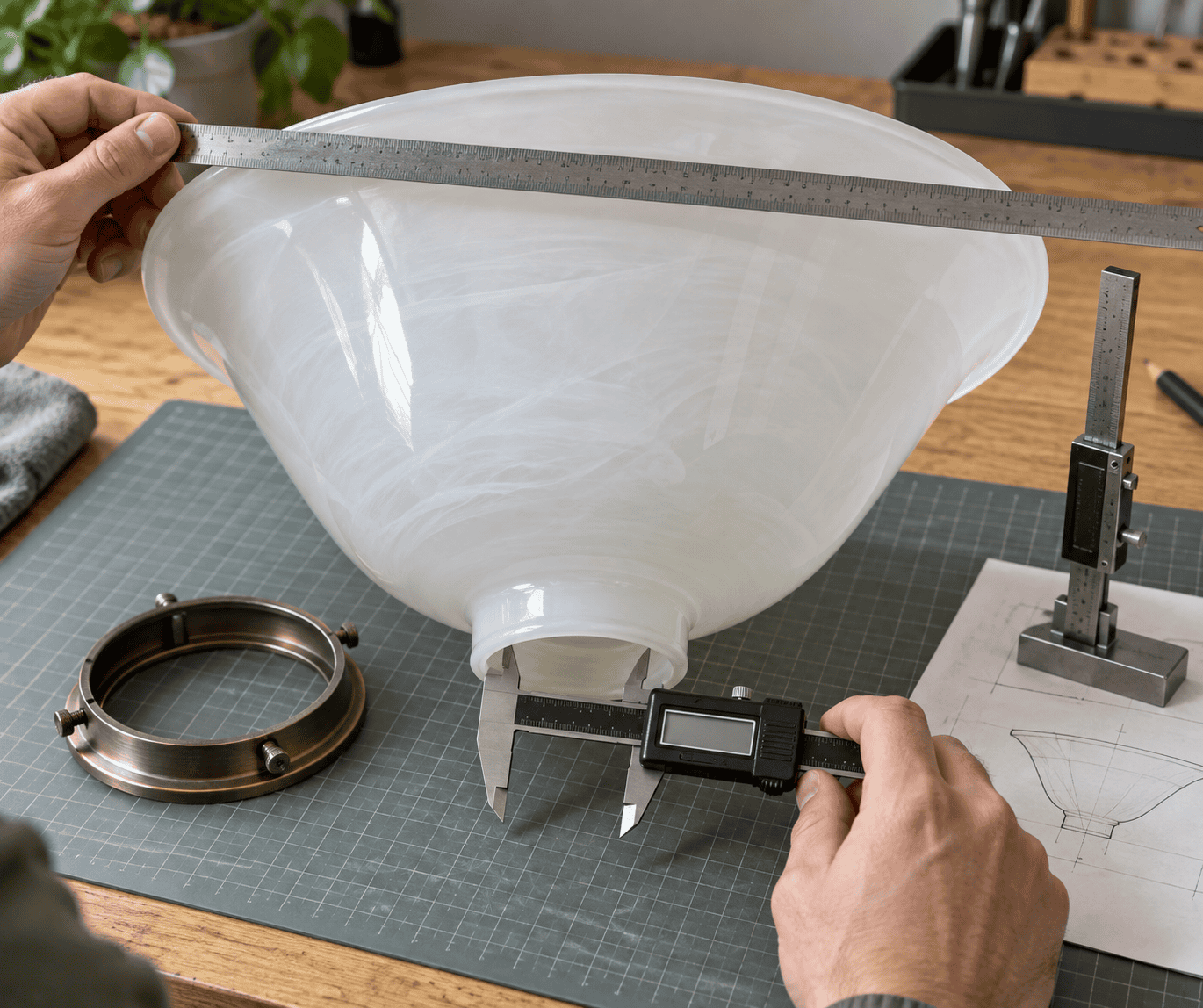
Use the following sequence:
- Photograph the complete floor lamp from the side and front, including the direction in which the shade faces.
- Photograph the stem top, gallery, washer, finial, clips and any gasket after the glass is removed.
- Select the support plane where the glass actually rests. Mark that datum on a quick sketch.
- Measure the working opening, central hole or inner seat at the datum. Record inside and outside readings separately.
- Measure support depth, ledge width, rim contact and the location of any spacer.
- Record body height, largest diameter and the distance from the opening to the outer rim.
- Note screw holes, clips, threads, offsets and orientation. Mark each value measured, estimated or missing.
| Measurement | Where to take it | Why it affects a replacement | Evidence to send |
|---|---|---|---|
| Working opening | Edge that enters or rests on the carrier | Decides whether the shade can seat without forcing | Caliper reading and hardware photo |
| Center hole | Circular passage around a stem or fastener | Controls the washer, finial and bulb clearance | Top and underside views with a datum |
| Pan seat | Actual metal-to-glass contact surface | Determines stability and load transfer | Section sketch with the ring or stem top |
| Height or depth | Support plane to the highest or lowest glass point | Changes ceiling spread and lamp-source position | Side profile with fixed reference points |
| Maximum diameter | Widest outside body or rim | Controls room clearance and carton size | Front view with ruler on the same plane |
| Edge condition | Cut, ground, fire-polished, rolled or shaped rim | Affects contact, handling and visible finish | Neutral-light close-up of the edge |
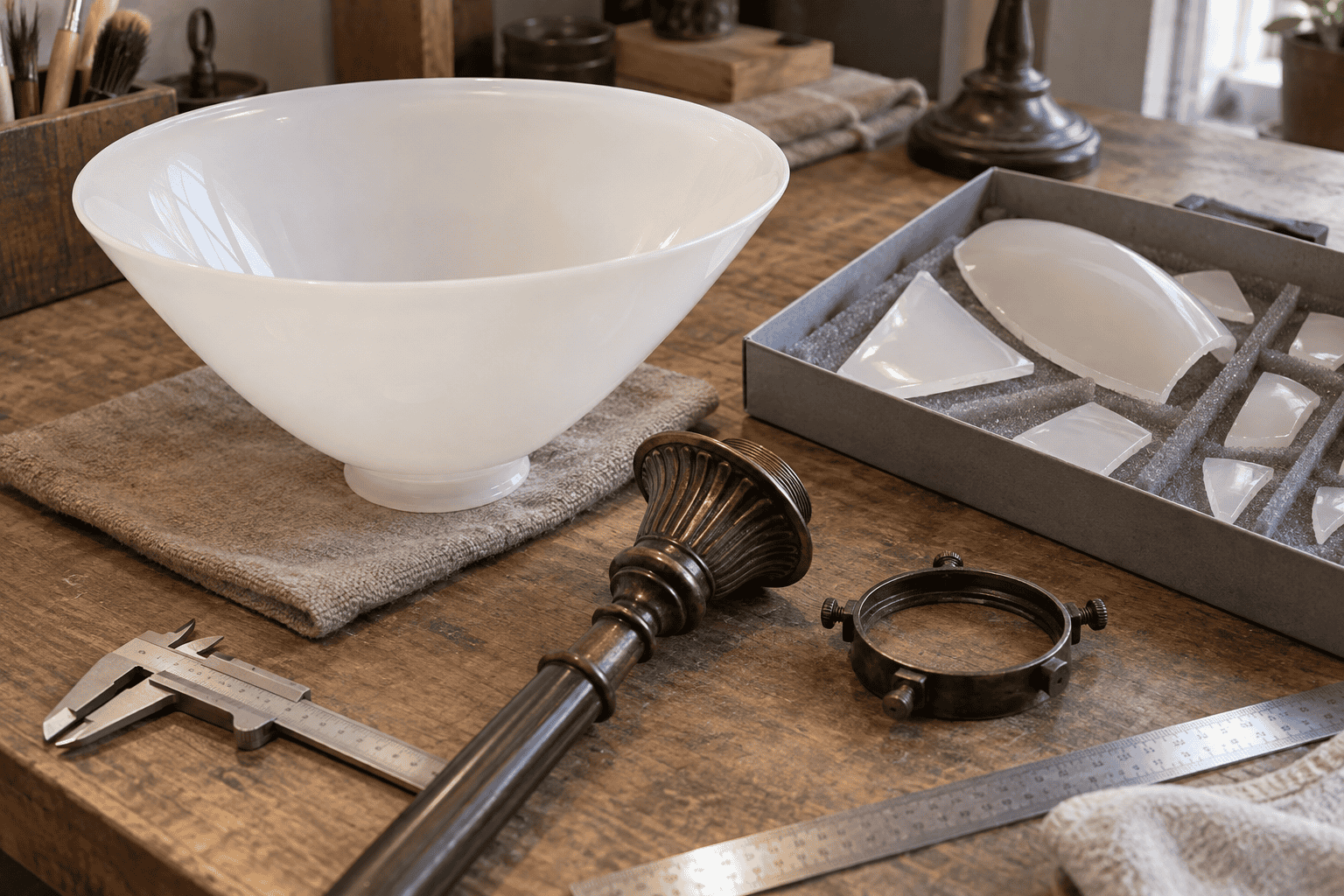
If all you have is a listing photo, treat it as a style lead. Camera angle can hide a center hole, exaggerate the pan depth or make the rim look level. Ask for a drawing, a reference sample or a supplier feasibility review before committing to a replacement batch.
Glass finish, diffusion and heat-related checks
The finish changes both the ceiling wash and the appearance of the torchiere when the lamp is off. Heat behavior also depends on the lamp source, enclosure, distance and fixture design. A glass finish name cannot replace a sample test or the fixture manufacturer's instructions.
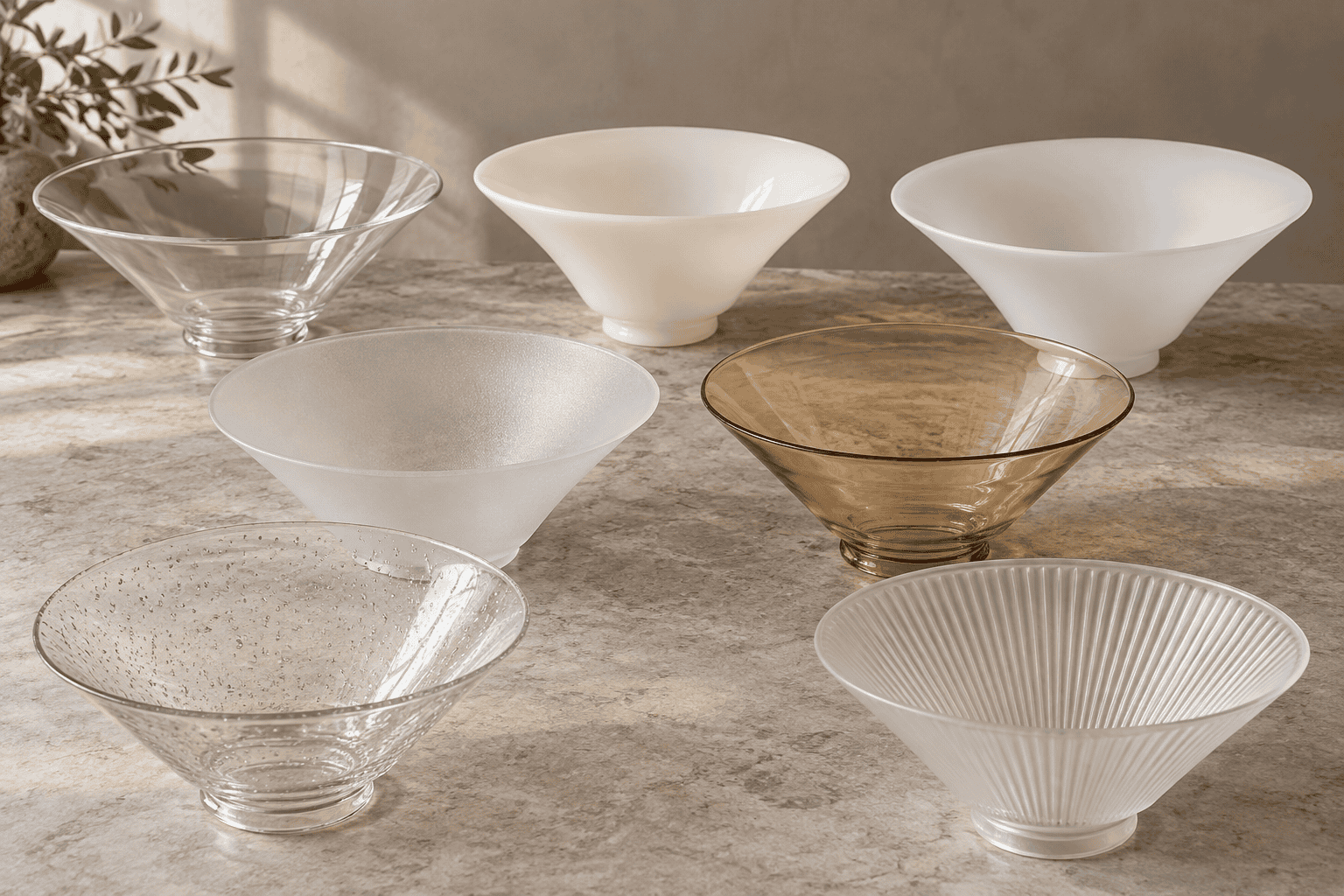
| Finish | Light and ceiling effect | Appearance when unlit | Buyer approval point |
|---|---|---|---|
| Clear | Direct light reaches the ceiling and the lamp source remains visible | Strong view of glass contour and hardware | Check glare, reflected filament and visible forming marks |
| Opal | Spreads the source and gives a softer ceiling wash | White or translucent body with reduced hardware visibility | Confirm opacity, edge color and body consistency |
| Milk white | Presents a more opaque white face than lightly translucent opal | Looks denser when the lamp is off | Approve the formula at the pan and center opening |
| Frosted or satin | Reduces sharp reflections and softens the hotspot | Matte or low-gloss surface | Check treatment uniformity, cleaning and edge transition |
| Seeded | Adds inclusions that break the light path in small areas | Decorative variation is visible without power | Agree seed size, distribution and acceptable variation |
| Ribbed or fluted | Divides reflections and creates a directional glow | Visible pitch and orientation | Confirm depth, pattern termination and rim alignment |
| Amber or colored | Changes the color of the upward light and the room reflection | Stronger body color in daylight | Approve with the intended bulb and ceiling material |
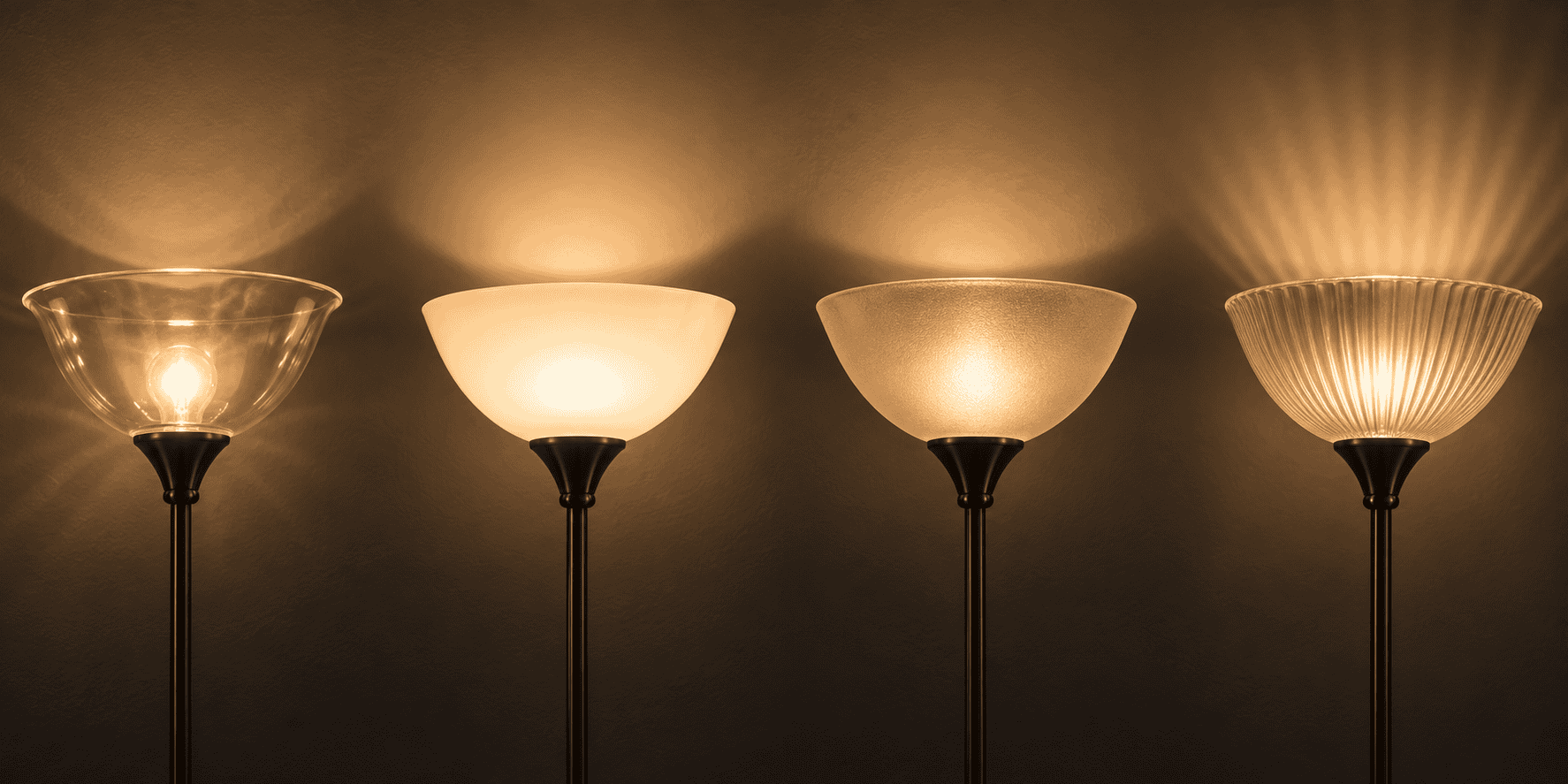
Do not publish a universal light-transmission percentage or a universal wattage recommendation for an unspecified shade. Ask the buyer to provide the lamp-source type, fixture instructions, clearance and intended environment. Confirm that the glass, retaining parts and heat conditions are compatible before installation.
Replacement glass versus a new OEM torchiere program
One-off replacement work and a new product family need different evidence. Keep those paths separate in the quotation.
| Project path | Best starting evidence | Main risk | Output to request |
|---|---|---|---|
| Single replacement | Existing stem hardware, photographs and safe glass reference | A similar pan uses a different center seat or retaining method | Feasibility answer, missing measurements and sample recommendation |
| Restoration quantity | Retained glass, fixture list and quantity by model | Old fixtures vary even when their names are the same | Approved reference, drawing, inspection record and pack method |
| Existing tool or catalog review | Tool reference, profile and requested finish change | Nominal product data hides a different rim or support process | Tool assessment, revised drawing and pilot plan |
| New OEM shade | Profile section, interface, finish direction and quantity forecast | A good-looking profile may be costly or unstable to repeat | Feasibility review, mold proposal, pilot sample and quotation |
| Multi-size family | Master outline, size formula and opening logic | Larger and smaller versions lose the intended relationship | Cross-size drawings, tool IDs and approval set |
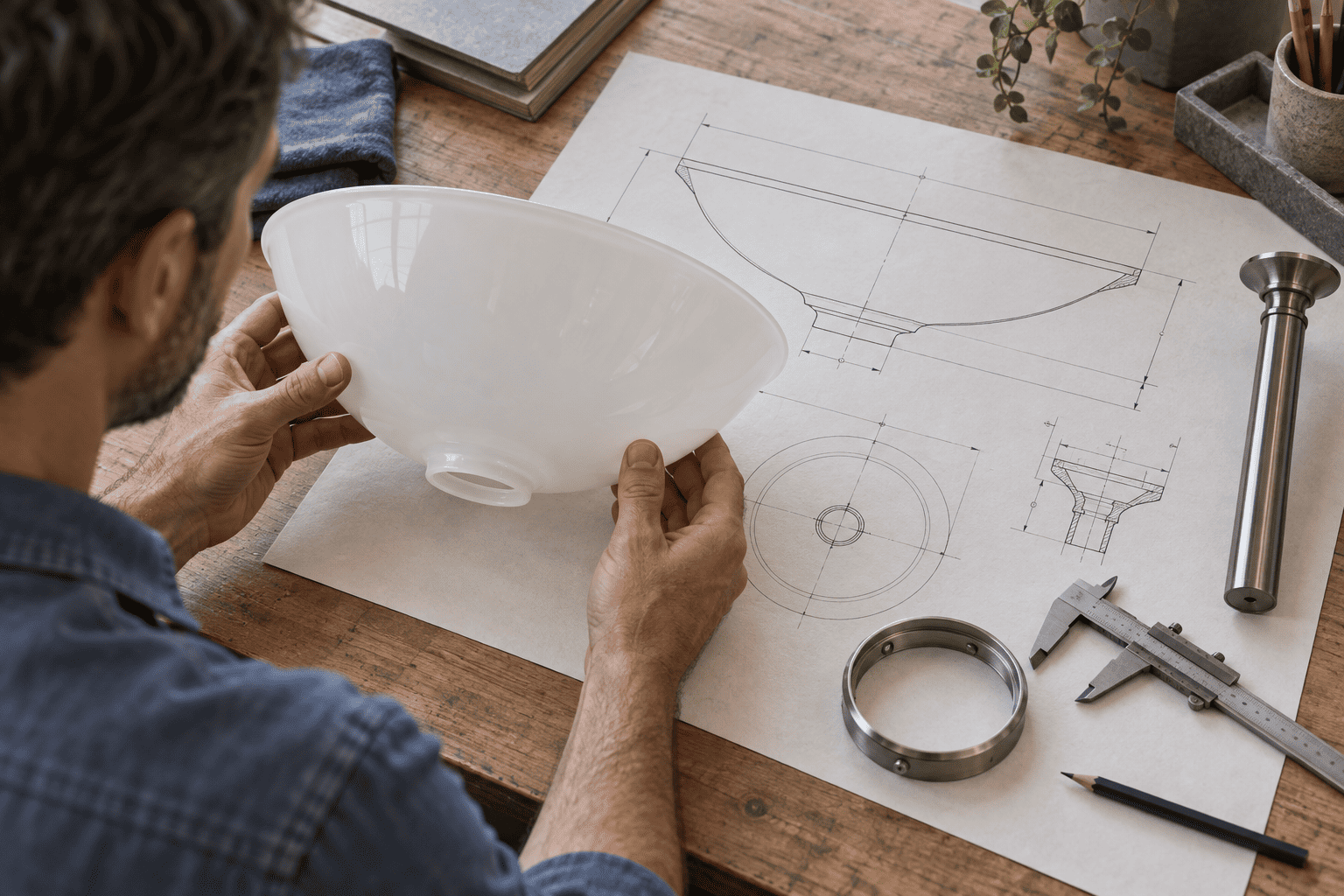
For replacement work, ask the supplier to identify which dimension was matched and which was estimated. For OEM work, mark the surfaces that cannot move and the proportions that may be adjusted. A quotation should expose its assumptions before the sample stage.
Machine-pressed, blown and hybrid production routes
The forming method affects pan repeatability, surface appearance and rim finishing. Choose it after reviewing the profile, quantity, pattern and acceptable variation.
Machine-pressed torchiere glass
A hot glass charge is shaped in a metal mold with controlled pressure. This route can suit a repeat range with a defined pan contour, crisp ribs or a consistent shoulder. The tool split, glass flow, cooling plan, rim operation and inspection method still need project-specific review.
Mouth-blown or mold-blown torchiere glass
A glassmaker shapes a gather around a tool or mold to establish the bowl or reflector contour. Buyers often choose this route when they want a hand-formed surface with defined limits on variation. The maker still needs a repeatable way to finish the central opening and the load-bearing edge for the planned order.
Hybrid development
A program may use a guided body with a hand-finished rim, a formed pan with a custom carrier or a standard glass body with a later surface treatment. Put the proposed route and the permitted variation in the RFQ. The words "pressed" and "handmade" do not define the complete process.

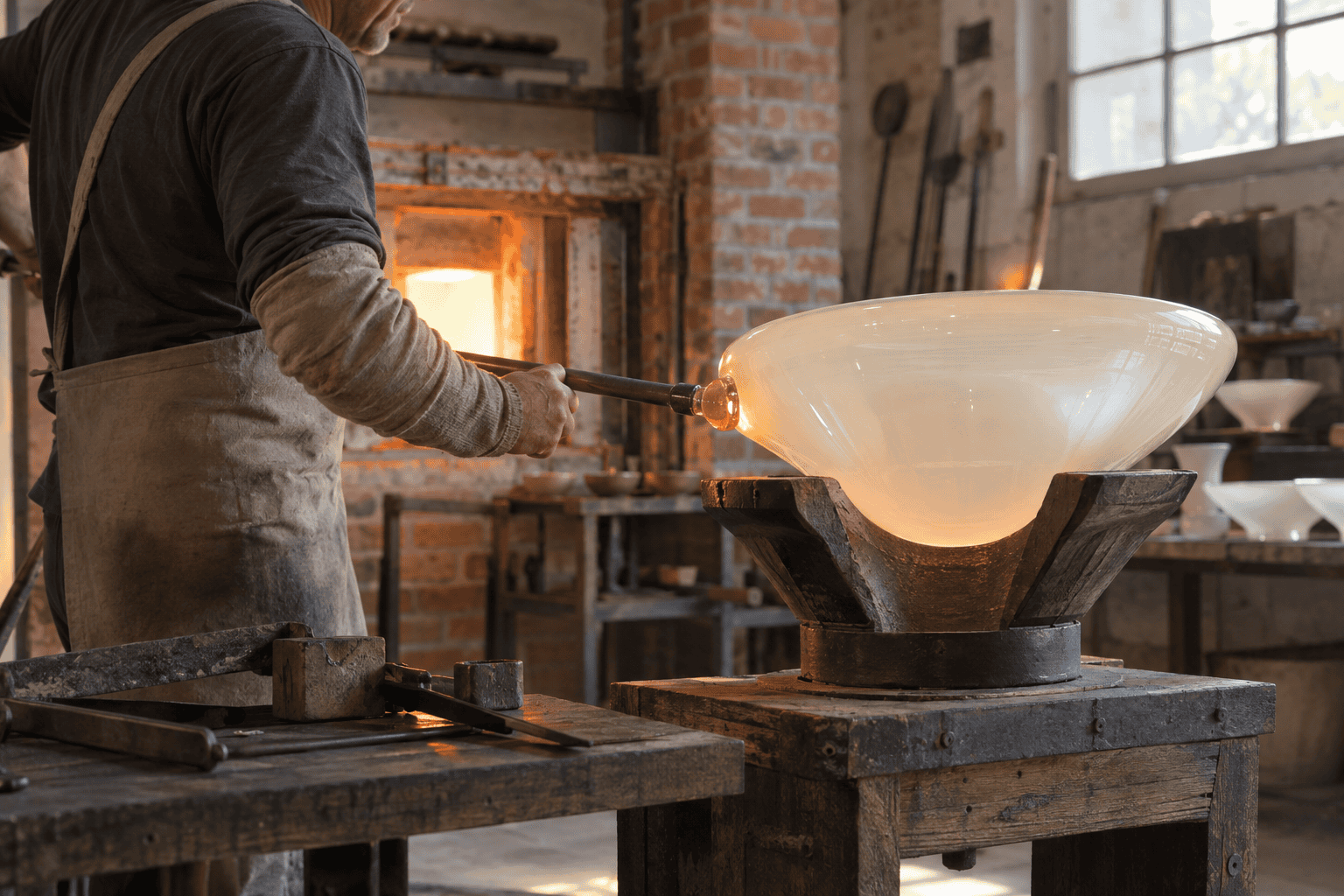
The JX manufacturing page gives broader process context. Confirm the actual route with engineering based on the drawing, glass type, finish, quantity and repeatability requirement.
Custom mold decisions for a torchiere shade
A torchiere mold must control the light-facing surface, the support edge and the way the part releases from the tool. Before authorizing new tooling, review:
- Draft direction and any undercut around the center opening or rim.
- Pan depth, shoulder radius, reflector angle and pattern depth.
- The seat, center hole and how the glass will be held during edge finishing.
- Parting-line location on surfaces visible from below or across the ceiling.
- Allowance for cutting, grinding, fire polishing or another rim operation.
- Tool identification, storage, maintenance, revision history and ownership.
Show the opening and outer rim in a section view. A small seat change can move the lamp source, while a reflector-angle change can alter the ceiling wash. Record both as design-critical dimensions instead of relying on a style name.
Tolerance, wall thickness and edge finishing
A tolerance has meaning only when the dimension, datum and production route are named. Wall thickness also changes weight, translucency, thermal behavior and the feel of the rim. Do not transfer a number from a different glass body without engineering review.
| Control point | Effect on the torchiere assembly | How the buyer should specify it |
|---|---|---|
| Center opening or neck | Sets entry, fastener clearance and carrier contact | Mark inside, outside or centerline reference on the section |
| Pan seat | Transfers load to the ring or stem top | Show the contact width, depth and gasket position |
| Body depth | Changes ceiling spread and lamp-source clearance | Use the support plane as the height datum |
| Maximum diameter | Controls projection, room clearance and case dimensions | Identify the widest point and measurement orientation |
| Wall section | Affects weight, appearance and forming variation | State glass direction and ask for engineering confirmation |
| Rim section | Influences seating, handling and visible edge quality | Approve an edge sample and show the intended finish |
For repeat production, classify dimensions as critical, major or cosmetic. The opening and seat may need tighter control than a hand-shaped reflector contour. Agree on that priority before approving the pilot.
The approved torchiere drawing should carry the actual limits for the opening, seat and wall section. Confirm with our engineering team based on the drawing, glass type and production method. Use the glass lamp shade technical drawing checklist to organize datums, dimensions and approval points.
Quality inspection for torchiere glass shades
Inspect the installed interface and the intended light direction. A smooth body is still unsuitable if the center hole is wrong, the pan rocks on the stem or the finish changes the approved ceiling wash.
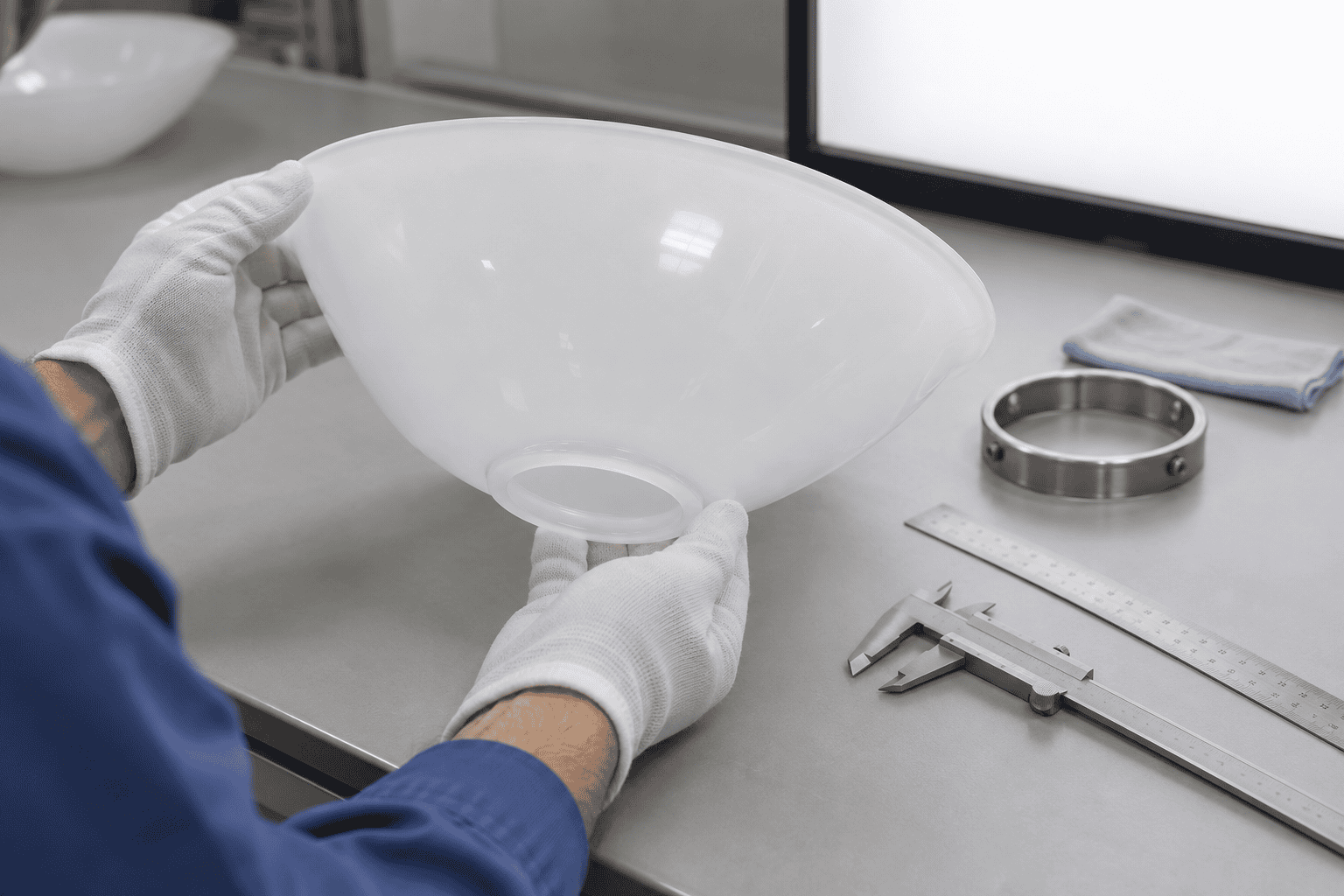
An inspection plan may include:
- Drawing number, revision, selected finish, sample status and batch traceability.
- Opening, seat width, stem clearance, clip positions and the retention load path.
- Pan depth, rim diameter, symmetry, reflector angle and visible forming marks.
- Body and rim condition, including cracks, chips, sharp edges, stones, bubbles and agreed cosmetic defects.
- Opacity, tint, frost, rib pitch, seed distribution and edge appearance against the approved reference.
- A hand fit on the approved stem or ring. The shade should settle without force or rocking.
- Insert position, rim clearance, piece separation, carton count and shipping identification.
Use the glass lamp shade quality inspection checklist as a general reference. Set the defect classes, sampling basis and acceptance limits for the torchiere design and destination market.
Packaging and international shipping
Large torchiere pans can put stress on the outer rim and the center seat when they move inside a carton. The pack should support the body without pressing hard on a finished edge, and adjacent pieces should not touch.
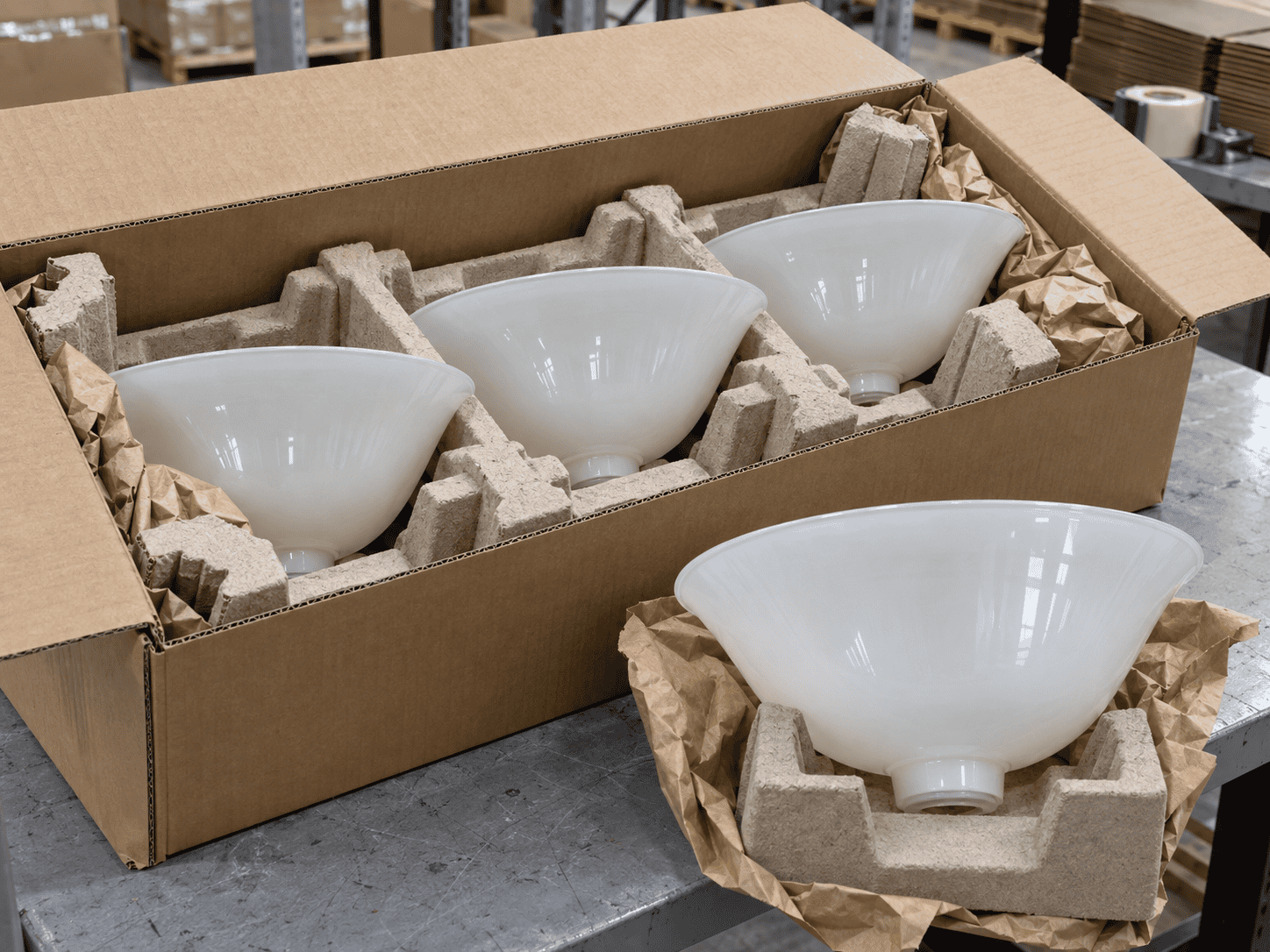
Ask the supplier to document:
- A formed support or individual wrapping around each bowl or pan.
- Clearance at the center opening, support seat and outer rim.
- Separation between pieces and allowed movement inside the inner pack.
- Carton dimensions, piece count, orientation and gross weight.
- Stacking instructions when the shipment requires them.
- Packing photographs or a pack sample before bulk release.
Compare freight with the same piece count and carton assumptions. A higher outer-carton count may reduce cost but increase contact risk. Approve the packing sample with the production-intent glass, since a light sample and a larger finished pan do not load the inserts in the same way.
MOQ, sampling and repeat production
MOQ, sample price and schedule depend on the forming route, existing tooling, number of sizes, surface treatment and packing design. Ask the supplier to list the assumptions behind each value.
Clarify what the sample represents:
- A stock shade that proves a general look but not the torchiere interface.
- A hand-formed feasibility piece used to test the outline.
- A production-intent sample made with the proposed tool and finish route.
- A small finish chip that cannot prove the full pan's light behavior.
Record sample cost, freight, revision rules, approval date and any credit arrangement. For repeat orders, retain the approved part, drawing revision, tool reference, finish description, inspection plan and packing photographs together. Record every change as a revision so a replacement shipment does not silently drift from the approved sample.
Buyer RFQ checklist for a torchiere glass shade
For broader OEM planning, see the custom glass lamp shade manufacturer page. The fields below give a supplier the information needed to quote a torchiere replacement or new shade.
| RFQ section | Buyer should provide | Supplier should clarify if missing |
|---|---|---|
| Fixture | Floor-lamp photographs, stem top, socket, finial, lamp source and installation direction | Which stem and clearance assumptions were used? |
| Glass body | Side profile, pan depth, largest diameter, center opening and rim | Which dimensions were estimated from an image? |
| Support interface | Gallery, seat, washer, clips, gasket or thread with measured references | Which edge is the quoted opening or seat? |
| Material and finish | Clear, opal, milk white, frosted, seeded, ribbed, amber or sample reference | How will the finish be approved in the upward light? |
| Heat context | Lamp-source type, fixture instructions, clearance and intended environment | Which conditions remain outside the supplier's review? |
| Quantity | Sample count, trial order, annual estimate and number of sizes | What MOQ and unit-price tier applies at this size? |
| Tooling | Existing tool reference or new mold requirement | Who owns, stores, maintains and identifies the tool? |
| Quality | Critical dimensions, cosmetic limits, assembly trial and records | What is inspected, with which reference and at what stage? |
| Packing | Rim support, seat protection, inserts, carton count and destination | Can the supplier provide packing photographs or a pack sample? |
| Commercial | Currency, Incoterm, named place, target timing and quotation validity | Which tooling, packing or freight costs sit outside the quoted scope? |
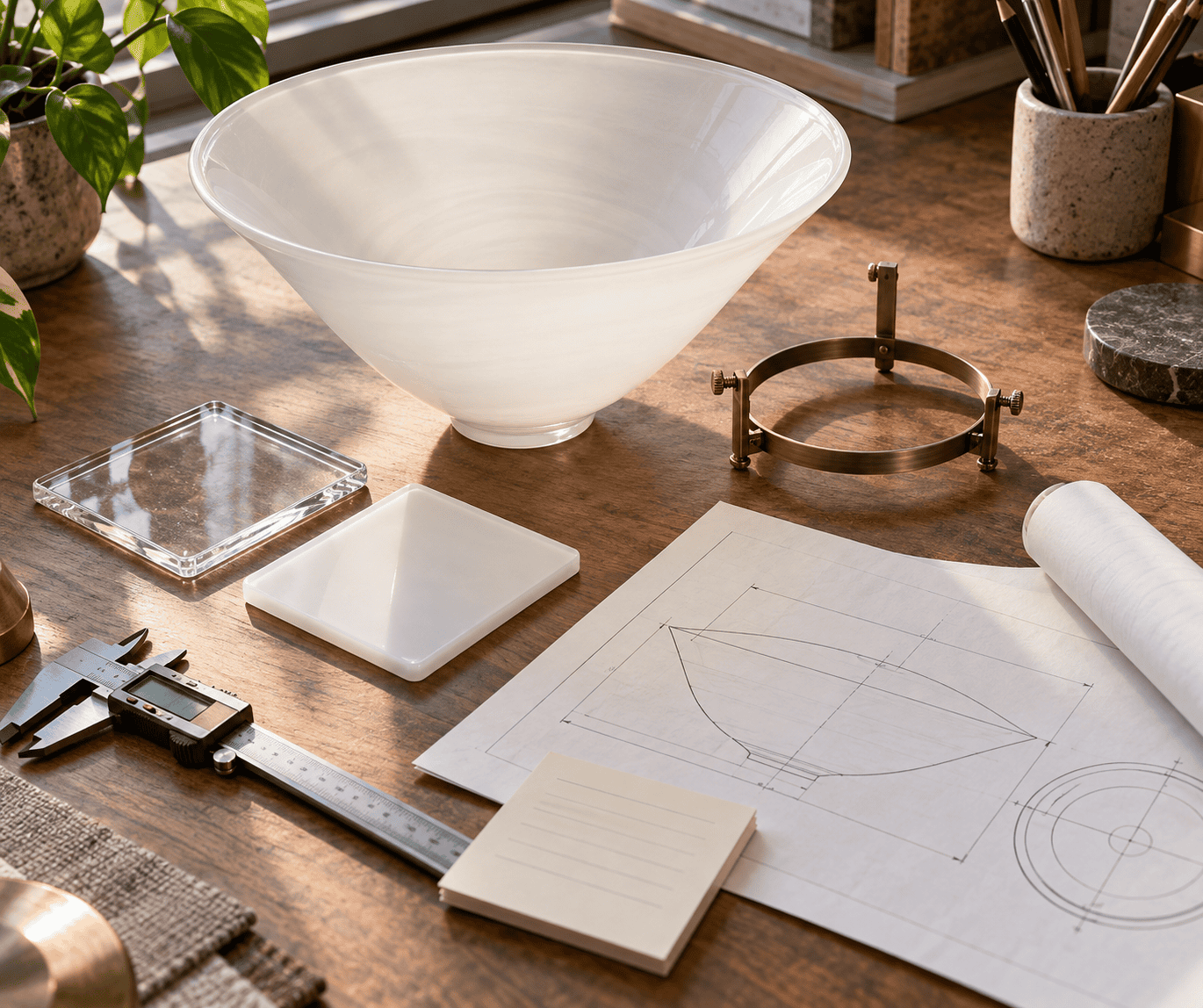
Give every shortlisted manufacturer the same specification pack. Mark replacement dimensions as match points, and mark OEM proportions as areas open to proposal. Comparable inputs produce more useful quotations and fewer avoidable sample revisions.
Send a torchiere shade brief for quotation review
Send a torchiere photograph or safe reference, the stem hardware, opening and seat measurements, profile, finish, quantities, packing requirement and destination. JX can classify the request as a replacement match, an existing-tool check or a new OEM development route.
Submit drawings, photographs and sample notes through the contact page. Ask the quotation to state its support-interface assumption, forming route, tooling scope, inspection basis and packing arrangement. That record gives repeat purchasing a clear starting point.
Buyer questions
What is a torchiere lampshade?
A torchiere lampshade is an upward-facing shade used on a floor lamp or related fixture. The glass may be a pan, bowl or reflector, and the stem or gallery carries it above the floor. Its job is to spread light toward the ceiling. The shade's visible diameter does not by itself define the stem fit.
Where can I find a replacement torchiere lamp shade?
Start with the original stem, gallery, washer or finial rather than searching by diameter alone. Photograph the support, measure the opening and seat, and record the shade depth and rim. A glass supplier can then compare the reference with an existing body or review a custom replacement route.
What does torchiere mean in English?
In lighting, torchiere refers to an upward light or a fixture that directs light toward the ceiling. The term describes the lighting direction and fixture family, not one universal glass shape or fitter.
Are torchiere floor lamps still in style?
The answer depends on the interior and the intended light. Their indirect ceiling wash remains useful in rooms where a direct bulb would create glare. For a new collection, proportions, finish and the relationship between the stem and glass matter more than the name alone.
What glass shade fits a torchiere floor lamp?
The correct glass must match the stem or gallery at the opening, seat, depth and retention points. Compare the center hole, support width, rim condition and bulb clearance. A pan with the right outside diameter can still be wrong for the fixture.
Can I replace only the glass on a torchiere?
Often, yes, if the original stem and retaining hardware are sound and the new glass matches their contact surfaces. Send the complete support parts or clear photographs with measurements. Confirm the fit before using the lamp.
Are 6, 8, 10 and 12 inch torchiere shades standard sizes?
They are common planning labels, not a universal interchange system. One listing may measure the outside pan, another the gallery or opening. Put the actual reference edge and support datum on the drawing before ordering.
Is opal or clear glass better for a torchiere?
Clear glass shows the lamp source and can create a sharper ceiling reflection. Opal or milk white glass spreads the source and gives a softer wash. The choice depends on glare, ceiling material, appearance and the approved sample under the intended lamp source.
What should a manufacturer receive for a torchiere glass shade quote?
Provide fixture photographs, stem and retention hardware, profile or safe sample, opening and seat measurements, body diameter and depth, glass and finish direction, lamp-source context, quantity by size, tooling needs, inspection requirements, packing destination and commercial terms.
Related torchiere glass shade resources
| Glass Manufacturing and OEM Process | Glass Lamp Shade Quality Inspection Checklist | Glass Lamp Shades |
| Custom Glass Lamp Shades Manufacturer | Glass Lamp Shade Fitter Types | Lamp Shade Size Guide |