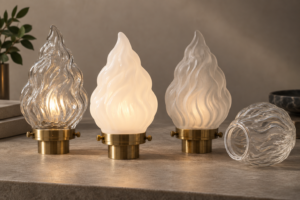
Quick answer
An etched glass lamp shade is a glass shade with a controlled matte, satin or patterned surface treatment that changes reflection and light transmission. The term describes the visible finish, not one universal glass composition or one standard fitter. For a replacement, confirm the shade profile, fitter opening, lip or neck, height, largest diameter and retaining hardware. For a new OEM or ODM project, also specify the glass body, etch coverage, pattern position, light source, sample approval method, inspection points and export packing. A supplier should confirm the practical tolerance, sample route, MOQ and lead time from the drawing, glass type and production method.
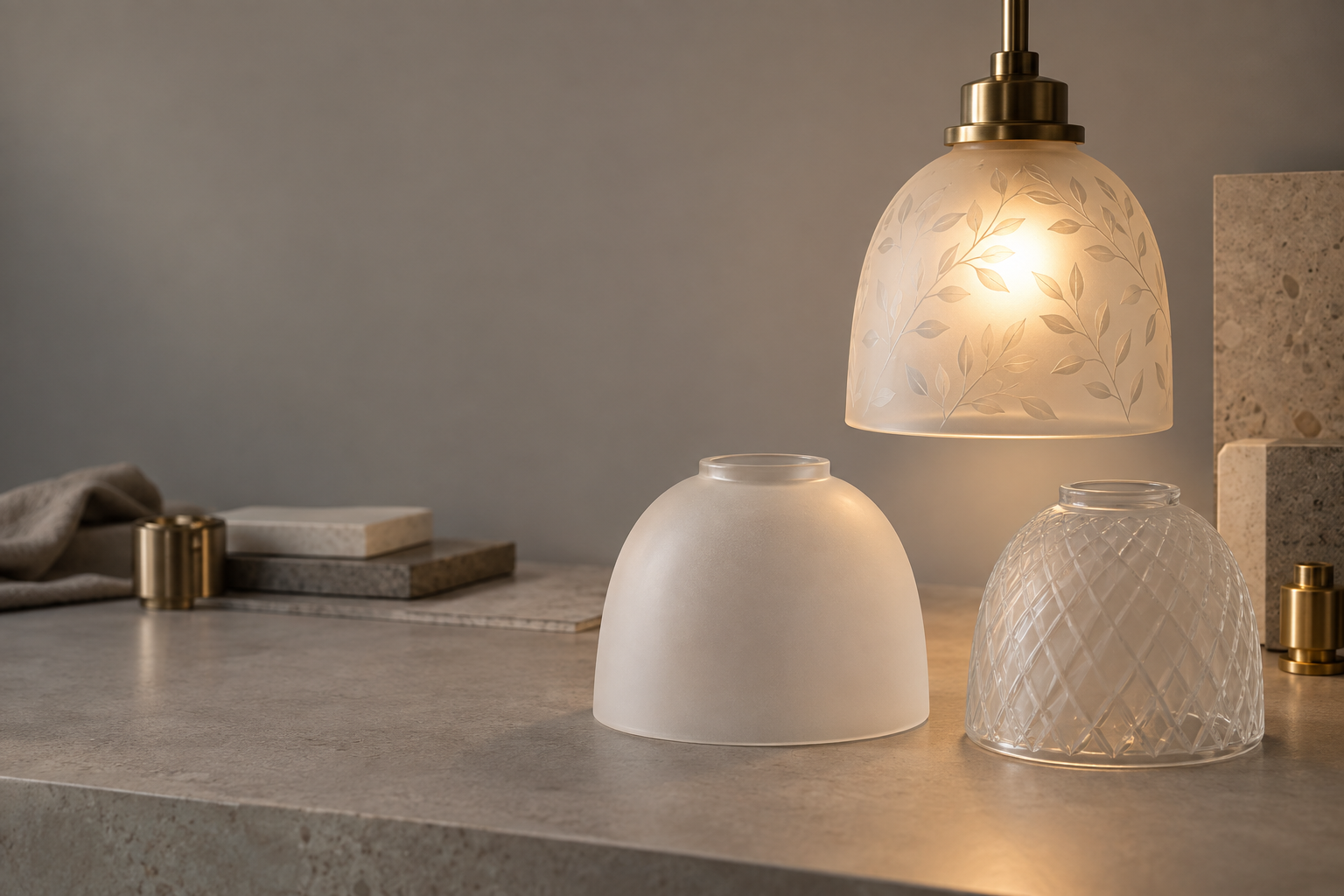
The useful distinction for a buyer is between appearance and fit. A shade can have the correct etched look and still fail because the opening is wrong, the rim does not seat, the retaining ring contacts the glass unevenly or the lighted sample is too bright. This guide treats the shade as a manufactured component for lighting brands, distributors, restoration suppliers and procurement teams.
What is an etched glass lamp shade?
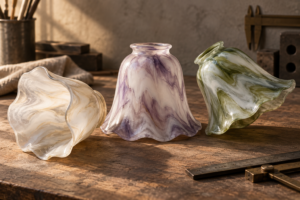
Etched glass is glass whose surface has been treated to create a less reflective or patterned appearance. Depending on the design and factory route, the result may be a uniform satin field, a fine matte area, a border, a band, a geometric pattern or a decorative motif. The finish may be applied across the whole body or stopped short of the fitter and rim.
The word etched does not tell a buyer whether the body is soda-lime, borosilicate, tempered, opal or colored glass. It also does not identify the forming method. The glass body may be mouth-blown, machine-pressed, tubular, heat-formed or produced by another route that the engineering team approves for the geometry. Surface treatment is one line in the specification, not a substitute for a complete drawing.
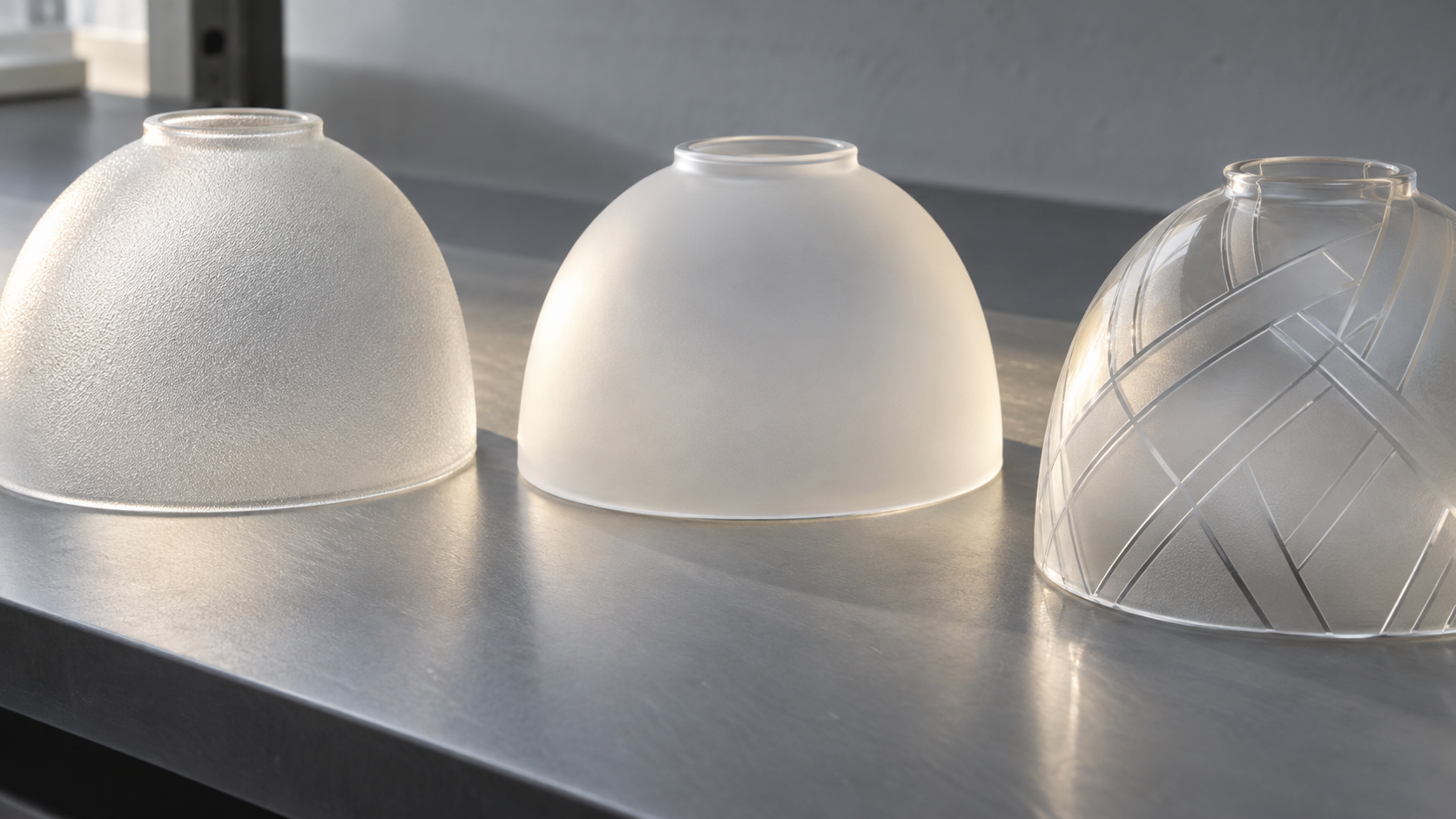
For a quotation, describe the finish in measurable or reviewable terms:
- Coverage: full body, upper band, lower band, panel, border or custom pattern.
- Appearance: matte, satin, soft translucent, opaque-looking or patterned.
- Contrast: low contrast for a quiet surface or higher contrast for a visible motif.
- Boundary: clean stop line, feathered transition or continuous treatment around the body.
- Lighted result: bulb concealment, glow uniformity, hotspot behavior and shadow softness.
- Approval reference: physical sample, approved finish chip, lighted photograph or drawing note.
The existing glass material and finish guide is useful for a broad comparison. This article narrows the decision to etched shade geometry, surface coverage and repeatable sourcing.
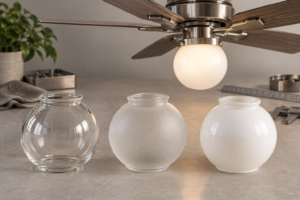
Etched, frosted, opal, clear and seeded glass compared
These terms are often mixed together in retail listings. They should be separated in an OEM brief because they can lead to different light behavior, cleaning expectations and sample approvals.
| Finish or body description | What the buyer usually sees | Light behavior to review | Main specification risk |
|---|---|---|---|
| Clear glass | Transparent body with direct reflections and strong source visibility | Crisp highlights and a sharper view of the lamp source | Glare, visible hardware and uneven reflections may be greater |
| Etched glass | A treated area with reduced reflection and a matte or patterned appearance | Softer reflections and a more controlled view of the source | Coverage, pattern contrast and the edge of the treated area can drift |
| Satin etched glass | Fine, even surface with a quiet translucent appearance | Broad softened glow with less mirror-like reflection | Buyers may use satin and frosted as synonyms even when the approved sample differs |
| Frosted glass | General market term for a diffusing or non-clear surface | Reduced source visibility and softer light | The word alone does not define process, opacity or surface uniformity |
| Opal or milk glass | White or pale body that may be translucent or opaque | Strong diffusion and a more uniform luminous field | Color, wall thickness and light transmission need a lighted sample |
| Seeded glass | Visible bubbles or seeds within the body or surface character | Decorative sparkle and broken highlights rather than a uniform matte field | Seed distribution and visual consistency may be intentionally variable |
An etched surface may be selected when a brand wants some glass depth and translucency while reducing a sharp reflection. Opal or milk glass may be more suitable when the brief calls for a broadly uniform white glow. Clear glass may be better when the lamp source and internal hardware are part of the design. The correct choice is the one that passes the lighted sample review on the actual fixture.
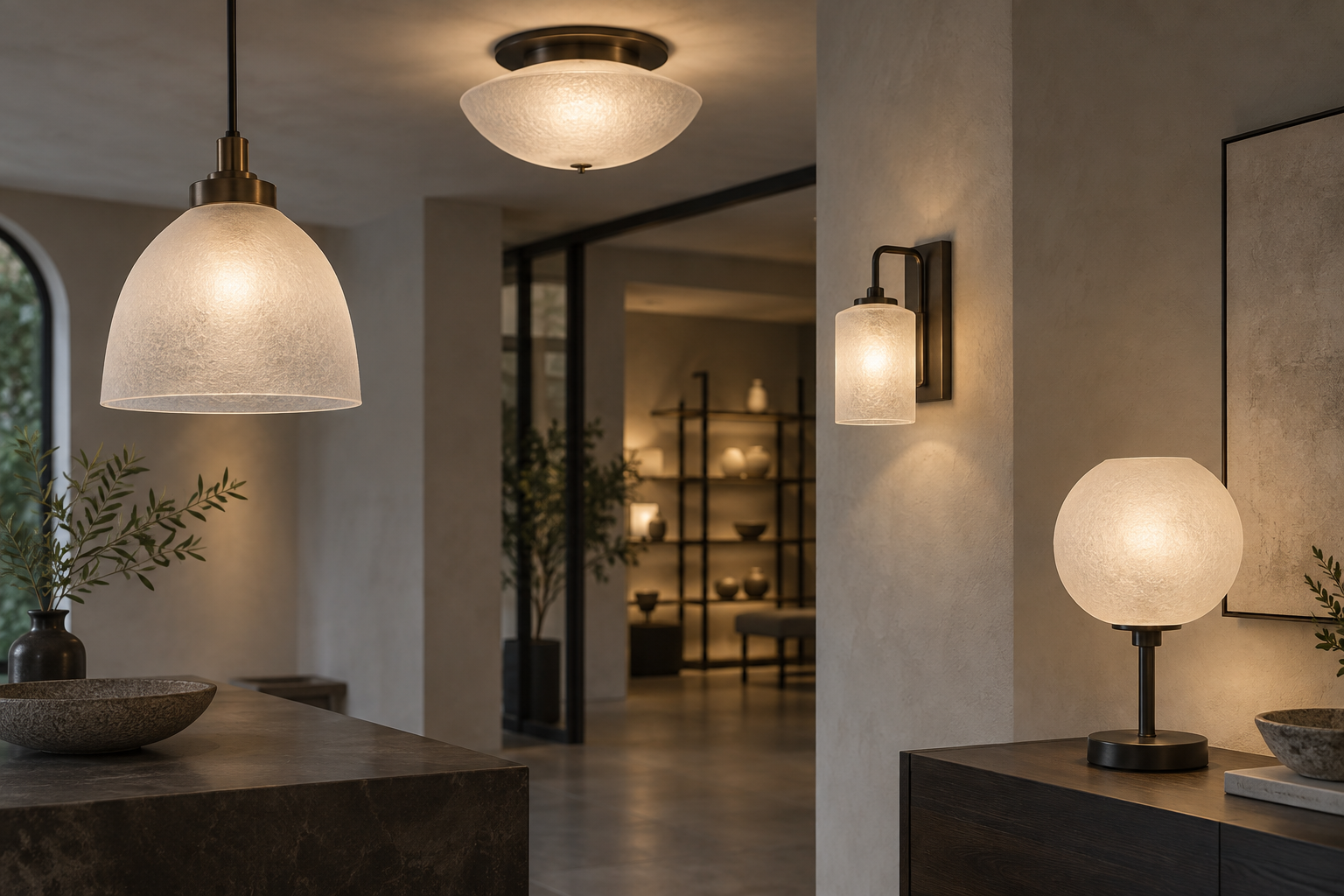
Where etched glass shades are used
Etched shades appear in more than one fixture family. The application changes the required profile, mounting detail and level of batch consistency.
| Application | Why an etched surface may be chosen | What the buyer should confirm |
|---|---|---|
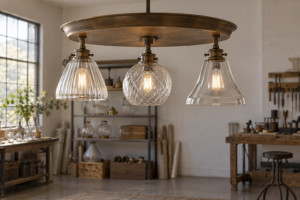
| Pendant light | Softens a direct view of the bulb while retaining a glass product feel | Top fitter or neck, cable clearance, shade balance and intended viewing angle |
| Wall sconce | Controls side glare and can create a quiet wall wash | Back clearance, wall plate, orientation and whether the pattern must face a room direction |
| Ceiling fixture | Creates a diffuser or decorative field below the light source | Mounting ring, screw or clip contact, ceiling clearance and service access |
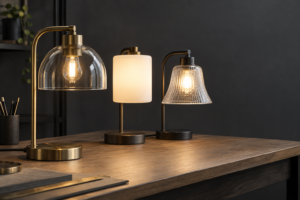
| Table or desk lamp | Reduces sharp reflections near eye level | Base or gallery fit, height, shade stability and bulb visibility |
| Restoration replacement | Recreates a historical appearance when the original is damaged or missing | Safe fragments, original hardware, profile, fitter, finish reference and color under light |
| New lighting collection | Gives a family of sizes a shared surface language | Master profile, finish recipe, pattern scaling, approval sample and repeat-order controls |
For hospitality or distributor stock, record the fixture family and the approved finish together. A finish that looks acceptable on a small table shade may look too dark or too reflective on a large pendant. The body diameter, wall curvature and lamp source all affect the result.
How to identify the shade shape and fitter
Start with the mechanical interface, not the product name. A lip fitter may rest on a carrier or gallery. A neck fitter may enter a ring or use a retaining component. A threaded or drilled interface may be part of the shade itself. A neckless globe may use an external holder and should not be described as a lip fitter simply because it is round.
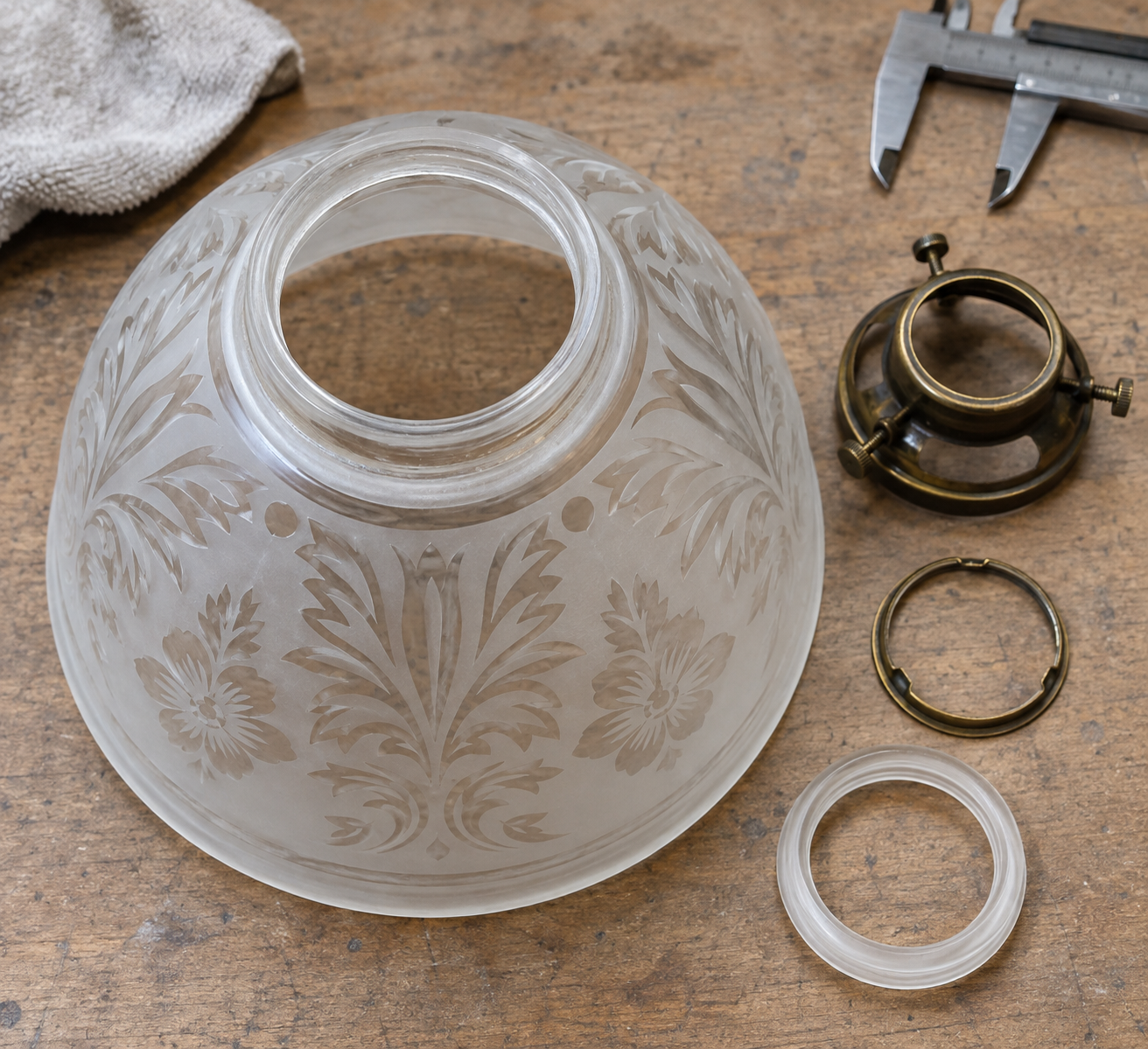
| Interface description | Evidence to photograph or measure | Common ordering mistake |
|---|---|---|
| Lip or rim fitter | Opening diameter, rim thickness, contact ledge and retaining ring | Using the outside body diameter as the fitter size |
| Neck fitter | Neck outside diameter, neck length, shoulder and ring clearance | Measuring the decorative body while ignoring the neck |
| Threaded glass interface | Thread or insert detail, starting point and mating component | Assuming a visually similar thread has the same pitch or seating length |
| Hole or central opening | Hole diameter, axis, washer contact and edge condition | Giving the hole size without the washer or carrier dimensions |
| Clip or spring retention | Rim shape, clip positions, glass thickness and spring load path | Tightening clips against an unapproved edge or surface |
| Neckless globe or external holder | Holder inside diameter, support depth and gasket or spacer | Ordering a globe by diameter alone |
The fitter compatibility guide provides general vocabulary. For an etched shade quotation, add a section sketch whenever metal touches the glass at more than one level. A top view alone cannot show whether the ring contacts the rim, the shoulder or a gasket.
How to measure an etched glass lamp shade for replacement
Do not measure a cracked shade while it is installed or under load. Isolate the fixture, allow it to cool, support the glass from below and follow the fixture maker's removal instructions. If the glass is damaged, use safe fragments only when they can be handled without cutting risk. A supplier can often work from the complete fixture and hardware when the original shade is missing.
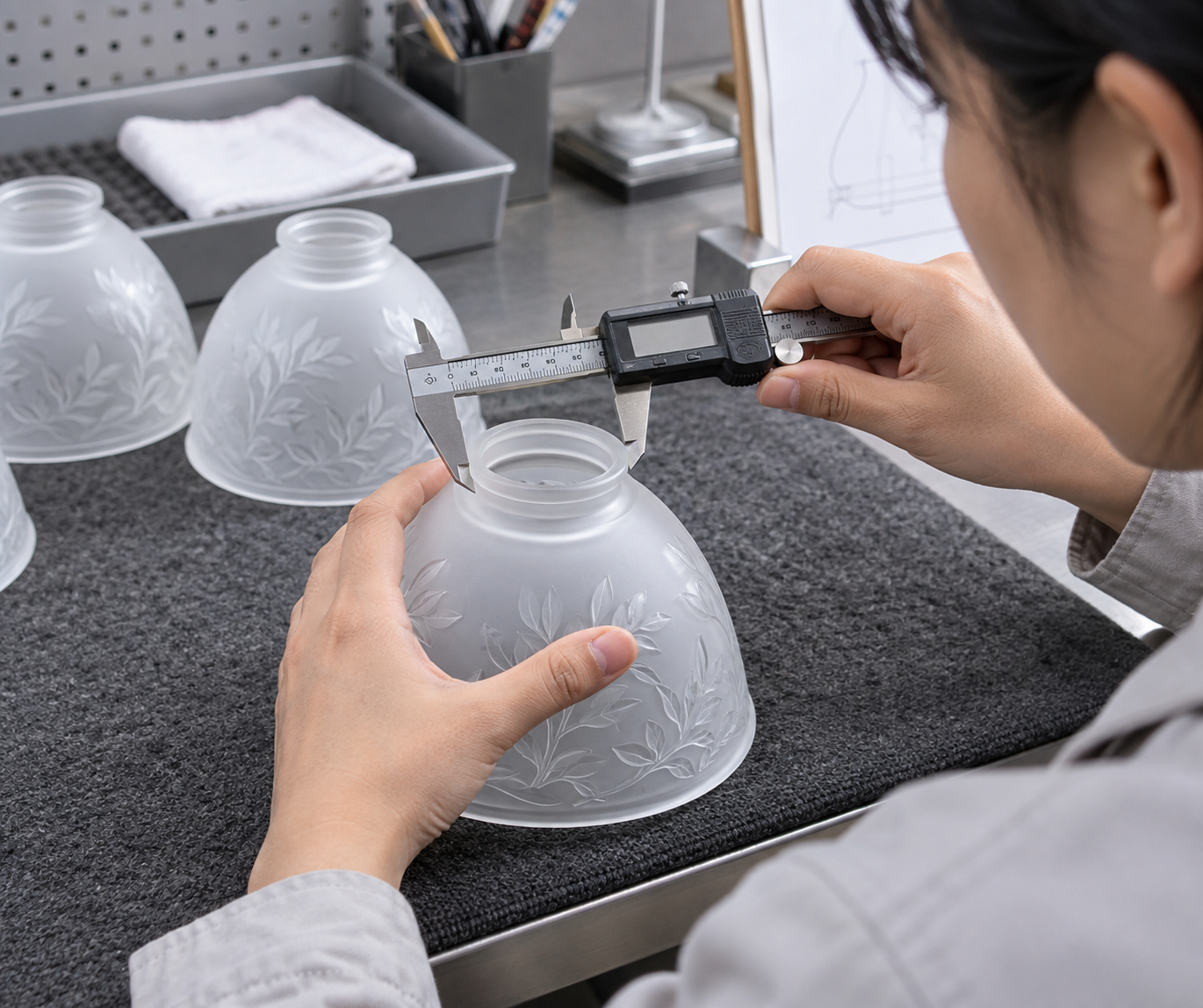
Use this sequence for a replacement intake:
- Photograph the complete fixture from the side, top and underside. Include the carrier, ring, finial, gasket, clips and lamp source.
- Mark the orientation. Record which side faces the lamp, room, wall or ceiling, especially when the etch is patterned or directional.
- Measure the fitter opening or neck at the actual contact edge. Do not infer it from a listing name such as 4 inch or 6 inch.
- Measure overall height, maximum outside diameter, shoulder diameter and the distance from the fitter to the widest point.
- Measure the rim or lip thickness and any seat depth. Note chips, ground edges, fire-polished edges, gaskets and retaining pressure.
- Record the lamp source and clearance. State whether the fixture uses an LED, incandescent, halogen or another source, but let the fixture designer confirm the complete assembly requirements.
- Compare the surface finish in daylight and when lit. Photograph the etched area at the same exposure as the reference sample.
- Send the drawing, fixture photos, hardware and safe sample together. Explain which dimensions are critical and which are open to a design proposal.
Keep the original units and add a converted unit only after checking the calculation. A rounded conversion is not a manufacturing tolerance. If a measurement is taken over a curved edge, explain how the caliper or rule was held so the supplier can reproduce the datum.
Common fitter sizes are planning references, not universal standards
Replacement markets may describe glass shades with nominal fitter sizes such as 2 1/4 inch, 3 1/4 inch, 4 inch or 6 inch. These labels help a buyer begin a search, but they can refer to different edges or fixture conventions. Treat them as a conversation starter until the actual opening and retaining method are confirmed.
| Nominal reference seen in shade sourcing | Approximate metric label | Check before quotation |
|---|---|---|
| 2 1/4 inch fitter | 57.2 mm | Whether the measurement is the inside opening, outside neck or ring seat |
| 3 1/4 inch fitter | 82.6 mm | Neck length, shoulder clearance, rim thickness and retaining-ring contact |
| 4 inch fitter | 101.6 mm | Fixture holder inside diameter, gasket compression and shade weight support |
| 6 inch fitter | 152.4 mm | Whether 6 inches describes the fitter, the body or a family name |
| Custom or neckless interface | Project-specific | Holder drawing, section view, support depth and approved sample |
For a new collection, choose one datum system and use it across the drawing set. For a replacement, preserve the original fixture's contact geometry even if the new body has a different decorative profile. The fitter reference should never be the only field in the purchase order.
Finish and light diffusion selection
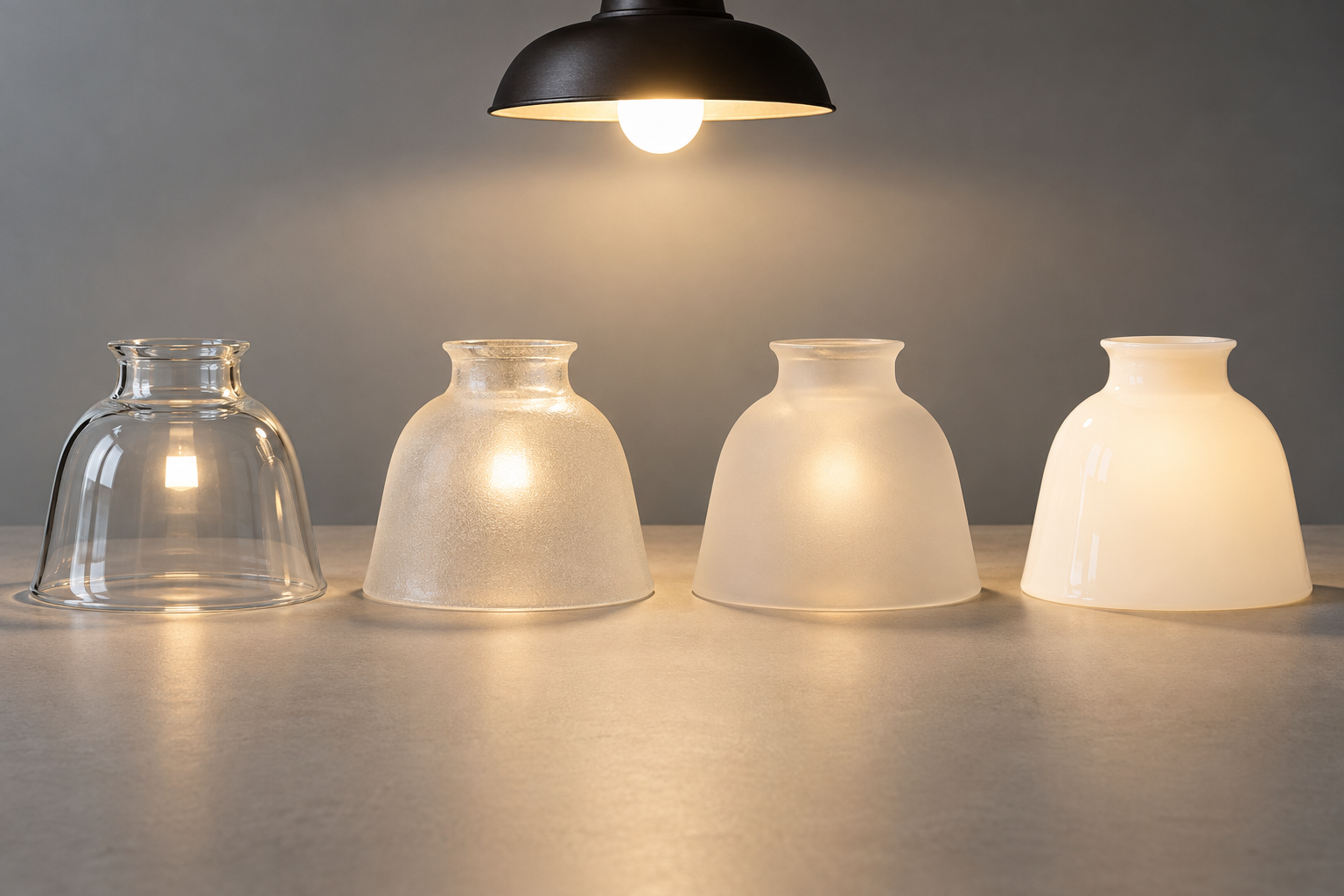
The correct etched glass lamp shade is approved under the light and at the viewing distance that matter to the final fixture. A shade can appear white in a studio photograph and show a concentrated bright area when installed close to a clear bulb. Conversely, a deep matte treatment can reduce the glow that a brand wanted from a decorative pendant.
| Buyer priority | Finish direction to investigate | Approval question |
|---|---|---|
| Preserve glass depth and reduce reflection | Fine etched or satin etched | Does the shade still show the intended body color and form? |
| Conceal the lamp source | More diffusing etched area, frosted or opal body | Is the lighted field even at the closest viewing angle? |
| Keep a visible decorative pattern | Banded, geometric or motif etch | Does the pattern remain legible after forming and around the curved body? |
| Create a soft white glow | Opal or milk glass, with or without a surface treatment | Does the color remain acceptable across the approved lamp sources? |
| Retain sparkle and variation | Clear or seeded body with limited surface treatment | Is the level of variation intentional and acceptable for the order? |
| Simplify cleaning | A uniform, accessible surface with no dirt-trapping detail | Are the rim, transition line and fixture hardware still easy to clean? |
Ask the supplier to show an unlit sample, a lighted sample and a close view of the surface. Review the top, side and installed view. For a patterned shade, rotate the sample around the fixture and check whether the design begins or ends at an awkward location. That approval step often matters more than a finish name.
Pattern, coverage and repeat-order controls
An etched motif may be simple on a flat drawing and difficult on a curved shade. The pattern can stretch near a shoulder, change apparent width around the circumference or lose contrast when the lamp is lit. The specification should state whether the visual target is a measured location or a general appearance.
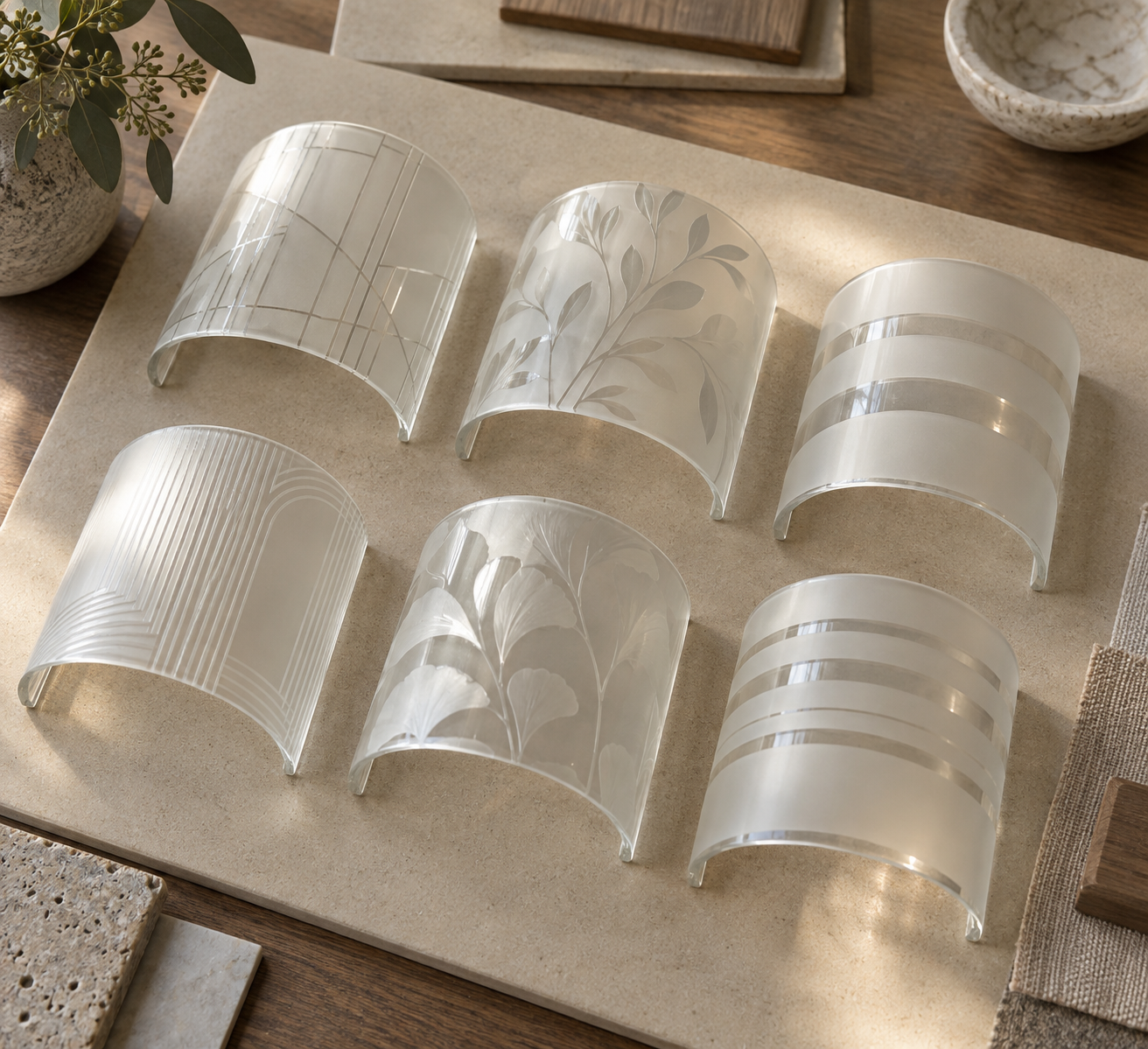
Define these items before tool or sample approval:
- Pattern scale and whether it is constant across all shade sizes.
- Start point, end point and rotation reference around the body.
- Distance from the fitter, rim, seam, hole or cutout.
- Treatment on the inside, outside or both surfaces.
- Border width, transition softness and any untreated handling area.
- Acceptable variation in contrast, texture and alignment after forming.
- Reference photographs taken with the same light source and camera exposure.
Do not approve only a flat finish chip when the final part is curved. A chip can confirm color and surface touch, but it cannot prove pattern registration, shade curvature, rim condition or the lighted appearance of the complete body.
Mouth-blown, machine-pressed and secondary treatment routes
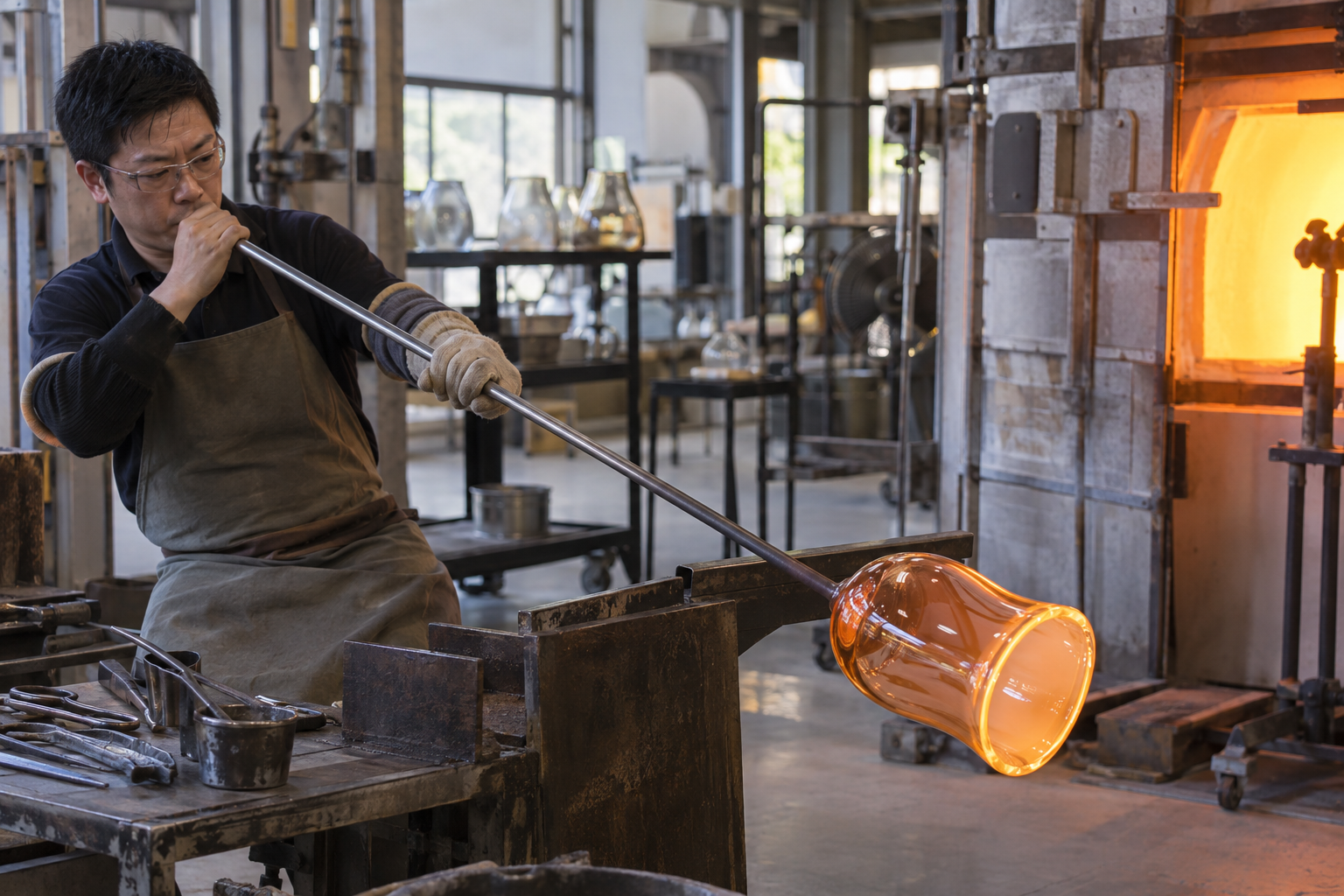
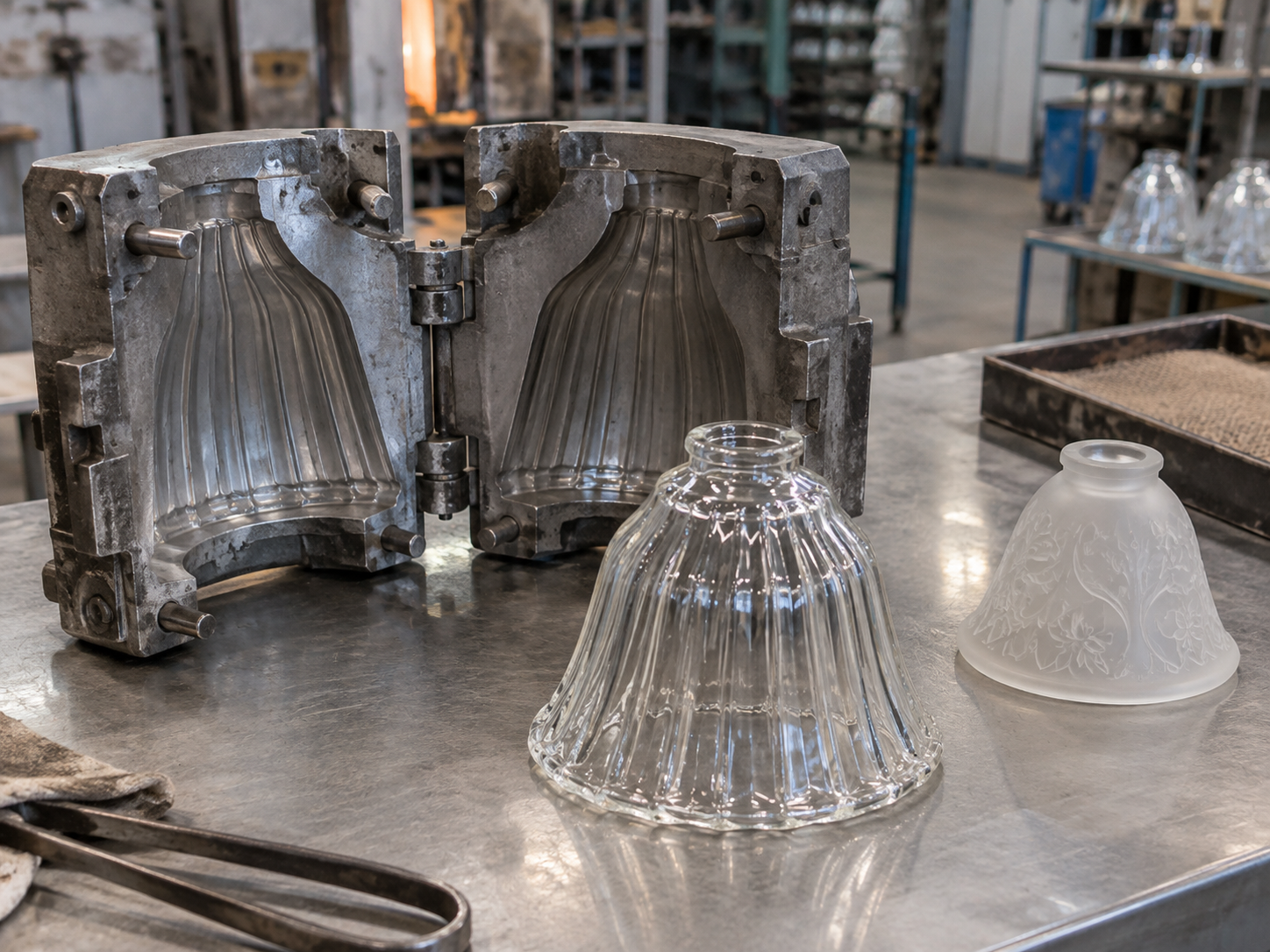
The manufacturing route should follow the shade's geometry, volume, finish and repeatability requirement. A production method is not selected by the keyword etched alone. The same surface appearance may require a different forming route for a shallow shade, a deep globe or a complex neck.
| Route | Where it may fit | Buyer trade-off to discuss |
|---|---|---|
| Mouth-blown or hand-formed | Small to medium runs, expressive profiles, development pieces or designs where hand forming is appropriate | More visual character and process variation may require a clear sample standard |
| Machine-pressed | Repeatable molded profiles and larger planned runs when tooling is justified | Tool design, parting line, draft, glass flow and finishing need review before commitment |
| Tubular or burner-shaped glass | Slender bodies, tubes, necks or technical forms suited to the chosen glass | Heat-forming sequence, wall variation and secondary operations need engineering review |
| Forming plus secondary etch | A formed body that needs a controlled matte or patterned surface | Treatment coverage, handling protection, masking and repeat-order consistency become critical |
| Existing tool adaptation | A family design that can use a verified mold or carrier reference | The old tool condition and compatibility must be confirmed, not assumed from a photograph |
The manufacturing process page gives the site-wide capability context. For a specific etched glass lamp shade, the engineering team should confirm the route from the drawing, glass type, surface treatment and order plan.
Custom mold development and sample approval
A custom mold is most useful when the shade profile, fitter, shoulder or pattern cannot be controlled with an existing tool. It is not automatically the best answer for every replacement. A one-piece restoration may be better served by a review of an existing form or a controlled development sample, while a new lighting collection may justify a tool that protects the master profile across sizes.
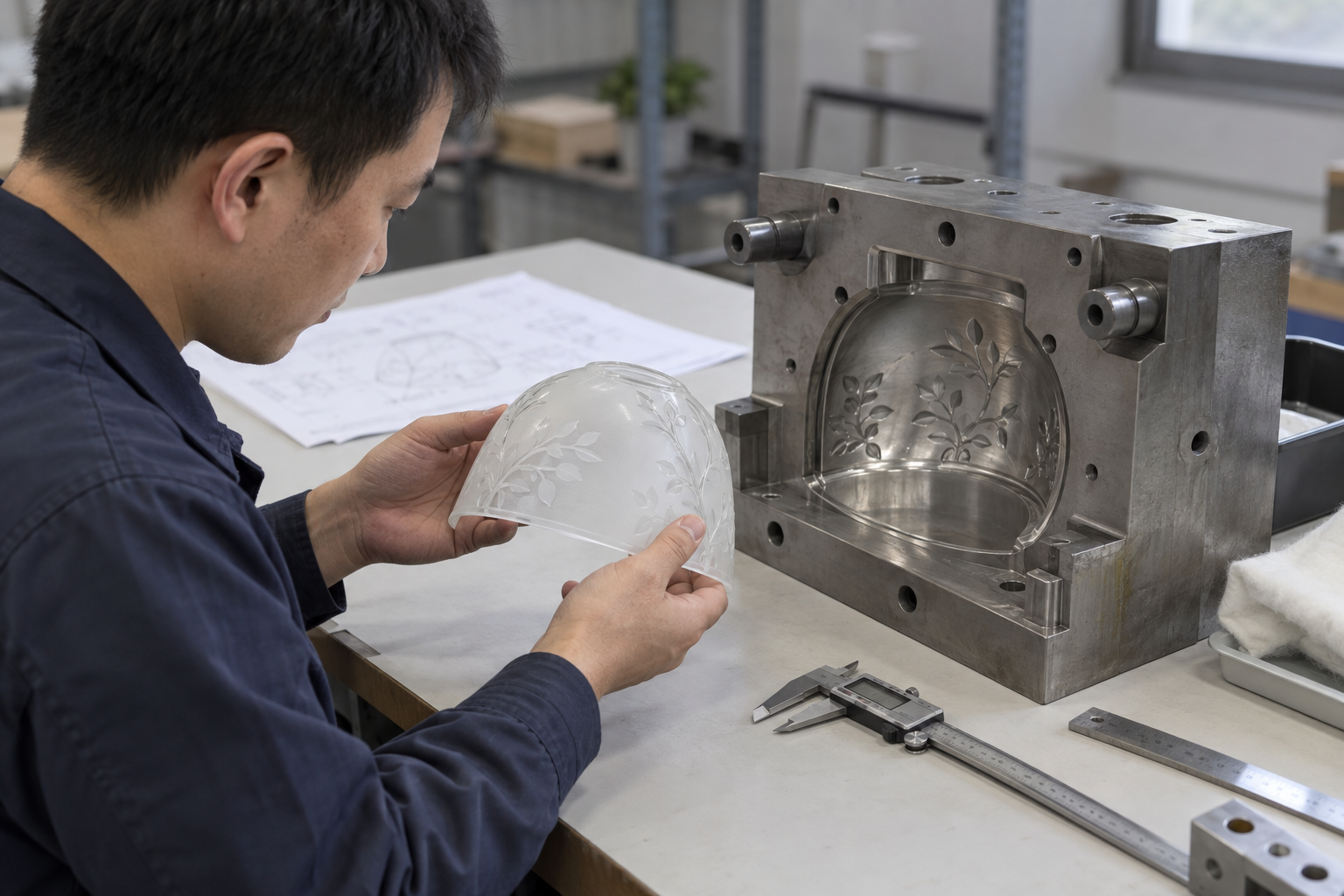
Discuss the following before tooling:
- Which drawing revision controls the outside profile, opening, shoulder and rim?
- Which dimensions are critical to assembly, and which are appearance targets?
- Where can a parting line appear, and what finish or inspection rule applies to it?
- Does the etch occur before or after the final forming and edge operations?
- How will the sample show lighted behavior on the intended fixture?
- Who owns, identifies, stores and maintains the mold or forming aid?
- What changes require a new sample rather than a written approval note?
Sampling should be staged. A feasibility sample can test the broad shape. A production-intent sample can test the proposed tool and finish route. A lighted approval sample can test the result on the fixture. Keep the sample, drawing revision, finish reference and inspection notes together for repeat orders.
Glass thickness, dimensional tolerance and edge finishing
Do not insert a universal glass thickness or tolerance into a purchase order just because it appeared on another shade. Wall variation depends on the body, forming route, glass type, curvature, rim and secondary processing. The critical question is where the glass must fit, seat, clear hardware or maintain an appearance.
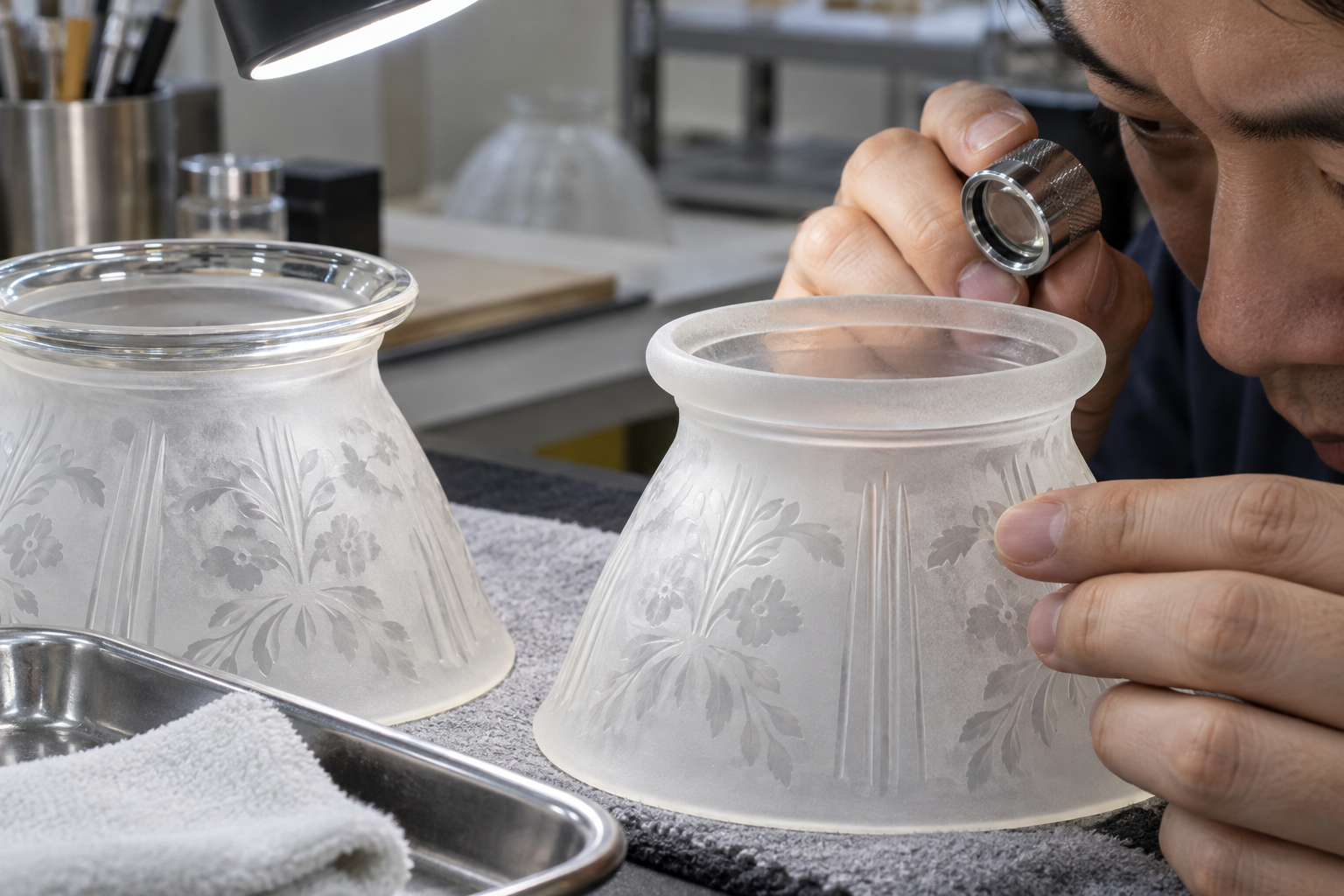
Your drawing should separate:
- Functional dimensions: fitter opening, neck, hole, seat, support depth and clearances.
- Appearance dimensions: outside diameter, height, shoulder location, pattern boundary and visible rim.
- Process notes: forming route, etch route, masking, seam location and edge treatment.
- Inspection notes: datum, tool, sample reference, measurement point and acceptance decision.
The rim may be fire-polished, ground, seamed, cut, rolled or finished by another approved route. The right edge depends on the holder and the handling condition. A glossy rim can look different from a ground rim under an etched surface, and a damaged contact edge can create an assembly problem even when the body looks correct.
Use the edge finishing guide when writing the rim requirement. For project-specific dimensional tolerances, ask the engineering team to confirm the drawing, glass type and production method. Do not treat a nominal fitter label as a tolerance.
Quality inspection for etched shades
Inspection should follow the buyer's risk. A replacement shade needs identity, fit and appearance checks. A new OEM collection also needs tool revision, finish consistency, pattern position, sample comparison and packing release checks.
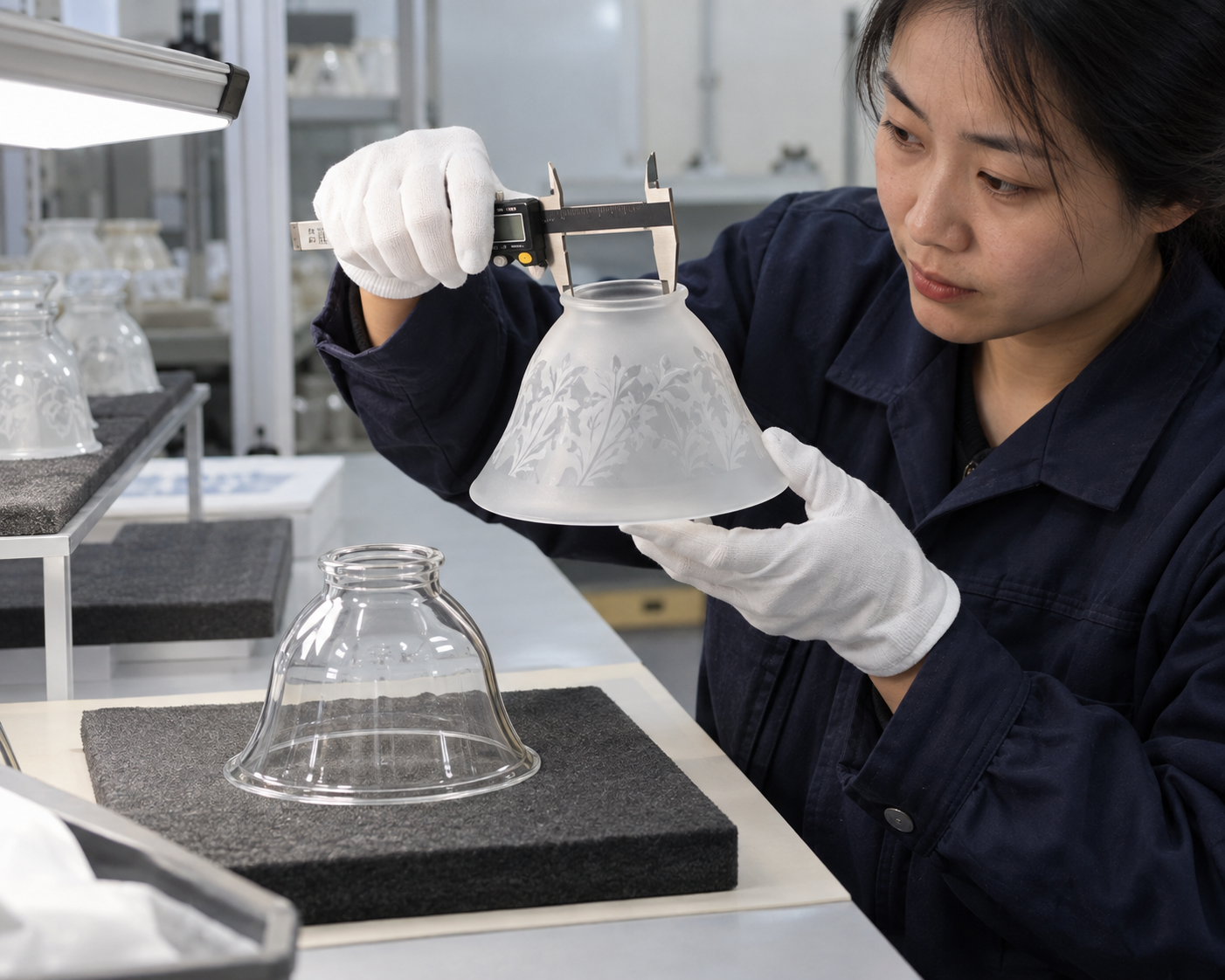
| Inspection group | Example checks | Evidence to retain |
|---|---|---|
| Identity | Correct shade, drawing revision, finish and quantity | Lot record, label or internal part reference |
| Fit | Opening, neck, seat, rim, hole, clips and hardware clearance | Measurement record and assembly trial where available |
| Body appearance | Shape, color, surface, bubbles, scratches and visible marks | Approved sample comparison and agreed cosmetic reference |
| Etch quality | Coverage, boundary, contrast, pattern position and uniformity | Unlit and lighted photos under the agreed setup |
| Edge condition | Chips, cracks, sharp areas, rim finish and contact surface | Close inspection record and handling decision |
| Optical result | Source visibility, glow, hotspot, shadow and room-facing appearance | Lighted fixture review rather than a finish chip alone |
| Packing | Rim support, separation, cushioning, carton condition and count | Pack photographs and shipment release notes |
The glass lamp shade quality inspection checklist is a useful companion for a wider inspection plan. It should be adapted to the actual shade, fixture and destination market. No inspection list can replace a drawing and an approved reference sample.
Packaging and international shipping
Etched surfaces can be visually sensitive, and the fitter or rim can be mechanically vulnerable. Packing should protect both the body and the connection edge. A carton that prevents a large crack but allows small rim contact can still create assembly failures after arrival.
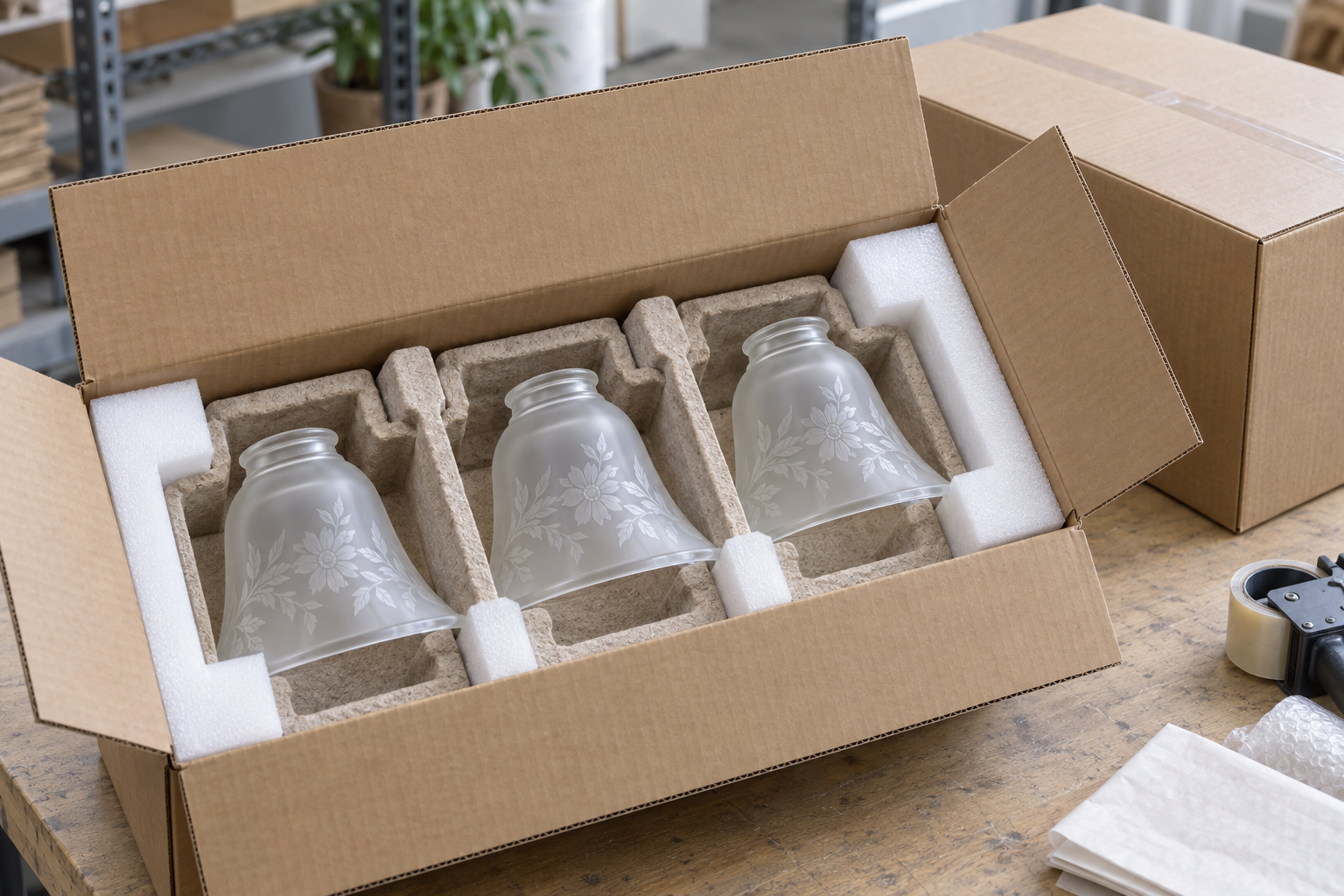
Ask the supplier to show the intended pack arrangement before mass production. Confirm:
- Individual separation between shades and between glass and metal parts.
- Rim and fitter support so the load is not concentrated on one edge.
- Protection from surface rubbing, dust and loose abrasive particles.
- Inner pack count, carton count, gross weight and dimensional assumptions.
- Marking, destination, freight method and any buyer-specific packing instruction.
- What happens when a shipment contains a damaged carton or a suspected broken shade.
Packaging should be approved with the shade geometry and order quantity in mind. A small sample pack may not represent the final carton when the body diameter, height or number of pieces changes. Confirm the packing recommendation with the logistics and engineering teams instead of assuming that one insert fits every size.
Replacement project versus new OEM project
The same search phrase can bring two very different buyers. A restoration supplier may need one replacement that matches an old fixture. A lighting brand may need several sizes, a repeatable surface treatment and a documented approval path.
| Project type | Main evidence | Best first request | Main risk |
|---|---|---|---|
| One replacement | Complete fixture, hardware, safe sample, measurements and finish photographs | Fit review or closest-form assessment | A visual match does not prove the interface |
| Small restoration batch | Multiple samples, target quantity, approved appearance and packing need | Feasibility and sample quotation | Original variation may be mistaken for a production standard |
| New OEM collection | Master profile, size family, finish direction, lamp source and forecast | Engineering review with tooling and sample route | A decorative idea may not be repeatable without a controlled datum |
| Distributor stock | Size list, fitter references, finish options and carton plan | Range quotation with sample set | Similar names can hide different openings or holders |
| Hospitality or project order | Fixture schedule, installed environment, quantity by location and replacement plan | Project specification review | One shade may not suit every position or lighting condition |
For a replacement, preserve the fixture's mechanical truth. For an OEM project, decide which dimensions define the family and which details may change by size. Keeping those two briefs separate makes the quotation easier to compare.
MOQ, sampling and mass-production considerations
MOQ is not a safe number to invent before the shade and route are known. A simple existing form, a custom pressed mold, a hand-formed replacement and a multi-size collection can have different tooling, labor, inspection and packing economics. Ask for the commercial basis of the quote instead of asking for a generic MOQ alone.
During sampling, clarify:
- Whether the sample uses the intended glass type and surface-treatment route.
- Whether the sample is for shape approval, finish approval or full production-intent approval.
- Which changes are included in the review and which require new tooling or a new sample.
- Whether the sample price, tooling, finishing and freight are listed separately.
- How the approved sample will be identified and stored for repeat orders.
For mass production, freeze the drawing revision, finish reference, inspection method, packaging arrangement and order quantity by size. Confirm the MOQ, lead time, tooling status and production schedule with the JX engineering and commercial teams for the actual project. The correct wording is project-specific: “Confirm with our engineering team based on the drawing, glass type and production method.”
What buyers should include in an RFQ
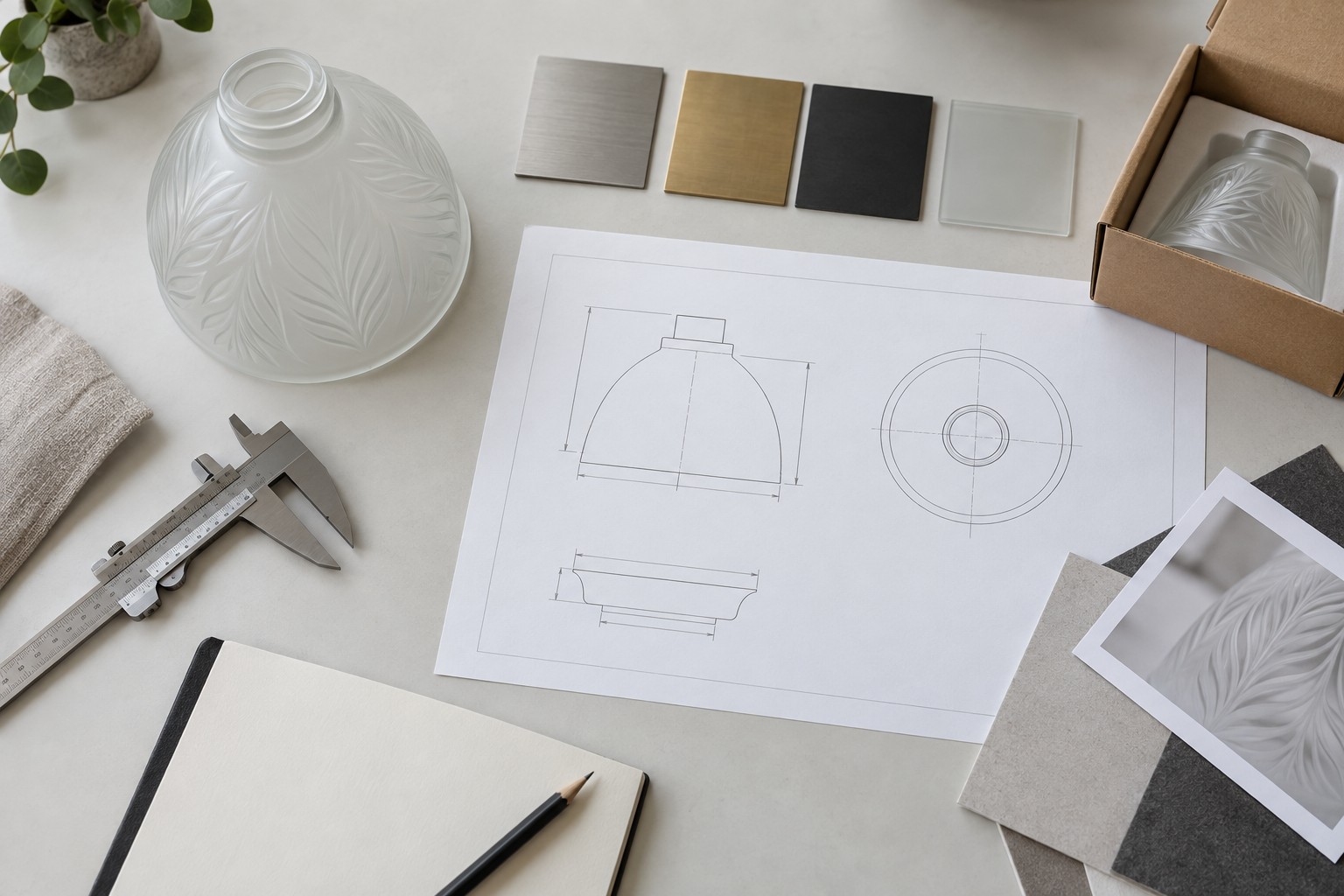
| RFQ field | Information to send | Why it affects the quote |
|---|---|---|
| Fixture application | Pendant, sconce, ceiling, table, restoration, hospitality or other use | Establishes viewing angle, clearance and retention context |
| Shade geometry | Side profile, top view, section view, height and largest diameter | Defines the glass body and tool or forming route |
| Fitter interface | Opening, neck, lip, hole, seat, thread, ring, clip or gasket details | Determines whether the shade can assemble safely |
| Surface finish | Etch coverage, satin level, pattern, border, untreated areas and reference sample | Controls optical appearance and process review |
| Glass direction | Clear, opal, milk, colored, seeded or other approved material direction | Affects transmission, color and forming review |
| Light source | Lamp type, wattage or system information, orientation and clearance | Supports a meaningful lighted sample review |
| Quantity | Sample count, trial quantity, repeat estimate and size mix | Supports tooling and commercial comparison |
| Quality | Critical dimensions, cosmetic limits, finish checks and assembly trial | Turns “good quality” into a reviewable acceptance plan |
| Packaging | Piece separation, rim protection, carton count and destination | Helps prevent damage and makes freight assumptions visible |
| Commercial basis | Currency, Incoterm, destination, target timing and quote validity | Keeps supplier quotations comparable |
If no drawing exists, send clear photographs beside a ruler, the fixture hardware, a safe sample and a list of measurements. Mark every estimate as an estimate. The more clearly a buyer separates known dimensions from open design questions, the faster a supplier can identify the right next sample.
Request a custom etched shade review
JX can review an etched glass lamp shade request as a replacement assessment, existing-form check or new OEM development project. Send the shade photographs or drawing, fitter and retaining details, finish reference, lamp-source context, target quantity, inspection requirements, packaging destination and any sample that must be matched.
The custom glass lamp shades manufacturer page explains the wider OEM and ODM conversation. For a quotation, use the contact page and ask the team to confirm the proposed glass, forming route, surface-treatment route, dimensions, sample scope, project-specific tolerance, MOQ, lead time and packing basis. Those details should be confirmed for the actual drawing rather than assumed from a generic shade category.

Buyer questions
What is an etched glass lamp shade?
It is a glass lamp shade with a controlled matte, satin or patterned surface treatment. Etched describes the surface appearance and treatment direction, not one universal glass composition, shade shape or fitter size. A purchase specification should also identify the body, interface, dimensions and lighted approval condition.
Is etched glass the same as frosted glass?
The terms can overlap in retail language, but they should not be treated as identical in an OEM order. Etched may describe a particular surface treatment or pattern, while frosted is often a broader appearance term. Approve a physical sample or finish reference that shows the actual surface, opacity and light behavior.
Does etched glass diffuse light?
It can soften reflections and reduce direct source visibility, but the result depends on the glass body, treatment coverage, wall thickness, lamp source and shade geometry. Compare an unlit and lighted sample on the intended fixture before selecting the finish for a repeat order.
How do I measure a replacement etched glass shade?
Measure the actual fitter opening or neck, overall height, largest outside diameter, shoulder, rim and seat. Photograph the retaining hardware and record the lamp source. Do not order only by a nominal 2 1/4 inch, 3 1/4 inch, 4 inch or 6 inch label because the reference edge may differ.
Can a supplier etch any glass lamp shade shape?
Not automatically. The forming route, curvature, rim, pattern coverage, handling sequence and treatment method all affect feasibility. Send the profile, glass direction, finish reference and quantity so the engineering team can confirm whether the proposed route is suitable.
Is a satin etched finish suitable for a pendant light?
It can be, when the intended result is a softer reflection or reduced bulb view. Confirm the top fitter, shade balance, lamp source, pattern boundary and lighted appearance. A satin finish that works on a small pendant may look different on a large curved body.
Does a custom etched shade require a new mold?
Only when the required profile, interface or repeatability cannot be achieved with an existing form or an approved adaptation. The tooling decision depends on the drawing, quantity, glass route and sample plan. Ask the supplier to separate an existing-form review from a new-mold proposal.
What should a lighting brand send for a quotation?
Send the fixture application, drawings or measured photographs, fitter and retaining hardware, glass and finish direction, pattern coverage, lamp-source context, target quantities, quality points, sample needs, packaging destination and commercial terms. State which dimensions are critical and which details are open to proposal.
Can you confirm MOQ, tolerance and lead time from a product photo?
No. A photo can help identify the shade family, but MOQ, dimensional tolerance and lead time depend on the drawing, glass type, finish, tooling, quantity and production method. Confirm them with the engineering and commercial teams for the specific project.
Choose the next specification step
The strongest etched glass lamp shade brief separates five decisions: the glass body, the surface treatment, the fixture interface, the lighted appearance and the repeat-order controls. Once those items are tied to a drawing, sample and inspection plan, a replacement or OEM discussion becomes much more precise than a product-name search.