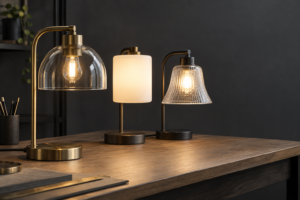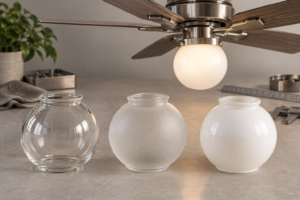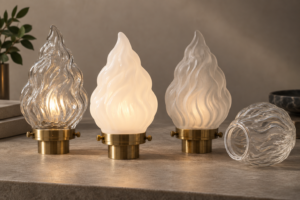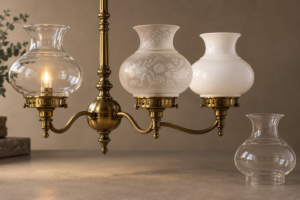
Quick answer
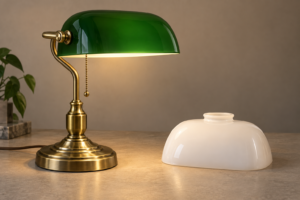
A gasolier glass lamp shade is a glass component used on a historic gas-light, combination gas-and-electric or gas-style lighting fixture. The word gasolier identifies the fixture family, not one universal glass profile. A correct replacement must match the gallery or arm hardware, fitter opening, seat, retaining method, body diameter, height and light-source clearance. For an OEM project, add the glass color, surface finish, wall thickness target, drawing, approved sample, inspection points, packing method and order pattern.
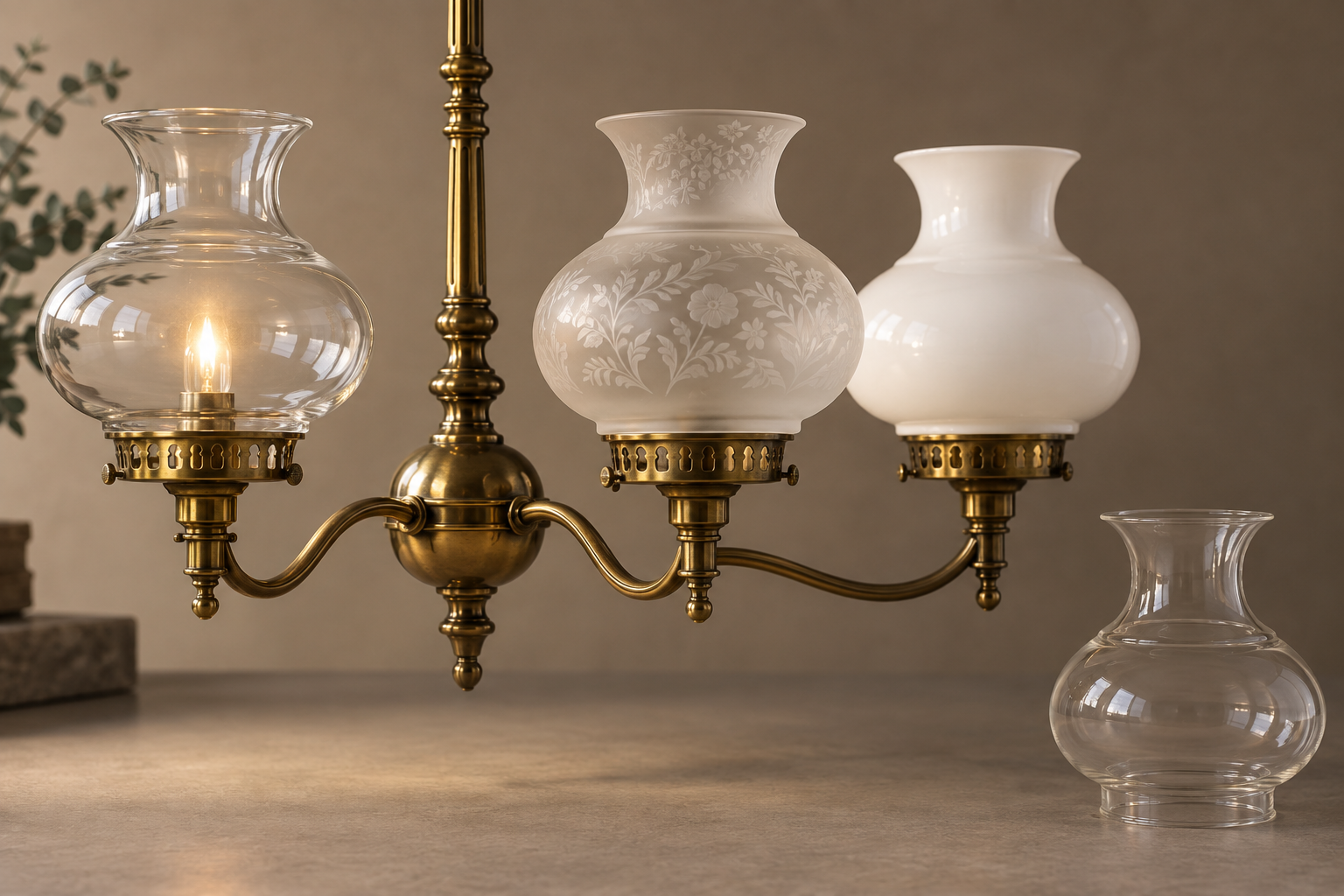
The phrase "gasolier shade" can describe a small etched shade, a clear bell, a flared glass, a globe-like cover or another period-appropriate profile. A catalog name helps with discovery, but it does not establish fit. Measure the original glass or the metalwork before asking for a quotation.
This guide is for lighting brands, restoration suppliers, distributors, wholesalers, product designers and OEM buyers. It explains how to identify a gasolier shade, distinguish it from similar gas-style glass, measure a replacement, choose a production route and prepare a practical RFQ for custom glass manufacturing.
What is a gasolier glass lamp shade?
Gasolier is a historical lighting term associated with fixtures that used gas lighting, electric lighting or a combination of the two. In the shade trade, buyers usually use the term to describe the glass fitted to a gas-style arm, gallery or chandelier rather than a modern pendant with a decorative glass cover.
The glass itself does not prove that a fixture is a gasolier. The useful identification comes from the complete assembly:
- the arm, stem or gallery that carries the glass;
- the fitter, neck, lip or retaining ring that touches the glass;
- the shade profile and its relationship to the burner or socket;
- the period, finish and light-source appearance the buyer wants to reproduce.
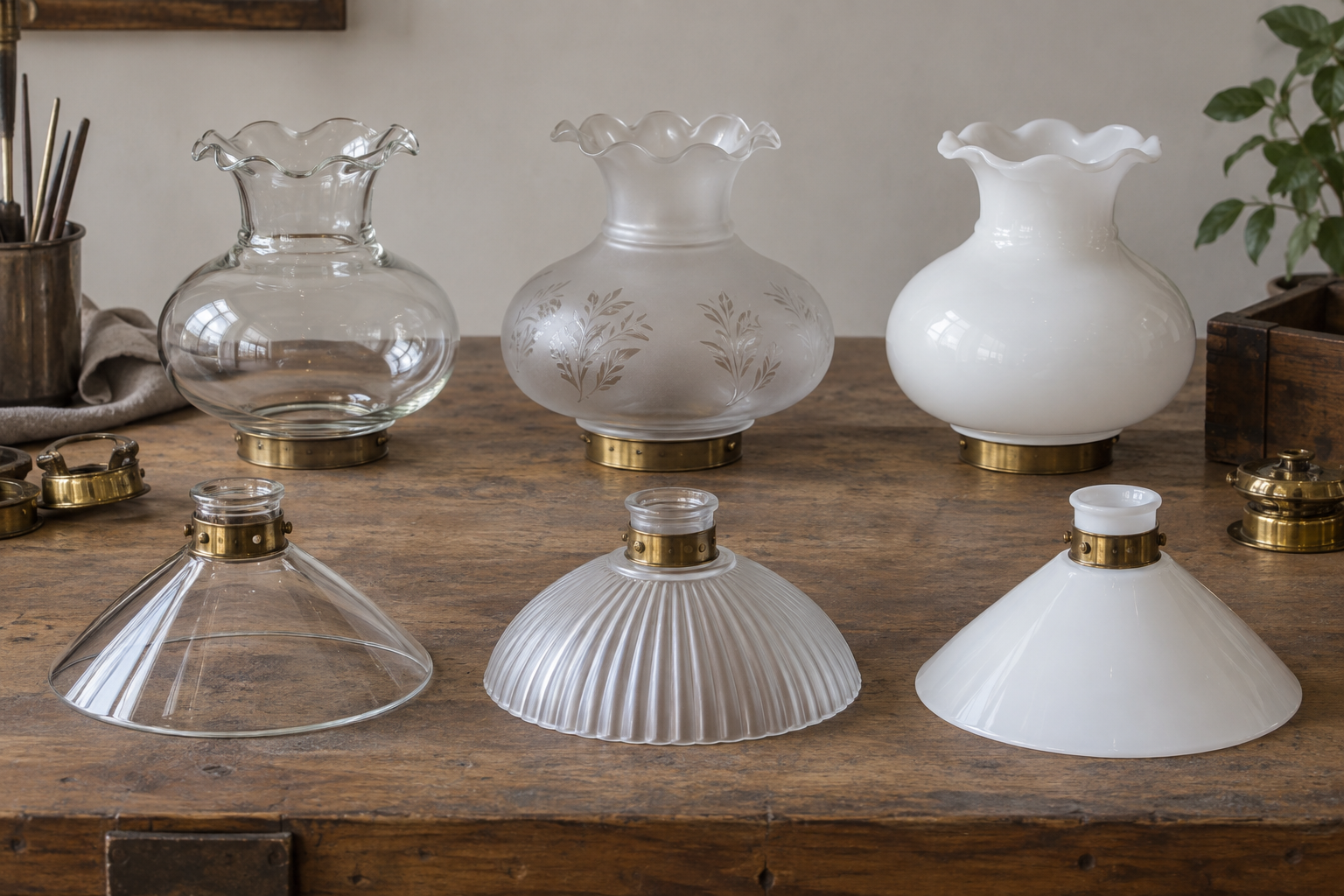
Gasolier glass shades may be transparent, etched, satin, opal, milk, colored or textured. They may have a straight mouth, a neck, a flared opening, a broad lip or a holder-supported rim. Two shades can look similar from the front and still require different glass geometry.
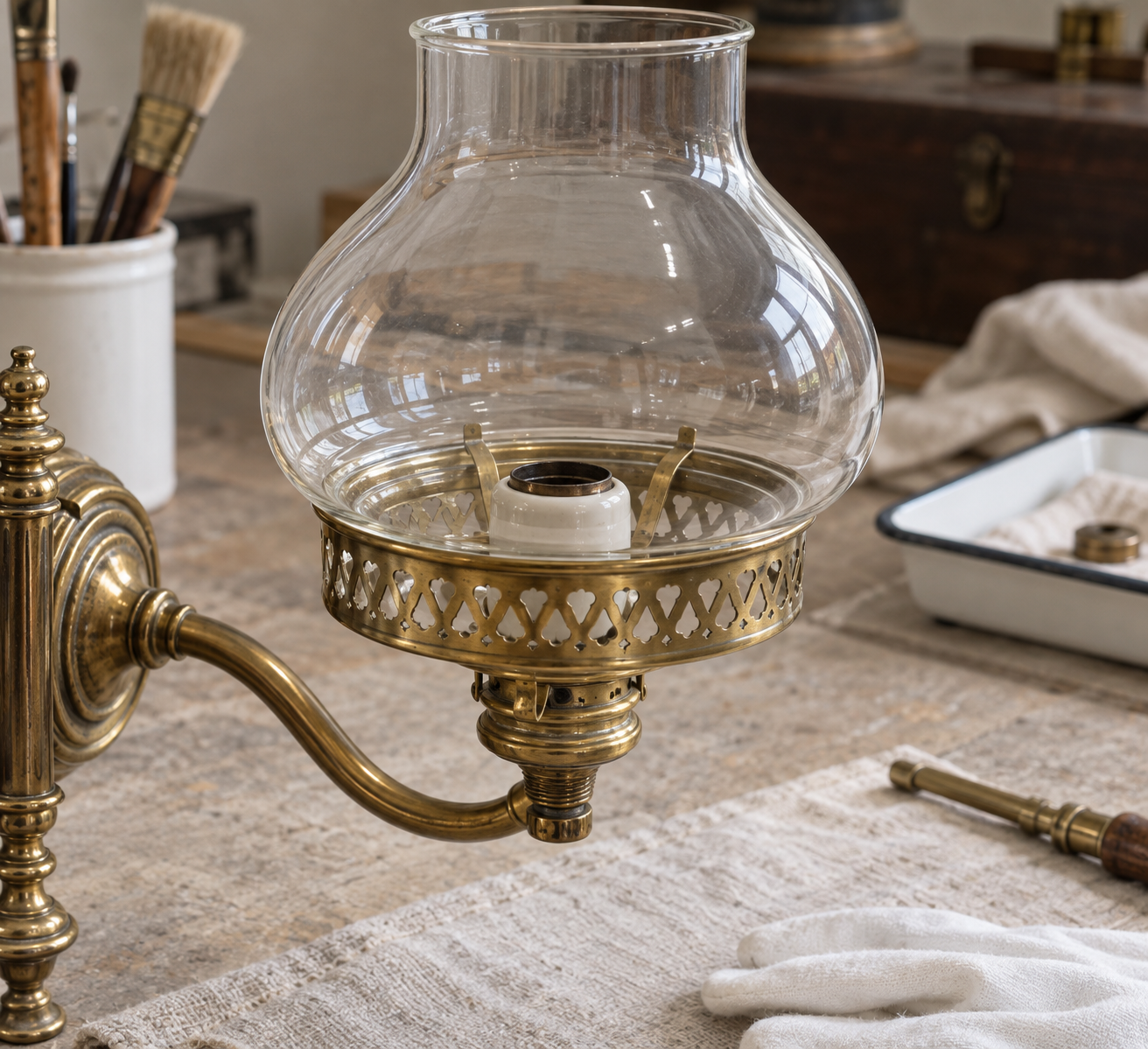
For a restoration project, the original shade and hardware are the strongest evidence. For a new product, a section drawing and the target light source matter more than a historical label. If the name and the measured interface disagree, use the interface as the quotation reference.
Gasolier, gas-style and generic pendant shade terminology
Search results mix several terms that are related but not interchangeable. A gasolier may refer to a complete historic fixture. A gas-style shade may be a replacement glass made for a gas or combination fixture. A gas fitter may describe the connection size or mounting family. A generic pendant shade may share a bell or dome silhouette but use a different gallery, neck or retaining method.
| Search term | What it usually describes | What it does not confirm | Buyer action |
|---|---|---|---|
| Gasolier | Historic gas, electric or combination fixture family | Glass diameter, fitter or light-source clearance | Photograph the fixture and identify the glass interface |
| Gasolier glass shade | Glass intended to suit a gasolier or gas-style assembly | Universal shape or universal fitter size | Send the shade profile and the metalwork that contacts it |
| Gas-style matching shade | Replacement glass selected for a historic gas-style fixture | Whether the listed size matches an older gallery | Compare the actual seat, opening and retaining method |
| Gas fitter shade | A shade with a connection associated with gas-style hardware | The body profile or period appearance | Record fitter dimensions and the shade body separately |
| Pendant glass shade | A suspended glass component on a pendant or gallery | Compatibility with a gasolier arm | Treat it as a candidate only after checking the support geometry |
| Chandelier glass shade | A glass cover used on a multi-arm fixture | The arm angle, gallery depth or socket position | Check the complete assembly, especially for paired shades |
The antique glass lamp shade replacement guide covers the broader restoration decision between a period original and a current reproduction. This article narrows that decision to gasolier glass, where the arm, gallery and light-source position often matter as much as the visible shape.
Common gasolier shade profiles and applications
Historic fixtures do not all use one shade shape. The glass profile should follow the gallery, the intended light distribution and the visual reference. A restoration supplier may need one close replacement. A lighting brand may need several related profiles that share a fitter but differ in body height or lower diameter.
| Profile direction | Typical visual result | Useful application | Main specification risk |
|---|---|---|---|
| Small bell or flared shade | Light downward and outward with a defined lower edge | Gas-style wall arm, chandelier arm or compact restoration fixture | The flare can change the distance to the arm and adjacent shades |
| Etched bell | Diffuse pattern with a period decorative surface | Historic reproduction and restoration programs | Etch coverage, pattern scale and clear fitter area can vary |
| Clear open shade | Visible bulb, burner or metalwork with direct transmission | Authentic-looking restoration or display fixture | Glare, heat context and surface marks become more visible |
| Opal or milk dome | Softer luminous body and reduced source visibility | New reproduction, hospitality or comfortable decorative lighting | Opacity changes the appearance of the fixture when illuminated |
| Ribbed or paneled shade | Strong vertical texture and controlled highlights | Decorative gas-style collections and replacement programs | Ribs can alter mold seams, wall thickness and packing contact |
| Custom historic profile | Exact silhouette tied to one fixture or brand | Museum-style restoration, lighting brand or OEM collection | A photograph may not show the section, fitter or critical height |
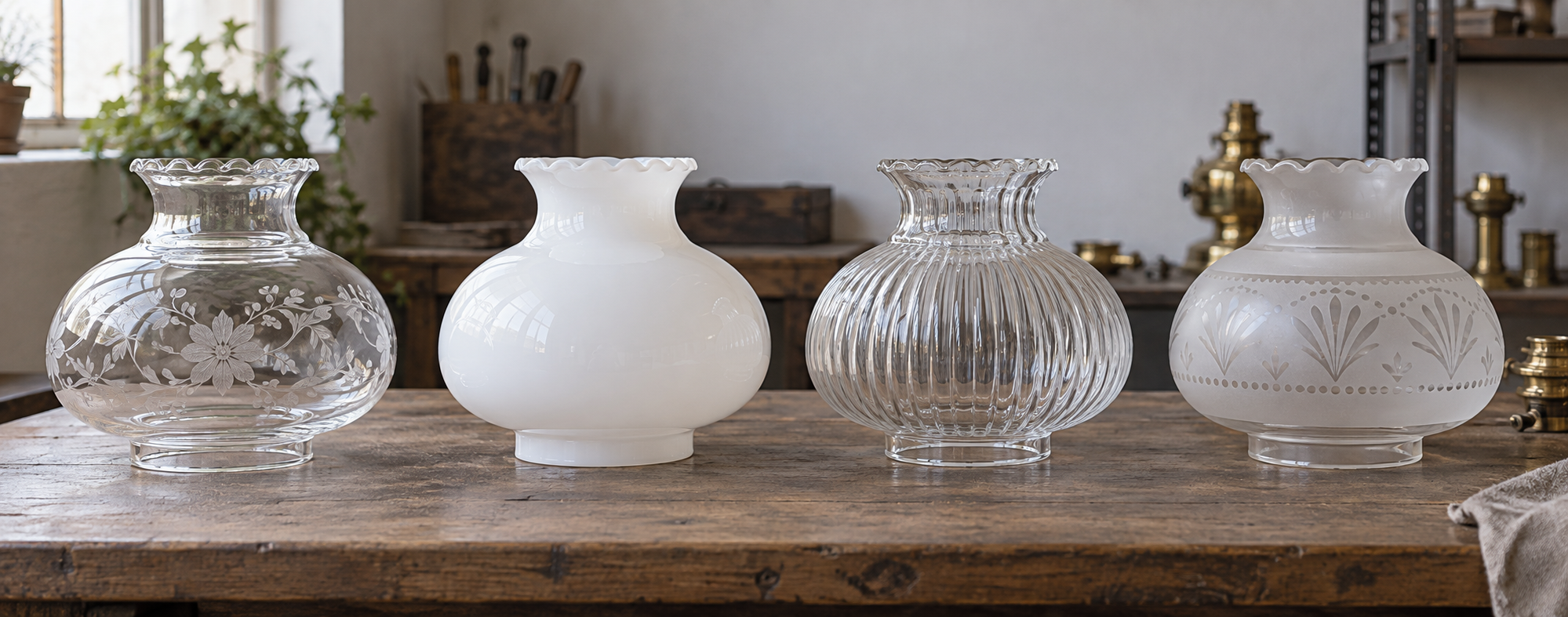
Before selecting a profile, identify whether the glass is carried by a single arm, a gallery ring, a socket cup, a spring or a retaining screw. A shade that looks correct on a display table may sit too high, cover the socket, expose too much of the light source or collide with an adjacent arm.
How to identify the fitter, gallery and retaining method
The fitter is the working interface between the glass and the fixture. On a gasolier shade, it may be a straight opening, a neck, a lip, a shoulder or a rim that rests on a gallery. The metal assembly may be hidden when the shade is installed, so photograph it with the glass removed if that can be done safely.
Use these checks:
- Photograph the fixture from the side, below and above. Include the arm, gallery, socket or burner position and the shade seat.
- Photograph the original glass opening and the metal part that contacts it. A close image of the rim is more useful than a full-room photograph.
- Determine whether the glass enters the holder, rests on top of it, slides over a neck or is captured by a ring or clip.
- Record whether the shade is retained by gravity, a threaded ring, a set screw, spring pressure, clips or a custom bracket.
- Check whether the glass must be oriented to keep an etch, rib or seam away from the front viewing angle.
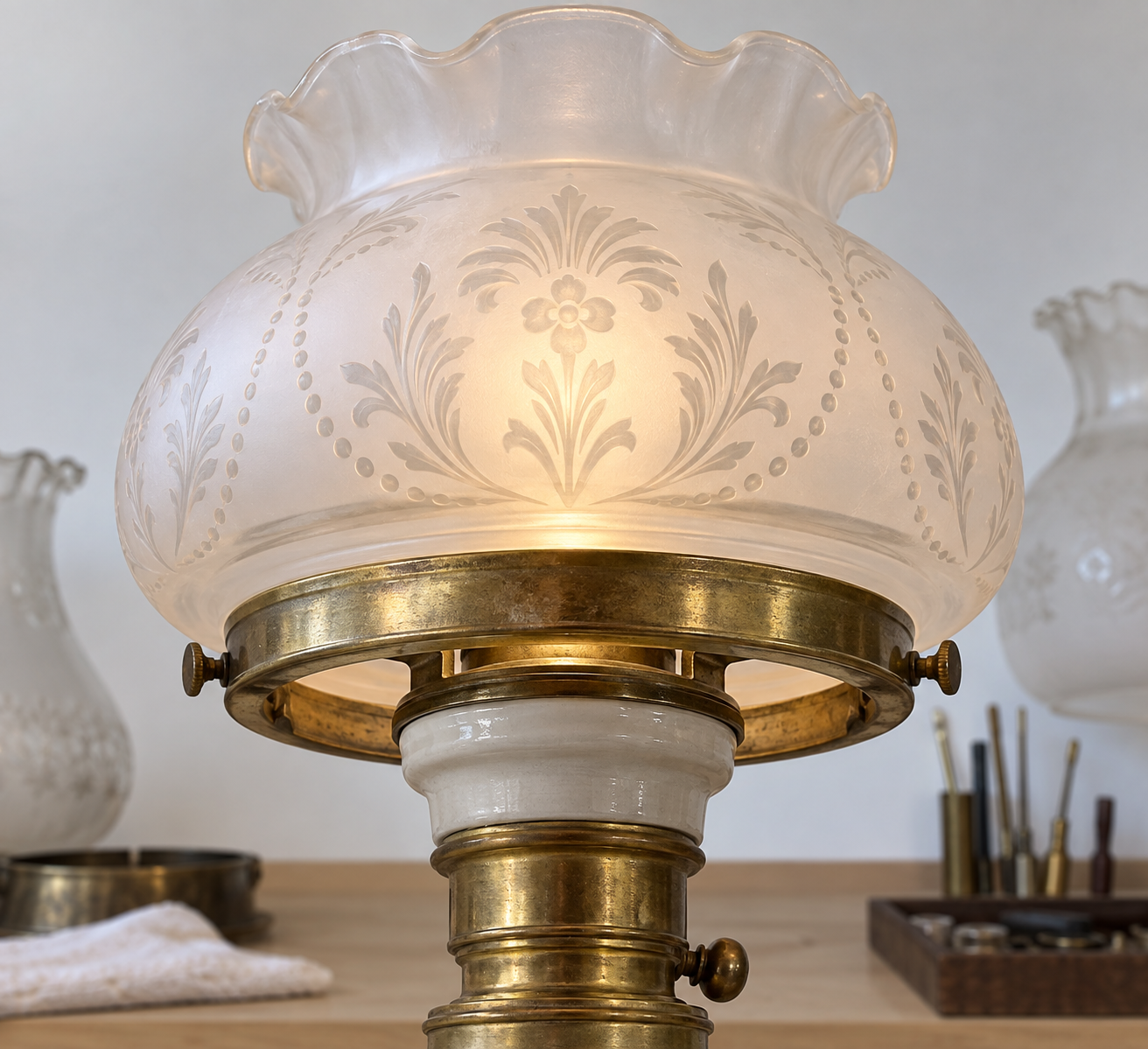
The glass lamp shade fitter guide is useful for the general vocabulary. Gasolier projects need one extra step: measure the gallery or arm seat as well as the glass opening. The holder may look circular but have a shoulder, taper or retaining detail that changes the usable diameter.
How to measure a replacement gasolier shade
Measure the fixture before ordering a replacement. If the original glass is broken, keep every safe fragment that shows the opening or rim. If no fragment remains, the gallery and retaining hardware still provide useful evidence.
Record the following dimensions:
- The largest outside diameter of the glass body, measured at the widest point.
- Overall height from the fitter reference plane to the lowest visible edge.
- Fitter opening inside diameter and outside diameter where the glass contacts the metal.
- Neck length, lip width, shoulder position or entry depth when the shade has a stepped profile.
- Rim thickness and edge finish at the holder contact area.
- Gallery or arm seat diameter, depth and any taper that restricts the glass.
- Clearance from the glass to the bulb, burner, flame path, socket, wire or adjacent arm.
- Angle and spacing of neighboring arms when the fixture uses several matching shades.
- The position of an etch, pattern, seam or colored area if orientation matters.
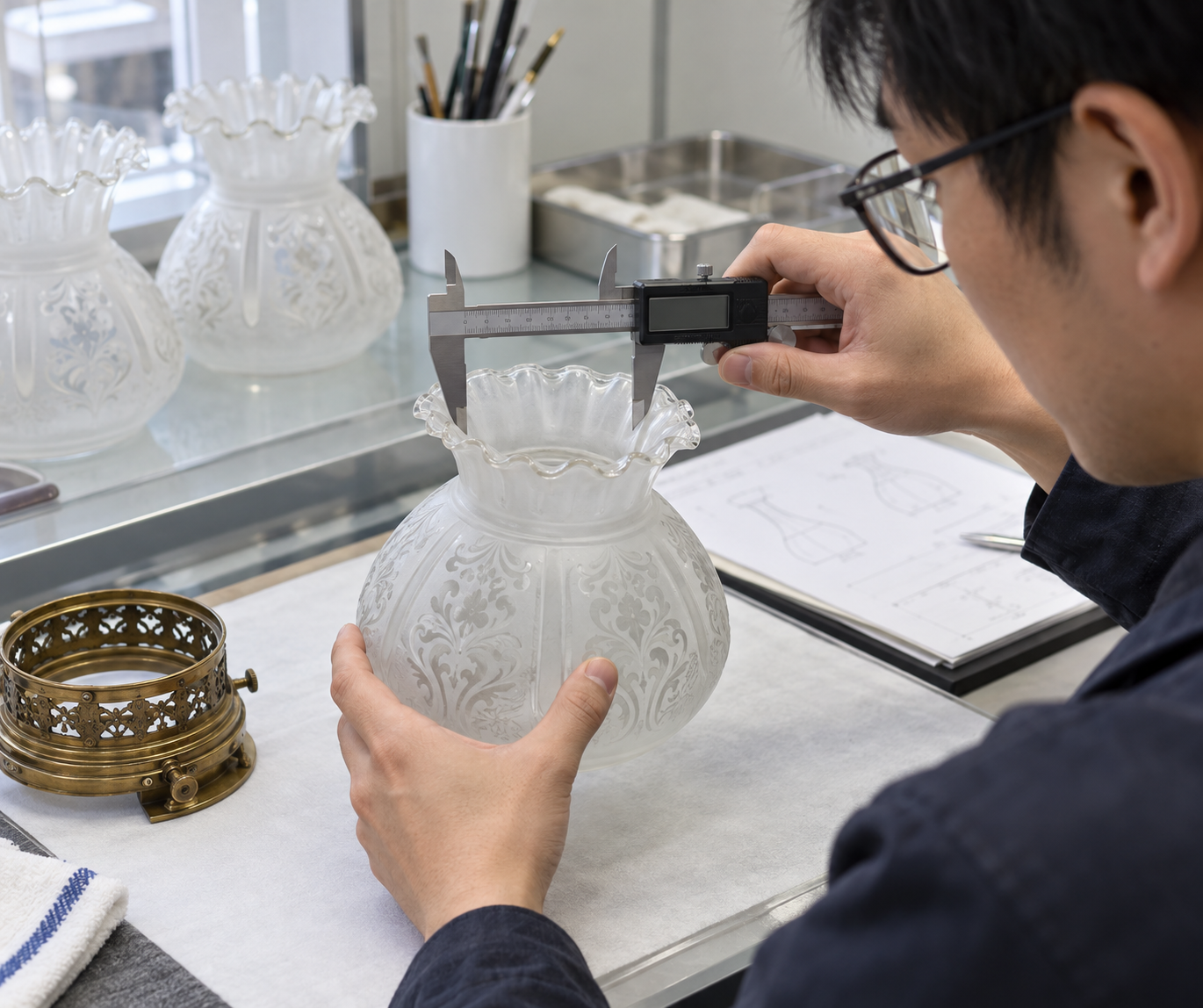
Take two measurements at right angles when the hardware may be old or slightly out of round. Note which measurements are direct, which are estimated from a broken part and which will be confirmed by a sample. The lamp shade size guide explains broader proportion and measurement terms, but it cannot replace a gasolier gallery drawing.
Common fitter sizes and why nominal labels are not enough
Buyers often search for gas or gasolier shades by a nominal fitter size such as 2 1/4 inches, 2 1/2 inches, 3 1/4 inches, 4 inches or 6 inches. These phrases can help locate a candidate, but a seller may measure the opening, the lip, the neck, the holder or a historical trade reference. The same label is not a complete glass specification.
| Nominal reference | What a buyer may mean | Dimensions to confirm | Why the label can mislead |
|---|---|---|---|
| 2 1/4-inch family | Small gas-style opening or fitter reference | Glass opening, lip, neck, seat and body diameter | Sellers may use different reference planes |
| 2 1/2-inch family | Compact replacement glass for a small gallery | Inside diameter, outside diameter and entry depth | A small difference can prevent the glass from entering |
| 3 1/4-inch family | Larger fitter or neck used on some historic assemblies | Neck length, holder depth and retaining ring | The body may still have several possible heights |
| 4-inch family | A broader opening or gas-style shade family | Actual opening, rim thickness and gallery support | The body shape and heat clearance remain unknown |
| 6-inch family | A large lip, ring or body reference | Which part is six inches and how the shade is supported | The number may describe the body, not the fitter |
| Custom reference | A fixture-specific old part or brand profile | Complete section and critical interface points | A catalog size cannot replace the original evidence |
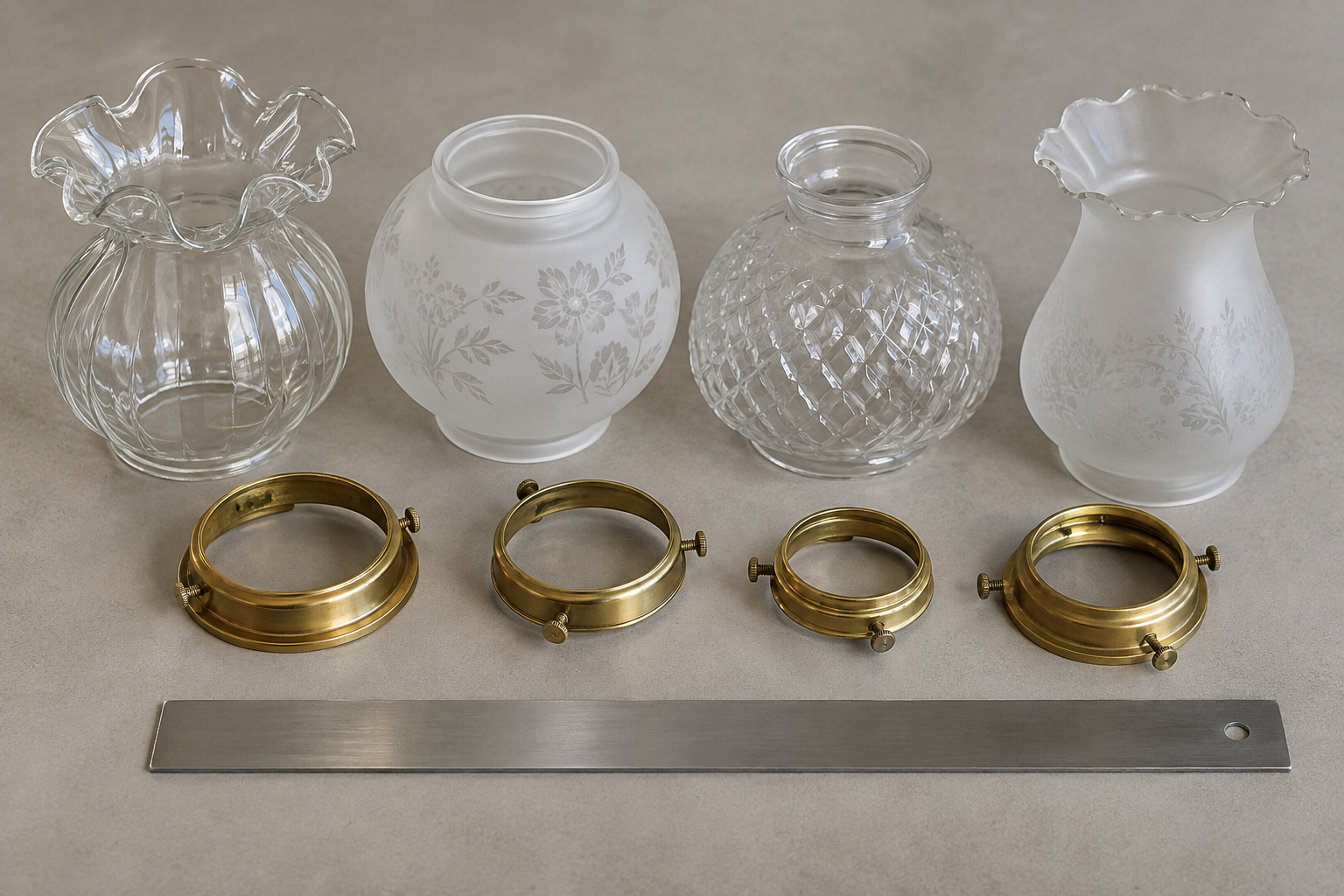
Do not order from a fitter number alone. Send a side profile, a close image of the gallery, the largest diameter, the height and the retaining method. If the project is a paired or multi-arm fixture, state whether all pieces must match within a visual range.
Clear, etched, satin, opal, milk, colored and seeded glass
Gasolier shades are often chosen for the way their surface looks when the fixture is off. The illuminated appearance can be very different. Clear glass may show the bulb and metalwork. Etched glass can soften the view while adding a period pattern. Opal and milk glass can make the shade read as a luminous white form. Colored or seeded glass introduces another layer of variation.
| Finish or glass choice | Unlit appearance | Illuminated behavior | Buyer approval point |
|---|---|---|---|
| Clear | Transparent body and visible hardware | More direct transmission and sharper source visibility | Source glare, surface clarity and edge appearance |
| Pattern etched | Decorative matte or acid-etched motif | Softer source image with pattern-dependent diffusion | Pattern scale, coverage, orientation and clear fitter area |
| Satin or frosted | Low-gloss surface with reduced reflection | More even highlights and a softer glow | One-side or two-side treatment and coverage boundary |
| Opal | Translucent white or lightly colored body | Broad diffusion and less direct view of the source | Opacity under the intended light source |
| Milk glass | More solid historic or porcelain-like appearance | Strong diffusion and a different off-state color | Body appearance, wall consistency and lighted sample |
| Colored glass | Green, amber, smoke or another controlled hue | Tinted transmission and changed contrast around the source | Color target in daylight and in the installed condition |
| Seeded or textured glass | Bubbles or surface movement in the body | Irregular local diffusion and visible highlights | Acceptable seed range, wall thickness and pair matching |
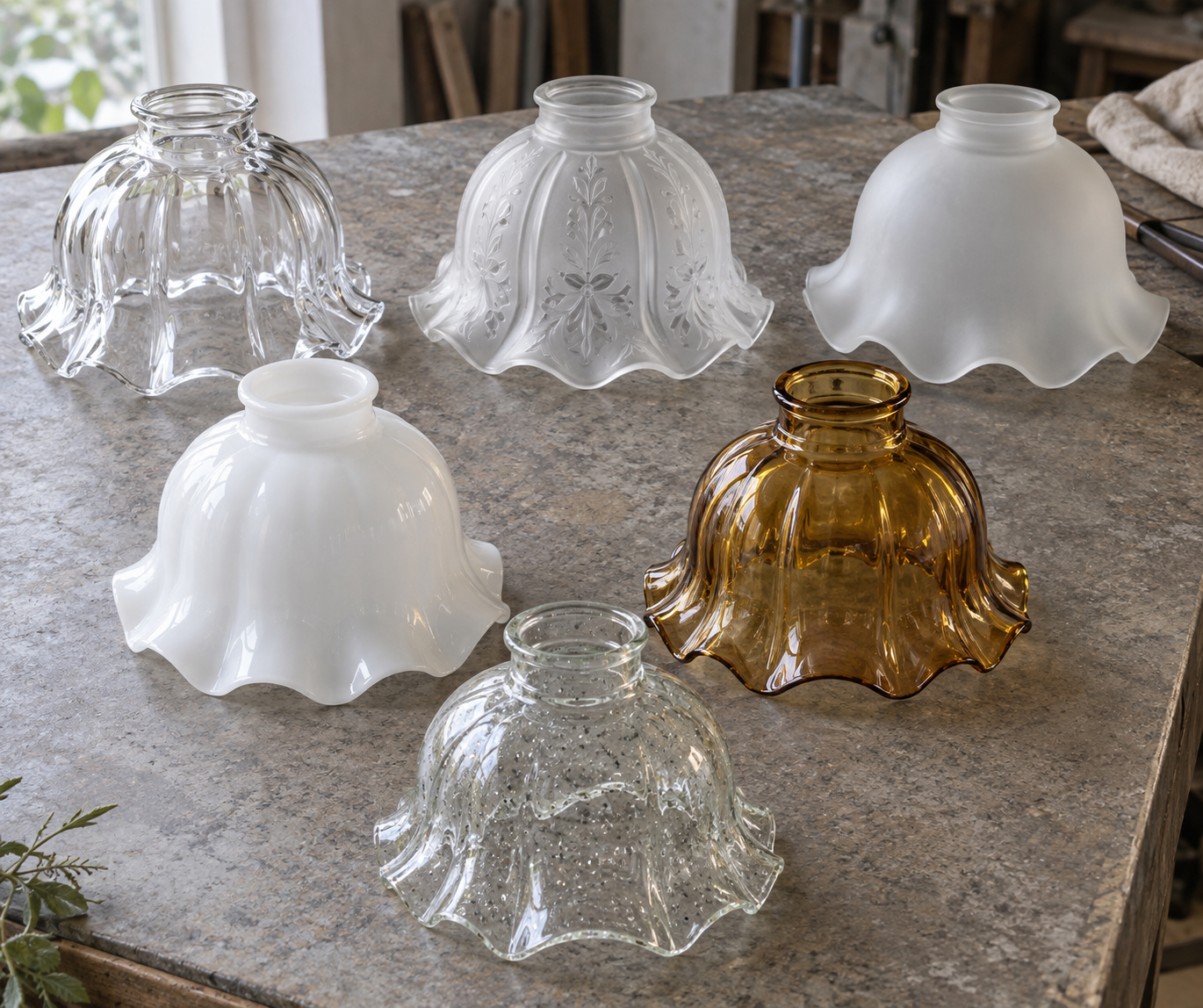
Do not describe an etched gasolier shade only as "vintage". State the pattern, the area covered, the surface side, the clear fitter zone and the visual standard. For a restoration project, compare the sample beside the surviving fixture. For a new collection, retain an approved sample so later batches have a stable reference.
Light diffusion and heat context
Light distribution depends on the glass body, wall thickness, finish, source position and shade profile. A transparent shade may preserve a historic appearance but reveal a bright filament or burner. An opal or milk body may hide the source more effectively but change the character of the fixture. A patterned etch can create a softer image without making the whole shade opaque.
| Design variable | More direct transmission tends to provide | More diffusion tends to provide | Buyer question |
|---|---|---|---|
| Clear versus opal body | More visible source and sharper highlights | Softer source and broader glow | Is the target an authentic clear look or a more comfortable visual result? |
| Etch density | Defined pattern and visible glass depth | Lower source contrast in treated areas | Which pattern and coverage should the sample show? |
| Color depth | Stronger fixture identity and tinted light | Lower apparent source brightness in some zones | Does the color need to match when the lamp is lit? |
| Body curvature | Directional or concentrated light in some areas | Broader spread from other profiles | Where should the fixture send light? |
| Wall thickness | More direct transmission at thinner sections | More absorption or diffusion at thicker sections | Which dimensions are critical for the process? |
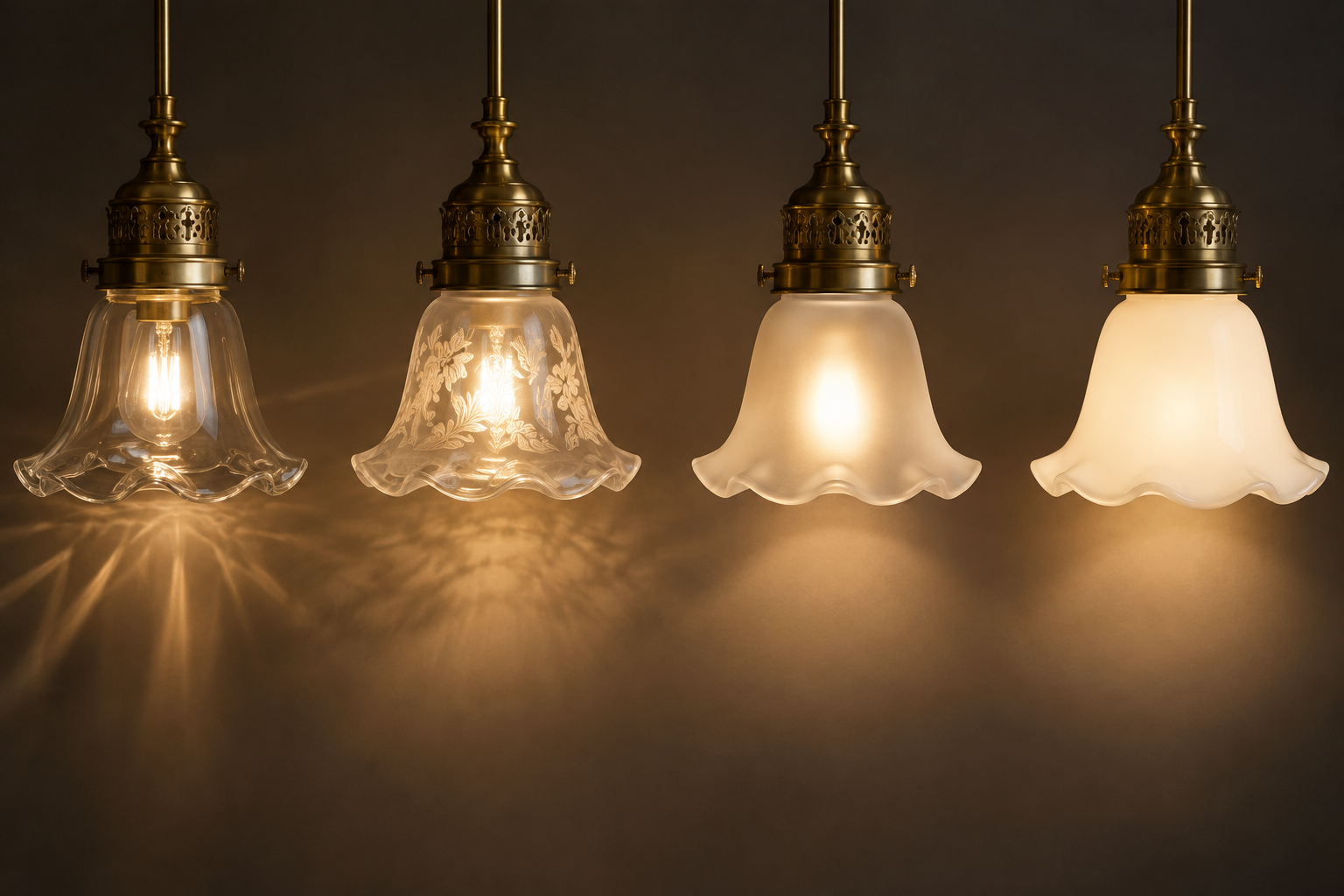
Gas, converted electric and modern electric fixtures do not create the same heat conditions. A replacement glass shade should not be approved for a live flame or a particular lamp source from a photograph alone. Provide the intended source, operating condition, clearance and any known fixture limitation. Confirm material, wall thickness and thermal suitability with the engineering team for the actual assembly.
Mouth-blown versus pressed gasolier shade production
The production route should follow the profile, order pattern, finish, acceptable variation and tooling plan. Mouth-blown forming can be useful when the buyer is matching an irregular historical part or developing a low-volume sample. Pressed forming can be useful when the profile is stable and the buyer needs repeatable geometry after a mold is approved.
| Production route | Where it can fit | Main control question | Buyer trade-off |
|---|---|---|---|
| Mouth-blown forming | Historic reproduction, low-volume custom work or flexible profile development | How will the approved range of variation be defined? | More profile flexibility, with more operator influence |
| Pressed forming | Stable profile, repeat program or planned product family | Can the mold and process hold the critical interface? | Better repeatability after tooling, with a tooling decision up front |
| Pressed body with secondary finish | Repeatable body with etch, satin or color treatment | Which step controls the visible finish boundary? | More process checkpoints and a separate finish approval |
| Formed and cut or ground profile | Special open shapes or a defined secondary edge | Can the cut edge and body survive handling and fitting? | More finishing work and a need for edge inspection |
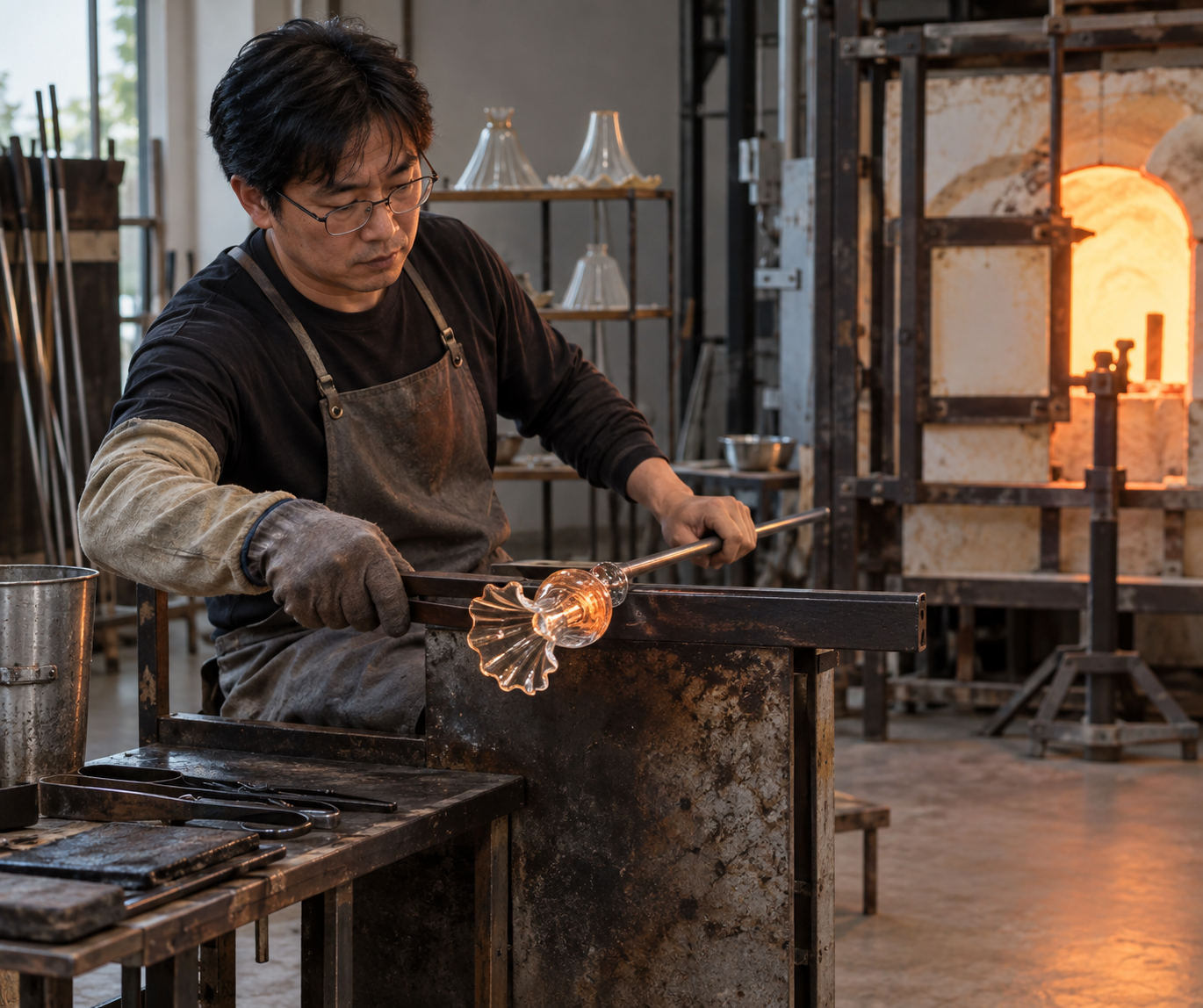
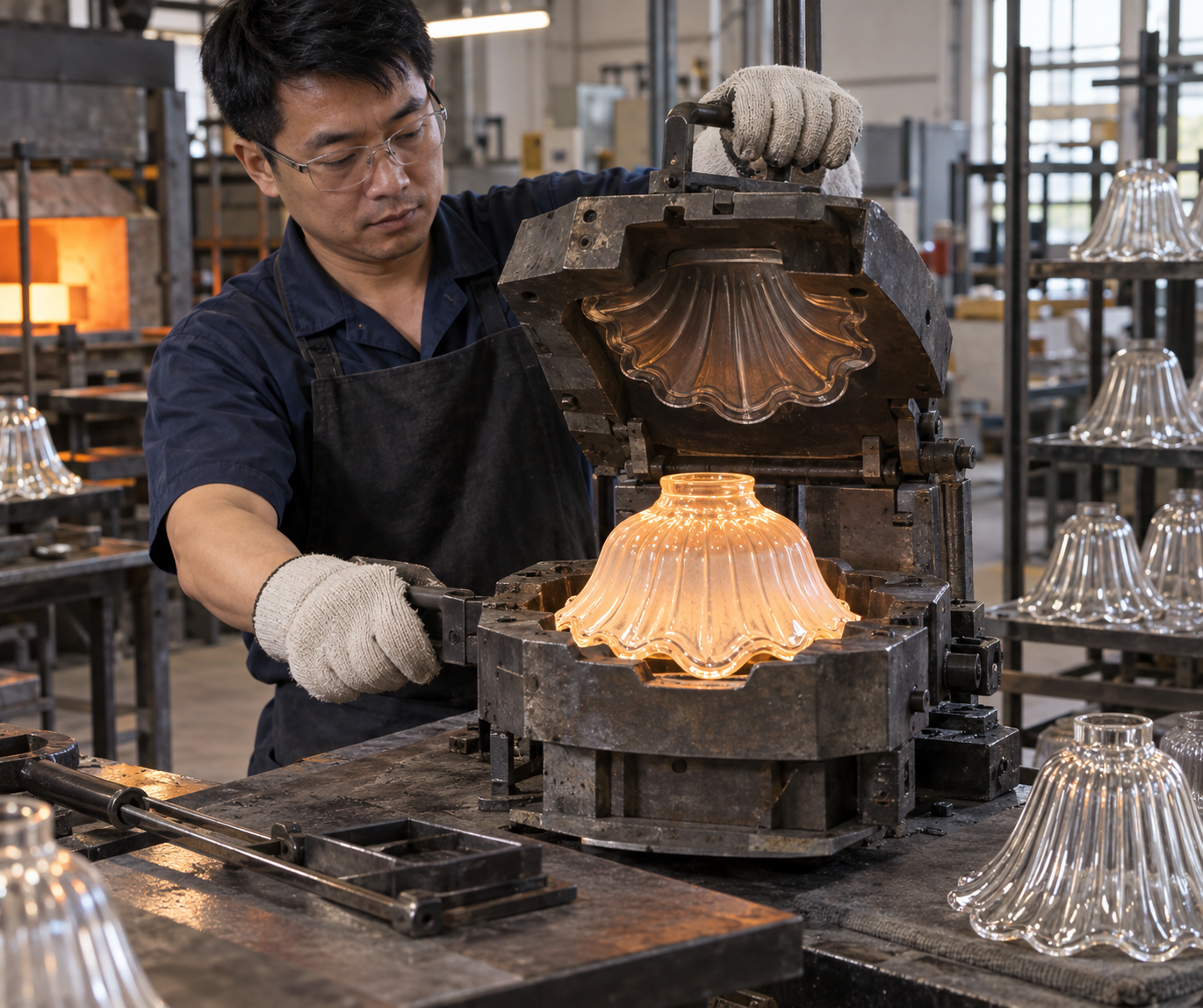
The pressed glass lamp shades guide and mouth blown glass lamp shade page provide broader process context. For a gasolier program, the route should be confirmed from the drawing, glass type, finish, quantity pattern and required repeatability. A process name is not a quality grade by itself.
Custom mold development for a repeat gasolier profile
An OEM gasolier shade usually needs a section drawing or a controlled physical reference. The development package should show the fitter or gallery seat, body diameter, overall height, wall thickness target, rim treatment, finish coverage and relationship to the light source. If the shade is a pair or part of a multi-arm fixture, include the matching requirement.
The mold review should answer these questions:
- Which dimensions define the fixture interface and cannot move?
- Which dimensions are appearance-driven and can use an agreed range?
- Where can a parting line, tool mark or forming trace appear?
- Is the glass formed directly to a mold or finished after forming?
- How will the fitter opening, rim and body diameter be measured?
- Does one mold serve several variants, or does each profile need its own tool?
- Which physical sample becomes the approved master for production?
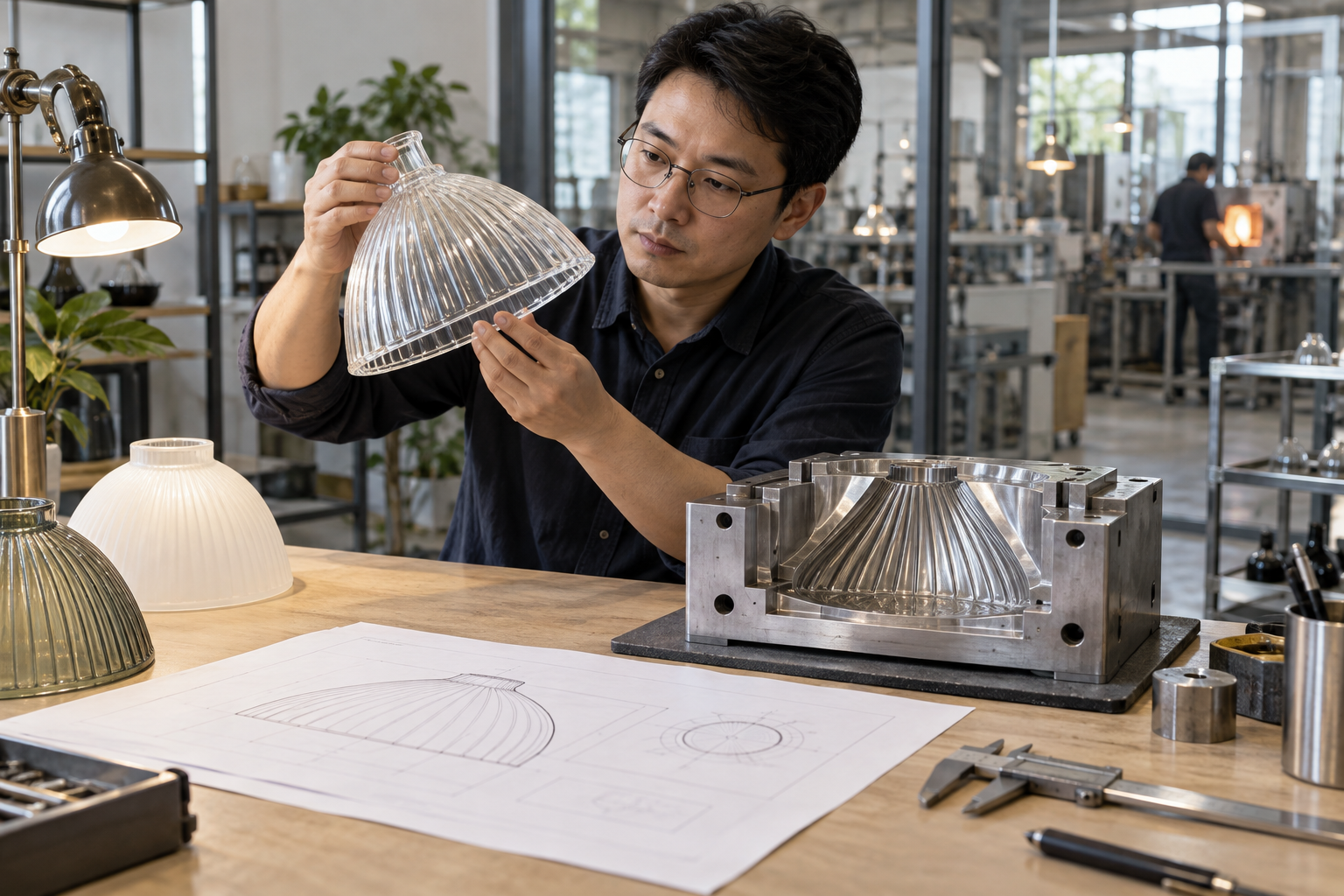
Confirm project-specific tolerances with the engineering team based on the drawing, glass type and production method. A narrow fitter requirement should be listed as a critical inspection point rather than hidden inside a broad overall dimension. The same approach applies to the rim, gallery seat, height and any paired shade matching requirement.
Edge finishing, tolerances and inspection
The shade rim is a functional surface. It may be polished, ground, fire-finished, seamed or otherwise treated depending on how the holder contacts the glass. A rim that looks acceptable from the front can still rock in the gallery, transfer load to one point or create a sharp handling edge.

Inspection can include:
- identity against the approved gasolier profile and drawing revision;
- largest diameter, overall height, fitter opening and seat depth;
- rim or neck thickness at the holder contact area;
- visual review for cracks, chips, sharp edges, unacceptable bubbles or surface marks;
- finish and color comparison in an agreed light condition;
- trial fit on the reference gallery or holder;
- pair or batch matching when the fixture uses multiple shades;
- clearance review against the specified light source and neighboring hardware.
The glass lamp shade quality inspection checklist provides a broader inspection framework. Final defect limits and sampling rules should be agreed for the actual gasolier profile, finish and market. Do not use a generic visual promise as a substitute for a retained sample and a measurable interface.
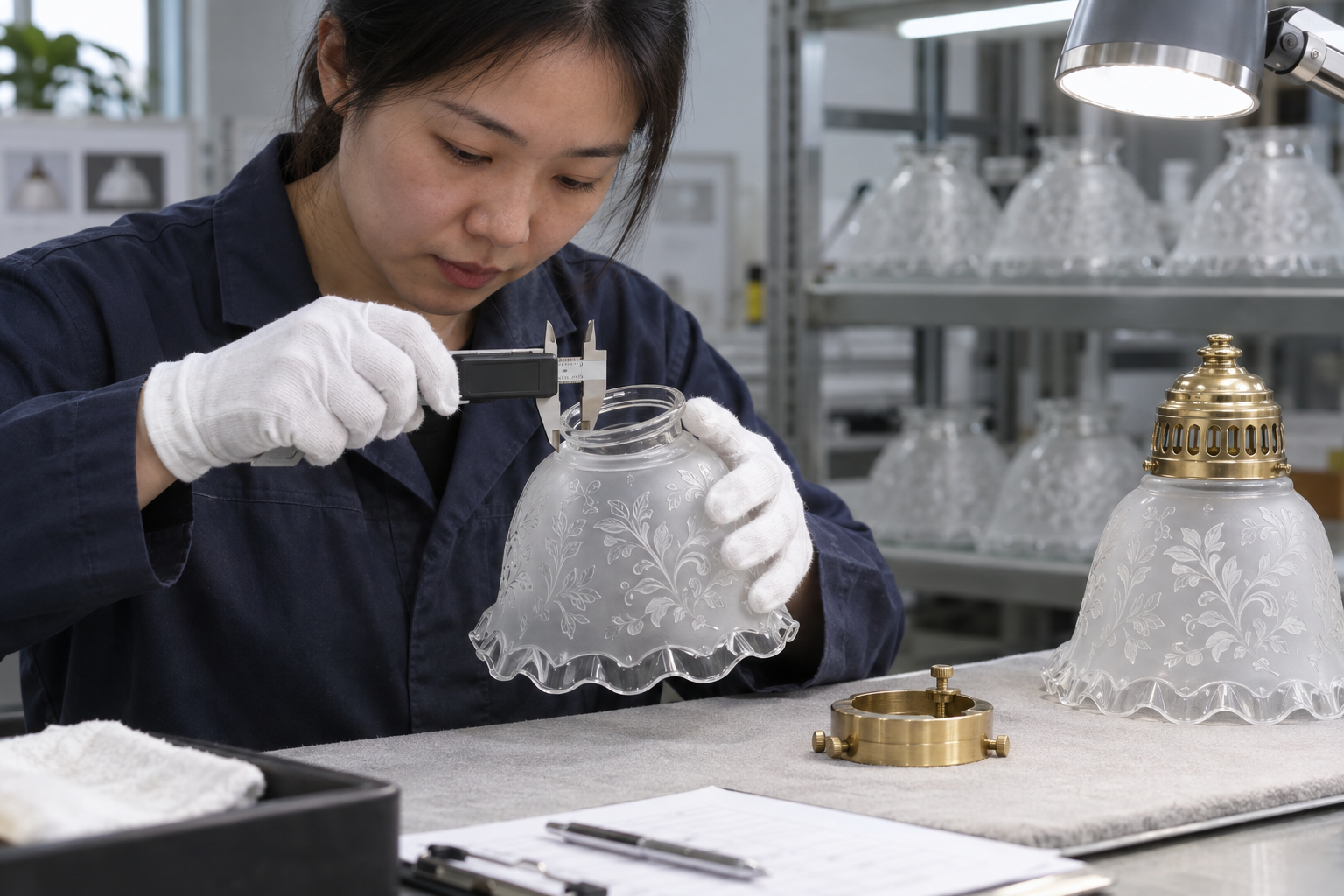
Packaging and international shipping
Gasolier shades often have a vulnerable fitter, a thin rim, a curved body and a surface finish that can rub against another piece. A packing plan should protect the body and the interface separately. The carton should prevent contact between glass pieces and keep the critical edge away from impact.
Ask the supplier to show:
- How each shade is separated from the next piece.
- How the fitter and rim are protected.
- How movement is limited inside the carton.
- How many pieces are packed per carton and how variants are identified internally.
- Whether the packing is intended for parcel, pallet or container handling.
- What the buyer should inspect when the shipment arrives.
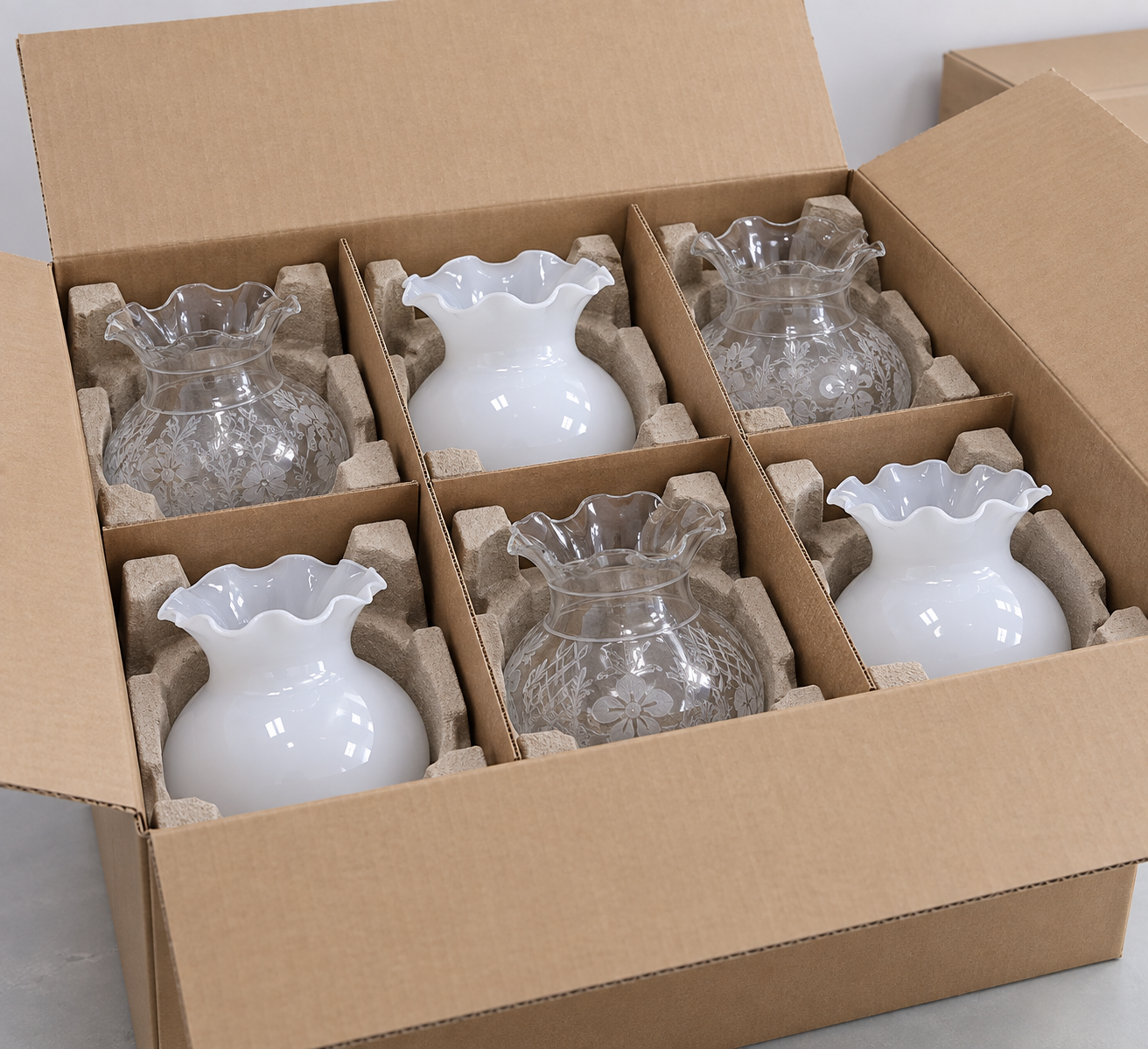
Do not approve export packing from a closed-carton photograph. Request an internal view that shows the rim clearance, divider structure and movement control. Exact carton quantities and shipping recommendations should be confirmed for the final glass dimensions and destination.
Replacement project versus new OEM gasolier program
The same gasolier vocabulary appears in both restoration and new product work, but the buyer's decision is different. Replacement work starts with an existing fixture and a need for compatibility. OEM work starts with a target design and a need for repeatable production.
| Project stage | Replacement gasolier shade | New OEM gasolier shade |
|---|---|---|
| Starting evidence | Original shade, gallery, arm and fixture photographs | Drawing, target profile, concept or approved sample |
| Main decision | Will the replacement fit and look appropriate? | Can the profile repeat at the required quality and commercial basis? |
| Critical dimensions | Fitter, seat, height, diameter, rim and retaining method | Interface plus every controlled body and finish dimension |
| Sample purpose | Confirm fit and visual match | Confirm design, process, finish, inspection and packing |
| Tooling question | Can an existing route reproduce the part? | Is a new mold or process development justified? |
| Repeatability | Match the original or retained reference | Match the approved master and documented project values |
| Commercial input | Number of replacement pieces and urgency | Variants, sample stages, order pattern and replenishment plan |

For a replacement, send the gallery and retaining hardware even when the original glass is available. For an OEM program, separate fixed interface dimensions from appearance preferences. If the buyer only has a marketplace photograph, the first quotation should be marked preliminary until the sample or drawing confirms the section.
MOQ, sampling and quotation inputs
There is no useful universal MOQ, sample fee or lead time for a gasolier shade. A one-time restoration order, a distributor replenishment program and a lighting brand launch have different tooling and inspection needs. The quotation should state its assumptions.
A practical review sequence is:
- Review the fixture photographs, surviving glass, drawing or concept.
- Confirm the gallery, fitter, retaining method, dimensions and light source.
- Select the glass body, color, finish and likely forming route.
- Agree what the first sample must prove.
- Check the sample on the reference fixture or gallery.
- Confirm the production specification, inspection points and packing plan.
- Release a commercial quotation based on the actual order pattern and destination.
MOQ, tooling charges, sample charges, lead time and mass-production capacity must be confirmed with the engineering and commercial team based on the drawing, glass type, production method and order scope. Do not infer them from the historical name or a catalog photograph.
What buyers should send for a gasolier glass shade RFQ
The most useful RFQ is a short evidence pack, not a product name by itself. Send the fields below when requesting a replacement review or OEM quotation.
| RFQ field | What to provide | Why it affects the quotation |
|---|---|---|
| Fixture identity | Gasolier, gas-style, chandelier, wall arm or restoration application | Establishes the fixture context and clearance questions |
| Glass profile | Side view, section sketch, original fragment or controlled photos | Identifies the body, opening and shoulder relationship |
| Dimensions | Largest diameter, height, opening, neck, lip, seat and wall target | Determines forming, finishing and compatibility |
| Gallery details | Arm, ring, socket cup, burner area, retaining ring or clips | Prevents a visually similar but unusable shade |
| Finish and color | Clear, etched, satin, opal, milk, colored or seeded reference | Changes light transmission, appearance and process choice |
| Light source | Gas, converted electric or electric source and relevant clearance | Guides thermal and optical review without assuming compliance |
| Quantity pattern | Samples, first order, annual estimate, variants and pair matching | Supports tooling and repeat-order discussion |
| Quality standard | Critical dimensions, visual defects, finish and fit checks | Turns preferences into acceptance points |
| Packing and destination | Individual protection, carton expectations and shipping country | Defines packaging scope and handling assumptions |
| Commercial format | Target price basis, Incoterm or quotation format if known | Helps the supplier return a usable commercial response |
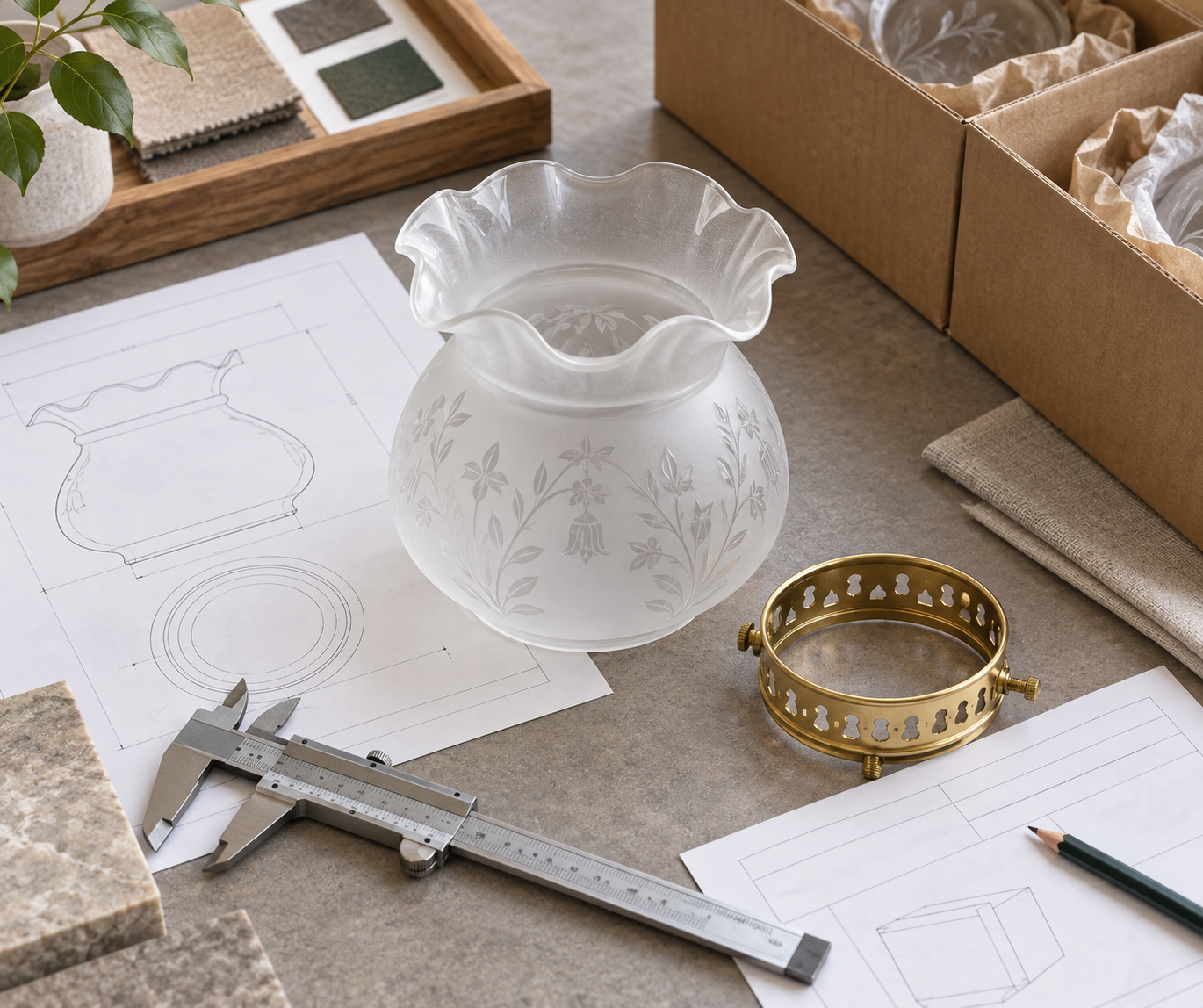
For a project review, start with the custom glass lamp shades manufacturer page and the glass lampshade manufacturing overview. Include a side profile and a close image of the gallery in the first message. If the shade is for restoration, include the original retaining hardware so the quotation does not rely on the word gasolier alone.
Buyer questions
What does gasolier mean?
Gasolier is a historical lighting term associated with gas-light, electric or combination fixtures. In a shade request, it usually points to a glass component made for a gas-style arm, gallery or chandelier. The word does not establish a universal shade profile or fitter.
What is a gasolier glass lamp shade?
A gasolier glass lamp shade is a glass cover fitted to a gasolier or gas-style lighting assembly. It may be clear, etched, satin, opal, milk, colored or textured. The glass must be specified by its profile and interface as well as its appearance.
How do I identify a replacement gasolier shade?
Photograph the fixture, gallery or arm, retaining hardware and original glass opening. Measure the largest diameter, height, fitter opening, seat, rim and clearance to the light source. A side profile and a close image of the metalwork are usually more useful than a full fixture photograph.
Are gasolier fitter sizes standardized?
No. Nominal references such as 2 1/4 inches, 2 1/2 inches, 3 1/4 inches, 4 inches or 6 inches can describe different reference points in different listings. Confirm the actual opening, lip, seat, body diameter and holder depth before ordering.
Can an antique gasolier shade be reproduced?
It may be possible when the buyer can provide a safe original sample, a section drawing or enough measured photographs to reconstruct the profile. The forming route, glass type, finish and order pattern determine whether an existing process or a custom mold is appropriate. Confirm the project after engineering review.
Is etched or clear glass better for a gasolier fixture?
Neither is always better. Clear glass preserves a more direct view of the source and hardware. Etched glass softens reflections and can support a period appearance. Choose from the surviving reference, light-source behavior, glare goal and the finish standard that can be repeated.
Is mouth-blown or pressed glass better for a gasolier shade?
Mouth-blown forming can suit a one-off restoration or an irregular historic profile when controlled variation is acceptable. Pressed forming can suit a stable profile and repeat program after tooling is approved. The correct route depends on the drawing, glass, finish, quantity and required repeatability.
Can gasolier shades be made for OEM or wholesale programs?
An OEM review should include the profile, gallery interface, glass finish, light source, quantity pattern, inspection points and packing requirement. Send a drawing, sample or controlled photos for a project-specific assessment. Confirm MOQ, tolerance and lead time with the engineering and commercial team.
What should I send for a gasolier glass shade quotation?
Send fixture photographs, the original shade or fragments, a side profile, fitter and gallery measurements, glass and finish direction, light-source information, quantity, inspection expectations, packing needs and destination. The more clearly the interface is shown, the fewer assumptions the quotation needs.
Start with the gallery, then approve the glass
The reliable way to source a gasolier glass lamp shade is to identify the gallery and retaining method first, then approve the glass profile, finish and lighted appearance. A historical name can begin the search. It cannot replace the section, measurements or sample review.
Use the contact page to send the gasolier shade photographs, drawing or sample details. The team can confirm the suitable review path with the glass type, production method and order information rather than assuming a nominal fitter or a catalog label is enough.
Related gasolier glass shade resources
| Glass lamp shade fitter guide | Antique glass lamp shade replacement guide | Pressed glass lamp shades |
| Mouth blown glass lamp shade | Custom glass lamp shade manufacturer | Contact JX Lampshade for an RFQ |