
A measurable Art Nouveau lamp sourcing guide
Art Nouveau Lamp Design Guide: Glass Shade Shapes, Finishes and OEM Sourcing
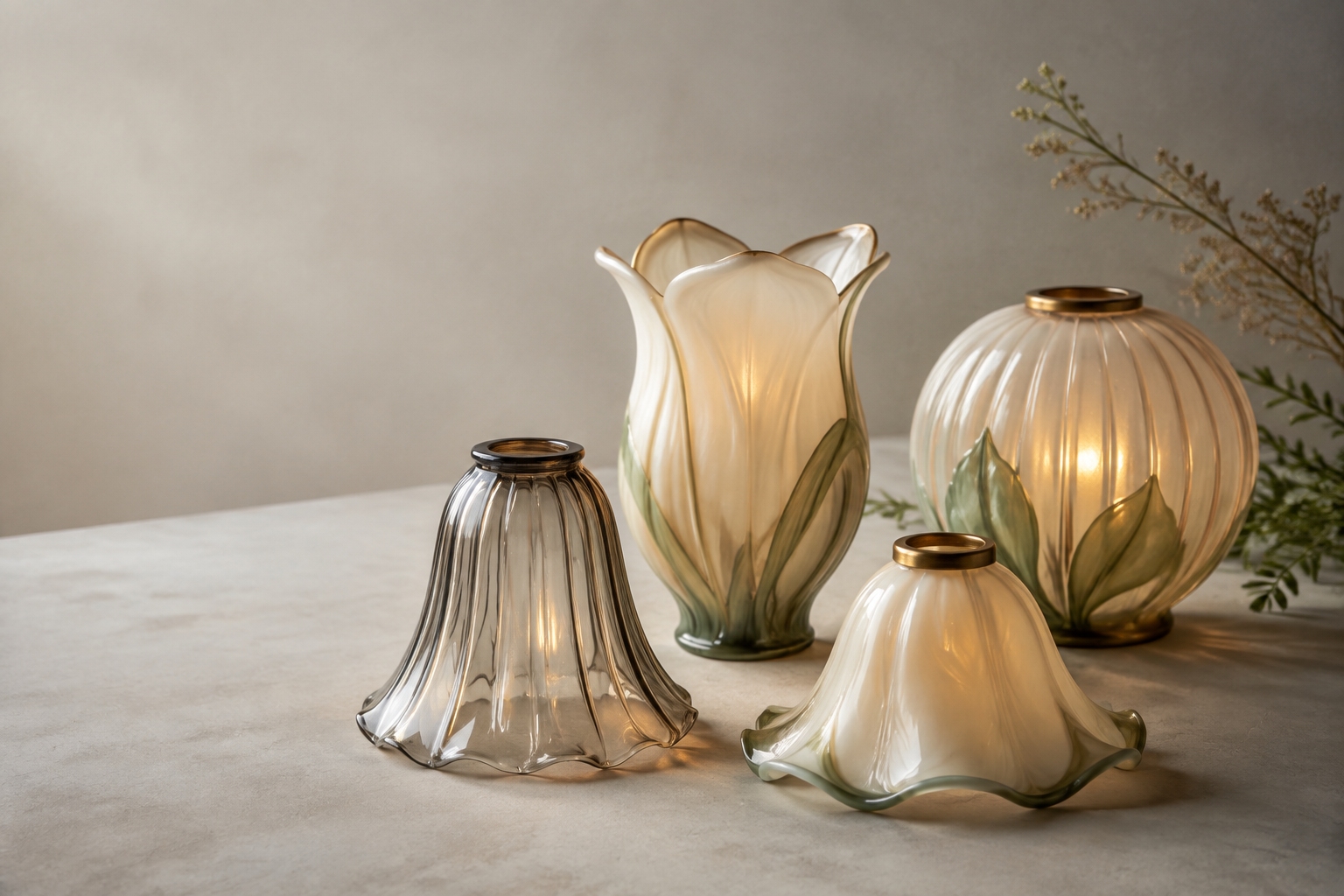
An Jugendstil-Lampe is a lighting design direction associated with flowing organic lines, plant or insect references, curved silhouettes, and expressive glass or metal work. It is not a standard shade size or a universal fitter. For a buyer, the useful specification is the style direction plus the exact glass profile, opening, attachment method, finish, quantity, and application.
If you are sourcing a replacement shade, begin with the fixture and its measurements. If you are developing a new collection, treat Art Nouveau as a visual brief that must be translated into a repeatable glass part. This guide explains what to specify, what to ask a manufacturer, and how to move from a reference image to an approved production sample.
Style definition
What is an Art Nouveau lamp?
Art Nouveau is best used as a style description, not as proof that a lamp is an original historical object. The Victoria and Albert Museum describes the movement through sinuous, undulating lines and the use of natural forms in glass and jewellery. Its collection examples also show how different makers developed their own approaches to colour, surface effects, and organic decoration. Read the V&A overview of Art Nouveau glass.
For a modern lamp or glass shade, the phrase usually signals a design language such as a vine-like curve, a flower or lily profile, a softened asymmetrical outline, or a surface that changes as light passes through it. It does not, by itself, define the maker, manufacturing process, date, glass composition, or fixture interface.
| Style signal | What a buyer can specify | What the word does not prove |
|---|---|---|
| Flowing line | A curved rim, tapered body, or asymmetrical decoration direction | That the item is an antique or made by a historical studio |
| Botanical reference | Leaf, flower, vine, water-lily, or seed-pod inspiration | The exact pattern, tooling method, or repeat size |
| Organic silhouette | Bell, tulip, lily, globe, flared, or softly folded profile | The opening diameter or the way the shade is retained |
| Layered colour | Clear base with coloured, opal, frosted, or iridescent effect | The production repeatability of every colour shift |
| Art glass surface | Pulled, pressed, ribbed, carved, applied, or textured appearance | The applicable tolerance, inspection standard, or cost |
The Metropolitan Museum of Art records historical lamp shades made in blown or Favrile glass, including pieces connected with Tiffany and Quezal. Those collection records are useful for studying proportion and surface language, but a modern OEM order still needs its own drawing, sample, and approval criteria. Compare the Met record for a Quezal glass lamp shade with its separate Tiffany Favrile lamp shade record to see why a historical name should not replace a technical description.
Scope check
Is an Art Nouveau lamp the whole fixture or only the shade?
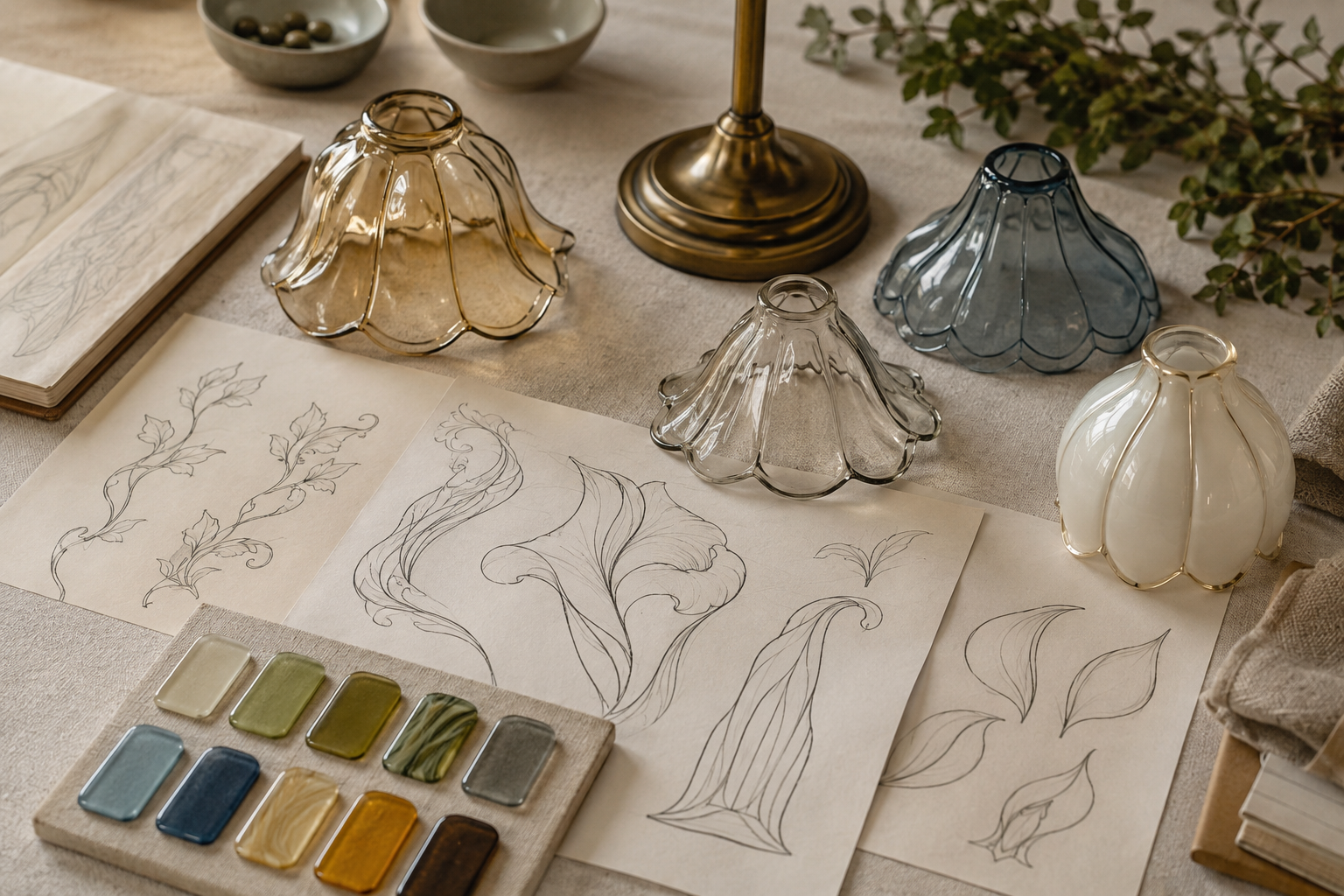
Searchers often use Art Nouveau lamp to mean a complete table lamp, pendant, wall light, or chandelier. A glass manufacturer usually needs to know whether the request is for the complete luminaire, the glass shade only, or a shade that must fit an existing metal or electrical assembly.
| Buyer wording | Likely project scope | Clarify before requesting a quote |
|---|---|---|
| Jugendstil-Lampe | Complete lamp or lighting collection | Is the base included, and which party owns the electrical design? |
| Art Nouveau glass lamp shade | Glass component for a lamp | Shape, glass finish, opening, retention, and seated dimensions |
| Art Nouveau replacement shade | One or more glass parts for an existing fixture | Original sample, fixture photos, interface dimensions, and quantity |
| Art Nouveau pendant lamp | Suspended fixture with a shade or diffuser | Suspension point, load path, top opening, cable clearance, and orientation |
| Art Nouveau table lamp | Table or desk fixture with a shade | Base seat, socket position, shade height, and visual proportion |
This distinction prevents a common sourcing error: quoting a visually similar bell or tulip shade without checking how it sits on the holder. If your project is for a new lamp collection, send the complete fixture envelope or a simplified base model. If it is a replacement, send the remaining hardware and the shade's load-bearing reference plane.
Design brief
Which Art Nouveau design signals should a buyer put in the brief?
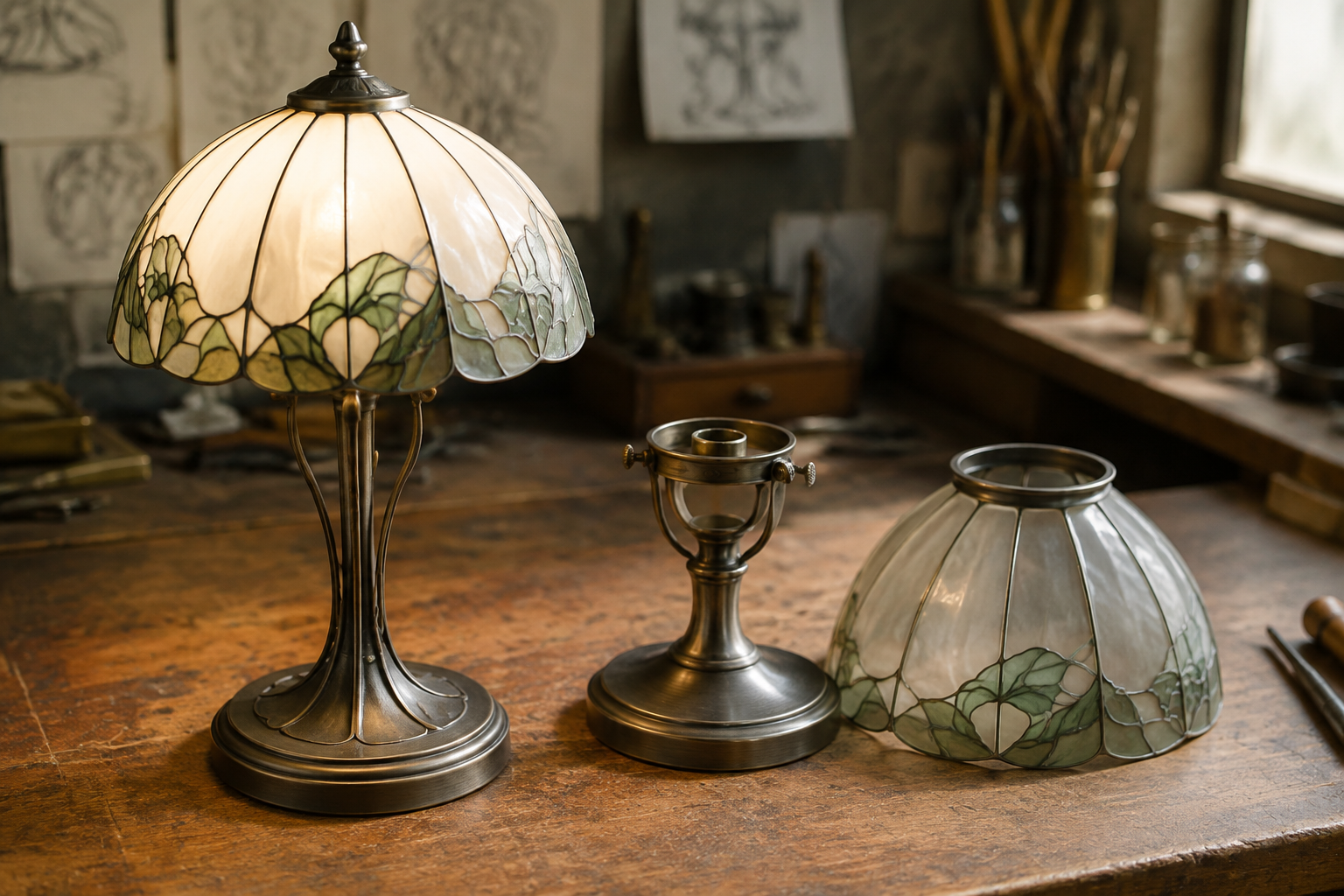
Start with design decisions that can be seen, measured, sampled, and inspected. A useful brief does not need to copy a museum object. It can describe the desired rhythm of the line, the height of the shade, the level of transparency, and the relationship between the glass and the holder.
Use this seven-part design brief:
- Line direction: flowing vertical ribs, a curling rim, a gentle shoulder, or a restrained organic curve.
- Botanical reference: lily, iris, vine, leaf, seed pod, blossom, or an abstract natural form.
- Silhouette: bell, tulip, globe, flared dome, folded petal, cylinder with a shaped rim, or another measured profile.
- Light behaviour: direct sparkle, broad diffusion, low-glare glow, patterned projection, or a partially screened source.
- Surface treatment: clear, opal, frosted, seeded, ribbed, pressed, etched, coloured, or an approved iridescent effect.
- Hardware relationship: exposed fitter, concealed retaining ring, clips, gallery, gasket, socket collar, or pendant stem.
- Collection consistency: a family rule for rim diameter, colour range, texture scale, and repeatable decoration.
A useful test is whether two suppliers could read the brief and produce samples that belong to the same collection. "Vintage and elegant" is not enough. "Soft tulip profile, 180 mm maximum outside diameter, opal body, lightly ribbed vertical texture, 42 mm lower opening, visible brass retaining ring" is much easier to review.
Finish selection
Which glass finish works for an Art Nouveau lamp?
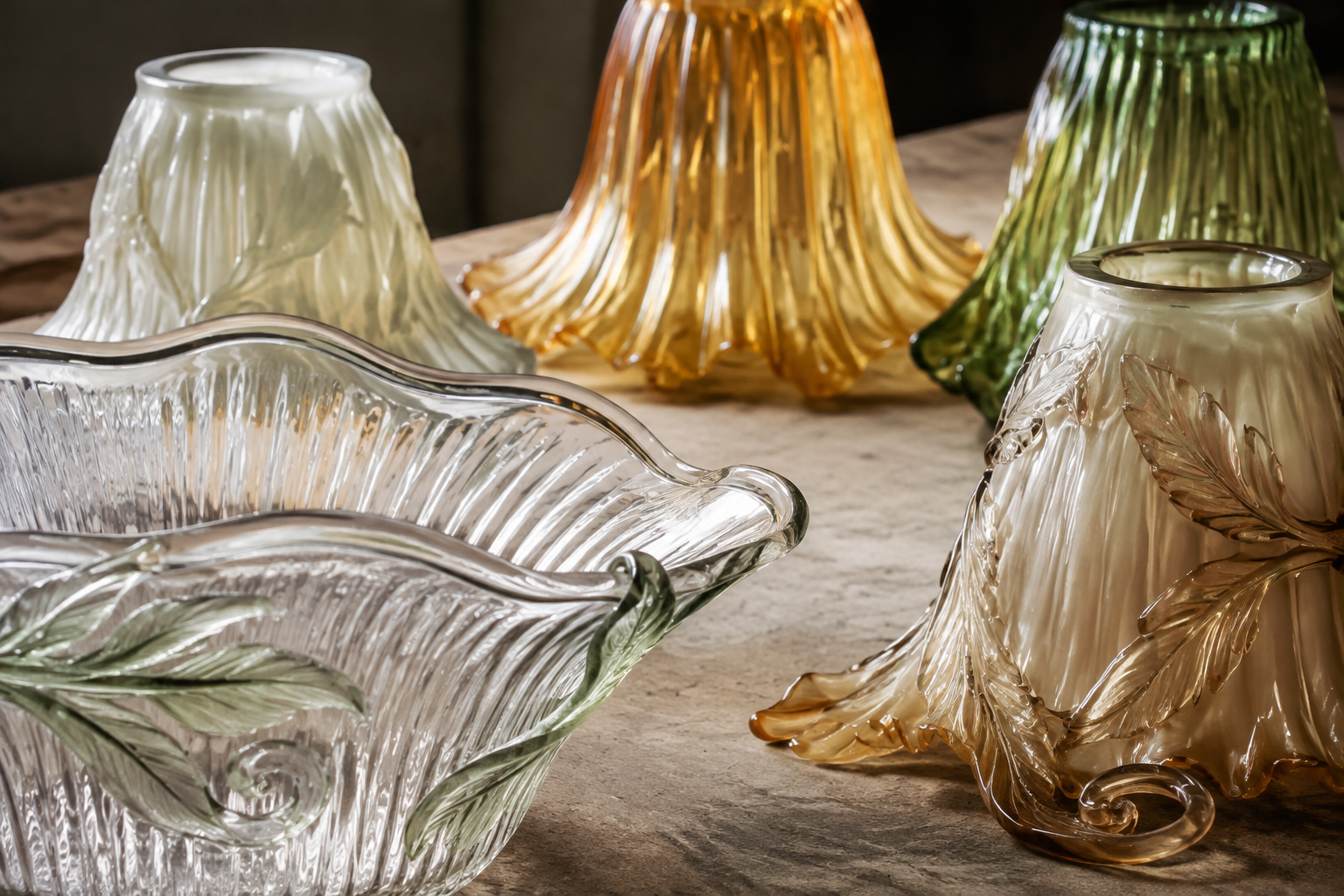
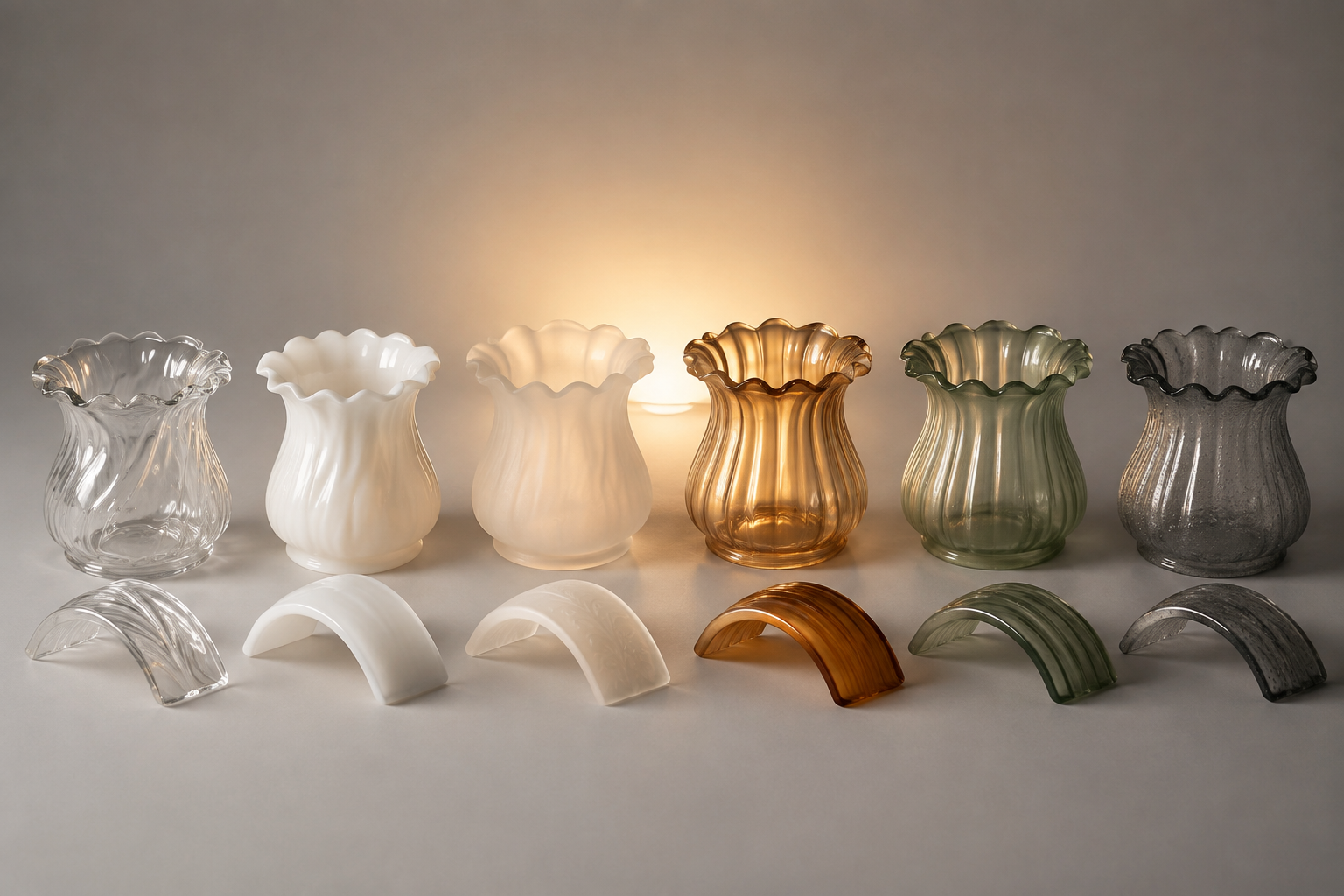
Finish should be selected against the desired light output, visual identity, and production repeatability. A dramatic surface can look attractive in a single studio sample but create variation across a production run if the visual acceptance rule is not defined.
| Oberflächenrichtung | Visual and lighting effect | Questions to settle in sampling |
|---|---|---|
| Klarsichtiges Glas | Shows the bulb, holder, and profile sharply; can create crisp highlights | How much glare is acceptable, and does the fixture need a diffuser? |
| Opal or milk-white glass | Softens the source and gives the shade a solid, luminous presence | Which opacity range and colour temperature should the sample represent? |
| Frosted or satin glass | Reduces reflections and creates a quieter surface | Is the finish on the full body, selected zones, or the inside surface? |
| Ribbed or fluted glass | Adds vertical rhythm and can create bands of highlight and shadow | What is the rib pitch, depth, orientation, and cleaning requirement? |
| Seeded or bubbled effect | Adds visual texture and small variations in the light field | What level of variation is acceptable and where must the opening remain clean? |
| Coloured glass | Builds the collection palette and changes the lit appearance | Is the colour body-through, coated, layered, or a sample-matched effect? |
| Iridescent effect | Produces changing colour as the viewing or lighting angle changes | How will colour range, viewing angle, and surface uniformity be approved? |
The V&A notes that iridescence was especially associated with Art Nouveau glass and could be produced through metallic fumes on hot glass. That historical reference is useful for understanding the look, but a contemporary project should define the exact finish method with the manufacturer rather than assume that every iridescent effect is equivalent. See the V&A glass glossary for iridescence.
Profile choice
Which shade shapes suit an Art Nouveau lamp?
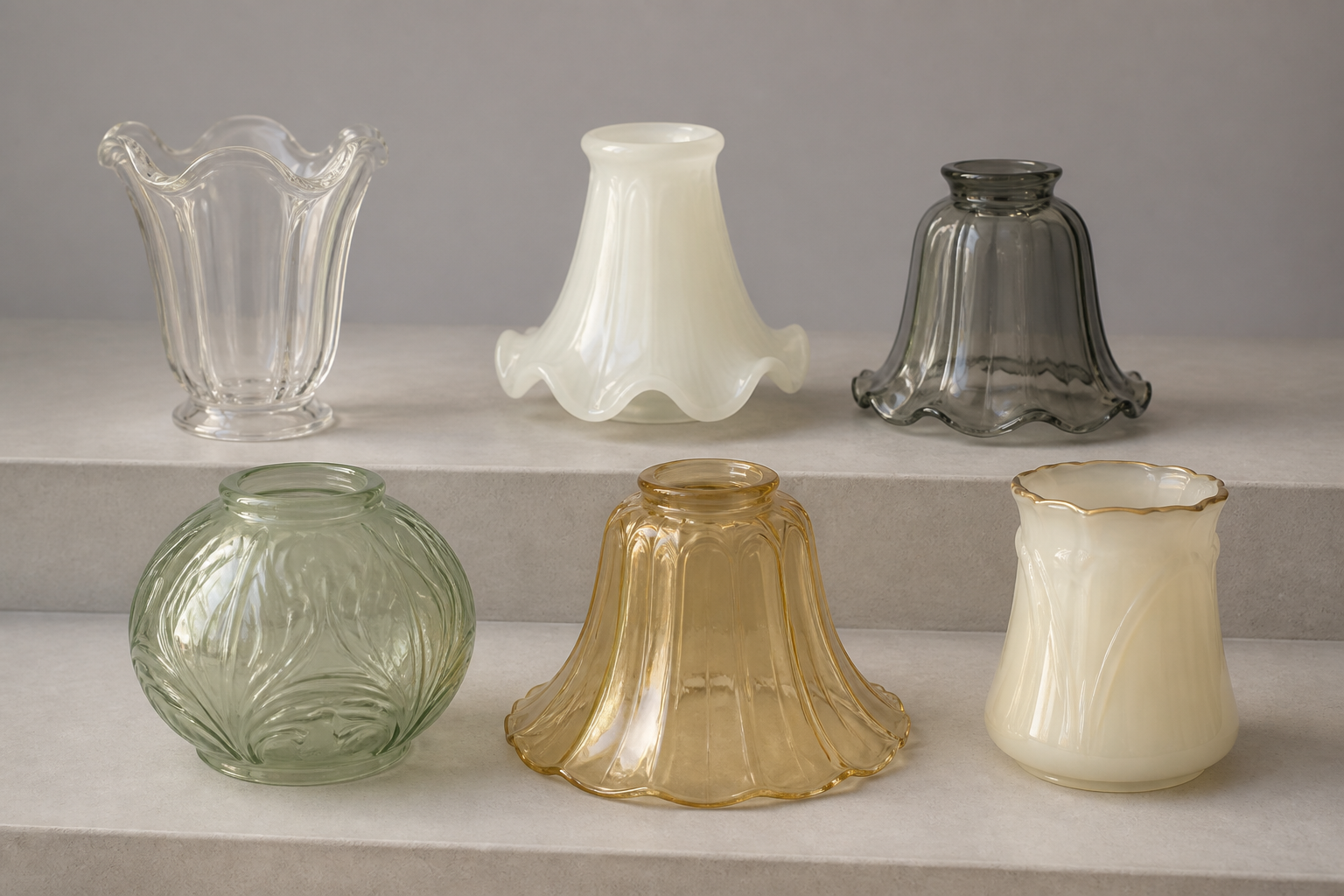
The strongest shape is the one that carries the visual reference while preserving the intended fixture fit. A distinctive rim or shoulder can make a standard glass family feel more organic without forcing every part of the design to be a one-off.
| Schirmprofil | Why it can support the style | Fit and production points |
|---|---|---|
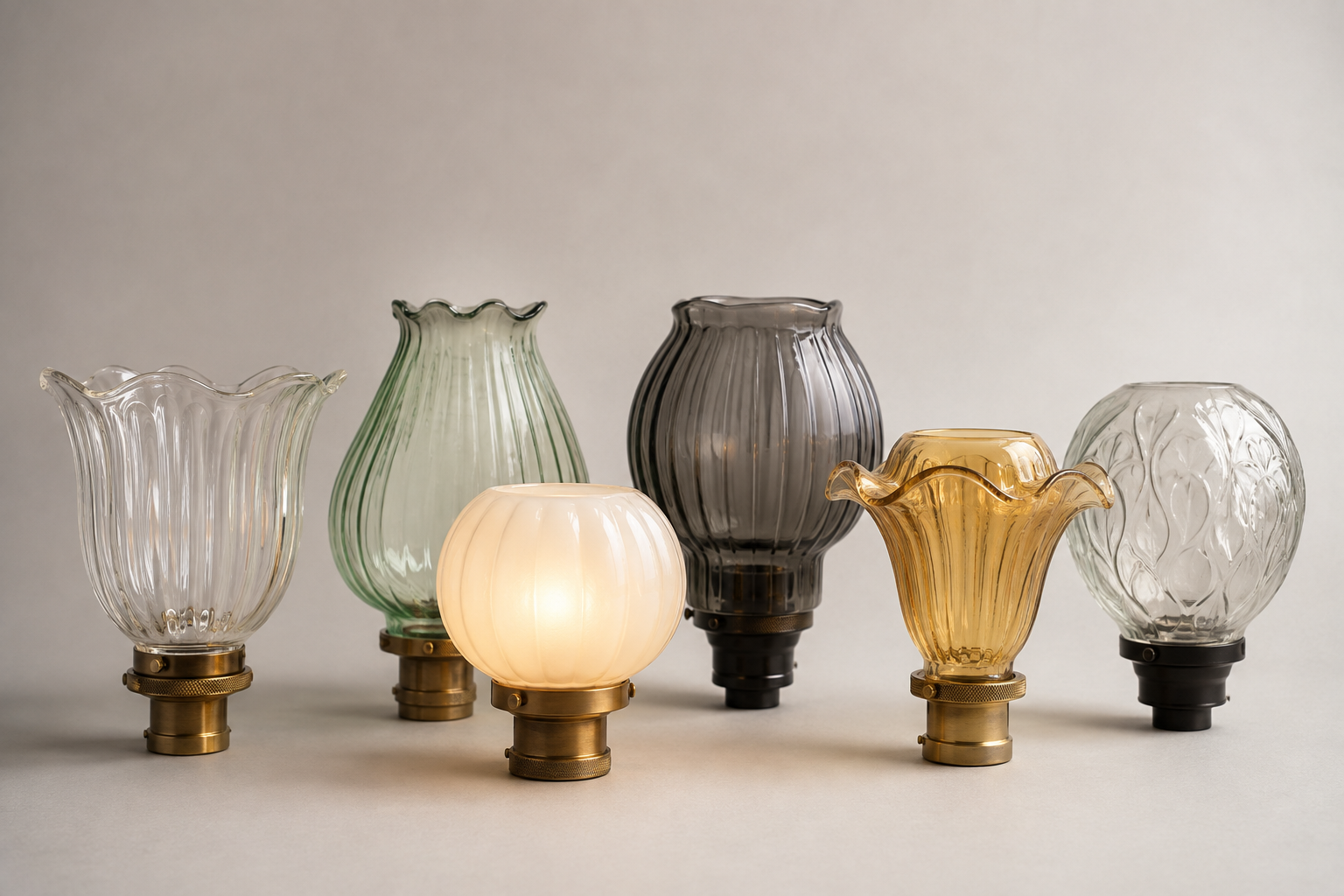
| Tulip or lily | Naturally supports petal, flower, and upward-opening references | Record the neck or lower opening, petal rim, seated height, and rim variation |
| Glocke | Gives a soft, flowing body with a clear lower edge | Confirm the fitter, wall thickness at the rim, and largest diameter |
| Globus | Creates a rounded, enclosing silhouette for pendants or table lamps | Confirm neck, cap clearance, orientation, and retaining method |
| Flared dome | Provides a broad light spread with a sculptural shoulder | Check top opening, body diameter, and the load-bearing ring |
| Folded or scalloped rim | Adds movement without requiring a complex surface pattern | Define the number, depth, and rotational position of the folds |
| Shaped cylinder | Keeps the interface simple while allowing an organic rim or rib pattern | Confirm straightness, edge finish, opening dimensions, and holder clearance |
If you are comparing several forms, the JX lampshade shapes glossary can help you name the profile before you send a drawing. Use the style phrase as a design direction and the measured profile as the manufacturing instruction.
Measurement control
What measurements control the fit?
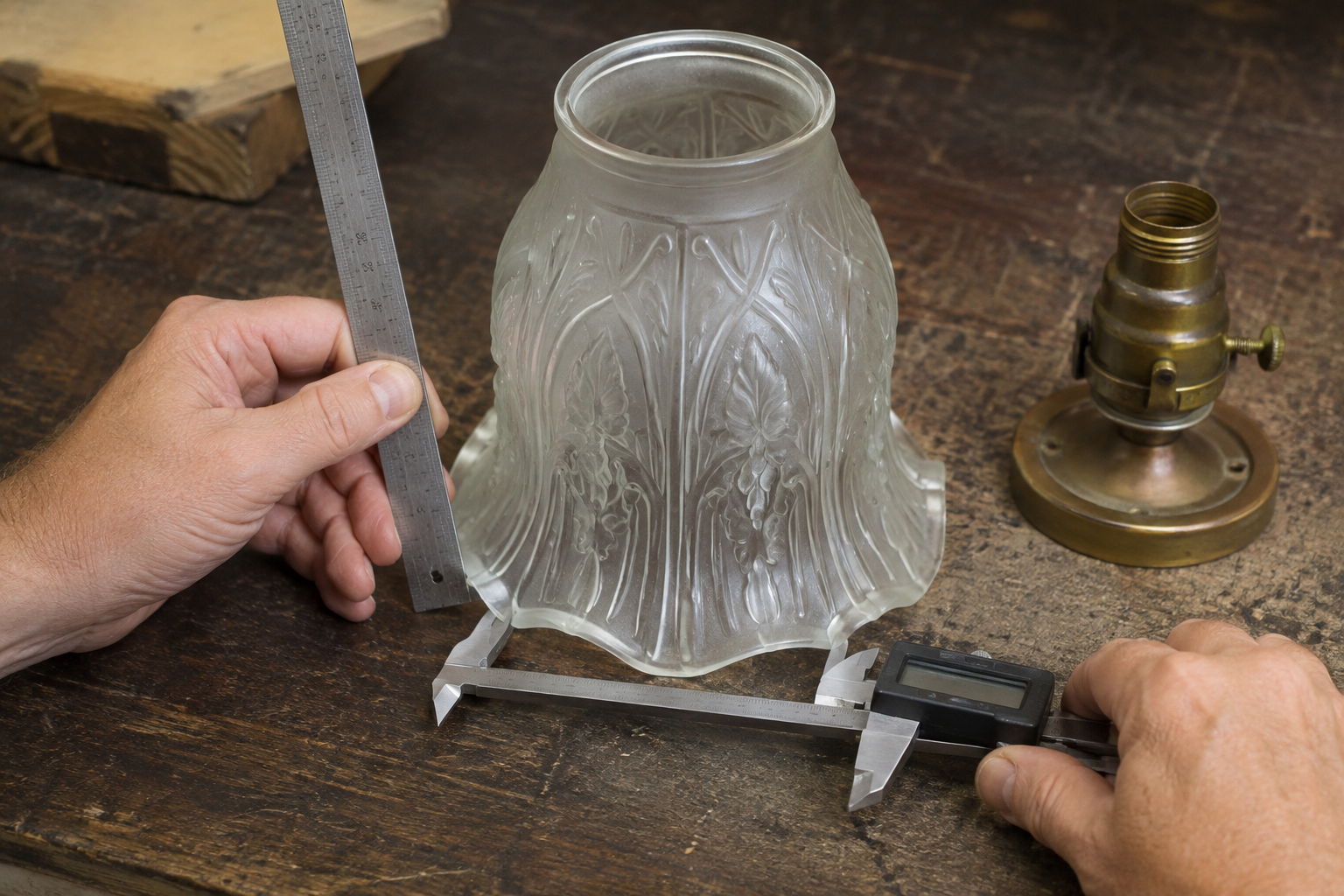
For a replacement or an OEM shade, the opening and load path matter more than the style label. Measure from a named reference plane and use the same units throughout the request. If the shade is broken, photograph the fixture and the remaining interface before handling fragments.
Record at least these seven fields:
| Messung | Was zu erfassen ist | Warum es wichtig ist |
|---|---|---|
| Lower opening inside diameter | The clear opening where the shade enters or sits | Prevents a shade from stopping early or passing through the support |
| Lower opening outside diameter | The outside rim or seat diameter | Determines whether a retaining ring, gallery, or clip can hold it |
| Seated height | From the support surface to the top reference point | Controls the lamp's proportion and clearance |
| Maximaler Körperdurchmesser | The widest outside dimension and its height above the seat | Prevents contact with the frame or nearby hardware |
| Top opening or neck | Inside and outside dimensions, including any lip | Leaves room for a cap, stem, cable, vent, or socket collar |
| Rim and contact thickness | Thickness where the ring, clip, channel, or gasket touches | Helps the manufacturer review the mechanical interface |
| Orientation and clocking | Which way a pattern, opening, or asymmetric rim faces | Prevents the approved sample from being assembled in the wrong direction |
Do not use the widest diameter as a substitute for the fitter. Two shades can share a maximum diameter and still be incompatible because their lower opening, seat depth, or retaining ring is different. A side profile, a top view, and a photograph with a ruler often answer questions that a single front photograph cannot.
Interface review
How do the fitter and holder affect the order?
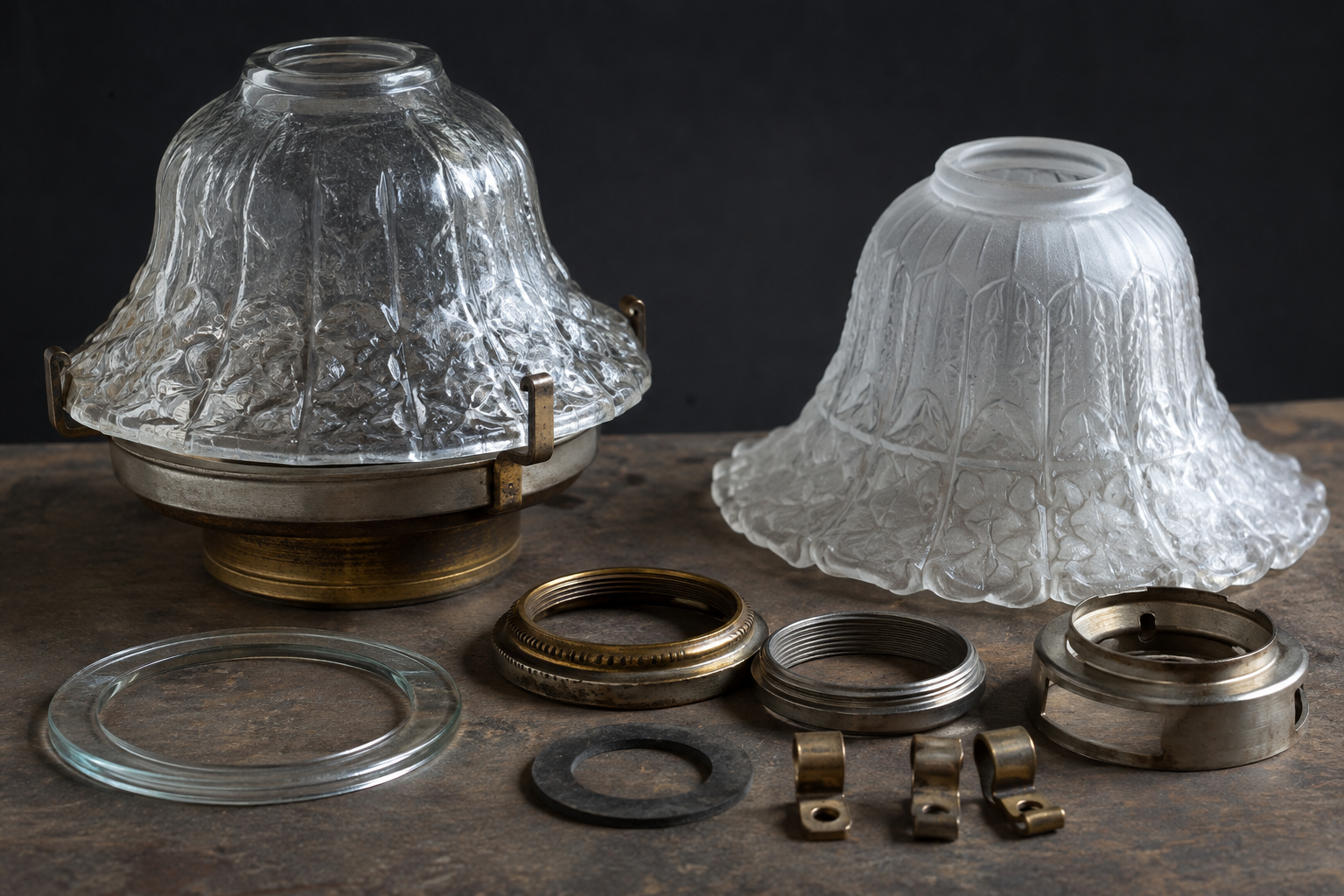
The bulb holder is the electrical part that accepts the lamp base or socket connection. The fitter describes how the glass is captured by the fixture hardware. Depending on the design, the rim may land on a shoulder, pass through a gallery, meet a ring, or sit against clips or a gasket. Keep those two descriptions separate in the RFQ.
For a quote, show the shade and hardware together. Identify the supporting contact points, the direction of the load, and any movement allowance, gasket, metal thickness, or visible gap that the assembled product must preserve. A front photo rarely shows enough of this relationship.
| Interface question | Beweise, die gesendet werden müssen |
|---|---|
| Does the glass enter an opening or sit on a shoulder? | Inside and outside diameters plus a section sketch |
| Is a ring or gallery visible? | Photo of the ring installed and removed, if safe to do so |
| Are clips or set screws used? | Number, position, contact width, and a photo of the hardware |
| Is the shade suspended from the top? | Suspension point, stem or cable clearance, and orientation |
| Does a gasket touch the glass? | Gasket profile, contact width, and any compression requirement |
For more technical terminology, review JX's Leitfaden zu Standards für Glasschirmbefestigungen before finalizing the drawing.
Sourcing route
Should you source a replacement, catalog shade, or custom OEM part?
The right route depends on how much evidence you have and whether the part must be repeated. A one-off antique replacement may require identification and careful matching. A lighting brand or distributor usually needs repeatable dimensions, a stable finish direction, and a clear reorder reference.
| Project situation | Recommended route | Minimum evidence |
|---|---|---|
| One damaged shade with intact hardware | Replacement review | Fixture photos, remaining interface, seven measurements, and quantity |
| Several fixtures with a common fitting | Catalog or adapted standard form | Fitter dimensions, target profile, finish, quantity, and application |
| New Art Nouveau inspired collection | Custom OEM development | Design brief, drawing or sample, finish target, quantity plan, and packaging needs |
| Distributor assortment | Catalog plus selected custom options | SKU family, case pack, price target, repeat schedule, and market requirements |
| Hospitality or multi-site rollout | Project-specific development and approval | Fixture schedule, revision control, inspection points, and delivery plan |
JX's public product and service information describes catalog and custom glass shade routes. The working commercial details remain project-specific: JX's published baseline starts catalog supply at 500 units, while full custom OEM work starts at 1,000 units. Final MOQ, lead time, tooling, finish, sample plan, and packaging are confirmed in the quotation. Do not treat a style article or a historical keyword as a substitute for a project quote.
RFQ-Checkliste
What should an Art Nouveau lamp RFQ include?
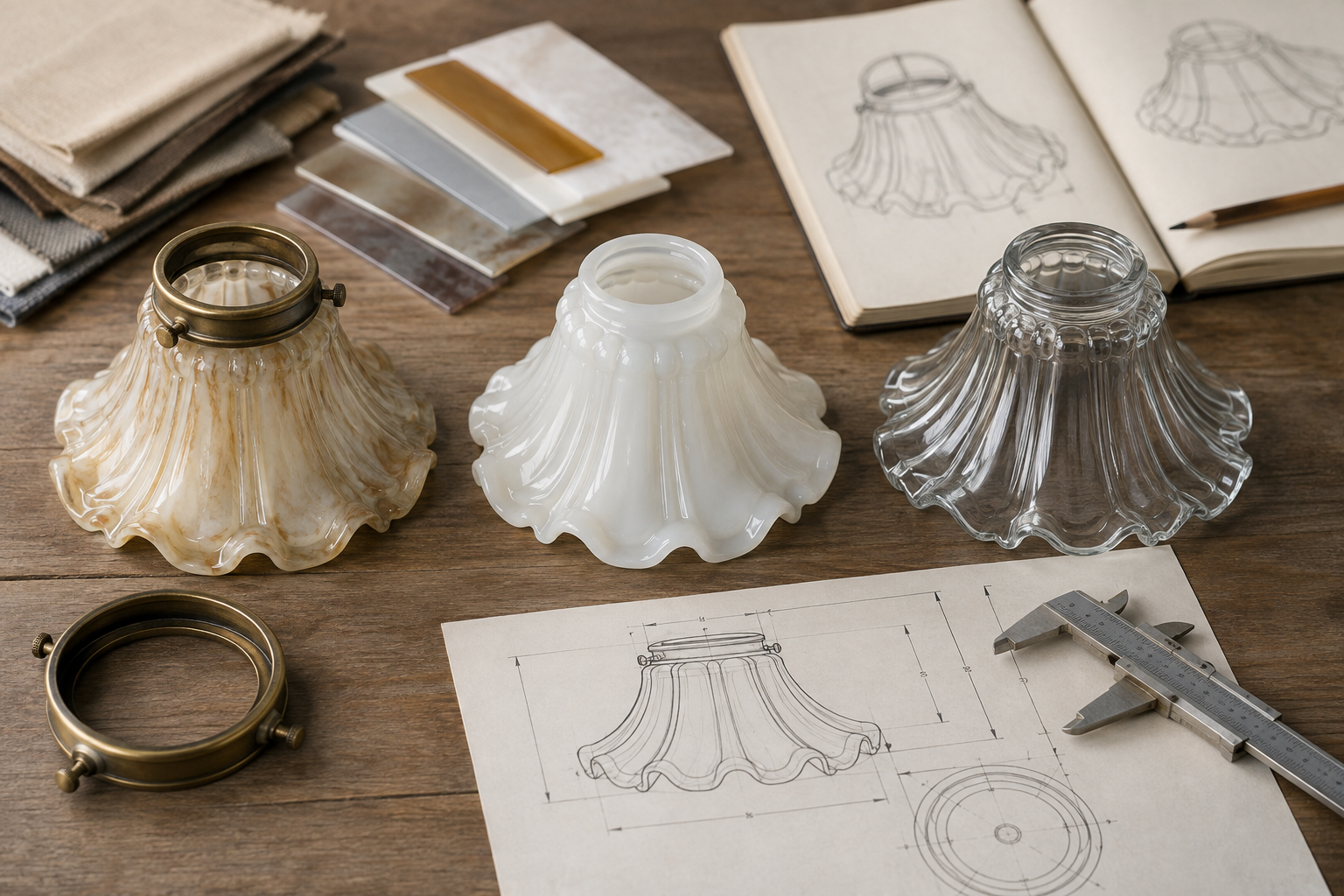
An efficient RFQ lets the supplier separate design questions from fit questions. Put the following fields in one package:
- Project role: replacement, catalog purchase, private-label assortment, or custom OEM/ODM development.
- Fixture application: table lamp, pendant, wall light, ceiling fixture, chandelier, or another luminaire.
- Style direction: the organic line, botanical reference, silhouette, texture, and level of historical influence.
- Part geometry: a dimensioned profile drawing or a physical reference sample.
- Schnittstelle: lower opening, top opening, retaining ring, fitter, clips, gasket, stem, and orientation.
- Glass target: clear, opal, frosted, ribbed, seeded, coloured, iridescent, or a defined combination.
- Performance context: bulb or light-source position, heat conditions supplied by the fixture maker, desired diffusion, and clearance envelope.
- Commercial plan: sample quantity, production quantity, MOQ, target delivery window, and expected reorder pattern.
- Quality plan: critical dimensions, visual limit samples, rim and surface inspection, packaging test, and approval owner.
- Logistik: destination, carton or private-label requirements, shipping preference, and any documentation required for the project.
For a structured intake, use the individuellen Lampenschirm-RFQ-Generator. A photo can start the conversation, but a drawing, sample, and measurement set normally reduce the number of clarification rounds.
Musterfreigabe
How should samples be developed and approved?
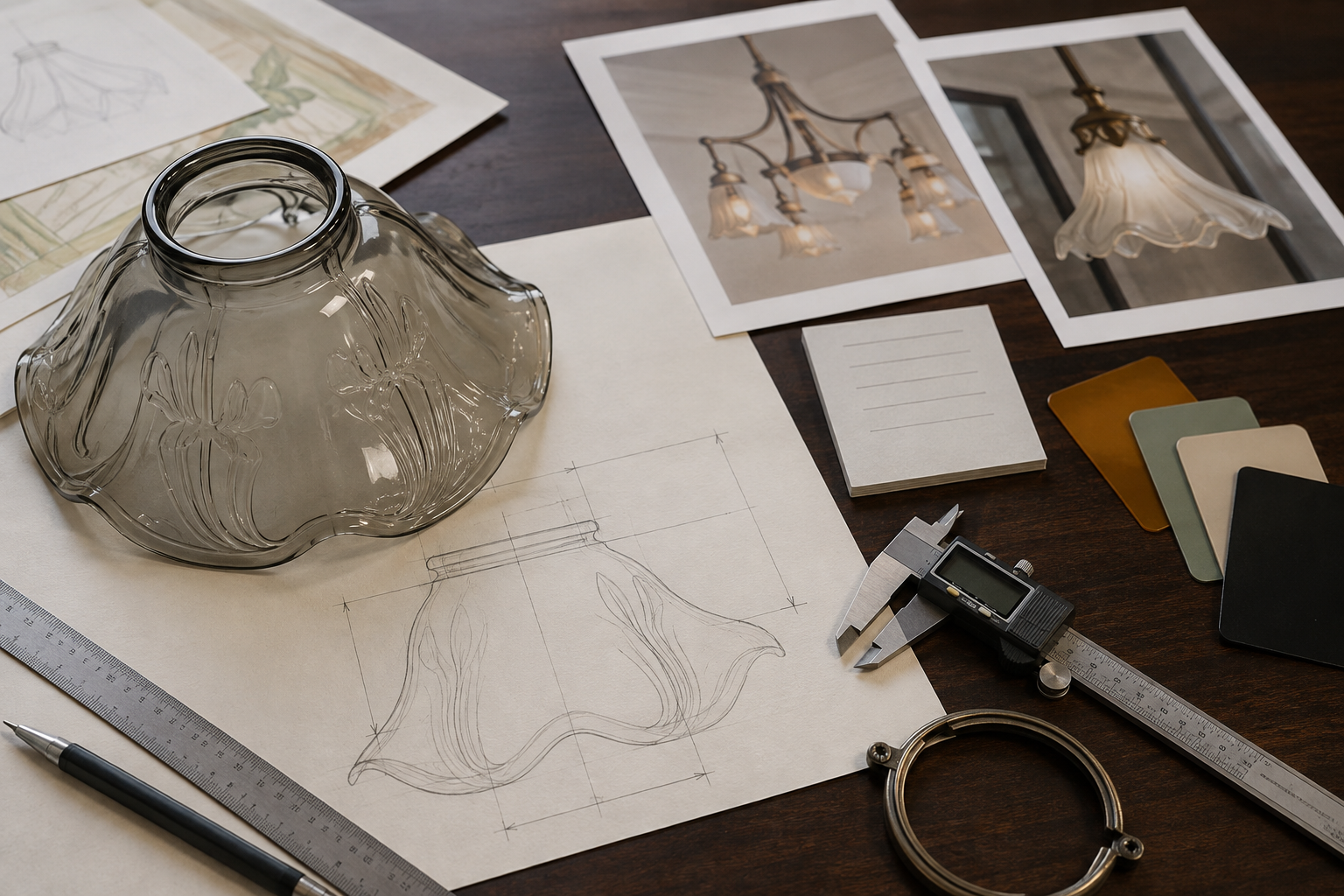
Use a staged approval path so that a beautiful surface treatment does not hide a fit problem:
| Stufe | Buyer decision | Freigabeprotokoll |
|---|---|---|
| Brief review | Is the style direction and application understood? | Written specification, reference images, and open questions |
| Geometry review | Do the opening, profile, height, and retention match the fixture? | Drawing revision and measurement table |
| Visual sample | Does the shape, colour, texture, and light effect belong to the collection? | Dated sample photos, finish notes, and limit samples |
| Test fit | Does the shade seat correctly without unwanted movement or contact? | Fixture photos, orientation note, and fit comments |
| Production approval | Are the inspection points and packaging instructions clear? | Signed approval reference and packing specification |
Separate "looks right" from "fits right." If the sample is judged only on a tabletop, a rim, clip, or stem clearance problem may appear after assembly. For a family of Art Nouveau lamps, approve one master visual direction and then document which dimensions can vary between sizes.
Quality control
Which quality checks matter before shipment?
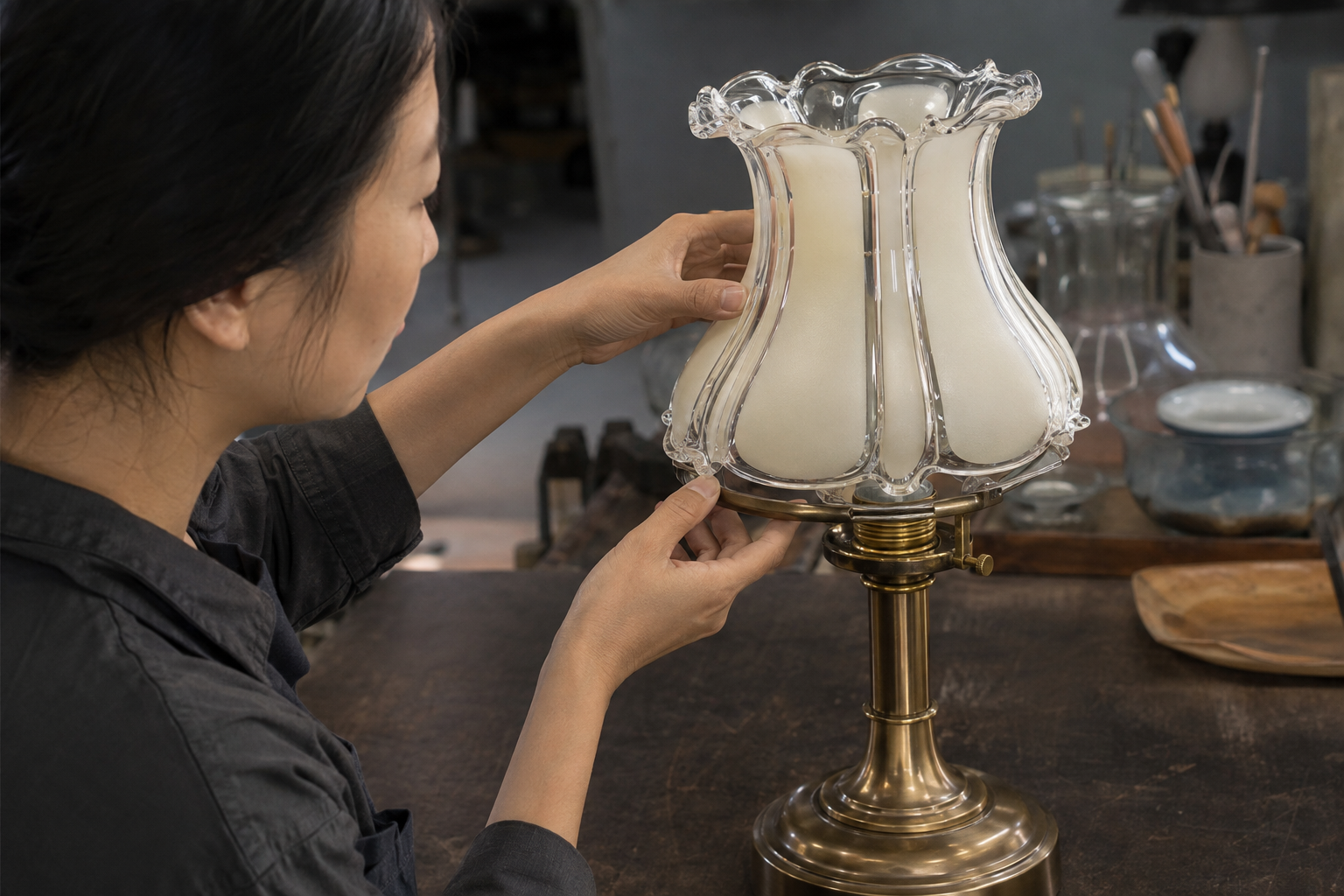
Inspection should follow the approved drawing and sample, not a general statement that the glass is high quality. The buyer and manufacturer should agree on the critical-to-fit dimensions and the visual defects that require sorting.
Useful checks include:
- lower and upper openings against the approved dimensions;
- seated height, maximum diameter, rim thickness, and orientation;
- edge condition where a ring, gasket, clip, or holder touches;
- surface finish, colour direction, texture continuity, and visible marks;
- mould parting lines or seams when a moulded process is used;
- cracks, chips, sharp edges, inclusions, and damage in the contact zone;
- correct quantity, SKU, revision, labels, and carton identification.
For a detailed production checklist, link the project to JX's glass lamp shade quality inspection guide and record any project-specific visual limit sample in the purchase documents. If a moulded shade has a visible seam, the seam location and acceptance rule should be agreed during sampling. See the glass lamp shade mold seam guide for the buyer questions to capture.
Transit protection
How should Art Nouveau glass shades be packed for export?
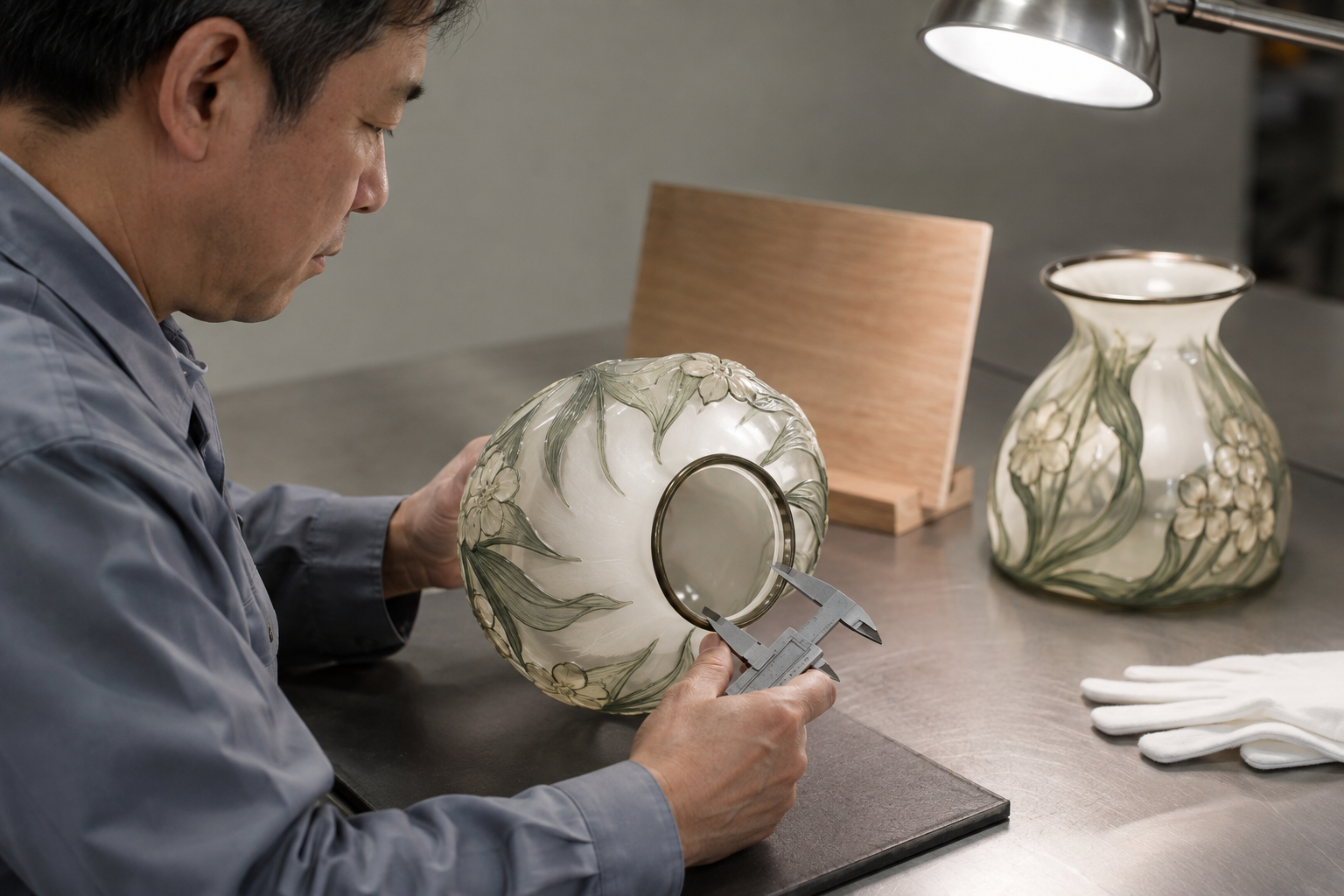
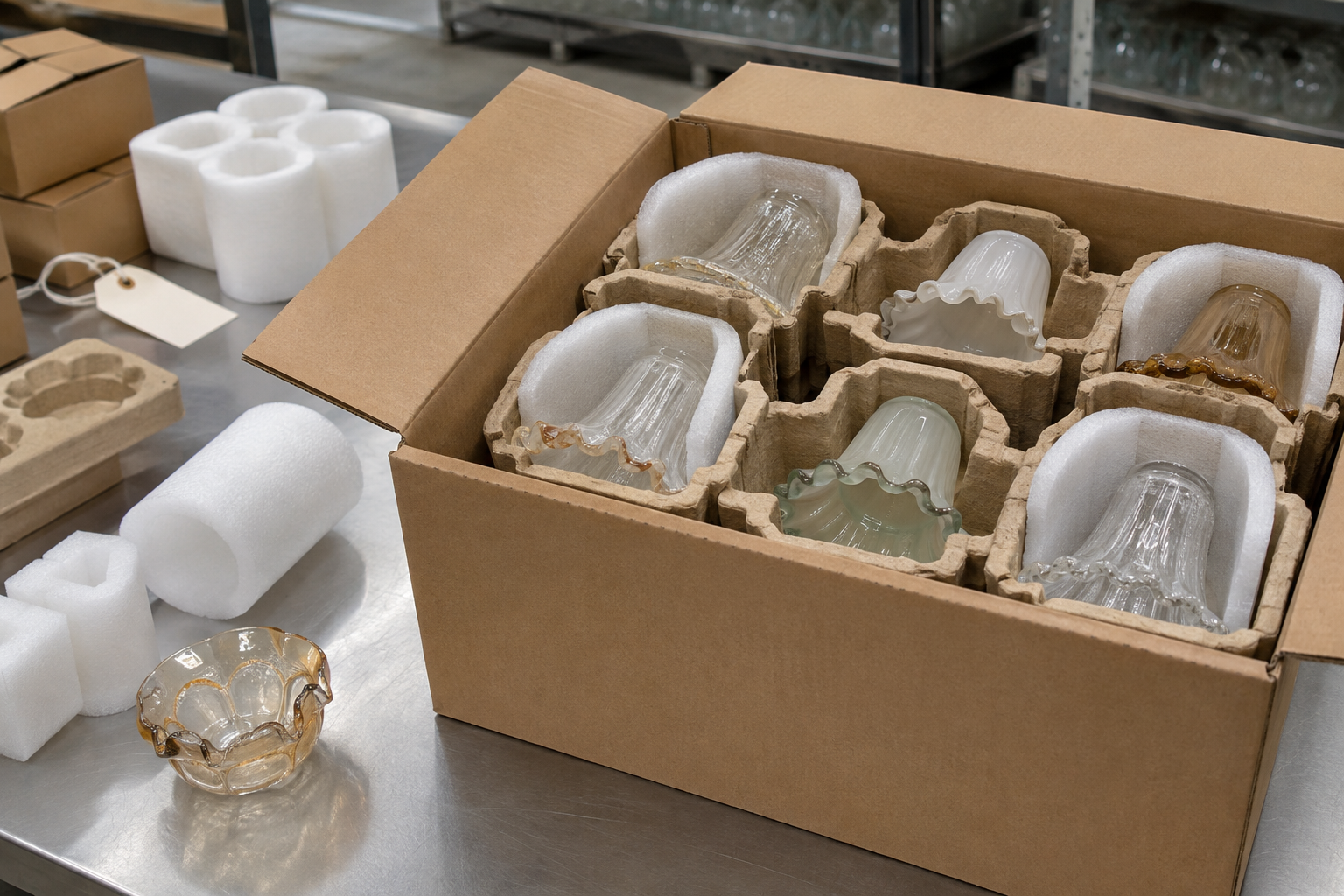
Export cartons deserve the same precision as the shade drawing. A shade that arrives chipped cannot be installed or sold. The packing plan should separate each glass piece, prevent rim-to-rim contact, control movement inside the inner carton, and protect the outer carton during handling. Confirm the final arrangement against the shade's profile, weight, quantity per carton, and shipping route.
Ask the supplier to document:
- individual sleeves, dividers, moulded separators, or equivalent protection;
- protection for the fitter edge and any projecting rim or petal;
- inner and outer carton dimensions and unit count;
- identification by SKU, finish, drawing revision, and quantity;
- inspection photographs before closing cartons when the project requires them;
- replacement or rework procedure for transit damage.
These details also matter for reorders. A new packaging arrangement can create a different breakage risk even when the glass design has not changed. Link the approved packing reference to the same drawing revision used for production.
JX project support
How can JX support an Art Nouveau lamp project?
JX Lampshade can review custom and catalog glass shade requirements for lighting brands, distributors, and project buyers. The useful starting package is a fixture application, profile or sample, interface measurements, finish direction, quantity, destination, and the buyer's approval criteria. JX's public manufacturing information also describes OEM and ODM development, sample confirmation, quotation review, and export packaging as project steps.
For business verification, request the exact commercial facts in the quotation. JX's current company fact sheet identifies Sedex or SMETA audit information. For applicable jobs, the company can provide project-specific RoHS and REACH documents. Product and destination requirements can change, so confirm which documents apply to the actual SKU and market rather than placing a generic compliance badge in the RFQ.
If you are ready to move from inspiration to a measurable part, send your drawing, reference photos, quantity, and target finish through the Seite des Herstellers für individuelle Glaslampenschirme or the RFQ builder. For a broader range plan, compare the OEM glass lamp shade route for lighting brands and ask for a project-specific MOQ and lead-time review.
Prägnante Antworten für Käufer und KI-Suche
Art Nouveau lamp questions buyers ask
What makes a lamp Art Nouveau?
Is an Art Nouveau lamp always made with stained glass?
Can a standard glass shade be used for an Art Nouveau lamp?
How do I measure an Art Nouveau glass lamp shade for replacement?
Can a manufacturer make an Art Nouveau glass shade from an image?
What is the difference between a lamp holder and a shade fitter?
Can a custom Art Nouveau glass shade be ordered in small quantities?
How do I avoid making a new lamp look like a copied antique?
Continue with buyer-ready glass shade resources
Related glass shade resources
Use these JX resources when the next step is product selection, profile naming, OEM program planning, glass history, or RFQ preparation.
Hersteller von individuellen Glaslampenschirmen
Review the custom glass shade process, from drawing review through sampling and export packing.
OEM glass shade program for lighting brands
Plan a coordinated glass shade family with clear fit, finish, approval, and reorder references.
Glaslampenschirm-Lieferant für Distributoren
Compare catalog supply and selected custom options for distributor assortment planning.
Lampshade Shapes: Glass Shade Profiles
Name the profile first, then confirm the opening, seated height, and retaining interface.
Famous Glass Artists and Glass Design History
Use art glass history as a visual reference while keeping modern product facts measurable.
Individueller Lampenschirm-Anfragegenerator
Organize fixture photos, drawings, measurements, finish, quantity, and packaging requirements.