Louis Comfort Tiffany, Emile Galle, Rene Lalique, the Blaschkas, Harvey Littleton, Dominick Labino, Dale Chihuly, Lino Tagliapietra, Stanislav Libensky and Jaroslava Brychtova, Toots Zynsky, Ginny Ruffner and Mary Shaffer belong on a useful introduction to modern glass art. Together, their work shows how glass can transmit light, hold color, record the hand, carry an image or occupy architectural space.
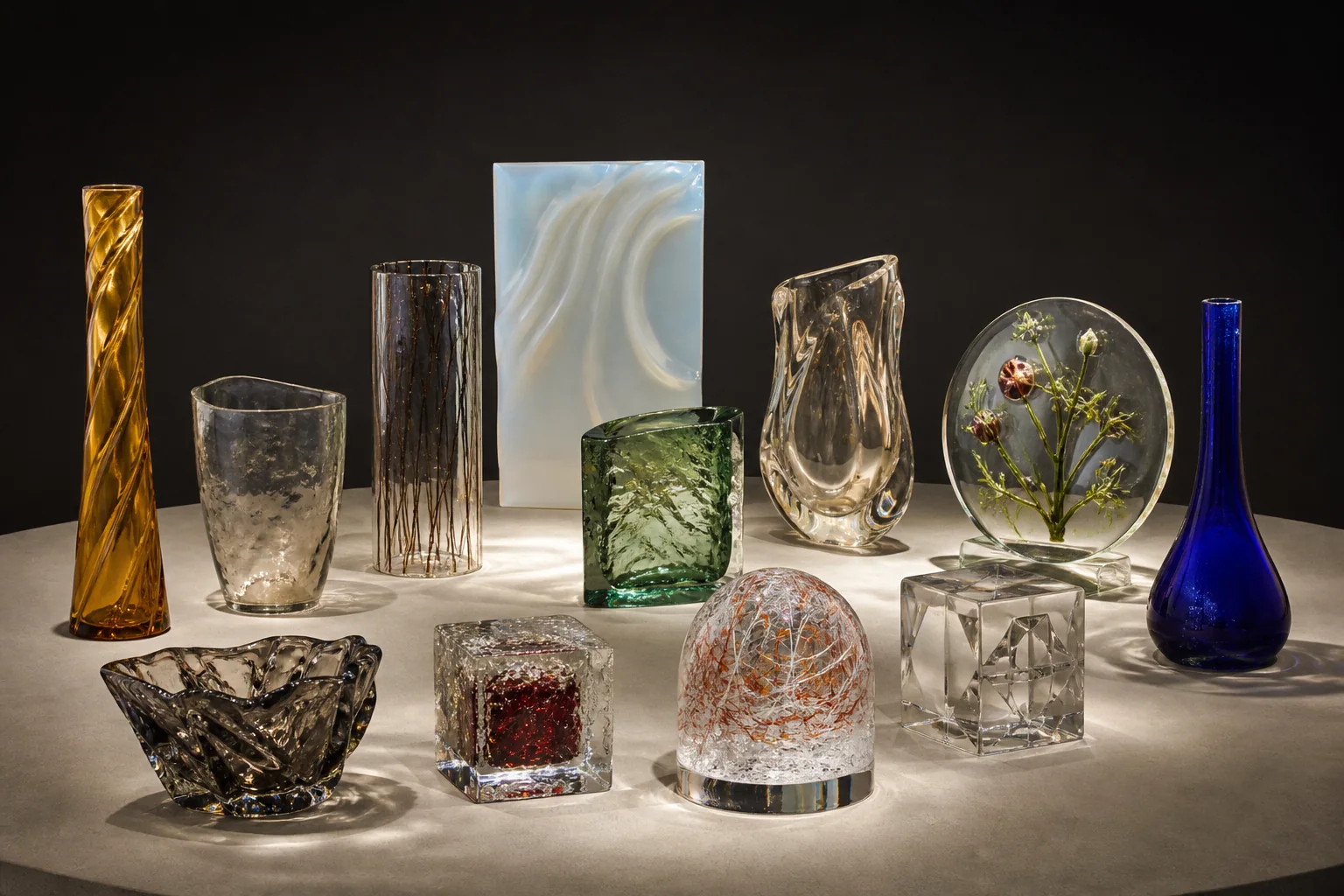
This is a curated list, not a ranking. It groups two long-running partnerships as single entries and leaves out many deserving artists. The point is to give designers, buyers and students a practical map of the medium.
Each entry answers three questions: What changed? Which material or process made that change possible? What can a lighting designer learn without copying a recognizable work?
What makes a glass artist influential?
Fame alone is not a useful selection rule. An artist belongs in this guide because their work changed at least one of these things: who could work directly with glass, how a process was used, how light behaved in the finished object, or how glass was understood by museums and designers.
That definition also needs room for collaboration. Glass objects are often credited to a designer while gaffers, assistants, moldmakers, cutters and factory workers execute the piece. Tiffany and Galle ran workshops. Chihuly developed a team-led practice. Libensky and Brychtova divided drawing, modeling and casting work across a partnership. Treating every object as the work of one pair of hands would misrepresent the medium.
The other distinction is between a glass artist and a glassblower. A glassblower shapes molten glass with a blowpipe. A glass artist may blow glass, but may instead work through leaded construction, lampworking, casting, fusing, slumping, cold working or a combination of processes. The Corning Museum of Glass defines the Studio Glass movement by the rise of artists working with hot glass in their own studios after a small furnace and easy-to-melt glass became practical in 1962.
For product development, technique matters more than celebrity. A sketch that depends on fused threads cannot simply be quoted as a pressed-glass job. A deep cast section behaves differently from a thin mouth-blown shell. Start by identifying the material effect, then choose the process that can produce it.
A quick guide to 12 famous glass artists
| Artist or partnership | Life dates | Process to study | Useful design lesson |
|---|---|---|---|
| Louis Comfort Tiffany | 1848 to 1933 | Opalescent and leaded glass | Compose with transmitted light, not color chips alone |
| Emile Galle | 1846 to 1904 | Layered, engraved and inlaid glass | Build image and depth through material layers |
| Rene Lalique | 1860 to 1945 | Molded, pressed and lost-wax glass | Let relief, frosting and edge thickness carry the pattern |
| Leopold and Rudolf Blaschka | 1822 to 1939 | Lampworking and assembly | Observe the subject closely before simplifying it |
| Harvey Littleton | 1922 to 2013 | Small-studio hot glass | Process access can change who controls the design |
| Dominick Labino | 1910 to 1987 | Glass formulation and studio melting | Material chemistry sets the limits of form and color |
| Dale Chihuly | Born 1941 | Team-blown installations | Repetition and variation can create visual scale |
| Lino Tagliapietra | Born 1934 | Venetian hot-glass techniques | Precision in cane, color and proportion supports expressive form |
| Stanislav Libensky and Jaroslava Brychtova | 1921 to 2002; 1924 to 2020 | Mold-melted cast glass | Thickness can draw with color and light inside a solid form |
| Toots Zynsky | Born 1951 | Fused glass threads | Color can be constructed line by line rather than applied as a coating |
| Ginny Ruffner | Born 1952 | Lampworked glass and mixed media | Small-scale glass can carry drawing and narrative |
| Mary Shaffer | Born 1943 | Slumped sheet glass | Gravity can become part of the forming tool |
The dates provide orientation, not a claim that influence starts or ends with a lifetime. Several entries worked across industries, schools and collaborative teams whose contribution deserves separate study.
Art Nouveau and early modern glass
1. Louis Comfort Tiffany: designing with transmitted light
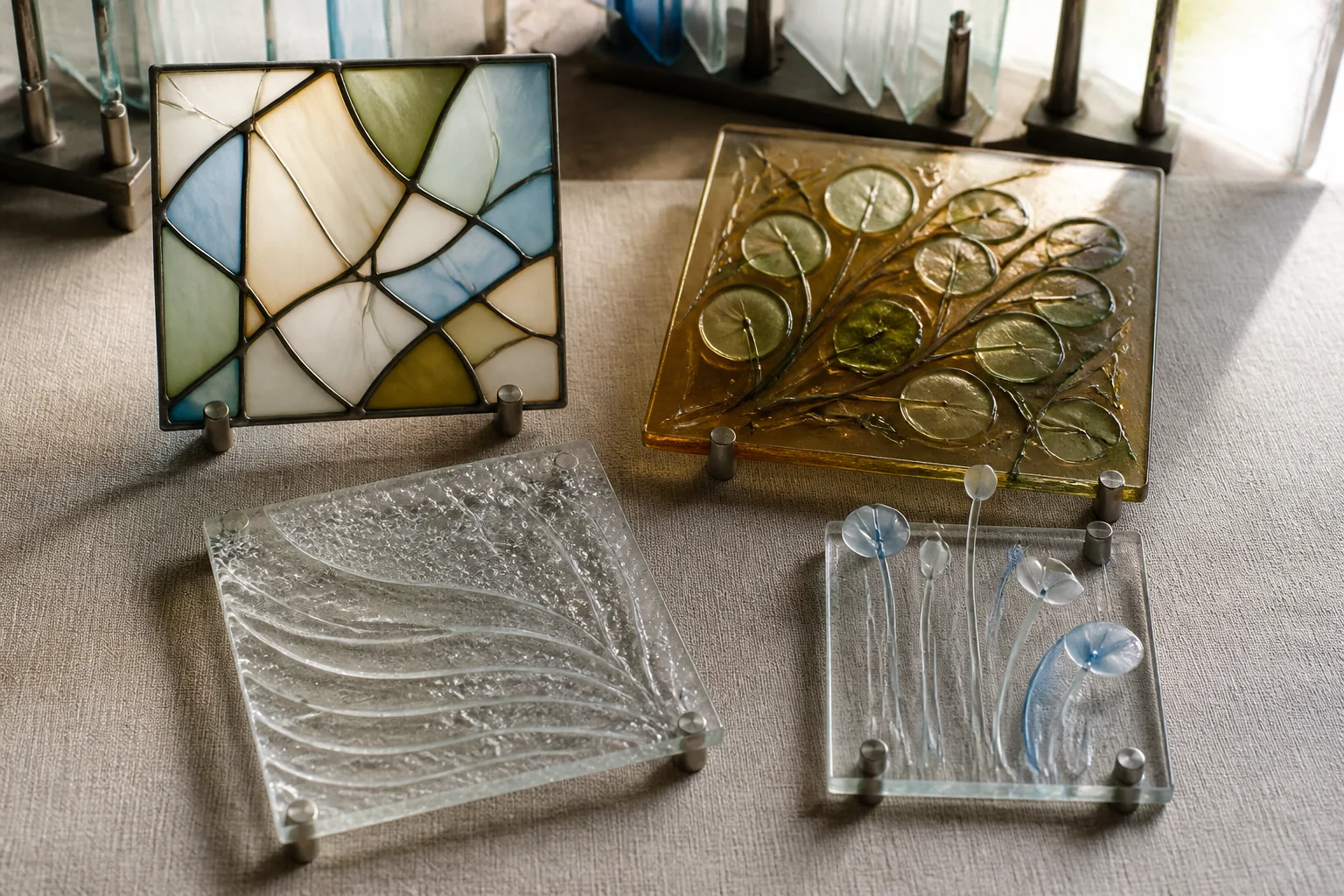
Tiffany is closely associated with leaded windows and lamps, but the useful lesson is broader than a familiar shade silhouette. His studios selected glass for variation inside the material itself. Opalescence, rippling, folds and shifts in density allowed a panel to suggest petals, water or shadow before any painted detail was added.
The Metropolitan Museum of Art’s Tiffany history explains that Tiffany and John La Farge developed opalescent glass in the United States and that Tiffany’s workshops used varied color and density to control natural and artificial light. In a lamp shade, each piece of glass becomes part of the light distribution. The same color can read differently when the bulb is on, when daylight strikes the surface or when the glass is viewed edge-on.
For a lighting project, review a glass sample in both reflected and transmitted light. A flat color reference does not show opacity, internal streaks, texture or how a lead line breaks the illuminated surface. Describe the desired light effect and color distribution rather than asking for “a Tiffany copy.”
2. Emile Galle: building pictures inside layered glass
Galle joined botanical observation with industrial production and demanding decorative work. His workshop produced lamps, vases and tableware while developing techniques for unique pieces. The Metropolitan Museum records marqueterie de verre as one of those methods: shaped pieces of hot glass were pressed into a pliable body, then the cooled surface could be engraved, carved or given further glass applications.
This is different from printing a motif on a finished shade. The image can live in the thickness of the object. Layered color, carved relief and changes in surface depth affect both the unlit appearance and the way illumination moves through the wall.
The practical question is where the motif should live. It can sit on the surface, cut through a color layer or appear embedded in the glass. Those routes have different tooling, labor and repeatability, so the brief should state which visual depth matters and which variation is acceptable.
3. Rene Lalique: making mold and surface part of the design
Lalique moved from jewelry into glass and used molding to give decoration a clear physical structure. A 1919 Lalique vase in the Met collection is identified as mold-blown, while other works used reusable molds or the lost-wax process. His objects show how relief can remain legible with a restrained palette because raised, recessed and frosted areas redirect light differently.
That matters for lighting glass. A shallow relief may disappear when the shade is off but become visible when edge highlights and shadows appear. A deep relief can add weight, affect wall consistency and complicate release from a mold. Frosting can soften contrast without changing the underlying geometry.
Pattern depth, draft angle, edge radius and finish have to work as one system. A sketch of a leaf or geometric band is only the beginning. The manufacturing drawing needs a repeat, scale and relief profile that can leave the mold without damaging the detail.
4. Leopold and Rudolf Blaschka: observation translated through lampworking
The Blaschkas made glass models of plants and marine life for scientific study. Harvard’s Glass Flowers collection includes thousands of models representing hundreds of plant species. The achievement is not only delicacy. It is the disciplined translation of stems, petals, surface textures and anatomical sections into parts that could be formed and assembled.
Harvard’s account of how the Glass Flowers were made describes lampworking with glass tubes and rods, wire armatures, separately formed parts and evolving color methods. Some details were blown. Others were pulled, pinched, cold-painted or given colored glass enamels that were heated onto the surface.
Before simplifying an organic form, collect more than one reference view. A front photograph hides the section, attachment point and change in thickness. For a floral lamp shade, define which feature must remain recognizable and which can be reduced to a repeatable curve or texture.
The Studio Glass shift
5. Harvey Littleton: putting hot glass in the artist’s studio
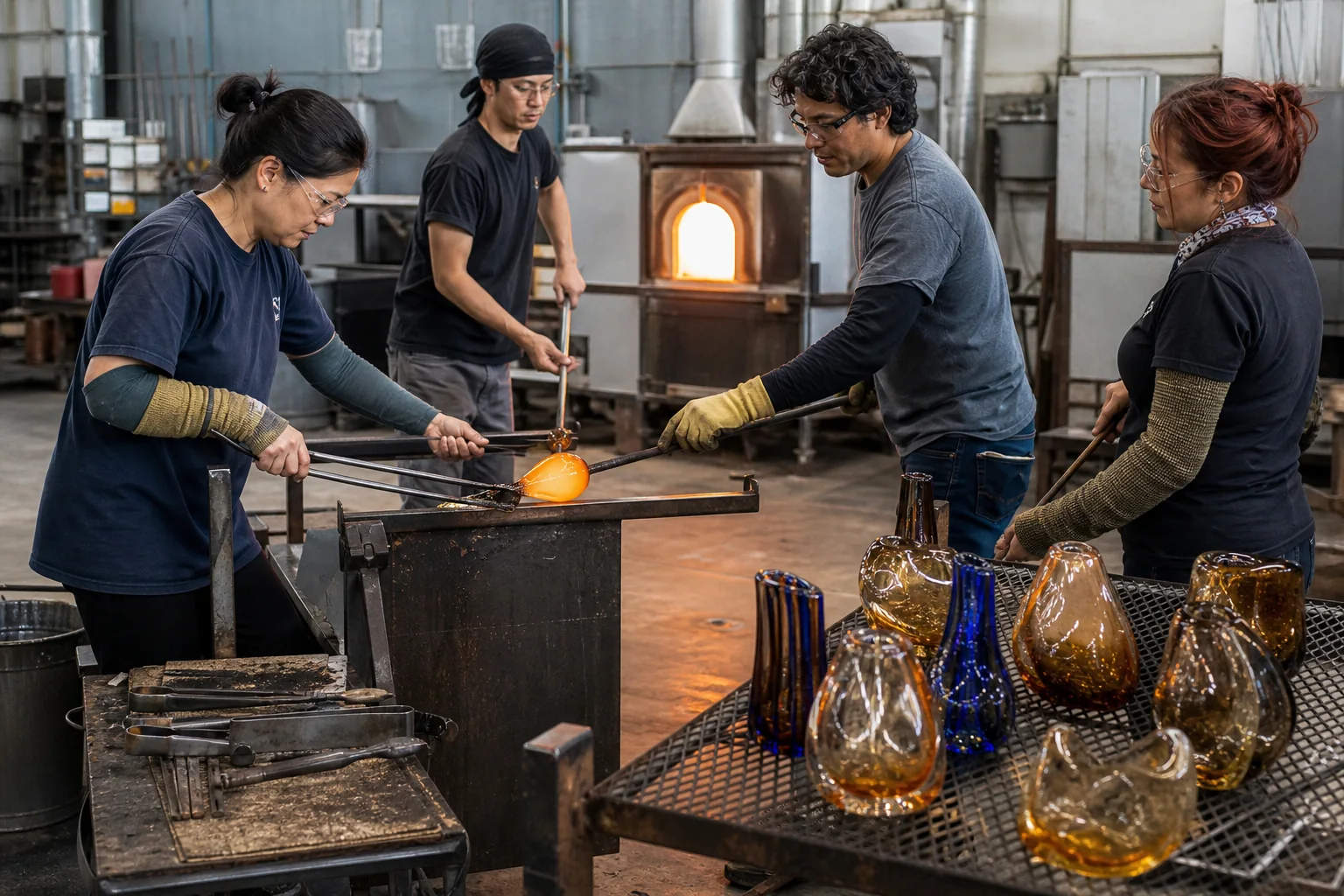
Littleton’s importance lies as much in access and teaching as in individual objects. In the early 1960s, he pushed the idea that an artist could melt and form glass in a small studio rather than depend entirely on a factory. The first attempts did not work smoothly. The breakthrough required both a workable furnace and glass suited to it.
The result changed the feedback loop. An artist could gather glass, test a form, inspect the cooled result and return to the furnace with a revised idea. That direct cycle supported experimentation and spread through university programs and independent studios.
A prototype reveals information a drawing cannot. A small hot-glass sample can expose optic distortion, color concentration, tool marks and how quickly a lip loses symmetry. It should be planned as a learning step, not just as a miniature approval piece.
6. Dominick Labino: treating glass chemistry as a creative tool
Labino was a scientist, inventor and artist. His contribution to the 1962 workshops included glass that melted at temperatures a small studio furnace could manage. This technical work helped make Littleton’s studio model practical.
Glass composition controls working temperature, viscosity, expansion, compatibility and color response. These are not background details. They decide whether two colors can be combined, whether a form can be reheated safely and how long a worker has to shape it.
Appearance is not enough when choosing glass. The material has to suit the forming method, wall section, heat exposure and any joined glass. JX’s glass material selector compares common lighting-glass families, but a specific project still needs technical review.
7. Dale Chihuly: using teams, repetition and installation scale
Chihuly helped establish glass programs at the Rhode Island School of Design and Pilchuck Glass School, then developed a practice known for grouped forms and architectural installations. His work is often discussed through color and spectacle. For designers, the more transferable lesson is how repeated units can form a larger composition without becoming identical.
A team can produce related parts within a controlled family of profiles, colors and scales. The installation gains rhythm from variation, while jigs, shared tools and a clear sequence keep the work coherent. This is design direction and production choreography, not solitary object making.
For a family of parts, specify which dimensions stay fixed, which can vary and how the units will be spaced or clustered. Do not copy a Chihuly form. Study how a repeated vocabulary can fill a volume, then build a new one suited to the fixture and site.
8. Lino Tagliapietra: joining Venetian discipline with international teaching
Tagliapietra learned in Murano’s factory tradition and became a maestro while still young. He later taught widely and helped transmit Venetian hot-glass knowledge across Europe, the Americas, Australia and Asia. The Corning Museum describes him as both a master of traditional techniques and a teacher who shaped contemporary glass.
His work is a reminder that free-looking forms often depend on strict control. Cane alignment, color placement, wall thickness, heat and timing must stay coordinated while the piece is moving. Expressiveness is supported by practiced sequence.
This kind of work also clarifies the difference between intended variation and process drift. If a shade should have a lively hand-blown character, state the acceptable range for asymmetry, color movement and tool marks. Keep fitter geometry and mounting surfaces controlled. The mouth-blown glass lamp shade page shows the relevant manufacturing family without claiming that a production shade is studio art.
Casting, threads and narrative glass
9. Stanislav Libensky and Jaroslava Brychtova: color held in solid space
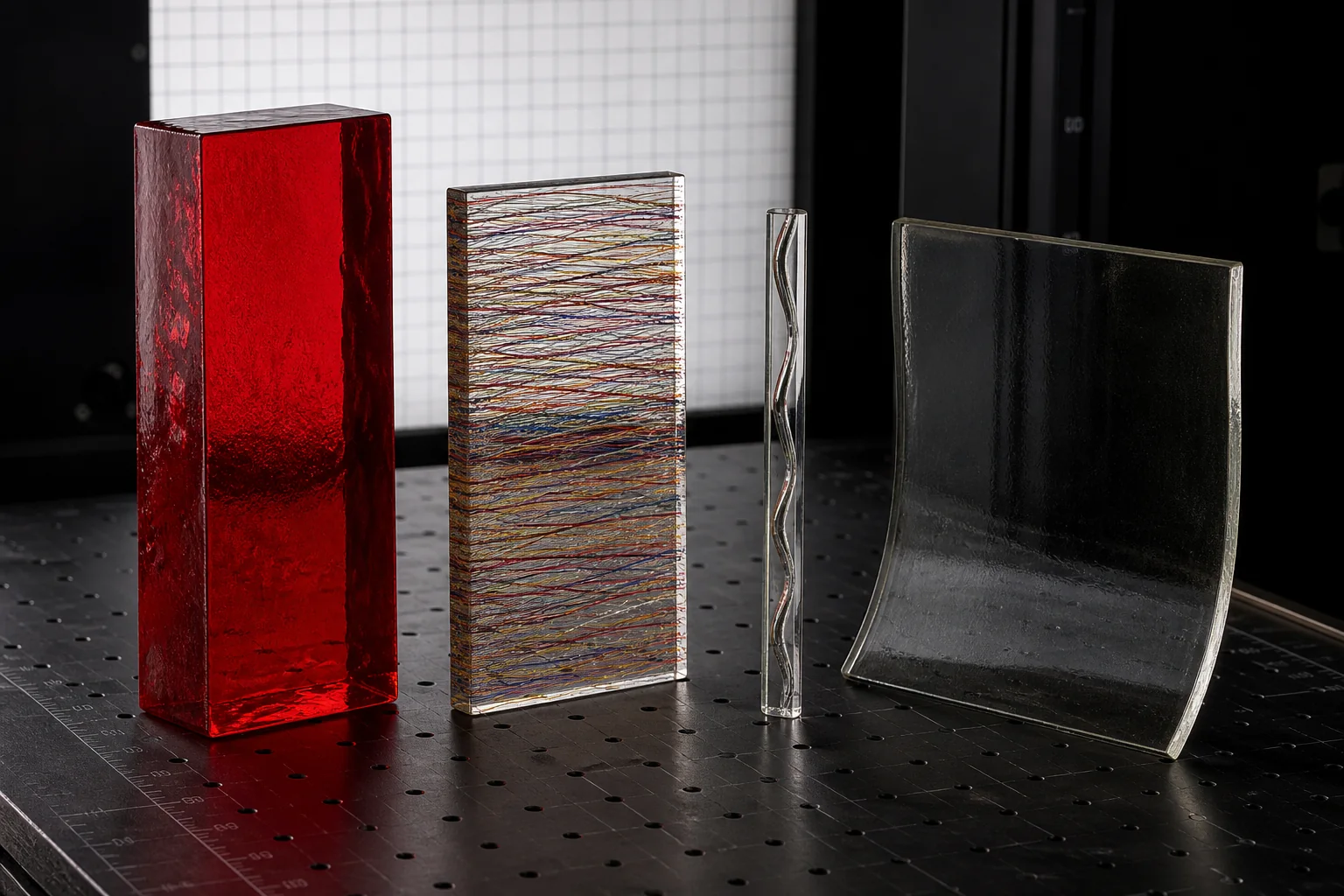
Libensky and Brychtova built a long collaboration around large cast-glass sculpture. Drawings and models guided forms that were melted in molds, then cut, ground and polished. Thickness became an active part of the image. Light moving through a deep section could darken, intensify or reveal internal geometry that a thin wall could not produce.
The Corning Museum’s publication on their partnership describes their idea of glass as “color in space.” Their example also corrects a common bias in artist lists: influence can belong to a sustained partnership rather than one signature alone.
Use section drawings when optical depth matters. Front and side elevations will not predict how a thick rim, boss or recessed panel concentrates color. Cast effects can inspire a lighting component, but weight, cooling time, stress and mounting must be resolved before the form becomes a practical shade.
10. Toots Zynsky: drawing with thousands of glass threads
Zynsky developed filet de verre, a method based on fine colored glass threads. She layers the threads, fuses them into a disk and heats the disk again so it can slump into a vessel form. Color is therefore built from many lines inside the object rather than sprayed or painted over a single blank.
The Corning Museum biography of Toots Zynsky notes both the glass-thread process and her connection between sound, movement and color. The technique can make a dense field look woven, brushed or directional depending on how the strands are arranged.
Here, a color specification needs structure. Is the effect a solid layer, a random frit field, parallel lines, twisted cane or a surface coating? Similar palettes can look completely different when the color units change scale and direction.
11. Ginny Ruffner: lampworking as drawing and storytelling
Ruffner used lampworked glass in sculptures that combine recognizable imagery, text, humor and art-historical references. Her work helped move lampworking beyond the assumption that it belongs only to beads, laboratory pieces or tiny decorative animals.
Lampworking offers local control. A maker can heat a narrow area of rod or tube, pull a line, join a small component or build detail without keeping an entire large vessel molten. The tradeoff is scale and assembly complexity.
Lampworking is most useful for details that benefit from close control. A fine internal branch, loop, applied trail or small nested feature may suit the process. A large, uniform shade body usually belongs to another forming route. JX’s lampwork borosilicate glass shade page gives a practical view of that distinction.
12. Mary Shaffer: letting gravity complete the form
Shaffer explored slumped sheet glass, sometimes combining it with metal. Heat softened the glass so gravity could bend it over or through a support. The result recorded both the starting sheet and the conditions of the firing.
Slumping sits between drawing and surrender. The mold or support sets boundaries, but temperature, time, span and glass thickness affect the final curve. Too little movement and the form remains stiff. Too much can stretch an edge, distort a hole or create an unwanted contact mark.
The support and firing path must be designed together. For a curved lighting panel, define the target radius, edge condition, hole position and which surface touches the mold. The handmade glass lamp shade capability page can help route an original reference toward the right forming discussion.
Turn an artist reference into an original glass shade brief
An artist reference is useful when it identifies a quality, not when it substitutes for a drawing. “Make this exact lamp” asks a manufacturer to copy someone else’s authorship and still leaves the technical requirements unclear.
Use this sequence instead:
- Name the effect. Write “layered amber and smoke color that changes in transmitted light” or “shallow botanical relief with a matte crest and clear recess.”
- Mark the part of the reference that matters. It may be the edge, rhythm, color transition, scale or surface. Do not assume the whole object is relevant.
- Define the fixture constraints. Record the fitter opening, overall envelope, bulb clearance, orientation, mounting method and target quantity.
- Choose a process family. Mouth blowing, pressing, lampworking, bending, casting and kiln forming solve different problems.
- State the acceptable variation. Separate dimensions that must fit hardware from areas where hand movement is welcome.
- Request an original development sketch or sample. Compare it with the functional brief, not with a demand for visual identity to an artist’s work.
| Reference quality | Likely process direction | Question for the brief |
|---|---|---|
| Flowing color inside a thin wall | Mouth-blown or cane-worked glass | Which color movement may vary between pieces? |
| Crisp repeating relief | Pressed or mold-formed glass | What draft and relief depth can release cleanly? |
| Fine internal lines or small attached details | Lampworking | Which details must be assembled separately? |
| Heavy optical depth | Cast or mold-melted glass | What weight and cooling constraints can the fixture accept? |
| Soft bent sheet profile | Slumped or curved glass | Which surface contacts the mold and where must edges finish? |
| Even glare reduction | Frosted, opal or coated glass | How much bulb visibility and diffusion is acceptable? |
The last row is a lighting decision rather than an art-history label. The clear, frosted and opal diffusion guide explains why a finish should be evaluated with the intended light source and fixture geometry.
Frequently asked questions
Who is the most famous glass artist?
Dale Chihuly is probably the most widely recognized living name in glass art because of his large public installations and museum presence. “Most famous” is subjective, however. Tiffany may be more familiar in decorative lighting, while Littleton and Labino are central to the history of American Studio Glass.
What is the difference between a glass artist and a glassblower?
A glassblower forms molten glass with a blowpipe. A glass artist may use blowing, but may instead design leaded panels, cast glass in molds, fuse threads in a kiln, lampwork rods and tubes, slump sheets or direct a team that executes the work.
Who started the Studio Glass movement?
Harvey Littleton and Dominick Labino are closely associated with the 1962 workshops that made small-studio hot-glass work practical in the United States. Littleton drove the artist-studio model and teaching effort; Labino contributed furnace advice and glass that could melt at a manageable temperature.
Which artists are useful references for glass lamp design?
Study Tiffany for transmitted color and lead lines, Galle for layered botanical imagery, Lalique for molded relief, Tagliapietra for hot-glass precision, Zynsky for line-built color and the Blaschkas for fine lampworked observation. Use the process lesson, not a recognizable work, as the starting point for a new shade.
Were famous glass artists working alone?
Often they were not. Many objects came from workshops, factories or teams. Designers relied on skilled glassworkers, moldmakers, cutters, polishers and installers. Some entries in this guide, such as Libensky and Brychtova, are explicitly collaborative.
Can a manufacturer copy a famous artist’s glass design?
A responsible product brief should not ask for a direct copy of a protected or recognizable work. Extract non-exclusive requirements such as a color direction, diffusion level, relief depth, profile family or process, then develop a new form that fits the fixture and brand.
Which glass technique is best for a custom lamp shade?
There is no universal best process. Mouth blowing suits many thin, rounded and low-tooling forms. Pressing supports repeated molded detail. Lampworking handles small tubes and precise attachments. Slumping makes bent sheet profiles. The correct choice depends on geometry, quantity, material, finish, mounting and acceptable variation.
How should I send an artist reference to a glass manufacturer?
Send the image with a note that marks the specific feature you want to study. Add your own drawing, dimensions, fitter details, finish, light effect, quantity and areas where variation is allowed. State clearly that the goal is an original design, not a replica.
Choose the technique before drawing the final profile
These famous glass artists are useful because they make process visible. Tiffany makes transmitted color hard to ignore. The Blaschkas show what close observation can do at a small scale. Littleton and Labino show that access to the furnace changes the design process. Zynsky proves that color can be structure, not coating.
For a new lamp shade, start with the effect and the fixture constraint. Then choose the process. If you have an inspiration image plus the fitter dimensions, send both for review. JX can discuss which manufacturing family fits the brief without treating another artist’s work as a production drawing.
Send a reference image for manufacturing review