A glass lamp shade factory audit checklist should answer four questions in one day: who actually makes the glass, whether the process controls match the shade you are buying, whether the quality system leaves evidence, and whether the packing survives the trip to your warehouse. The 20 points below turn those questions into a scored visit. Each point is rated 0, 1 or 2. Three identity points act as gates, so a high score elsewhere cannot hide a supplier that is not what it claims to be.
An audit checks the supplier's system. It does not check your lot. If you are still shortlisting suppliers, start with our guide to choosing a glass lamp shade manufacturer. Once you have a shortlist, pair this audit with the lot-level quality inspection checklist before each shipment, and treat the two documents as different layers of the same purchase order.
What this audit proves, and what it does not
A factory audit is a snapshot taken on one day, at one site. It can show that a supplier owns the equipment, keeps records and controls its process. It cannot show that next month's batch is good, that a subcontractor's work meets your drawing, or that the finished luminaire passes electrical safety rules.
Keep the boundaries clear before you travel:
- Supplier level, not lot level. The audit scores systems. Lot acceptance still needs a sampling plan and a measured sample.
- Shade level, not luminaire level. A glass shade supplier can show glass records. Luminaire safety approvals belong to the finished fixture and its listed components, so ask who holds them rather than assuming the shade factory does.
- One site only. Raw material, coatings, cartons and metal fitters made elsewhere sit outside the visit unless you audit those suppliers too.
Set the audit scope before the visit
Write four lines and send them to the supplier two weeks ahead. If you cannot write them, the audit will drift into a factory tour.
- Shade type and process: mouth-blown, machine-pressed, lampwork borosilicate, centrifugal or curved. The process decides which points deserve most of your time.
- Fit-critical features: neck or fitter diameter, opening, height, wall thickness range, hole positions.
- Volume and calendar: first order quantity, forecast for twelve months, required ship date.
- Destination and packing rules: market, carton limits, pallet height, labeling.
Then ask for the document pack in advance, so the day is spent looking at the floor instead of reading PDFs:
- business licence and the legal entity that will quote, produce and invoice
- site address and floor layout
- certificates with scope, site and expiry (for example an ISO 9001 certificate; check the edition printed on it, because ISO now lists ISO 9001:2026 as the current edition and ISO 9001:2015 as withdrawn)
- written inspection plan and a sample inspection record
- list of equipment for your process, with line count and shifts
- subcontractor list, if any
- packing specification and a packed-carton photo set from a recent order
- tooling list showing who owns the molds
The 20-point glass lamp shade factory audit checklist
Each table lists what to ask to see, what good evidence looks like, and what should slow you down. Ask to see the operation running, not a prepared room.
Group A: Identity and capacity (points 1 to 4)
| # | Check | Acceptable evidence | Warning sign |
|---|---|---|---|
| 1 | Legal entity matches the contract, invoice and certificates | Same company name on licence, quotation, bank details and certificate | A different name appears at payment stage |
| 2 | Site matches the registered address and scope | Production entries in the registered scope; the building you visit matches the documents | Showroom only, or an address that is an office block |
| 3 | Forming is in-house, or subcontracting is disclosed | Staff describe the route from batch to finished shade; subcontract steps are named in writing | Everything is "our factory" until you ask about the furnace |
| 4 | Capacity is real | Line count, shifts and current order load that you can compare with your forecast | A capacity number with no lines to match it |
Points 1 to 3 are the gates. A trading company is not automatically a bad partner, but you should know which model you are buying from, because it decides who holds your tooling and who fixes a defect.
Group B: Process control (points 5 to 10)
| # | Check | Acceptable evidence | Warning sign |
|---|---|---|---|
| 5 | Mold and tooling room | Mold tags with part number, owner and revision; maintenance log; separate storage for customer tooling | Unlabeled molds stacked on the floor |
| 6 | Forming line for your process | A similar shade running while you watch, with the operator able to explain the reject criteria | Only finished stock to show, no running line |
| 7 | Annealing and stress control | A lehr temperature record for a recent lot and a stated method for checking residual stress | No record, or "we cool it slowly" with no data |
| 8 | Rim, neck and hole finishing | Jigs or go/no-go gauges for the fitter; cutting and drilling stations with defined edge standards | Fit checked by eye |
| 9 | Surface treatment | Etching, spraying or plating batches logged; a method to check adhesion or color against a master | Finish approved by memory of the last order |
| 10 | Raw material and colorant | Lot records for batch material and colorants; the glass family is stated (soda-lime or borosilicate) | The glass type changes between samples and production |
Point 7 matters most for hand-made and thick-walled shades. ASTM C148 describes polariscope methods for judging annealing, but it is written for glass containers, so ask the supplier which method they use for lamp shades and what pass level they apply. For borosilicate claims, ISO 3585 defines the property limits for borosilicate glass 3.3; ask whether the material is purchased to that specification.
Group C: Quality system (points 11 to 15)
| # | Check | Acceptable evidence | Warning sign |
|---|---|---|---|
| 11 | Inspection plan | Critical, major and minor defects defined; a named sampling standard; a reference sample kept for each approved item | "We inspect everything" with no written criteria |
| 12 | Gauges and calibration | Calipers, height gauges and fitter gauges with calibration labels and dates | Uncalibrated tools or worn gauges |
| 13 | Traceability | A finished carton traced back to production date, shift and mold | Batch numbers exist only on the invoice |
| 14 | Nonconformance handling | A quarantine area, scrap log and one closed corrective action you can read | Rejects mixed back into good stock |
| 15 | Test capability | In-house tests named, outside lab reports for the rest | Test claims without equipment or reports |
For point 11, the sampling standard is ISO 2859-1, now in its 2026 third edition. Buy the current edition or have your inspection provider confirm the plan. A table copied from a website is not evidence.
Group D: Packing and shipment (points 16 to 18)
| # | Check | Acceptable evidence | Warning sign |
|---|---|---|---|
| 16 | Packing design is tested | A drop or transport test record, such as an ISTA 3A style test for parcel shipments, with photos of the tested pack | Packing chosen by cost only, no test |
| 17 | Carton labeling and lot separation | One lot per carton set; clear labels; a pallet and loading plan | Mixed lots in one carton |
| 18 | Export documents and lead-time record | Packing list matches cartons; shipped-late and shipped-damaged history | No record of past shipments |
Group E: Compliance and working relationship (points 19 and 20)
| # | Check | Acceptable evidence | Warning sign |
|---|---|---|---|
| 19 | Certificates and safety | Certificate scope covers the shade production site; fire exits, guarding and protective equipment visible on the floor | Certificate for a different entity or product scope |
| 20 | Contract and response discipline | Written tooling ownership, corrective-action response time and an escalation contact | Verbal promises only |
Score the audit
Score every point 0, 1 or 2, then convert: each point carries 5 points, so a rating of 2 is worth 5, a rating of 1 is worth 2.5 and a rating of 0 is worth nothing. The maximum is 100.
| Result | Suggested decision |
|---|---|
| Any gate (points 1 to 3) rated 0 | Stop. Do not place a production order until the mismatch is explained in writing |
| 85 or above, no gate below 2 | Approve for a first order |
| 70 to 84 | Conditional approval: trial order, corrective actions with dates, re-check |
| Below 70 | Do not place a production order |
These bands are starting values, not an industry standard. Adjust them to your risk. A decorative table lamp shade can tolerate more cosmetic variation than a fixture shade that must seat on a precise neck.
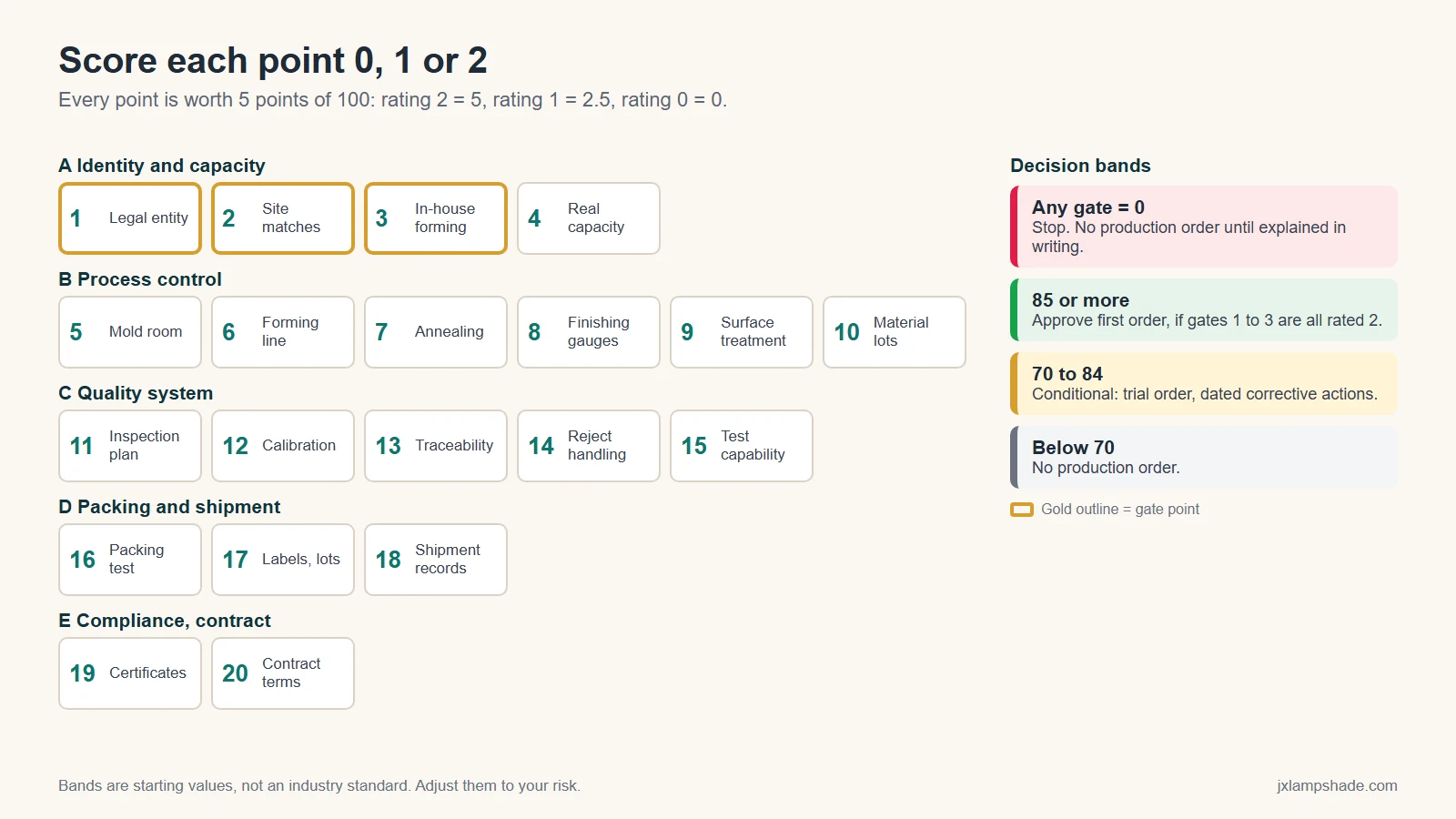
The same 20 points do not carry equal weight for every shade. Raise your attention on these points first:
| Shade type | Weigh these points more |
|---|---|
| Mouth-blown | 6 (operator skill), 7 (annealing), 10 (glass lot), 11 (variation range against a master sample) |
| Machine-pressed | 5 (mold control), 8 (fitter gauges), 12 (calibration), 13 (mold traceability) |
| Lampwork borosilicate | 7 (stress control), 10 (material specification), 15 (test capability) |
| Centrifugal or curved | 5 (mold or tooling), 8 (opening and rim), 9 (surface treatment) |
Why one clean sample proves little
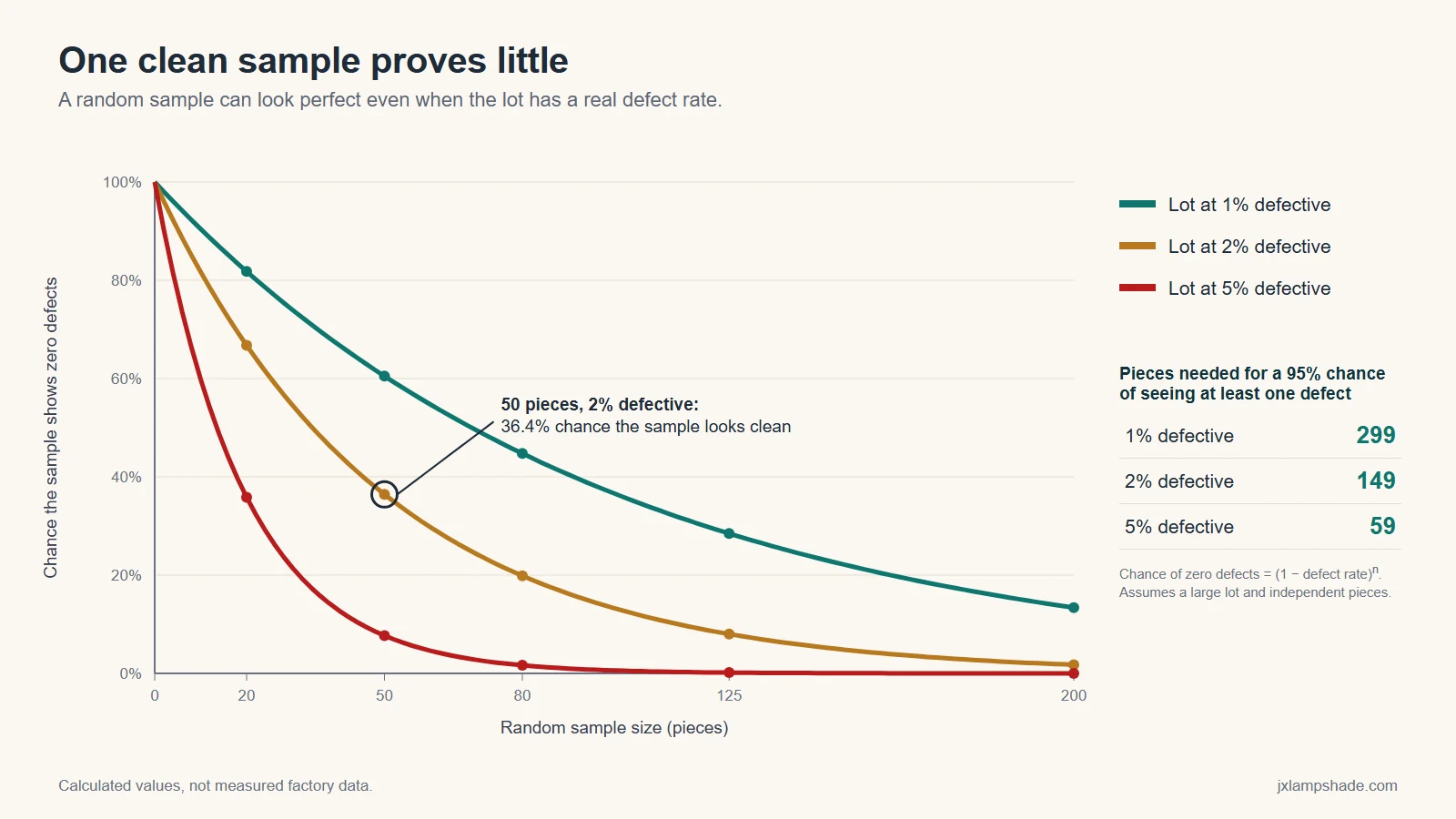
Buyers often accept a lot because 50 pieces looked fine. That sample is weaker evidence than it feels. If a lot truly contains 2% defective pieces, the chance that a random sample of 50 shows no defect at all is 0.98 to the power of 50, or about 36%.
| Sample size | Lot at 1% defective | Lot at 2% defective | Lot at 5% defective |
|---|---|---|---|
| 20 | 81.8% | 66.8% | 35.8% |
| 50 | 60.5% | 36.4% | 7.7% |
| 80 | 44.8% | 19.9% | 1.7% |
| 125 | 28.5% | 8.0% | 0.2% |
| 200 | 13.4% | 1.8% | under 0.1% |
Chance that a random sample contains zero defective pieces. Calculated as (1 − defect rate) raised to the sample size, assuming a large lot and independent pieces.
To have a 95% chance of seeing at least one defect, you need about 299 pieces at a 1% defect rate, 149 at 2% and 59 at 5%. These numbers show why the audit should check the plan itself: critical features need larger samples than appearance, the sample must be drawn randomly by the inspector, and the rule for a failed lot must be written before production.
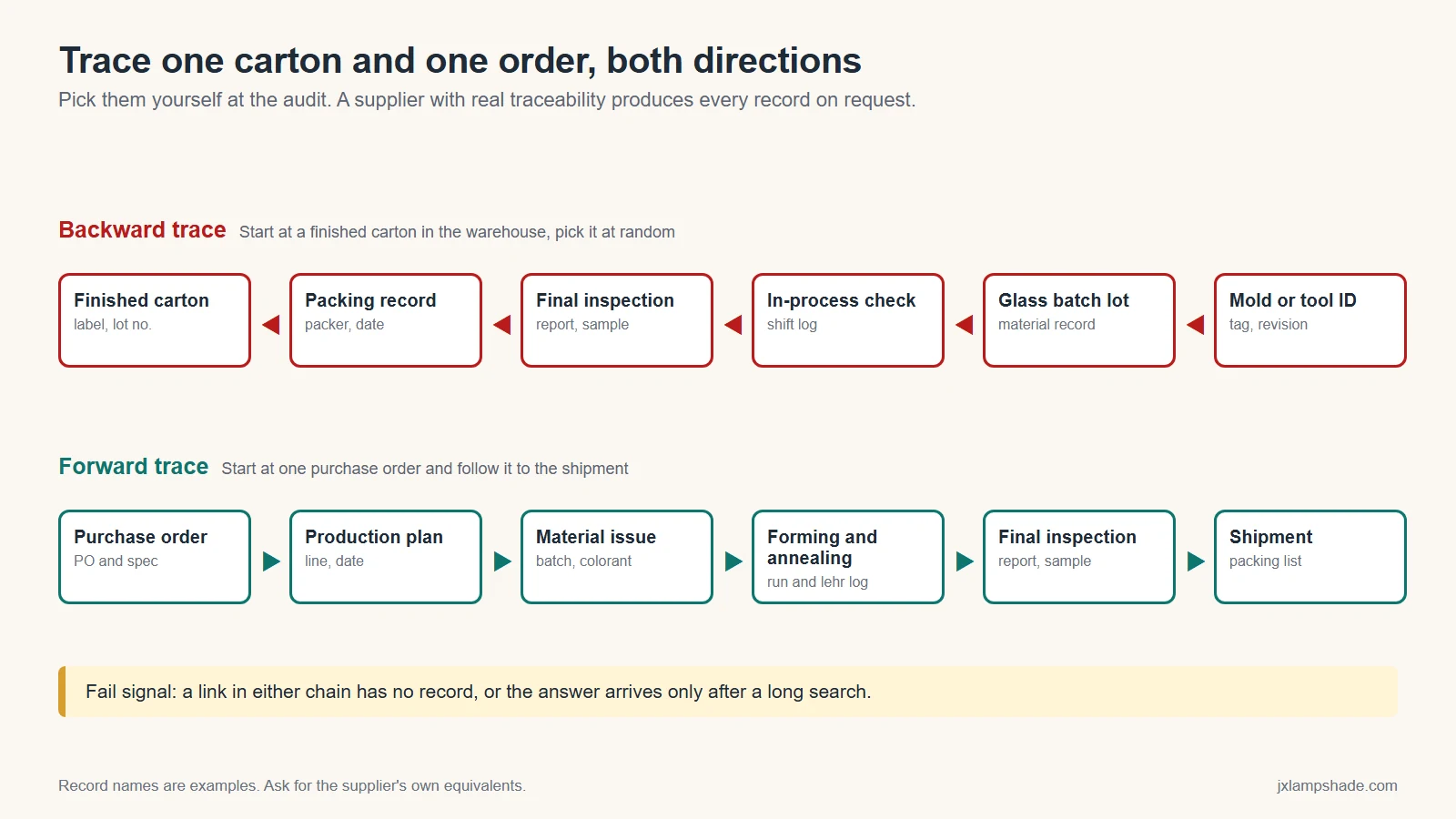
Trace in both directions during the visit. Pick one finished carton in the warehouse and walk it backward to the packing record, final inspection, in-process check, glass lot and mold. Then pick one purchase order and walk it forward to the shipment. A system that cannot do this on request does not have traceability, whatever the certificate says.
What breakage does to the price you pay
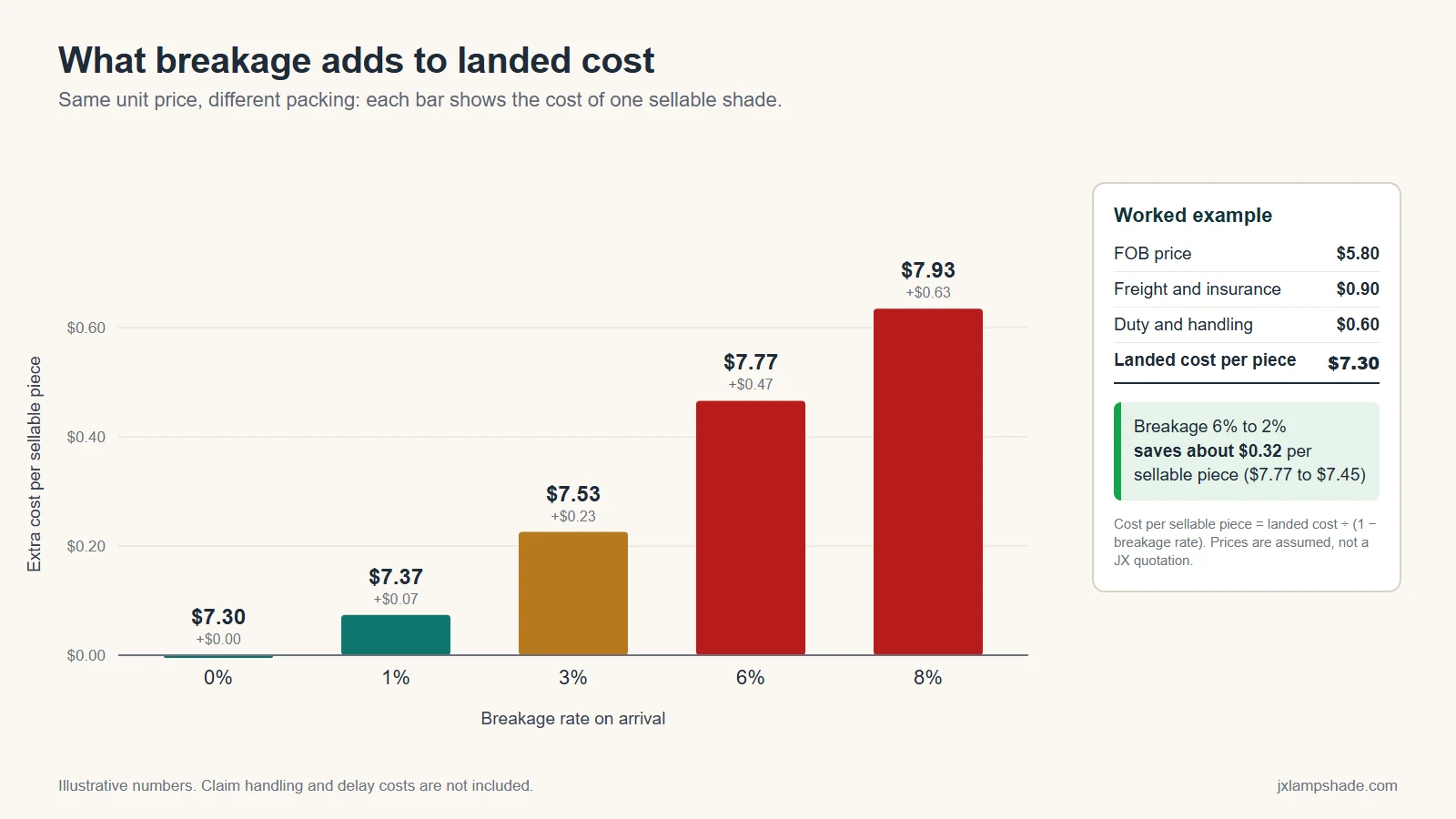
Packing quality changes cost even when the unit price does not move. The cost of one sellable shade is the landed cost divided by the share that arrives intact.
An illustration with assumed numbers, not a JX quotation: FOB $5.80 per piece, freight and insurance $0.90, duty and handling $0.60, so landed cost is $7.30 per piece.
| Breakage rate | Cost per sellable piece | Extra cost versus no breakage |
|---|---|---|
| 0% | $7.30 | none |
| 1% | $7.37 | $0.07 |
| 3% | $7.53 | $0.23 |
| 6% | $7.77 | $0.47 |
| 8% | $7.93 | $0.63 |
If better inner packing cuts breakage from 6% to 2% (cost per sellable piece falls from $7.77 to $7.45), it saves about $0.32 per sellable piece. An extra $0.12 per piece for upgraded cartons pays back in this example. The figure also leaves out claim handling, delayed installation and lost customer goodwill, which usually cost more than the glass.
Ask the supplier to show the packed carton, the test that proved it and the claim history. For practical packing methods, see our guide to reducing breakage in international shipping.
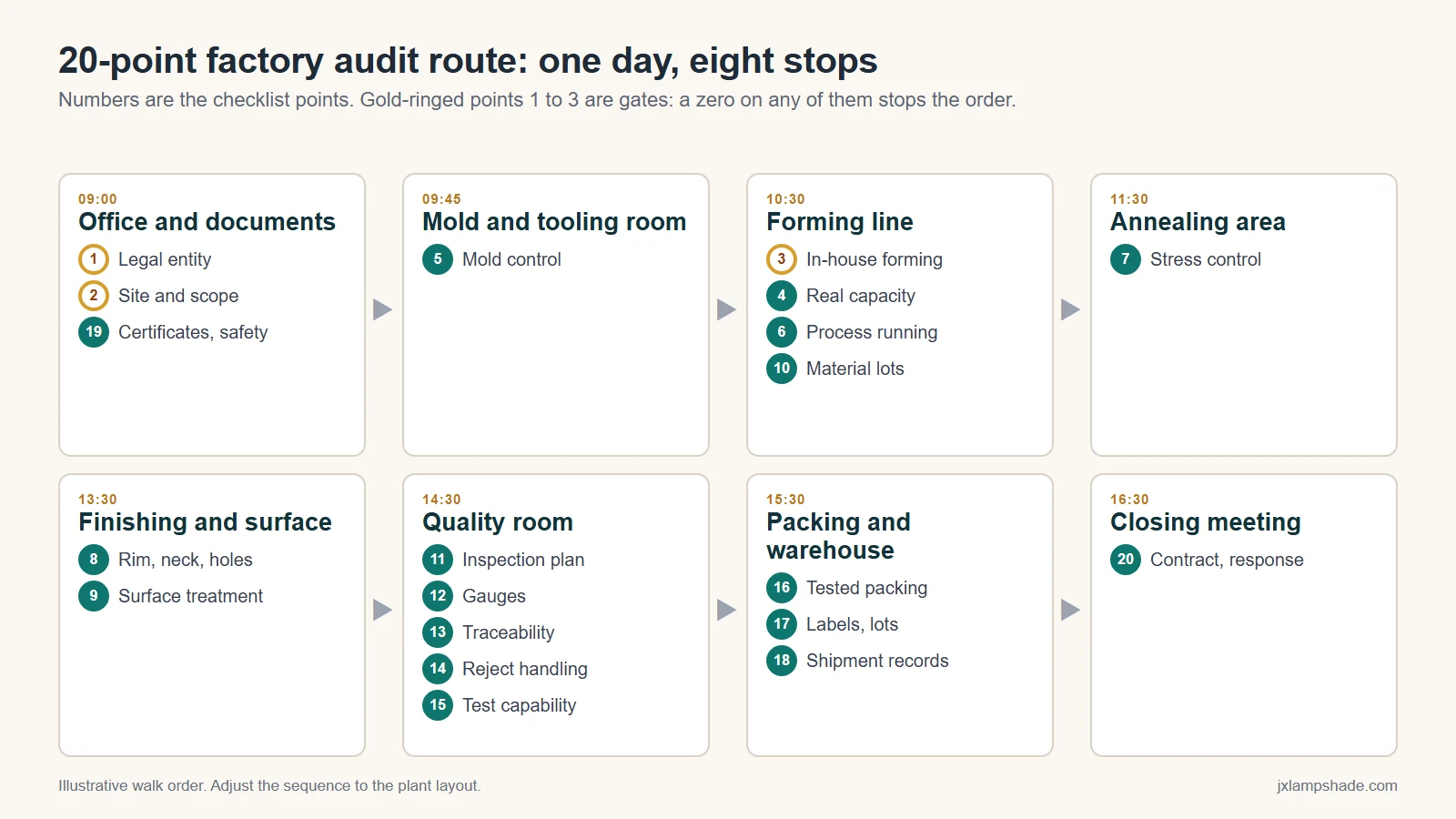
A one-day on-site plan
| Time | Activity | Points covered |
|---|---|---|
| 09:00 | Opening meeting: scope, documents, escorts | 1, 2, 19 |
| 09:45 | Mold and tooling room | 5 |
| 10:30 | Forming line, running a similar shade | 3, 4, 6, 10 |
| 11:30 | Annealing area and stress check | 7 |
| 13:30 | Finishing, drilling, surface treatment | 8, 9 |
| 14:30 | Quality room: gauges, records, nonconformance | 11 to 15 |
| 15:30 | Packing and warehouse, two-way trace | 16 to 18 |
| 16:30 | Closing meeting: findings read aloud, signed by both sides | 20 |
Keep the walk order flexible. If the plant layout allows it, ask to start at the packing area or the quality room instead of the planned first stop, so you see the floor as it normally runs.
When a remote audit is enough
A video audit is a sensible first filter when travel is hard, the order is small or you are comparing several suppliers. Insist on a live walk-through at a time you choose, and ask the auditor to carry a camera into the mold room, lehr area and packing area. Move to an on-site audit when the order is large, the shade is fit-critical, the supplier holds your tooling or the remote audit left gates unproven. You can also use a third-party audit firm. In either case, send the same 20-point sheet so scoring stays comparable across suppliers.
Warning signs that should slow the order
One warning sign on its own settles nothing. Two or three together are a reason to pause the order.
- the audit is refused, or limited to a showroom
- site, documents and invoice show different company names
- rooms look staged: clean machines, no work in progress
- records appear only when you ask, and none shows a history of use
- everyone answers at commercial level, nobody can explain defects
- payment is pushed before the audit ends
A missing certificate is not an automatic fail. A small craft workshop with strong records, calibrated gauges and a clear sample approval process may score higher than a certified factory that cannot trace a carton. Score the evidence you see.
What to send with your RFQ
Audit scope and quote request travel together. Send:
- the drawing or reference sample, with fit-critical dimensions marked (see our technical drawing checklist)
- annual forecast and first-order quantity
- destination market and any packing rule
- the audit sheet you plan to use and the date range for a visit
- your requirement for sample approval before mass production
You can structure the request with the custom lamp shade RFQ builder, then submit it through the contact page. Say in the request whether you want a site visit, a live video walk-through or a document review, so the 20 points can be matched to the right kind of evidence.
Frequently asked questions
How long does a glass lamp shade factory audit take?
One working day is enough for a single site if the document pack arrives in advance. Add time for a second site when forming and finishing are done in different places.
Should I audit before or after sampling?
Audit after the sample looks right and before you commit to tooling or a large order. Sample quality shows the best the factory can make. The audit shows whether it can repeat that quality.
Is a certificate enough instead of an audit?
No. A certificate shows that a system was assessed for a stated scope and site. It does not show how your shade is made or packed. Use it as one piece of evidence, and check scope, site, issuing body and expiry.
Can a trading company pass the audit?
Yes, if it discloses that it is a trading company, names the factory, and gives you audit access to the factory that makes your shade. The gates fail when the ownership is hidden, not when it is a different model.
How often should I repeat the audit?
Repeat it when volume rises sharply, when the supplier changes site, process or ownership, or after a serious quality failure. A yearly record review is enough for a stable supplier.