Published: May 21, 2026 | Author: Sean — 12+ years Production Manager at Yancheng Jingxin Glassware
Painting a glass lampshade is one of the fastest and most cost-effective ways to transform a plain shade into a designer piece. Whether you are a homeowner refreshing a vintage pendant or a B2B lighting brand prototyping a small batch for a hospitality client, the same five-step workflow applies: clean → prime → paint → seal → cure. This guide walks through each step with the exact materials, ratios, and curing temperatures we use on the factory floor.
1. Choose the Right Type of Paint for Glass Lampshades
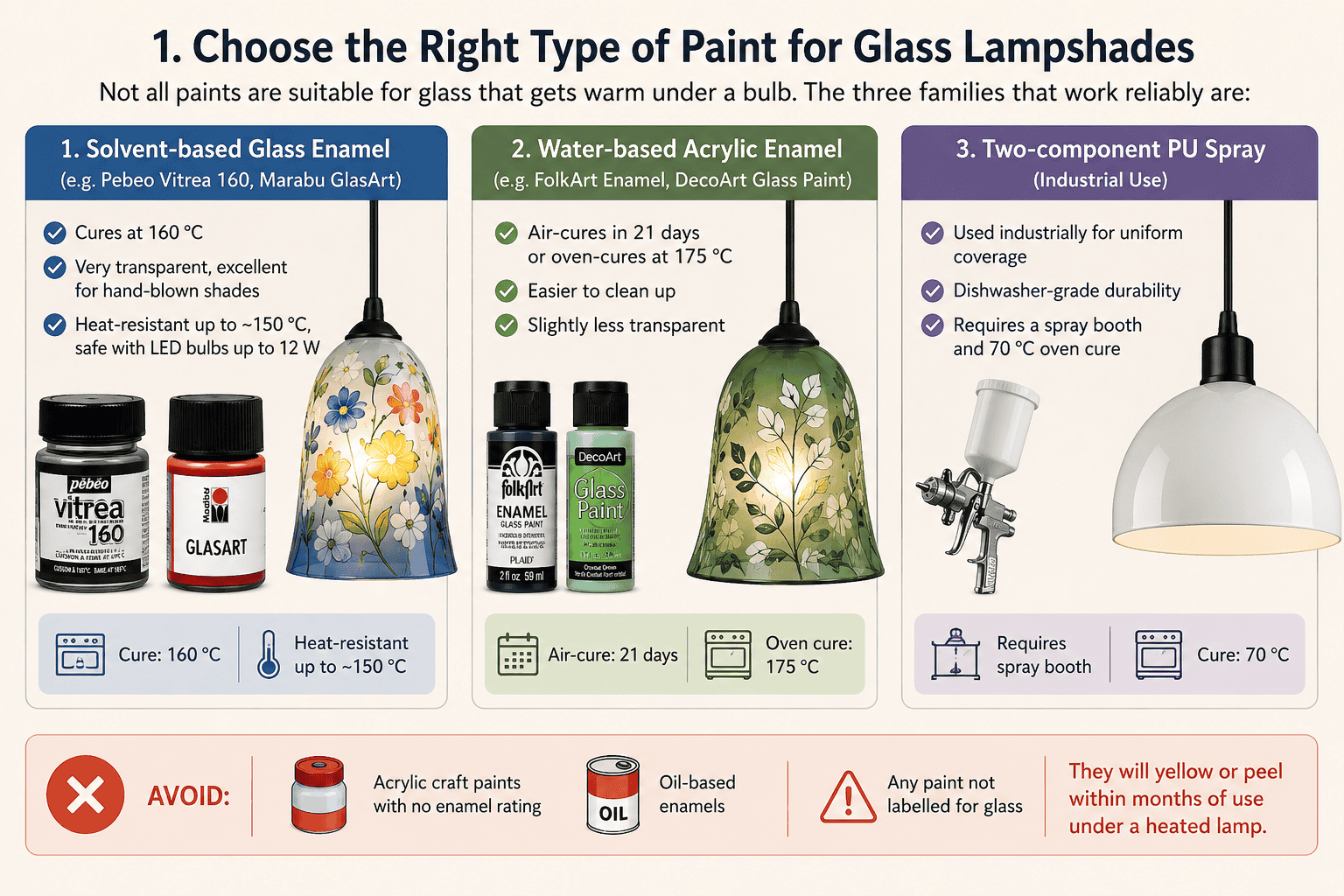
Not all paints are suitable for glass that gets warm under a bulb. The three families that work reliably are:
- Solvent-based glass enamel (e.g. Pebeo Vitrea 160, Marabu GlasArt) — cures at 160 °C, very transparent, excellent for hand-blown shades. Heat-resistant up to ~150 °C, safe with LED bulbs up to 12 W.
- Water-based acrylic enamel (e.g. FolkArt Enamel, DecoArt Glass Paint) — air-cures in 21 days or oven-cures at 175 °C. Easier to clean up; slightly less transparent.
- Two-component PU spray — used industrially when uniform coverage and dishwasher-grade durability are required. Requires a spray booth and 70 °C oven cure.
Avoid: acrylic craft paints with no enamel rating, oil-based enamels, and any paint not labelled for glass. They will yellow or peel within months of use under a heated lamp.
2. Clean and Degrease the Glass Surface
Paint adhesion fails on the slightest film of dust, oil, or release agent left from manufacturing. In our factory we use a three-stage process: (a) warm soapy water wash, (b) 99% isopropyl alcohol wipe with a lint-free cloth, (c) 60-second air-dry. Do not touch the painting surface with bare fingers after cleaning — wear nitrile gloves.
3. Apply a Glass Primer (Optional but Recommended)
A thin coat of clear glass primer (e.g. Krylon Glass Primer) increases bond strength by roughly 40% according to ASTM D3359 cross-hatch testing. For solvent enamels you can skip primer if the glass is borosilicate; for soda-lime glass we always prime.
4. Paint in Thin, Even Coats
Two thin coats outlast one thick coat. Use a foam roller for solid colours, a synthetic-bristle round brush for patterns, or an HVLP spray gun at 1.5 bar and 1.4 mm nozzle for production runs. Allow 30 minutes flash-off between coats. For decorative effects:
- Marbling: drip two thinned colours onto wet base coat and tilt the shade.
- Stencilling: use adhesive vinyl stencils; remove while paint is still wet to avoid tearing.
- Gradient: spray darker colour at the rim and feather upward.
5. Cure the Paint Properly
This is the single most important step. Curing transforms the paint film into a thermoset coating that survives bulb heat. Place the shade upside down on a wire rack in a cold oven, ramp to the manufacturer’s specified temperature (typically 160-175 °C), hold for 30-40 minutes, then let the oven cool with the shade inside. Do not open the door during cure — thermal shock can crack glass walls thinner than 3 mm.
6. Quality Check and Sealing
After cure, inspect for pinholes, runs, and adhesion using the ASTM D3359 tape test. A high-temperature clear acrylic sealer (rated 200 °C+) extends life by 2-3 years if the shade will be used outdoors or in a high-humidity bathroom.
Heat & Safety Considerations
Always specify LED bulbs (not incandescent or halogen) under painted shades. LEDs run at 30-50 °C surface temperature versus 200 °C+ for incandescents, well within the safe range of cured enamels. Mark the wattage limit on the shade with a heat-resistant label.
When to Buy Pre-Painted Shades Instead
If you need more than 200 pieces, an industrial spray-and-bake line will give you better consistency, food-safe labelling, and a lower per-unit cost than hand painting. Contact Jingxin Glassware for OEM quotations starting at 500 pcs MOQ.
Frequently Asked Questions
Can I paint over a frosted glass lampshade?
Yes, but reduce paint viscosity by 10-15% so the frosting texture remains visible. Frosted glass already has the surface roughness needed for excellent paint adhesion.
How long does painted glass last under daily use?
Properly cured solvent enamel lasts 8-10 years indoors, 3-5 years outdoors. Air-cured acrylic typically lasts 2-3 years.
Is painted glass dishwasher safe?
Only if the paint manufacturer explicitly certifies it (e.g. Pebeo Vitrea 160 after full cure). Most lampshade applications never see a dishwasher so this is rarely a concern.