ランプシェード用ガラス素材の選び方:強化ガラス、ホウケイ酸ガラス、ソーダライムガラス
Choosing the right glass material for lamp shades is one of the most critical decisions in lighting product design and manufacturing. The glass you select directly affects heat resistance, safety, light diffusion, durability, compliance, cost, and long-term performance.
For lighting manufacturers, interior designers, architects, and hospitality project buyers, understanding the differences between tempered glass, borosilicate glass, and soda-lime glass is essential to avoid cracking, quality failures, and costly project delays.
In this guide, we break down each material from both a technical and commercial perspective, helping you make the right choice based on application, environment, and production scale—while avoiding common mistakes that B2B buyers often encounter.
Why Glass Material Matters in Lamp Shade Manufacturing
Lamp shades are not purely decorative components. In real-world use, they must withstand:
Continuous heat exposure from bulbs or LED modules
Thermal shock from switching lights on and off
Mechanical stress during installation and transportation
Long-term exposure to UV light and ambient temperature changes
Selecting the wrong glass material can result in:
Cracking or shattering during use
Uneven light diffusion and glare
High breakage rates during shipping
Non-compliance with safety or project standards
That is why professional lighting manufacturers evaluate glass materials not only by appearance, but by thermal performance, mechanical strength, and consistency in mass production.
Overview: The Three Most Common Glass Materials for Lamp Shades
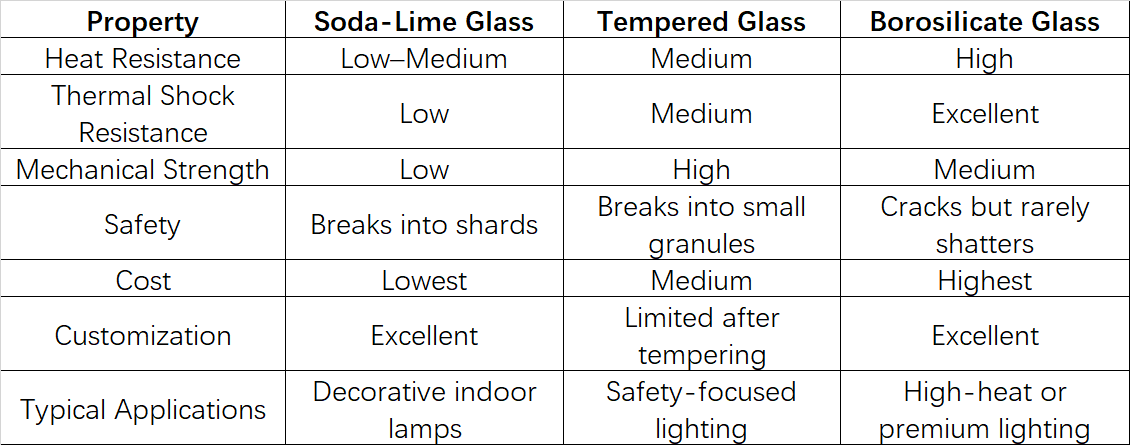
Before diving into details, here is a quick comparison:
Each material serves a different purpose, and there is no “one-size-fits-all” solution.
Soda-Lime Glass: Cost-Effective and Widely Used
What Is Soda-Lime Glass?
Soda-lime glass is the most common type of glass used worldwide. It is composed mainly of silica (SiO₂), sodium oxide, and calcium oxide. Because it is easy to melt and shape, it is widely used in household glassware, decorative products, and standard lamp shades.
Key Characteristics of Soda-Lime Glass
Maximum working temperature: ~150–200°C
Low resistance to thermal shock
High clarity and smooth surface finish
Easy to cut, drill, frost, or decorate
Lowest raw material and production cost
Advantages for Lamp Shades
Soda-lime glass is ideal for:
Decorative table lamps and wall sconces
Low-heat LED lighting fixtures
Indoor residential lighting
Projects with strict cost targets
Its excellent workability allows for:
Complex shapes
Thin or thick wall designs
Frosted, etched, painted, or sprayed finishes
This makes it a popular choice for custom decorative lamp shades where aesthetics matter more than extreme performance.
Limitations and Risks
The biggest drawback of soda-lime glass is its poor thermal shock resistance. Rapid temperature changes—such as turning a lamp on after it has cooled—can cause cracking.
It is not recommended for:
High-wattage bulbs
Enclosed fixtures with poor ventilation
Outdoor or commercial environments
Tempered Glass: Strength and Safety First
What Is Tempered Glass?
Tempered glass is soda-lime glass that has undergone a controlled heat-treatment process. This process increases surface compression, making the glass significantly stronger than untreated soda-lime glass.
Key Characteristics of Tempered Glass
3–5 times stronger than regular glass
Better resistance to mechanical impact
Breaks into small, blunt granules (safety glass)
Moderate heat resistance
Advantages for Lamp Shades
Tempered glass is commonly used when safety and durability are top priorities.
Typical applications include:
Commercial lighting fixtures
Hospitality and public spaces
Pendant lights in high-traffic areas
Fixtures requiring compliance with safety regulations
Because of its strength, tempered glass reduces:
Breakage during installation
Damage during shipping
Safety risks in public environments
Important Design Constraints
One key limitation of tempered glass is post-processing restriction.
Once glass is tempered:
It cannot be cut or drilled
Shape and holes must be finalized before tempering
つまり:
Design changes after sampling are costly
Complex customization requires careful upfront engineering
For B2B buyers, this makes supplier engineering support especially important.
Borosilicate Glass: High-Performance and Heat Resistant
What Is Borosilicate Glass?
Borosilicate glass contains boron oxide, which significantly improves thermal and chemical resistance. It is commonly used in laboratory glassware, cookware, and high-performance lighting applications.
Key Characteristics of Borosilicate Glass
Maximum working temperature: 300–500°C
Excellent thermal shock resistance
低い熱膨張係数
High chemical stability
Advantages for Lamp Shades
Borosilicate glass is the preferred choice for:
High-temperature lighting fixtures
Enclosed lamp designs
Industrial or architectural lighting
Premium or long-life products
It performs exceptionally well in environments where:
Lamps are frequently switched on/off
Heat buildup is unavoidable
Long-term stability is required
From a brand perspective, using borosilicate glass can significantly reduce:
Warranty claims
Cracking complaints
Project replacement costs
Cost and Production Considerations
Borosilicate glass is more expensive due to:
Higher raw material costs
Higher melting temperature
More demanding production control
However, for professional lighting projects, total lifecycle cost is often lower due to reduced failure rates.
Light Diffusion and Optical Performance
Glass material also influences how light behaves.
Clear soda-lime glass offers high transparency but can create glare
Frosted or opal soda-lime glass provides softer diffusion
ホウケイ酸ガラス maintains stable optical performance even at high temperatures
強化ガラス maintains clarity but limits post-processing finishes
For lighting designers, the ideal solution often combines:
Correct material selection
Surface treatment (frosted, sandblasted, opal)
Proper wall thickness
A professional manufacturer should be able to recommend the optimal combination based on light source and application.
Safety, Compliance, and International Standards
For B2B buyers, compliance is often non-negotiable.
Different markets may require:
Safety glass for public spaces
Heat resistance documentation
Material composition reports
Tempered glass is often specified for:
Commercial projects
Hospitality and public buildings
Borosilicate glass is favored where:
High-temperature safety is critical
Long-term reliability is required
Choosing the right supplier means ensuring they can provide:
Material test reports
Batch consistency documentation
Compliance support for different markets
Cost vs Performance: Making the Right Trade-Off
A common mistake in lamp shade sourcing is focusing only on unit price.
A better approach is to evaluate:
Failure risk
Replacement cost
Brand reputation impact
Long-term maintenance

How a Professional Glass Manufacturer Adds Value
Choosing the right material is only part of the equation. A reliable glass lamp shade manufacturer should also provide:
Engineering consultation during design
Material comparison and testing support
Prototyping and sampling
Quality control and batch consistency
Secure packaging and export logistics
For B2B buyers, this technical support often makes the difference between a smooth project and a costly failure.
よくある質問
Yes, for low-heat LED applications, soda-lime glass is commonly used.
Not necessarily. It is better for heat resistance, but may be unnecessary for decorative or low-temperature applications.
No. Tempered glass is stronger mechanically, but borosilicate glass has superior thermal resistance.
Soda-lime and borosilicate glass offer the greatest customization flexibility.
当社のプロセスは量産前に品質を確保します。
お客様によるデザイン確認
自社施設での金型開発
承認用サンプルの製作
お客様によるテストとフィードバック
最終サンプル承認後のみ量産を開始します
私たちは提供します 安全な国際配送のための包括的なカスタムパッケージ:
- 保護用の内側梱包材
- 輸出用グレードの段ボール箱
- カスタムカラーボックスと小売用パッケージ
- ラベル印刷とブランディング
- 国際配送基準に合わせて設計されたパッケージ
- 各生産段階での検査
- 科学的な品質管理手順
- 各ロットの出荷前検査
- 国際輸出基準への準拠
- 認証された品質管理システム
私たちは運営しています 経験豊富な作業員による複数の生産ライン, これにより、あらゆる規模の注文に対して安定した大量生産が可能です。私たちの施設は、小ロットから大量注文まで、一貫した品質と信頼できる納期を保証します。.
リードタイムは複雑さや数量によって異なります:
- カタログ/ライトカスタマイズ:1,000個までの注文は25~30日
- 1,000~5,000個のご注文:35~45日
- 新しい金型による完全カスタムOEM:45~65日;最終納期はプロジェクトにより確定
当社は日本を含む全世界120以上の国と地域に輸出しています, 例として:
- 日本(日本国内)
- ヨーロッパ(イギリス、ドイツ、フランスなど)
- アジア太平洋市場
- 中東
- アフリカ
- オセアニア(オーストラリア、ニュージーランド)
当社は包括的なグローバル流通ネットワークを維持しています。.