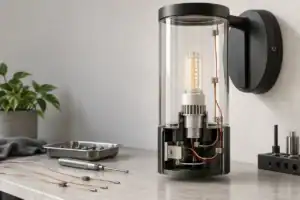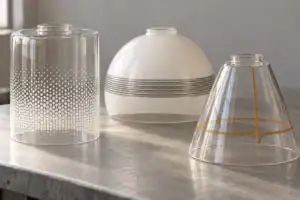
The decorative knob atop a lampshade is called a finial, a small ornamental cap that threads onto the lamp harp to secure the shade in place while serving as the fixture’s crowning decorative accent.
Most people replace a lampshade and never think twice about the small knob on top. Easy to overlook, until it’s missing, stripped, or so mismatched with the lamp that the whole fixture looks cobbled together. The decorative knob atop a lampshade does two things at once: it locks the shade onto the harp and, when chosen well, acts as the quiet crowning detail that makes a lamp feel finished. Get it right and nobody consciously notices. Get it wrong and something just looks off, even if the viewer can’t say exactly why.
What follows covers what the decorative knob atop a lampshade is actually called, the full range of finial types and materials, how they attach, how to size and match one to your lamp, and where design trends are heading in 2026. Whether you arrived from a crossword puzzle or you’re outfitting a new floor lamp, you’ll find the answer here.
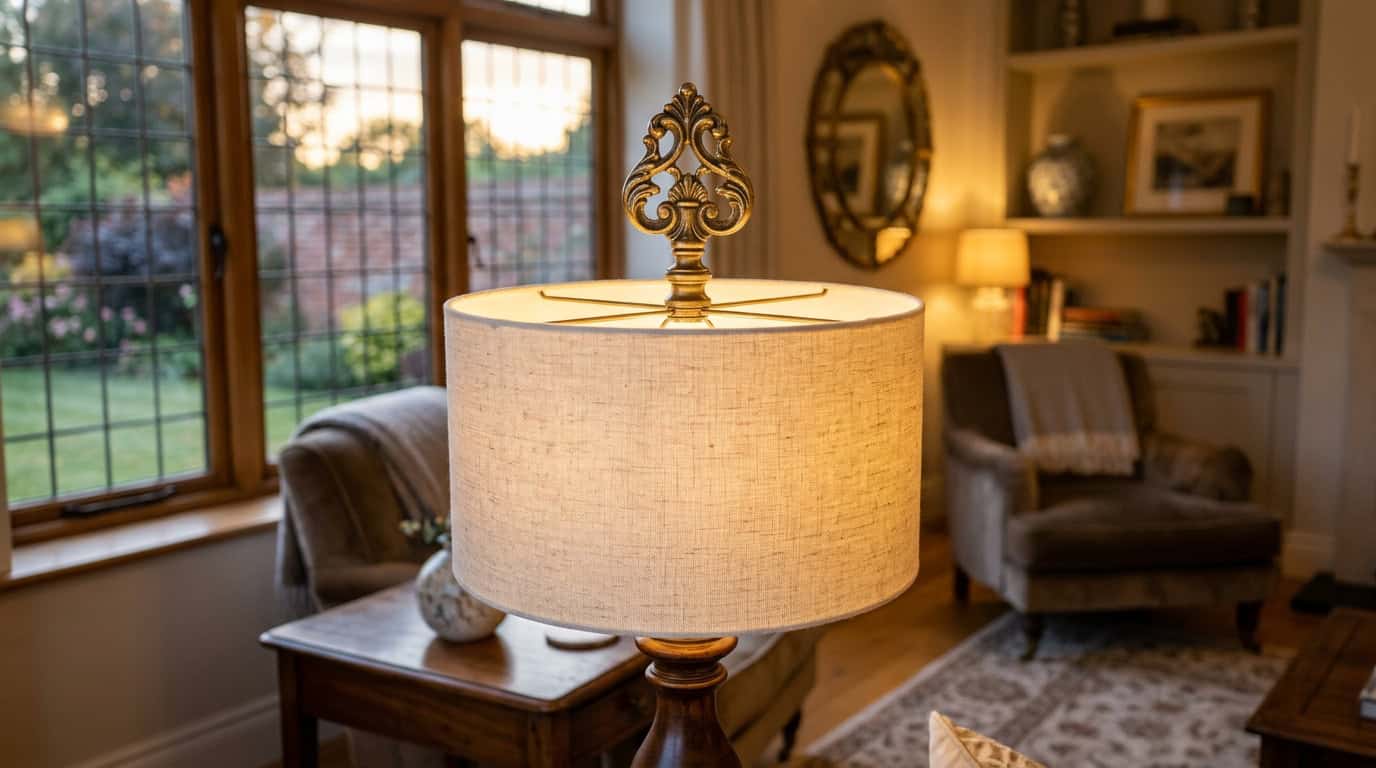
What is the decorative knob atop a lampshade?
The decorative knob atop a lampshade is a finial, from the Latin finis meaning “end,” an ornamental cap that threads onto the harp post to lock the shade in place while serving as the lamp’s crowning accent.
The word “finial” traces back to the Latin finis, meaning end or boundary. In architecture, finials have topped spires, gables, and roof ridges for centuries. They’re the pointed ornaments that crown Gothic cathedrals and Victorian gateposts. According to Wikipedia’s entry on architectural finials, the term has been in English use since the 15th century, initially describing the crowning ornament of a canopy or spire. The word carried directly into furniture and decorative arts: a finial is always the ornamental termination point of a vertical form. On a lamp, it’s the endpoint of the harp post and the last visual detail the eye lands on when looking upward at the fixture.
By the 19th century, as gas lamps and then electric lamps moved into domestic interiors, “finial” migrated into the vocabulary of lamp design. Victorian parlor lamps used finials to cap glass chimneys and fabric shades with something that matched the lamp base’s material: brass finials on brass bases, silver on silverplate, porcelain on ceramic. That tradition of the coordinated finial persists in quality lamp design today, though the default in mass-market production is still the plain brass nut.
The anatomy of a finial: function vs. decoration
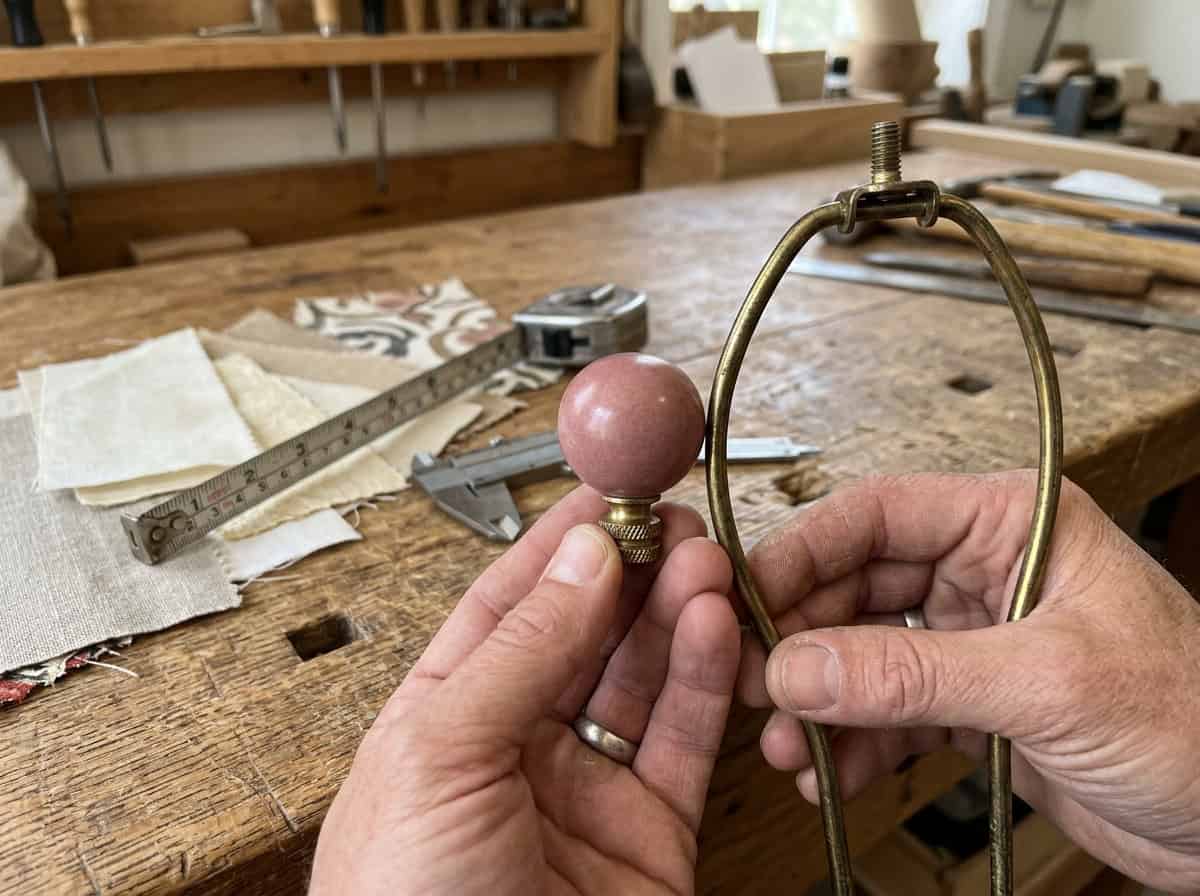
The finial does real mechanical work. Beneath the decorative form sits a threaded post (almost universally 1/4-27 thread on modern American lamps) that screws into the top of the lamp harp. The harp is the U-shaped wire frame that rises from the lamp socket and cradles the light bulb. The shade’s spider fitter (the crosswise metal bracket inside the top of the shade) rests on the saddle of the harp, and the finial threads down through a center hole in the spider to clamp the whole assembly together.
Remove the decorative knob atop a lampshade and the shade lifts off freely. Tighten it and the shade is locked. That’s the mechanical story, but most finials are chosen for decoration, not engineering. Swap the standard brass nut that ships with most lamps for a hand-turned ceramic sphere or a faceted crystal drop and the lamp changes character entirely. A finial replacement costs $15 to $80 for most decorative options, making it one of the lowest-cost ways to update a lamp without replacing it.
| Hardware piece | Role in the lamp assembly |
|---|---|
| Lamp harp | U-shaped wire frame; supports shade above the bulb |
| Harp saddle | Base bracket; harp slides in, held by a snap lock ring |
| Spider fitter | Crosswise bracket at the top of the shade; rests on the harp |
| Shade washer | Optional ring between spider and finial on certain shade types |
| Finial (decorative knob atop lampshade) | Threaded cap; screws onto harp top; locks the entire assembly |
Etymology and the crossword connection
If you arrived here from a crossword puzzle, here’s the answer: the decorative knob atop a lampshade is FINIAL, six letters, F-I-N-I-A-L. It appears regularly in crossword grids because it’s a specific technical term that most people recognize without necessarily knowing the name. Related clues include “lampshade topper,” “decorative knob,” and “crown of a lamp.”
The same word describes the ornamental tip on a curtain rod, the carved peak on a piece of furniture, and the crowning element of an architectural structure. In every case, a finial terminates a vertical form with a decorative flourish.
Types of lamp finials
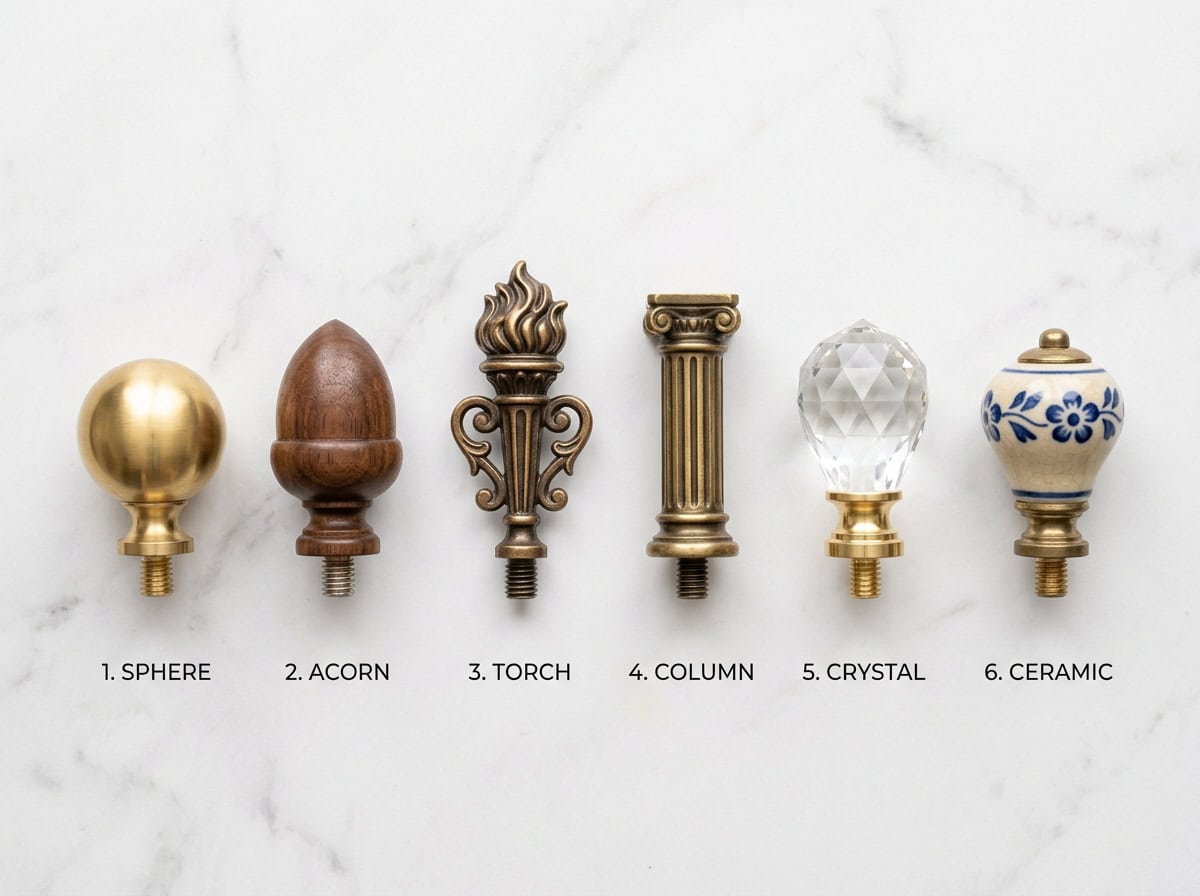
Lamp finials fall into five main shape families (ball/sphere, acorn, torch/flame, column/pillar, and themed novelty), each available in brass, nickel, crystal, ceramic, wood, or resin.
The five families cover most of the market, but within each there’s genuine variation in scale, proportion, and surface treatment.
Shape categories: the five main families
Ball and sphere finials are the most versatile and the most common decorative knob atop a lampshade across all price points. A clean sphere, 1 to 2 inches in diameter, reads as decorative without being distracting. It suits almost any lamp style: traditional, transitional, contemporary, coastal. Sphere finials in polished brass are the default for traditional and transitional rooms; in matte black or brushed nickel they work in minimalist and industrial interiors. A faceted crystal ball is the standard for glamorous or feminine spaces.
Acorn finials carry a specific traditional association. The acorn is a centuries-old symbol of strength and longevity in European decorative arts, and acorn-shaped decorative knobs were common on Victorian and Edwardian-era lamps. They pair naturally with brass or bronze bases, antique fabrics, and rooms furnished with period pieces or reproduction furniture. Too formal for contemporary spaces, exactly right for a library or study with a leather chair.
Torch and flame finials taper upward to a point, evoking a candle flame or architectural spire. They add visual height, which helps when the lamp base is wide and low, and they read as more formal than a sphere. Flame finials in antique brass or oil-rubbed bronze suit traditional dining rooms and formal living rooms well.
Column and pillar finials are cylindrical or slightly tapered forms, sometimes fluted. They’re architectural in character, the shape closest to the building-hardware origins of the word “finial,” and they suit lamps with strong geometric lines: mid-century modern, transitional, or contemporary traditional spaces.
Themed and novelty finials cover everything from botanical forms (acanthus leaf, fleur-de-lis, pine cone) to animals, sporting motifs, and custom sculptural shapes. These work in rooms with a strong decorative theme where the finial acts as small punctuation reinforcing the room’s character. In a neutral room they tend to feel random rather than personal.
Materials: what each brings to the fixture
Brass is the baseline for traditional lamp hardware. Cast brass finials resist tarnishing, hold detail well, and age gracefully. Polished brass reads as formal; satin or antique brass reads as warm and classic. For fixtures with brass hardware elsewhere, a brass finial is the lowest-risk choice.
Nickel and chrome are the contemporary counterpart. Brushed nickel suits transitional rooms, not as cold as chrome, not as warm as brass. Polished chrome is sharp and modern, best in industrial or minimal interiors. Both finishes photograph well, which matters in spaces designed with social media in mind.
Crystal (whether cut glass, acrylic, or genuine lead crystal) adds sparkle. Crystal finials catch incident light and scatter it across nearby surfaces. They suit glamorous bedrooms, dressing rooms, and living rooms where chandeliers or mirror work is already present. The effect is pronounced; use deliberately rather than by default.
Ceramic and porcelain finials range from hand-painted to solid-color to textured unglazed stoneware. A painted porcelain decorative knob can echo the pattern of fabric upholstery or the glaze of a ceramic lamp base. Solid-color matte ceramics in dusty rose, sage green, or warm white are the clear 2026 trend driver, pairing well with natural linen shades and woven-fiber bases. For more on linen shade pairings, see the linen lampshades buyer’s guide.
Wood (turned, carved, or raw) brings warmth and natural texture. Wood finials suit coastal, Scandinavian, and organic-modern interiors. They’re lighter than metal, which matters on shades where the harp assembly is already near its comfortable weight limit. Ebonized wood is an underused option in formal traditional rooms.
Resin and acrylic allow for shapes and colors impossible in cast metal: translucent, brightly colored, or intricately detailed novelty forms. Quality varies widely. Premium cast resin finials are a reasonable substitute for carved materials at lower cost, while cheap injection-molded resin looks plastic regardless of how it’s finished.
Standard thread sizing: the technical detail most guides skip
Most lamp finials in the United States use a 1/4-27 thread, meaning 1/4-inch diameter at 27 threads per inch. This has been the U.S. standard for lamp hardware across the 20th century and into today, which is why a finial bought from any mainstream lamp supplier fits any mainstream lamp harp. That standardization covers roughly 95% of all table and floor lamps currently sold in the American market.
The less-common alternative is 1/8-IP (iron pipe thread, approximately 3/8-inch outer diameter), found on older fixtures and some European imports. If a finial won’t thread onto your harp, the harp is likely 1/8-IP. Inexpensive adapters bridge the two sizes.
Finials range from roughly 0.5 inches to 4 inches in decorative height, with the most common range being 1.5 to 2.5 inches for standard table lamps. Larger finials (3 inches or more) suit floor lamps with tall shades; smaller finials (under 1 inch) are appropriate for mini chandelier shades or table lamps where a large decorative knob atop the lampshade would read as top-heavy.
| Finial shape | Best lamp style | Ideal room setting |
|---|---|---|
| Ball / sphere | Any, universal | All rooms |
| Acorn | Traditional, Victorian, Edwardian | Library, study, formal living room |
| Torch / flame | Traditional, formal | Dining room, formal entry |
| Column / pillar | Geometric, transitional, mid-century | Living room, office |
| Crystal ball | Glamorous, Hollywood Regency | Bedroom, dressing room |
| Ceramic solid-color | Contemporary traditional, organic | Living room, bedroom |
| Wood turned | Coastal, Scandinavian, organic modern | Any room with natural materials |
| Novelty / themed | Eclectic, rooms with strong theme | Children’s rooms, themed studies |
How finials attach to lampshades
Most finials use a standard 1/4-27 threaded post that screws onto the top of the lamp harp, the U-shaped wire frame that supports the shade above the bulb.
Understanding the attachment matters when buying a replacement or upgrade finial. Wrong thread size and it won’t fit. The mechanics are simple once you’ve seen them once.
The 1/4-27 standard: what it means in practice
The numbers break down simply. 1/4 inch is the outer diameter of the threaded post; 27 is the thread count per inch. This pitch is specific to lamp hardware and doesn’t match standard hardware-store bolt threads, which run at different pitches for the same diameter. You won’t find 1/4-27 hardware at a general hardware store, but any specialty lamp supplier will carry it.
The harp’s top post is 1/4-27 male thread; the finial’s base is 1/4-27 female thread. Thread the decorative knob clockwise until it seats firmly against the spider fitter. Finger-tight is sufficient for most materials. Over-tightening a resin or ceramic finial can crack it at the base; metal finials can take slightly more torque.
As the lampshade hardware overview at Lighting New York notes, adapters are available to bridge 1/4-27 and 1/8-IP threads. A finial designed for an older fixture can work on a modern lamp with a $2 adapter, so there’s no reason to discard an heirloom decorative knob just because the thread size doesn’t match current hardware.
Finials thread in and out, which makes swapping genuinely easy. Unscrew the existing finial counterclockwise, lift off the shade, change whatever you want, lower the shade back onto the harp, and thread on the new finial. The whole process takes under a minute.
Alternative attachment methods
Clip-on shades attach to the bulb directly, bypassing the harp entirely. No harp means no finial. Some decorative clip-on shades include an ornamental ring at the top to mimic the look of a finial, but it’s non-structural.
Uno shades thread directly onto the lamp socket ring, also bypassing the harp. No finial required. Some uno-fitter shades include a decorative cap for visual continuity, but it’s cosmetic.
The fitter type of your shade determines whether a finial is part of the assembly. Spider/washer fitters use a harp and require a finial. Clip-on and uno fitters don’t. If your shade has a crossbar fitting at the top interior, it’s a spider fitter, and a harp and finial are part of the system.
How to choose the right finial for your lamp
Match the finial’s finish to the lamp base metal, not the shade. Scale it to roughly one-eighth of the shade height. Then pick a shape that suits the room.
Most people pick finials in the wrong order. They start with shape because shape is the most visible variable, then realize the finish clashes with the lamp base, then compromise on scale. Finish first, scale second, shape third.
Matching finish to lamp base: the key starting point
The decorative knob atop a lampshade sits directly above the lamp base in the visual hierarchy. If the base is polished brass, the finial should be polished brass, or a warm-toned material (warm crystal, antique gold, warm wood). If the base is brushed nickel, the finial should be cool-toned: brushed nickel, chrome, silver-leaf, or clear crystal.
The shade is less constraining. A white linen shade works with almost any finial finish, which is why it’s the default. Patterned or colored shades narrow the field: a shade with gold embroidery calls for a warm-toned finial; a shade with blue trim reads better with a cool metal or clear crystal.
The modern exception is mixed metals, but only when the contrast is wide. A brass lamp base with a brushed nickel finial reads as a mistake because the gap between them is too small to look like a choice. A brass lamp base with a matte black finial reads as deliberate because matte black sits outside the metal-finish spectrum entirely and registers as an accent rather than an almost-match. Near-matches are the worst outcome; clear contrasts work.
Getting the scale right: proportion rules
The finial’s height should be approximately one-eighth of the shade’s height. A 12-inch shade pairs well with a 1.5-inch finial. An 18-inch shade can carry a 2 to 2.5-inch finial. Oversized finials (3 inches or more) are legitimate statement pieces on tall floor lamp shades but will look cartoonish on a bedside table lamp.
Width follows height: the finial’s widest point should be narrower than the shade’s top opening. A decorative knob that extends wider than the shade’s top rim looks perched rather than integrated.
Per Pooky’s lampshade selection guide, always scale accessories to the full fixture height. A finial that looks correct on the shade alone may look dwarfed on a tall floor lamp, so view the complete assembled fixture before finalizing.
Style matching: four interior contexts
Traditional rooms with antiques, formal upholstery, and wood-paneled walls call for acorn, torch, and sphere finials in antique brass, oil-rubbed bronze, or hand-painted porcelain. Clean geometric forms will clash with ornate surroundings.
Transitional rooms, the contemporary-meets-classic blend that dominates most furnished interiors, work well with sphere finials in satin brass or brushed nickel. Safe, versatile, correct. Upgrading to a ceramic solid-color finial is the easiest way to add character without risk.
Contemporary and minimalist rooms: column or sphere finials in matte black, brushed nickel, or raw metal. Smaller is better here. An oversized novelty finial will fight the room’s aesthetic.
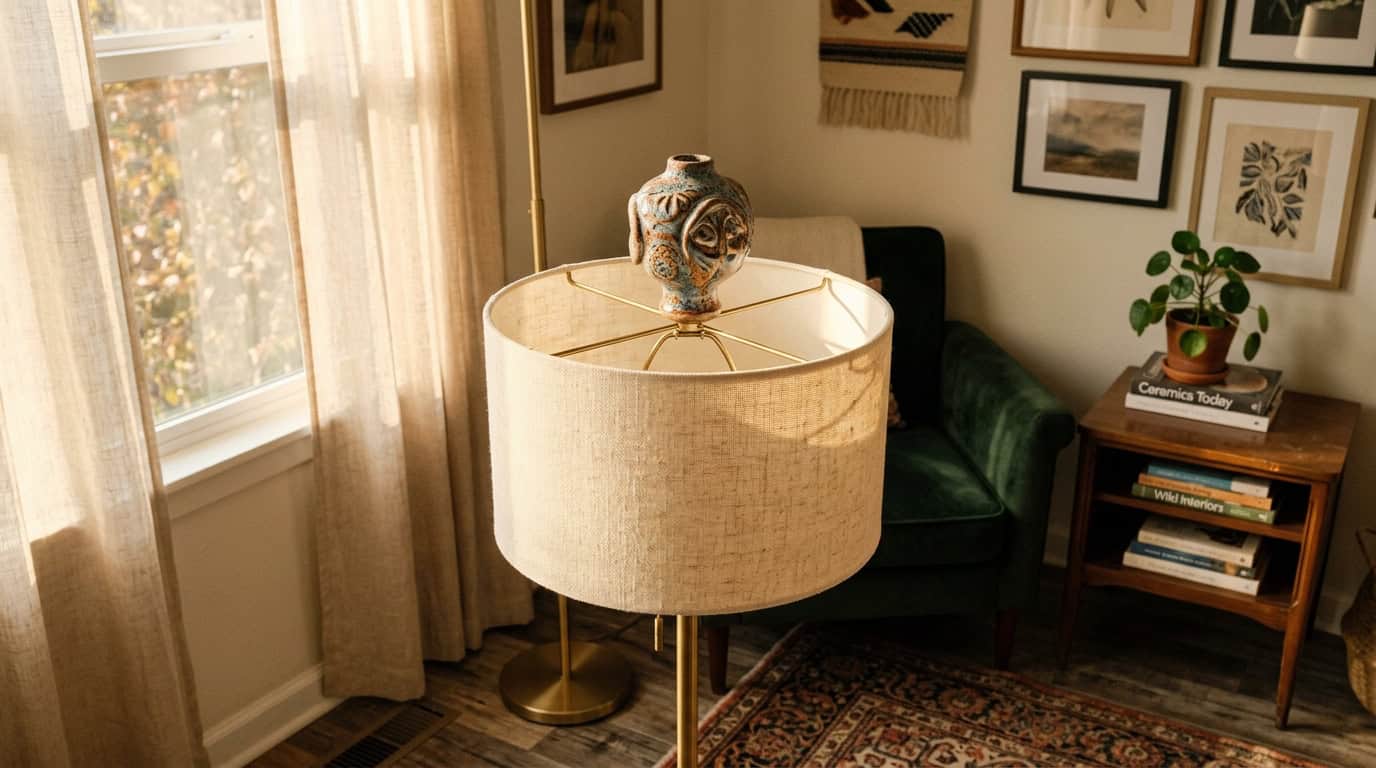
Bohemian and eclectic rooms have the most latitude. Wood-turned finials, hand-painted ceramics, raw quartz crystals mounted on 1/4-27 threaded bases, all are valid, as long as the decorative knob atop the lampshade looks chosen rather than inherited.
Room-by-room finial applications
Bedrooms, living rooms, and dining rooms each impose different constraints on finial selection. The lamp’s scale, the ambient light level, and how close viewers typically stand to the fixture all shift meaningfully by room.
Bedroom table lamps
Bedside lamps are viewed close-up and often at eye level when reading in bed. That proximity means the decorative knob atop a lampshade is more visible here than almost anywhere else in the house. A scratched or poorly finished finial registers clearly. So does one that feels wrong against the lamp base.
Bedroom finials should feel personal and refined rather than architectural. Ceramic spheres in dusty rose, sage, or warm ivory are the 2026 bedroom choice. They pair naturally with linen shades and natural-material bases without demanding attention. Crystal drops work in more glamorous bedrooms. Novelty finials are generally the wrong call in a bedroom; the whimsy that works in a study reads as restless in a room meant for sleep.
Living room floor and accent lamps
Floor lamps are viewed from a distance, so surface detail reads less sharply. Scale matters more than finish precision. A 2.5 to 3-inch decorative knob atop a lampshade that would overpower a bedside lamp is proportionate on a 60-inch floor lamp. Bold shapes (carved wood, large crystal, sculptural ceramic) work here because there’s enough visual distance for the eye to read them as intentional rather than oversized.
Accent lamps flanking a sofa or console follow the same rules as bedroom lamps: close viewing distance, so quality and material matter more than scale.
Dining room chandeliers
Chandeliers with multiple lampshade arms use mini finials scaled to the small drum or bell shades common on candelabra-base sockets. These typically run from 0.5 to 1 inch in height. The most important factor in dining rooms is consistency: all finials on a chandelier should match exactly. A mix of brass and nickel finials on a multi-arm chandelier reads as incomplete rather than eclectic.
When buying chandelier finials, purchase several extras from the same production run. Finish tones vary subtly across batches, and what looks like the same “antique brass” from two separate suppliers will read as different tones under dining room light. For a deeper look at full chandelier configurations, see the lampshade chandelier guide on this site.
Lamp finial trends for 2026 and beyond
Sculptural hand-thrown ceramic finials and deliberate mixed-metal combinations lead 2026, alongside a revival of hand-turned wood and faceted colored crystal accents in statement rooms.
The finial trend story in 2026 is part of a broader shift in home décor: away from mass-produced matchy-matchy sets and toward pieces that look assembled by someone with taste over time. A stock lamp with a custom ceramic finial reads as considered. A perfectly coordinated lamp set from a box store reads as unedited.
Artisan ceramic and the handmade finial revival
The strongest 2026 trend is the artisan ceramic finial. Hand-thrown stoneware spheres and organic ovoid forms in matte glazes (dusty rose, sage green, terracotta, warm ivory) have moved from craft-fair accessories to mainstream interior design. They began gaining traction in specialty ceramics studios around 2023-2024 and are now carried in independent home goods retailers and premium lamp shops.
The appeal is tactile and personal. A handmade ceramic decorative knob atop a lampshade has slight variations in form and glaze that make no two identical. That’s exactly the point in rooms where everything else is production-made. The surfaces also photograph with remarkable texture and depth in natural light, useful for any room that doubles as a photo background.
For linen lampshades, a category with its own strong resurgence, a ceramic finial in a warm neutral is the natural pairing. The two materials reinforce each other’s earthy, artisan character.
Mixed metals and the anti-matchy approach
The second significant trend is deliberate finish contrast: a brass lamp base with a matte black decorative knob, or a nickel base paired with a warm wood finial. This departs from the traditional rule of matching all hardware finishes, but it works when the contrast is wide enough to read as a decision.
Contrast must be unambiguous to communicate intention. Brass base with antique brass finial matches, clean and traditional. Brass base with polished gold almost matches, which is the worst outcome since it reads as careless. Brass base with matte black creates a contrast that’s too wide to mistake for an accident. The gap must be clear.
| Trend | Dominant material | Best lamp style | 2026 momentum |
|---|---|---|---|
| Artisan ceramic sphere | Hand-thrown stoneware | Linen shade, natural base | Strong, broad retail adoption |
| Matte black contrast | Powder-coated metal | Any base except black | Strong, becoming mainstream |
| Hand-turned wood | Solid hardwood, ebonized | Coastal, Scandinavian, organic | Moderate, niche but growing |
| Faceted colored crystal | Hand-cut glass | Maximalist, Hollywood Regency | Moderate, higher price point |
| Sculptural novelty | Cast resin, mixed materials | Eclectic, themed rooms | Steady, perennial niche |
FAQ
What is the decorative knob on top of a lampshade called?
It’s called a finial. The word comes from the Latin finis (end) and describes any ornamental cap that terminates a vertical form. On a lamp, the finial threads onto the top of the harp to lock the shade in place. It’s simultaneously functional hardware and a decorative accent.
What size finial do I need?
For most table lamps, a finial between 1.5 and 2 inches in height is proportionate. Floor lamps can carry finials up to 3 inches. Mini chandelier shades use finials of 0.5 to 1 inch. The general rule: finial height equals roughly one-eighth of shade height. When torn between two sizes, go smaller. An undersized decorative knob atop a lampshade reads as restrained; an oversized one reads as clumsy.
Are all lamp finials the same thread size?
No, but most modern U.S. lamps use the same 1/4-27 thread standard, meaning 1/4-inch diameter at 27 threads per inch. Some older fixtures and certain European imports use 1/8-IP thread (slightly larger). Inexpensive adapters bridge the two. As Hirosart’s detailed finial guide explains, the 1/4-27 standard fits the harp on approximately 95% of all modern lamps sold in the U.S. market.
Can I use any finial with any lampshade?
Only if the shade uses a harp-and-spider fitter. Clip-on shades attach to the bulb directly, no harp, no finial. Uno-fitter shades thread onto the socket ring, also bypassing the harp. If your shade has a crossbar fitting at the top interior (the spider), it uses a harp, and any standard 1/4-27 decorative knob will fit.
How do I remove a stuck or stripped finial?
Grip with rubber-grip kitchen pliers (not metal pliers, which scratch the finish) and turn counter-clockwise. If the finial is seized from old brass-on-brass thread corrosion, a drop of penetrating oil left for 10 minutes usually frees it. If the thread is stripped and the decorative knob spins freely without releasing, the harp top itself may need replacing. Harps are inexpensive and widely stocked.
Do I need a finial if I use a clip-on shade?
No. Clip-on shades bypass the harp entirely. Some decorative clip-on shades include a non-structural ornamental cap at the top for aesthetics, but it isn’t secured to anything load-bearing and shouldn’t be confused with a true finial.
What is the most popular lamp finial style in 2026?
The matte ceramic sphere in earthy neutrals (sage green, dusty rose, warm ivory, terracotta) is the dominant style in 2026, driven by the shift toward natural materials and handmade accessories. For traditional rooms, antique brass acorn and sphere finials remain the consistent standard. As Wikipedia’s lampshade overview notes, materials like silk, linen, and artisan-made elements have defined premium lamp design in each era.
Where can I buy decorative lamp finials?
Specialty lamp retailers including Lamps USA and Fenchel Shades carry the widest finial selection. Ceramics studios on Etsy carry hand-thrown artisan options. For glass lampshade bases that pair naturally with decorative finials (crystal finials look exceptional against clear or opal glass), browse the JX Lampshade glass shade collection.
The finial that finishes the lamp
A decorative knob atop a lampshade is a small part with an outsized effect on how the whole fixture reads. The right finial (finish matched to the base, size proportionate to the shade, shape suited to the room) goes unnoticed in the best possible way: the lamp simply looks right, finished, and deliberate. The wrong one creates that vague sense that something is off, even for viewers who couldn’t name what a finial is or why it matters.
The practical sequence is short: note your harp’s thread size (1/4-27 in almost every case), measure your shade’s height and divide by eight for a target finial height, match the finish to your lamp base metal rather than your shade fabric, then choose a shape that suits the room’s character. After that it’s just style, and style is the part worth enjoying. Explore the full range of glass lampshades at JX Lampshade to find a base worth crowning.