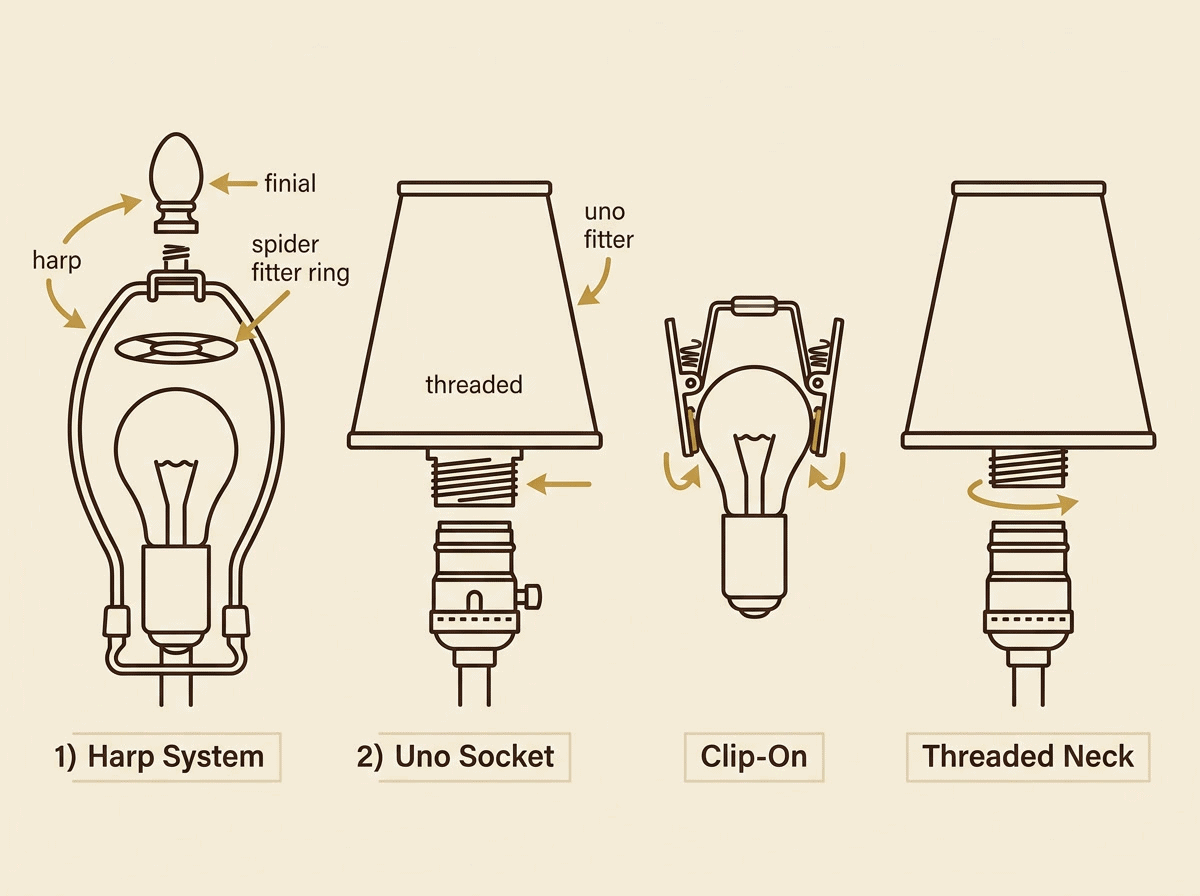
The part of a lamp that holds the shade is called the harp — a U-shaped metal bracket that slips into the harp saddle mounted on the lamp socket and is secured at the top by a decorative screw called the finial. On lamps that don’t use a harp, the shade is held by one of three alternatives: a uno socket ring the shade screws onto directly, a clip-on fitter that grips the bulb, or a threaded neck fitter on the shade body itself.
It has no obvious name on the box. When it’s bent or missing, the shade tilts, wobbles, or falls off entirely. When you go to replace it, you don’t know whether to search for “lamp bracket,” “shade holder,” or “the metal U-thing.” The part of a lamp that holds the shade is called a harp, and the harp is just one piece of a four-part system. This guide names every component, explains what each one does, and tells you what to do when any part is missing, damaged, or simply wrong for the shade you want to use.
The Harp — The Main Part of a Lamp That Holds the Shade
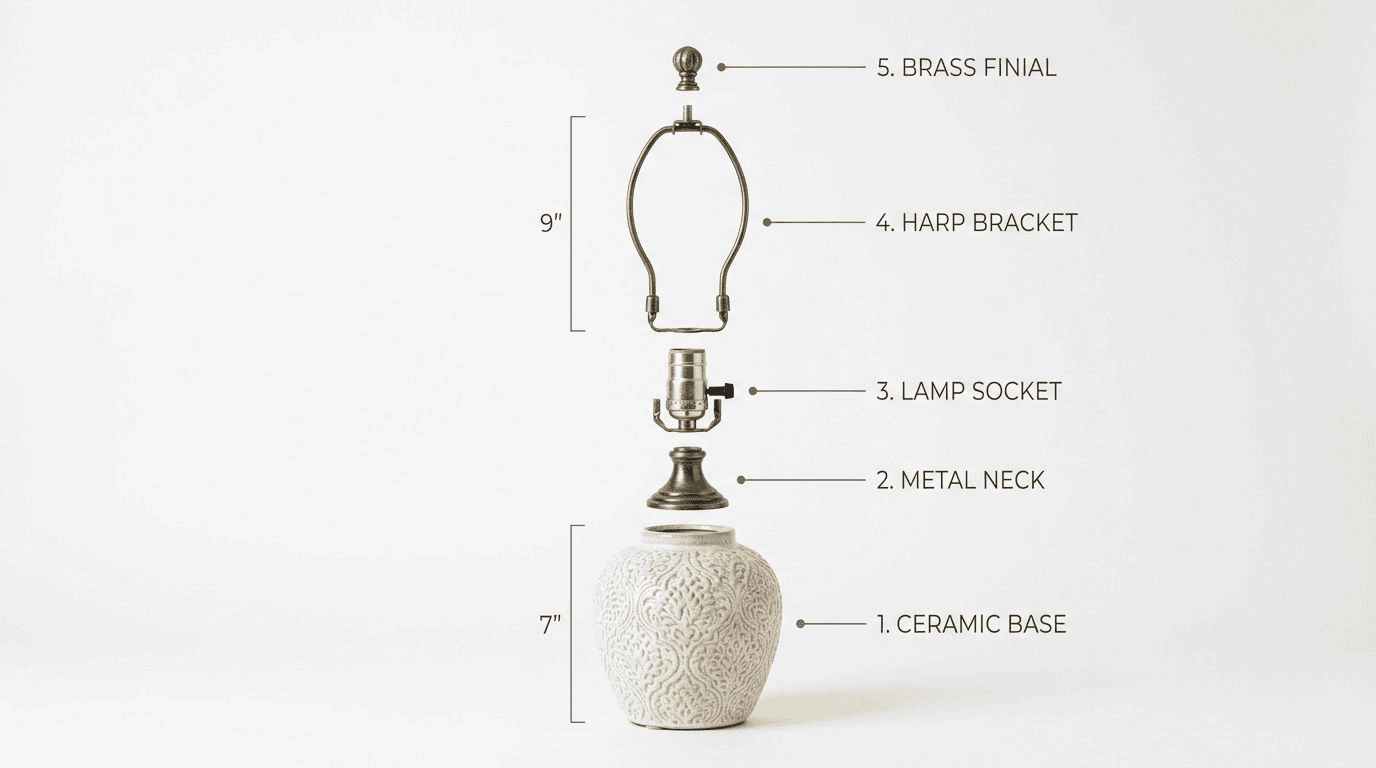
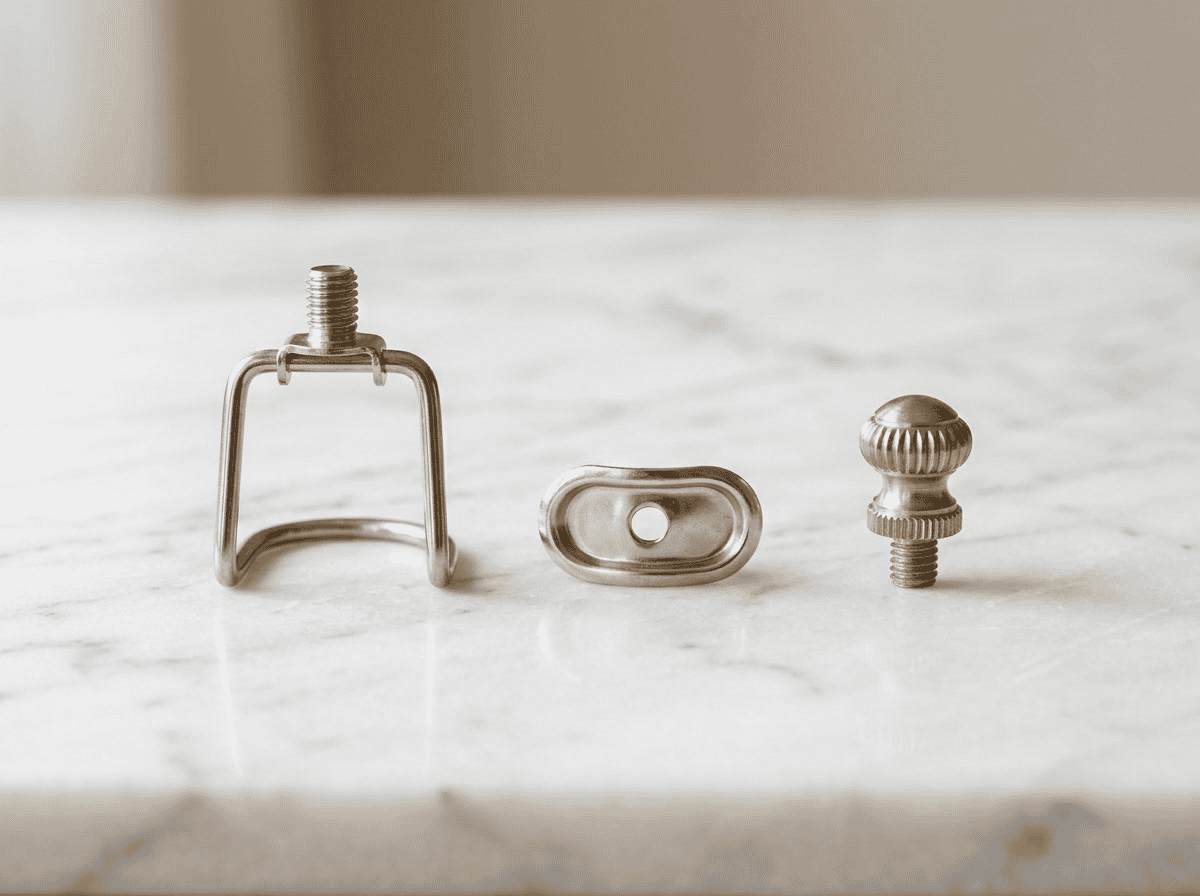
The harp is the central answer to “what is the part of a lamp that holds the shade?” It’s a U-shaped metal wire bracket — typically steel, sometimes brass-plated — that straddles the bulb socket and arches up on both sides of the bulb. At the bottom, two prongs clip into a separate fitting called the harp saddle. At the top, both sides of the U meet at a single loop. The shade’s spider fitter ring rests on this loop, and a decorative screw called the finial threads through the shade’s fitter ring and into the harp loop to lock everything in place.
This three-piece system — harp saddle, harp, and finial — is the standard shade-holding mechanism for table lamps sold in the United States and Canada. According to the Wikipedia overview of lampshade construction, the harp system became dominant in North American residential lighting during the mid-twentieth century and remains the default for table lamps in this market, though it never became standard in Europe, where uno-socket and direct-mount systems dominate.
What a Harp Looks Like and How It Works
Pick up a standard table lamp and look at the area just above the socket, below where the shade rests. If you see a U-shaped metal bracket arching up around the bulb on both sides, that’s the harp. The two legs of the U are parallel and straight; the bottom of each leg ends in a small inward-curving prong. Those prongs slot into a separate oval metal fitting — the harp saddle — which is either integrated into the socket body or clipped onto it separately.
Harps are sold by height: a “7-inch harp” measures 7 inches (18 cm) from the bottom of the saddle slot to the top loop. This height governs how high the shade sits above the lamp base. A taller harp raises the shade; a shorter harp lowers it. The correct harp height is determined by the shade’s proportions relative to the lamp body.
When you need to remove the shade, squeeze the two harp legs together near the bottom, slide them out of the harp saddle notches, and the entire harp lifts free. The shade and harp come off as one unit. Unscrew the finial from the top loop, and the shade’s spider fitter ring releases from the harp.
Harp Saddle — The Socket Clip the Harp Slots Into
The harp saddle is a small oval metal fitting that encircles the lamp socket body just below the socket shell. It has two notches — one on each side — where the harp’s bottom prongs clip in. Without the saddle, the harp has nothing to anchor to; without the harp, the saddle sits dormant. They’re sold separately and together as a “harp and saddle set.”
Some lamp sockets have the saddle integrated as part of the socket body — a thicker socket shell with molded notches. Others use a separate saddle that clips onto the socket collar. If you’re replacing a missing saddle, examine the socket: if it has molded notches, you need a replacement saddle that clips over those notches. If the socket has a smooth collar, you need an independent saddle that clamps onto the socket body.
The saddle’s notch depth and width are not fully standardized across manufacturers — most standard saddles accept most standard harps, but inexpensive harps and older saddles can be slightly mismatched, causing the harp to feel loose. When replacing either part, test the fit before installing the shade.
Finial — The Decorative Screw That Locks Everything Together
The finial is the decorative top piece that threads into the harp loop and passes through the shade’s spider fitter ring to lock the shade in place. It serves two functions simultaneously: mechanical retention (preventing the shade from lifting off the harp) and decorative finishing (covering the harp’s top loop with a styled cap).
Finials in the lamp context are almost universally threaded to the ¼-27 standard — a ¼-inch diameter, 27 threads-per-inch specification that is genuinely standardized across the North American lamp industry. This means any standard replacement finial will fit any standard harp loop, regardless of brand. Finials are available in brass, nickel, chrome, bronze, crystal, ceramic, and dozens of decorative profiles — swapping the finial is one of the easiest ways to change a lamp’s character without touching anything else.
If the finial is missing, the shade can still rest on the harp, but it won’t be retained — any contact will knock it off. A missing finial is the easiest part of a lamp that holds the shade to replace: search “lamp finial ¼-27” and you’ll find hundreds of options.
| Component | Function | Location | What Happens If Missing |
|---|---|---|---|
| Harp | Main structural bracket that holds the shade | Clips into saddle, arches above socket | Shade has nothing to rest on |
| Harp saddle | Anchor point for harp on the socket | Encircles socket body below socket shell | Harp can’t attach to lamp |
| Finial | Locks shade’s spider fitter ring to harp | Threads through fitter ring into harp top loop | Shade sits on harp but lifts off with any contact |
| Spider fitter | Shade-side frame that rests on harp | Inside shade top, radiating metal arms + ring | Harp can’t engage the shade |
The Spider Fitter — The Shade-Side Part of the System
The harp doesn’t work alone. The part of a lamp that holds the shade requires a matching component on the shade itself: the spider fitter. This is a metal wheel-spoke frame built into the top of the shade — typically three or four radiating arms connecting to a central ring. The harp passes through this central ring, and the finial threads through the ring from above to clamp it against the harp loop.
A shade with a spider fitter will only work on a lamp with a harp. A shade without a spider fitter (one designed for uno, clip-on, or threaded neck mounting) will not sit correctly on a harp lamp — there’s nothing for the harp to pass through or the finial to clamp against.
How the Spider Fitter Connects to the Harp
Installation is straightforward once you understand the geometry. Hold the shade above the lamp and thread the harp’s top loop up through the spider fitter’s central ring. Lower the shade so the ring rests on the harp loop. Thread the finial down through the ring from above and screw it clockwise into the harp loop. Two or three full turns is typically enough — the finial needs to be snug but not over-tightened, or you risk distorting the fitter ring on glass shades.
The spider fitter ring also needs to seat level on the harp loop for the shade to hang straight. If the shade tilts consistently to one side after installation, the spider fitter arms may be slightly bent or uneven — a common issue with inexpensive fabric shades. Gently bending the arms back to level position solves the problem in most cases.
What to Check When a Shade Sits Crooked or Falls Off
Three failure modes account for nearly every shade that won’t stay put on a harp lamp. First: the finial is missing or insufficiently tightened — the shade rests on the harp but isn’t retained. Second: the harp prongs are not fully seated in the saddle notches — the harp feels secure but shifts under load. Third: the spider fitter ring diameter is too small or too large for the harp loop, so the finial either can’t thread through or engages only a few threads. Check all three before purchasing any new parts.
Lamps Without a Harp — Other Parts That Hold the Shade
The harp is the dominant shade-holding mechanism in North America, but not all lamps use one. Three other systems exist, each with a different part of the lamp holding the shade. Identifying which system your lamp uses is essential before buying any replacement shade — a shade designed for one system won’t work on another.
The Illuminating Engineering Society notes that shade-mounting systems were never globally standardized, which is why European and American lamps are often incompatible even when their shade geometries look similar. The system your lamp uses is determined by its country of origin and design era as much as by its style.
Uno Socket — Shade Screws Directly onto the Socket Collar
On a uno-socket lamp, there is no harp. The shade has a single threaded ring (the uno fitter) that screws directly onto a threaded collar on the lamp socket body. The socket itself is the part of the lamp that holds the shade — specifically, the threaded collar that the shade ring engages.
To identify: look at the socket on the lamp. If it has a visible external thread on the socket shell — rather than a smooth socket shell with a separate saddle — it’s a uno socket. Uno sockets are the European standard and appear on imported lamps, pharmacy-style lamps, and many mid-century modern designs. The Edison screw standard defines the thread dimensions that uno fitters are designed to engage: E26 (26 mm) in the US, E27 (27 mm) in Europe — functionally the same in most residential applications.
To replace a shade on a uno lamp, you need a shade with a uno fitter (the single threaded ring). Shades sold for US residential use typically come in spider fitter versions — always check the fitter type before purchasing.
Clip-On Fitter — Shade Clips Directly to the Bulb
On clip-on fitter lamps, neither the socket nor a harp holds the shade — the bulb itself does. The shade has spring clips inside its top opening that grip the bulb body. This system is common on chandeliers, wall sconces, and small decorative table lamps where the socket is too small or inaccessibly positioned for a harp or uno system.
The part of the lamp that holds the shade here is technically the bulb socket (indirectly, because the bulb is what the clips grip), but the real retention force comes from the clip springs in the shade. This means two things: the shade must be light (heavy glass shades are not safe for clip-on applications), and the bulb must be a standard shape the clips can grip (A19 or candelabra-base globes; PAR and BR bulbs don’t work).
Threaded Neck Fitter — Shade Neck Threads onto a Fixture Ring
A threaded neck fitter is the reverse of a uno socket: instead of the socket having the thread, the shade has a threaded neck projecting from its top. This neck screws onto a smooth ring or collar on the lamp or ceiling fixture. Common on ceiling pendants, wall sconces, bathroom vanity fixtures, and some torchieres — less common on table lamps.
The part of the lamp that holds the shade here is the fixture’s mounting ring or collar. To replace the shade, measure the outside diameter of the shade’s neck thread. Standard sizes are 2¼” (57 mm), 3¼” (83 mm), and 4″ (102 mm). The replacement shade’s neck thread must match the fixture ring’s internal diameter.
| System | Part of Lamp Holding the Shade | Part of Shade Engaging It | Common On |
|---|---|---|---|
| Harp + spider | Harp (secured by saddle + finial) | Spider fitter ring | USA/Canada table lamps |
| Uno socket | Socket’s threaded collar | Uno fitter (threaded ring) | European imports, pharmacy lamps |
| Clip-on | Bulb (clips grip the bulb) | Spring clips inside shade top | Chandeliers, wall sconces, small decorative |
| Threaded neck | Fixture mounting ring/collar | Shade’s integral threaded neck | Pendants, sconces, bathroom fixtures |
Full Anatomy of a Table Lamp — Every Part Named
Understanding the full anatomy of a table lamp helps when a part is missing, damaged, or needs describing to a supplier. A complete table lamp has 10 to 12 distinct named components from foot to finial, each with a specific function.
Base, Foot, and Neck / Column — The Structural Parts
The base is the main body of the lamp — the ceramic, glass, metal, or wood form that gives the lamp its visual character and provides the structural weight that keeps the lamp from tipping. The foot (or base plate) is the flat bottom surface the lamp stands on, often fitted with felt pads to protect furniture surfaces.
The neck or column is the vertical shaft connecting the base body to the socket assembly. On simple column lamps the neck and base are one continuous form; on more complex designs (urn base, ginger jar, figural lamp) the neck may be a separate connecting piece. The harp pipe is a short threaded pipe at the top of the neck where the socket and saddle assembly mounts.
Socket, Socket Saddle, and Harp Saddle — The Functional Core
The socket is the electrified bulb holder at the top of the lamp. It consists of the socket shell (the outer metal cylinder), the socket interior (the insulated holder with the contacts), and the socket cap (the threaded base that attaches the socket to the harp pipe). This is where the bulb screws in.
The socket saddle (also called harp saddle) is the oval clip that encircles the socket body below the socket shell, providing the two side notches that the harp prongs clip into. On some lamps, this is integral to the socket; on others, it’s a separate clip-on component.
The check ring or socket cap is a small ring that threads onto the harp pipe to lock the socket assembly in place and cover the pipe threads. It serves no shade-holding function but is often confused with the harp saddle by first-time lamp restorers.
Cord, Switch, and Plug — The Electrical Parts
The lamp cord runs from the socket interior down through the neck and base to the switch (either inline on the cord or integrated into the socket shell) and then to the plug. The strain relief is a rubber or plastic grommet where the cord exits the lamp base, preventing the cord from pulling directly on the socket wiring.
None of these electrical parts are directly involved in the part of a lamp that holds the shade — but they share the socket assembly with the harp saddle, so understanding the full socket area avoids confusion when working on that part of the lamp.
| Part Name | Location | Function | Common Materials |
|---|---|---|---|
| Base | Main lamp body | Visual form, structural weight | Ceramic, glass, metal, wood |
| Foot / base plate | Bottom of lamp | Stable standing surface | Cast metal, molded ceramic |
| Neck / column | Vertical shaft | Connects base to socket | Same as base, or separate pipe |
| Harp pipe | Top of neck | Threaded post for socket + saddle | Steel pipe, ⅛ IP thread |
| Socket cap | Base of socket | Attaches socket to harp pipe | Brass, steel |
| Socket shell | Outer cylinder of socket | Houses socket interior, carries saddle | Brass, steel |
| Harp saddle | Encircles socket body | Anchor point for harp | Steel, brass-plated |
| Harp | U-bracket above socket | Holds shade above bulb | Steel wire, brass-plated |
| Finial | Top of harp loop | Locks shade fitter ring to harp | Brass, nickel, crystal, ceramic |
| Lamp cord | Inside neck, exits base | Delivers power to socket | PVC-insulated copper |
Harp Sizes and How to Choose the Right Replacement
Harps are sold by height — the distance from the bottom of the saddle slot prongs to the top loop where the finial threads in. Standard harp heights run from 4 inches (10 cm) to 12 inches (30 cm), typically in 1-inch increments. The correct harp height keeps the shade’s bottom edge at the right position relative to the lamp base.
The general rule for harp sizing: the bottom of the shade should sit at approximately the same height as the widest point of the lamp base, give or take 2–3 cm. A shade that sits too high exposes the socket and harp; a shade that sits too low makes the lamp look squat and may position the bottom rim too close to the table surface. The harp height controls this positioning.
How to Measure a Harp for Replacement
If the existing harp is still on the lamp (even if bent), measure it before ordering a replacement. Measure from the bottom of the prongs (where they enter the saddle notches) to the top of the loop. This is the nominal harp height. Order the same height or adjust by 1–2 inches to reposition the shade if needed.
If the harp is missing entirely, measure the total lamp height from the foot to the top of the socket. The shade should sit such that its bottom edge aligns approximately with the lamp base’s visual midpoint. Calculate what shade height you want at that position, then work backward: harp height = desired shade-bottom height minus socket height. For most standard residential table lamps with a 20–30 cm base, a 7-inch or 8-inch (18–20 cm) harp is the correct starting point.
Adjustable Harps and Harp Extenders
Adjustable harps have a sliding collar that can be repositioned along the harp legs, changing the effective height by 2–4 inches without replacing the harp. These are useful when the correct exact harp height is unknown or when a slightly non-standard shade height is needed.
Harp extenders (also called harp raisers) are short threaded tubes that thread between the harp saddle and the socket cap, physically raising the entire saddle-harp assembly higher on the lamp. They add 1–3 inches of height and are typically used when the shade sits too low and a longer harp isn’t available.
How to Fix a Lamp When the Shade-Holding Part Is Missing or Broken
Knowing the name of the part of a lamp that holds the shade immediately solves most repair problems — once you know you need a “harp,” “harp saddle,” or “finial,” a five-minute hardware store search or online order gets the part in hand. Here’s the fix for each common failure scenario.
Replacing a Missing Harp and Saddle
A complete harp-and-saddle set — harp, saddle, and finial sold together — costs $3–$12 at hardware stores and online. They’re universally sold this way because replacing just the harp without the saddle often results in a poor fit, and the saddle is small enough to lose at the same time as the harp.
To install: clip the saddle onto the socket body below the socket shell — it squeezes over the socket collar and clicks into the molded notches or clamping points. Then squeeze the harp’s bottom prongs together, align them with the saddle notches, and release — the prongs spring outward into the notches and lock. The harp should not wiggle side-to-side once seated; if it does, the saddle is the wrong size for the socket.
For glass lamp shades on commercial or hotel properties — where harps are replaced frequently and the correct size needs to be standardized — maintaining a small inventory of the correct harp-and-saddle set size eliminates delays. We cover the broader topic of maintaining replacement parts inventory in the hotel lamp shade replacement guide.
Replacing a Bent or Broken Finial
A finial that’s stripped, broken, or simply the wrong style is the easiest part to replace. The ¼-27 thread standard means any replacement finial — regardless of brand or retail source — will fit any standard harp loop. Unscrew the old finial counter-clockwise, screw the new one clockwise until snug. That’s the entire procedure.
When the finial won’t unscrew (corrosion or overtightening), apply a small amount of penetrating oil to the thread junction and let it soak for 30 minutes before trying again. If it still won’t move, grip the harp loop with needle-nose pliers and apply counter-torque — but do this gently, because harp loops are thin metal and will deform under excessive force.
Converting a Harp Lamp to Uno Fitter (Removing the Harp System)
If you want to use a shade with a uno fitter on a lamp currently set up for harp-and-spider, the conversion is straightforward. Remove the harp and saddle entirely. Replace the standard socket with a uno socket (a socket with an external threaded collar). The uno-fitter shade then screws directly onto the uno socket’s threaded collar, and the harp is no longer needed.
Conversion uno sockets cost $5–$15 and install the same way as a standard socket — unscrew the socket cap from the harp pipe, pull the socket out, disconnect the wires, connect the new uno socket’s wires, replace and screw down the socket cap. This is a one-time modification that eliminates the harp hardware permanently.
FAQ — Part of a Lamp That Holds the Shade
What is the part of a lamp called that holds the shade?
The part of a lamp that holds the shade is called the harp — a U-shaped metal bracket that clips into a harp saddle on the socket and is topped with a finial screw that locks the shade’s spider fitter ring in place. On lamps without a harp, the shade is held by a uno socket (shade screws onto the socket), a clip-on fitter (shade clips to the bulb), or a threaded neck fitter (shade neck threads onto a fixture ring). The harp system is standard on US/Canadian table lamps; the alternatives are more common on European lamps and ceiling fixtures.
What is a lamp harp?
A lamp harp is the U-shaped metal wire bracket that holds the shade on most table lamps. It has two prongs at the bottom that clip into the harp saddle on the socket, two arching legs that rise on either side of the bulb, and a single loop at the top where the finial screws in to lock the shade’s spider fitter ring. Harps are sold by height (4″–12″) and are replaceable — available at hardware stores, lamp parts suppliers, and online for $3–$12 as a complete harp-and-saddle set.
What is a harp saddle on a lamp?
The harp saddle is the small oval metal clip that encircles the lamp socket body below the socket shell, providing two side notches where the harp’s bottom prongs snap in. Without the saddle, the harp has nothing to anchor to. Saddles are sold separately and in harp-and-saddle sets. Some sockets have the saddle integrated into the socket body; others require a separate clip-on saddle. Saddles are standardized in width to fit most socket collars, though fit quality varies by manufacturer.
What is a finial on a lamp?
A finial is the small decorative screw that threads into the top loop of the harp, passing through the shade’s spider fitter ring to lock the shade in place. It serves both a mechanical function (shade retention) and a decorative one (finishing the top of the lamp). Lamp finials use a standardized ¼-27 thread, meaning any replacement finial fits any standard harp loop regardless of brand. They’re available in dozens of finishes (brass, nickel, chrome, crystal, ceramic) and styles — swapping the finial is the easiest way to refresh a lamp’s look.
How do I know what size harp I need?
Measure the existing harp from the bottom of the prongs to the top of the loop — that’s the nominal harp height, and the replacement should match. If the harp is missing, measure the total lamp height and aim for a shade bottom that sits level with the lamp’s visual midpoint. For most standard residential table lamps with a 20–30 cm base, a 7-inch or 8-inch harp is the correct starting point. Adjustable harps allow a 2–4 inch height range if the exact size is uncertain. Standard harp heights from most suppliers run 4″ to 12″ in 1-inch increments.
What holds the shade on a lamp with no harp?
On lamps without a harp, three alternative systems hold the shade. A uno socket has a threaded collar that the shade’s uno fitter ring screws directly onto — the socket is the part of the lamp that holds the shade. A clip-on fitter has spring clips inside the shade top that grip the bulb directly — no socket hardware involved, just the bulb. A threaded neck fitter has an integral neck on the shade that threads onto a ring or collar on the fixture. European lamps and most ceiling fixtures use these systems rather than the harp-and-spider combination common in North America.
Can I add a harp to a lamp that doesn’t have one?
Yes — if the lamp has a standard socket with a socket collar that accepts a harp saddle. Purchase a harp-and-saddle set in the correct height. Clip the saddle onto the socket collar, snap the harp prongs into the saddle notches, and you’ve added a harp to a lamp that previously didn’t have one. The shade must have a spider fitter to work with the harp. If the lamp has a uno socket instead of a standard socket, you’ll also need to replace the socket with a standard socket before adding the saddle and harp.
What is a spider fitter on a lamp shade?
A spider fitter is the metal wheel-spoke frame built into the top of a lamp shade that allows it to mount on a harp. It consists of three or four radiating metal arms connecting to a central ring. The harp passes through this central ring, and the finial threads through the ring from above to clamp it to the harp loop. Without a spider fitter, a shade can’t mount on a harp-style lamp. Shades sold for the US/Canadian market almost always come with a spider fitter as the standard mounting option.

Conclusion
The part of a lamp that holds the shade has a name — harp — and it works as part of a three-piece system: harp saddle (the socket anchor), harp (the U-bracket), and finial (the locking screw). On lamps without a harp, the shade is held by a uno socket, clip-on fitter, or threaded neck, each a self-contained system.
Knowing these names turns a frustrating replacement search into a five-minute parts order. Harp and saddle sets, replacement finials, and alternative socket types are all standard lamp hardware available at hardware stores and specialist lamp parts suppliers. Measure the existing harp height before ordering a replacement, check the fitter type on the shade before buying a new one, and the system goes back together in minutes.
For more on selecting and measuring lamp shades for the right fit, see our complete guide to how to measure a lamp for a new lamp shade.
For hotel and hospitality properties replacing glass shades across hundreds of fixtures, the harp-and-spider specification matters at scale. custom glass lampshades built to hotel lamp specifications are produced to the exact fitter diameter and spider-ring dimensions of your fixtures, ensuring consistent fit and finish across every room without on-site adjustment.