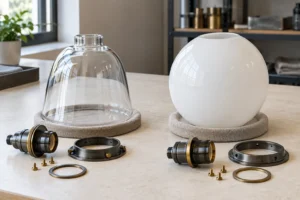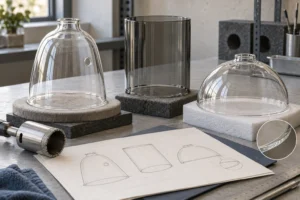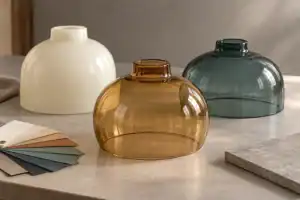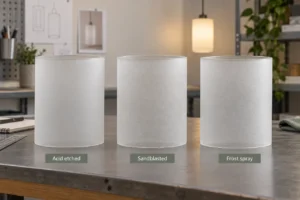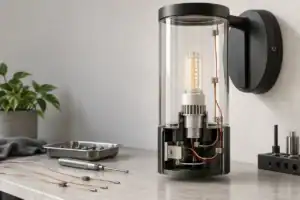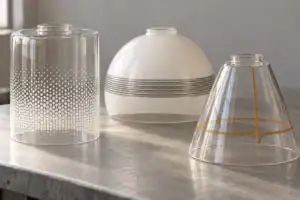
The best glass colors for restaurant lighting are frosted white for general dining (flattering, glare-free), amber for bars and intimate dining (blue-filter warmth), clear for fast-casual and industrial interiors (maximum brightness, filament display), and smoke grey for cocktail bars and high-concept spaces — all paired with 2700K or 3000K LED sources.
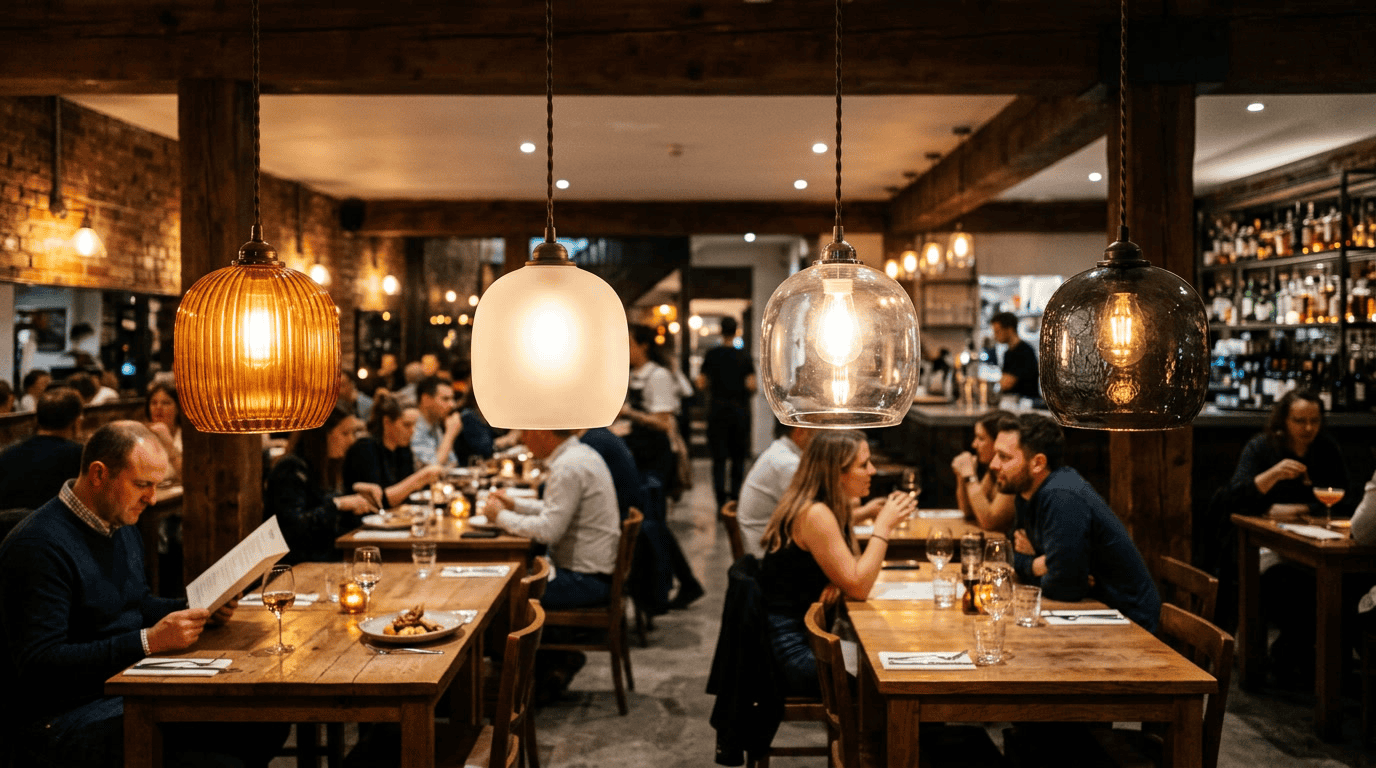
The glass color of a restaurant pendant shade is one of the least discussed and most impactful decisions in a hospitality fit-out. It directly determines the color of the light that falls on the food, the faces of the diners, and the surfaces of the room. Get it wrong and the most carefully sourced ingredients look flat, skin tones look cool and clinical, and the warm atmosphere the rest of the interior is designed to create is undermined every time the lights come on.
This guide covers the best glass colors for restaurant lighting — what each color does to the light, why it matters for food and face rendering, and which restaurant concept each glass color serves best.
What Light Color Is Best for a Restaurant?
The answer depends on two things that the question conflates: the color temperature of the LED source (measured in Kelvin) and the glass shade color that filters and shapes the light from that source.
Standard restaurant lighting guidance focuses on color temperature: 2700K for fine dining, 3000K for casual dining, 4000K+ for fast-casual and quick-service. This is correct but incomplete. A 2700K LED through a frosted white glass shade produces different light than a 2700K LED through an amber glass shade — the spectral filtering of the amber glass shifts the output toward the red-orange end of the spectrum, producing light that is effectively 2400K or lower in character even though the source is 2700K.
Understanding both the source color temperature and the glass shade color interaction is what separates restaurant lighting that creates genuine atmosphere from restaurant lighting that merely avoids obvious problems.
The light color spectrum that affects human perception of food and faces:
- Below 2500K (very warm amber-orange): Produces candlelight-like warmth. Excellent for faces and warm-colored food (meats, breads, rosé). Poor for green vegetables and blue-tinted foods.
- 2700K (warm white): The standard for fine dining. Renders warm food colors accurately, produces flattering skin tones. The most broadly appropriate color temperature for restaurant lighting.
- 3000K (neutral warm): The standard for casual dining and bars. Slightly cooler than 2700K, still flattering, appropriate for broader spectrum of food types.
- Above 3500K (cool white): Not appropriate for warm dining environments. Creates clinical appearance that is inconsistent with any restaurant atmosphere goal.
Per research cited by Cornell University’s Center for Hospitality Research, warm-spectrum restaurant lighting (below 3000K) consistently produces higher guest satisfaction scores for food quality perception, independent of actual food quality — the light itself shapes how the food is experienced.
The Six Glass Colors for Restaurant Lighting
Frosted White Glass: The Most Versatile Restaurant Glass Color
Frosted white glass transmits 75–82% of the LED source output with no color filtering — the light color through frosted glass is essentially identical to the source color temperature. If the source is 2700K warm-white, the room lighting is 2700K warm-white. If the source is 3000K, the room is 3000K.
Why frosted white works across restaurant concepts:
– No unintended color bias — the source color temperature decision controls the room color temperature
– Eliminates point-source glare while maintaining high lux delivery
– Works with any interior palette without visual conflict
– The most consistent food color rendering of any glass type (no spectral filtering)
Frosted white glass is the safe, reliable choice for any restaurant that wants to control lighting color through LED source selection rather than glass filtering. It is appropriate for fine dining, casual dining, family dining, hotel dining rooms, and any restaurant where color accuracy for food presentation matters.
Amber Glass: The Best Glass Color for Bar and Intimate Dining
Amber glass selectively transmits red and orange wavelengths while absorbing blue-wavelength light (400–500nm). The result is light that reads as significantly warmer than the source color temperature — 2700K LED through amber glass produces effective light in the 2200–2400K range.
Why amber glass works for bars and intimate dining:
– Produces the most flattering light for faces at bar seating — the warm spectrum suppresses the unflattering blue-shadow effect that standard white light creates on faces at close range
– Makes amber-colored beverages glow dramatically — whiskey, bourbon, dark rum, amber beer, rosé, and aged cocktails all appear more visually compelling under amber-shifted light
– Physiologically relaxing effect that encourages longer dwell time at bar seating
– Creates a distinctive visual atmosphere that differentiates bar environments from the main dining room
The trade-off: amber glass transmits 50–65% of the source output — significantly less than frosted white. Bar fixtures with amber glass shades need 15–20 watt LED sources to achieve adequate bar surface illuminance (150–300 lux at bar surface for comfortable drink preparation and menu reading).
Clear Glass: The Best Glass Color for Industrial and High-Energy Environments
Clear glass transmits 88–92% of source output with no filtering. The lamp source is fully visible — maximum brightness per watt, maximum visual energy.
When clear glass is the right restaurant glass color choice:
– Industrial-style restaurants where the exposed filament LED is the visual design element
– Fast-casual environments where the bright, energetic atmosphere encourages table turnover
– Bar counter positions at sufficient height above eye level where glare is not an issue
– Environments where the open, airy feel of clear glass is part of the brand concept
The clear glass caution: At dining table pendant heights (28–34 inches above table surface), clear glass with a standard LED chip creates uncomfortable glare for guests seated across the table from each other. This is the most common complaint about clear glass in restaurant contexts. The mitigation: use filament-style LED bulbs, which produce distributed, lower-luminance light that is significantly less glare-inducing than LED chip arrays through clear glass.
Smoke Grey Glass: The High-Concept Bar and Lounge Color
Smoke grey glass is a dark-tinted glass that transmits 35–50% of source output with a slight cool-grey color shift. The resulting light is:
– Lower lux than any other glass type at equivalent wattage
– Slightly cooler in tone — a grey cast rather than warm amber or neutral white
– Dramatic and mysterious — the pendant shade itself appears almost opaque, creating a visual weight that contrasts with the light it emits below
Smoke grey glass is not appropriate for food-service dining contexts where food color rendering and adequate illuminance matter — it transmits too little light and shifts the color in the wrong direction for food. Its correct application is cocktail bars, lounge seating, and high-concept bar environments where atmosphere is the design goal and supplemental lighting (underbar LEDs, candlelight, backlit spirits displays) provides the functional illuminance.
Sage Green and Cobalt Blue Glass: Specialty Color Statement
Green and cobalt glass shades produce strong color casts — sage green casts a cool, verdant tone; cobalt blue creates a dramatic cool-blue atmosphere. The color effect is pronounced even at low transmittance (30–50%), making these inappropriate for food service where color accuracy matters.
Research on light color and food perception has shown, as noted by scientists at the Max Planck Institute for Empirical Aesthetics, that pink-spectrum light increases perception of food sweetness while green light reduces appetite signals. Restaurants pursuing specific sensory design effects have used these findings intentionally, but they are specialist applications, not general recommendations.
Sage green and cobalt glass shades work best as feature elements — a single statement pendant over a bar, an art installation, or a signature position — rather than as the primary pendant glass color across all fixtures.
Opal White Glass: The Premium Soft Glow Option
Opal glass (milk glass, 60–75% transmittance) produces a denser, more uniformly white appearance than frosted glass. Lit, the opal glass pendant appears to glow from within — a visual quality that is more premium-feeling than frosted glass at equivalent lumen output.
For upscale restaurant concepts — fine dining, hotel dining rooms, upscale casual — opal glass pendant shades signal quality and craftsmanship in a way that frosted glass does not. The trade-off is lumen output: opal glass requires 15–20 watt LED sources to achieve the same table illuminance as 10–15 watt frosted glass.
Glass Color by Restaurant Concept
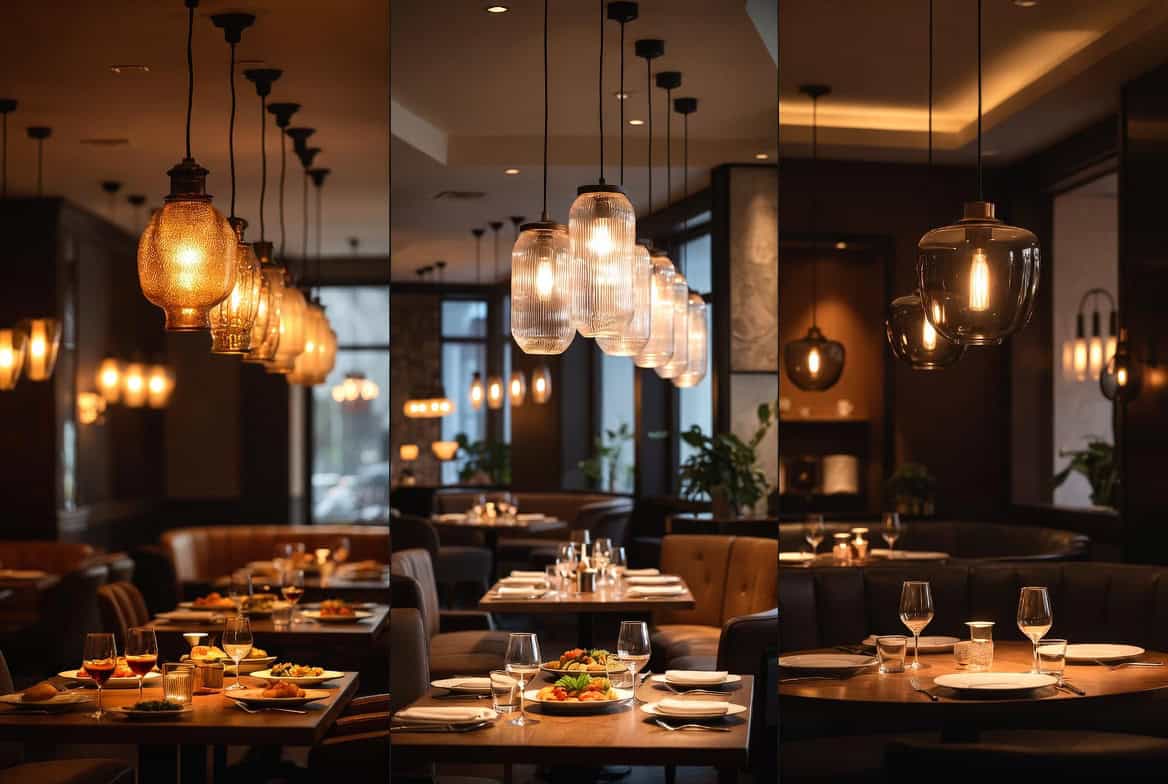
The glass color selection for restaurant lighting maps directly to the dining concept and revenue model:
| Restaurant Concept | Best Glass Color | Color Temperature | Notes |
|---|---|---|---|
| Fine dining | Opal or frosted white | 2700K | Maximum color rendering for food |
| Upscale casual | Frosted white | 2700K | Reliable all-purpose |
| Casual dining | Frosted white | 3000K | Energy and comfort balance |
| Fast-casual | Clear or frosted | 3000K | Brightness = turnover |
| Full-bar (dining section) | Frosted white | 2700K | Complement bar amber |
| Bar counter | Amber | 2700K or 3000K | Face and beverage flattery |
| Cocktail lounge | Amber or smoke grey | 2200–2700K | Atmosphere priority |
| Café daytime | Frosted white | 3000K | Productivity balance |
| Café evening | Amber | 2700K | Shift to lounge mode |
| Industrial restaurant | Clear + filament LED | 2200K | Aesthetic element |
How Glass Color Affects Food Photography in Restaurants
Modern restaurant revenue includes an indirect but measurable contribution from social media photography — guest-generated content that functions as free marketing. The glass shade color directly affects how food and the restaurant environment look in photographs.
Best glass colors for restaurant photography:
Clear glass with filament LED creates the “restaurant bokeh” — the warm, blurred points of light in the background of food photography that signal quality and atmosphere. This effect is most dramatic with clear glass and filament LEDs and cannot be replicated with frosted or opal glass.
Amber glass makes warm-colored food (coffee, bread, meat, pastry) look dramatically appealing under the warm amber-shifted light — these photographs appear richly warm and inviting. However, fresh salads and green-dominant plates photograph less appetizingly under amber light.
Frosted white is the most neutral photography glass — the light quality is excellent for accurate food color rendering in photos, without the dramatic stylistic effect of amber or clear glass. Best for restaurants where accurate food representation matters more than atmospheric effect.
Per the National Restaurant Association’s research on social media and restaurant marketing, restaurants where guests frequently photograph and share food images see 18–24% higher customer acquisition through social channels than comparable restaurants without strong visual social media presence — making the lighting’s photography quality a direct revenue factor.
Matching Glass Color to Interior Design Palette
The glass shade color must coordinate with the interior palette — not just with the LED source color temperature — to create a coherent visual environment.
Warm interior palette (wood tones, terracotta, warm metals):
Best glass color: amber or frosted white. The warm glass color amplifies the warm tones of the interior; cool glass (smoke grey, frosted with 3000K+ LED) creates a visual discord between the warm materials and the cool light.
Cool interior palette (concrete, steel, slate, cool grey):
Best glass color: clear or frosted white at 3000K, or smoke grey. The neutral-to-cool glass colors harmonize with cool material palettes. Amber glass in a cool-material interior creates an interesting warm/cool contrast that can work as a deliberate design choice.
Eclectic or maximalist palette (dark walls, jewel tones, mixed materials):
Best glass color: depends on the dominant tone. Deep, jewel-toned interiors pair well with amber glass for visual warmth. Graphic, high-contrast black-and-white interiors work with clear or frosted glass.
According to Architectural Digest’s documentation on hospitality interior design, the most common error in restaurant lighting specification is choosing a glass shade color that conflicts with the dominant palette rather than amplifying it — warm glass in a cool-material restaurant, or cool glass in a warm-material restaurant.
Trends in Restaurant Glass Colors for 2026
Amber glass becoming standard for full-service bars. What was once a specialty or accent choice — amber glass at the bar — is becoming the default specification for full-service bar lighting in quality-tier restaurant groups. The physiological and photographic advantages of amber-shifted bar lighting have become well-understood in hospitality design circles.
Smoke and dark glass expanding from cocktail bars to casual dining. Smoke grey glass is migrating out of pure cocktail-bar contexts into casual dining and café-bar environments that want a moodier, more distinctive atmosphere.
Clear glass with filament LED stabilizing. The Edison-bulb-in-clear-glass trend peaked and is stabilizing — it remains the dominant choice for industrial-style restaurants but is no longer growing as a proportion of new openings.
| Glass Color Trend | Context | 2026 Adoption |
|---|---|---|
| Amber glass as bar default | Full-service bar counter | Growing standard |
| Smoke glass in casual dining | Casual, cafe-bar | Emerging |
| Clear/filament stabilizing | Industrial, fast-casual | Stable, established |
| Opal for premium casual | Upscale casual | Slow growing |
| Ribbed/textured specialty | Coffee, craft hospitality | Growing niche |
Frequently Asked Questions
What light color is best for a restaurant?
2700K warm-white is the best color temperature for fine dining and upscale casual restaurants — it renders warm food colors (meats, breads, sauces) accurately and produces flattering skin tones. 3000K is better for casual dining and cafes where a slightly brighter, more energetic atmosphere serves the concept. The glass shade color provides an additional layer of control: amber glass shifts any LED source warmer; clear glass passes the source color through unchanged; frosted white is neutral.
What glass color makes food look best in restaurants?
Frosted white glass at 2700K produces the most accurate and flattering food color rendering — it does not introduce any color bias and the warm LED source enhances red and orange tones in food. Amber glass makes warm-colored food (meats, pastry, coffee) look dramatically appealing but makes green vegetables and cool-colored food appear muted. Clear glass with filament LEDs produces excellent food photography conditions.
Is amber glass better than frosted white for restaurant lighting?
Amber glass is better than frosted white for bar and lounge sections where atmosphere and face flattery at close range are the priority. Frosted white is better for general dining sections where food color rendering and glare-free comfortable illuminance are the priority. Many restaurants use frosted white in dining sections and amber at the bar — the two glass colors create a distinct visual character change between the dining and bar zones.
What is smoke grey glass for in a restaurant?
Smoke grey glass produces dramatic, low-lux, slightly cool-toned atmosphere lighting — appropriate for cocktail bars, lounge seating, and high-concept bar environments where ambiance takes priority over illuminance. It is not appropriate for dining surfaces where food visibility and color accuracy matter. Smoke grey glass pendants need supplemental lighting (under-bar LEDs, candlelight, backlit bottle displays) to achieve adequate functional illuminance.
Can I use multiple glass colors in the same restaurant?
Yes — and in many restaurant concepts, using different glass colors in different zones is the correct specification. A full-service restaurant might use frosted white in the dining section, amber at the bar, and smoke grey in a private dining or lounge area. The key is intentionality: different zones with different glass colors creates planned atmosphere variation; inconsistent glass colors within the same zone creates visual incoherence.
What glass color is best for a wine bar?
Amber glass or frosted white at 2700K are both excellent choices for wine bars. Amber glass particularly enhances the appearance of red wines, rosé, and amber-colored spirits — the warm-shifted light makes wine colors glow. Frosted white at 2700K produces accurate color rendering for wine without the exaggeration that amber glass creates. For wine bar environments where viewing the actual wine color in the glass matters (as in a serious wine bar), frosted white at 2700K is more accurate.
Does glass color affect the energy consumption of restaurant lighting?
Yes, indirectly. Lower-transmittance glass colors (amber at 50–65%, smoke grey at 35–50%) require higher-wattage LED sources to achieve equivalent illuminance compared to frosted white (75–82%). A restaurant that specifies amber glass throughout all pendant fixtures will need 20–40% higher LED wattages than equivalent frosted glass fixtures to maintain the same table illuminance — a meaningful difference in energy cost across a large restaurant over years of operation.
Conclusion
The best glass colors for restaurant lighting are not a universal answer — they are a zone-by-zone specification that matches each glass color to the lighting goal of that specific area. Frosted white for dining where food rendering and comfort matter. Amber for bar where atmosphere and face flattery at close range are the priority. Smoke grey for cocktail lounge where drama and mood trump lux. Clear glass for industrial concepts where the visible filament is the visual design element.
Getting this specification right is not a decorating decision — it is a revenue decision. The glass shade color above every table and bar position shapes how the food looks, how guests feel, and how long they stay.
For restaurant glass shade colors in frosted white, amber, smoke grey, opal, and clear glass across all standard fitter sizes for commercial hospitality applications, our glass lampshade product line at jxlampshade.com supplies matched batches for full restaurant fit-outs with documented glass specifications.