# Clear vs Frosted vs Opal Glass Lamp Shades: Which to Choose in 2026
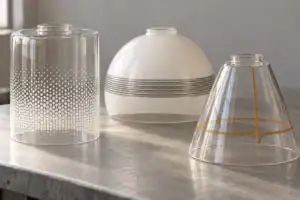
Clear glass shades transmit ~95% of light with visible bulb, frosted glass transmits ~70% with soft diffusion, and opal glass transmits ~50% with full bulb hiding. Choose clear for decorative filament bulbs, frosted for general task light, and opal for ambient glow without glare.
Of all the choices a buyer makes when sourcing a glass lamp shade, the clear-vs-frosted-vs-opal decision affects the room more than any other. Diameter is forgiving (within 20% feels fine). Color temperature is recoverable with a different bulb. But pick clear glass for a sofa-side reading lamp and you’ll squint every evening; pick opal for a decorative filament-bulb pendant and you’ll lose the entire reason for buying the filament bulb.
This guide compares the three on their physical behavior – light transmission, hotspot visibility, dust collection, durability, manufacturing cost – and tells you exactly when each one wins.
How Each Glass Type Actually Behaves
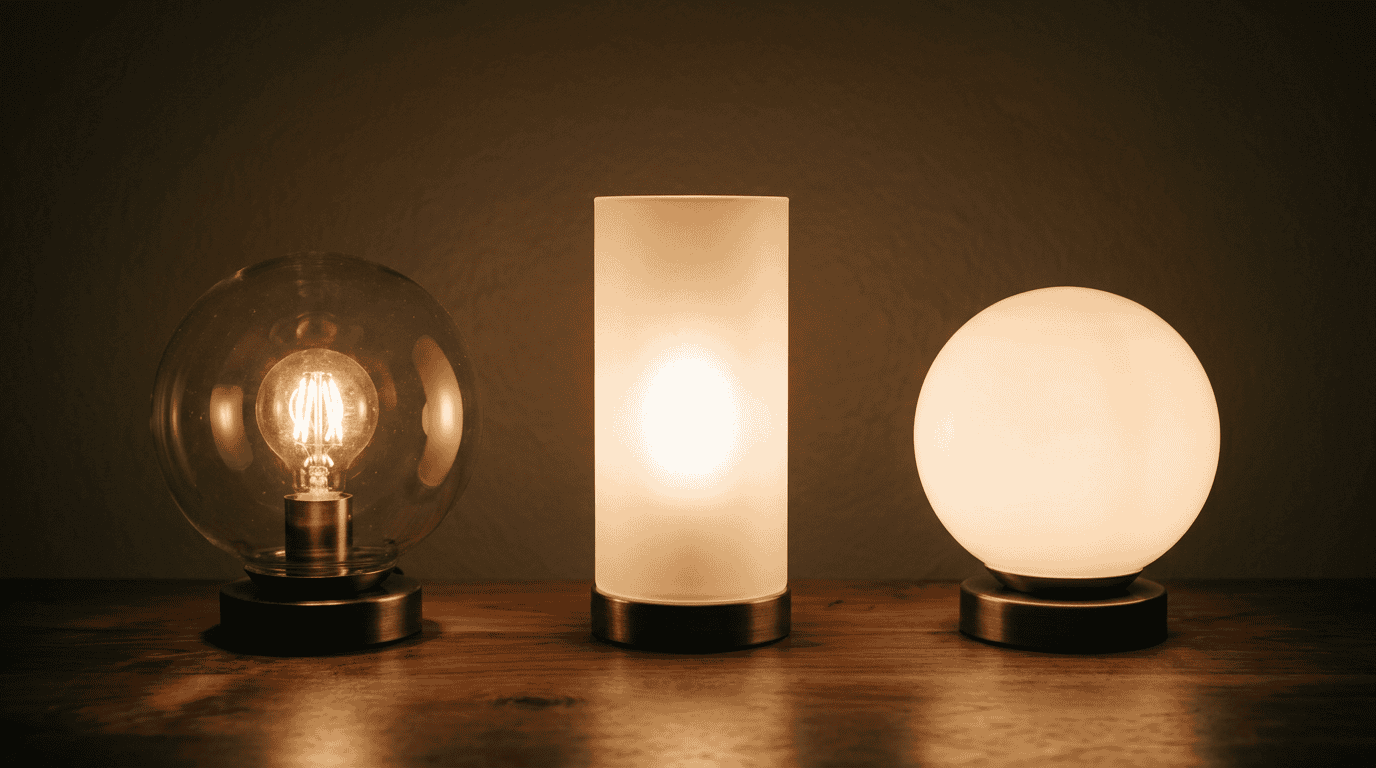
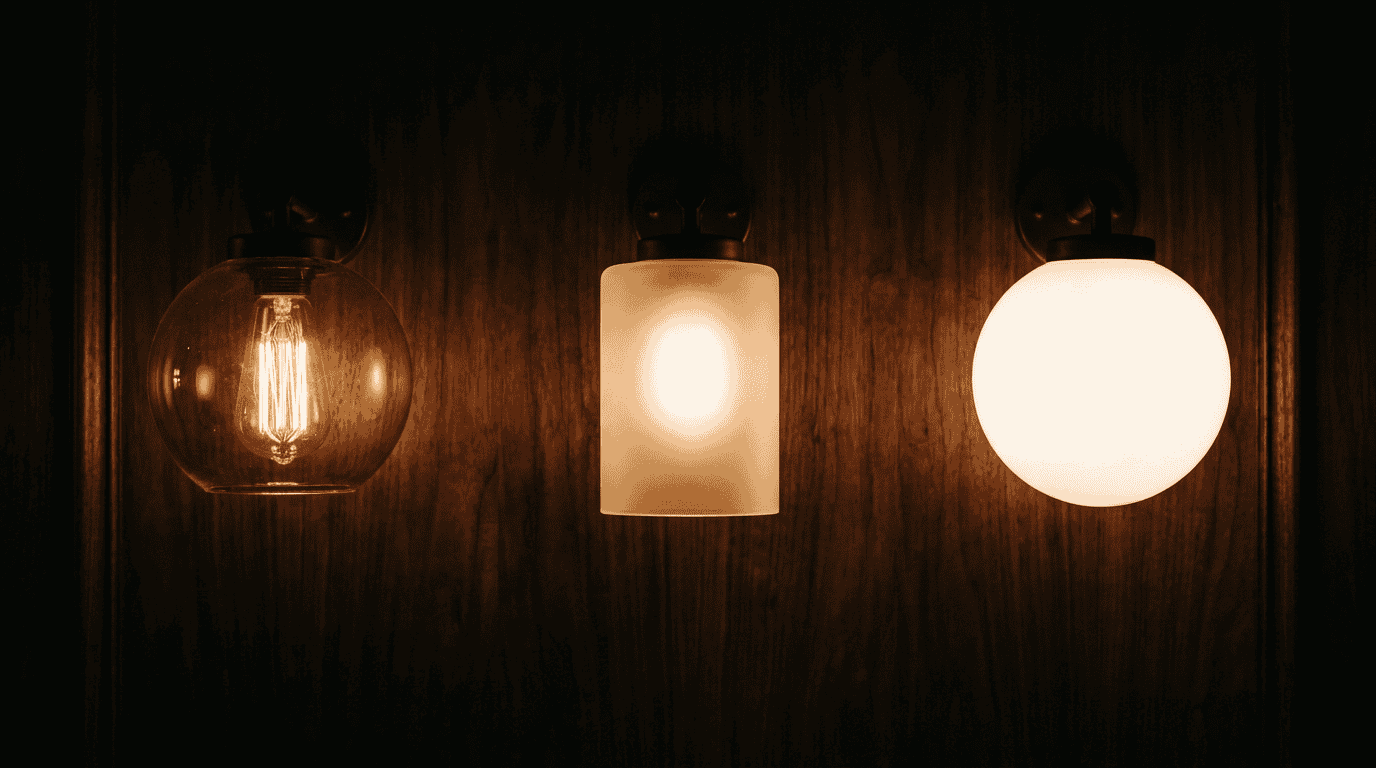
The three materials sit on a continuum of light scattering. At one end, perfectly clear glass scatters almost nothing – photons pass through, the bulb is fully visible, output is essentially the bulb’s full lumen rating. At the other end, opal (milk) glass scatters intensely – the entire shade glows uniformly, the bulb image is completely hidden, and the room sees roughly half the bulb’s rated lumens as usable light. Frosted glass sits in the middle.
Clear glass
Transmission: ~95% of bulb output passes through the glass directly. The remaining ~5% is reflected at the air-glass interface (Fresnel reflection) and absorbed in the glass body. Clear soda-lime glass at 3 mm thickness has measured transmission near 90-92% in the visible spectrum, per material data summarized in Wikipedia’s article on optical glass.
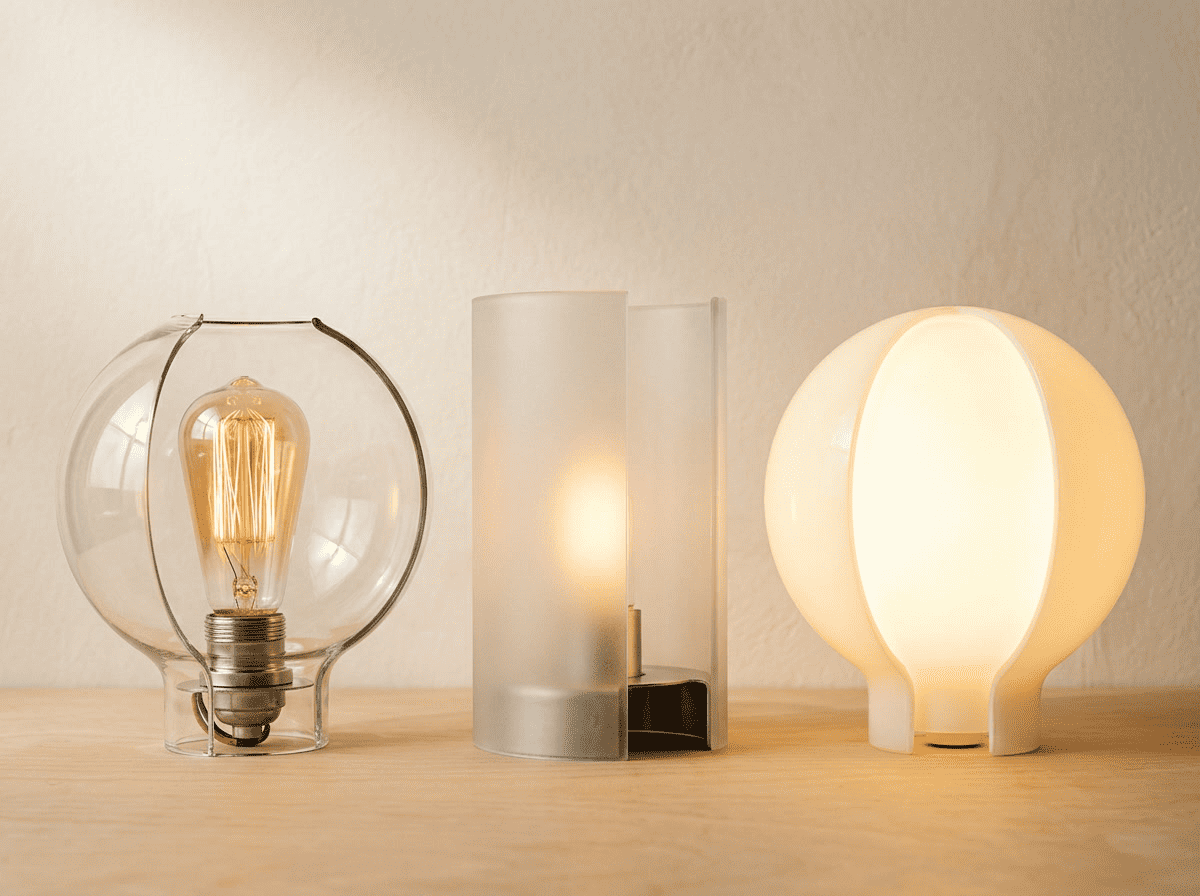
Bulb visibility: 100%. You see the filament, the screw thread, the bulb’s shape. This is the entire point of using clear glass with a decorative bulb.
Hotspot behavior: Severe at any seated eye-line. Tolerable when the shade is well above eye level (pendant over a dining table, ceiling fixture, tall arc lamp).
Best uses: Decorative pendants above 1700 mm, statement chandelier components, conservatory and outdoor fixtures where the bulb itself is the design feature.
Worst uses: Sofa-side table lamps, floor reading lamps, low-height sconces. Glare destroys the room.
Frosted glass
Transmission: ~70-78% depending on frost depth. The acid-etched (or sandblasted) surface scatters incoming light at a roughly Lambertian distribution, eliminating hotspots without losing much total output. Coverage on the physics in detail: our glass light diffusion explained: clear vs frosted vs opal glass for lighting.
Bulb visibility: ~30-50%. The bulb’s general shape and brightness are perceptible but the filament detail is hidden. Cheap bulbs look acceptable behind frosted glass; premium decorative bulbs lose most of their visual appeal.
Hotspot behavior: Soft and broad. Acceptable at any viewing angle. The shade reads as “luminous” rather than “bright spot.”
Best uses: General-purpose table lamps, floor lamps in seated zones, bedside lamps, wall sconces in halls. The workhorse residential and hospitality shade.
Worst uses: Decorative filament bulb display (defeats the purpose), studio task lighting where maximum lumens matter (use clear glass with appropriate placement instead).
Opal (milk) glass
Transmission: ~45-60% depending on opal layer thickness and casing technique. Two-layer or three-layer cased glass – a milky inner layer behind a clear or tinted outer shell – scatters internally rather than at the surface. Light enters the inner opal layer, bounces between particles, and exits in every direction with no preferred angle.
Bulb visibility: 0%. The bulb is completely invisible from any viewing angle. The shade reads as a self-luminous object.
Hotspot behavior: Eliminated. The entire shade surface emits at roughly the same brightness, regardless of where the bulb sits inside. This is the optical signature of opal that no other shade type achieves.
Best uses: Ambient lighting at seated eye-level (table lamps, sconces at sofa height), feature pendants where the shade is the design element (Pendant Bauhaus-style globes), bathroom fixtures where glare matters.
Worst uses: Task lighting that needs maximum lumen output, situations where someone wants to see a decorative bulb.
For dedicated opal coverage: how opal glass improves light diffusion in lampshades.
Side-by-Side Comparison Table
| Property | Clear glass | Frosted glass | Opal glass |
|---|---|---|---|
| Light transmission | 90-95% | 70-78% | 45-60% |
| Bulb visibility | 100% | 30-50% | 0% |
| Hotspot at seated eye-line | Severe | Soft | None |
| Best bulb pairing | Filament LED, 400-600 lm | A19 LED, 800 lm, 90+ CRI | A19 LED, 1000-1100 lm |
| Dust visibility on surface | Very high | Moderate | Low |
| Manufacturing cost (relative) | 1.0x | 1.3x | 2.0-3.0x |
| Wall thickness (typical) | 3-5 mm | 3-4 mm | 4-6 mm (cased) |
| Glass weight (relative) | 1.0x | 1.0x | 1.2-1.5x |
| Hand-blown availability | High | High | Medium |
| Machine-pressed availability | Very high | Very high | Limited |
| Color tinting options | Many | Many | Layered casing only |
| Cleaning frequency needed | Monthly | Monthly | Every 6 weeks |
| Crack risk on thermal stress | Medium (clear shows it) | Medium | Low (thicker walls) |
Manufacturing Differences That Affect Quality
The three shade types come out of fundamentally different processes, which translates into different price tiers and quality variation.
Clear glass production
Clear shades are blown or pressed from a single clear soda-lime gather. The cooling cycle matters – rapid cooling leaves residual stress in the glass that can fracture under modest impact. Reputable manufacturers anneal slowly, which is why a “cheap clear globe” often weighs 30% less and rings tinny when tapped – it’s been pulled out of the lehr early to save cost.
Hand-blown clear globes are easy to identify: they have visible variation in wall thickness if you hold them up to light, often with subtle bubbles. Machine-pressed clear shades are uniform, sometimes to the point of looking sterile.
Frosted glass production
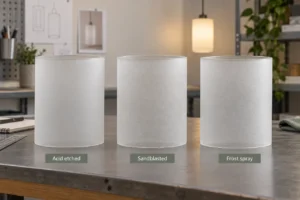
Frosting is a finishing step applied to clear glass. Two methods:
- Acid etching – the glass is dipped or sprayed with hydrofluoric acid solution, which etches the surface. Inside-frost vs outside-frost is determined by which side gets the acid. Per Wikipedia’s article on glass etching), the resulting matte surface scatters light without significantly absorbing it.
- Sandblasting – a stream of aluminum oxide or silica abrasive removes the surface layer. Less commonly used than acid etching for shades because the resulting texture is coarser.
Inside-frosting is technically harder (the inside of a blown shade is hard to access) but produces a much more durable, dust-resistant shade. Outside-frosting is cheap and easy but creates a dust-magnet surface. When buying frosted shades, always confirm the frosting is on the inside.
Opal glass production
Opal is the most complex of the three. The classic technique is cased glass – two or three layers of glass blown one inside the other, with at least one layer being opalescent. The opalescence itself comes from microscopic particles (fluorides, phosphates, or arsenic compounds in traditional formulations; modern lead-free formulations use other phase-separating compounds) that scatter light internally.
Casing requires specialized skill and a longer blowing process. Single-layer “opal” glass exists – it’s machine-pressed and uses bulk opal frit – but it’s noticeably less luminous than properly cased opal. The visual cue is depth: cased opal looks like a glowing pearl, single-layer pressed opal looks like white-painted glass.
This is why opal shades cost 2-3x more than clear or frosted at the manufacturer level.
Choosing the Right One: Decision Framework
| Your situation | The right choice |
|---|---|
| Pendant above eye level with decorative filament bulb | Clear |
| Pendant above eye level, wanting “luminous moon” look | Opal |
| Table lamp at seated sofa height | Opal or frosted |
| Floor reading lamp | Frosted (light opal also works) |
| Bathroom vanity sconce | Opal (zero glare, good color rendering) |
| Kitchen pendant over island | Frosted or opal |
| Outdoor patio fixture | Clear (with decorative bulb) or frosted |
| Hotel room desk lamp | Frosted (durability + acceptable cost) |
| Hospitality lobby feature pendant | Opal (pure luminous object) |
| Bedside table lamp | Opal (ultra-low glare from horizontal viewing angle) |
| Decorative wall sconce in hallway | Frosted or opal |
| Studio/workshop task light | Clear (need maximum output) |
The framework: if anyone will be at a seated position looking sideways at the shade, choose frosted or opal. If the shade is above eye level OR the bulb itself is the design feature, clear becomes viable.
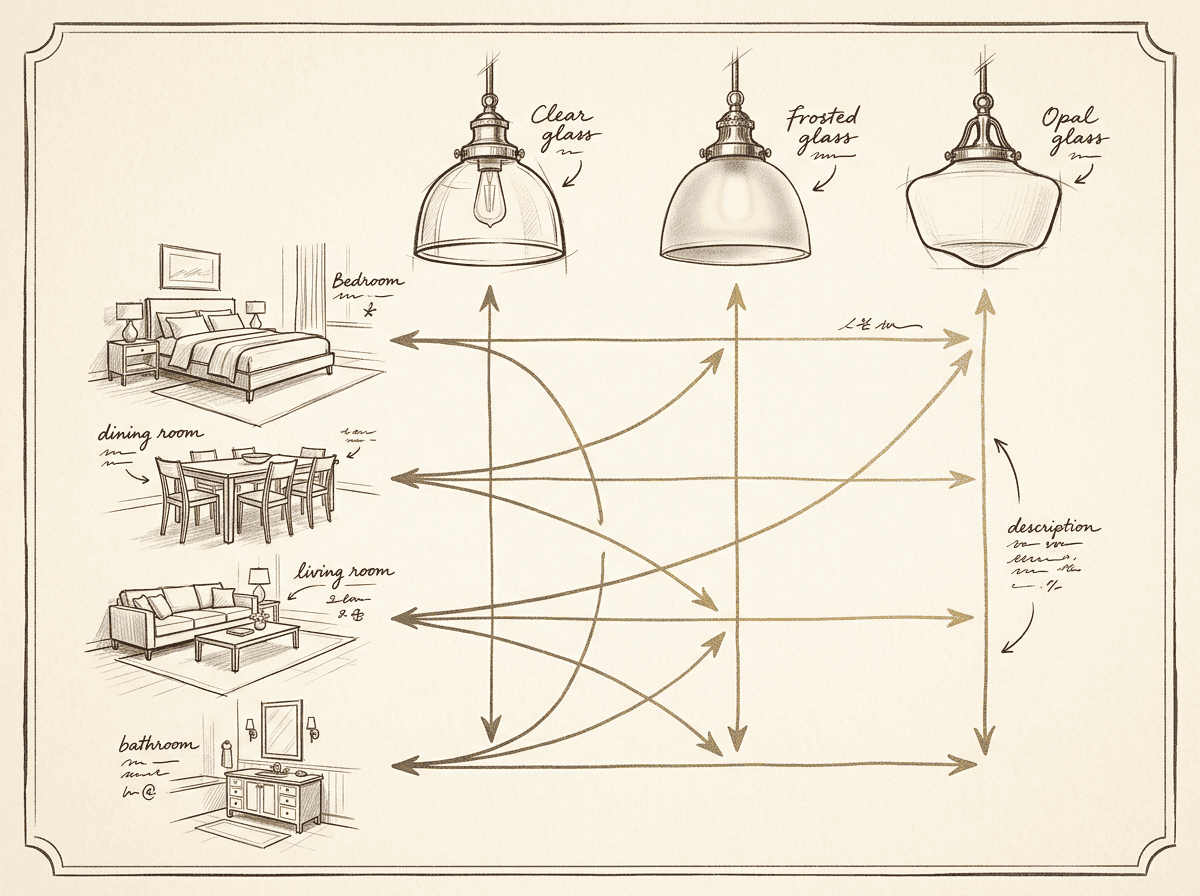
Where the Three Materials Look Wrong
Equally important: knowing when each material fails. Three common failure modes:
Clear glass failure: the “industrial showroom” effect
Putting clear glass on every fixture in a room is the most common over-mistake. Five fixtures all with visible bulbs reads as “hardware showroom” rather than “designed room.” The eye registers each hotspot independently, which is visually exhausting. One clear glass moment per room is the design rule.
Frosted glass failure: the “Holiday Inn 1995” effect
Putting cheap outside-frosted glass on every fixture – particularly in matching cream tones – reads as dated commercial. This was the default 1990s hospitality look and it remains stuck in budget motel aesthetics. Lifting frosted glass into 2026 territory requires either inside-frosting (more refined) or pairing frosted shades with non-cream metal hardware (brass, oil-rubbed bronze, matte black).
Opal glass failure: the “operating room” effect
Pure opal glass on too many fixtures, with cool-temperature (3500K+) bulbs, reads as clinical. Opal works best when the bulb behind it is warm (2700K) and the surrounding palette is warm. Mixing opal shades with cool LED bulbs and white-cool interior palettes creates a hospital-corridor mood.
Bulb Pairing Recommendations
| Shade | Bulb type | Lumens | CCT | CRI |
|---|---|---|---|---|
| Clear | Decorative filament LED (squirrel-cage, ST64, T45) | 400-600 | 2700K | 90+ |
| Frosted | A19 LED, frosted | 800-1100 | 2700K | 90+ |
| Opal | A19 LED, any envelope | 1000-1200 | 2700K | 90+ |
Three specific notes:
- Clear shades need premium bulbs. A 5-dollar filament bulb with crooked filament wires behind clear glass looks cheap. A 15-dollar filament bulb with a clean filament pattern behind the same shade looks intentional. The bulb is part of the visible composition.
- Frosted shades hide bulb quality. This is the practical advantage – you can run a 5-dollar A19 LED and the shade looks fine. Use this advantage in budget projects.
- Opal shades need high-lumen bulbs to compensate for absorption. 1100 lm becomes ~550 lm in the room after opal absorbs its share. Use this calculation: required room lumens / 0.5 = bulb spec.
For broader CRI guidance: the U.S. Department of Energy’s lighting guide covers color rendering at length.
Dust, Cleaning, and Long-Term Appearance
Each shade type ages differently in a real home environment.
Clear glass shows dust within days. Every fingerprint is visible. The dust is most obvious on the outer surface but worst on the inner surface (which collects dust from the convective air column rising past the bulb). Cleaning frequency: monthly minimum for an active living room, weekly for kitchen or close-to-window fixtures.
Frosted glass hides dust on the outer surface (the matte texture diffuses the appearance of dust particles) but collects it dramatically faster than clear glass on the inside surface if the frosting is inside-applied. Cleaning frequency: monthly.
Opal glass hides dust almost completely on the outer surface due to the luminous diffuse appearance. The inner surface accumulates dust like any other glass but doesn’t show it as much. Cleaning frequency: every 6 weeks, or more if the shade is in a kitchen.
For cleaning method recommendations, our maintenance guide for glass lamp shades covers safe cleaners and tools – or check our dedicated cleaning article when published.
Cost Comparison at the Manufacturer Level
The wholesale price difference between the three materials is significant. As a rough benchmark across our catalog and the industry generally:
- A 250 mm diameter clear glass globe at 4 mm wall thickness sets a baseline of 1.0x
- The same shade in frosted glass costs ~1.3x (frosting is a finishing step)
- The same shade in cased opal glass costs ~2.0-3.0x (requires multi-layer blowing)
For a single residential lamp, the difference is 20-50 dollars retail. For a 100-unit hospitality order, the difference scales to 4000-15000 dollars – which is why hospitality procurement specialists scrutinize this choice carefully.
Hospitality and Commercial Considerations
For commercial buyers (hotel chains, restaurant groups, office property managers):
- Opal is the safest commercial choice – hides bulb imperfections, eliminates guest complaints about glare, looks premium with low cost-of-ownership.
- Frosted is the budget commercial choice – adequate diffusion, much cheaper, easier to replace at scale.
- Clear is rarely commercial-appropriate – too high glare for guest-facing spaces, too prone to fingerprint visibility for housekeeping efficiency.
The exception: clear glass with decorative filament bulbs in lobby pendants and restaurant feature lighting, where the bulb is the design feature and the space is large enough that glare from any single seat is unlikely.
For full hospitality sourcing context: hotel glass lamp shades walks through hospitality spec patterns.
Future Material Trends (2026 and Beyond)
Three emerging trends are reshaping the clear-vs-frosted-vs-opal landscape:
| Trend | What changes | Buyer implication |
|---|---|---|
| Layered opal with selectable transmission | Custom-spec opacity per project | Order the exact opacity rather than picking from three tiers |
| Smart electrochromic shades | Switch between clear and frosted on demand | One shade serves multiple moods – early luxury launches in 2026-2027 |
| Sustainable lead-free opal | Cleaner production, slight optical changes | Procurement actively requests this for hospitality |
| Recycled-content soda-lime | 30-70% recycled cullet in baseline shades | New spec sheet line for designers |
Per Architectural Digest’s recent coverage of lighting trends, opal is having a notable moment in 2026 residential design – the editorial preference is shifting from clear-glass-decorative-bulb (peak 2020) toward opal-spherical-luminous (rising through 2026).
Frequently Asked Questions
Which is the most energy-efficient lamp shade?
Clear glass passes the most light through (95%+), so it’s technically the most efficient at converting bulb watts into room lumens. But “efficient” here is misleading – the high transmission also means severe glare, which often makes the light less usable. Frosted at 70-78% transmission is the practical efficiency winner for general use.
Can I tint clear or frosted glass amber or smoke?
Yes for both. Amber and smoke tints are produced by adding manganese, iron, or other oxides to the glass batch. The tinting is in the glass body itself, not a surface coating, so it doesn’t degrade over time. Tinted versions of clear and frosted glass behave like their untinted counterparts but with the added color shift.
Why does my opal shade look slightly yellow when lit?
Two possibilities. Either the opal layer has a warm tint (some traditional opal formulations have slight cream coloration), or the bulb behind it is warmer than spec (e.g., 2200K instead of 2700K). The first is a feature, the second is a bulb issue.
How do I tell good opal from cheap pressed opal?
Hold both up to a light source. Quality cased opal looks like a glowing pearl with depth – you can see slight luminance variation through the wall. Cheap pressed opal looks flat and chalky, like white-painted glass. The weight is also different: cased opal is 20-50% heavier than pressed opal of the same size.
What’s the right shade for a bathroom vanity?
Opal. Bathroom vanities are seen at close range, often with the user looking directly at the shade while doing makeup or shaving. Opal eliminates glare entirely while delivering the diffuse light that flatters skin tones. Frosted is acceptable; clear is generally wrong unless the fixture is well above eye level.
Can frosted glass be cleaned with vinegar?
Yes. Distilled water with white vinegar (2:1 ratio) on a microfiber cloth cleans frosted glass without damaging the etched surface. Avoid ammonia-based cleaners on inside-frosted shades because the ammonia can dull the etched texture over time.
What’s the most popular choice for hotel rooms?
Frosted glass. It hits the sweet spot of acceptable diffusion, low replacement cost, easy housekeeping, and broad guest acceptance. Opal is used in more premium hospitality properties; clear is rare except in lobby feature lighting.
The Bottom Line
Three materials, three jobs. Clear glass for showing off the bulb. Frosted glass for the workhorse role across most residential and hospitality lighting. Opal glass for any context where the shade itself needs to look luminous and the bulb needs to disappear.
If you can only buy one material across an entire room, frosted is the safest default. If you can mix two materials, opal for seated-zone fixtures plus clear for the statement pendant is the editorial pattern dominating 2026 interior photography. If you can mix three materials, that opal + frosted + one clear-accent combination is the design pattern used by interior photographers and editorial stylists.
Next step: walk through your room and identify whether each existing fixture is correctly matched (right shade type for its job) or mismatched (wrong shade type, causing glare or muddy light). One audit usually surfaces 2-3 swap priorities.