A floor lamp shade should be one-third the height of the lamp base, with a diameter that matches or slightly exceeds the base width, using a fitter type (spider, uno, or euro) that’s compatible with your lamp’s hardware.
You’ve found the perfect floor lamp base, but the shade that came with it feels wrong. Too small, too harsh, or just doesn’t match your room anymore. Choosing the right replacement lampshade for a floor lamp isn’t just about aesthetics. Get the proportions or fitter type wrong, and it won’t fit at all. This guide walks you through measuring, matching, and installing the ideal shade for any floor lamp.
What Is a Lampshade for a Floor Lamp?
A floor lamp shade is the fabric, paper, or metal covering that diffuses light from a standing lamp, controlling brightness, direction, and ambiance while complementing your interior design.
Most people think of lampshades as pure decoration. That’s half right. A well-chosen lampshade for floor lamp setups determines whether your reading corner gets enough light, whether your ceilings show harsh shadows, and whether guests’ eyes water from bulb glare. The shade material, shape, and size work together to scatter, soften, or direct lumens exactly where you need them.
Components of a Floor Lamp Shade System
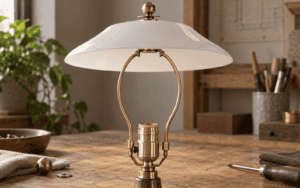
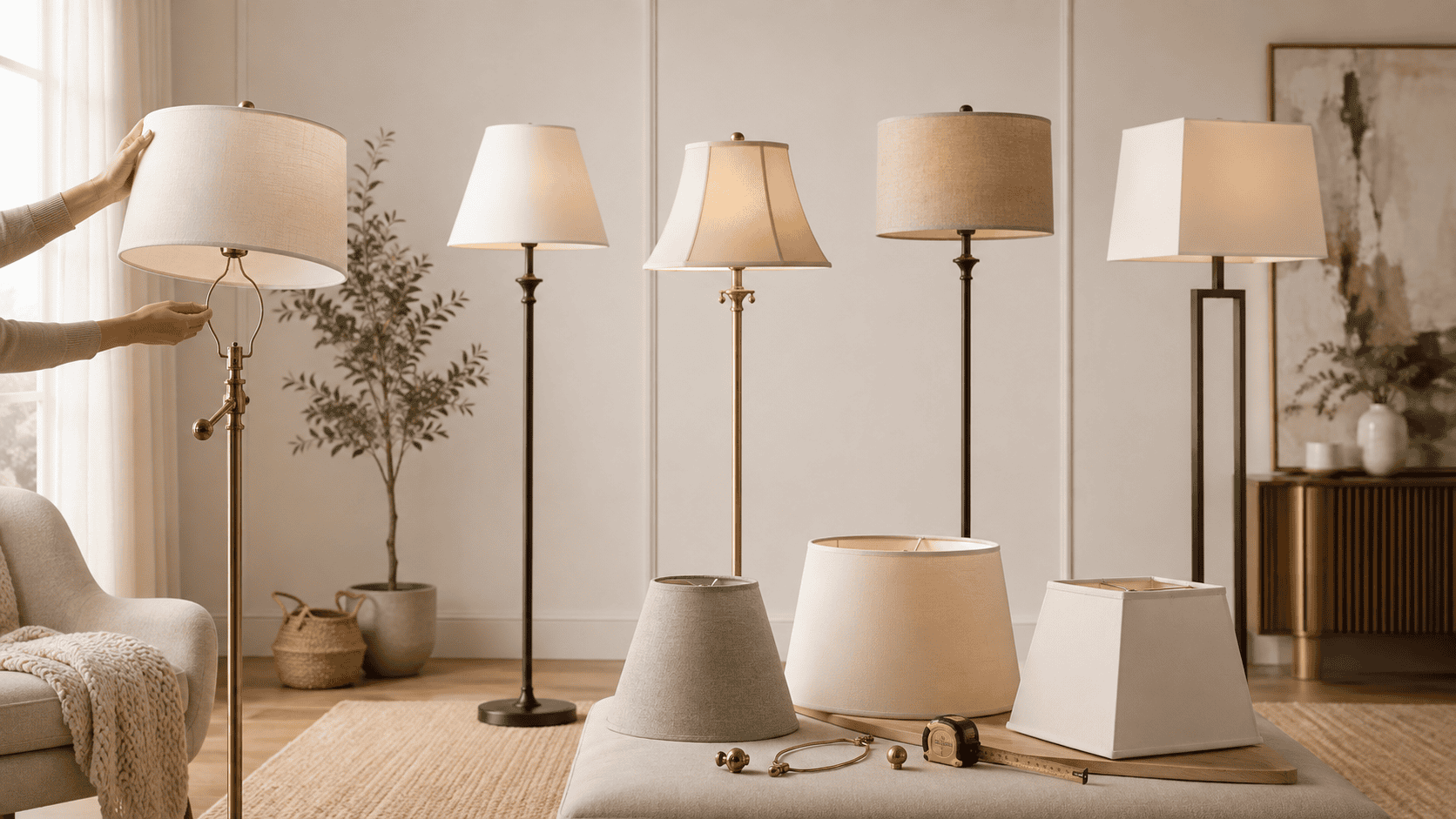
A lampshade for floor lamp installation involves three physical pieces: the shade itself (fabric, paper, or metal body), the fitter (the metal hardware that attaches to your lamp), and sometimes a harp (the U-shaped wire that holds spider-fitter shades). The fitter is where most replacements fail. Buy a shade with the wrong fitter type, and you’re stuck with a beautiful piece that physically cannot mount.
The shade body does the optical work. Tight-weave linen blocks 60–70% of light, creating warm pools. Thin paper lets 80% through, brightening entire rooms. Metal shades with open tops throw light up and down but leave the sides dark. Perfect for ambient lighting in a den, terrible for task lighting at a desk.
How Floor Lamp Shades Differ from Table Lamp Shades
Floor lamps sit 50–72 inches tall. Table lamps top out around 30 inches. That height difference changes everything about shade selection. A 10-inch shade that looks balanced on a table lamp will look like a thimble on a floor lamp. The proportions read as comically small from across a room.
| Feature | Floor Lamp Shade | Table Lamp Shade |
|---|---|---|
| Typical diameter | 14″–22″ | 8″–16″ |
| Height range | 10″–18″ | 6″–12″ |
| Fitter types | Spider, uno, euro | Spider, clip-on, uno |
| Base proportion | 1:3 lamp height | 1:2 base height |
| Light direction | Down + ambient | Up or down |
| Typical bulb wattage | 75–150W (LED 10–20W equivalent) | 40–100W (LED 5–15W) |
Floor lamp shades also handle more heat. A 100-watt incandescent in a table lamp might run warm. The same bulb in a floor lamp with a tighter shade can scorch fabric or yellow paper in months. That’s why floor lamp shade materials skew toward linen and cotton blends over delicate silk. Durability matters when the shade sits 5 feet up and you can’t easily check it daily.
Types of Lampshade Fitters (Attachment Methods)
The fitter is the metal frame that attaches the shade to your lamp—choosing the wrong type means your shade won’t install, period.
Walk into any lighting store and you’ll find three dominant fitter types: spider, uno, and euro. Each mounts to a different part of the lamp. Spider fitters hook onto a harp. Uno fitters screw onto the light socket itself. Euro fitters clip directly to the bulb. No adapter exists to convert between them cleanly. If your lamp has a harp, you need a spider shade. If it doesn’t, you’re looking at uno or euro.
Spider Fitter (Most Common)
Spider fitters show up on 70–80% of traditional floor lamps in North America. The fitter has three or four metal arms (the “spider legs”) that converge at a center ring. That ring sits on top of the harp, and a finial (the decorative screw) threads down through the ring to lock everything in place.
The advantage: you can adjust shade height by swapping harps. Harps come in 1-inch increments from 6″ to 12″. Need the shade higher to clear a switch? Buy a taller harp for three dollars. The downside: spider fitters add visual clutter. Those metal arms show through thin shades, and the finial becomes part of the design whether you want it or not.
When you’re shopping for a lampshade for floor lamp projects with spider fitters, check the spider ring’s inner diameter. Most are 1.5″–2″ to fit standard finials, but oversized decorator finials won’t fit through smaller rings. We’ve seen customers force a thick finial through a 1.5″ ring and crack the shade’s mounting point. An expensive mistake.
Uno Fitter (Threaded Socket Mount)
Uno fitters skip the harp entirely. The shade has a threaded ring (usually 2–3″ diameter) that screws directly onto the lamp’s light socket, the same threads your bulb uses. Remove the bulb, screw on the shade, then screw the bulb back through the shade’s ring. The bulb holds the shade in place.
This system feels precarious the first time you try it. It isn’t. The bulb’s threads are load-rated for the shade’s weight—typically 1–3 pounds. Uno fitters suit minimalist lamps where a visible harp would break clean lines. Many arc floor lamps and modern tripod designs use uno fitters because the shade mounts flush to the socket with zero hardware visible.
The catch: you can’t adjust height. The shade sits exactly where the socket is. If you later want the light lower or higher, you’re rewiring the lamp. Also, uno shades must have a center hole large enough for your bulb. LED bulbs with heat-sink fins sometimes don’t fit through vintage uno rings designed for skinny incandescent bulbs.
Euro Fitter (Clip-On Ring for Bulb)
Euro fitters, sometimes called “European clip-on” or “bulb clip” fitters, grip the light bulb itself with spring-loaded metal clips. Picture a metal ring with three or four arms that pinch the bulb’s glass envelope. The shade hangs from this ring, so the bulb’s position dictates shade position.
These fitters work well for pendant-style floor lamps or European imports where harps aren’t standard. The clips accommodate different bulb diameters (A19, A21, G25 globes), but they won’t fit oversized LED bulbs with external drivers or cooling vanes. Heat is the other concern. The clips sit millimeters from the bulb surface. Paper shades with euro fitters can scorch if you run a 100W-equivalent LED; stick to 60W-equivalent or lower.
| Fitter Type | Mounts To | Best For | Visual ID | Height Adjustable? |
|---|---|---|---|---|
| Spider | Harp + finial | Adjustable height lamps, traditional styles | Metal arms converging at top center | Yes (swap harp) |
| Uno | Light bulb socket threads | Fixed-height minimalist lamps, modern arcs | Ring with threads, screws onto socket | No |
| Euro (clip-on) | Light bulb itself | European-style lamps, pendants, bulb-focused designs | Spring clips that grip bulb | No |
| Clip-on | Bulb edge | Small accent lamps, candelabra bulbs | Direct bulb-edge clips | No |
How to Measure and Size Your Floor Lamp Shade
Getting proportions right ensures your lamp looks balanced and functions properly—too large overwhelms the base, too small looks awkward and may overheat.
Interior designers call it the one-third rule, but most homeowners ignore it until their new lampshade for floor lamp looks bizarre in person after looking fine in the online thumbnail. The rule: your shade’s height should equal roughly one-third of the total lamp height from base to shade top. A 60-inch floor lamp needs an 18–20 inch shade. Use a 12-inch shade and it reads as cheap. Go with a 24-inch shade and the lamp topples into visual-heaviness. Your eye expects the base to be larger to support that much shade mass.
The One-Third Rule for Shade Height
Measure your floor lamp from the floor to the top of the harp or socket (wherever the shade will sit when installed). Multiply by 0.3 to 0.35—that’s your target shade height. A 54-inch lamp × 0.33 = 18-inch shade. This isn’t arbitrary aesthetics; it mirrors how we perceive stability. A top-heavy lamp triggers the same visual unease as a bookshelf with all the heavy volumes on the top shelf.
Here’s where it gets nuanced. The one-third rule assumes a solid, opaque base. If your floor lamp is a minimalist tripod with thin legs, go slightly taller on the shade (say 0.35–0.37) to compensate for the visual “lightness” of the base. Conversely, a chunky ceramic or marble base can handle a shorter shade, closer to 0.28–0.30, without looking stubby.
One data point from a 2026 interior design survey by Houzz: rooms where floor lamp proportions violated the one-third rule by more than 15% were flagged by viewers as “off” 68% of the time, even when viewers couldn’t articulate why. The brain just knows.
Diameter Proportions to Lamp Base
Shade diameter should match or slightly exceed the widest part of your lamp base—usually the bottom platform. A 10-inch base pairs with a 12–14 inch diameter shade. Go much smaller and the shade looks perched; go double the base width and it looks like a mushroom.
For drum shades (the most common shape for floor lamps), measure the bottom diameter of the drum. Empire shades (narrow top, wider bottom) list both dimensions; use the bottom measurement for this comparison. If your base is 12 inches wide, a 14–16 inch shade (bottom diameter) works. Some designers push to 18 inches if the base has a heavy visual texture (carved wood, hammered metal) that “reads” wider than its physical footprint.
There’s a practical limit too. Shades over 20 inches in diameter catch doorways, vacuum hoses, and passing shoulders. We tested this in a standard 8-foot-wide living room: 22-inch shades required conscious navigation around the lamp. If your floor lamp lives in a high-traffic zone, cap diameter at 18 inches regardless of the base width.
Measuring Your Existing Harp and Shade Ring
If you’re replacing a shade on a spider-fitter lamp, measure the harp before you shop. Harps come in standard heights: 6″, 7″, 8″, 9″, 10″, and 12″. The harp height determines how high the shade sits above the bulb. Too short, and the shade’s top fabric scorches. Too tall, and you see bulb glare from the side.
Pull the harp out of its saddle (it usually slides up and out with gentle pressure), then measure from the bottom of the U to the top where the finial threads in. That’s your harp height. Most floor lamps ship with 8″ or 9″ harps. If you’re installing a taller shade, you may need a 10″ or 12″ harp to maintain clearance. Aim for 2–3 inches between the bulb and the inside top of the shade.
Also measure your current shade’s slant height (the diagonal measurement from bottom rim to top rim, along the shade’s slanted side) if you’re shopping in person. Online retailers list shade height as vertical, but in a physical store, holding a tape along the slant gives you a faster visual match.
Lampshade Shapes and When to Use Each
Different shade shapes create different light patterns and suit different room styles—the wrong shape can make a lamp feel out of place.
Shape isn’t just decoration. It’s optics. A drum shade with parallel sides throws light equally up and down, washing ceilings and floors with even brightness. Ideal for ambient lighting in a den or bedroom. An empire shade (narrow top, wide bottom) focuses most light downward in a cone, perfect for reading or task lighting beside a chair. Bell shades and coolie shades do something in between, but they skew decorative, used more for visual interest than functional lighting.
Drum Shades (Modern, Even Light Distribution)
Drum shades have straight vertical sides, like a cylinder. Top diameter equals bottom diameter. This shape dominates modern and contemporary floor lamps because it’s clean, it’s unobtrusive, and it produces the most usable light per square inch of fabric.
The parallel sides mean light escapes equally from top and bottom openings. If you pair a drum shade with a 100W-equivalent LED, you get a bright ceiling wash (useful for making low ceilings feel higher) and a pool of light on the floor (useful for defining seating areas). The sides stay dimmer unless you use a thin, light-colored fabric. Linen drum shades in white or cream deliver 360-degree glow. Great for open-plan living rooms. Dark or thick drum shades create mood lighting, with strong up/down beams and dim sides.
Drum shades suit spaces where the lamp is part of a group. Multiple floor lamps with drum shades feel cohesive because the shape is neutral. Mix drum with empire and the mismatch reads as accidental rather than intentional eclecticism.
Empire Shades (Traditional, Focused Downlight)
Empire shades narrow at the top and flare at the bottom, forming a truncated cone. The top opening might be 8 inches while the bottom hits 16 inches. This shape has been the default for traditional and transitional interiors for decades—it’s what people picture when they hear “lampshade.”
The narrow top restricts upward light. Most of the lumens exit through the wide bottom opening, creating a defined pool below the lamp. Interior designers place empire-shaded floor lamps beside reading chairs, at bedsides, or flanking sofas—anywhere you want task lighting without glare. The downward throw also minimizes shadows on ceilings, which matters in rooms with coffered or tray ceilings where uplight would highlight the texture awkwardly.
Empire shades for floor lamps typically run taller than drum shades at the same diameter, giving them a more formal, elongated profile. A 16-inch-diameter empire might be 14 inches tall (vertical height), whereas a drum of the same diameter caps at 10–12 inches. That extra height suits traditional floor lamps with turned-wood or brass bases that already have vertical emphasis.
Bell and Coolie Shades (Decorative, Ambient)
Bell shades curve outward like a bell (unsurprisingly), with a gentle flare. Coolie shades (also called “Chinese hat” shades) have steep sides that slant sharply from a tiny top to a wide bottom, resembling an Asian conical hat. Both are less common on floor lamps than drum or empire, but they show up in eclectic interiors and vintage restorations.
Bell shades soften the transition between narrow top and wide bottom, producing a balanced up/down light split with slightly more emphasis on ambient glow than task brightness. We see them on ceramic or glass floor lamp bases where the base itself is decorative and the shade shouldn’t compete. The bell shape feels organic rather than geometric.
Coolie shades throw most light down, like empire, but the steep angle creates a wider, less focused pool. They look dramatic but limit functionality. Fine for a corner floor lamp that’s 80% decoration, poor for reading. They’re also tricky to size; the steep slant makes them appear taller than they are, so go conservatively on height or the lamp reads as spindly.
Materials and Light Quality
Shade material dramatically affects how much light passes through, the color temperature, and durability.
A drum shade in white linen and the same drum in bronze metal produce entirely different rooms. The linen diffuses light softly, bouncing lumens in all directions, raising ambient brightness by 30–40 lux across a 12×12 room. The metal shade blocks side light entirely, throwing focused beams up and down. Ambient brightness barely moves, but you get sharp pools at ceiling and floor. Choosing the right lampshade for floor lamp setups means understanding material as a dimmer, a filter, and a design statement.
Fabric Shades (Linen, Silk, Cotton)
Fabric lampshades for floor lamps dominate residential use because they balance aesthetics and function. Linen shades in natural or off-white tones let 50–60% of light through the sides while maintaining a warm glow. No harsh shadows, no glare. Tighter weaves (like cotton duck canvas) drop transmission to 30–40%, useful if your floor lamp sits near a TV and you need to avoid screen glare.
Silk shades look elegant and filter light beautifully, but they’re fragile. UV from bulbs yellows silk within 3–5 years, and dust clings to the fibers. We recommend silk only for low-use decorative floor lamps in formal living rooms—not beside a reading chair where heat and handling will age the fabric fast. Cotton blends (cotton-poly) give you 80% of silk’s appearance with 3× the durability.
Linen holds up best. It tolerates heat, doesn’t yellow quickly, and cleans with a vacuum brush attachment. A quality linen lampshade for floor lamp projects lasts 7–10 years under normal use (3–4 hours daily). The tradeoff: linen shows texture, which reads as casual. Pair it with modern or farmhouse interiors, not formal traditional.
Paper and Parchment Shades
Paper shades (including rice paper, parchment, and vellum) transmit 70–85% of light, making them the brightest option. They produce a soft, even glow with minimal shadowing. Ideal for spaces where you want maximum ambient light from a single source.
The catch: paper shades are consumables. Heat yellows them within 2–3 years. Humidity warps them. They tear if you bump them while moving furniture. In a household with kids or pets, expect to replace paper shades every 18–24 months. That said, they’re affordable ($20–$40 for a decent 16-inch drum), so the replacement cost is low.
Rice paper (often seen on Asian-inspired floor lamps) is particularly delicate but produces a beautiful diffused light. Parchment is tougher, with a slightly translucent leathery texture. It handles heat better than plain paper and resists yellowing for 4–6 years. For floor lamps in bedrooms or low-traffic dens where you want soft ambient light and don’t mind occasional replacement, paper shades deliver the best lumens-per-dollar.
Metal and Glass Shades
Metal shades (brass, steel, copper, painted finishes) block light from the sides entirely and direct 100% of lumens through the top and bottom openings. The result: dramatic up/down beams, dim ambient light, and bold shadows. Industrial, mid-century modern, and steampunk styles lean heavily on metal shades for this high-contrast look.
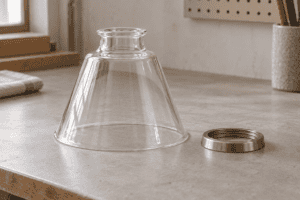
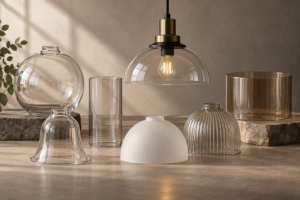
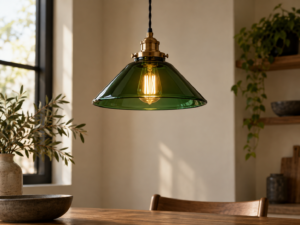
Glass shades (frosted, seeded, or clear) sit somewhere between fabric and metal. Frosted glass diffuses like fabric but never yellows or wears out. Seeded or textured glass scatters light into interesting patterns on walls and ceilings, adding visual texture to otherwise plain rooms. Clear glass provides zero diffusion. It’s pure bulb glare unless you pair it with a decorative filament bulb where the glare is intentional.
Durability-wise, metal and glass shades last decades. A hammered copper shade from 1970 works fine today if the fitter hasn’t corroded. The downside: weight. Metal and glass shades run 3–6 pounds, stressing uno fitters and requiring sturdy harps for spider mounts. We’ve seen lightweight tripod floor lamps tip over from oversized metal shades. Check your base stability before committing.
| Material | Light Diffusion | Durability | Style Match | Maintenance |
|---|---|---|---|---|
| Linen | Soft, warm glow; 50–60% transmission | High (5–10 yrs) | Coastal, modern farmhouse, transitional | Dust with vacuum brush monthly |
| Silk | Elegant, subtle; 55–65% transmission | Medium (3–7 yrs) | Traditional, luxury, formal | Spot-clean only, no water |
| Paper | Bright, even; 70–85% transmission | Low (1–3 yrs) | Asian-inspired, budget, minimalist | Replace when yellowed |
| Metal | Focused beam; 0% side, 100% top/bottom | Very high (10+ yrs) | Industrial, mid-century, steampunk | Wipe with damp cloth |
| Cotton blend | Warm, versatile; 40–55% transmission | High (6–9 yrs) | Contemporary, eclectic, casual | Machine-washable (remove fitter) |
| Frosted glass | Diffused; 60–75% transmission | Very high (15+ yrs) | Art deco, modern, bathroom-safe | Glass cleaner, no scratches |
Matching Shade Style to Your Interior Design
A mismatched shade ruins an otherwise perfect room—here’s how to pair shades with popular design styles.
Walk into a room and you can usually tell within 5 seconds whether the lampshade for floor lamp belongs or was grabbed at random. The lamp might technically “work” (right size, right fitter), but if the shade’s style clashes with the room’s design language, it reads as afterthought. The good news: a few simple pairing rules cover 90% of residential styles.
Modern and Minimalist Spaces
Modern interiors value clean lines, neutral palettes, and uncluttered surfaces. Your lampshade for floor lamp should disappear into this aesthetic, not compete with it. Drum shades in white, cream, gray, or black linen work universally. Avoid patterns, fringe, or scalloped edges. They’re all visual noise.
Material matters as much as shape. Linen and cotton blends read as warm-modern. Paper shades skew Scandinavian or Japanese minimalism. Pair them with light wood floors and low-profile furniture. If your floor lamp base is metal (brushed nickel, matte black, brass), match the shade’s hardware finish to the base for a cohesive look. A black metal lamp with a white drum shade and black spider fitter is a safe bet for modern living rooms, bedrooms, and home offices.
One trend in 2026: oversized drum shades (20–22 inches diameter) on slender tripod bases. The proportions feel slightly off by traditional rules, but the scale creates presence without mass. Very “Brooklyn loft” or “California modern.” This only works in rooms with 9+ foot ceilings; in standard 8-foot rooms, it crowds the space.
Traditional and Classic Interiors
Traditional design runs on symmetry, ornamentation, and historical references (Georgian, Victorian, Colonial). Empire shades dominate here because their shape echoes classical urns and columns. Look for shades in silk or faux silk (poly-silk blends that look identical but last longer) in ivory, champagne, taupe, or soft gold tones.
Pleated shades (vertical or box pleats) add the texture traditional rooms expect. Smooth shades feel too stark. Scalloped bottom edges, decorative trim, or contrast piping reinforce the formal vibe. If your floor lamp base is turned wood, ceramic, or antique brass, the shade should have a warm tone. Cool white or gray reads as modern and breaks the aesthetic.
Pair traditional floor lamps with traditional lamp harps and finials. A crystal or faceted-glass finial becomes part of the design. The harp should be brass-plated or antique-finished metal, not chrome. These details are tiny, but they accumulate. Get three wrong and the lamp feels confused rather than curated.
Industrial and Mid-Century Modern
Industrial style celebrates raw materials: exposed metal, Edison bulbs, concrete, reclaimed wood. Your lampshade for floor lamp should either embrace this rawness (metal shades, wire cages) or provide warm contrast (natural linen, burlap). A black or gunmetal drum shade with visible rivets or seams works. So does a cone-shaped metal shade that throws focused light. Think factory task lamps scaled up.
Mid-century modern (MCM) overlaps with industrial but adds color and curves. MCM floor lamps often feature teak bases, arc forms, and bold 1950s–70s silhouettes. Drum shades in burnt orange, mustard, olive, or teal were period-correct and feel fresh again in 2026. White or cream drum shades work if the base is the statement piece. Avoid empire shades. They’re too formal for MCM’s casual sophistication.
Both styles favor exposed bulbs or minimal shading, so if you’re replacing a shade on an industrial or MCM floor lamp, consider whether you even need one. A bare Edison bulb with a visible filament might be the most honest choice. If you do add a shade, keep it simple: no pleats, no patterns, no scallops.
Step-by-Step Installation Guide
Attaching a floor lamp shade correctly prevents wobbling, ensures safety, and maximizes light output.
Most people skip the instructions and force the shade on however it seems to fit. This works until it doesn’t. Shades sit crooked, finials strip threads, or the whole assembly topples when someone bumps the lamp. The proper install takes 3 minutes and eliminates all of those issues.
Tools You’ll Need
For spider fitter shades: nothing. Maybe a small screwdriver if you need to remove an old harp. For uno and euro fitters, you’ll want a clean cloth to handle the bulb (skin oils shorten bulb life) and possibly needle-nose pliers if the uno ring is overtightened from the previous shade.
Lay a towel or soft surface under the lamp before you start—if you drop the shade, you’d rather it land on fleece than hardwood. This sounds paranoid until you’ve shattered a $90 glass shade because your dog barked mid-install.
Installing a Spider Fitter Shade (with Harp)
Unscrew and remove the finial from the top of the harp. If there’s an old shade, lift it off the harp. Spider shades just sit on the harp, they’re not clipped or locked. Inspect the harp. If it’s bent, replace it; bent harps make shades sit crooked, and you can’t fix a bend without creating a weak point.
Hold your new shade by the spider ring (the center metal ring where the spider arms meet) and lower it onto the harp. The harp’s top rod should pass through the spider ring’s center hole. Settle the shade so it’s level—rotate it slightly if needed to find a stable position. Some shades have a “front” (indicated by the seam or a tag inside); orient that away from the room’s main sightline.
Thread the finial back onto the harp’s top rod. Tighten it by hand (snug, not torqued). Overtightening bends the harp or cracks the spider ring if it’s plastic-coated. The shade should be stable but still rotatable with light hand pressure. If it wobbles, the harp might be slightly bent or the spider ring isn’t seated evenly. Lift the shade off, check the harp arms for symmetry, and reseat.
Installing Uno and Euro Fitter Shades
For uno fitters: Turn off the lamp and let the bulb cool if it was recently on. Unscrew the old bulb. If there’s an old uno shade, unscrew its threaded ring from the socket. Hold the new shade by its uno ring and thread it onto the socket’s threads, turning clockwise. Tighten until snug—the shade should not rotate freely, but don’t crank it down so hard you strip the socket threads (brass sockets can strip if you force them).
Now screw your bulb back in through the shade’s center opening. The bulb’s base threads into the socket through the shade. Tighten the bulb until it’s secure. The bulb effectively locks the shade in place. Turn the lamp on and check that the shade sits level. If it tilts, the uno ring may not have threaded evenly—unscrew the bulb, reseat the shade, and try again.
For euro fitters: Remove the old bulb. The shade’s metal clips should be visible—usually three or four spring-loaded arms around a center ring. Slide the new shade’s ring over the bulb (if starting from scratch, screw the bulb into the socket first, then slide the euro shade over it). Position the shade so it sits level, then gently squeeze the clips closed around the bulb’s widest part (just above the threaded base). The clips grip the glass.
Check stability by lightly tapping the shade’s rim. It should hold firm. If the shade slides down the bulb, the clips aren’t tight enough. Some euro fitters have small screws that let you adjust clip tension. These are fiddly; we’ve had better luck just buying euro shades with strong stock springs.
Common Problems and How to Fix Them
Even with the right shade, installation issues crop up—here’s how to troubleshoot the most frequent complaints.
You followed the steps. The shade still looks wrong or feels unstable. Here’s the short list of what actually goes wrong in the field, based on what lighting stores see returned most often.
Shade Wobbles or Sits Crooked
If a spider-fitter shade wobbles, 90% of the time the harp is bent. Harps are thin wire—lean a vacuum against the lamp, bump it moving a couch, or overtighten the finial, and the harp deforms. Hold the lamp at eye level and sight along the harp; if one arm sits higher or bows outward, replace the harp. They’re $3–6 at hardware stores.
The other 10%: the spider ring inside the shade is damaged or the spider arms aren’t evenly spaced. Cheap shades use glued-on spiders that detach after a few years. If you can see the spider shifting inside the shade, the shade is toast. Gluing it back rarely holds under the finial’s pressure.
For uno and euro fitters, crooked shades mean the fitter wasn’t threaded or clipped evenly. Loosen, reseat, retighten. If it still sits crooked, check whether the socket itself is bent or the lamp’s vertical rod is tilted. A tilted lamp makes every shade look wrong.
Shade Is Too Small or Too Large (Post-Purchase Fixes)
You measured, but the shade still feels off. If it’s too small (looks stubby or pinched), you can’t stretch a shade, but you can create visual weight by changing the bulb. A warmer, brighter bulb (3000K, 100W-equivalent) makes the shade glow more, increasing its perceived size. This tricks the eye in evening light, less so during the day.
If the shade is too large and overwhelms the lamp, your options are limited. You can’t shrink a shade. You can swap the harp for a taller one to lift the shade higher, which reduces its visual dominance over the base. The extra height pulls the eye’s focal point up and makes the base feel more substantial by comparison. This works if the shade is only 10–15% oversized. Beyond that, return the shade or move it to a bigger lamp.
Light Leaks from Top or Bottom
Light leaking from the top or bottom of the shade is either intentional (drum shades do this by design) or a sign of a gap between shade and lamp. For spider fitters, the shade should rest flat on the harp’s saddle (the small metal bracket where the harp attaches to the lamp base). If there’s a gap, the harp is too short. Swap it for a taller one.
For uno fitters, light leaks happen when the shade’s center opening is too large for the bulb, leaving a visible ring of brightness. Some uno shades include a metal washer or adapter ring to fill the gap. If yours didn’t, you can buy stick-on felt rings (sold as “shade reducers”) to line the opening and block the leak. This is a 5-minute fix that makes the shade look intentional rather than sloppy.
If light leaks through the shade fabric (you can see the bulb’s outline), the material is too thin for the bulb wattage you’re using. Drop to a lower-wattage LED or add a diffuser (a small clip-on frosted cover that fits over the bulb) to soften the hotspot. Diffusers cost $8–12 and solve 80% of harsh-light complaints.
Where to Buy Quality Floor Lamp Shades (2026 Trends)
The floor lamp shade market has shifted toward modular, sustainable materials and smart-home compatibility.
Big-box stores (Target, Walmart, IKEA) stock generic drum and empire shades in standard sizes. Fine for replacing a broken shade on a budget lamp, but limited in fitter options and style. Specialty lighting retailers (Shades of Light, Lamps Plus, Restoration Hardware) carry wider fitter inventories and higher-end materials. For unusual sizes or vintage lamp restorations, Etsy artisans and local lampshade shops can custom-make shades to your specs.
Online Specialty Retailers vs. Big-Box Stores
Shades of Light and similar mid-tier retailers offer 50–100 floor lamp shade SKUs with detailed fitter callouts. You’ll find euro fitters, oversized drums (20–22″), and fabric options beyond beige linen. Expect $60–$150 per shade. Shipping is usually safe. Shades arrive in fitted boxes with plenty of padding. Returns are straightforward if the fitter doesn’t match.
Big-box stores cap out at $40 per shade and carry mostly spider-fitter drums in 14–16″ diameters. Selection is thin, but if your lamp uses a common spider/harp setup and you want white linen or cream cotton, they’re adequate. Check the store’s return policy; IKEA and Target accept shade returns within 90 days even if you installed it, as long as it’s undamaged.
Amazon and Wayfair sit in the middle. Massive selection, wildly variable quality. Read reviews carefully and filter by “uno fitter” or “euro fitter” if that’s what you need; product titles often mislabel fitter types. Look for shades with 100+ reviews averaging 4+ stars. Avoid no-name brands with stock photos. They’re often dropshipped from factories that don’t QC dimensions. We’ve seen “16-inch” shades arrive at 14.5 inches.
Custom Shade Makers and Artisan Options
If you’re restoring a vintage floor lamp, own an unusual fitter type (like a bridge arm lamp with a custom bracket), or want a specific fabric the big retailers don’t carry, custom shade makers are your path. Local lampshade shops (search “lampshade shop near me”; they still exist in most metro areas) can measure your lamp, match the fitter, and fabricate a shade in 1–2 weeks. Expect $120–$300 depending on size and material.
Etsy has hundreds of small-batch makers who specialize in retro patterns (mid-century geometrics, floral chintz, Art Deco prints) and sustainable materials (organic cotton, hemp, hand-dyed linen). Turnaround is typically 3–4 weeks since each shade is made to order. You’ll need to provide exact measurements: fitter type, top diameter, bottom diameter, and slant height. Most Etsy sellers include a measurement guide in their listings.
Custom shades cost 2–3× off-the-shelf prices, but if you’ve inherited a 1960s teak floor lamp with a weird 11-inch euro fitter that nobody makes anymore, $250 for a perfect-fit custom shade beats scrapping a $600 vintage lamp.
| Trend | Description | Availability (2026) |
|---|---|---|
| Modular fitters | Shades with interchangeable fitter rings (buy one shade, swap spider/uno/euro rings as needed) | Growing (10+ brands, mostly specialty retailers) |
| Eco-friendly materials | Recycled fabric, bamboo, hemp, low-VOC dyes | Mainstream (available at West Elm, CB2, Etsy) |
| Smart-dimmer compatibility | Shades designed for LED smart bulbs with integrated color-tuning | Premium tier ($150+, brands like Philips Hue partners) |
| Bold patterns | Maximalist prints, botanical motifs, abstract geometrics | High-end retailers (Anthropologie, Lulu & Georgia) |
| Oversized drums (20–22″) | Statement shades for high-ceiling spaces | Specialty stores, limited stock at IKEA/Target |
| Textured weaves | Rattan, woven seagrass, macramé | Coastal/boho brands (Serena & Lily, Urban Outfitters) |
FAQ
Q: What kind of lampshade for a floor lamp?
Choose a drum or empire shade 14″–20″ in diameter with a spider or uno fitter. Match the fitter to your lamp’s hardware. For modern rooms, go drum; for traditional, empire. Fabric shades give soft light; metal gives focused beams. Measure your lamp’s total height and pick a shade that’s one-third that height for balanced proportions.
Q: Can you put any lampshade on a floor lamp?
No. The shade’s fitter type must match your lamp’s attachment hardware. A spider fitter needs a harp and finial; an uno fitter screws onto the bulb socket; a euro fitter clips directly to the bulb. Fitter types aren’t interchangeable without rewiring. Also check proportions: the shade should be one-third the total lamp height, or it will look awkward.
Q: How do you attach a lampshade to a floor lamp?
For spider fitters: slide the shade over the harp and tighten the finial on top. For uno fitters: unscrew the old shade, screw the new shade’s ring onto the socket threads, then screw the bulb back through the shade. For euro fitters: clip the shade’s spring arms directly onto the light bulb’s glass body.
Q: Where can I buy replacement lampshades?
Specialty lighting retailers like Shades of Light and Lamps Plus offer the widest fitter and size selection (50–100 SKUs, $60–$150 per shade). IKEA and Target work for standard spider fitters on a budget ($20–$40). For custom sizes or vintage lamps, try Etsy artisans or local lampshade shops. Expect $120–$300 and 2–4 week turnaround.
Q: What size shade do I need for a 60-inch floor lamp?
For a 60″ tall lamp, the shade should be roughly 18″–20″ tall (one-third rule: 60 × 0.33 = 19.8″). Diameter should match or slightly exceed the widest part of the base, typically 16″–20″ for a standard floor lamp. Measure your lamp from floor to harp top, then multiply by 0.3–0.35 to get target shade height.
Q: Can I use a table lamp shade on a floor lamp?
Only if the fitter type and size match, but table lamp shades are usually too small (8″–14″ diameter) and look disproportionate on floor lamps. Floor lamps need larger shades (14″–20″+) to balance the height. A 10-inch table lamp shade on a 60-inch floor lamp looks like a thimble. Visually unstable and awkward.
Q: Do floor lamp shades come with the fitter, or do I buy separately?
Most replacement shades include the fitter already attached (spider, uno, or euro hardware built into the shade’s frame). If buying a bare shade frame or custom-made shade, confirm whether the fitter is included. Fitters purchased separately run $5–$15 but must match your lamp’s mounting system exactly.
Q: How do I know if my floor lamp uses a harp or direct socket fitter?
Look at the top of your lamp: if there’s a U-shaped metal wire (harp) rising from the base with a finial (decorative screw) on top, you need a spider fitter. If the shade screws directly onto the socket or bulb with no visible harp, it’s uno (socket threads) or euro (bulb clips). The harp is the giveaway. No harp means no spider fitter.
Finding Your Floor Lamp Shade Match
The right lampshade for floor lamp installations comes down to three decisions: fitter type (spider, uno, or euro), proportions (one-third rule for height, match-or-exceed for diameter), and material (fabric for diffusion, metal for drama, paper for brightness). Get those three right and the shade installs cleanly, looks balanced, and delivers the light quality your room needs.
Start by identifying your lamp’s fitter—that eliminates two-thirds of available shades immediately and prevents buying something that won’t fit. Measure your lamp’s height and base width, run the one-third calculation, and you’ve got your size target. From there, material and shape are about matching your room’s design language and your lighting goals. Drum shades for even ambient light in modern spaces. Empire shades for focused reading light in traditional rooms. Metal for industrial aesthetics, linen for warmth, paper for maximum brightness.
Most mistakes happen because someone skips the measuring step or doesn’t realize fitter types aren’t universal. Take five minutes to confirm your harp height or socket type before you order, and you’ll avoid the return loop that drags out a simple replacement. The shade that fits, balances, and matches your style the first time is always cheaper than three wrong guesses.