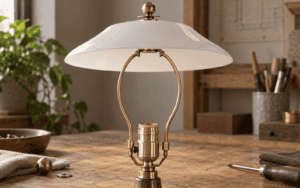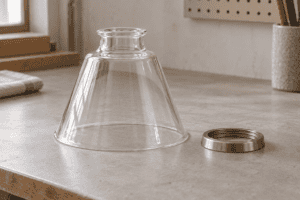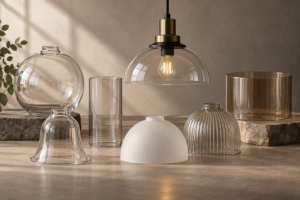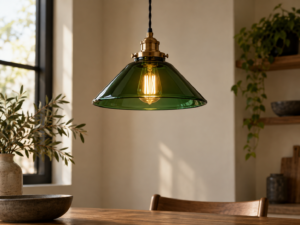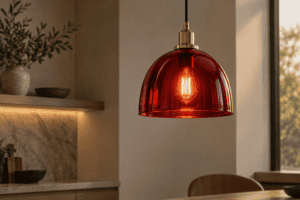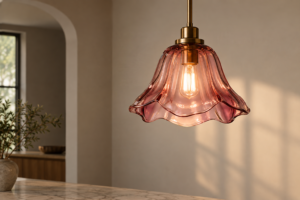
A red glass lamp shade is a glass cover whose body, coating or decoration produces a red appearance around the light source. The useful buying question is not simply whether the shade looks red in a photograph. Confirm how much light it transmits, whether the red is in the glass or on the surface, how the fitter seats on the fixture, and how the color is approved under the intended LED.
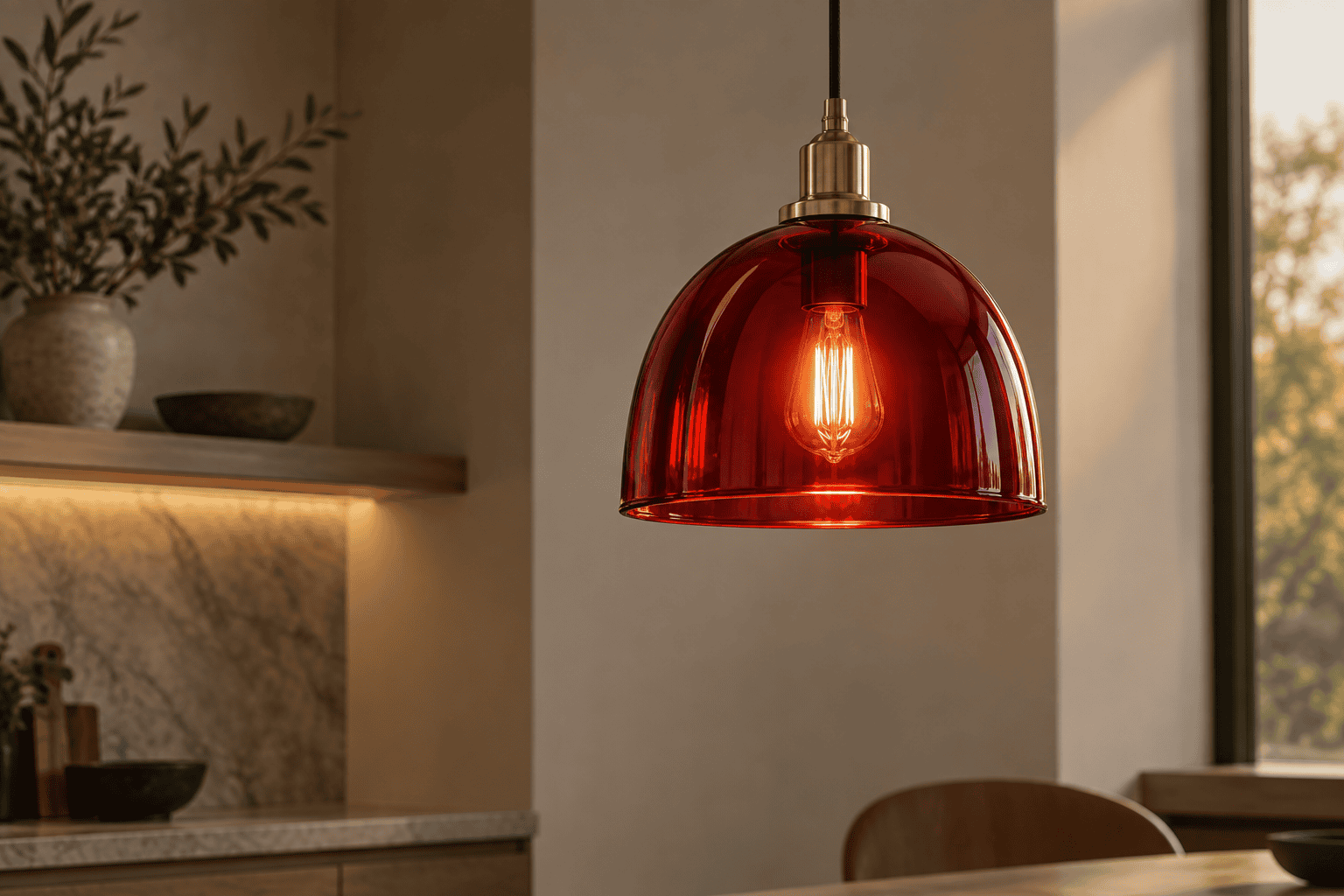
What does red glass mean in a lamp shade?
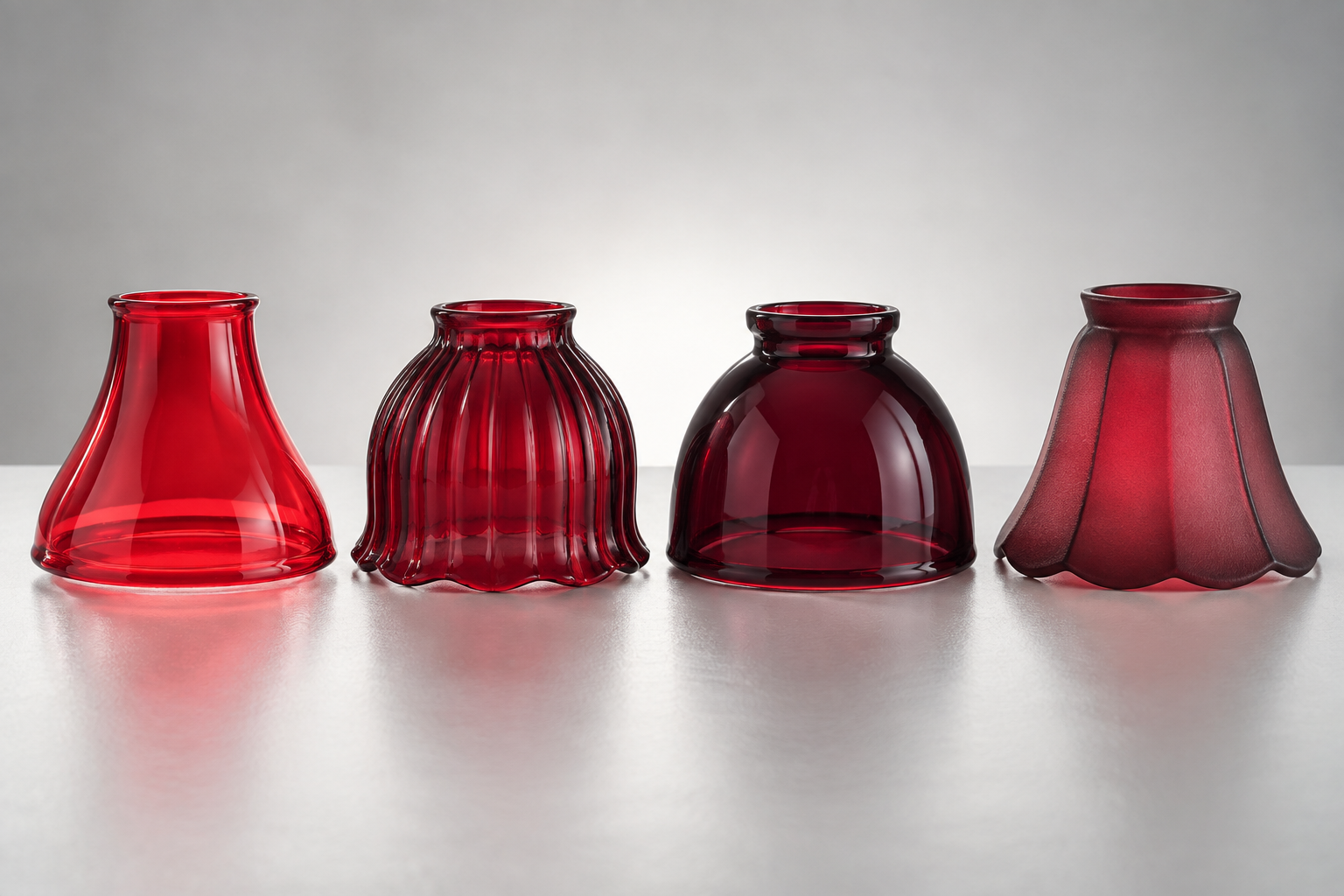
In a lighting listing, red glass usually describes visible color rather than one universal formula. The shade may be transparent red body glass, cased glass with a colored layer, satin or ribbed glass, painted glass, enamel decoration, or a surface coating. Those routes can produce similar photographs while creating very different light output, handling requirements and replacement expectations.
For a buyer, the phrase becomes useful when it is tied to four details:
- The target hue, from bright cherry through deep ruby or muted cranberry.
- The intended transmission, from clear glow to a more private diffused light.
- The surface route, such as body color, frosting, ribs, paint or enamel.
- The fixture interface, including the fitter, opening, support ring and clearance.
The same red shade can look brighter on a white background and much darker against a black wall. A warm filament-style LED can make it appear deeper, while a cool source can reveal violet or brown shifts. A product photograph is therefore a useful reference, not a complete color specification.
| Description used by a seller | What it may mean | What to confirm before purchase |
|---|---|---|
| Red glass | A red appearance in the body or surface | Whether the color is full-body, cased, painted or coated |
| Ruby glass | A deeper red visual family or a historical glass term | Hue, transparency, wall thickness and production route |
| Cranberry glass | Pink-red to wine-red glass, often used for decorative pieces | Whether the shade is clear, opaque, hobnail, ribbed or gradient |
| Red stained glass | Separate pieces joined into a panel or decorative assembly | Construction, joints, weight, maintenance and fixture support |
| Red metallic or painted shade | A finish applied over clear or colored glass | Adhesion, edge coverage, cleaning limits and heat exposure |
Treat the name as a starting point. Treat the sample and the measurement record as the specification.
Red, ruby, cranberry and rose glass: how are they different?
These words overlap in retail language, but they are not interchangeable when a factory is quoting a part. Red is the broad visual target. Ruby often suggests a stronger, jewel-like red. Cranberry can describe a warmer pink-red or wine-red appearance. Rose sits closer to pink, blush or warm red and may read lighter than a saturated red shade.
Corning's gold ruby entry records a historical route in which gold chloride was added to the batch to produce a deep red result. That is useful context, but a modern red lamp shade should not be called gold ruby unless the material and process record support that name.
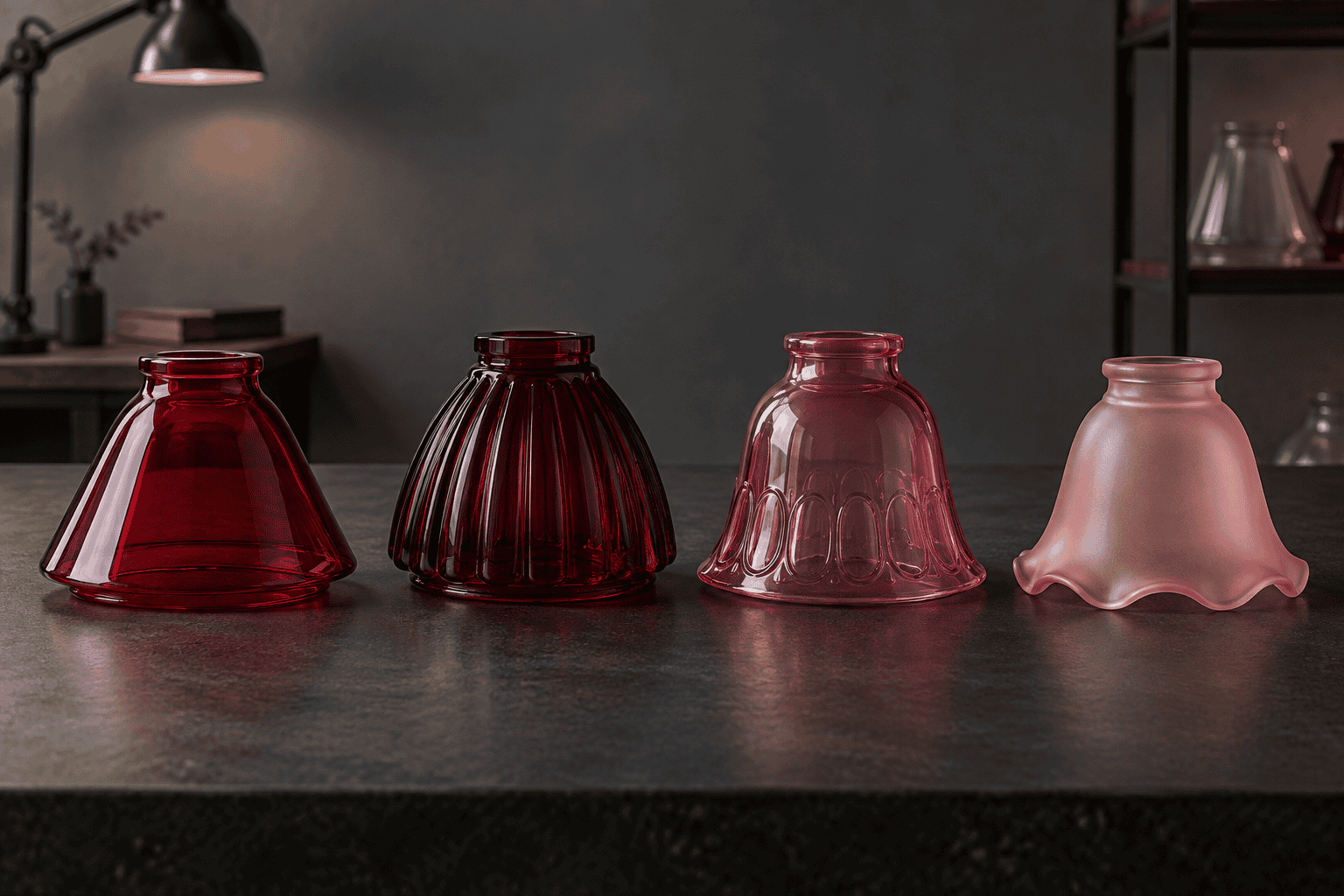
| Visual family | Typical impression when unlit | Likely buyer concern |
|---|---|---|
| Clear red | Bright colored edge with the room visible through the body | Will the shade look too pale when the lamp is off? |
| Saturated ruby | Darker red with strong visual weight | Will the installed shade reduce useful light too much? |
| Cranberry | Warm pink-red, sometimes with a softer vintage character | Is the color even across the wall thickness and rim? |
| Rose | Lighter blush or warm pink-red | Will it be confused with a separate rose or pink specification? |
| Red with surface decoration | Local color or pattern over a base glass | Will the finish survive cleaning and handling? |
The practical decision is not which word sounds most attractive. It is whether the chosen visual family fits the fixture, viewing distance, light output and maintenance plan.
How red glass changes the light
Red glass filters the light that reaches the viewer. The result depends on the glass composition, thickness, surface treatment, bulb spectrum and background. Two shades with the same outside color can deliver different light because one is thin and clear while the other is thick, satin-finished or layered.
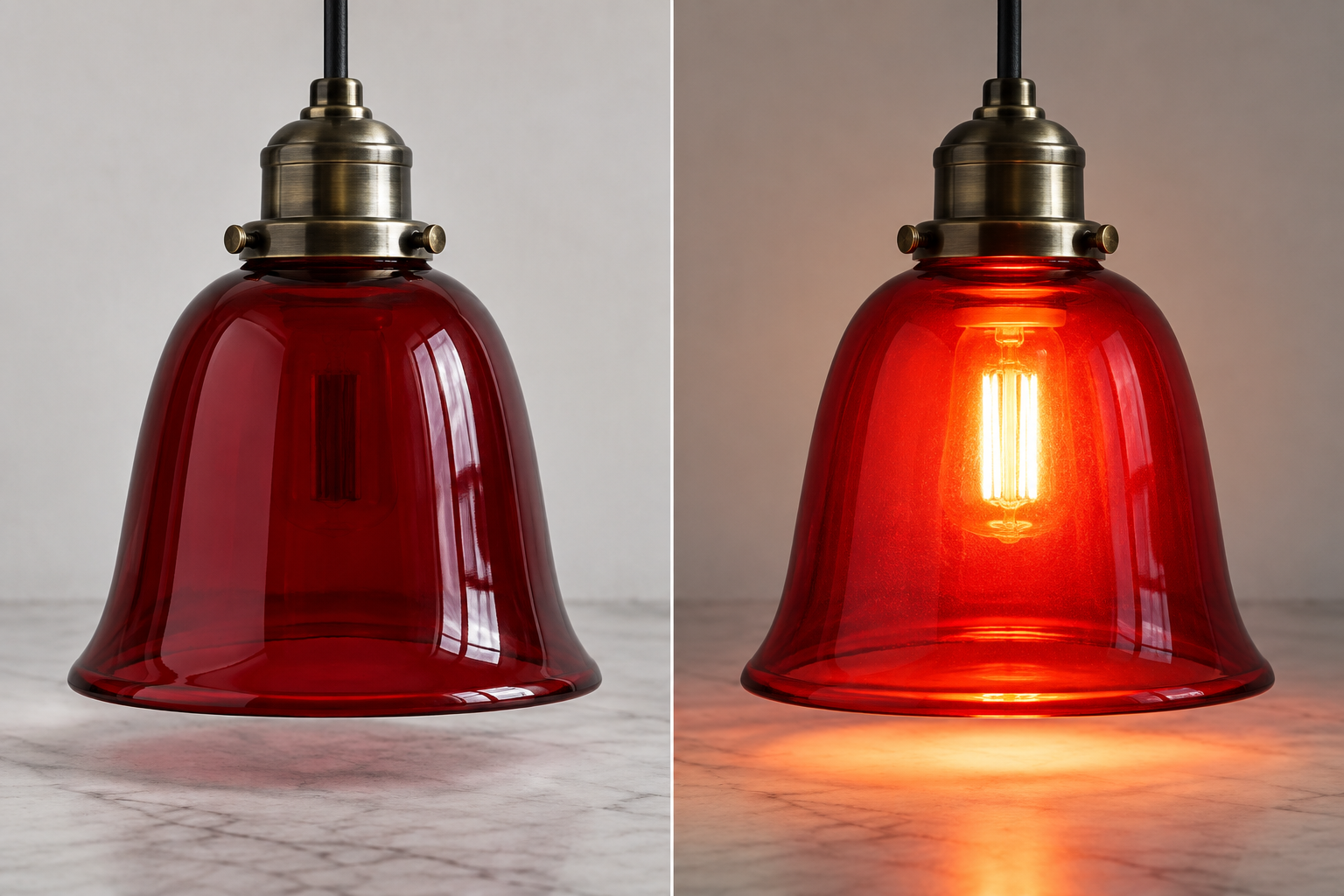
When reviewing a red glass lamp shade, check three views:
- unlit against a light background, to see the body color and surface condition;
- illuminated with the intended LED, to see transmitted glow and hotspots;
- illuminated against the actual wall, counter or product display, to see the installed color.
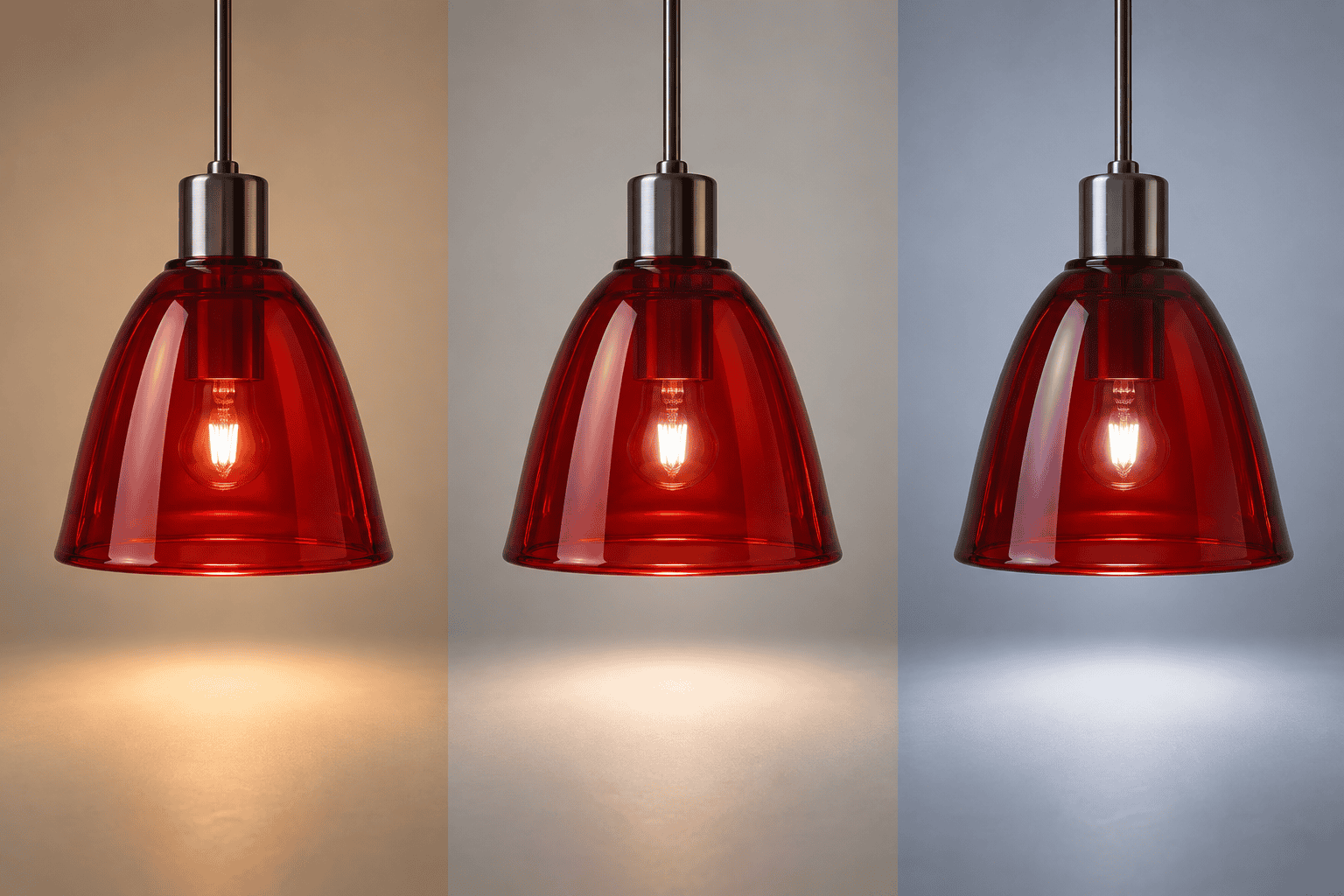
| Test view | What to observe | Why it belongs in the approval record |
|---|---|---|
| Daylight, unlit | Hue, rim color, bubbles, scratches and coating marks | Separates the object from the lamp output |
| Warm LED | Saturation, warmth and the visible glow | Represents many decorative and hospitality installations |
| Neutral LED | Balance between red, brown and violet | Gives a more repeatable comparison between samples |
| Cool LED | Washed areas, purple shifts and glare | Shows whether the color depends too heavily on warm light |
| Backlit wall | Center, edge and fitter transition | Reveals thin spots, gradients and uneven coverage |
Do not approve a red shade solely because it looks dramatic in a dark studio. If it will light a counter, aisle or dining table, judge the output where people will actually see it.
Which red glass shade profile and fitter should you choose?
Color does not correct a poor mechanical fit. Start by identifying the fixture and the retaining method. A gallery fitter, neck fitter, threaded opening, clip support and top ring each place different demands on the shade.
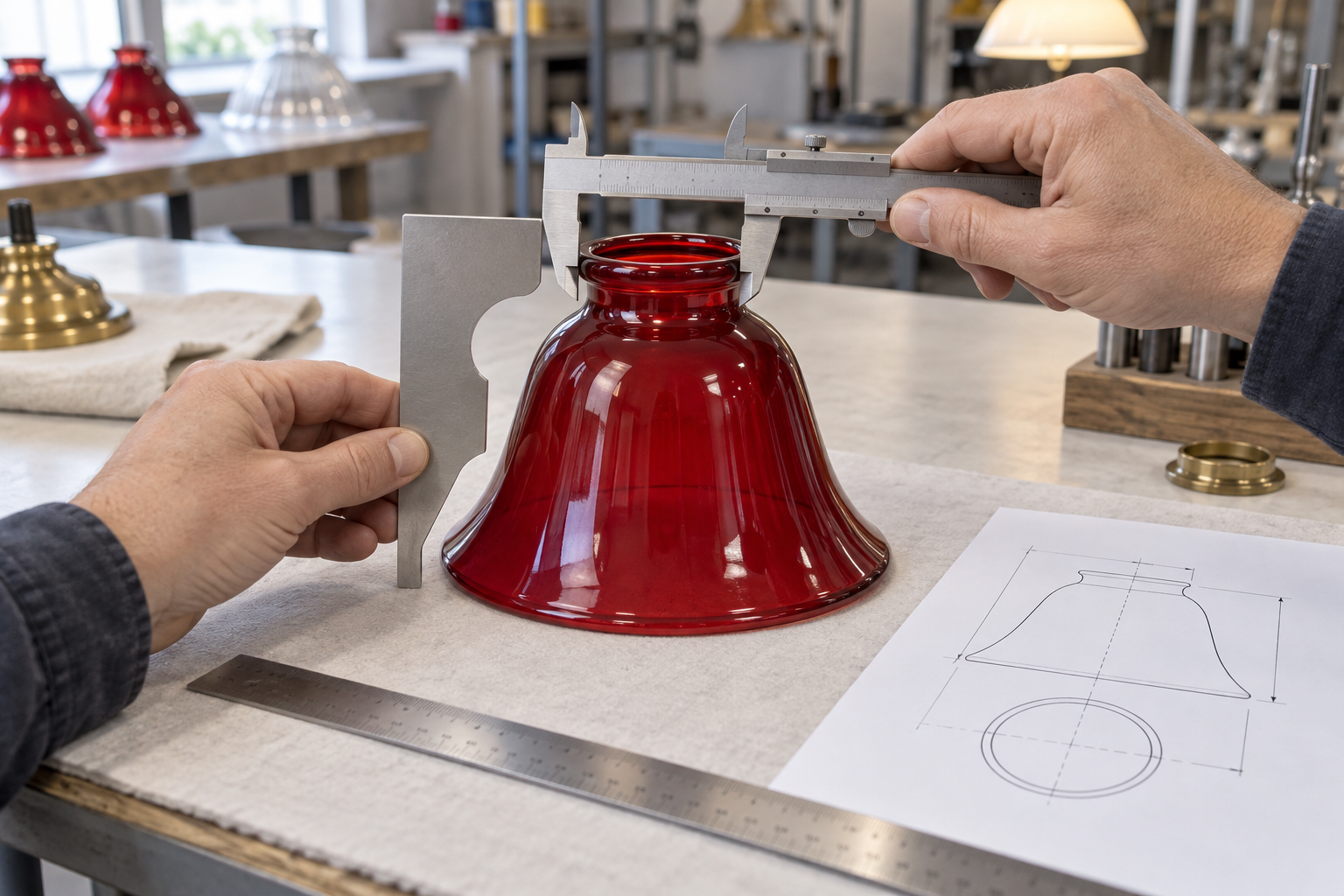
For a pendant, record the top opening, socket or ring relationship, overall height and clearance around the lamp. For a table lamp, record the bottom opening, gallery contact, widest diameter and seating position. For a wall sconce, add the mounting direction and the distance between the shade and the wall. The glass lamp shade fitter types guide is useful when the existing hardware is difficult to identify.
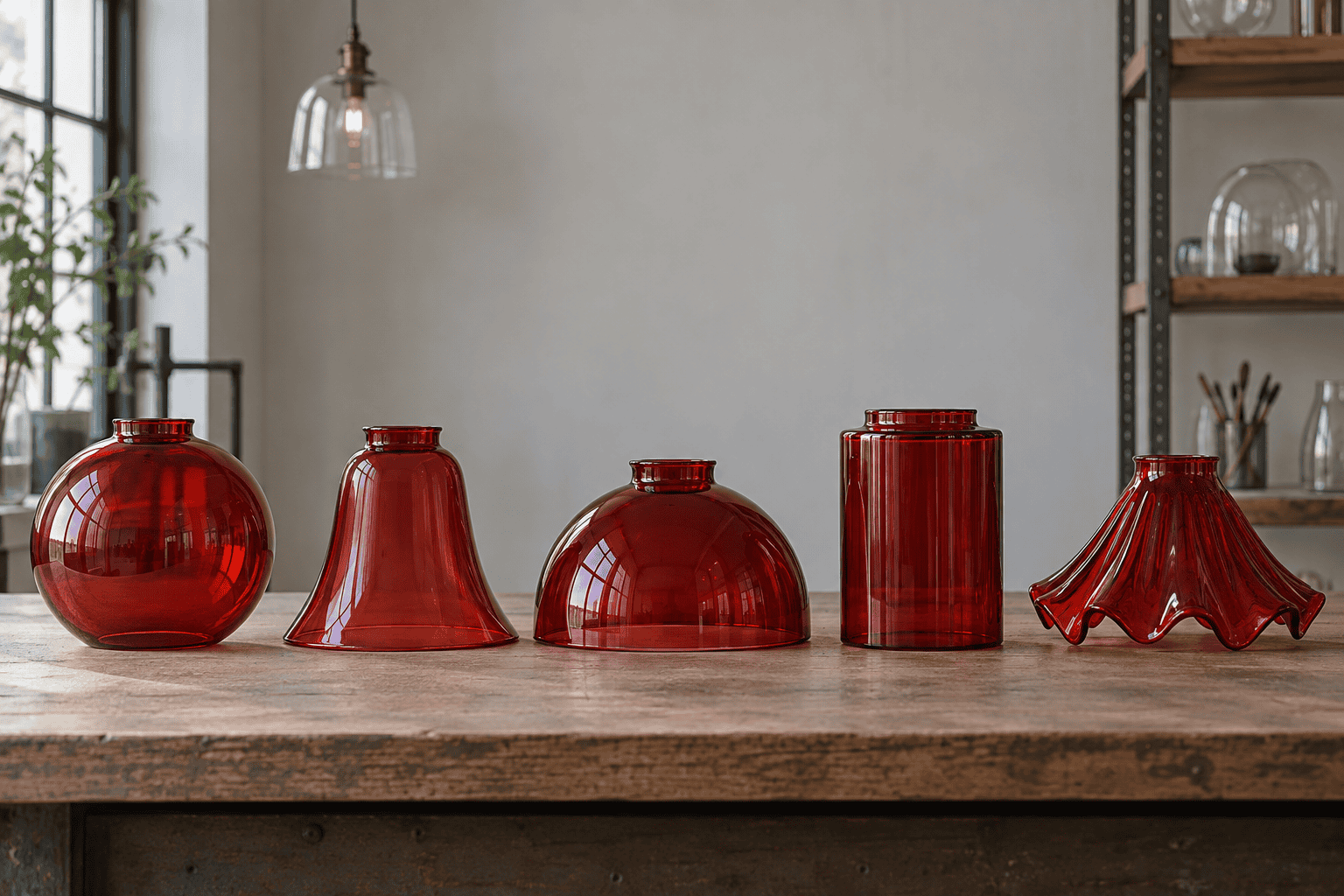
| Profile | Visual result | Fitter question |
|---|---|---|
| Globe | Even colored volume around the bulb | Is the opening centered and does the ring support the full weight? |
| Bell | Strong downward flare and visible lower rim | Does the gallery or neck sit at the correct height? |
| Dome | Broad lower spread with a compact top | Is the top opening compatible with the socket hardware? |
| Cylinder | Controlled vertical silhouette | Will the retaining ring prevent rotation or slipping? |
| Flower or ruffled | Decorative edge that catches highlights | Is the rim protected and clear of nearby hardware? |
How to match a red glass lamp shade replacement
Replacement work is a matching exercise, not a color-shopping exercise. Start with the original fixture and record the dimensions that control seating. A close red color is still the wrong replacement if the opening, support ring or height is incompatible.
Check the following before requesting a replacement:
- Photograph the fixture from the side and from the fitter end.
- Measure the opening or neck at the actual seating surface.
- Record overall height, widest diameter and any flare or taper.
- Identify the retention method, including gallery, screws, clips or threaded ring.
- Check bulb clearance and the direction in which the shade is installed.
- Compare the original red tone in both unlit and lit conditions.
- Inspect the old rim for chips, distortion or a non-round opening.
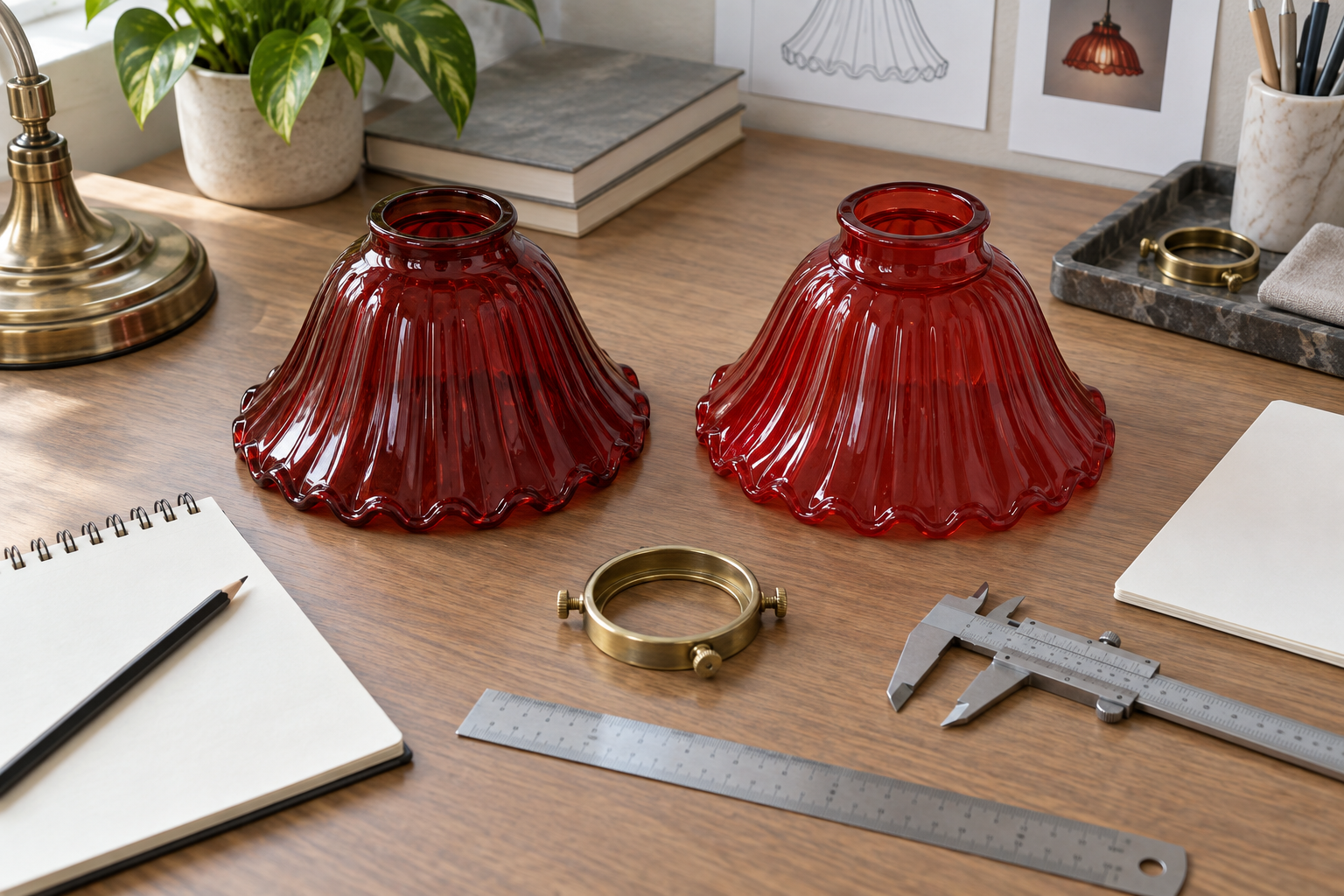
JX's replacement glass shade finder and matching guide can support the first comparison. If the existing part is unusual, send the original shade or a dimensioned profile instead of relying on a single catalog phrase.
Surface and material options for red glass shades
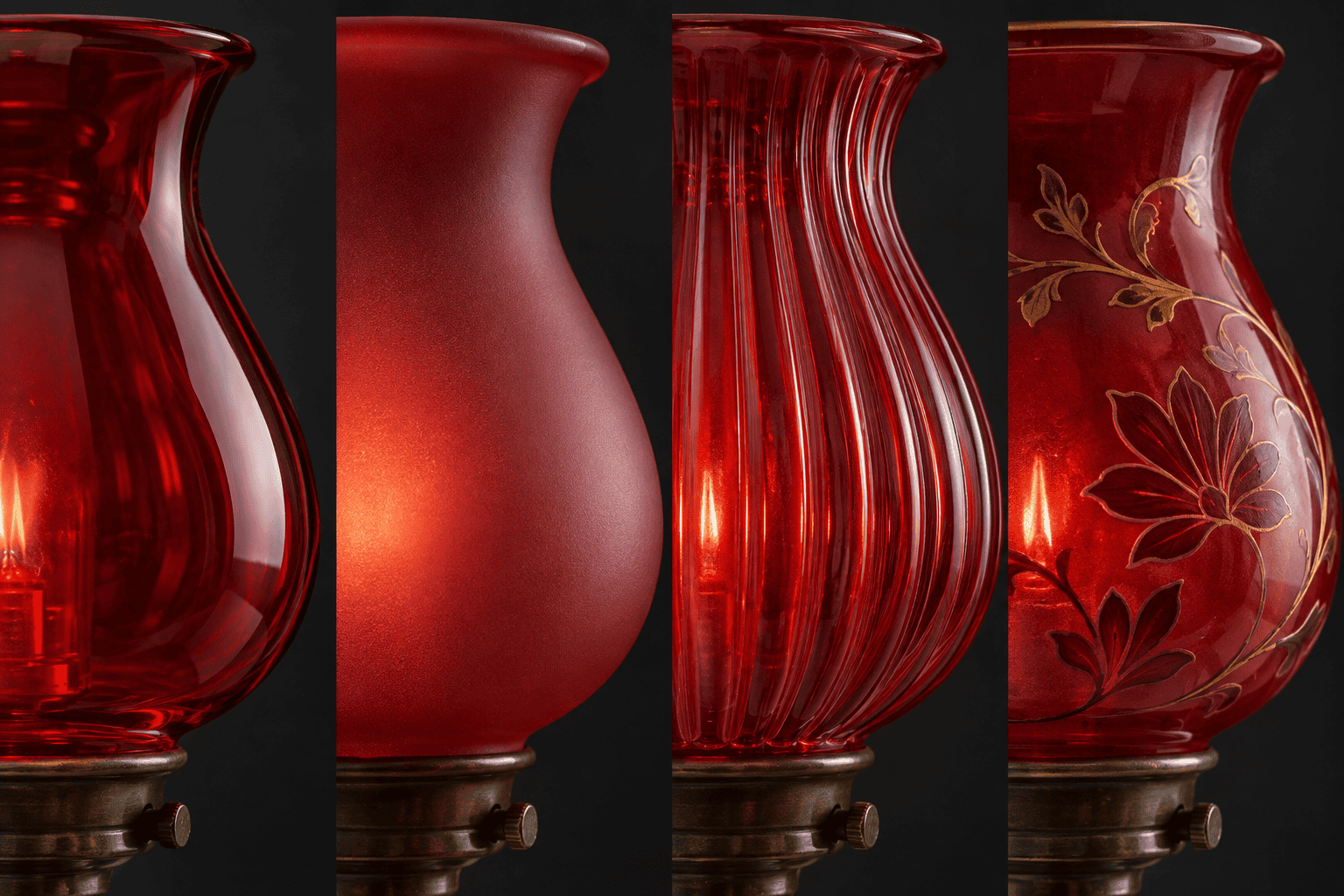
The red body is only one design decision. Surface texture changes reflection, cleaning and how the color reads near the edge. For a production project, state where the color lives and what must remain unchanged after handling.
| Finish route | Strength | Limitation to discuss |
|---|---|---|
| Transparent body color | Color remains part of the glass and can show depth | Wall thickness can make the rim look darker than the center |
| Satin or frosted red | Softer reflection and less direct glare | Frosting changes transmission and can hold residue if poorly finished |
| Ribbed or pressed red | Adds controlled highlights and a tactile pattern | Ribs can magnify thickness variation and make cleaning slower |
| Painted or enamel detail | Allows bands, motifs or local color placement | Adhesion, edge coverage and heat exposure need inspection |
| Cased or layered glass | Creates depth between clear and colored layers | Layer alignment and rim finishing become part of the acceptance check |
Avoid promising that one route is universally better. The right choice depends on whether the shade is meant to glow, conceal the bulb, carry a decorative pattern or act as a repeatable replacement.
What historical red glass can teach a modern buyer
Historical objects show why color names should not be treated as manufacturing recipes. The Metropolitan Museum of Art records a free-blown American glass lamp shade from around 1800, showing that lamp shades have long been made as individual glass forms rather than as generic fabric covers. Its lamp shade collection record is useful context for the variety of historical shapes and glassmaking methods.
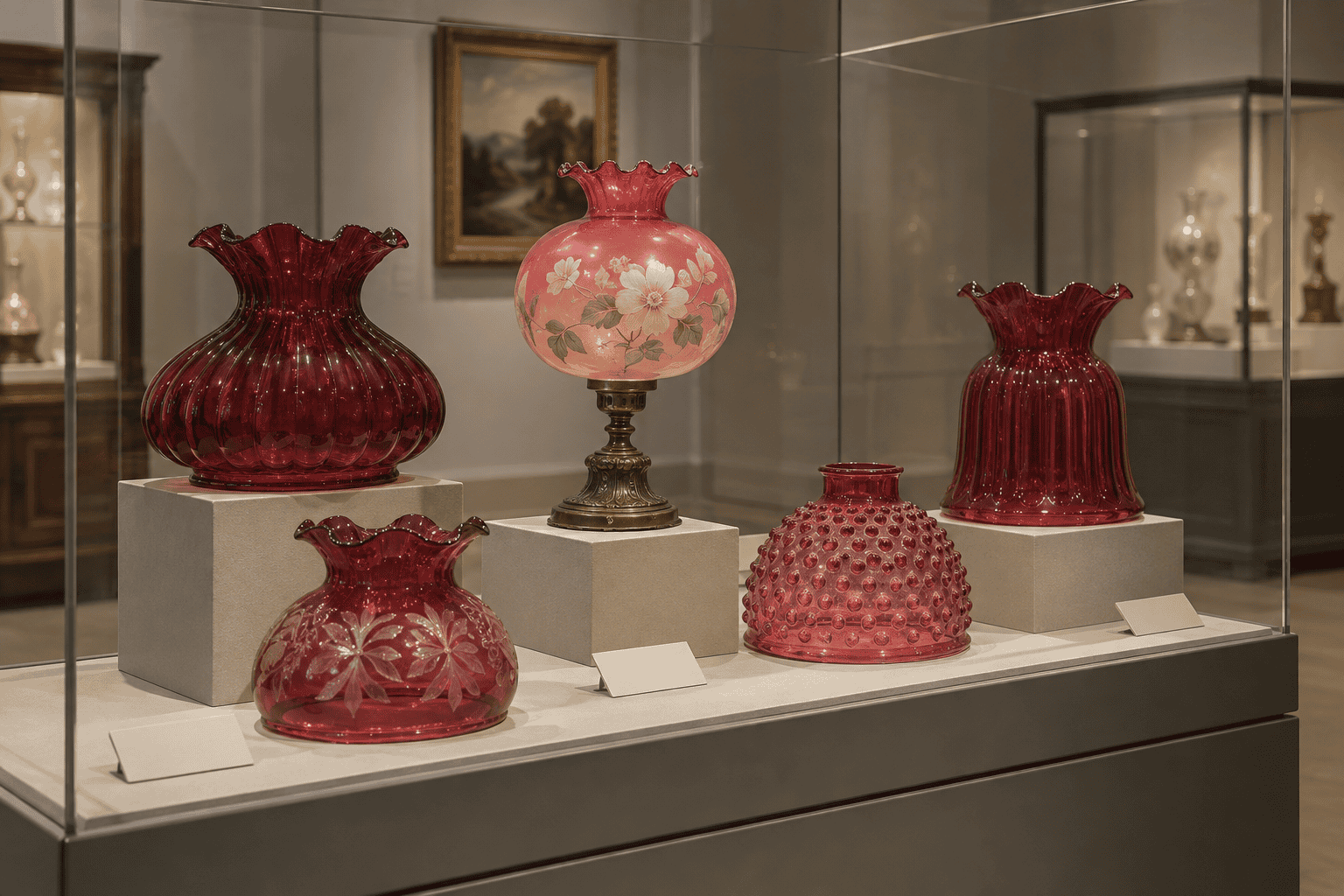
The Met's record of a Mamluk mosque lamp also explains that red decoration could be painted onto glass and heated so the color adhered. That is different from a red body glass shade. The museum process description helps buyers ask whether a red appearance comes from the glass itself, a surface decoration or a later finish.
For OEM work, the useful lesson is simple: do not approve a historical name without documenting the current process, the physical master sample and the lighting condition used for comparison.
How an OEM buyer should approve red glass color
Color approval should happen before a large production quantity is released. A supplier and buyer can use a retained master, a controlled background and two or more lighting conditions. The record should state what is acceptable and what requires correction.
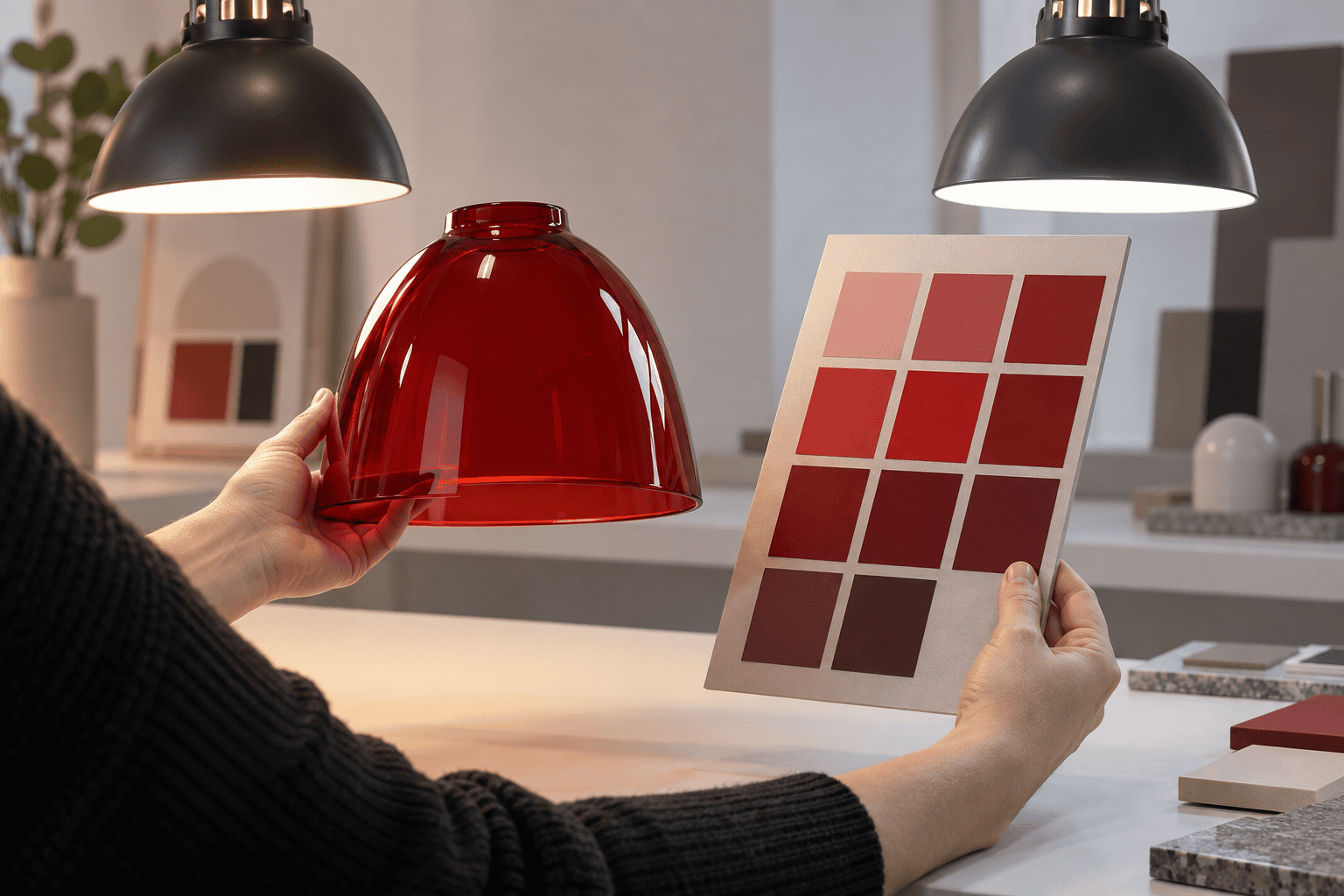
Send a sourcing brief that includes:
- a physical red reference or an approved master sample;
- the intended profile and a dimensioned side view;
- fitter opening, support ring and retention details;
- body glass, cased layers or surface finish;
- transmission target and bulb or LED reference;
- acceptable hue, saturation, gradient and wall-thickness variation;
- sample quantity, production quantity and packaging expectations;
- the point at which the buyer will inspect and approve production samples.
The glass lamp shade technical drawing checklist helps turn a visual idea into a quotable part. A supplier should be able to explain which details are controlled at forming, finishing, annealing and final inspection without inventing a tolerance that has not been agreed.
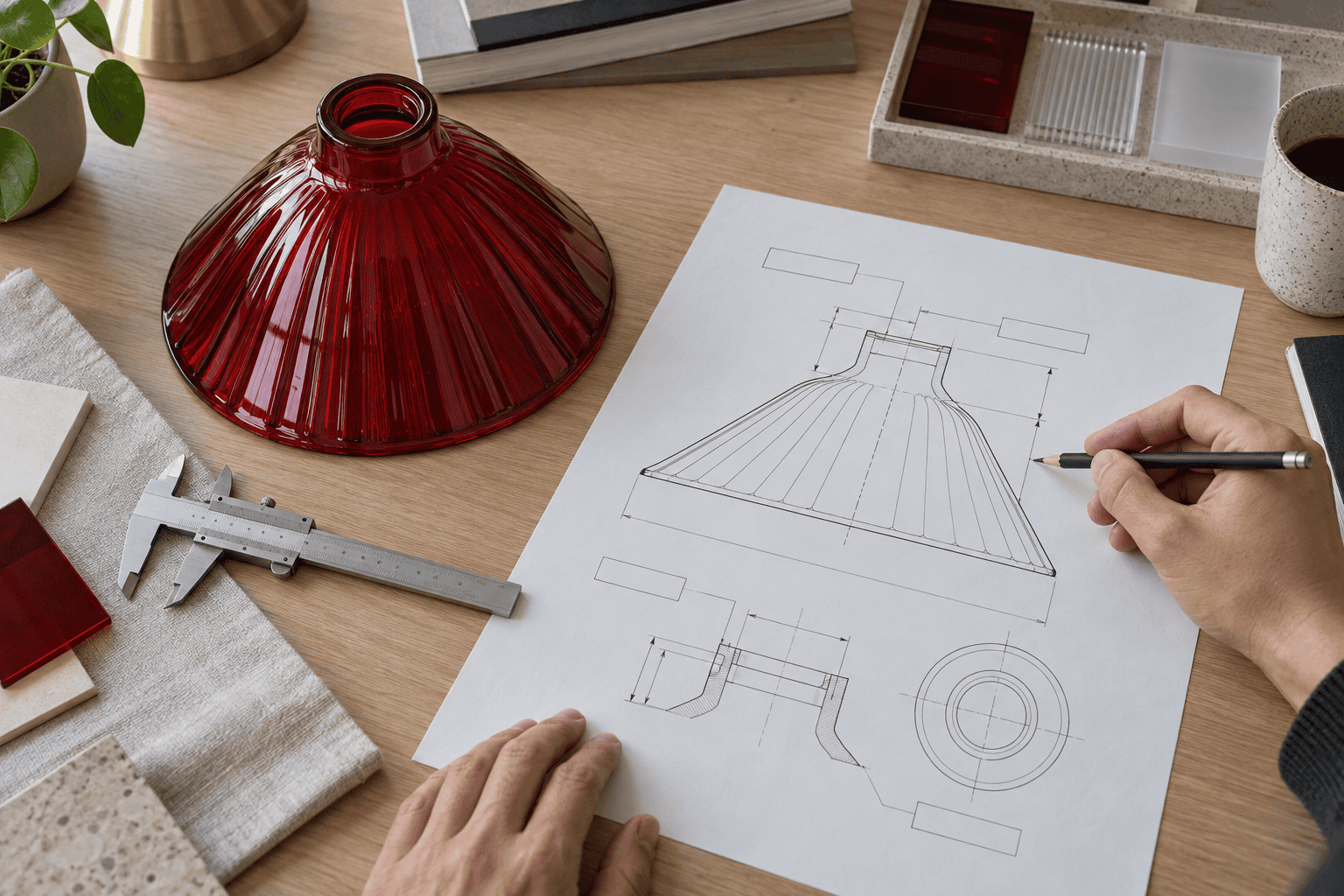
Sample inspection and batch consistency
The first sample proves that the concept can be made. It does not prove that every later piece will match it. For a group installation, compare several samples under the same light and view them side by side.
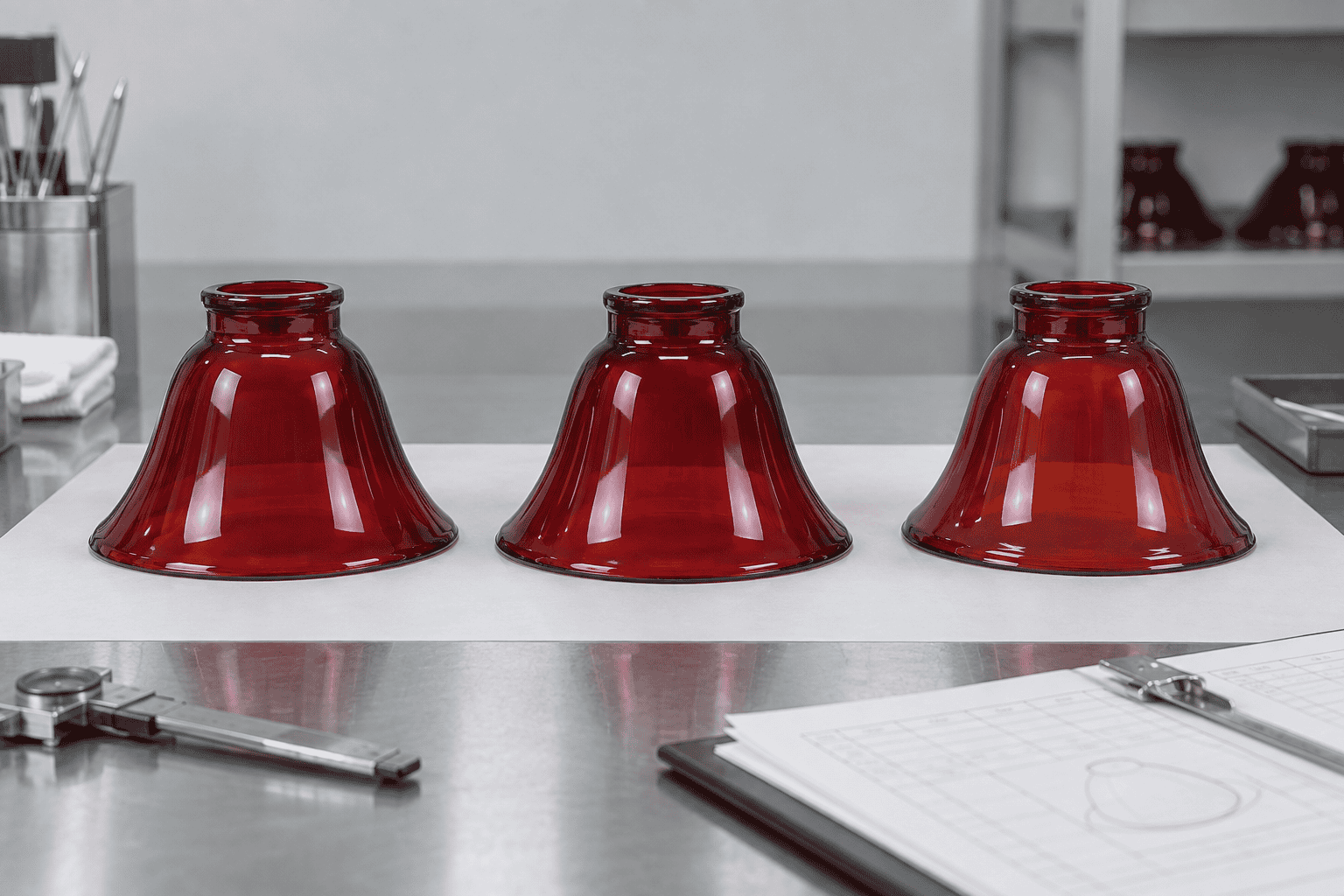
| Inspection point | Practical pass condition |
|---|---|
| Color | Hue and saturation stay within the approved range |
| Transmission | Glow and visibility match the agreed target |
| Surface | No obvious scratches, pinholes, residue or uneven decoration |
| Profile | Height, diameter and silhouette follow the drawing or master |
| Fitter | Opening is round, stable and seats without rocking |
| Rim | No sharp edge, chip, crack or irregular color edge |
| Batch | A sample set stays inside the agreed variation |
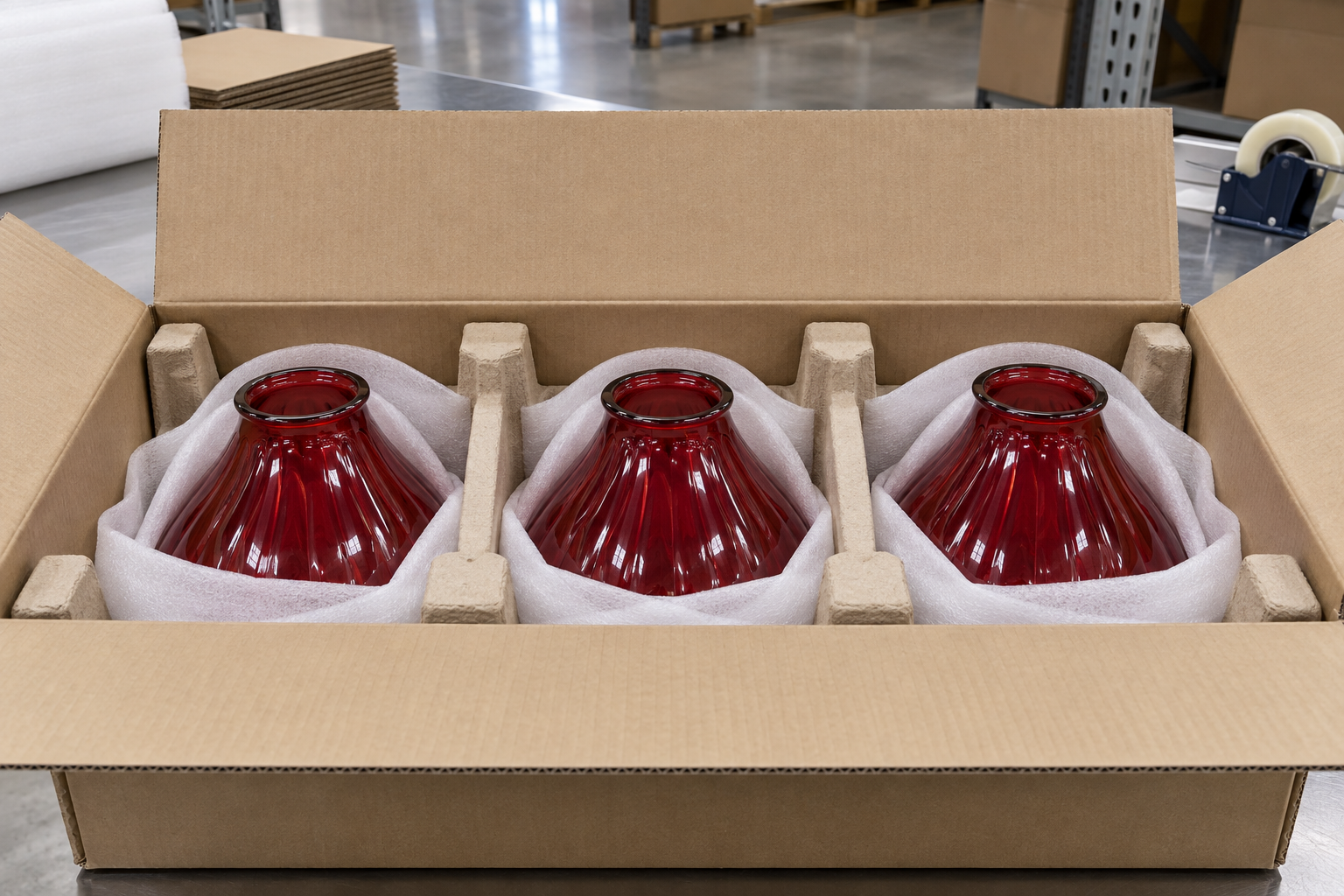
| Packaging | Thin rims and decorated surfaces are protected for transport |
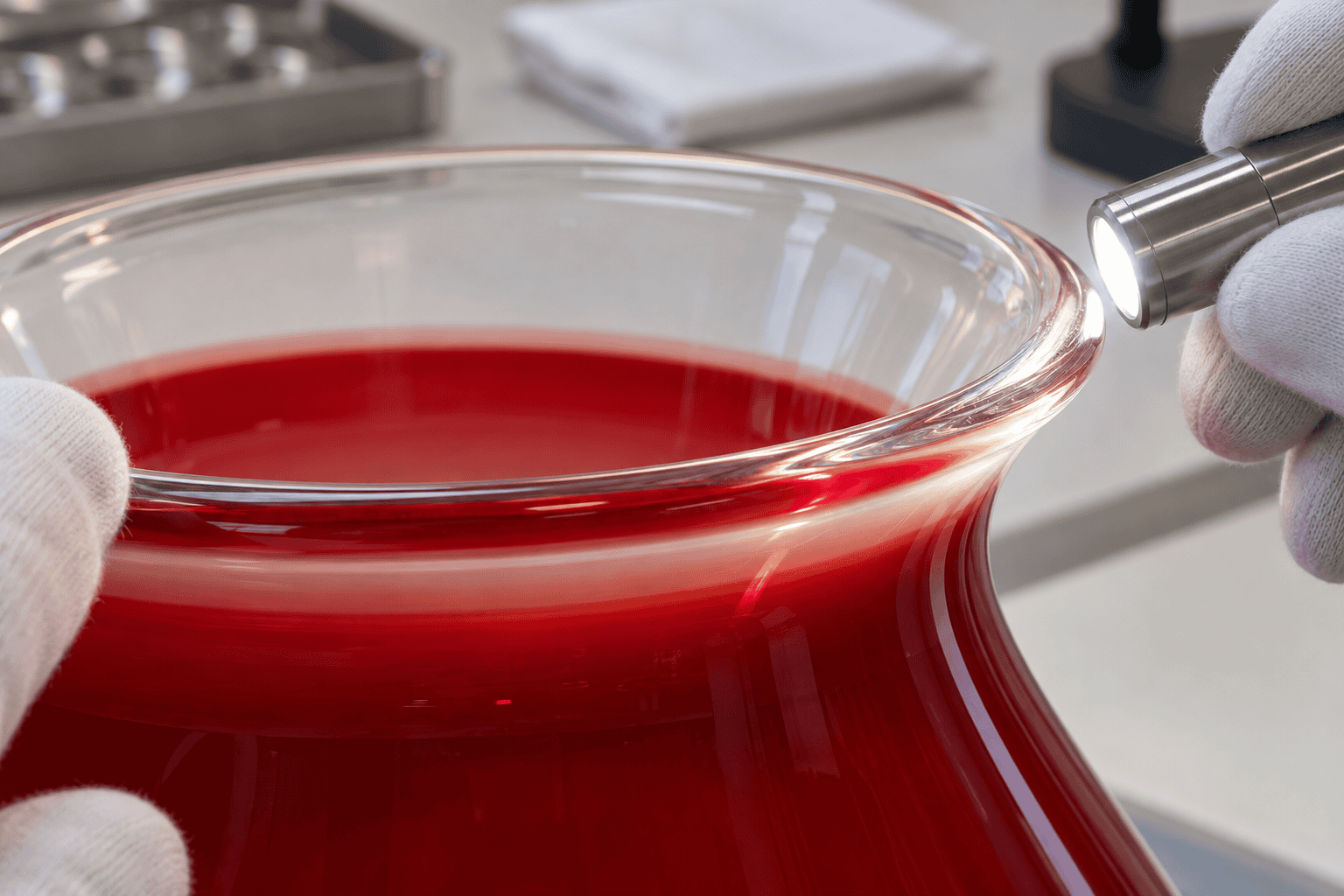
The glass lamp shade quality inspection checklist can be adapted into a purchase record. Do not use a generic pass statement if the project depends on a particular red gradient, clear window or decorative edge.
Safety questions for red glass lamp shades
The glass color does not determine whether the complete luminaire is safe. Fixture type, lamp holder, wiring, heat, mounting and mechanical support all matter. A red shade that is acceptable on a low-temperature LED pendant may not be suitable for an older fixture with a hotter light source or poor clearance.
For North American projects, the buyer should ask how the complete fixture will be evaluated. UL Solutions identifies standards such as UL 1598 for luminaires and UL 153 for portable luminaires, while LED equipment may involve UL 8750. The UL lighting safety overview is a starting point for the fixture-level conversation. It is not a certification claim for a glass shade or for JX.
Confirm the bulb type, maximum wattage, enclosure condition, air space, mounting stability and replacement instructions with the fixture maker or qualified electrical professional. Do not drill, trim or force a glass shade to make an incompatible fitting work.
Where red glass lamp shades work well
Red glass is a strong visual decision. It can be effective when the shade is intended to create an accent, anchor a vintage palette or make a small group of pendants read as one installation. It is less suitable when the fixture must deliver neutral task light or make product colors appear unchanged.
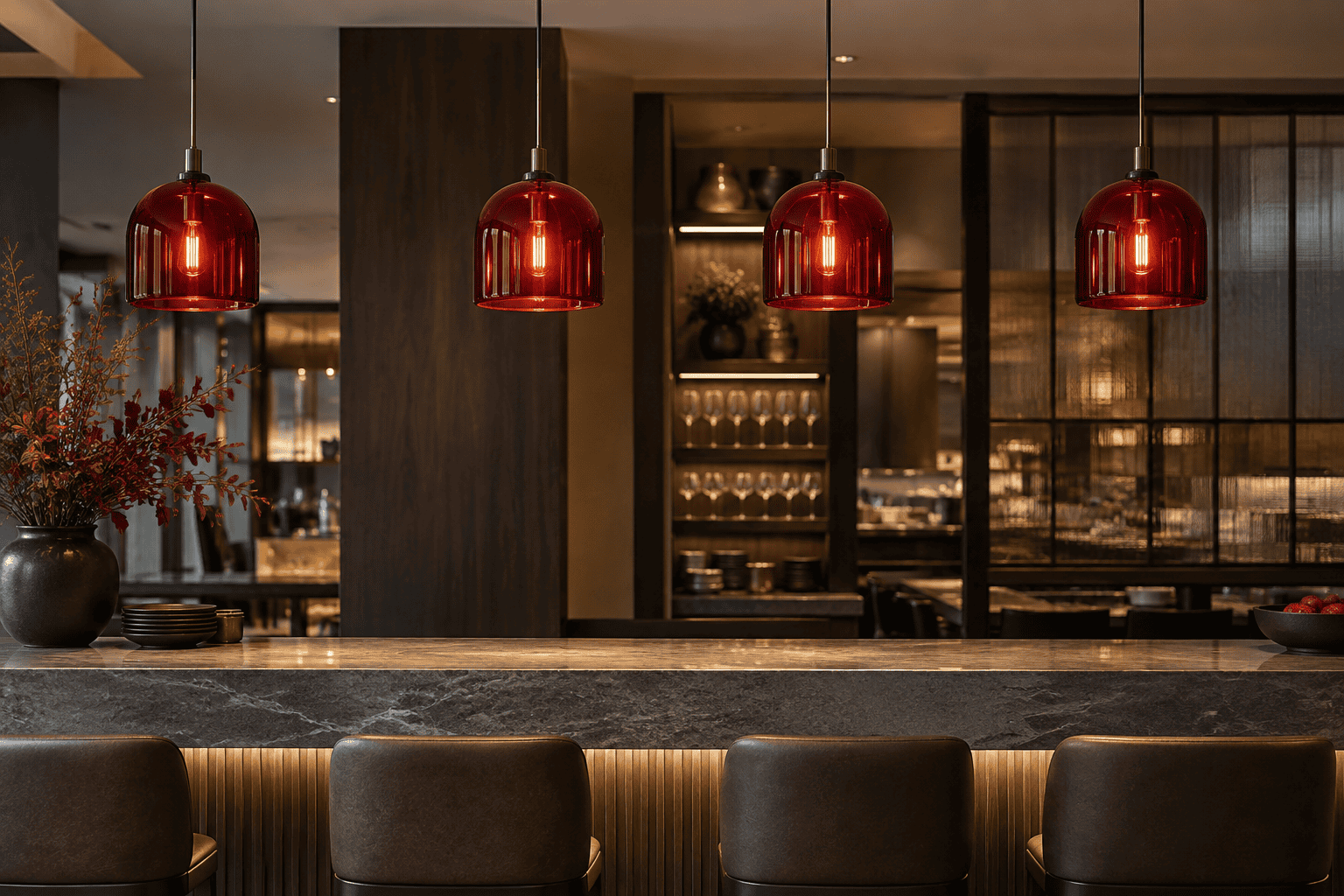
Common applications include:
- restaurant or bar pendants where a controlled warm accent is part of the interior brief;
- residential table lamps where the red body must look intentional when the fixture is off;
- vintage-style replacements where the profile and fitter are more important than a generic color match;
- retail display lighting where the buyer has tested how red light affects the products below;
- boutique hospitality installations using repeated shades with a retained color master;
- custom OEM collections that need a defined red family across several profiles.
For restaurant work, compare the red brief with JX's glass color guide for restaurant lighting and then approve the actual shade above a representative counter or table.
Buyer questions
Is red glass the same as ruby glass?
Not always. Ruby can describe a deeper red appearance or a historical material route, while red is the wider visual description. Confirm the actual body glass, coating, transparency and sample rather than choosing only from the name.
Does red glass make a room darker?
It can reduce or recolor transmitted light compared with clear glass, but the result depends on wall thickness, surface finish, LED spectrum and fixture geometry. Test the shade in the installed position before approving it for task lighting.
Can a red glass lamp shade be used as a replacement?
Yes, when the opening, support, overall dimensions, retention method, bulb clearance and rim condition match the fixture. Color is only one part of a replacement specification.
Is red stained glass the same as red body glass?
No. Stained glass usually refers to separate pieces joined into a panel or decorative assembly. A red body glass shade is formed as a glass part with color distributed through the body or a defined layered route. Their weight, edge construction and maintenance can differ.
Should an OEM buyer specify a Pantone color for red glass?
A color reference can help, but it should not replace a physical glass master. Transparency, wall thickness and backlighting change how a color reference appears. Use the reference together with a sample, light source, background and acceptable variation.
What should be included in a red glass shade RFQ?
Send the profile, dimensions, fitter, retention hardware, body glass or finish route, red color target, transmission, LED condition, sample quantity, production quantity, inspection points and packaging requirements. A drawing and physical sample reduce interpretation risk.
Specify the red finish before requesting a shade quote
Red glass lamp shades are easiest to source when the visual idea is converted into a measurable part. Define the red family, review the unlit and illuminated appearance, record the fitter, approve a retained sample and agree how batch variation will be judged. For an OEM quote, start with JX's custom glass lamp shade manufacturer page and custom lampshade RFQ builder. Upload the dimensions, photographs and finish notes in the same request.