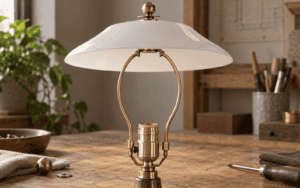
A lamp shade harp is the curved metal support between a lamp socket and a shade. The lower ends fit into a socket saddle, while the threaded top accepts a washer and finial that hold a spider-style shade in place. To choose one correctly, check the saddle, harp height, shade opening, finial thread and bulb clearance together.
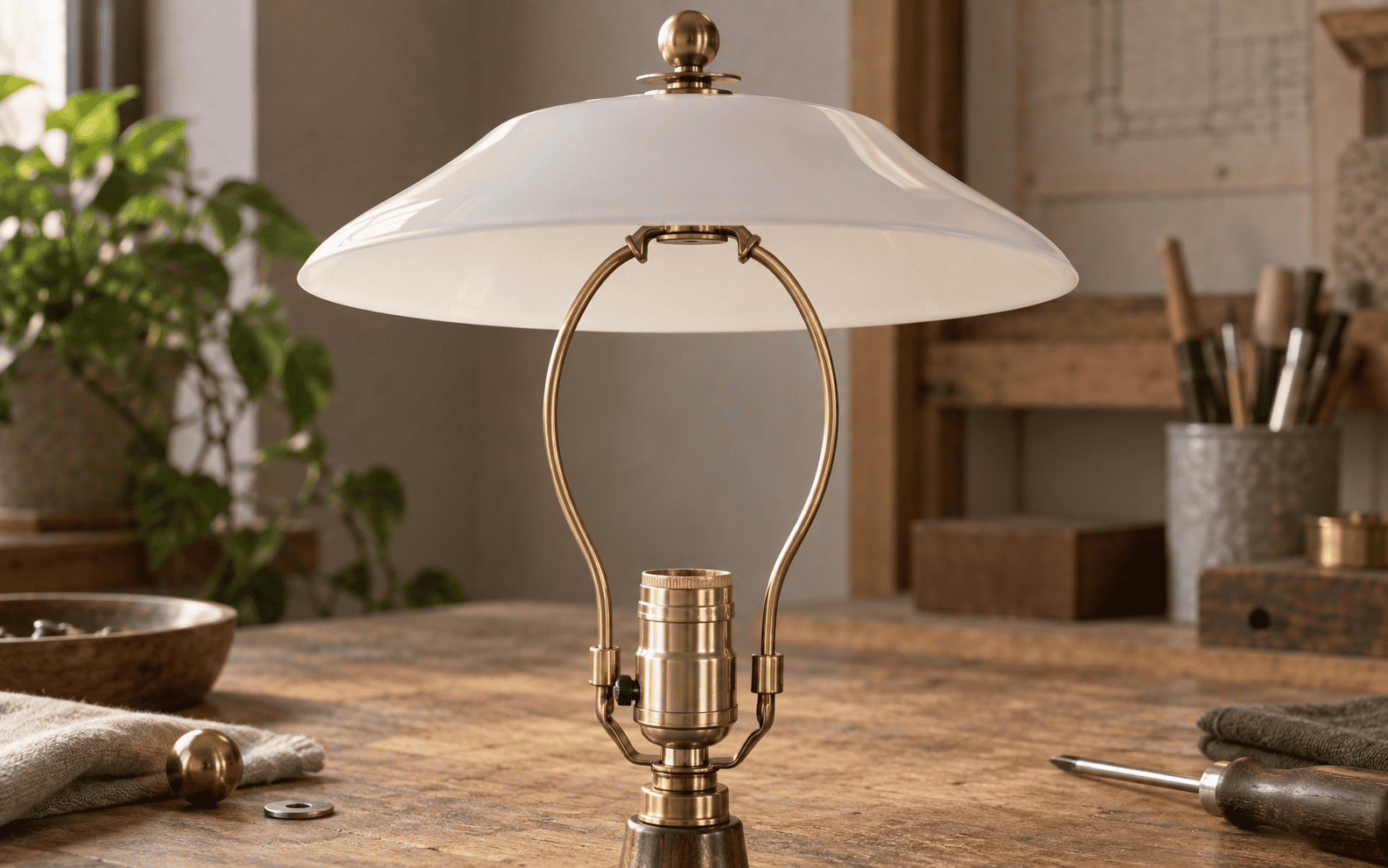
If you searched for a lamp shade harp because a replacement shade sits too high, leans to one side or will not pass over the hardware, the name of the part is only the first step. The harp controls support height. The shade opening controls whether the glass can reach the support. The finial and washer control retention. A workable replacement has to satisfy all three interfaces.
This guide covers the common harp-and-finial arrangement used on table and floor lamps, then shows where that arrangement stops applying. It is also useful for a buyer specifying a replacement glass shade, because the harp gives the supplier a physical reference for height and clearance even when the original glass is damaged.
What is a lamp shade harp?
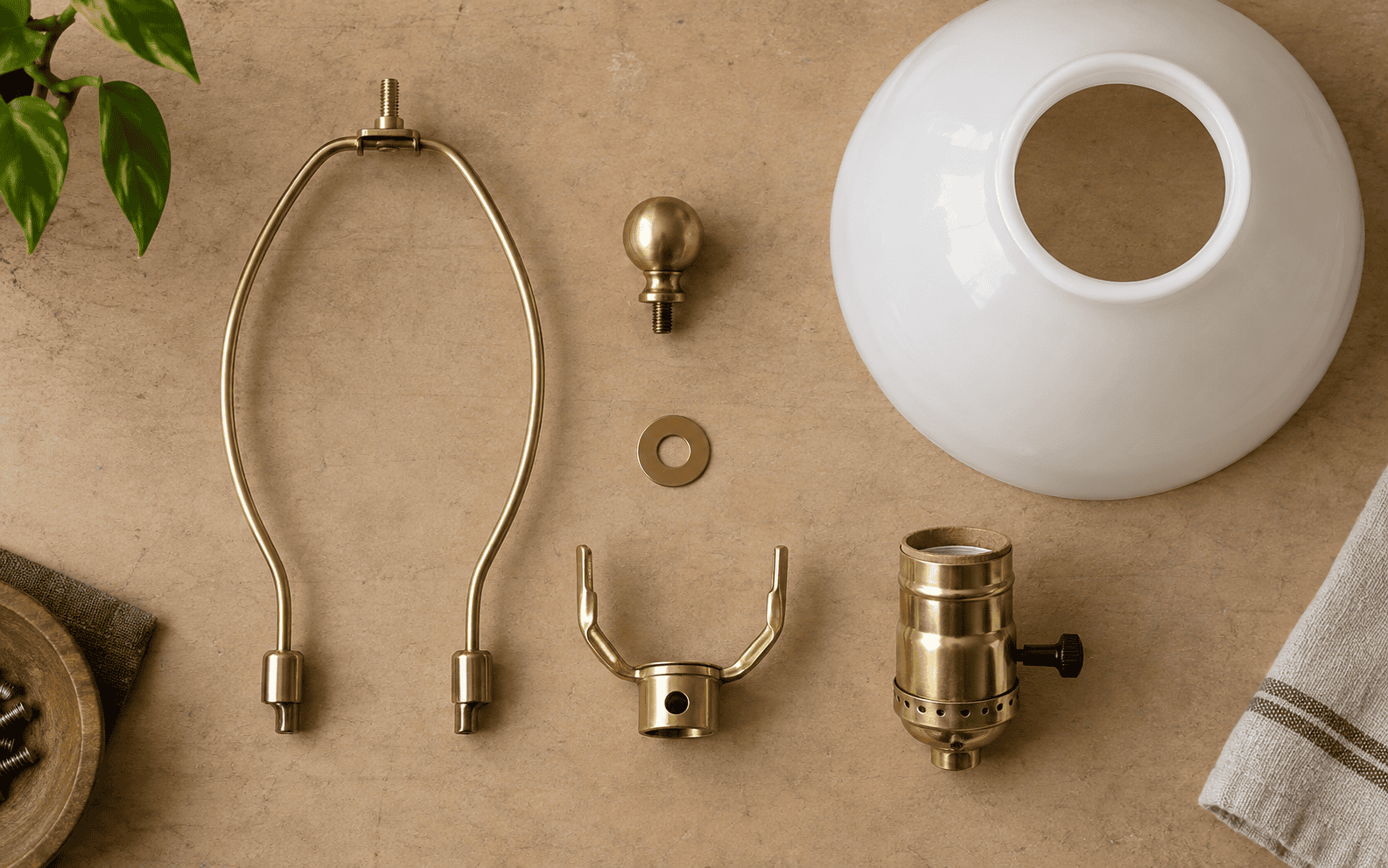
A lamp harp is a removable metal bracket that rises from the socket area and supports a shade above the lamp body. Its lower legs sit in a saddle or harp base near the socket. The upper loop has a threaded stud or finial opening. A spider fitter on the shade rests on that top point, and a washer plus finial keeps the shade from lifting or rotating.
The exact shape varies by fixture. Some harps are straight-sided, some bow outward, and some use a detachable saddle. Finish, wire diameter and saddle style also vary. The word harp identifies the support family, not a universal size or a universal thread.
The parts that matter during a replacement
| Part | Job in the assembly | What to record |
|---|---|---|
| Harp body | Raises and supports the shade | Overall height, width, wire or rod form, finish |
| Saddle or harp base | Receives the lower harp legs | Leg spacing, slot shape, mounting position |
| Socket | Holds the light source and may carry the saddle | Socket body, shoulder, switch, clearance |
| Top stud or loop | Supports the shade fitter and finial | Thread or opening, usable projection |
| Washer | Spreads finial pressure around the fitter | Outside diameter, hole size, thickness |
| Finial | Retains the shade from above | Thread compatibility, shape, tightening access |
| Spider fitter | Connects the shade to the top support | Center opening, metal thickness, contact condition |
The saddle, washer and finial are easy to overlook because they may be hidden under the shade. Photograph them before disassembly. A close view of the lower harp legs and socket saddle can prevent a buyer from ordering a visually similar harp with the wrong base.
How a lamp harp holds a shade
The usual sequence is simple: the saddle receives the harp, the harp lifts the shade, the spider fitter rests on the top stud, and the finial tightens from above. The shade does not hang from the glass itself. Its metal fitter, ring or neck takes the load and transfers it into the support.
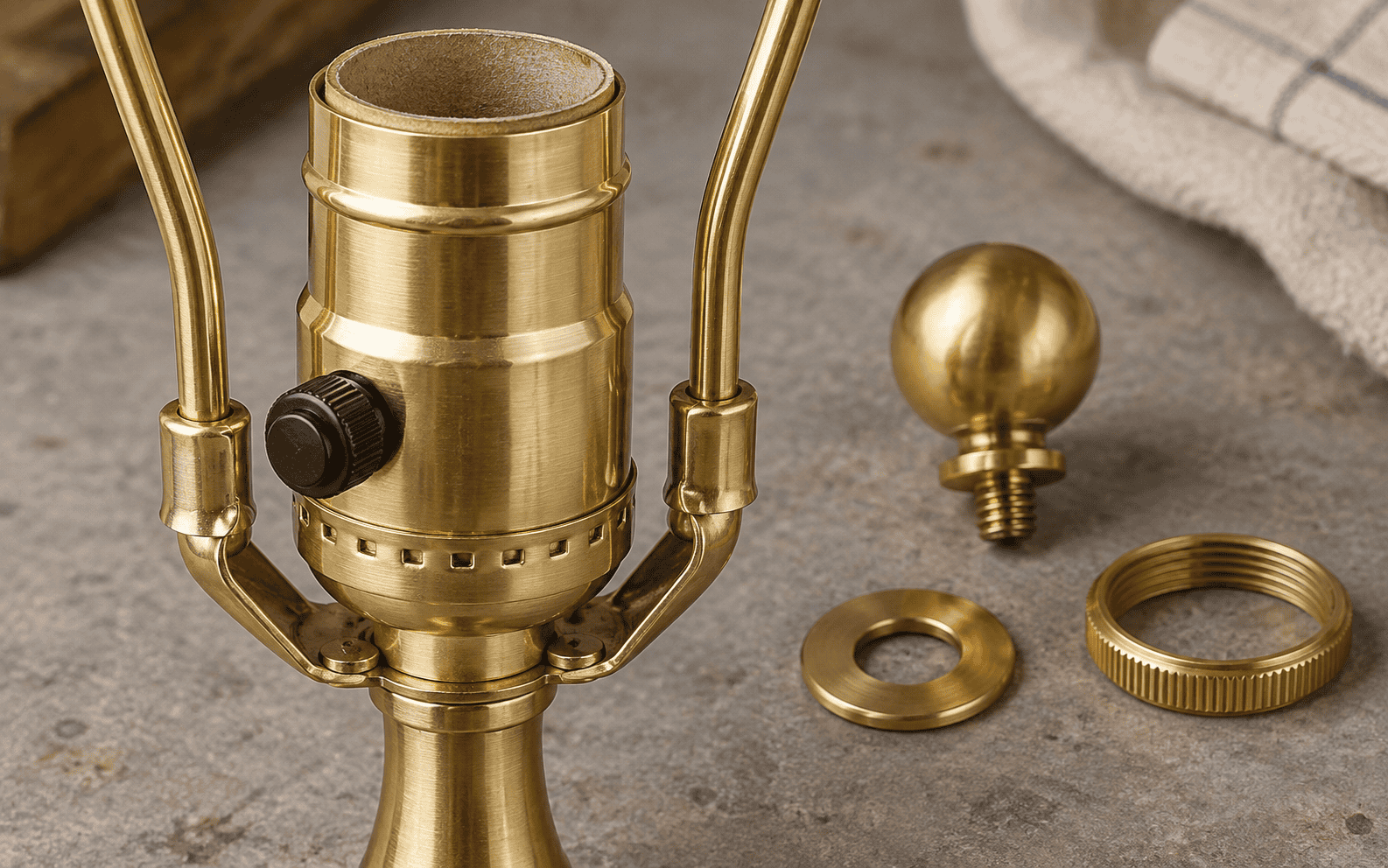
Keep the light source and glass clearance in the same check. A shade can appear to fit the finial and still sit too close to the bulb, switch or socket. For a glass shade, also look for a hard point that could concentrate force on the rim.
| Checkpoint | Correct question | Typical evidence |
|---|---|---|
| Lower support | Do both harp legs sit fully in the saddle? | Straight-on and underside photographs |
| Vertical position | Does the shade sit at the intended height? | Side profile with the lamp assembled |
| Top retention | Does the fitter sit flat under the washer? | Close-up of the top opening and finial |
| Radial clearance | Does the glass clear the socket and bulb? | Unlit assembled view and measured clearance |
| Stability | Does the shade remain level when lightly touched? | Repeat fit check on a flat surface |
Lamp shade harp vs ring, fitter and finial
These terms are related, but they answer different questions. A harp is the raised support. A fitter is the attachment route at the shade. A ring may locate or retain the shade. A finial is the fastener at the top. Calling all of them a “lamp shade holder” makes a replacement request harder to review.
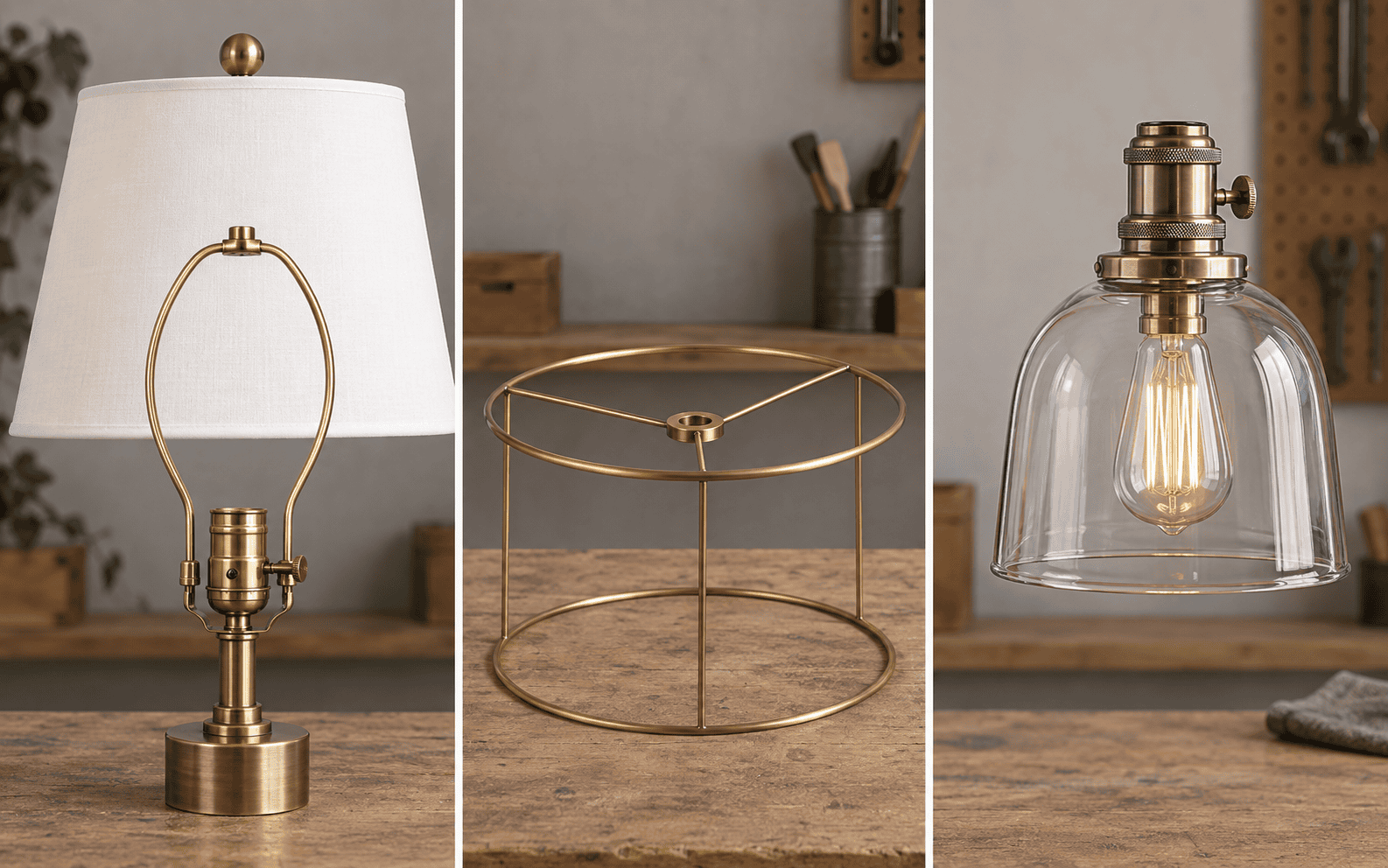
| Term | What it describes | What it does not prove |
|---|---|---|
| Lamp harp | Curved support rising from the socket saddle | That every shade opening will pass over it |
| Spider fitter | Metal crossbars and center opening attached to a shade | That the top stud has the right thread or height |
| Lamp shade ring | Circular locating or retaining feature | That the ring works with a harp or a particular glass rim |
| UNO fitter | Socket or neck-based shade connection | That the shade also needs a harp |
| Clip-on fitter | Spring or clip connection near the bulb | That the shade is suitable for every bulb envelope |
| Finial | Top fastener that retains a fitter | That the lower saddle is compatible |
The lamp shade fitter compatibility checker is useful when the existing shade does not use a spider opening. The lamp shade ring guide covers the separate case where a circular ring controls the seat or retention. Do not choose a harp simply because the word “fitter” appears in a product listing.
How to choose the right lamp harp size
Start with the installed shade position, not with a generic size chart. The right harp height is the height that places the shade at the intended level while leaving the required bulb and socket clearance. The top stud must also extend far enough through the shade fitter for the washer and finial to engage.
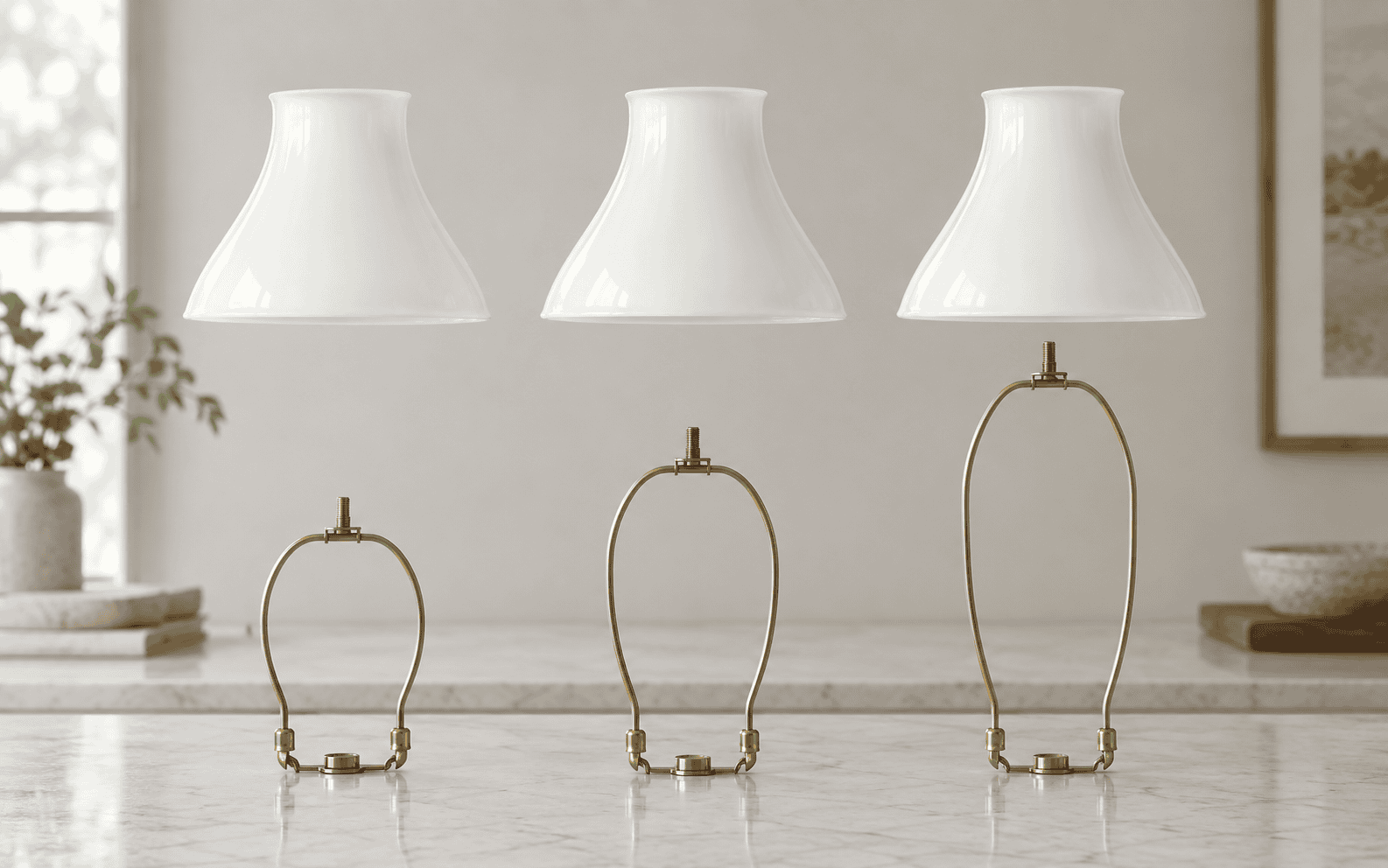
Measure the current assembly first
If the existing lamp is available, record the dimensions that already work. Measure from the saddle reference to the top support, then measure the shade body, top opening and the distance from the fitter to the top of the glass. Record units and reference surfaces. Do not mix the harp height from one lamp with the shade opening from another.
| Measurement | How to take it | Why it matters |
|---|---|---|
| Harp height | Saddle or socket reference to the top support | Sets the shade elevation |
| Shade height | Fitter or top opening to the lower rim | Shows how much of the harp is hidden |
| Shade top opening | Inside diameter at the actual pass-through | Confirms the fitter can reach the top support |
| Fitter thickness | Metal thickness around the center opening | Affects washer engagement and seating |
| Finial projection | Usable threaded length above the fitter | Confirms the finial can tighten without bottoming out |
| Bulb clearance | Closest radial and vertical distance to the glass | Reduces contact and heat-related fit risk |
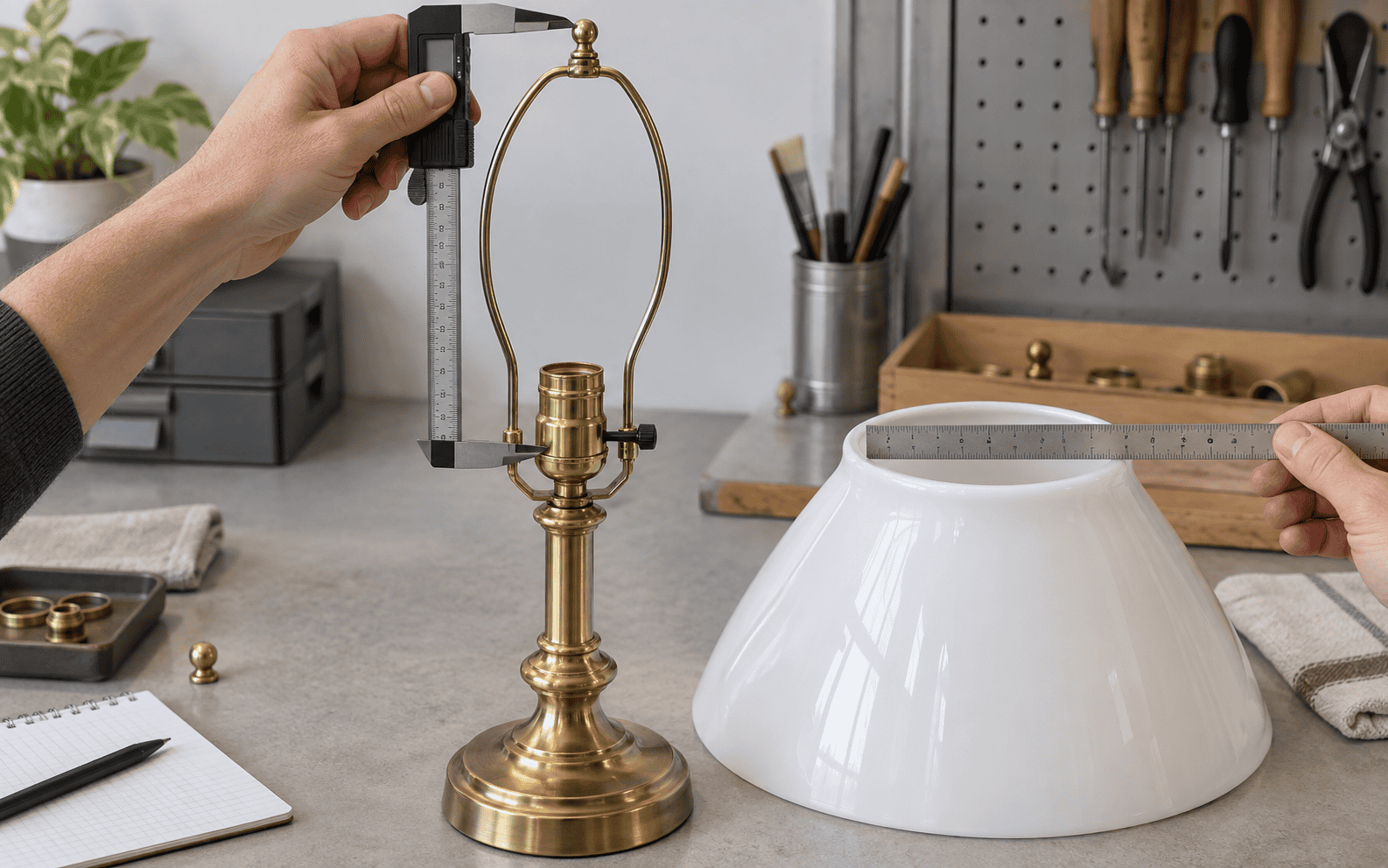
Use a side profile to catch height errors
Place the lamp on a level surface and photograph it from the side. The camera should show the saddle, shade top, bottom rim and bulb envelope in one view. A top-down photo helps with the opening, but it cannot show whether the harp is too tall or whether the shade is leaning.
If the current shade sits too high, a shorter harp may help, but only if the lower saddle and top fitter remain compatible. If the shade sits too low, a taller harp may create the needed separation, but the top opening still has to pass over the support and the bulb clearance has to be rechecked. These are fit decisions, not universal formulas.
| Symptom | First measurement to revisit | Do not assume |
|---|---|---|
| Shade looks high above the socket | Harp height and shade top-to-fitter distance | The shade itself is the wrong size |
| Finial barely reaches the thread | Fitter thickness and top stud projection | Tightening harder will solve it |
| Shade touches the bulb | Radial clearance and shade neck profile | A taller harp always creates clearance |
| Shade leans | Saddle seating, fitter flatness and rim condition | The glass body is automatically uneven |
Which shades work with a lamp harp?
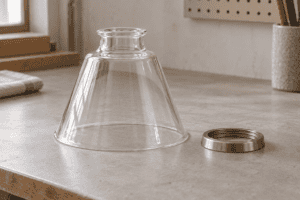
A harp is usually paired with a spider-style shade whose center opening passes over the top support. Fabric, parchment, mica and some glass shades can use this route, but the shade must have a suitable fitter or opening. A glass shade with a narrow neck, thick rim or formed shoulder may stop before the top support even when its outside diameter looks correct.
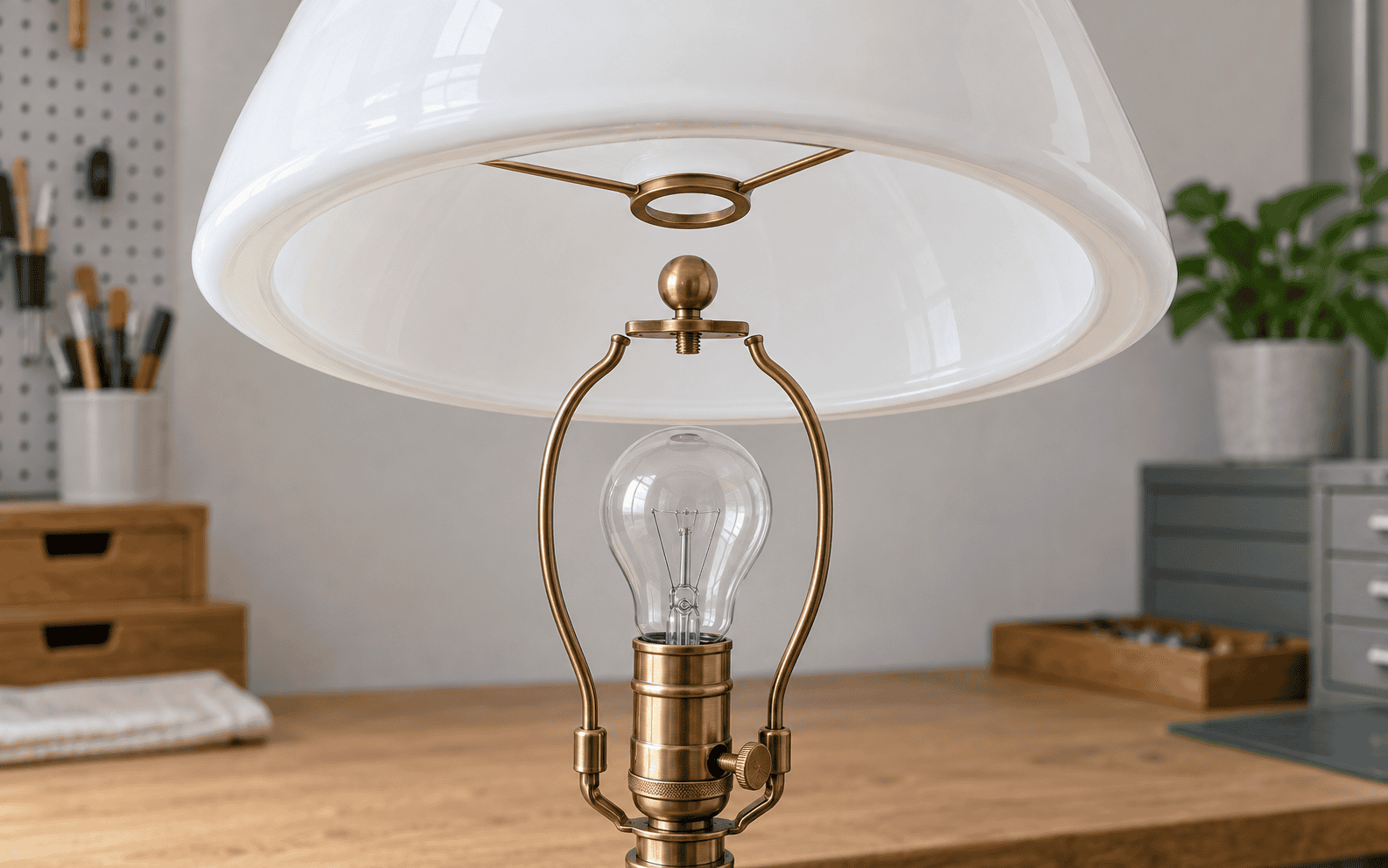
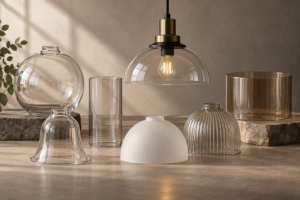
For custom glass, describe the opening as a controlled interface. Include the opening diameter, rim thickness, shoulder or neck profile, overall height, maximum width, and how the shade is retained. Clear, opal, frosted, colored and textured glass may share an opening while producing different optical and visual results, so the appearance requirement belongs in the same request.
| Shade attachment route | Harp needed? | First interface to check |
|---|---|---|
| Spider fitter and finial | Often, if the fixture uses a saddle | Center opening, support height, finial engagement |
| UNO or neck mount | Usually no separate harp | Neck diameter, thread or shoulder, socket relationship |
| Clip-on shade | Usually no separate harp | Clip span, bulb clearance and shade weight |
| Glass retaining ring | Depends on the fixture | Rim, seat, gasket and ring engagement |
| Fixture-specific gallery | Depends on the frame | Complete frame drawing and assembly direction |
The lamp shade types guide can help with the broader shade family. It should not replace a measurement of the actual fitter or glass opening.
Do all lamp shades need a harp?
No. A harp is only one attachment method. Many table and floor lamps use it, but UNO shades, clip-on shades, threaded necks, galleries, retaining rings and fixture-specific frames use other routes. A shade that has no top spider opening may be designed to mount directly around the socket or bulb area.
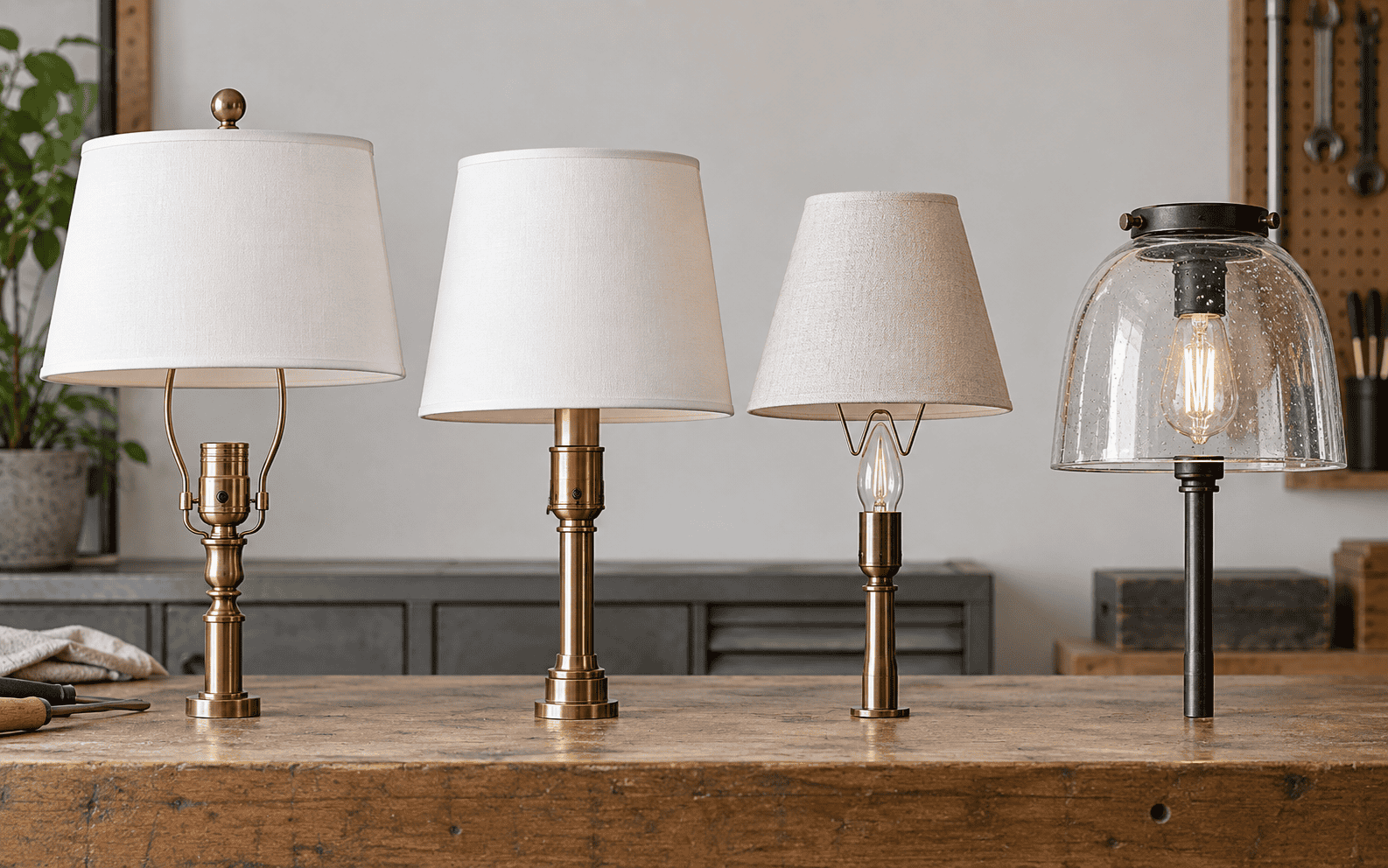
To identify the route, remove the shade only when the fixture is cool and disconnected from power. Look at the point where the shade meets the lamp. If the shade rests on a crossbar and a top finial, it is likely a spider and harp arrangement. If the socket passes through a threaded center opening, it may be an UNO or neck mount. If spring clips grip the bulb, it is a clip-on route. If a rim sits in a ring or gasket, record that retaining interface instead.
Common lamp harp fit problems
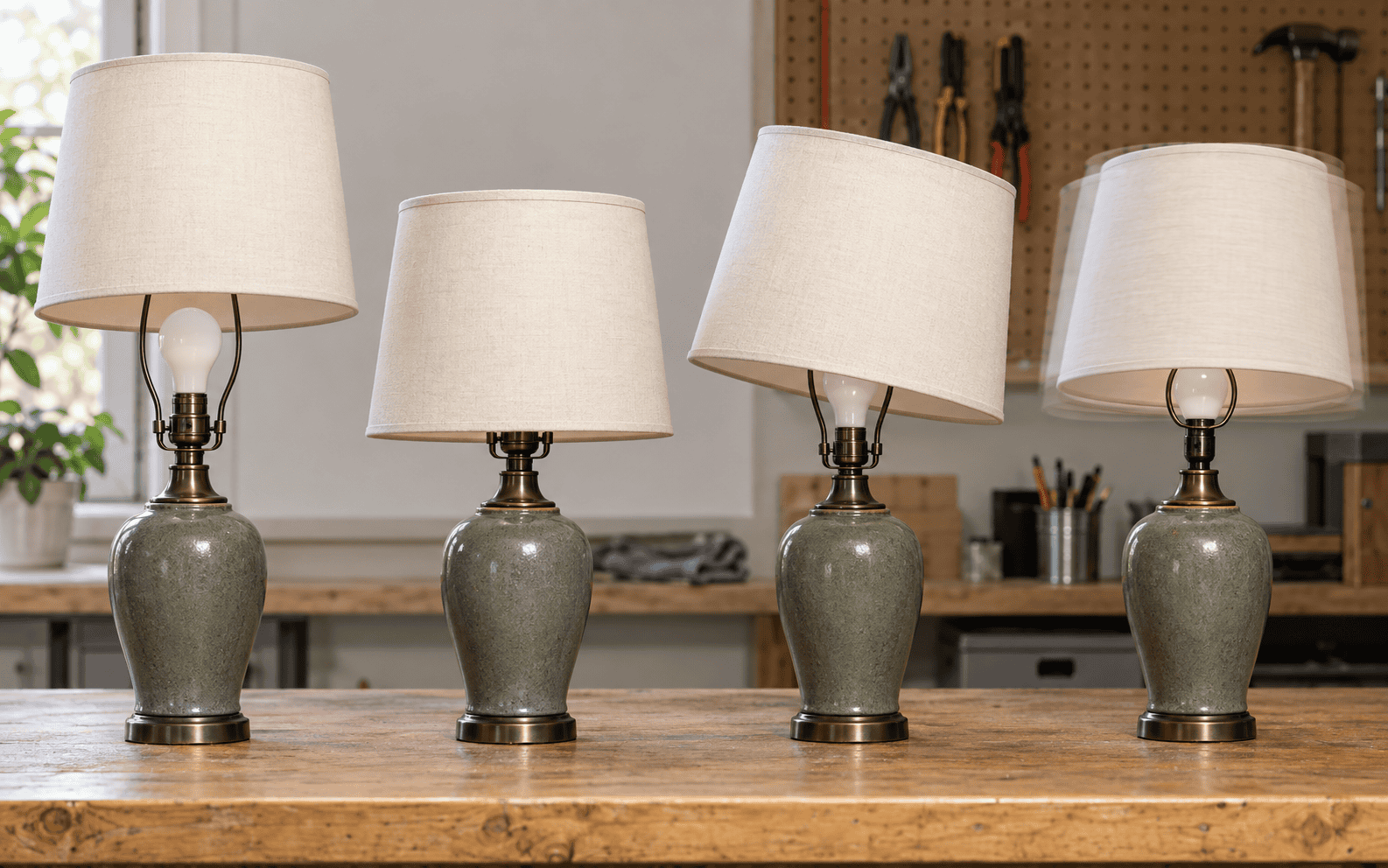
Most problems come from one of four mismatches: the lower saddle does not accept the harp, the harp height does not match the shade, the top opening cannot reach the finial, or the glass clearance is too small. Diagnose the physical interface before buying another finish or shape.
| Fit problem | Likely cause | Practical next step |
|---|---|---|
| Harp legs will not seat | Wrong saddle width, base style or leg form | Photograph the socket saddle and measure the receiving slots |
| Shade sits too high | Harp too tall or shade top-to-fitter distance too large | Compare the assembled side profile with the original |
| Shade sits too low | Harp too short or fitter is at a different level | Check the support height and finial engagement |
| Finial will not tighten | Wrong thread, insufficient stud projection or thick fitter | Record the top hardware and washer clearance |
| Shade wobbles | Uneven fitter, loose saddle, damaged rim or missing washer | Check contact at several points and preserve the original sample |
| Glass touches the bulb | Narrow opening, wrong profile or insufficient clearance | Recheck the bulb envelope and the glass neck together |
| Shade rotates during use | Smooth or incomplete retention path | Inspect the washer, finial, fitter and any locating feature |
Do not force a glass shade over the harp, add an improvised spacer near a hot light source, or over-tighten the finial against a fragile rim. If the glass is chipped or stressed, stop using it until the contact path has been reviewed.
How to replace a glass shade on a harp lamp
The safest replacement workflow is a short evidence pack rather than a guess from a product photograph.
- Disconnect power and allow the lamp and bulb to cool.
- Photograph the full lamp, socket, saddle, harp, shade and finial before disassembly.
- Remove the shade carefully and record the fitter opening, rim condition and overall profile.
- Measure the harp height, saddle, top stud, washer, finial and bulb clearance.
- Record the glass requirement, such as clear, opal, frosted, colored, ribbed or decorated.
- Compare the new sample on the actual harp before approving a production replacement.
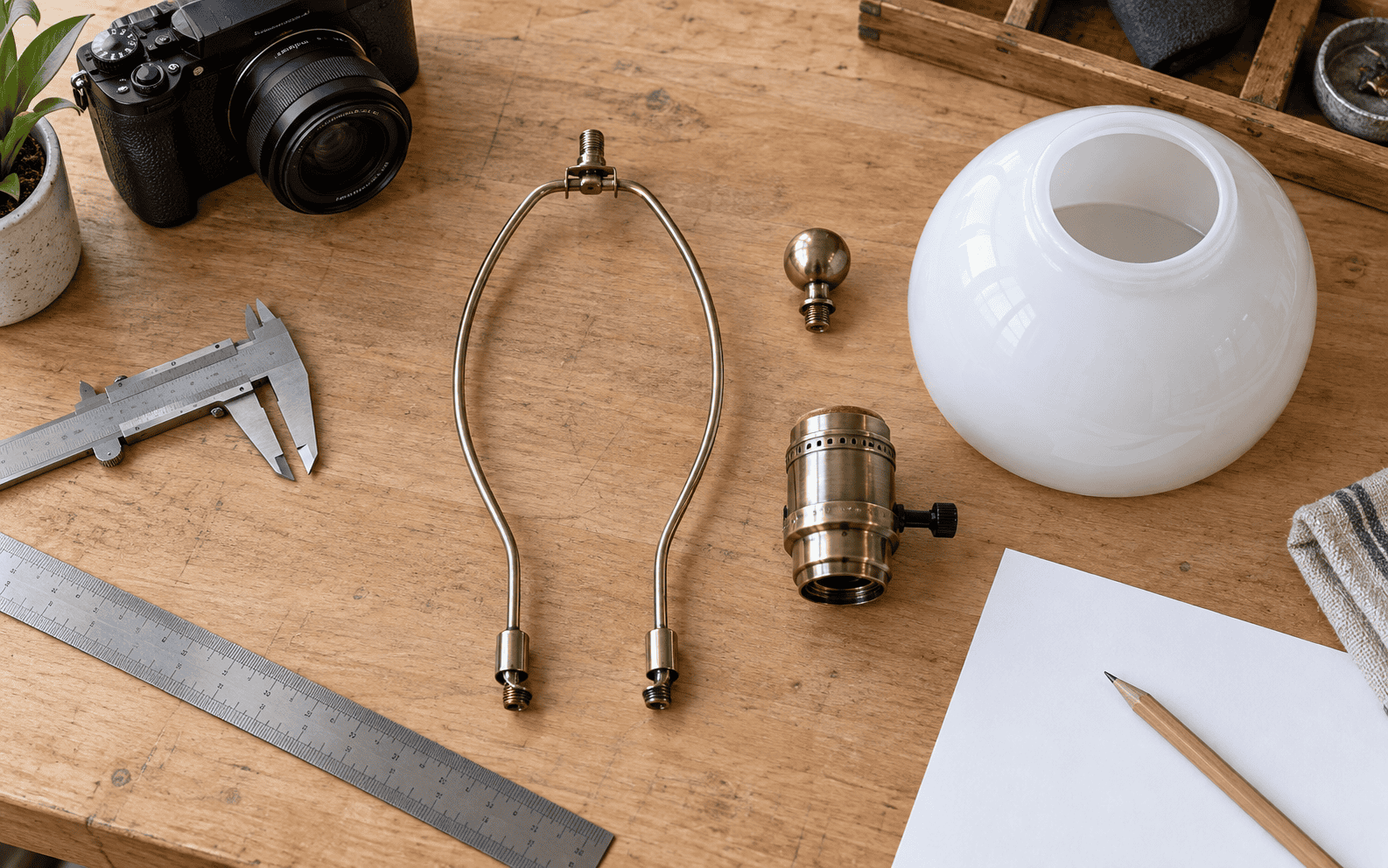
When a ring, gallery or separate glass collar is involved, use the replacement glass lamp shade measurement guide as a companion record. The important point is to preserve the original reference surfaces. Measure the part that carries the load, not only the widest visible edge.
OEM specification checklist for a harp and glass shade
For a lighting brand, importer or distributor, a harp-and-shade request should describe the installed interface and the intended visual result in the same document. A phrase such as “standard white glass shade” leaves too many decisions open.
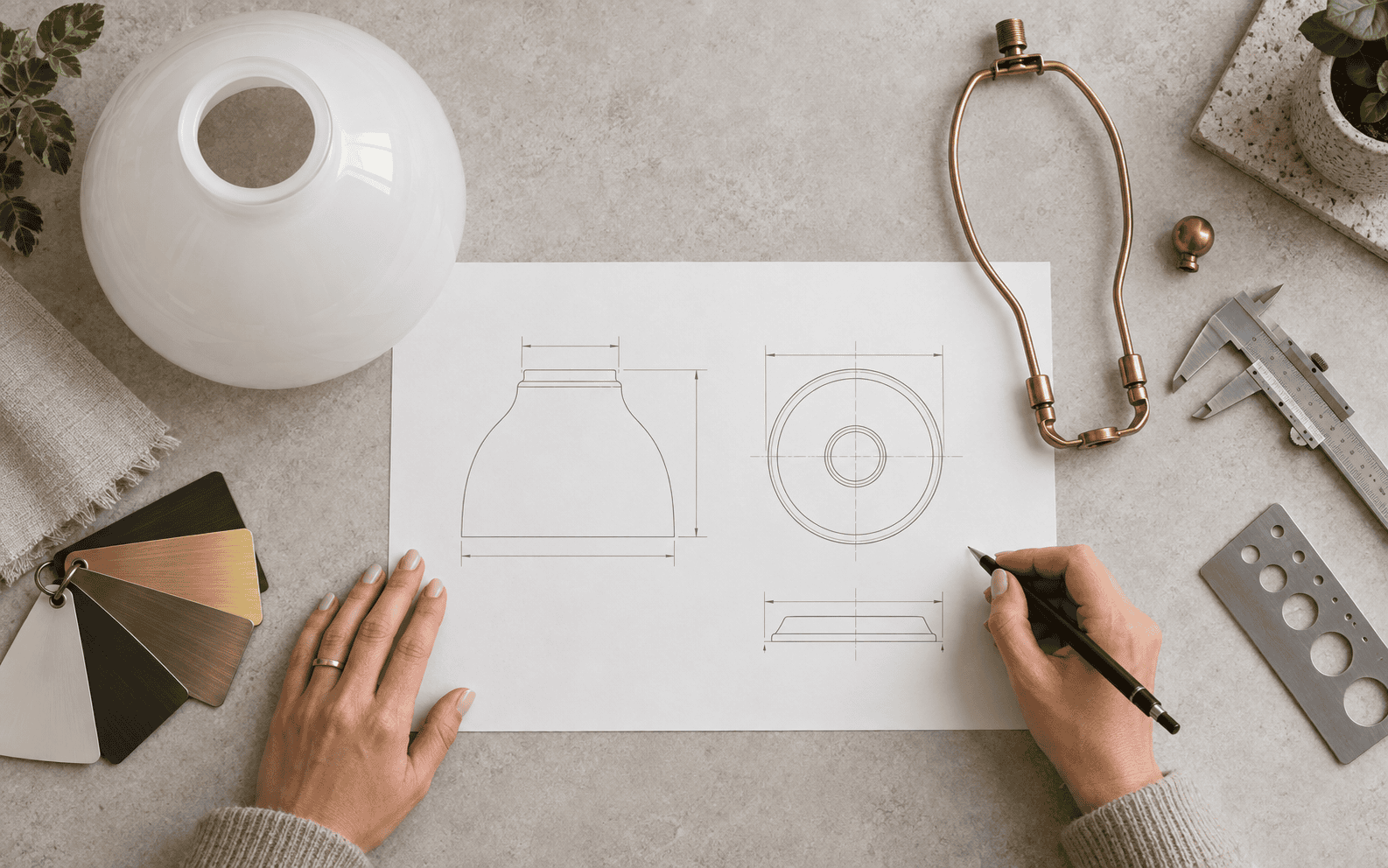
| Specification group | Include in the request | Why it helps |
|---|---|---|
| Fixture reference | Lamp type, application, socket, saddle and assembly direction | Connects the shade to the real fixture |
| Harp | Height, base, finish, wire or rod form, top support | Prevents a visually similar but incompatible support |
| Shade opening | Inside diameter, rim thickness, neck or shoulder detail | Controls the pass-through and seating |
| Glass body | Profile drawing, height, width, wall or rim condition | Controls clearance and appearance |
| Retention | Washer, finial, gasket, ring, clip or gallery | Defines how the shade stays in place |
| Light source | Bulb or LED envelope, wattage limit from the fixture, intended position | Screens clearance and visual output |
| Finish and optical result | Clear, opal, frosted, colored, ribbed, seeded or decorated reference | Reduces appearance ambiguity |
| Inspection | Fit on the real harp, level, clearance, finish and lit sample | Creates a repeatable approval step |
| Packing | Rim protection, harp separation, dividers and carton layout | Protects the interface during transit |
Do not insert a certification, capacity or production claim into the request unless the buyer has verified it. A supplier can review a drawing, sample and quantity without guessing at business facts.
Sample inspection before bulk approval
An approved sample should be tested on the same or a controlled equivalent of the fixture. Check the top opening, finial engagement, vertical position, level, bulb clearance, glass rim and visible finish. If the lamp is part of a series, test the dimensional features that must remain common across every size.
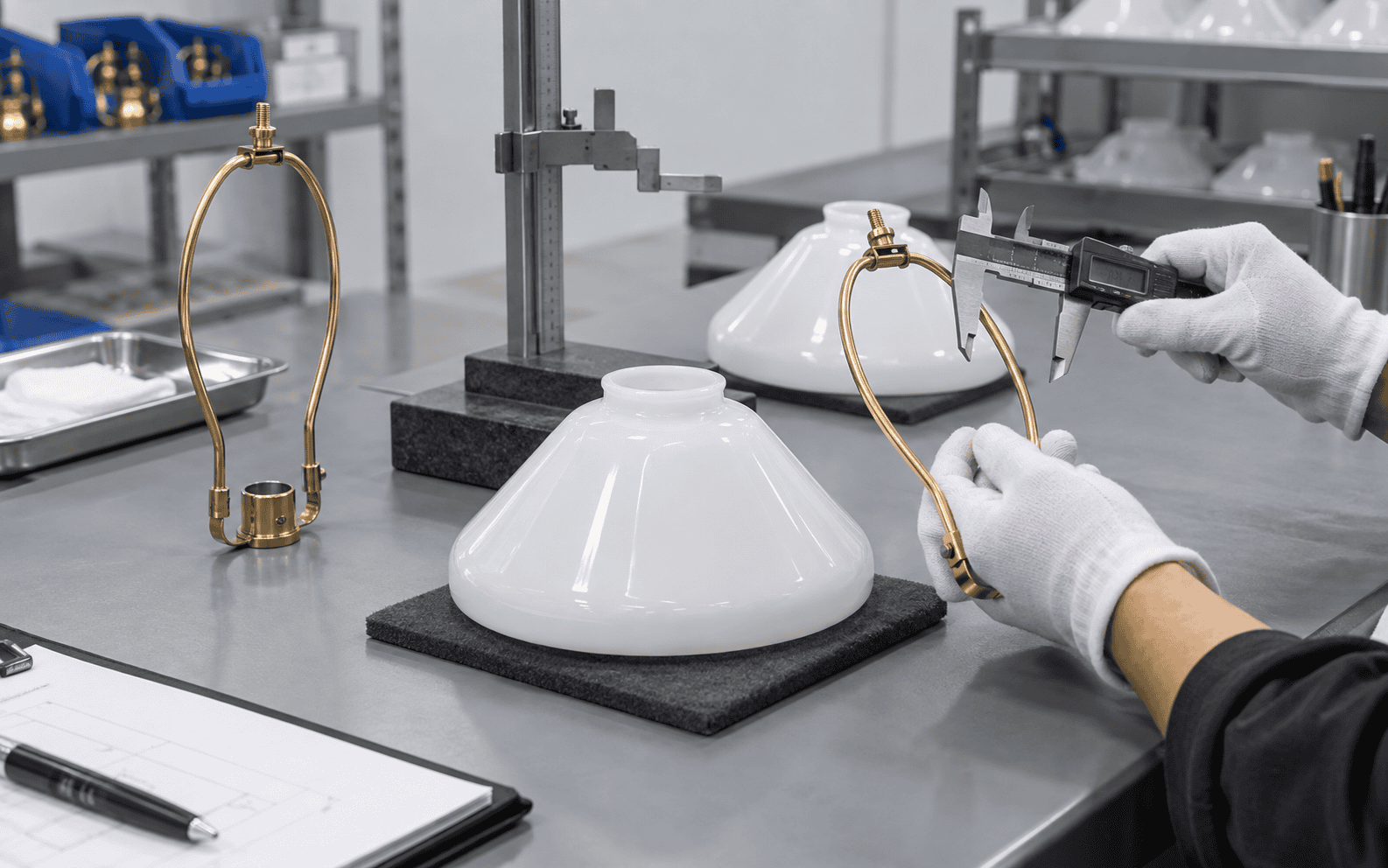
| Inspection point | Pass condition to record |
|---|---|
| Lower harp fit | Both legs seat fully without rocking |
| Shade opening | Shade reaches the intended support without forcing |
| Finial | Washer sits flat and thread engages safely |
| Level | Rim is level relative to the lamp base or fixture reference |
| Clearance | Glass and hardware clear the light source and socket |
| Surface | Visible finish and glass surface match the approved reference |
| Packing test | Rim, fitter and harp remain protected after handling |
Packaging a harp and glass shade together
Glass and metal should not share an unprotected contact point in a shipping carton. Separate the harp from the glass rim, protect the opening and keep the finial from moving into the shade. The exact material depends on the package design, but the part record should show where the load is supported and where the glass is isolated.
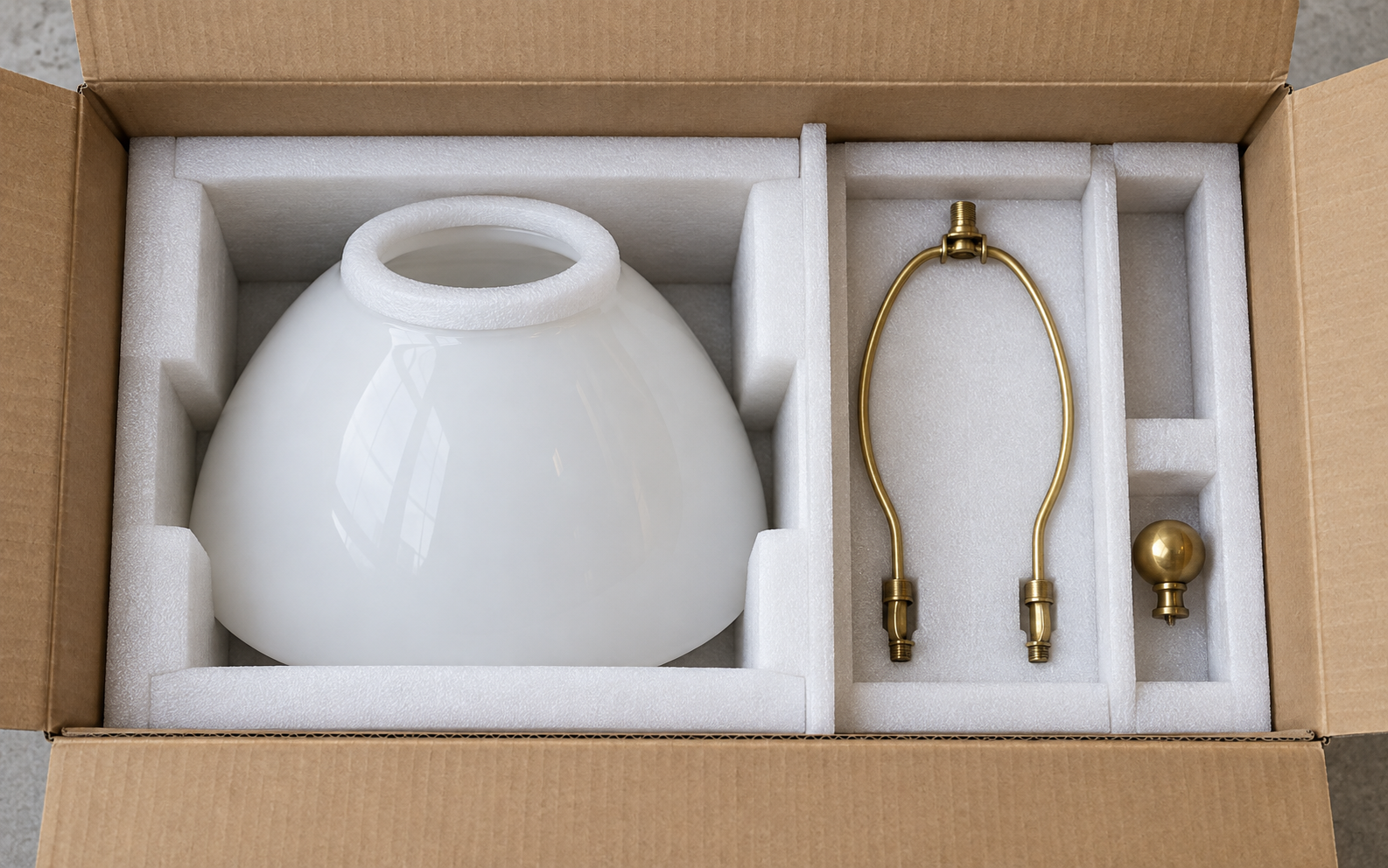
The packaging photo should be part of the approval record when the glass is fragile or the harp has a plated finish. It can also reveal a common oversight: a carton that protects the body but lets the metal harp press against the shade opening.
Turn the harp measurement into a glass shade RFQ
The most useful inquiry starts with the interface and ends with the desired sample. Send the full fixture photo, close views of the saddle and top opening, harp height, shade dimensions, bulb clearance, glass appearance, quantity, application and inspection requirement. If the existing shade is damaged, add a tracing or side profile rather than relying on a front photograph.
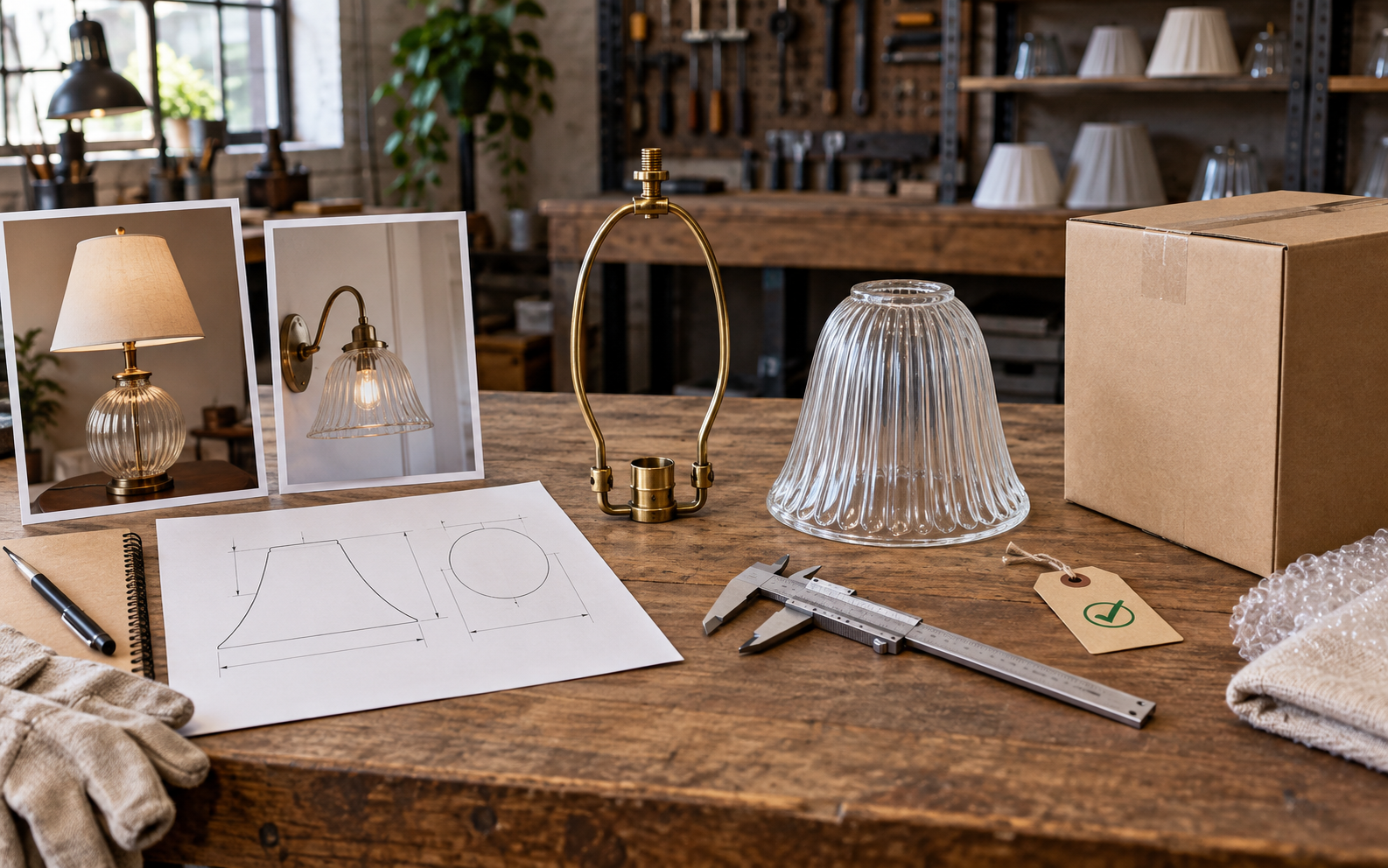
For a sourcing discussion, the OEM glass lamp shades for lighting brands page is the most relevant next step. Include the harp record in the inquiry, but do not describe the harp as a product supplied by the glass manufacturer unless the supplier confirms that scope. For a direct review, use the contact page and attach the photos or drawing.
Buyer questions
What is a lamp harp?
A lamp harp is a curved metal support that fits into a saddle near the socket and holds a shade above the lamp. Its top support normally works with a spider fitter, washer and finial.
What is a lamp shade harp used for?
It raises and stabilizes a shade while giving the finial a point for retention. It does not determine the shade opening by itself. The fitter, washer, finial and bulb clearance still need to match.
What size lamp harp do I need?
Measure the existing saddle-to-top support height, the shade top-to-fitter distance, the opening, the finial projection and the bulb clearance. Choose a harp that recreates the intended assembled position and fits the lower saddle.
Do all lamp shades need a harp?
No. Spider shades often use a harp, but UNO, clip-on, threaded neck, gallery and retaining-ring shades use other attachment routes. Inspect the actual connection before ordering hardware.
Can a glass lamp shade use a harp?
Yes, if the glass has a compatible spider or center opening and enough room for the harp, socket and bulb. The rim, opening and retention path should be checked with the actual fixture.
What is the difference between a lamp harp and a lamp shade ring?
A harp is a raised support from the socket area. A ring is a circular locating or retaining feature. A ring may be part of another fitter or glass assembly and does not automatically accept a harp.
Why does my lamp shade wobble on the harp?
The fitter may be uneven, the washer may be missing, the finial may not engage correctly, the saddle may be loose, or the glass rim may not sit flat. Check the contact path at several points instead of tightening harder.
How do I measure a lamp shade harp for replacement?
Measure the harp height from a defined saddle reference to the top support. Also record the lower leg shape, saddle spacing, top stud or loop, finish, shade opening, finial thread and assembled bulb clearance.
Can I use a taller harp with my existing glass shade?
Possibly, but a taller harp changes the shade elevation and may change the visible proportion or finial engagement. Confirm the saddle, opening, washer, finial and clearance after assembly.
What should I send for a custom glass shade quote?
Send full-fixture and close-up photos, the harp and saddle measurements, shade opening, rim and profile dimensions, glass appearance, application, quantity, sample requirement and inspection points. A tracing or drawing is useful when the original glass is damaged.
Lock the fixture interface before ordering glass
The best lamp shade harp decision is a fit record, not a finish choice. Save the saddle, harp height, top opening, finial, washer, shade profile, bulb clearance and glass appearance together. That record makes it easier to compare a replacement sample against the original lamp and easier for a supplier to identify a mismatch before production.
If the project involves a custom or replacement glass shade, send the fixture photographs, measurement record and drawing with the requested finish and quantity. The right next step is a review of the harp, glass opening and installed clearance as one assembly.