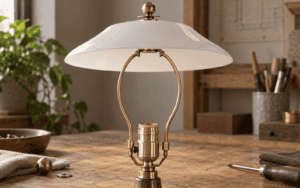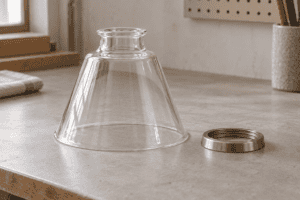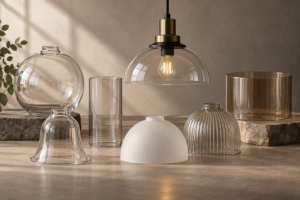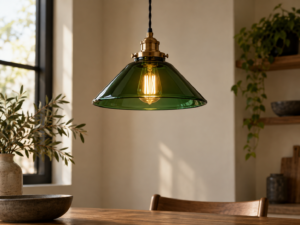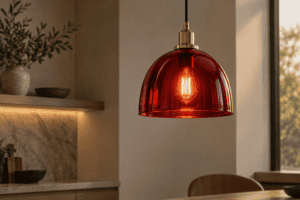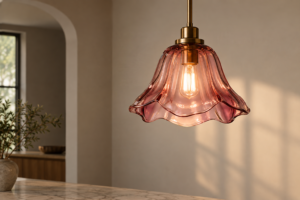
A green glass lamp shade is a glass cover whose body, layer or surface treatment gives the fixture a green appearance. For a useful buying decision, define the hue, transmission, profile, fitter and light source together. A shade can look right in an unlit photograph and still be too dark, too blue or mechanically wrong after installation.
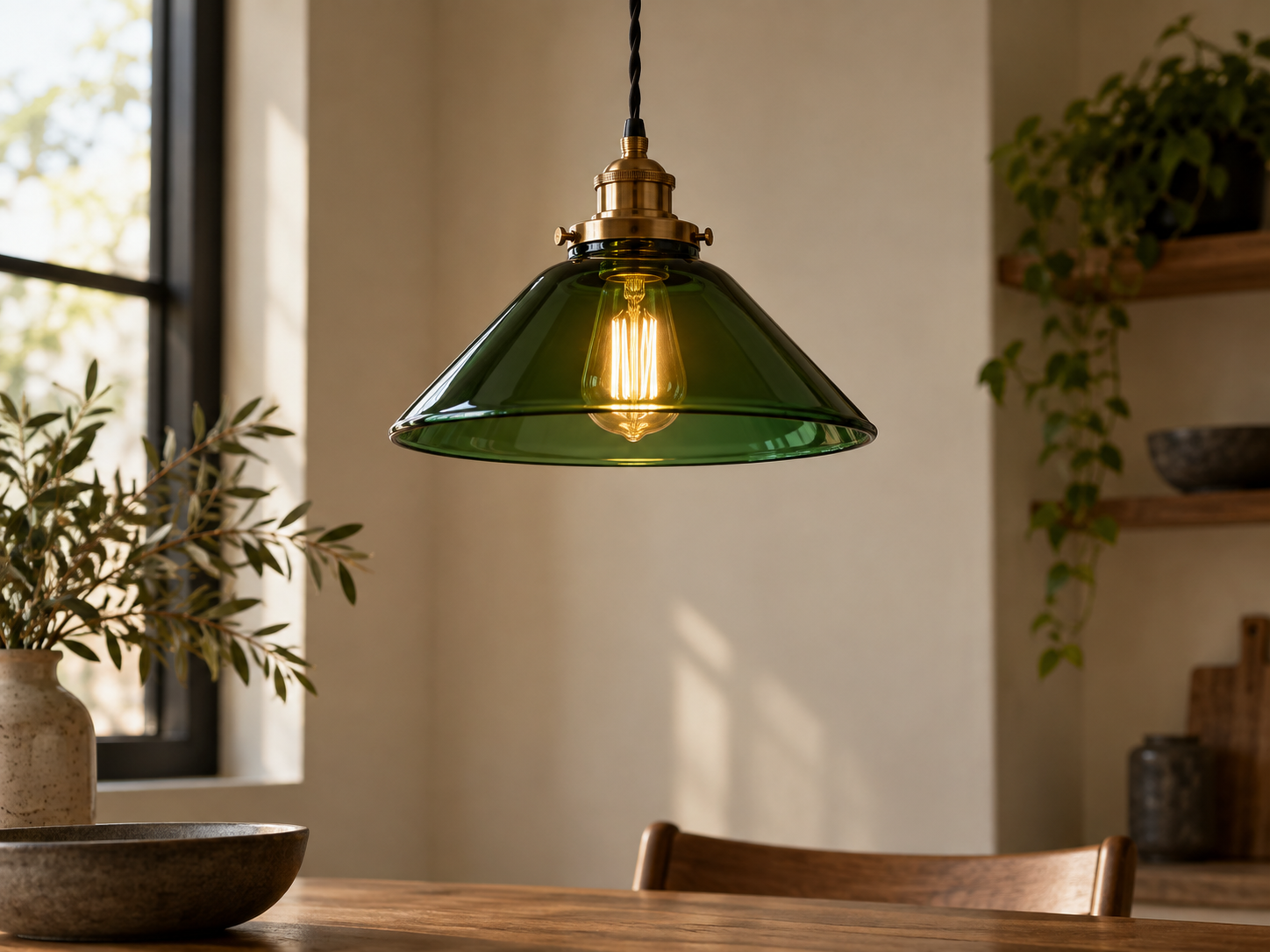
What does green glass mean in a lamp shade?
In a lighting listing, green glass describes an appearance, not one universal recipe. The color may run through the glass body, sit between clear layers, come from a surface finish or be created by a decorative coating. The Corning Museum of Glass definition of colored glass describes color entering through the batch or through dispersed or suspended materials. Its glass FAQ also explains that colored glass can transmit much of the spectrum while absorbing more of the colors it does not show. That distinction matters because each route changes light output, edge color, cleaning and replacement behavior.
For a buyer, the phrase becomes a usable specification when it answers five questions:
- Which green is required: bottle green, emerald, olive, sage or a custom sample?
- Should the shade transmit a clear glow, a softened glow or very little direct light?
- Is the color part of the glass body, a cased layer, a fired finish or a removable coating?
- What profile and fitter must seat on the fixture?
- Which LED, background and viewing distance will be used for approval?
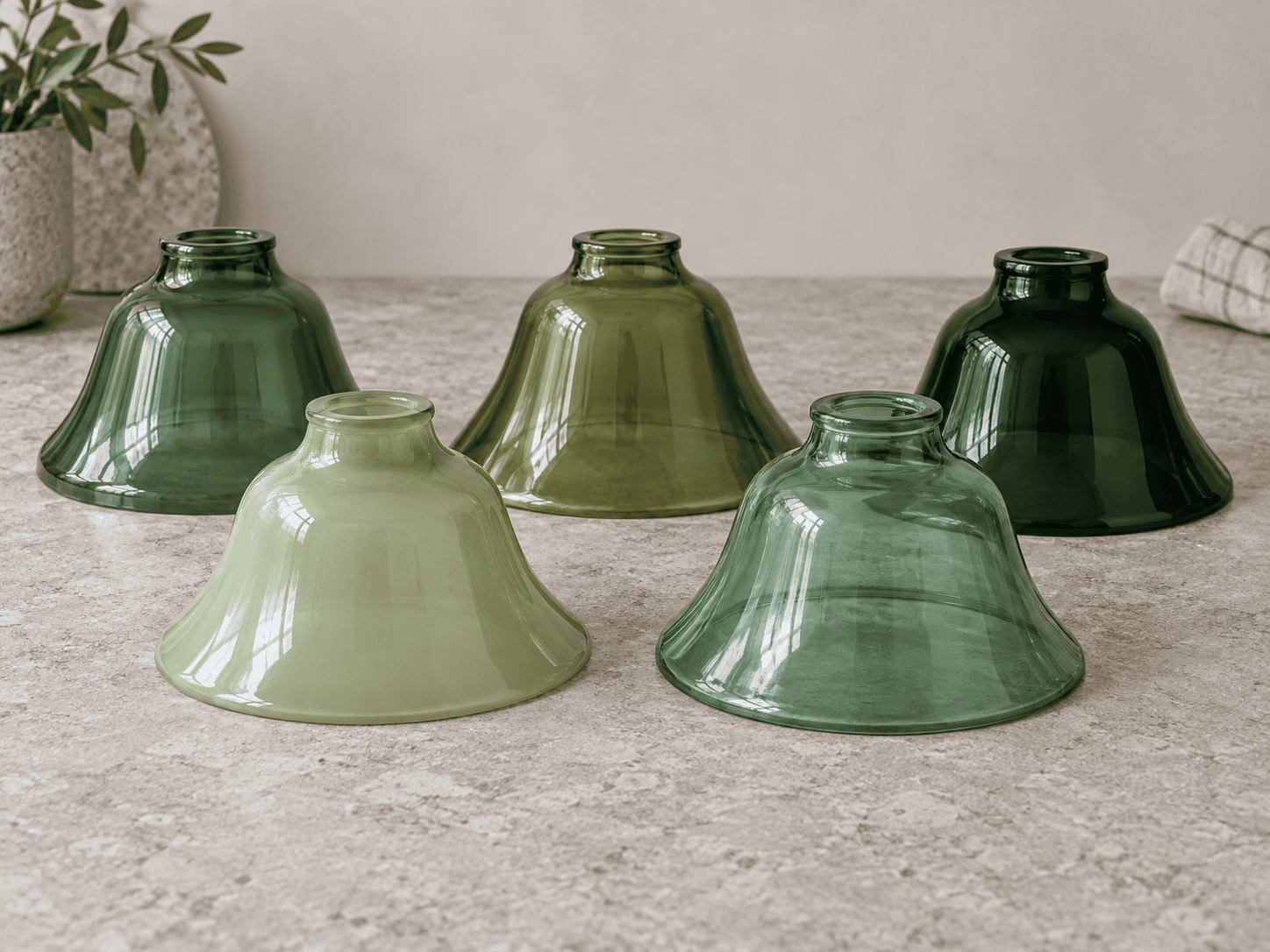
| Seller wording | What it may describe | What to confirm |
|---|---|---|
| Green glass | A broad green visual result | Hue, transparency, wall thickness and color route |
| Bottle green | A darker green with a blue or yellow shift depending on the glass | The actual sample under the intended LED |
| Emerald green | A saturated jewel-like green | Whether the shade remains bright enough when lit |
| Olive or moss green | A warmer green with yellow or brown influence | Batch variation and the background used for comparison |
| Sage or sea green | A paler green with more visible transmission | Whether the surface is colored glass, satin glass or paint |
Treat the name as a starting point. Treat the sample, light condition and measurement record as the specification.
Which process creates the green color?
Green glass can be colored in the batch, built as a colored layer, or finished after forming. The Corning Museum of Glass notes that metallic compounds such as iron can produce green in glass. That is useful material context, but it does not tell a buyer which shade process a supplier will use for a particular lamp part.
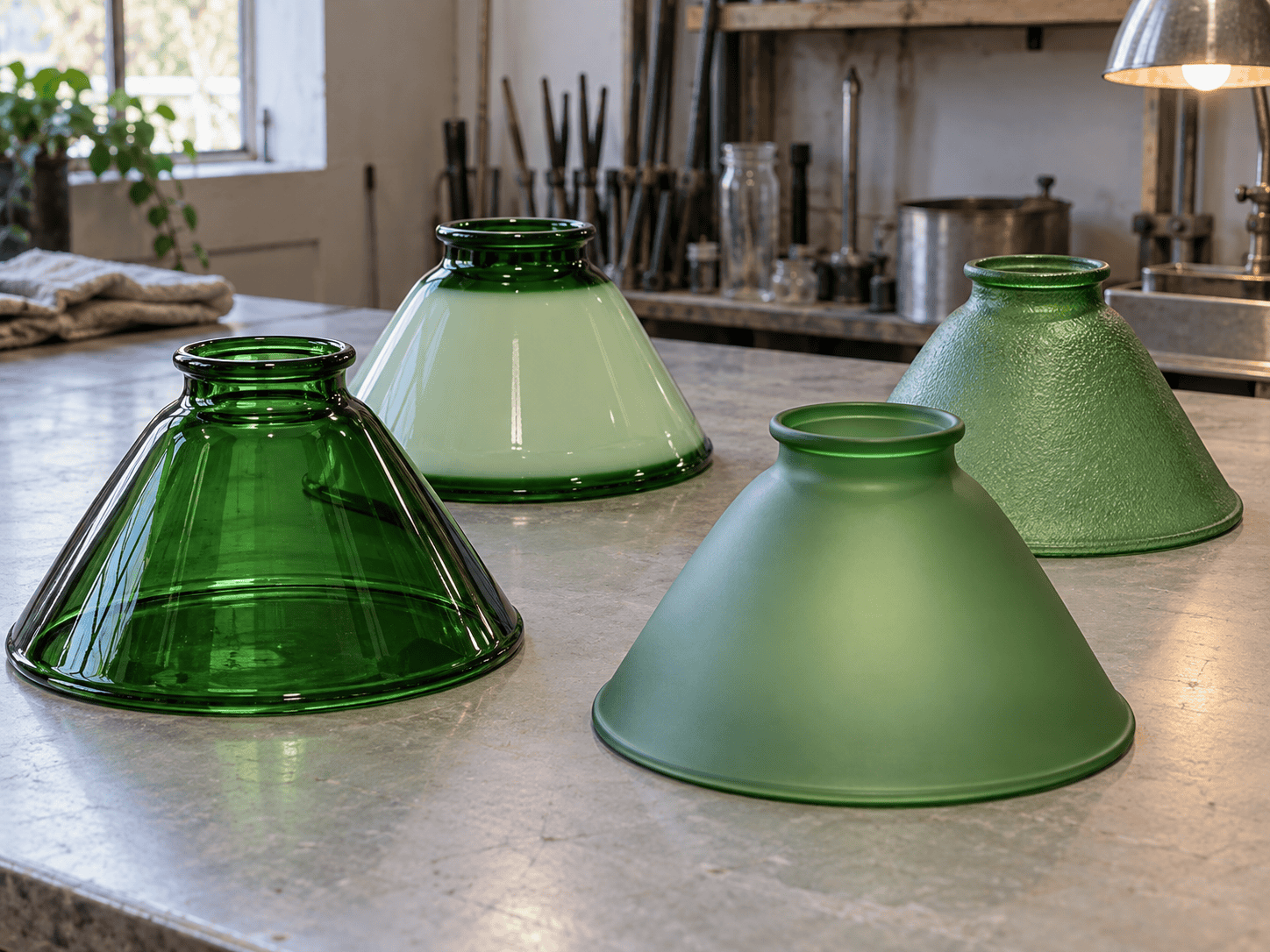
| Color route | What the buyer sees | Questions for the quotation |
|---|---|---|
| Full body color | Green depth through the wall and rim | How will wall thickness affect the center and edge? |
| Cased or layered glass | A colored layer protected by clear glass | How will the layer meet the fitter and rim? |
| Satin or frosted color | A softer glow with less direct reflection | What transmission target and cleaning method apply? |
| Pressed or ribbed color | Patterned highlights and stronger edge variation | Will ribs magnify thickness differences between pieces? |
| Fired paint or enamel | Local bands, marks or opaque areas | How are adhesion, heat and edge coverage inspected? |
Do not use "green glass" as a substitute for a process record. If a buyer needs the color to remain visible after a scratch or cleaning cycle, the route should be agreed before sampling. If the shade is meant to hide the lamp while giving a soft glow, transmission and surface finish deserve as much attention as hue.
How does green glass change the light?
Green glass changes the balance of light that reaches the viewer. The effect depends on color density, wall thickness, texture, bulb spectrum, shade geometry and the surface behind the fixture. A dark green shade can look almost black from the outside and still create a colored halo when lit. A pale green shade can look decorative when off and nearly clear when illuminated.
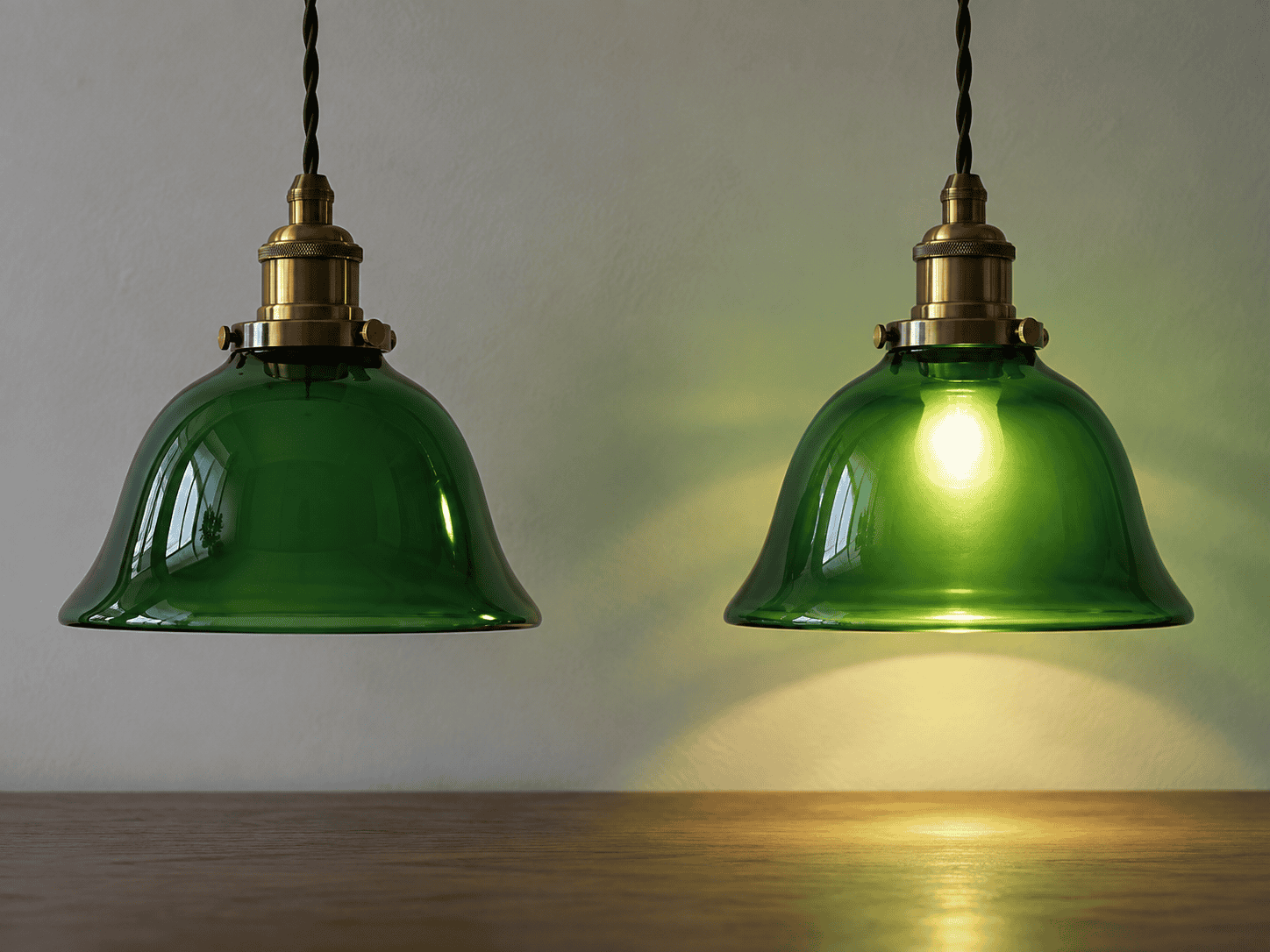
Review every candidate in three positions:
- unlit against a light background, to check hue, rim color, bubbles and surface marks;
- illuminated with the intended LED, to check glow, hotspots and the amount of visible bulb;
- installed against the actual wall, counter or product display, to check the final green cast.
The glass lampshade light diffusion guide is useful when the project depends on more than color alone.
| Review condition | What to observe | Why it belongs in the approval record |
|---|---|---|
| Unlit, light background | Hue, scratches, bubbles, rim and surface coverage | Separates the glass appearance from lamp output |
| Warm LED | Saturation, warmth and visible glow | Represents many decorative and hospitality fixtures |
| Neutral LED | Balance between blue, yellow and brown shifts | Gives a repeatable comparison between samples |
| Cool LED | Washed areas, glare and unexpected color shift | Shows whether the green depends on a warm source |
| Backlit wall or counter | Center, edge and fitter transition | Reveals thin spots and uneven coverage |
Do not approve a green glass lamp shade only because it looks dramatic in a dark studio. If the fixture will light a counter, aisle or table, judge the output where people will use it.
Which profile and fitter should you choose?
Color cannot rescue a mounting mismatch. First identify how the fixture holds the glass. Common arrangements include a gallery, socket neck, threaded opening, spring clip or upper retaining ring. Each supports the part at a different contact point.
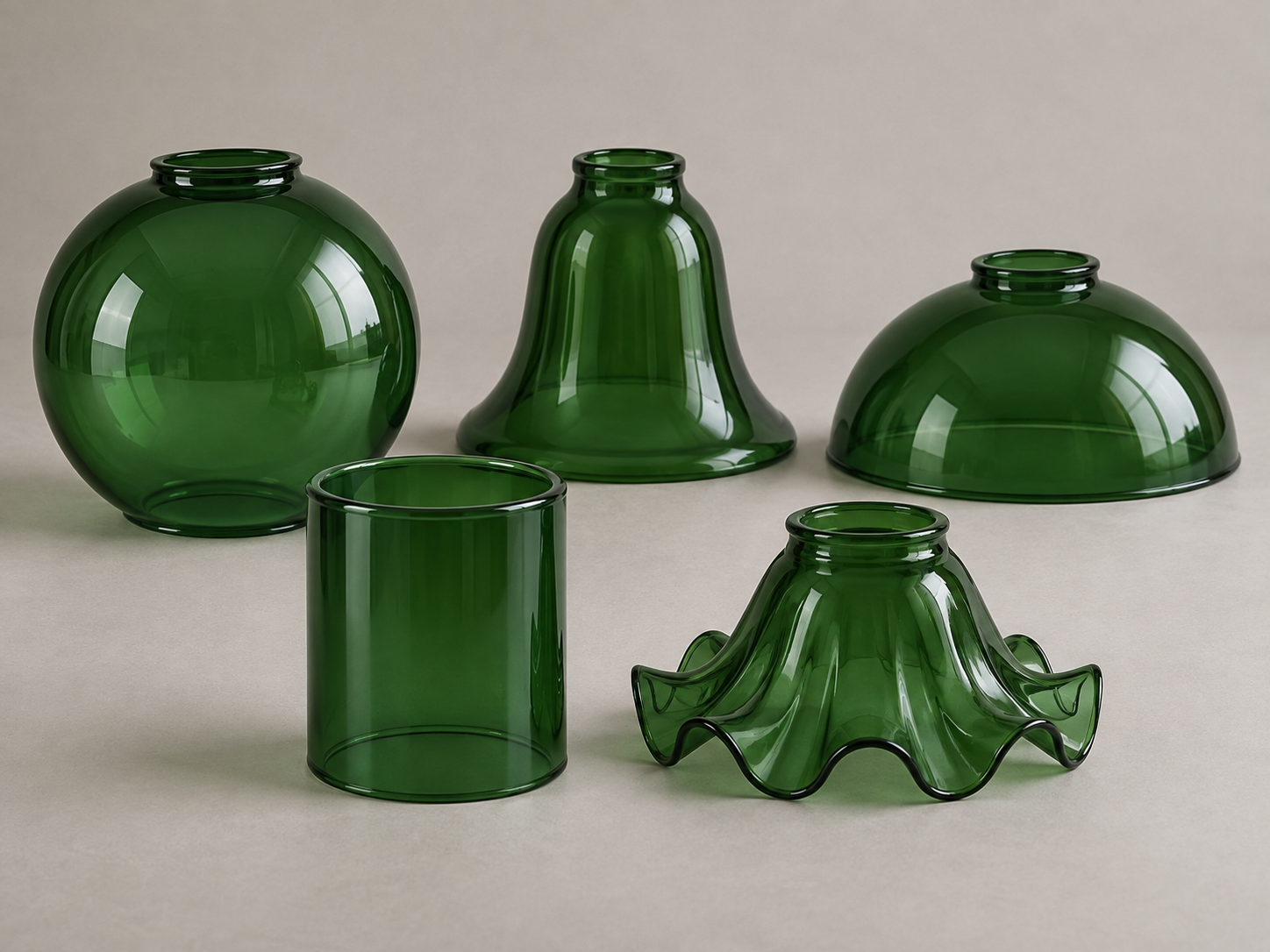
For a pendant, note the upper aperture, the socket or ring position, the hanging height and the bulb clearance. For a table lamp, measure the lower seat, gallery contact, largest width and resting angle. A wall sconce also needs its mounting direction and the gap to the backplate. The glass lamp shade fitter types guide can help when the hardware is hard to name.
| Profile | Common visual result | Fitter question |
|---|---|---|
| Globe | Even color around the lamp | Does the support ring carry the full weight? |
| Bell | A broad lower flare and visible rim | Does the gallery sit at the correct height? |
| Dome | A compact top with a wide lower spread | Is the top opening compatible with the socket? |
| Cylinder | A controlled vertical silhouette | Will the retaining ring stop rotation? |
| Flower or ruffled | A decorative edge with extra highlights | Is the rim protected from nearby hardware? |
How to measure a green glass lamp shade replacement
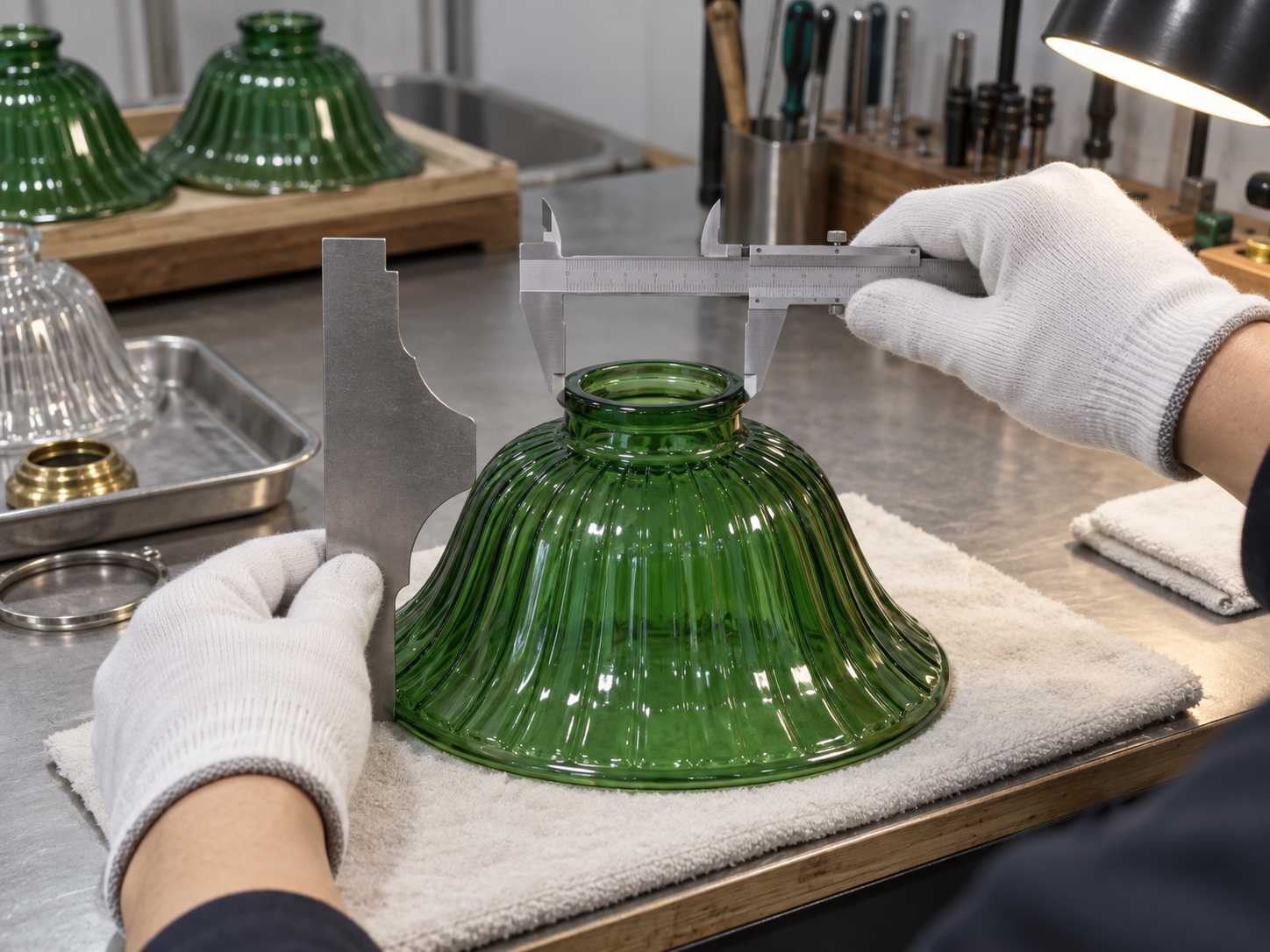
Replacement is a geometry check with a color requirement attached. A visually close piece can still fail when its aperture, support, depth or retention hardware differs from the original.
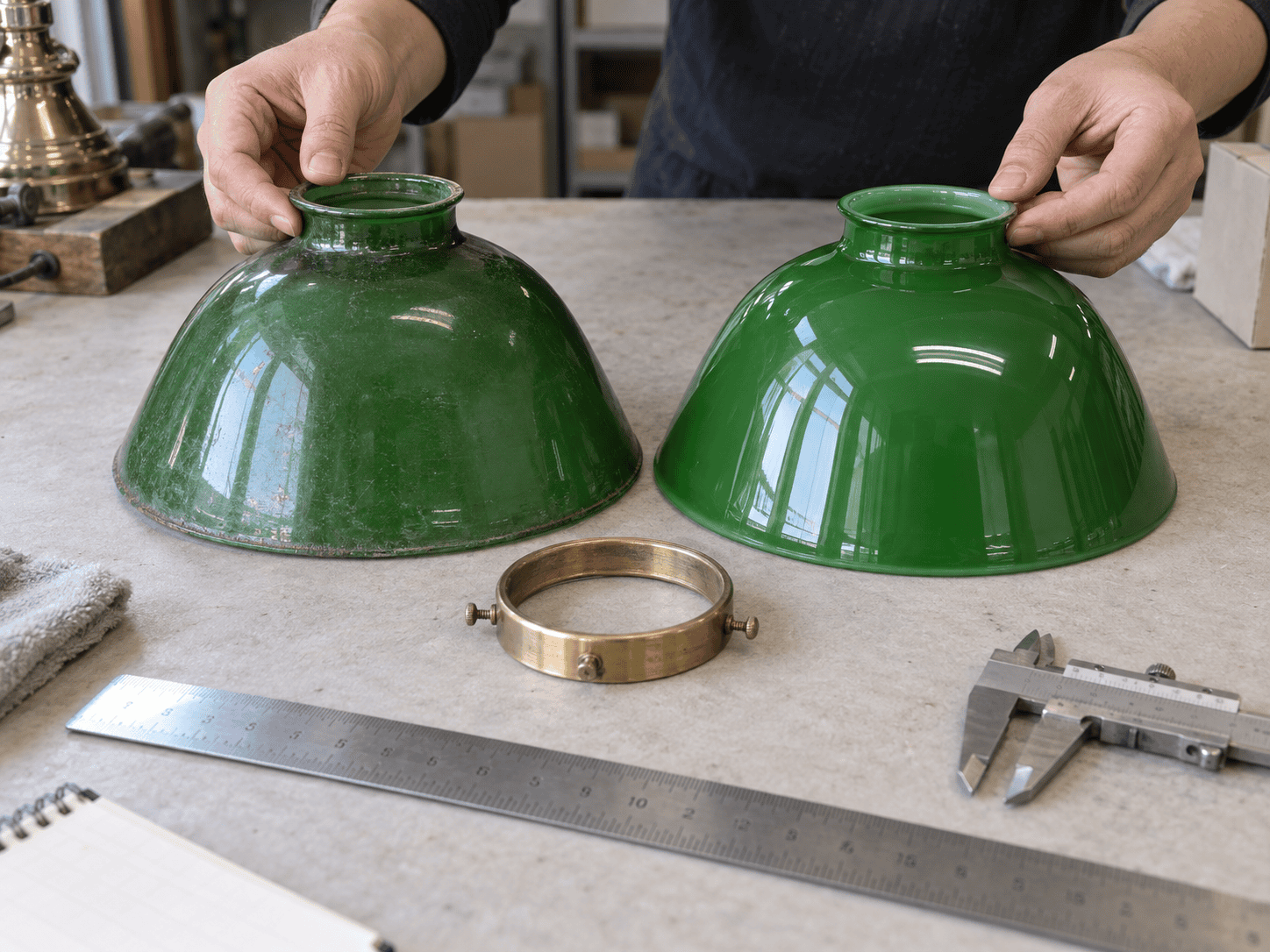
Build the replacement record in this order:
- Take one side photograph and one photograph looking directly at the fitter.
- Use inside calipers at the seat where the glass actually rests.
- Write down vertical depth, maximum width, flare and taper as separate values.
- Describe the hardware that holds the part, such as a gallery, screw, clip or thread.
- Verify the lamp position, bulb envelope and installation direction.
- Compare the old green sample in daylight and with the intended LED switched on.
- Check the broken rim for chips, oval distortion and uneven wall thickness.
| Measurement | How to record it | Why it affects the replacement |
|---|---|---|
| Fitter opening | Inside diameter or neck profile at the seating point | Controls whether the shade can seat safely |
| Overall height | From fitter contact to the lowest edge | Affects bulb clearance and the visual balance |
| Maximum diameter | Widest outside measurement | Checks nearby hardware, walls and adjacent shades |
| Rim condition | Chips, sharp areas, distortion or uneven thickness | Helps decide whether the old part can be measured reliably |
| Retention method | Ring, screws, clips, gallery or thread | Determines how the replacement is supported |
For an unusual vintage part, send the original or a dimensioned tracing. A catalog color name cannot replace that evidence. For repeat orders, store the approved green sample with the drawing and the fixture photographs.
Green glass shades by application
The same color can behave differently in a pendant, table lamp or wall fixture because the viewing angle, lamp position and surrounding surface change. Choose the application before deciding how much of the shade should be transparent.
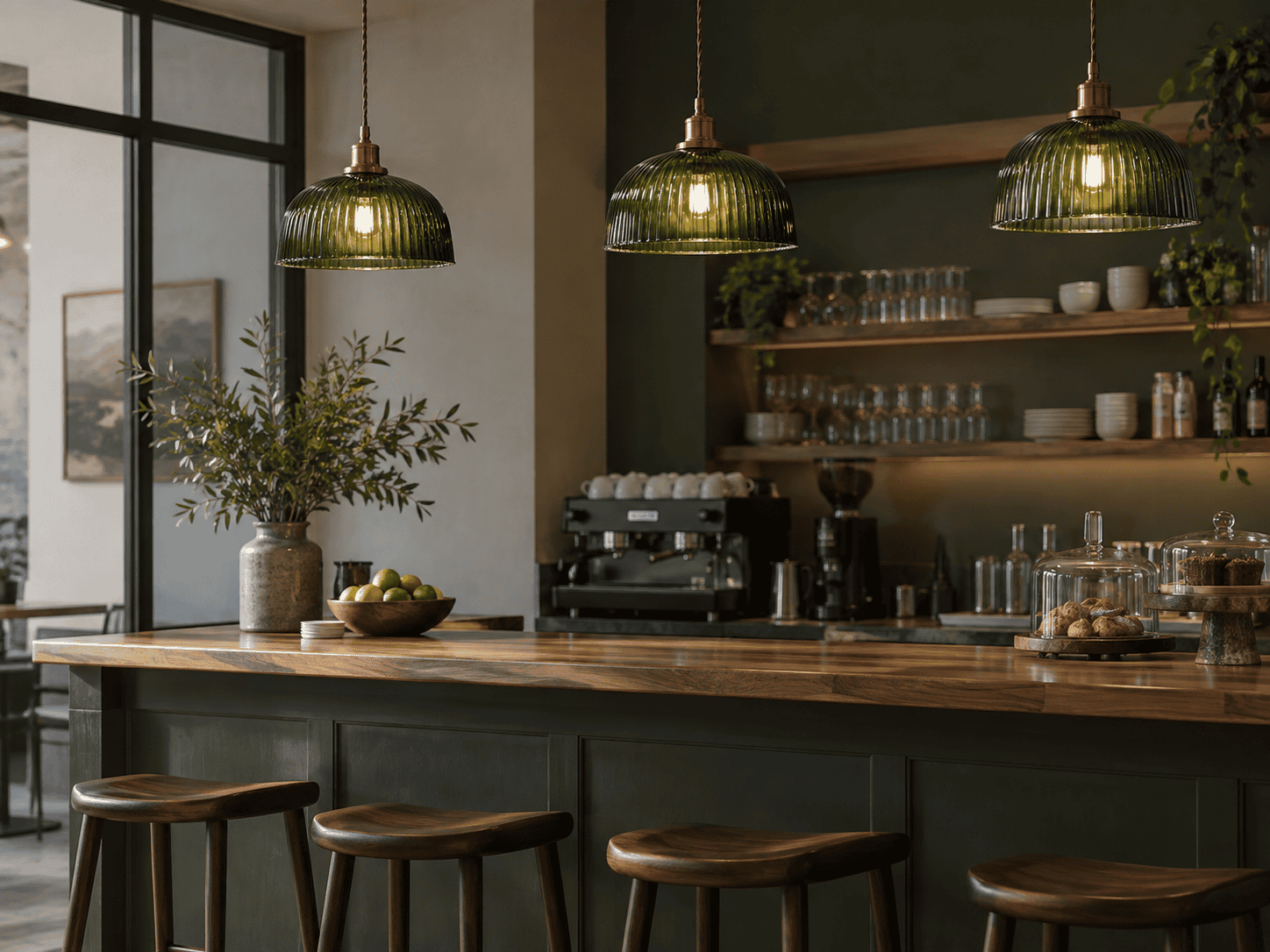
Pendant and ceiling fixtures
Pendant shades are usually viewed from the side and below. The bottom opening, edge profile and bulb concealment are easy to notice. Confirm the hanging clearance, retaining ring, cord or stem relationship and cleaning access. If several pendants are installed in one line, sample comparison should happen side by side rather than one at a time.
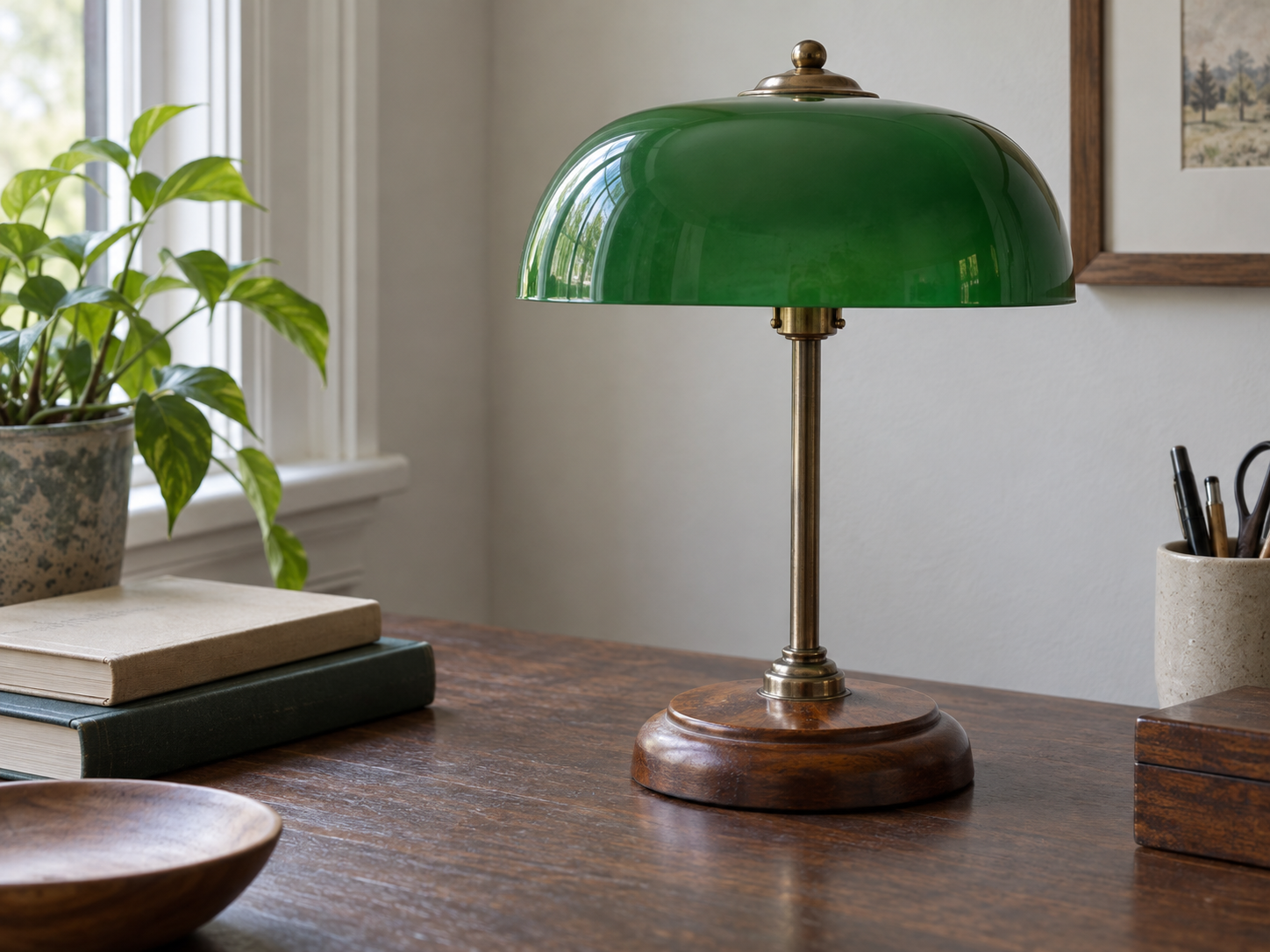
Table and desk lamps
Table and desk lamps are viewed close to eye level. A small scratch, uneven color edge or leaning shade is easier to notice than it would be on a high pendant. Record the base gallery, bottom opening, shade weight and the distance between the lamp and nearby objects. If the lamp is used for reading, check whether the green tint makes the work surface too dim or too colored.
Wall sconces and decorative replacements
Wall shades often have a shallow profile and a tight relationship with the backplate. Confirm the direction of installation, screw or clip clearance, wall distance and the visible edge from the room. A green shade may work as an accent, but the fixture still needs a stable seat and enough clearance for the specified light source.
For broader product selection, see the glass lamp shades collection. For a green banker style, use the narrower banker's lamp shade guide rather than treating every green shade as the same fixture type.
Surface finish, cleaning and handling
Surface texture changes both appearance and maintenance. Ribbed, satin, etched, painted and cased surfaces can all read as green, but they do not respond to cleaning or abrasion in the same way.
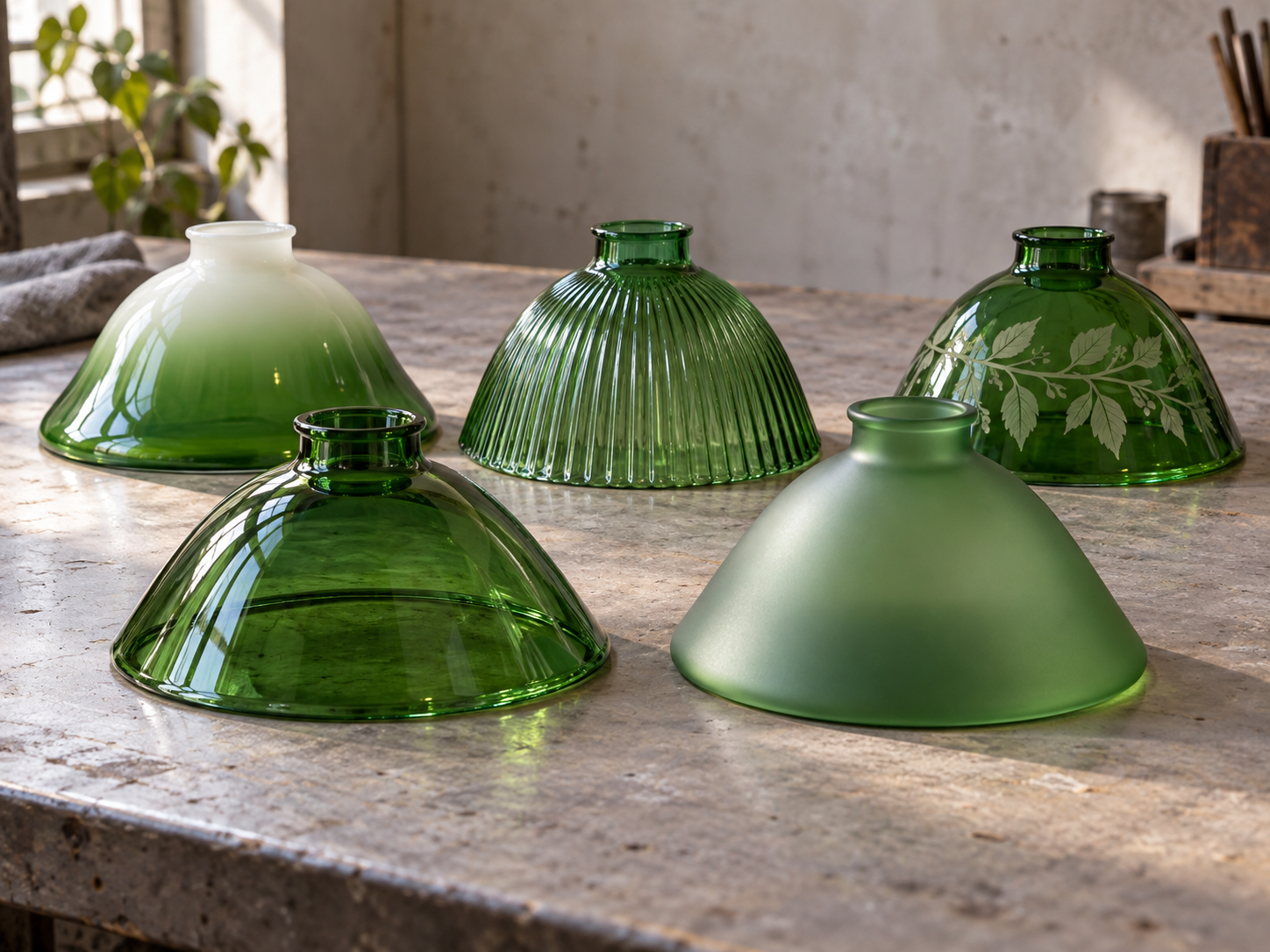
| Finish | Useful when | Handling point to confirm |
|---|---|---|
| Clear body color | The buyer wants depth and visible transmission | Rim and thick areas may read darker |
| Satin or frosted | The fixture needs softer reflection | Abrasive cleaning can change the surface |
| Ribbed or pressed | The design needs controlled highlights | Ribs can trap residue and show thickness variation |
| Cased glass | The color needs a protected layer or depth | Layer alignment and rim finishing require inspection |
| Painted or enamel detail | The design needs a band, mark or local color | Adhesion, edge coverage and heat exposure need agreement |
Use the fixture maker's cleaning instructions. Do not assume that a surface coating has the same resistance as the glass body. For replacement or export orders, state the permitted cleaner, cloth type and packaging separation for decorated surfaces.
Bottle green, emerald and olive need a sample
Color names help a team talk about a design, but they can hide different expectations. One buyer may use bottle green for a blue-green transparent shade. Another may mean a darker olive bottle. Emerald may mean a bright jewel tone to one team and a muted green to another.
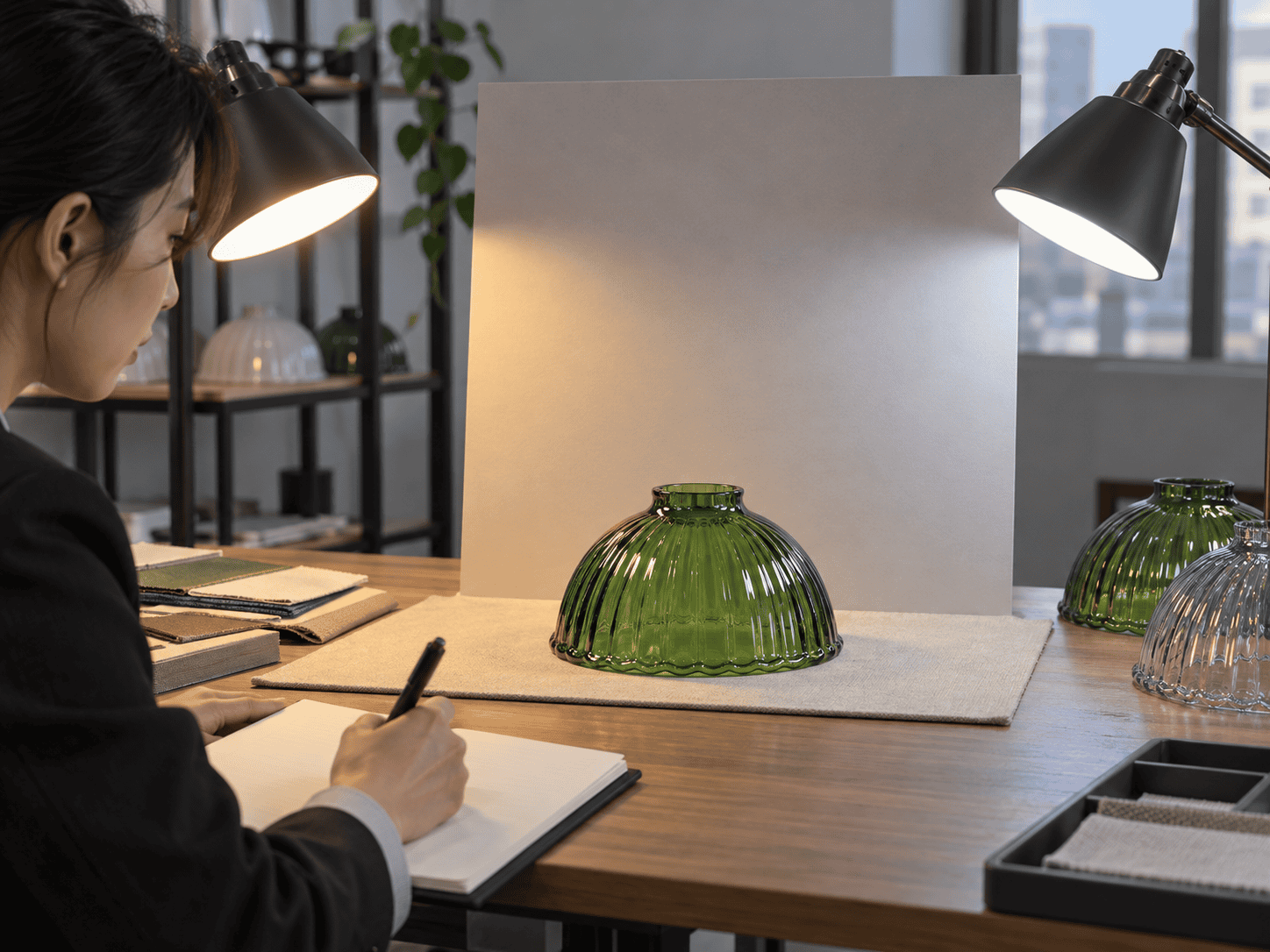
Set the approval record with:
- a physical green reference or retained master shade;
- the intended background and viewing distance;
- the LED type and color temperature used for the comparison;
- acceptable hue, saturation, gradient and wall-thickness variation;
- the visible edge, rim and fitter transition;
- the sample number and date of approval.
The glass lamp shade technical drawing checklist helps turn a color idea into a quotable part. Ask the supplier to name the checkpoints after forming, during annealing, at finishing and at final inspection. Put each tolerance in writing instead of assuming that a visual match covers it.
What should a green glass lamp shade RFQ include?
An RFQ should let a supplier price the same part that the buyer intends to approve. A single photograph is rarely enough. Send a drawing, a side and top view, the existing fitting information and a short color brief.
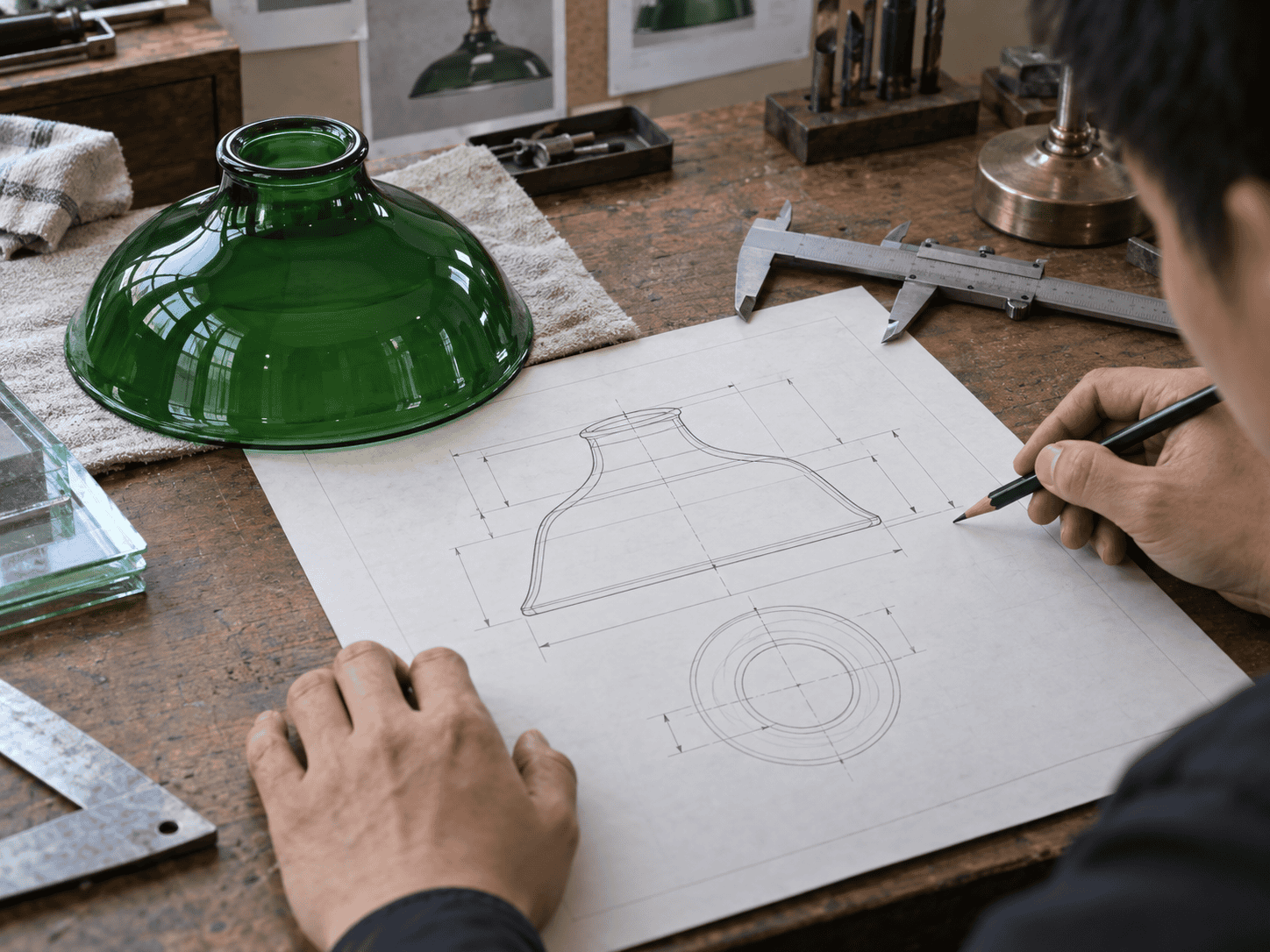
| RFQ field | Minimum information | Why the supplier needs it |
|---|---|---|
| Profile | Side view, top view and overall dimensions | Defines the glass form and material use |
| Fitter | Opening, seat, ring, thread or clip details | Prevents an attractive but unusable sample |
| Green target | Physical master, reference image and name used by the team | Reduces disagreement about hue and saturation |
| Light condition | LED type, color temperature and intended installation | Makes transmission and glow testable |
| Finish | Clear, satin, ribbed, cased, painted or enamel route | Sets handling and inspection requirements |
| Quantity | Sample count, pilot quantity and production quantity | Supports a realistic quote and batch plan |
| Packaging | Individual protection, carton layout and drop concerns | Connects the sample to shipment risk |
If the project is a replacement, include photos of the original fixture and the broken rim. If it is a new collection, include the related fixture drawing so the supplier can check clearance and support. Use the custom glass lamp shade manufacturer page or the custom lampshade RFQ builder to send the brief.
Sample inspection and batch consistency
The approved sample is the reference for production, but one piece cannot expose batch spread. Put the master and several later pieces on one bench, use one background and keep the light source unchanged during the comparison.
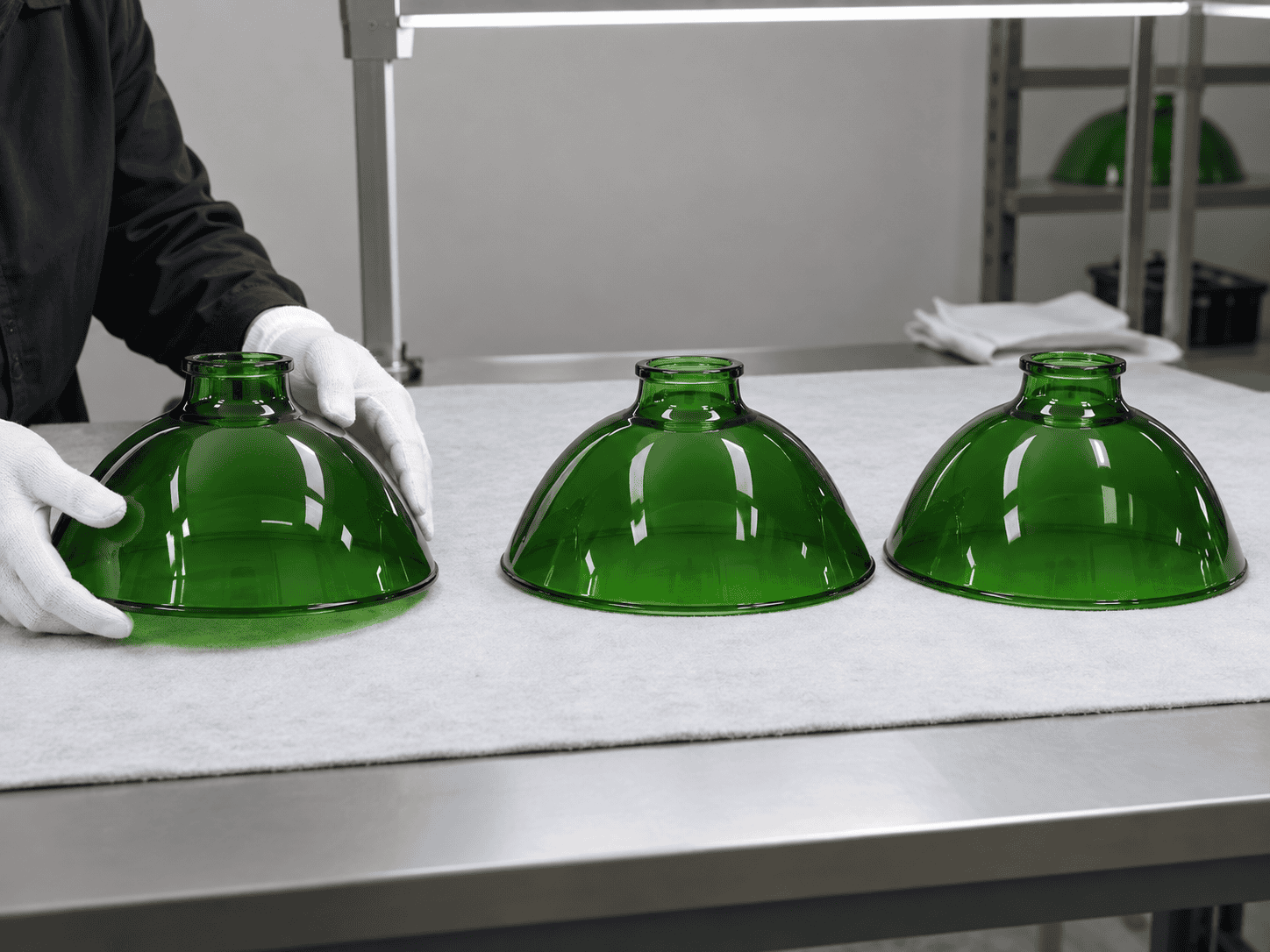
| Check | What the inspector records |
|---|---|
| Green match | Hue, depth and saturation compared with the retained master |
| Lit appearance | Glow, shadow and bulb visibility under the agreed LED |
| Finish | Surface marks, pinholes, residue and decoration coverage |
| Shape | Height, width and silhouette measured against the drawing |
| Mounting seat | Roundness, stability and contact with the support ring |
| Edge | Chips, cracks, sharp sections and color boundary condition |
| Lot spread | Differences observed across the selected sample group |
| Protection | Rim, fitter and decorated surfaces secured for transit |
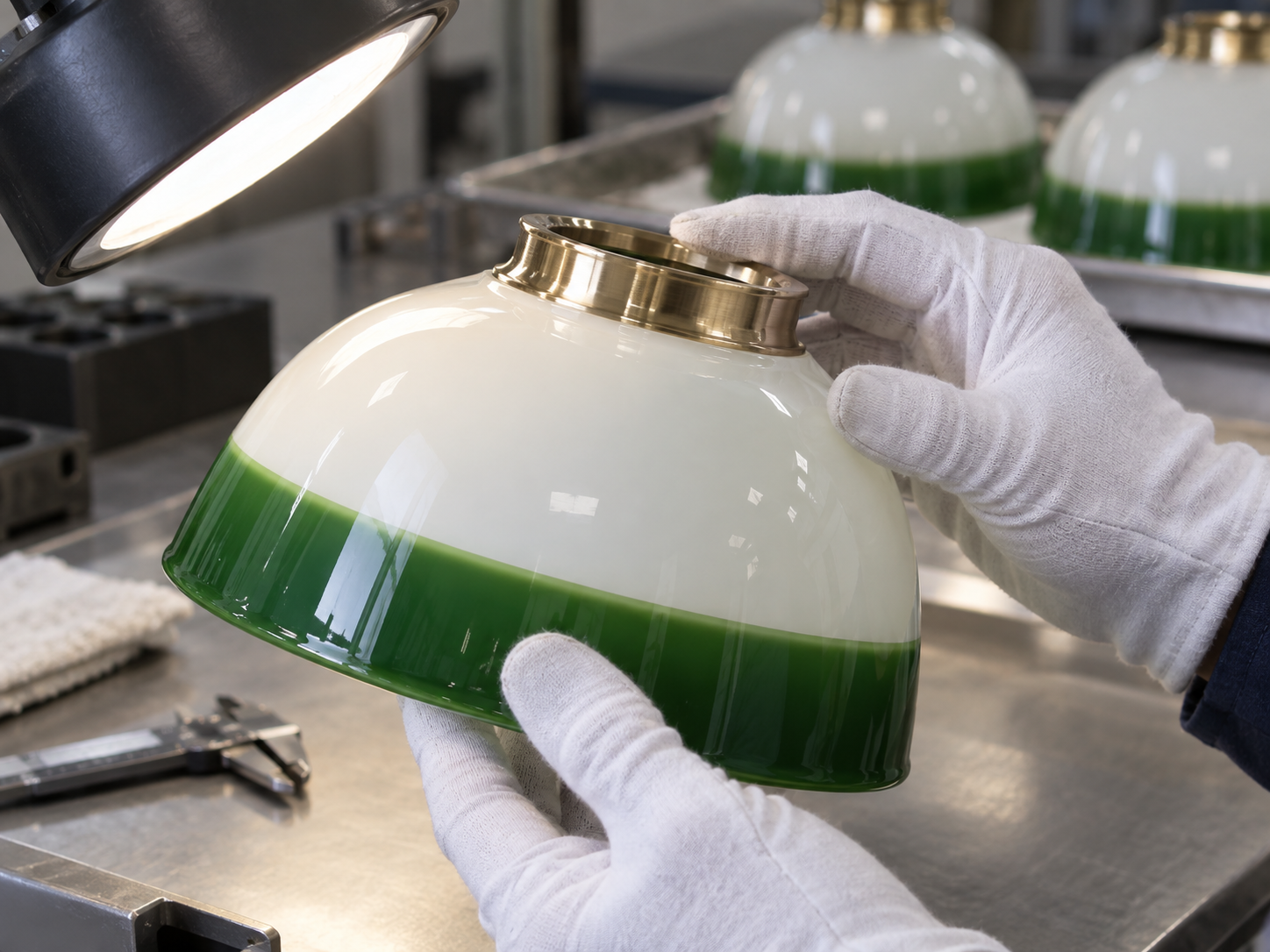
Do not approve a generic "green" pass statement if the project depends on a clear window, a dark rim, a gradient or a particular surface mark. Write the acceptable difference beside the retained master.
Packaging and fixture-level safety questions
Green is a visual attribute. It cannot certify the luminaire around it. The lamp holder, wiring, heat path, enclosure, support and installation all remain part of the safety review. UL Solutions describes evaluation across lamps, fixtures, components and systems. Its lighting safety testing overview is a starting point for that fixture conversation, not a certification claim for this shade or for JX.
Before installation, identify the lamp type, maximum wattage, enclosure state, ventilation gap, support stability and replacement procedure with the fixture maker or a qualified electrical professional. A glass part should never be drilled, cut or forced onto hardware that was not made for it.
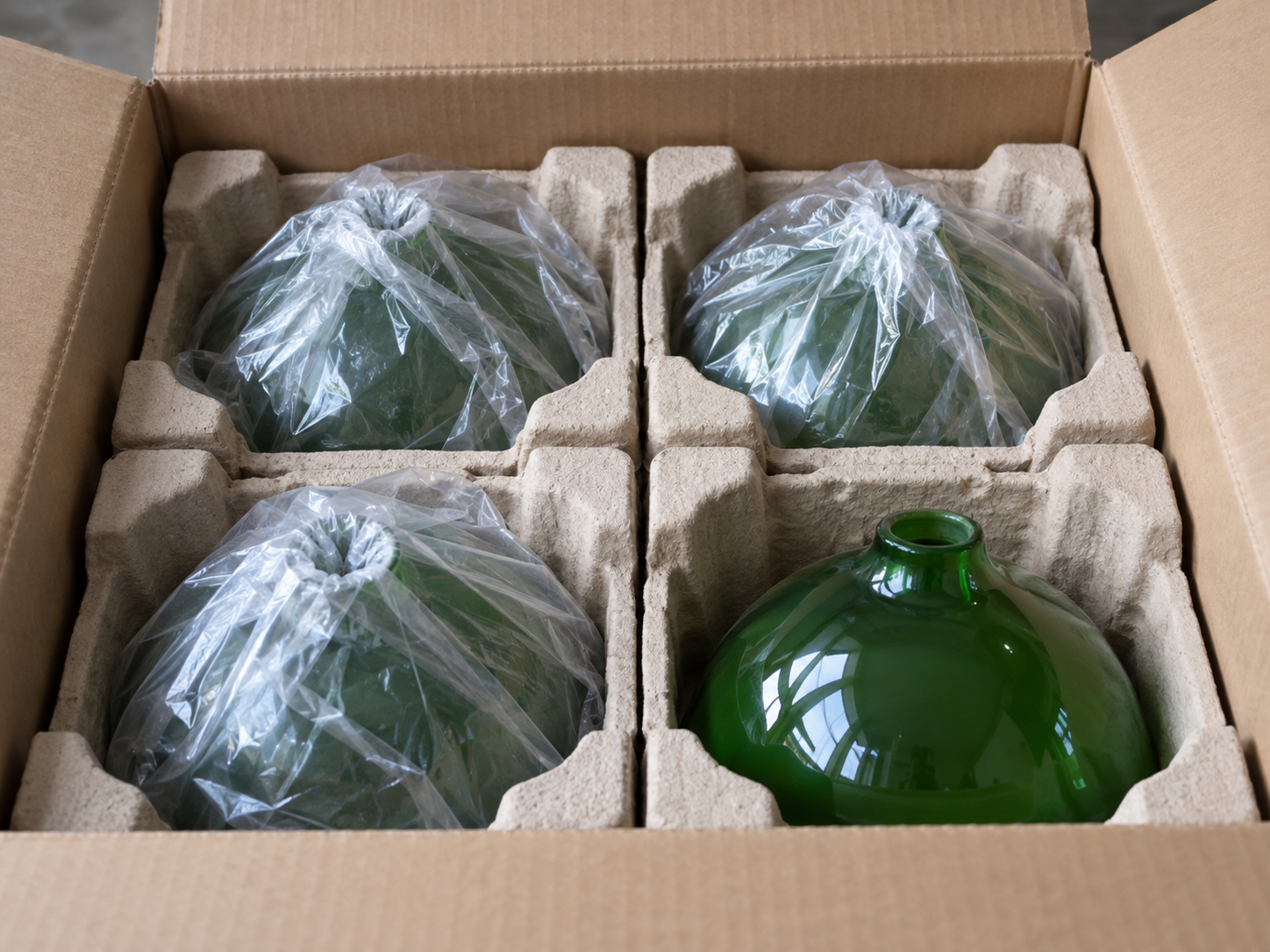
For shipment, agree how the fitter and rim are protected, whether each shade is bagged or wrapped, how the carton separates pieces and what evidence is required if damage occurs. A packaging photograph should show the actual packing method for the project, not a generic carton.

Buyer questions
Is green glass the same as emerald glass?
No. Emerald usually suggests a saturated visual family, while green is a broad description. Confirm the physical sample, transmission, wall thickness and light source instead of choosing only from the color name.
Does green glass make a room darker?
Often, yes, or it can shift the light toward green. Darkness depends on the color load, glass depth, texture, LED spectrum and fixture shape. Switch on the finished fixture in its working position before assigning it to a task-lighting area.
Is bottle green glass transparent?
It can be transparent, translucent or close to opaque. The seller's name does not define transmission. Ask for an unlit and lit view under the intended LED and request a sample when the output matters.
Can a green glass lamp shade be used as a replacement?
It can, provided the new piece seats on the same support, clears the lamp, follows the same dimensions and has a sound rim. The green tone is one field in the replacement record, not the whole record.
What is the difference between colored glass and painted glass?
Colored glass has color in the body or in a defined glass layer. Painted glass has a surface finish over a base glass. The two routes can look similar in a photograph but differ in edge appearance, cleaning and heat exposure.
Should an OEM buyer specify a Pantone color for green glass?
Use a Pantone or other color reference as a conversation aid, then anchor the decision to a glass master. Transparency, wall depth and backlighting can move the visual result. Keep the reference, sample, LED condition, background and allowed variation in one approval file.
What measurements are needed for a green glass shade replacement?
Send the fitter opening, overall height, widest diameter, rim condition, retention method and installation photos. A side profile or the original shade makes an unusual replacement easier to quote accurately.
What should be included in a green glass lamp shade RFQ?
An RFQ needs the profile drawing, key dimensions, fitter and retaining hardware, green target, light condition, finish route, sample count, order quantity, inspection gates and packing method. Pairing a drawing with a physical sample gives the factory something it can price and reproduce.
How should a green shade be checked before shipment?
Compare the agreed sample set for color, transmission, profile, fitter, rim condition, surface finish and packaging. Use the same light and background for color comparison and record any accepted variation before packing.
Turn a green shade idea into a repeatable part
The fastest route to a useful quote is a complete part record: green sample, drawing, fitter, LED condition, quantity and inspection method. Begin with the custom glass lamp shade manufacturer page or the custom lampshade RFQ builder, then attach the dimensions, fixture photographs, light source and finish notes together.