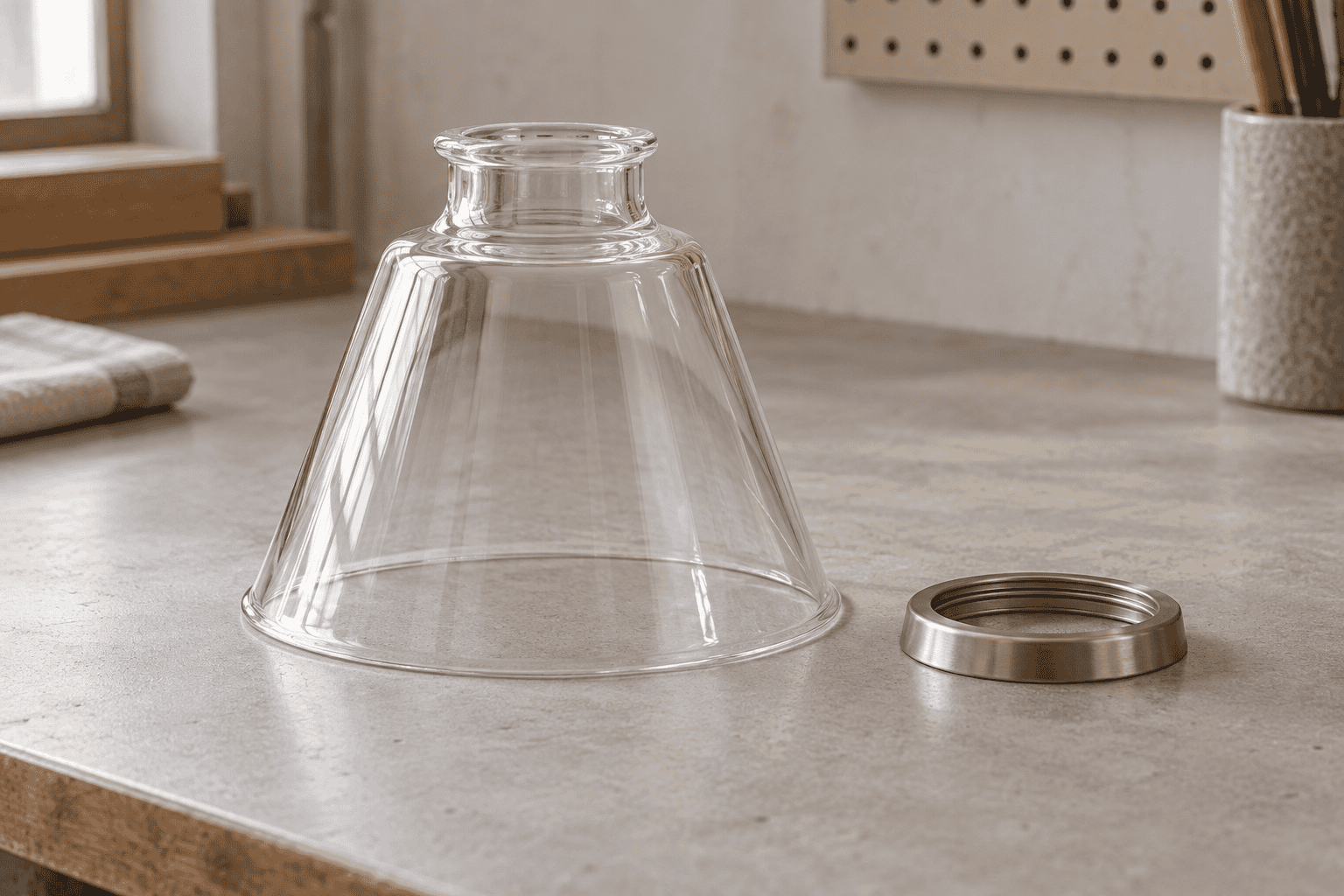
A lamp shade ring is the circular support, locating or retaining interface that connects a shade to a fixture. The correct replacement depends on the attachment route, opening geometry, ring or washer relationship, fixture clearance and glass profile, so there is no universal ring size.
What is a lamp shade ring?
A lamp shade ring is a circular part that helps a shade sit on, locate against or stay attached to a lamp assembly. Depending on the fixture, the ring may be a wire element in a spider fitter, a threaded opening around a socket, a collar in a glass shade, or a separate retaining ring that clamps a shade against a shoulder or gasket.
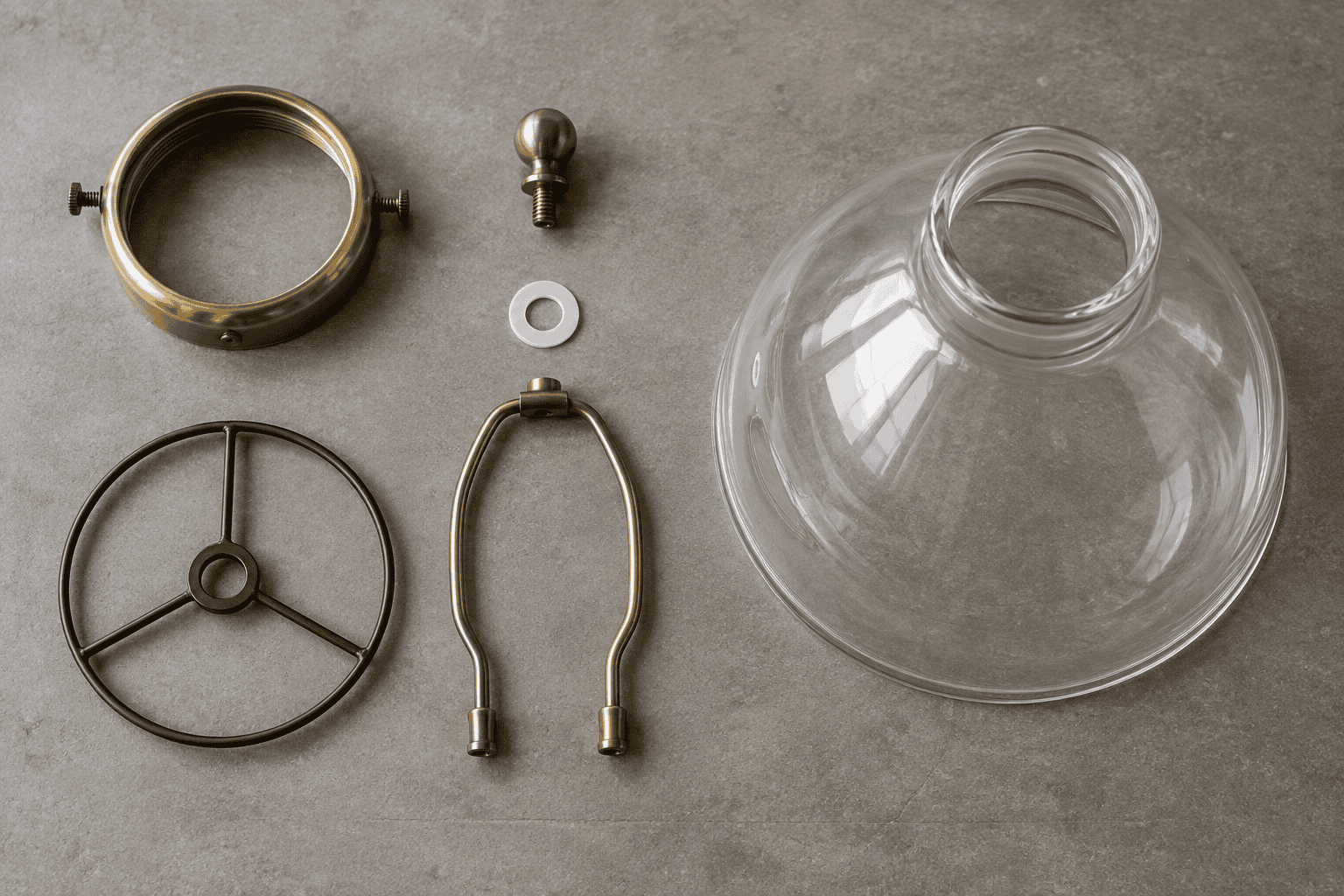
The term is easy to misuse because people also call the complete attachment system a fitter. A ring is one physical feature or component. A fitter is the broader interface that explains how the shade meets the lamp. A harp, finial, washer, gallery or gasket may work with the ring, but none of those words should be used as a substitute without checking the actual hardware.
For a replacement glass shade, the ring is usually a fit question before it is a style question. A globe, dome or cylinder can look correct in a photograph and still fail because its opening does not pass over the hardware, its seat is too shallow, or its retaining ring cannot reach the mating thread or shoulder.
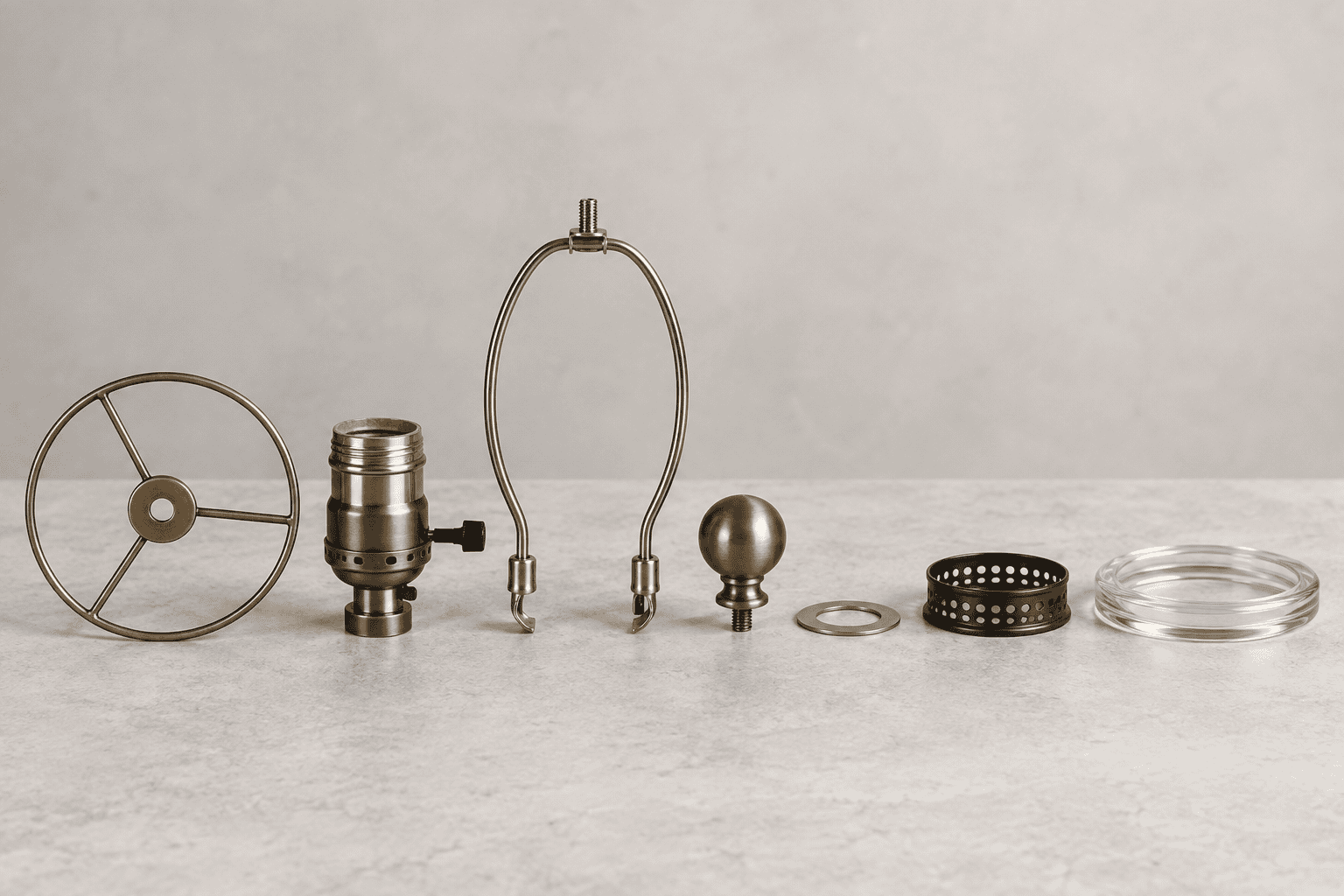
The anatomy reference from Royal Lamp Shades is useful for the vocabulary around a spider fitter, washer and finial. For a glass replacement, add the ring opening, seat and retention details to that vocabulary instead of describing the part only as a shade.
| Term | What it usually describes | Why it matters to a replacement |
|---|---|---|
| Lamp shade ring | A circular support, locating or retaining feature | Sets the contact point and opening relationship |
| Fitter | The complete shade-to-fixture attachment interface | Determines how the part mounts and is retained |
| Washer | A load-spreading disc or ring used with a support or finial | Changes the bearing area and the required opening |
| Harp | A U-shaped bracket that raises and supports a shade | Controls shade height and the top retention position |
| Finial | A threaded decorative fastener or cap | Retains some spider shades through the upper opening |
| Rim | The boundary edge of the shade body | Must remain protected and dimensionally consistent |
| Gasket | A cushioning or spacing element between surfaces | Can change seating depth, rattle and compression |
What jobs does the ring perform?
The same-looking ring can perform different jobs in different fixtures. Before ordering a replacement, identify whether the ring carries weight, locates the shade, prevents rotation, spreads pressure, or simply finishes an exposed opening.
| Ring job | Physical clue | What to record |
|---|---|---|
| Support | The shade rests directly on the ring or its shoulder | Contact diameter, support width and shade weight path |
| Location | The ring centers the shade around a socket, neck or stem | Inside diameter, outside diameter and concentricity |
| Retention | A thread, nut, finial or clip presses the shade against it | Thread or locking method, engagement depth and access |
| Spacing | A ring keeps glass away from a socket, bulb or backplate | Clearance to the bulb, socket and nearby metal |
| Anti-rotation | A slot, shoulder, key or friction surface stops movement | Key position, stop height and rotation direction |
| Finish | The ring hides a raw opening or hardware transition | Visible diameter, finish and relationship to the glass rim |
If a ring only appears decorative, do not remove it from the specification. It may still define the glass seating surface or hide a retaining feature. The lamp shade fitter compatibility guide is a useful cross-check when the ring is part of a spider, uno or specialty fitter assembly.
Lamp shade ring types by attachment method
Spider ring and washer
A spider arrangement places a metal support near the upper area of the shade. The central opening or washer area meets a harp, finial or related support. In fabric shades, the ring may be part of a wire frame. In a glass replacement, the relevant feature may be a collar, opening or separate washer that must align with the existing hardware.
Measure the actual seating opening rather than the outside diameter of the visible shade. Also record whether the ring sits above, below or inside the shade rim. A small change in seating height can alter the final shade position even when the opening diameter appears correct.
Uno ring and socket mount
An uno arrangement uses a socket or neck relationship around the bulb area. The circular interface may be threaded, shouldered or captured between fixture parts. It is often mistaken for a standard bulb-holder dimension, but the shade interface and the electrical socket are not automatically the same measurement.
Record the neck diameter, shoulder location, thread or slot pattern, assembly direction and the space needed to remove the shade. If the fixture is being reproduced, include a side view that shows how far the ring sits above the bulb and socket.
Retaining ring for glass shades
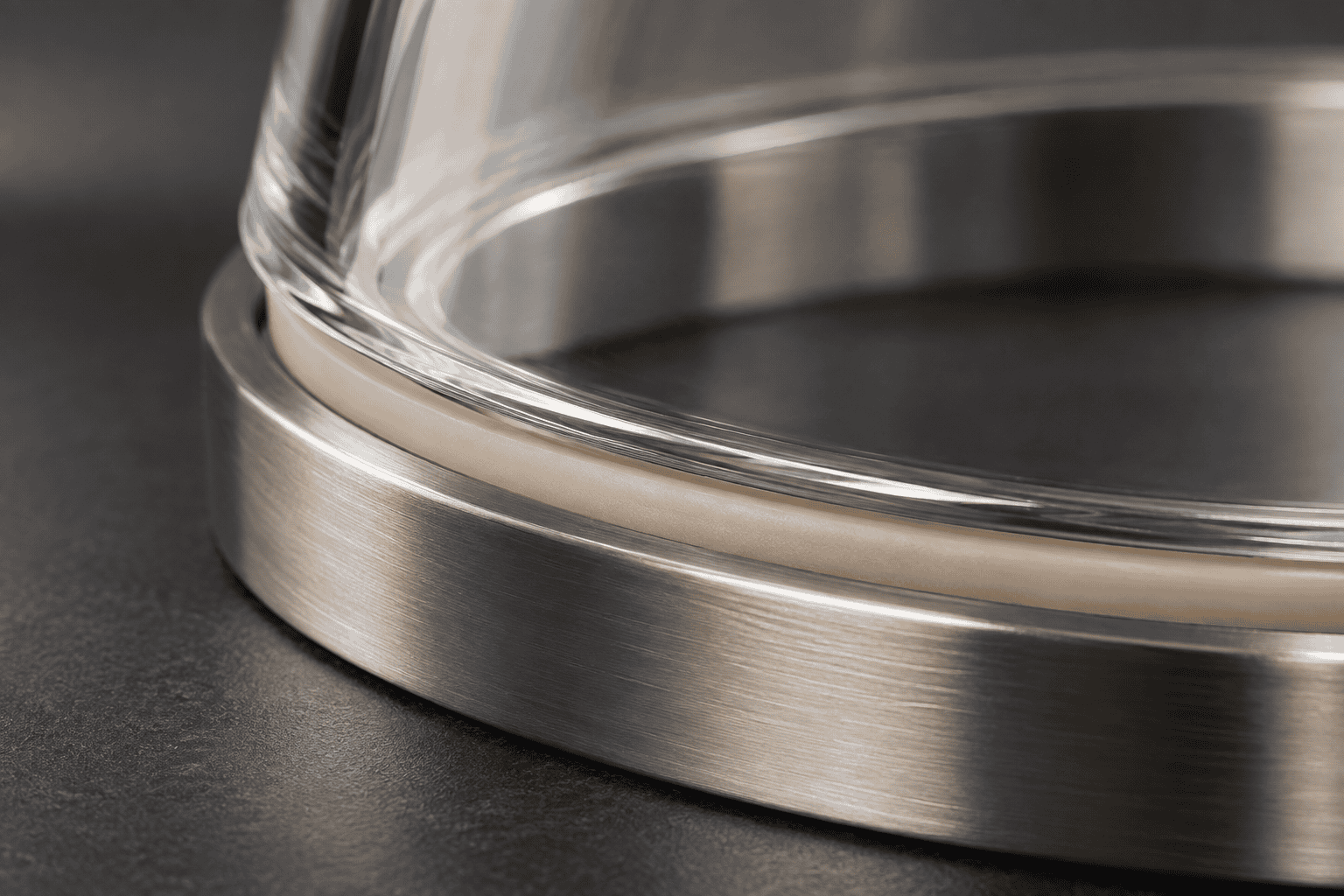
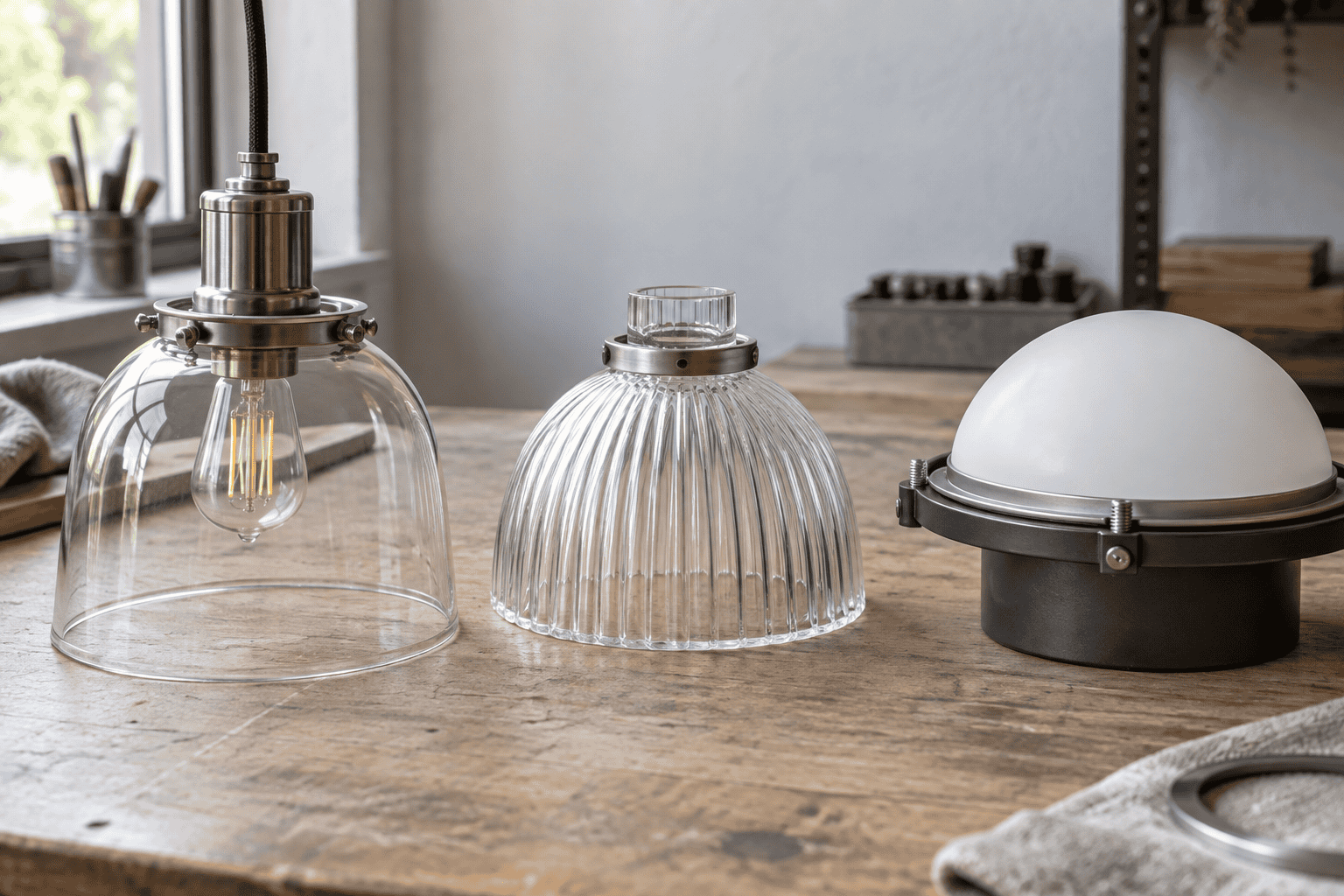
A retaining ring for glass may press a globe, dome, cylinder or diffuser against a shoulder, gasket or gallery. The ring can be visible from the outside or hidden behind a rim. Some designs use a threaded ring, while others use clips, tabs, a spring action or a fixture-specific frame.
The lamp shade-making hardware range from Grand Brass shows why ring, washer and frame terms should be kept separate when a part is ordered. A glass shade needs the same distinction, but its rim, weight, wall thickness and handling requirements make the seating geometry more important.
| Attachment route | Ring or related interface | Best first measurement | Common wrong assumption |
|---|---|---|---|
| Spider or gallery | Central ring, washer or upper support | Seat opening and support height | Any ring with the same outside diameter will fit |
| Uno or neck mount | Threaded or shouldered neck ring | Neck opening and mating depth | The bulb or socket code identifies the shade opening |
| Clip-on adapter | Circular or spring-mounted clip assembly | Clip span and bulb clearance | The adapter is suitable for any shade weight |
| Glass retaining ring | Threaded ring, collar, gasket or gallery | Glass seat and retaining engagement | The visible rim is the same as the seating diameter |
| Fixture-specific frame | Ring combined with tabs, slots or arms | Complete interface drawing | A close photograph is enough to reproduce the part |
Ring vs fitter vs harp vs finial
Use the narrowest accurate term when describing a replacement. This prevents a supplier or buyer from sending a visually similar component that cannot be installed.
| Part or term | It answers | It does not answer |
|---|---|---|
| Ring | Where does the shade locate or bear against the fixture? | Which complete attachment system is used? |
| Fitter | How does the shade attach to the lamp? | What is the outside profile or finish? |
| Harp | What bracket raises and supports the shade? | What opening or glass rim will fit the shade? |
| Finial | What fastener retains the upper opening? | Whether the shade can pass over the lower hardware |
| Washer | How is pressure distributed around the opening? | Whether the glass profile has enough clearance |
| Gallery | What frame or decorative carrier surrounds the opening? | Whether the fixture uses the same thread or neck |
| Retaining ring | What presses the shade against a seat or gasket? | Whether the ring is compatible with the fixture structure |
A ring and a fitter can be described together, but they should not be collapsed into one field in a drawing or RFQ. State the fitter family first, then list the ring geometry that makes the interface repeatable.
How to measure a lamp shade ring
Measure the fixture and the shade together. A loose ring on a workbench can give a misleading result because the installed position may depend on a shoulder, gasket, thread or support arm.
- Switch off the fixture, allow it to cool, and remove the shade only when the assembly can be handled safely.
- Photograph the complete fixture before removing the ring, including a straight-on view of the opening and an underside or rear view of the retaining hardware.
- Identify the contact surface. Mark the diameter where the shade actually sits, not just the widest outside edge.
- Measure the opening, outside diameter, ring thickness, seat depth and support height. Record whether each value is an inside, outside or contact dimension.
- Check threads, slots, tabs, shoulders, clips or a finial passage. A ring that looks round may still have a keyed or non-rotating feature.
- Record the clearance to the bulb, socket, stem, backplate and any nearby metal. The shade must fit the assembled fixture, not only the loose ring.
- Repeat the critical measurement at more than one point. An oval, bent or distorted ring needs a drawing or an inspection decision, not one average number.
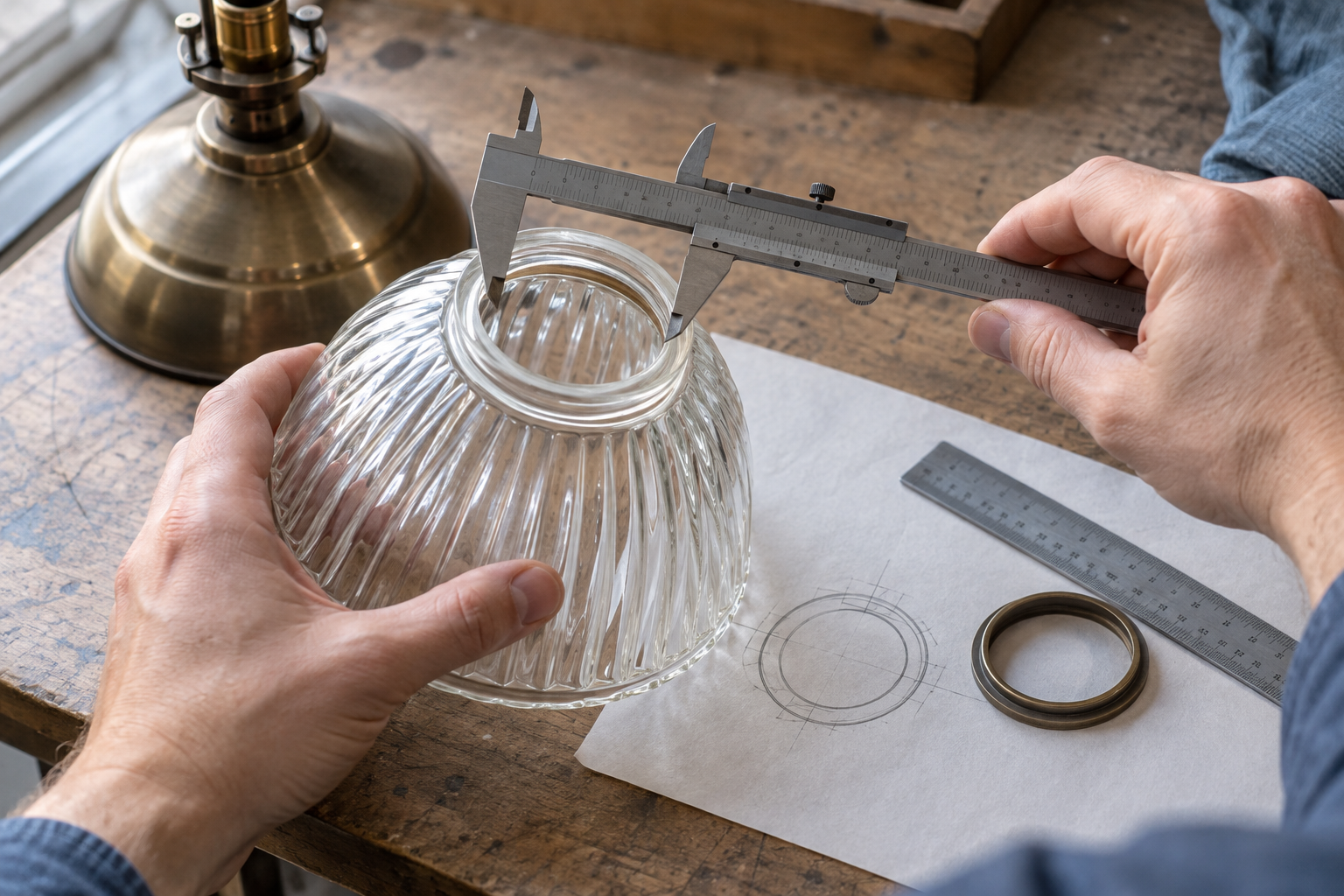
| Field | What to measure | Why it prevents a wrong replacement |
|---|---|---|
| Ring opening | Inside diameter at the actual pass-through or seat | Prevents the shade from stopping before it reaches the support |
| Contact diameter | Diameter where the glass or frame bears on the ring | Confirms the load and locating surface |
| Ring outside diameter | Widest external ring dimension | Checks nearby clearance and visible trim |
| Seat depth | Vertical distance to the shoulder, gasket or stop | Controls final shade height and pressure |
| Retention detail | Thread, slot, tab, clip, nut or finial passage | Identifies the mating hardware |
| Support height | Distance from fixture reference to the shade seat | Prevents tilt or an incorrect visual proportion |
| Bulb clearance | Radial and vertical space around the light source | Avoids interference during installation |
| Glass rim | Rim diameter, thickness and condition | Separates the visible edge from the true seating feature |
For a replacement glass shade, compare this record with the step-by-step glass shade measurement guide. Do not send only the ring outside diameter. Include the fixture photograph and the dimension that controls the seat.
How to match a ring to a glass shade
Start with the interface, then screen the glass profile. The ring should be compatible with the shade opening, but the shade also needs room for the bulb, socket, fastener and installation path.
| Interface condition | Glass detail to match | Reject the option when |
|---|---|---|
| Ring supports a flat or shallow shoulder | Shoulder diameter, edge thickness and flatness | The glass contacts only at a point or rocks on the seat |
| Ring locates a neck | Neck outside diameter, neck length and transition radius | The neck reaches the ring but the shoulder cannot seat |
| Retaining ring clamps a rim | Rim diameter, rim thickness and gasket position | The ring bottoms out before the glass is retained |
| Threaded ring captures the shade | Thread path, stop position and assembly direction | The glass has to be rotated against a sharp or exposed edge |
| Gallery surrounds the opening | Gallery clearance, arm position and visible rim | The profile collides with the arms or hides the intended light opening |
Do not treat clear, frosted, opal, colored or ribbed glass as interchangeable only because the ring opening matches. The body may have a different rim transition, wall thickness or visual light output. The glass light diffusion reference can help define the optical target after the mechanical interface is known.
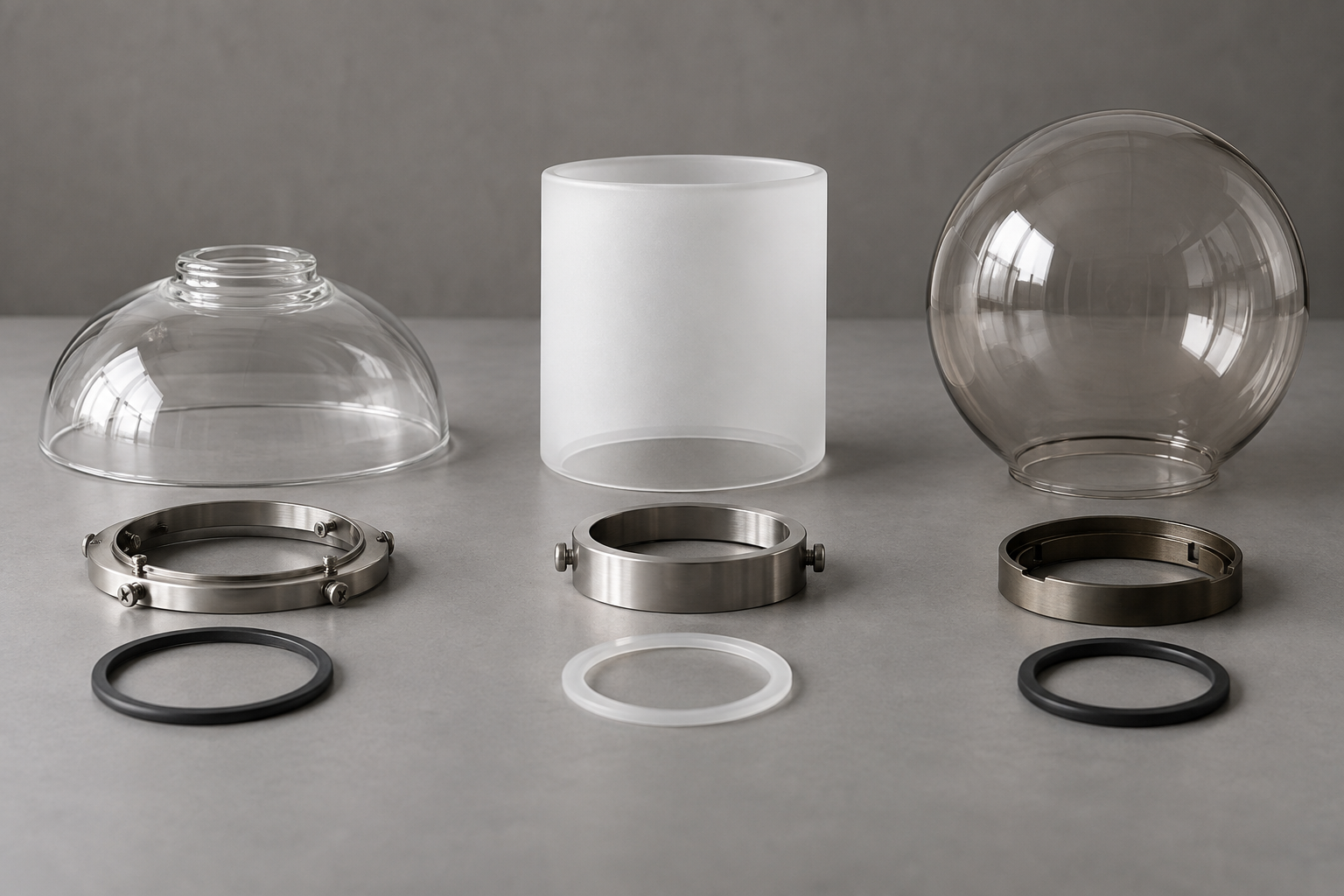
The replacement lampshade accessory catalog is a useful reminder that rings, adapters and frames are sold as different accessory families. For a custom glass part, describe which existing accessory is being retained and which part is being replaced.
Common ring-fit failures and what they mean
A failed fit usually leaves a physical clue. Diagnose the interface before changing the outside shape or adding an improvised spacer.
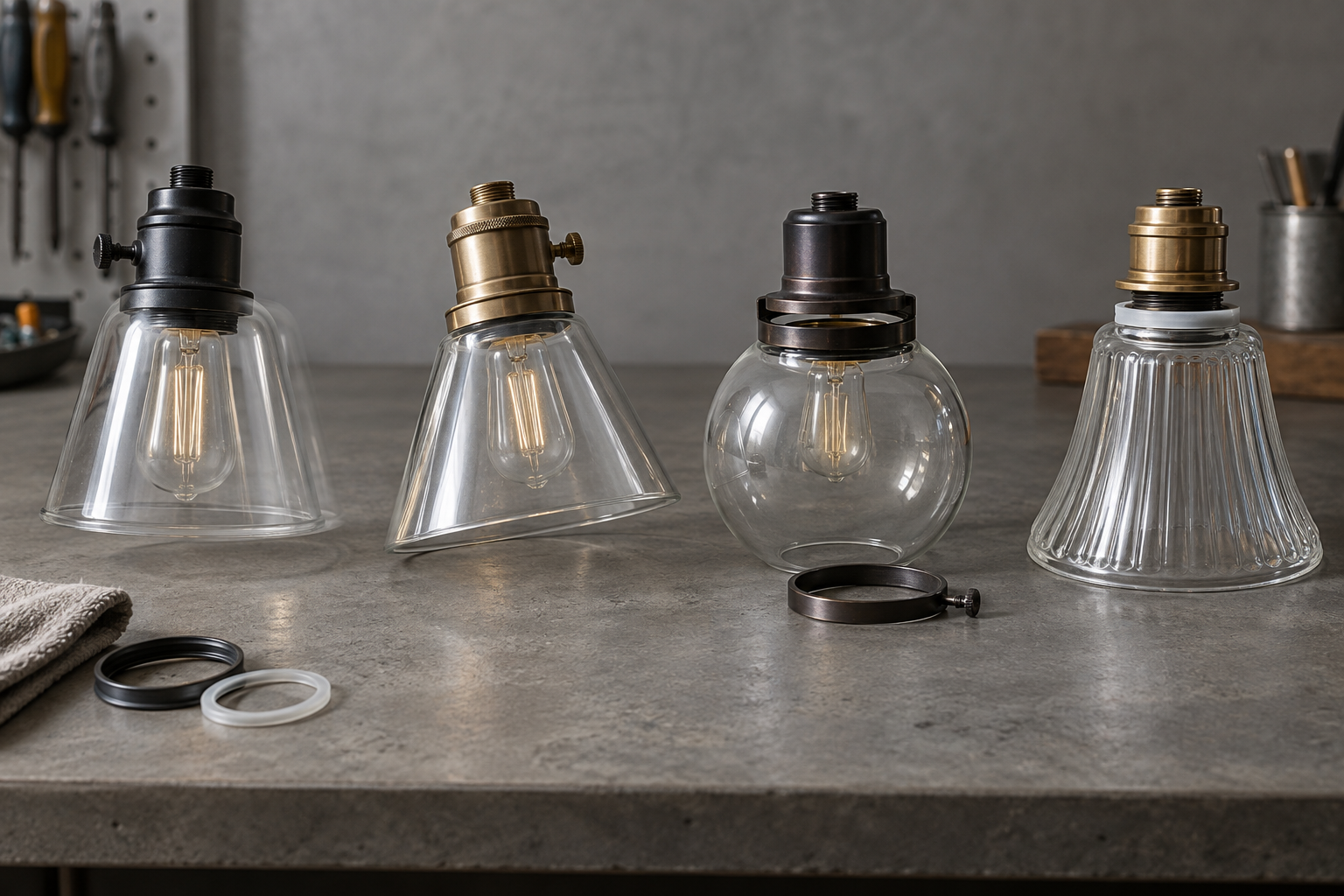
| Symptom | Likely area to inspect | Next check |
|---|---|---|
| Shade wobbles after tightening | Ring contact, seat depth or an uneven rim | Check contact at several points and inspect the ring for distortion |
| Shade tilts to one side | Support height, ring shoulder or fixture alignment | Compare the fixture reference to the shade seat, not just the top edge |
| Ring spins with the shade | Missing key, stop, gasket or anti-rotation feature | Photograph the underside and inspect for a slot, tab or stop |
| Shade rattles when touched | Loose retention, missing cushion or mismatched seat | Check the gasket path and the amount of ring engagement |
| Shade stops before reaching the seat | Opening too small or a hidden shoulder is interfering | Measure the pass-through diameter and the first obstruction |
| Bulb is too close to the glass | Wrong neck depth, profile or support height | Check the installed clearance before selecting a thinner finish |
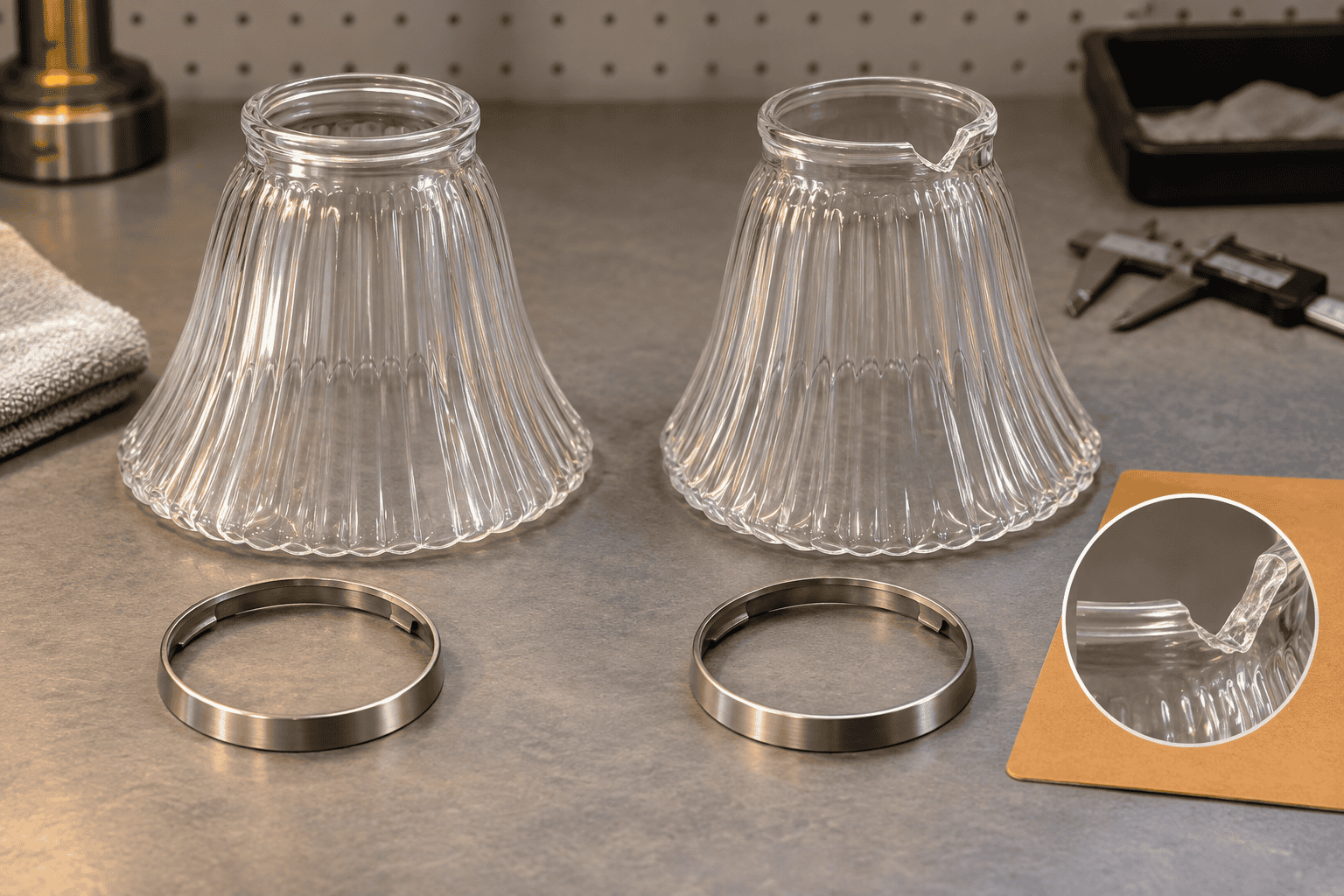
| Rim shows stress or a chip | Point loading, hard contact or a damaged edge | Stop using the piece until the rim and contact path are reviewed |
Do not solve a structural mismatch by forcing the ring, over-tightening a fastener or grinding a glass opening on site. Record the symptom, preserve the original part and request an interface review when the ring or rim is damaged.
OEM and wholesale ring specification checklist
An OEM request should describe the interface as a controlled part. A style name such as “round glass shade” is not enough for a repeatable ring and shade assembly.
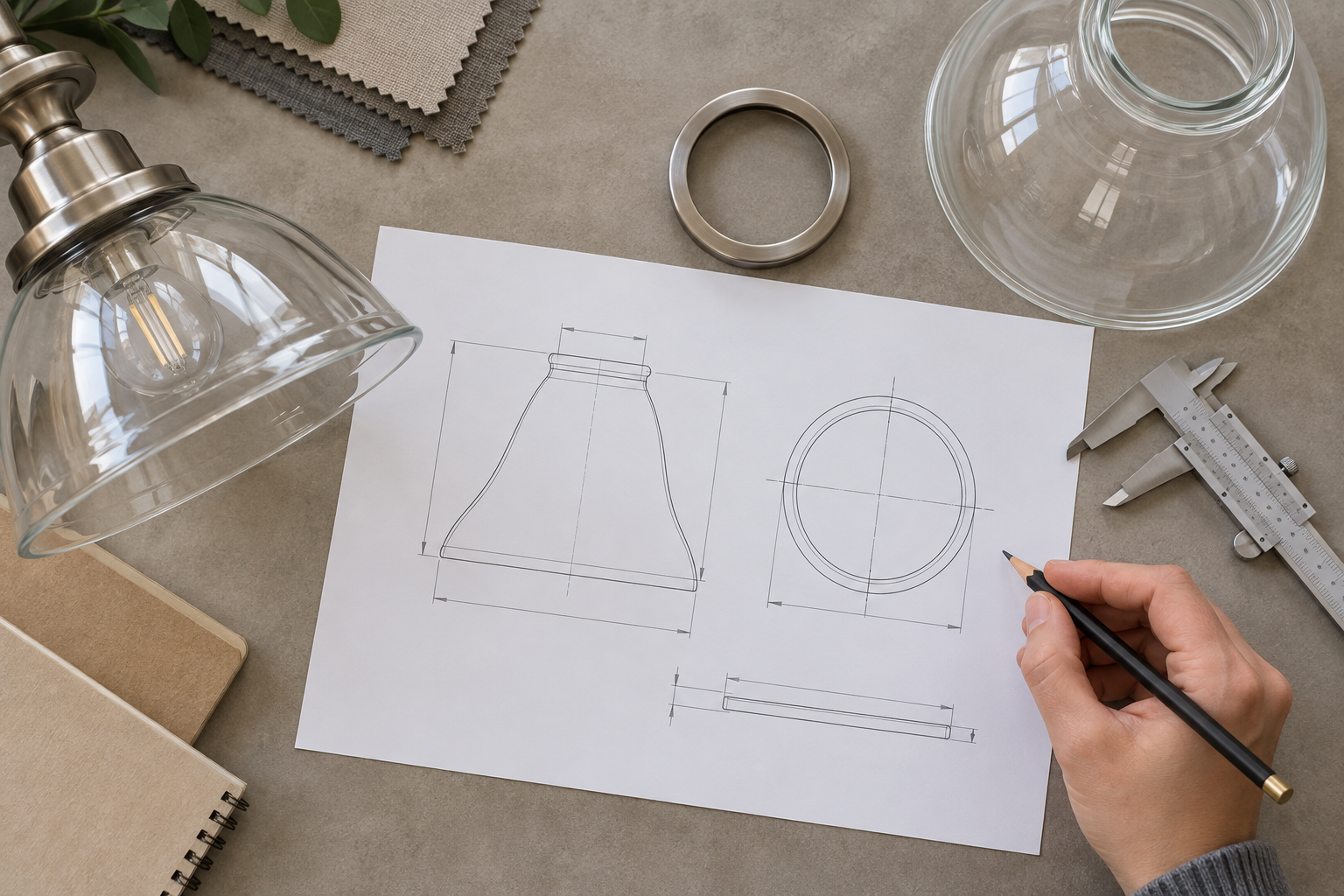
| Specification section | Include | Avoid |
|---|---|---|
| Fixture interface | Ring type, fitter family, retention route and installation direction | “Standard ring” without a drawing or sample |
| Ring geometry | Opening, contact diameter, thickness, seat depth and support height | One outside measurement with no reference surface |
| Mating hardware | Thread, nut, finial, gallery, clip, gasket, slot or shoulder | Assuming the supplier can infer the hardware from a style photo |
| Glass profile | Side elevation, overhead or underside view, overall height and maximum width | A front image with no scale or fixture context |
| Visual result | Desired transparency, diffusion, color, texture or decoration, with a sample when possible | A color adjective without a viewing condition |
| Light condition | LED envelope, color temperature, viewing angle and application | Approving only from an unlit image |
| Inspection | Ring seat, rim, opening, retention, surface, color and lit appearance | A general request for “good quality” |
| Packing | Rim protection, separation, ring protection and carton layout | Treating the fitter and rim as ordinary fill space |
Use the glass lamp shade technical drawing checklist when the ring interface needs to be reproduced. A drawing should show the reference datums and the dimensions that control assembly, not only the overall silhouette.
When to reuse the ring and when to replace the glass
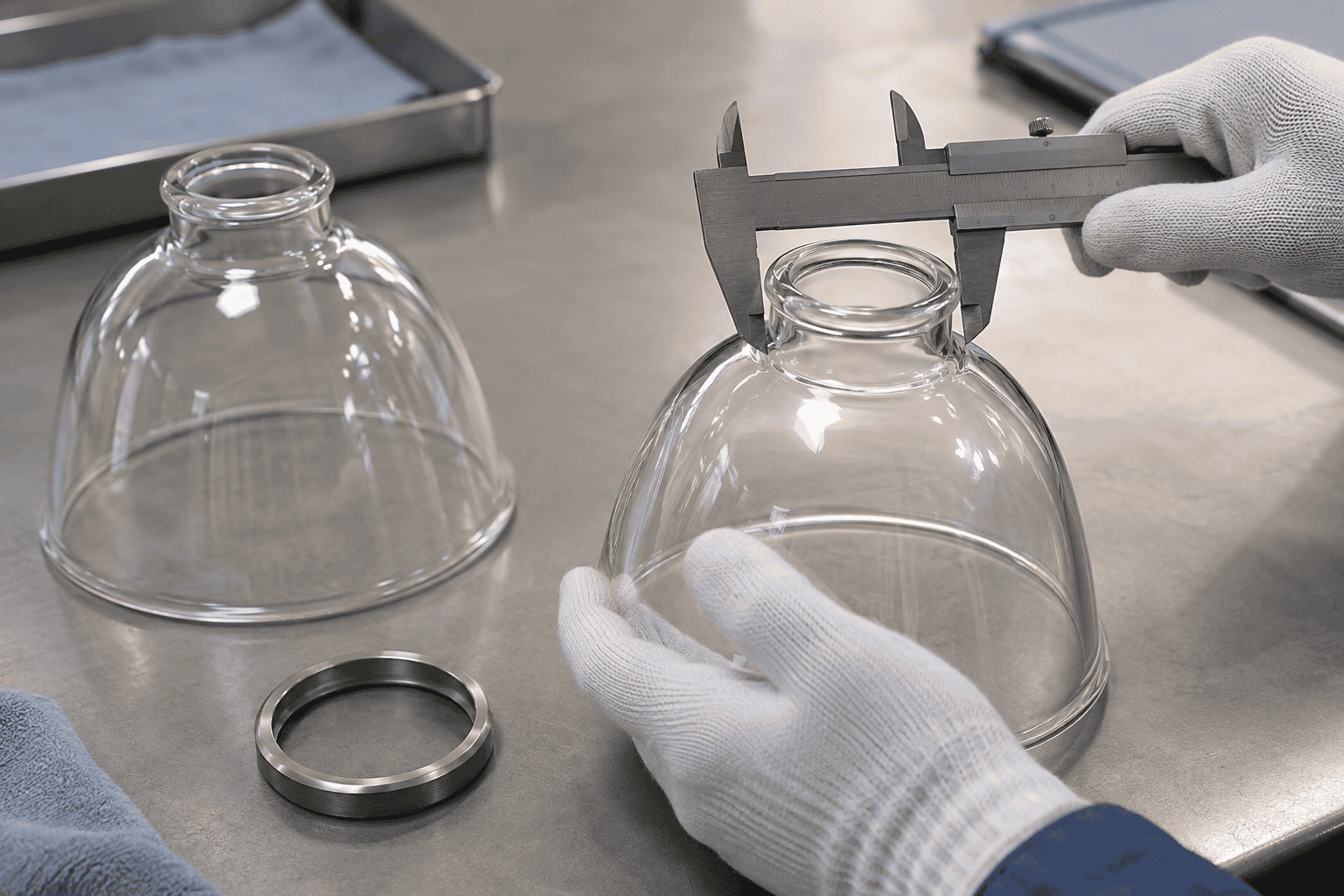
Reuse an existing ring when its contact surfaces are intact, its retention method is understood, and its dimensions remain consistent with the fixture. A sound ring can be the best reference for a replacement glass shade because it preserves the installed interface.
Treat the ring as a replacement candidate when it is bent, loose, corroded, cracked, missing a key feature or impossible to measure reliably. If the ring and glass are both damaged, identify which part defines the fixture and which part can be recreated from a drawing or sample.
Replace the glass when the rim is chipped, the profile is no longer available, the shade has the wrong optical result, or the existing body cannot be safely retained. The new glass should be reviewed against the ring, bulb clearance and installation path as one assembly.
How to prepare a custom glass-shade inquiry
Send evidence in the order a supplier needs to review it:
- A full fixture photograph showing the lamp, socket, stem, backplate or pendant hardware.
- A close view of the ring and a straight-on view of the opening.
- A side profile or tracing of the existing glass shade, even if the glass is damaged.
- Ring opening, contact diameter, seat depth, retention detail and bulb-clearance measurements.
- The intended application and viewing position, such as table, pendant, wall or hospitality fixture.
- The desired glass result, such as a clear, opal, frosted, colored, ribbed, seeded or decorated appearance.
- Sample quantity, expected order quantity and any inspection points that must be compared against a retained sample.
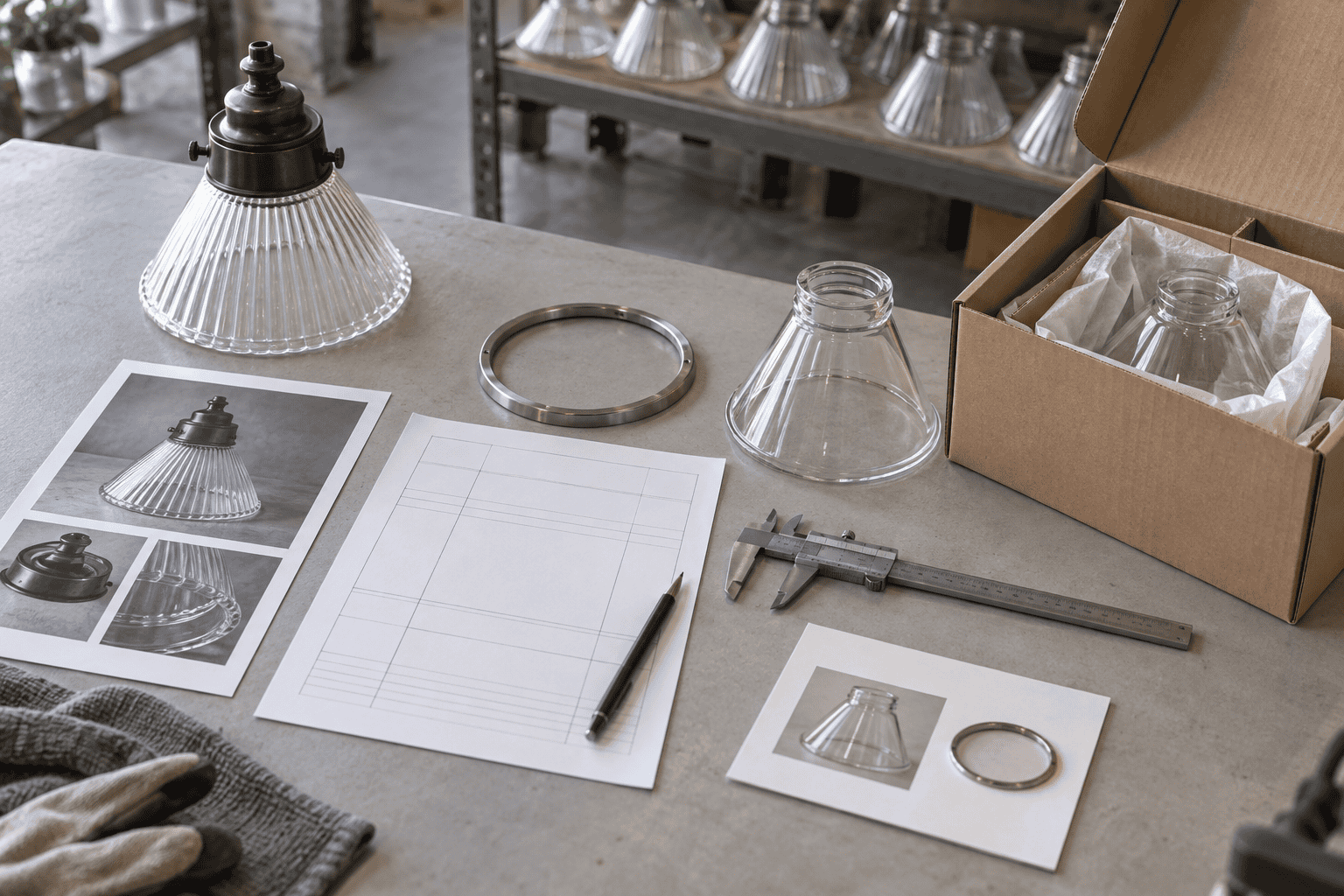
The custom glass lamp shade manufacturer page explains the relevant sourcing path. For a structured request, use the custom lampshade RFQ builder and attach the ring photographs and measurements. Ask for a review of the complete interface rather than a quote based only on an outside diameter.
Buyer questions about lamp shade rings
What is a lamp shade ring?
A lamp shade ring is a circular support, locating or retaining feature that helps a shade meet a fixture. It may be part of a spider fitter, a threaded neck, a gallery, a glass collar or a separate retaining assembly.
Is a lamp shade ring the same as a fitter?
No. A ring is one component or feature. A fitter describes the broader attachment route between the shade and the fixture. A replacement request should name both when the ring is part of a larger assembly.
How do I know what size lamp shade ring I need?
Measure the actual seating opening, contact diameter, seat depth and retention detail on the fixture. Add the bulb and socket clearance, then compare the result with the shade rim or neck. Do not choose from the ring outside diameter alone.
Can I replace a glass lamp shade without replacing the ring?
Often, yes, when the ring is intact and its interface can be measured. The replacement glass still needs to match the ring seat, rim or neck, retention path, clearance and intended light result.
Does a spider ring need a harp?
Not always. A spider-style shade may work with a harp and finial, a gallery or another support arrangement. Identify where the ring is supported and how the shade is retained before ordering a replacement.
Do glass pendant shades use a lamp shade ring?
Some do. Pendant glass may use a neck, gallery, threaded ring, clamp, set screw, gasket or fixture-specific frame. The correct description depends on the actual hardware and the assembly orientation.
Why does a lamp shade ring make the shade wobble?
Wobble can come from an uneven ring, a damaged rim, a mismatched contact diameter, a missing gasket, a tilted fixture or incomplete retention. Check the contact path at several points before changing the shade profile.
What measurements should I send for a custom glass shade?
Send the ring opening, contact diameter, seat depth, ring thickness, retention method, support height, bulb clearance, glass profile, application and desired finish. Add full-fixture and close-up photographs with a scale reference.
Is a lamp shade ring part of the glass shade?
It can be either part of the glass shade assembly or a separate fixture component. A collar or formed neck may be part of the glass body, while a threaded retaining ring or gallery may be supplied by the fixture. Inspect where the ring is attached before describing it.
Turn the ring measurement into a repeatable part
Once the ring is identified, save a compact part record: fitter family, ring geometry, retention method, glass profile, finish, application, light condition, quantity and inspection checkpoints. This record lets a buyer compare a replacement sample against the original interface instead of relying on a vague product name.
For a custom glass shade review, send the fixture photographs, ring measurement, side profile or tracing, intended LED, desired glass appearance and sample or order quantity. The ring is the starting point, not the complete specification. Request a review of the ring, glass seat and installed clearance together.