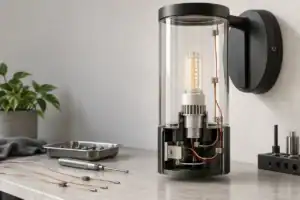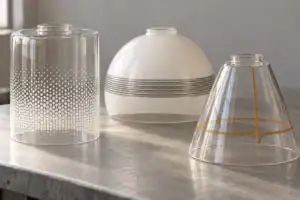
Lampshade fabric is the textile or textile-backed material fitted to a shade frame. Choose it by light diffusion, frame geometry, cleaning needs, and the safety requirements of the complete lamp.
A fabric can look right as a swatch and still perform poorly on a lamp. Backlight the sample, bend it around the intended frame, inspect the cut edge, and confirm the bulb, clearance, backing, and project requirements before approving it. This page focuses on material selection. For finished shade forms and styling, use the fabric lampshades guide.
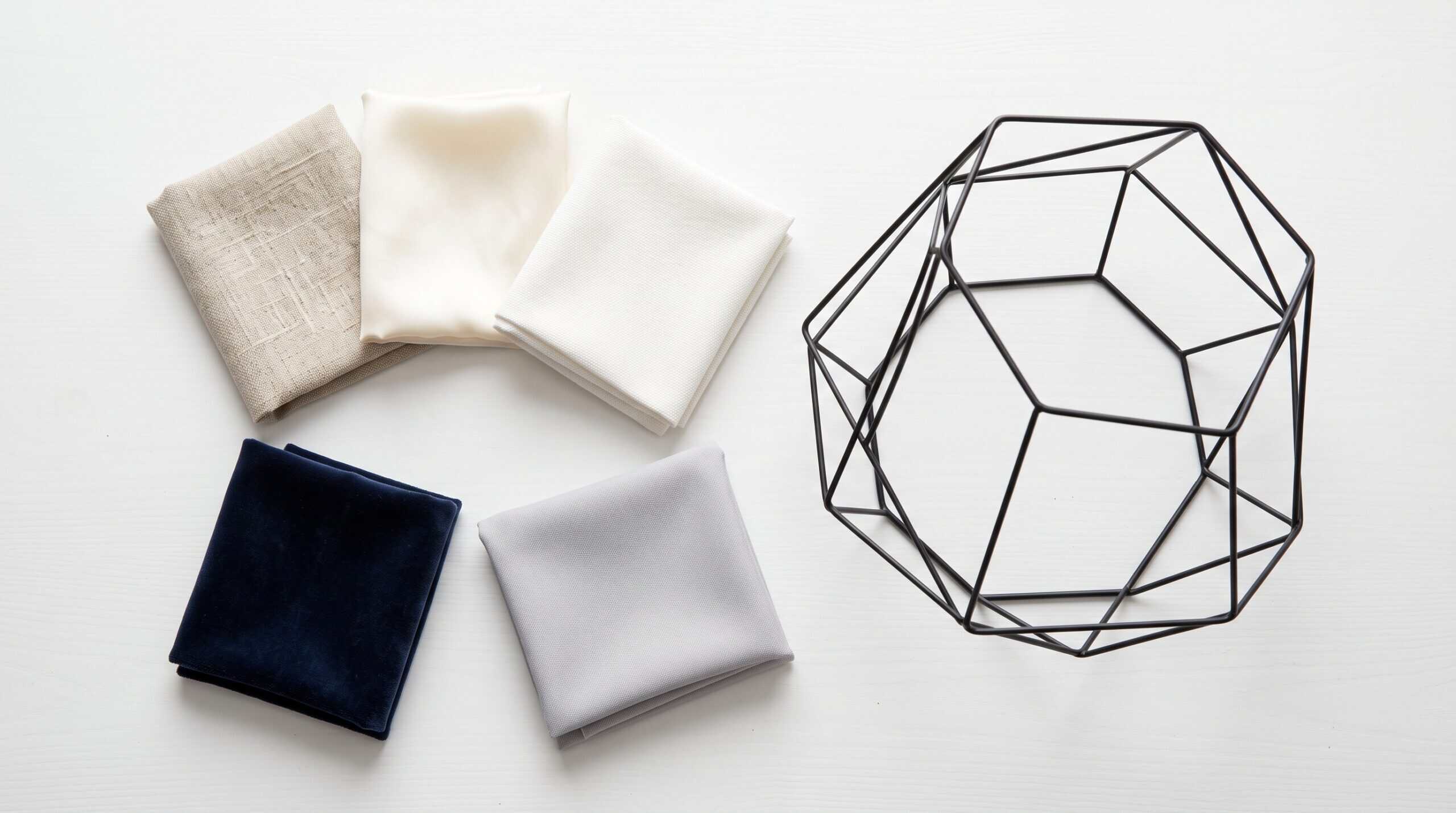
From left: linen, silk dupioni, cotton, velvet, and polyester swatches arranged beside an open wire lampshade frame on a white work table.
How to evaluate lampshade fabric
Good lampshade fabric is semi-translucent (unless blocking light is the goal), stable enough not to sag on a frame, heat-tolerant for the bulb type in use, and either tightly woven or adhesive-backed to resist fraying at cut edges.
Four properties separate workable lampshade fabric from fabric that fails under regular use.
Heat resistance and bulb safety
Lampshade fabric sits close to a heat source, but safe use depends on the complete fixture rather than fiber name alone. Confirm the permitted bulb type and wattage, ventilation, shade dimensions, lining, and clearance from the lamp holder. LED lamps usually reduce radiant heat compared with incandescent or halogen sources, although the base and driver can still become hot.
Do not treat a fabric label or a generic wattage rule as approval for a lamp. Commercial, hospitality, healthcare, and public-space projects may specify flame-performance documents or a particular test method. The buyer, lighting designer, and supplier should confirm the applicable requirement for the destination and the assembled product before production.
Translucency and the quality of light
A lampshade’s diffusion effect comes from the fabric’s weave density and fiber reflectivity working together. Tightly woven cotton emits warm, concentrated downward light. Loosely woven linen scatters light sideways and upward, filling the room with ambient glow. Silk bounces light with a distinctive warm amber cast. Velvet absorbs almost all transmitted light, producing dramatic pools above and below the shade rim with very little room fill.
The combination of fiber type and weave structure produces the final result. Two fabrics at the same weight can transmit light in completely different ways if one uses a plain weave and the other uses a satin weave.
Dimensional stability on the frame
Fabric that stretches, relaxes, or shrinks after installation can pull away from attachment points and develop ripples. Stability varies by weave, finish, backing, humidity, and construction method, not simply by natural versus synthetic fiber. Test the shortlisted fabric on the intended backing and frame, especially for large diameters or tightly tapered shapes.
Fraying resistance at cut edges
The raw edges of lampshade fabric are typically hidden behind binding tape or folded under the frame ring, but fraying during construction damages the fabric before it reaches that point. Tightly woven fabrics with high thread counts fray less than loosely woven or low-thread-count materials. Fabrics with a fusible backing applied during manufacturing fray very little regardless of weave density.
| Fabric | Translucency | Heat tolerance | Fraying risk | Care |
|---|---|---|---|---|
| Linen | Medium | Good | Low | Machine wash |
| Silk | Medium-high | Fair | High | Dry clean |
| Cotton | Medium-low | Good | Medium | Machine wash |
| Velvet | Opaque | Good | Medium | Dry clean |
| Dupioni silk | Medium | Fair | High | Dry clean |
| Polyester | Medium | Excellent | Low | Machine wash |
| Styrene-backed sheet | Low-medium | Excellent | None | Wipe clean |
Best lampshade fabric materials
Linen leads for everyday versatility, silk and dupioni for formal rooms, cotton for DIY projects, velvet for dramatic accent lighting, and polyester or styrene-backed fabric for durable results at any skill level.
Each fabric type performs differently depending on the lamp’s function, the room’s ambiance, and whether the shade is being purchased ready-made or constructed from scratch.
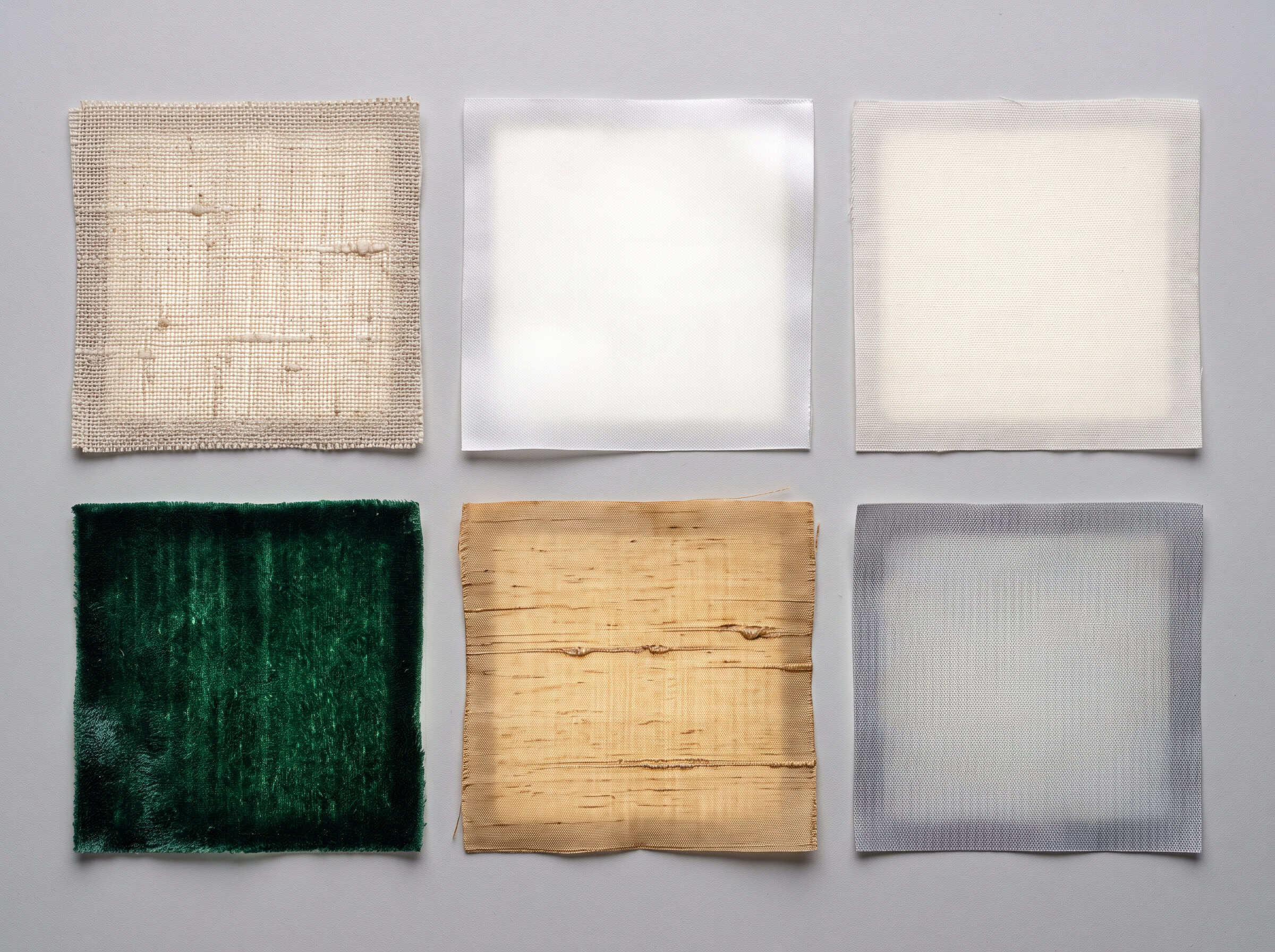
Close-up flat lay of six lampshade fabrics: linen (top left), silk (top center), cotton (top right), velvet (bottom left), dupioni (bottom center), polyester (bottom right). Each swatch is backlit to show actual light transmission.
Linen : the everyday workhorse
Linen’s tight, even weave gives it a clean, consistent transmission: light passes through without hot spots, and the slightly textured fiber surface diffuses it enough to eliminate glare while maintaining warmth. The natural material takes dye reliably, so linen lampshades hold color without yellowing under extended use. It does not stretch, which means it stays flat on both straight-sided drum frames and tapered empire shapes without buckling or pulling at stress points.
Linen’s dimensional stability comes from flax bast fibers that stiffen when dry and relax very slightly in high humidity. For lampshade applications, that characteristic is almost entirely an asset: the shade holds its shape through seasonal changes in ambient humidity, requiring no reshaping or replacement.
Medium-weight linen is a practical starting point, but weight alone does not predict light transmission or workability. Request a swatch with the intended backing, then test it unlit and backlit. A light weave may work with a liner, while a heavier fabric may still wrap cleanly on a straight drum frame.
Linen suits virtually every lampshade form: drum, empire, bell, coolie, and oval. It is the fabric to start with if there is no strong reason to choose another.
Silk and dupioni : formal and luminous
Silk transmits light with a warm amber cast that no synthetic replicates. The natural protein fiber reflects light differently from cellulose fibers: instead of a flat scatter, silk produces a soft internal glow that reads as elegant even in utilitarian shade forms.
Dupioni is a two-thread silk variant with a characteristic slub texture: irregular crosswise ridges created when thread from two silk cocoons interweaves during weaving. Those ridges catch directional light in a way that makes a plain drum shade look decorative without additional embellishment. The visual interest is built into the material itself.
Both silk and dupioni are fragile compared to linen or cotton. The fibers weaken under prolonged UV and heat exposure, and they fray aggressively at cut edges. For DIY projects, dupioni is significantly more forgiving than plain silk because the slub texture conceals small construction imperfections: a slightly uneven seam disappears in the visual noise of the irregular surface.
Silk should be assessed as part of the complete shade construction. Ask the supplier to confirm the lining or backing, recommended lamp source, clearance, and any project-specific test evidence. Do not use a raw-fiber temperature figure as a fixture safety rating.
Cotton : the DIY entry point
Cotton is the default fabric for beginner lampshade projects: widely available in fabric stores, inexpensive, easy to cut and glue, and forgiving of small alignment errors during construction. Plain-weave cotton at 140 to 180 gsm performs identically to linen in most lampshade applications. The main visual difference is a slightly cooler, less warm light transmission compared to linen’s amber cast.
Canvas-weight cotton at over 200 gsm works well for structured drum shades that need to hold their cylindrical shape without internal reinforcement rings. For small decorative table shades, cotton muslin around 100 gsm gives a soft, almost translucent effect that suits nurseries and casual interior settings.
Cotton’s practical advantages are availability, print choice, and straightforward cutting. Compare quotations using the same backing, width, finish, and quantity because the fabric price alone does not represent the finished-shade cost.
Velvet : opaque and dramatic
Velvet blocks almost all transmitted light, making it a deliberate stylistic choice rather than a general-purpose option. A velvet lampshade creates focused columns of light above and below the shade rim rather than filling the room with ambient glow. The pile surface absorbs ambient light, so the shade itself becomes a dark visual anchor rather than a glowing element when lit.
Velvet works best on floor lamps and accent table lamps used for decorative rather than functional lighting. It pairs poorly with reading lamps because the opaque construction severely limits useful light output for task work.
Stretch velvet, a polyester-backed velvet with spandex content, is significantly easier to construct with than traditional woven cut velvet. The slight stretch allows it to conform to curved frame sections that would buckle and develop stress lines under a rigid fabric. For DIY velvet lampshade projects, stretch velvet is the practical choice.
Jewel tones in velvet : deep green, sapphire blue, burgundy : are among the strongest 2026 interior trends, particularly in maximalist and eclectic interior styles.
Polyester and synthetic blends : durable and forgiving
Polyester lampshade fabric offers the widest range of textures at the lowest price point. It handles heat better than most natural fibers, resists UV fading over long periods, and washes easily. The main tradeoff: polyester transmits light with a slightly cooler, more neutral quality than linen or silk, and the surface can develop a slight sheen under prolonged high-wattage incandescent heat.
Polyester-linen blends combine visible texture with easier care, but blend percentages and finishes vary. Approve the actual swatch under the intended lamp source rather than relying on a generic fiber description.
For high-traffic or children’s room applications where the shade will be cleaned frequently, polyester or a polyester blend is the rational material choice over any natural fiber.
| Fabric | Best room type | Light output quality | Cost range | Machine washable |
|---|---|---|---|---|
| Linen | Living, bedroom, office | Warm, even | $$ to $$$ | Yes |
| Silk | Formal dining, bedroom | Warm, luminous | $$$ to $$$$ | No |
| Cotton | Any casual space | Neutral-warm | $ | Yes |
| Velvet | Accent, lounge | Minimal (opaque) | $$ to $$$ | No |
| Dupioni | Formal, traditional | Warm, textured | $$$ | No |
| Polyester | High-traffic, children’s | Neutral | $ | Yes |
| Poly-linen blend | Any | Warm, durable | $$ | Yes |
Match lampshade fabric to the frame shape
Empire and bell shades need fabric with some bias-cut flexibility because the panels taper and must lie flat against a curved, angled form. Drum shades suit flat-panel construction with any woven fabric. Pleated shades require lightweight fabric that folds to a crisp edge without permanent creasing or gapping between pleats.
The relationship between fabric type and frame geometry is one of the most commonly overlooked aspects of lampshade construction. The wrong combination produces a shade that looks correct in a photograph but develops visible stress marks and shape distortion within weeks of regular use.
Empire and bell shades
The slanted sides of empire and bell shades require fabric to conform to two arcs simultaneously: the top ring at one diameter and the bottom ring at a larger diameter. On fabric cut on the straight grain, this geometry creates a pull that buckles the material inward at the midpoint of each panel. The fix is to cut on the bias at 45 degrees to the grain, which allows the weave to flex laterally without resistance.
Linen and cotton handle bias cutting well and maintain stability on the frame after construction. Silk and dupioni must also be cut on the bias for empire shapes, but the fraying risk increases significantly at angled cuts, so seam sealant applied to raw edges before construction is essential. Velvet should not be cut on the bias: the pile direction becomes inconsistent around the perimeter, creating visible variation in light absorption that reads as a manufacturing defect.
Drum shades
Drum shades are the most forgiving shape for fabric selection. Because the top and bottom rings are the same diameter, the fabric wraps on a true cylinder with no taper and no geometry-driven stress. Any woven fabric cut on the straight grain lies flat against the frame without the stress forces that affect empire shapes.
For drum shades, fabric stiffness becomes the primary selection variable rather than stretch or bias behavior. A rigid fabric like canvas-weight cotton holds the cylindrical form without internal support rings. A very lightweight fabric like chiffon or fine georgette requires a styrene-backed inner layer to maintain shape because it lacks the structural integrity to span the frame on its own.
Drum shades also benefit from pattern-on-fabric alignment in a way that tapered shades do not: a stripe or geometric print placed on a drum shade remains perfectly vertical and horizontally aligned around the full circumference, which is not achievable on a tapered shade.
Pleated shades
Pleated construction requires a fabric that folds sharply to a defined edge and holds that angle without springing back when released. The pleat must stay crisp at the fold line and lie flat against the adjacent panel without gapping or pulling.
Lightweight silk, cotton poplin at around 120 gsm, and fine linen all pleat well because the fibers compress cleanly at the fold line. Velvet cannot be pleated: the pile collapses at fold lines and never recovers the standing structure. Polyester-linen blends pleat adequately, but the polyester content reduces fold sharpness compared to pure natural fibers.
Pressing pleats with a warm iron before attaching them to the frame sets the fold permanently and ensures consistent spacing. Fabric with high polyester content may not hold the pressed pleat once heat cycling from the bulb begins.
How much lampshade fabric do you need?
Measure the slant height, multiply by the bottom circumference, add 2 inches per edge for seam allowance, then divide by fabric width to get yardage. Most standard table lamp shades need 1 to 1.5 yards of 54-inch fabric.
Getting the yardage calculation right before buying avoids a return trip to the store for more fabric and prevents a visible seam landing at the wrong position on the finished shade.
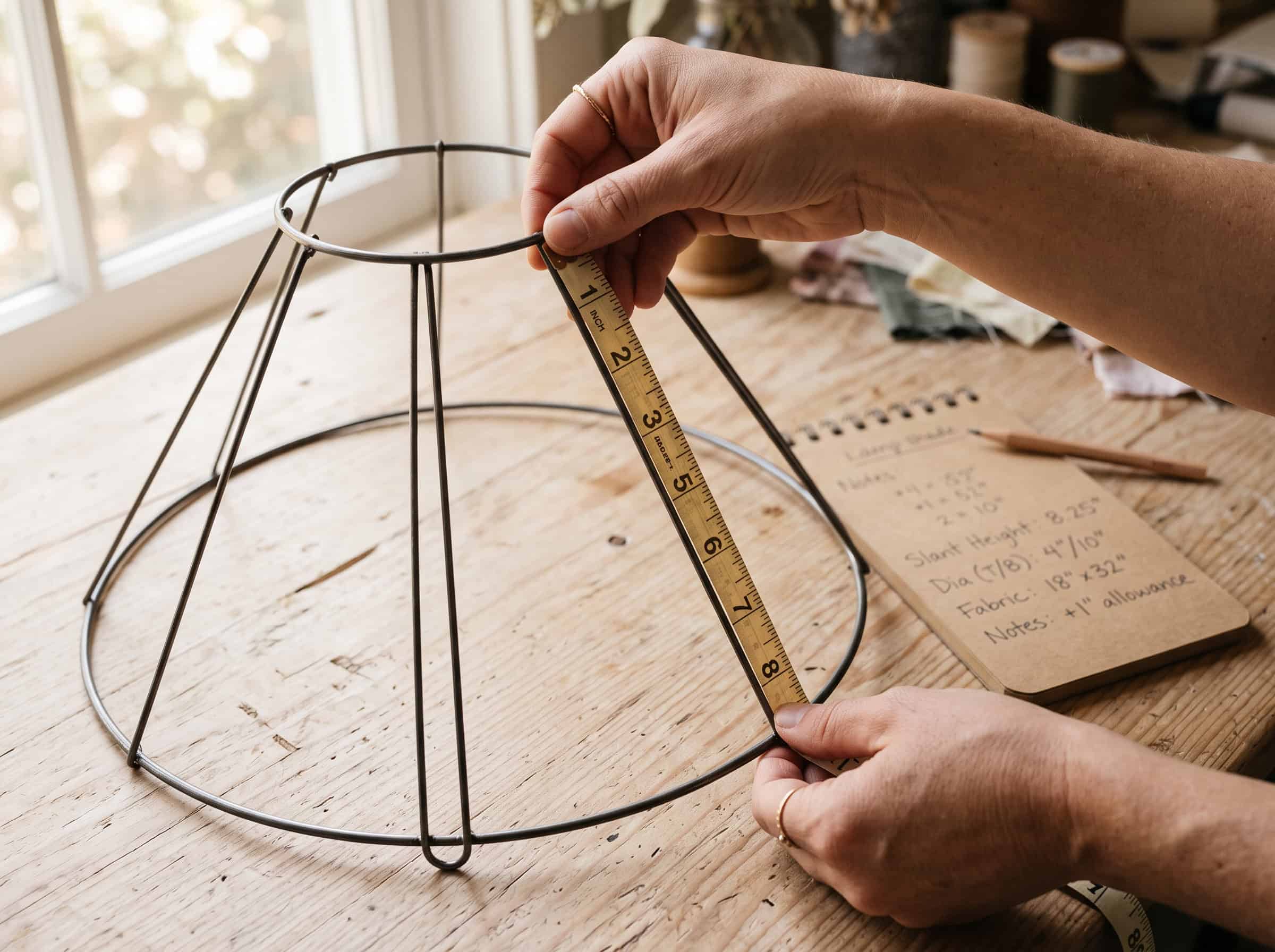
Measuring slant height from the top ring wire to the bottom ring wire along the angled slope of the frame gives the correct panel height for cutting. The vertical interior measurement is always shorter and always incorrect for this purpose.
Measuring slant height and circumference
The slant height runs from the top ring to the bottom ring along the angled side of the shade, not through the vertical interior. Use a flexible tape measure pressed against the frame wire and following the slope of the shade wall, not a ruler held straight through the center.
The circumference to use for fabric width calculations is the bottom ring. Multiply the bottom ring diameter by 3.14 to convert diameter to circumference. Add 10% to that figure for seam overlap and minor alignment adjustment.
Formula:
– Panel width needed: Bottom circumference + 4 inches (2 inches per side)
– Panel height needed: Slant height + 4 inches (2 inches top and bottom)
– Number of fabric widths: Panel width divided by fabric roll width, rounded up
– Yardage: Number of widths × panel height, converted from inches to yards
Worked example: A 16-inch diameter drum shade with a 12-inch slant height. Bottom circumference = 16 × 3.14 = 50.2 inches, plus 4 = 54.2 inches wide needed. One 54-inch fabric roll width just covers this. Height needed: 12 + 4 = 16 inches = 0.44 yards. Buy 0.75 yards to allow for cutting errors and seam sealant margin.
For a tapered empire shade with a 10-inch top ring, 16-inch bottom ring, and 14-inch slant height: use the bottom circumference (50.2 inches) for the width calculation. Slant height (14 inches) + 4 = 18 inches = 0.5 yards per fabric width. If the panel width requires two fabric widths, buy 1 yard minimum, 1.5 yards recommended.
Accounting for pattern repeats
Directional prints and large pattern repeats require extra fabric to align the design at visible seam lines. For a print with a 6-inch vertical repeat, add one full repeat per panel. For prints with 12-inch or larger repeats, add 1.5 repeats per panel when calculating total yardage.
Non-directional solids, textures like linen weave or boucle, and small all-over prints need no extra yardage beyond the standard margin already accounted for in the formula.
Stripes on a drum shade require planning: a vertical stripe lands cleanly at a seam if the stripe spacing divides evenly into the shade circumference. Calculate whether the stripe repeat aligns before buying, or budget for one additional full fabric width to allow for re-cutting.
Lampshade fabric construction methods
The stretch-and-glue hardback method suits stiff fabrics and rigid frames with pre-attached backing. The panel-sewn softback method works for any fabric weight and produces a softer finished look. Styrene-backed fabric sheets offer the fastest construction with the most consistent results for first-time builders.
The right technique depends on the frame type, fabric choice, and the desired visual character of the finished shade.
Stretch-and-glue on a hardback frame
A hardback frame has a solid styrene or card backing already bonded to the wire rings. The decorative fabric is stretched over the exterior surface and glued around the top and bottom edges. This method works best with fabrics that have some diagonal flexibility: linen or cotton cut on the bias, stretch velvet, and polyester blends.
Materials required: Heat-resistant fabric glue (not standard PVA), bulldog clips with silicone jaw pads to avoid indenting the fabric, a bone folder, sharp fabric scissors, and seam sealant for fraying edges.
Process: Apply a thin bead of fabric glue to a 3-inch section of the top ring edge. Stretch the fabric across that section, fold the edge down over the ring, and clip until set. Move to the next 3-inch section. Work in short sections rather than applying glue around the full circumference at once: the glue sets faster than the full wrap takes to complete, and rushing causes ripples.
After the top edge is fully bonded and dry, repeat for the bottom edge, re-checking tension before each clip placement.
Panel-sewn softback construction
A softback shade uses an open wire frame with no pre-attached backing. The fabric panels are cut to shape, pinned onto the frame spokes, and sewn directly to the frame structure. The result is softer-looking than a hardback shade, with slight organic variation between panels that reads as handcrafted.
Best fabrics: Silk, linen, and cotton at 140 to 180 gsm. These weights are pliable enough to pin without distortion but stable enough to hold their shape once attached.
Process: Cut fabric panels with a 1-inch seam allowance on each edge. Pin to the frame with the right side of the fabric facing outward. Sew each panel to the frame spokes using a whip-stitch with waxed thread, working from top ring to bottom ring along each spoke. Trim excess fabric at the top and bottom rings after all panels are attached, then cover the raw edges with matching binding tape.
Styrene-backed fabric sheets
Pre-backed styrene sheets combine woven fabric on one face with a heat-activated adhesive styrene backing. The composite material cuts cleanly with scissors or a craft knife, bonds to itself at seam edges when pressed, and holds a permanent shape without requiring a wire frame in most sizes up to 14 inches in diameter.
These sheets suit beginners because construction errors are visible before the piece is finished. A misaligned cut or a gap at a seam can be caught and corrected before the final seam is pressed closed. The main limitation is restricted aesthetic range: the fabric options available in pre-backed form are far narrower than raw fabric options.
Styrene-backed lampshade panels are available through specialist lampshade suppliers in standard heights from 6 to 18 inches. For non-standard sizes, raw styrene backing material can be applied to any fabric using an iron at low heat with a silicone pressing sheet between the iron and fabric surface.
Lampshade fabric specifications for commercial orders
Commercial orders add requirements that a one-off DIY shade may not have: repeatable color, controlled construction, documented inspection, packaging, and any project-specific fire or material evidence. Glass may simplify textile-related questions, but the complete fixture and destination requirements still need review.
Commercial lampshade fabric must be reviewed against the project specification, approved sample, construction method, and expected production consistency. A useful supplier review starts with the assembled shade and its destination, not a fabric name alone.
What to send a lampshade supplier
Send enough information for the supplier to identify conflicts before sampling. Exact availability, sample timing, production lead time, minimum quantity, testing, and documentation must be confirmed for the specific project.
- Fixture type, room or project application, intended lamp source, and destination market.
- Top and bottom dimensions, slant height, frame shape, fitter, and required clearances.
- Fabric composition, weave, color reference, pattern direction, backing, lining, and approved swatch status.
- Sample quantity, production quantity, inspection points, packaging direction, and delivery destination.
- Required reports, declarations, labeling, or customer specifications, with the exact acceptance criteria stated by the buyer.
For a structured first inquiry, use the custom lampshade RFQ builder and attach the latest drawing or reference sample.
Confirm fire and project requirements
Project documents may reference textile tests such as BS 5867 or NFPA 701, but applicability depends on the product, occupancy, installation, and local authority requirements. Ask the buyer or specifier for the exact standard, test method, performance level, report format, and validity requirements. Do not assume that one textile certificate approves the complete lamp.
Retail fabric descriptions often lack the traceable documentation required by a commercial specification. Before quoting, confirm whether the project needs a supplier declaration, a third-party report, lot traceability, or testing of the finished construction. Record the agreed requirement on the purchase order and sample approval.
Dye-lot consistency across production runs is a separate commercial challenge. The same fabric ordered six months apart from the same supplier can differ visibly in color depth. Commercial lampshade manufacturers typically order full-project quantities at once to eliminate this variable, increasing upfront stock requirements.
When to specify glass instead
Fabric lampshades require dye-lot matching across production batches, consistent tension during assembly, periodic replacement as fabric ages and yellows under heat and UV exposure, and fire compliance documentation for commercial use.
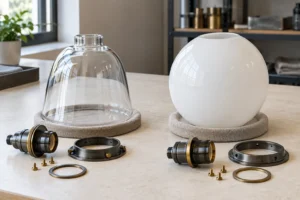
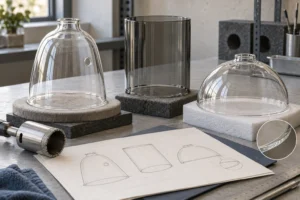
A glass lampshade avoids textile dye-lot and fabric-aging concerns and can be easier to wipe clean. It still requires project review for dimensions, fitter compatibility, thermal conditions, impact risk, finish consistency, packaging, and any fixture-level compliance documents. Compare lifecycle cost using the actual replacement, cleaning, breakage, and labor assumptions for the project.
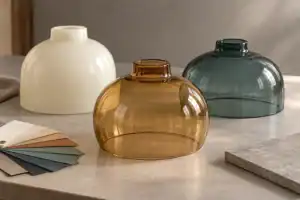
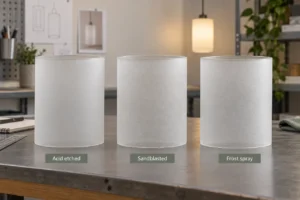
Fabric provides a soft surface and visible weave. Frosted, opal, etched, or textured glass can produce a different form of diffusion with a cleanable rigid surface. For hospitality or multi-location work, compare approved samples and state the acceptable color, finish, dimensions, inspection method, and replacement plan for whichever material is selected.
Lampshade fabric directions for 2026
Current lampshade fabric briefs often request visible natural texture, boucle, undyed-looking neutrals, and material documentation. Treat these as design directions, then verify construction, cleaning, sourcing continuity, and the evidence behind any sustainability claim.
For a repeat order, appearance is only one part of the decision. Ask whether the material will remain available, how color variation is controlled, and whether a replacement swatch can be matched to the approved sample.
Natural fiber resurgence
Undyed-looking linen: Natural ecru tones and visible weave suit interiors that use warm neutrals and restrained finishes. Confirm whether the fabric is genuinely undyed or only styled to look natural, especially when environmental claims are part of the brief.
Organic cotton: Certifications under the Global Organic Textile Standard (GOTS) are becoming a meaningful purchase filter for sustainability-focused buyers, particularly in nursery, children’s room, and wellness-focused residential applications. GOTS certification covers both fiber origin and dyeing and finishing processes, making it a more comprehensive sustainability marker than “natural fiber” alone.
Grasscloth and jute weaves: Paper-backed grasscloth has been a wallcovering material for decades. As a lampshade fabric, it transmits light with warm, visible fiber variation that reads as artisanal and handmade. It is fragile compared to woven textile fabrics and suits only small table lamps in low-humidity interior environments. High ambient humidity causes grasscloth to soften and lose shape.
Textured and boucle weaves
Boucle fabric, long associated with Chanel-style suiting material, has crossed from fashion textiles into residential interior applications. As a lampshade material, the looped yarn structure creates surface texture that casts micro-shadows under directional light, adding visual depth to what would otherwise be a plain shade form.
The structural challenge with boucle is the irregular surface: the loops catch on frame spokes during construction and can pull free during fabric tensioning. Pre-backing the boucle on a fusible interlining before construction eliminates both problems and allows normal stretch-and-glue technique without loop damage.
Boucle lampshades suit larger statement floor lamps and table lamps as room focal points. The texture reads as background noise on small shades where the detail becomes too fine to register visually.
| Trend fabric | Aesthetic | Best lamp style | 2026 momentum |
|---|---|---|---|
| Undyed linen | Japandi, quiet luxury | Table, floor | Strong |
| Boucle | Maximalist, textured | Table, statement | Strong |
| Organic cotton | Nursery, eco-conscious | Table, pendant | Medium |
| Grasscloth | Artisanal, warm | Table only | Medium |
| Velvet, jewel tones | Maximalist, eclectic | Accent floor | Steady |
| Poly-linen blend | Practical, transitional | Any | Steady |
Lampshade fabric FAQ
What is the best fabric to make a lampshade?
Linen is the best general-purpose fabric for a lampshade. It transmits warm, even light without hot spots, holds its shape on any frame type without stretching, and is available in a range of weights to suit small table shades and large floor lamp shades alike. Silk performs better in formal rooms where its warm luminous quality is the primary design objective.
Can you put regular fabric on a lampshade?
Regular fabric works if the weave is stable enough to stay flat on a frame without stretching, the weight falls between 140 and 220 gsm for most shade sizes, and the fabric has no loose loops or pile that would catch on frame spokes. Avoid sheer fabrics for standalone construction. Very sheer materials like organza or chiffon work only as overlay decoration on a pre-built opaque shade.
Lampshades use linen, cotton, silk, dupioni silk, velvet, polyester, and backed fabric sheets. Other shades use glass, paper, parchment, metal, or woven plant materials. Glass can suit commercial and hospitality projects when a rigid, cleanable shade and repeatable finish fit the fixture. The supplier still needs to confirm the glass specification, tolerances, fitter, packaging, and project documents.
How many yards of fabric do you need for a lampshade?
Most standard table lamp shades at 14 to 16 inches in diameter need 1 to 1.5 yards of 54-inch-wide fabric. Larger floor lamp shades at 18 to 22 inches need 1.5 to 2.5 yards depending on slant height. Always buy 15 to 20% more than the minimum calculated quantity to allow for cutting errors and pattern alignment adjustments at seam positions.
Lampshade fabric must be suitable for the complete lamp and its permitted light source. LED lamps often reduce radiant heat, but no fabric is automatically safe for every LED fixture. Follow the fixture rating, maintain the specified clearance, and confirm the backing, lining, ventilation, and any project test requirement with the supplier.
What fabric is best for a DIY lampshade?
Cotton or linen at 140 to 180 gsm are the best starting choices for DIY construction because they are widely available, straightforward to cut and glue, and forgiving of small alignment errors. For the easiest possible DIY project, styrene-backed fabric sheets skip the gluing process entirely: the backing bonds to itself at seam edges when pressed, making construction faster and more consistent than working with raw fabric on a wire frame.
How do I attach fabric to a lampshade frame?
The two main methods are stretch-and-glue for hardback frames with a pre-attached styrene or card backing, and whip-stitch panel sewing for open wire frames. For hardback frames, apply heat-resistant fabric glue in 3-inch sections along the top ring, stretch the fabric evenly across that section, fold the edge down, and clip until fully set. Repeat for the bottom edge. For open wire frames, cut panels with 1-inch seam allowance on each edge and sew directly to the frame spokes using waxed thread in a tight whip-stitch pattern.
Is linen or silk better for a lampshade?
Linen is better for everyday table and floor lamps in living rooms, bedrooms, and home offices. Silk is better for formal spaces, dining rooms, and statement pieces where the warm luminous glow of silk light transmission is the primary design goal. Silk requires dry cleaning and is more fragile under sustained heat than linen, so it carries higher maintenance requirements over the lifetime of the shade.
Prepare your lampshade fabric specification
A usable lampshade fabric specification connects the required light effect to the frame, construction method, cleaning plan, approved sample, quantity, and project documents.
Linen and cotton cover most applications without special handling requirements. Silk and dupioni are the right call when light quality and formal aesthetic take priority over practicality. Velvet belongs on accent fixtures where opacity and drama are the design intent. Polyester and styrene-backed sheets are the practical choice when durability and easy care matter more than light quality nuance.
The calculation shifts significantly in commercial and manufacturing contexts. Fabric compliance documentation, dye-lot consistency, and multi-year replacement planning add costs that do not appear in the initial material price.
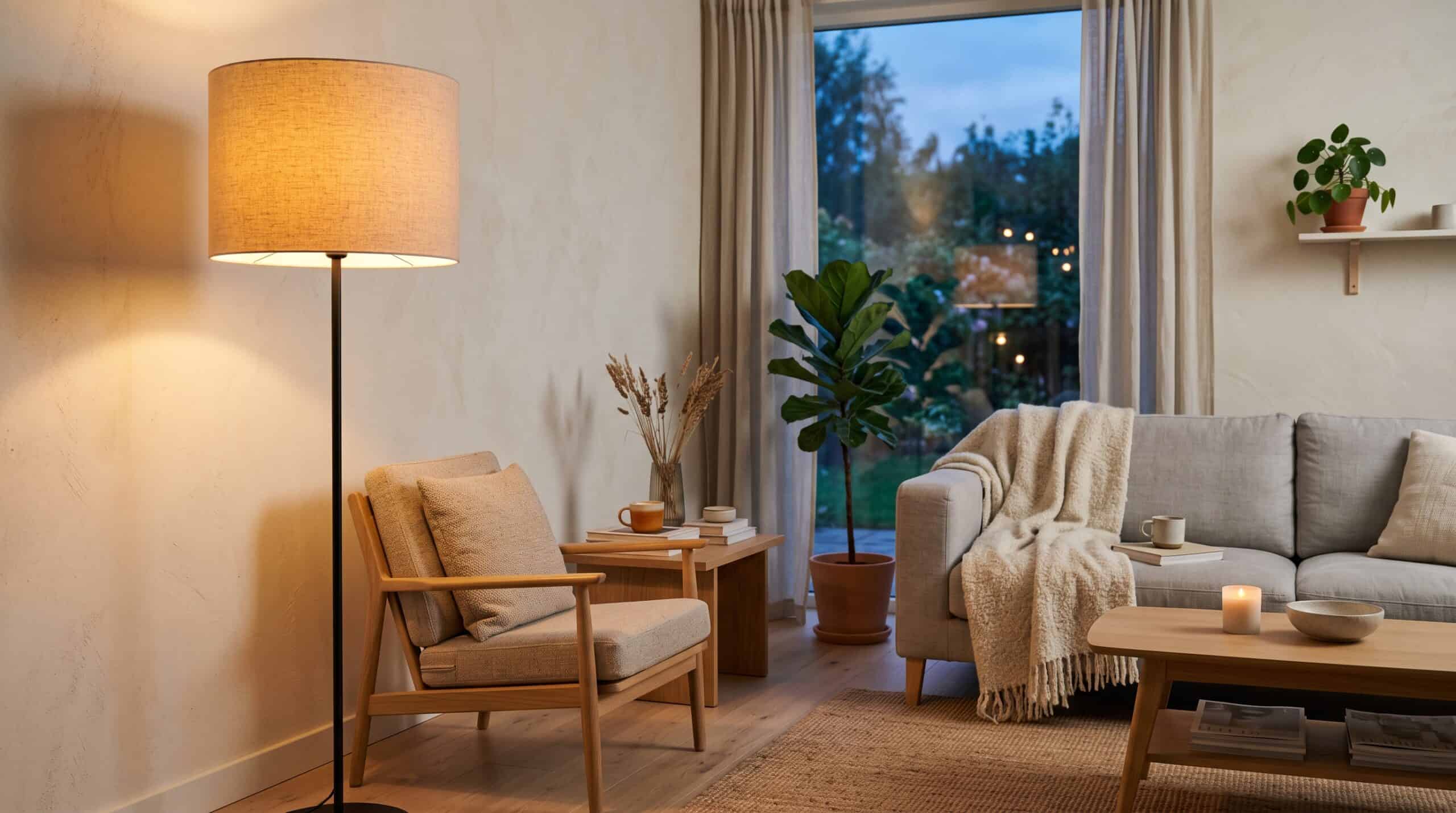
A drum shade in undyed linen casting warm, diffused light in a contemporary living room. The natural weave creates a visible gradient from bright at the lower rim to soft at the top that synthetic fabrics cannot replicate.
When a project needs a rigid, wipe-clean shade, compare the fabric option with the glass lampshade collection. Send the drawing, fitter details, finish reference, quantities, destination, and required documents so the supplier can confirm the available material and manufacturing route. Exact MOQ, sample timing, lead time, testing, and packaging must be confirmed for the project.