Light Shades for Wall: The Complete Buyer’s Guide (2026)
Wall light shades are decorative covers for wall-mounted fixtures that diffuse light, reduce glare, and add polished style to any room.
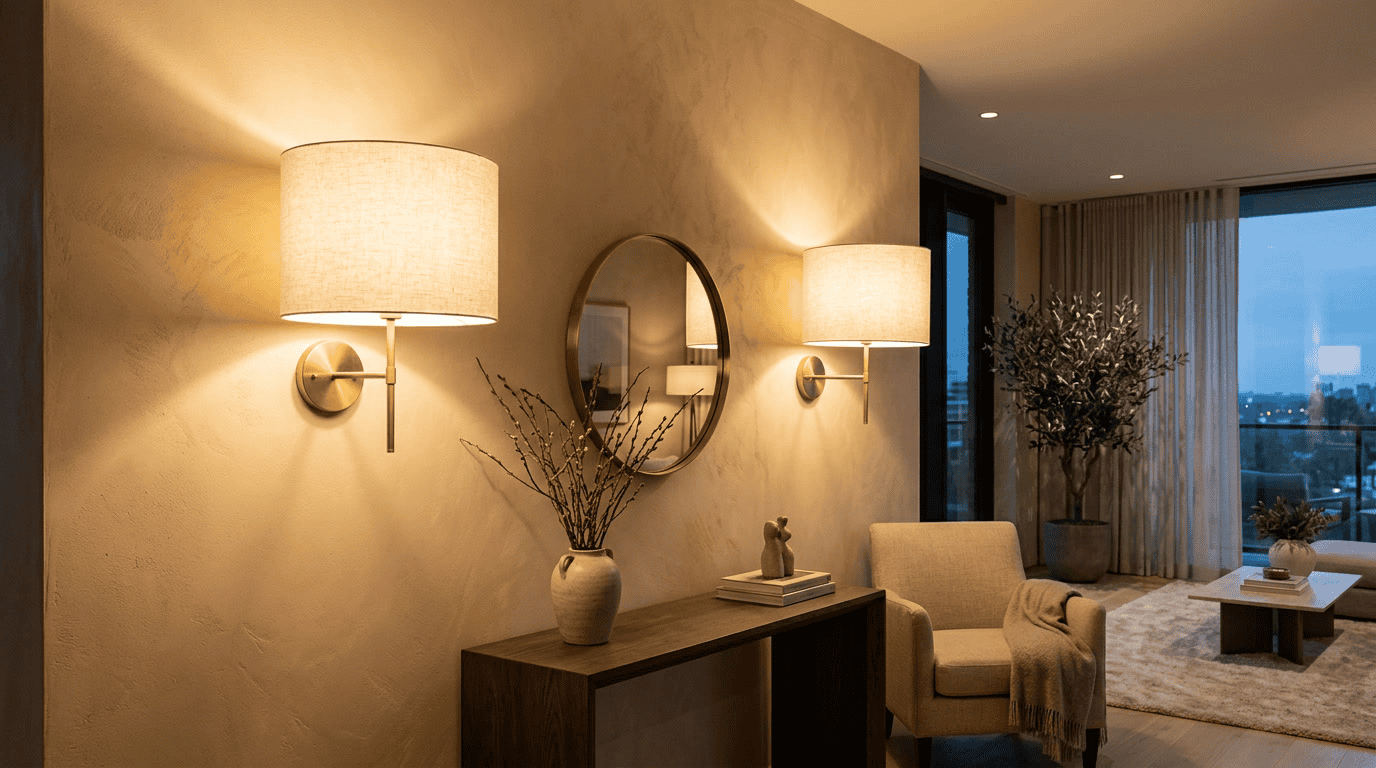
You finally replaced that old wall sconce bracket — then realized the bare bulb looks worse than what was there before. Or you inherited a house with swing-arm wall lights and the original shades are yellowed, cracked, or simply wrong for the room. Either way, buying light shades for wall fixtures feels deceptively simple until you’re standing in a lighting aisle holding a shade that’s two inches too wide for the fitter ring.
This guide fixes that. By the time you finish reading, you will know exactly which shade style fits your bracket, how to measure for a perfect swap, which materials hold up in bathrooms versus bedrooms, and what to watch for in 2026’s fastest-growing wall-shade trends. No guesswork, no returns.
What Are Light Shades for Wall?
Light shades for wall fixtures are purpose-built shade forms that attach to wall-mounted lamp bases, sconces, or swing-arm brackets — and they differ from ceiling or table-lamp shades in ways that matter for both fit and function.
A ceiling pendant shade points downward and hangs from a cord. A table-lamp shade sits on a harp above a weighted base. A wall shade, by contrast, must:
- Mount flush or at a fixed angle against a vertical surface
- Clear the wall bracket arm without touching the wall itself
- Direct light outward and slightly downward into the room — not up into a ceiling fan
The result is that wall shades tend to be shallower in depth, shorter in height-to-width ratio, and specifically engineered around the attachment hardware called a fitter.
How Wall Light Shades Differ from Ceiling Shades
The most important structural difference is the fitter opening — the hole at the top (or bottom) of the shade that locks onto the fixture. Ceiling fixtures often use a spider fitter with a central metal ring. Wall sconces most commonly use one of three systems:
- UNO fitter: The shade screws directly onto a threaded lamp socket. Very common in American swing-arm wall lamps. The shade hangs from the socket itself.
- Clip-on fitter: A spring clip grabs the bulb. Used on older sconces and European-style wall fixtures. Works only with certain bulb shapes — A19 bulbs accept clips, candelabra bases usually do not.
- Euro/Duplex fitter: A two-ring system that the shade slips over a collar on the fixture. Common in UK and European wall lights; increasingly found in Scandinavian-influenced designs.
Buying a shade without confirming your fitter type is the single most common mistake. A UNO shade will not clip onto a bulb; a clip-on shade will not thread onto a UNO socket.
Anatomy of a Wall Light Shade
| Part | Description | Why It Matters |
|---|---|---|
| Top opening (fitter) | UNO thread, clip, or euro ring | Must match your bracket hardware exactly |
| Bottom opening | The open mouth of the shade | Determines how much light spills downward |
| Height | Top rim to bottom rim, vertically | Sets visual proportion against the wall |
| Width (bottom diameter) | Widest point of the shade | Must clear the bracket arm; dictates room coverage |
| Slope / taper | How steeply sides angle inward | Affects light spread angle |
| Lining | Inner surface color (white, gold, black) | White bounces neutral light; gold warms; black creates drama |
Types of Light Shades for Wall
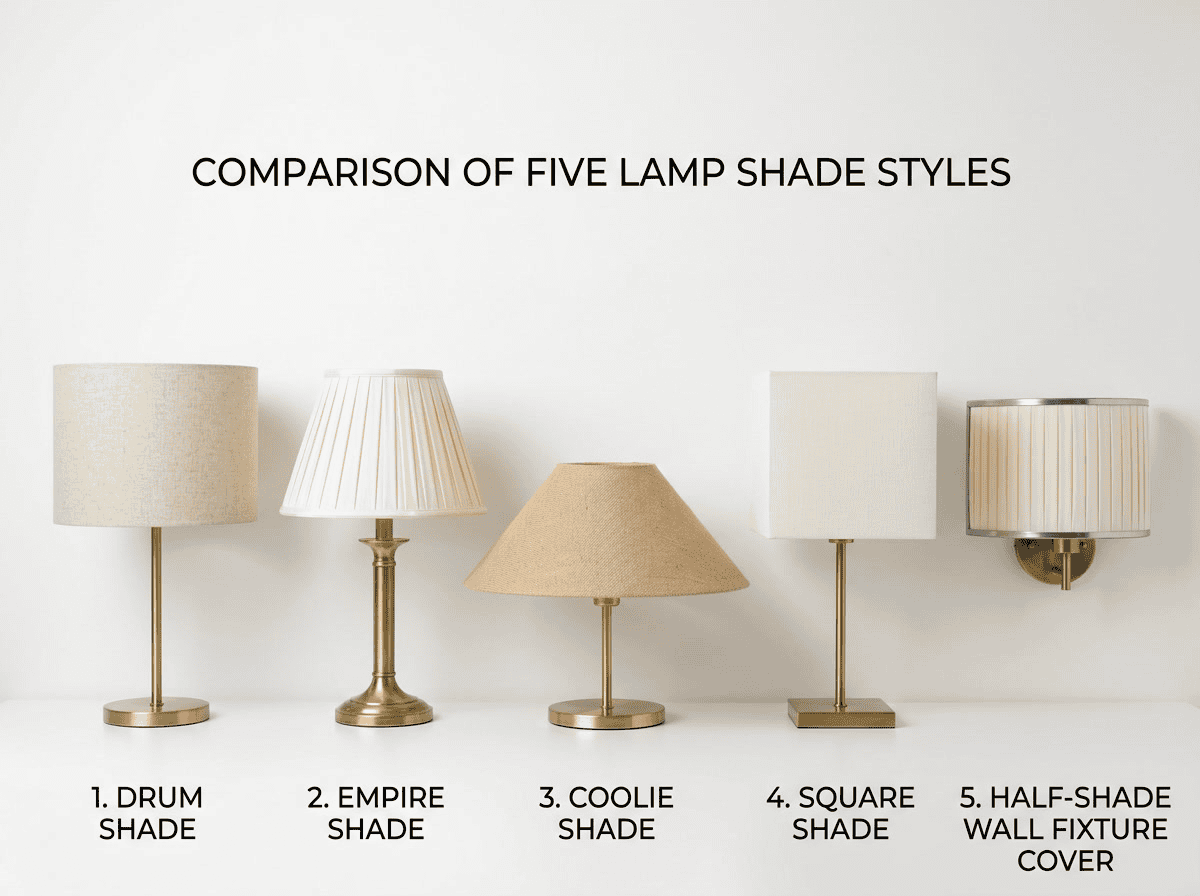
The five primary types of light shades for wall fixtures are drum, empire, coolie, square, and half-shade — each producing a distinct light pattern and visual weight.
Drum Shades
Drum shades are cylindrical: equal diameter at top and bottom, straight sides. They are the most neutral style — equally at home in contemporary, transitional, or industrial interiors. Light exits both the top and bottom of the shade, producing a soft ambient glow around the fixture and a direct pool below.
Key spec to verify: Drum shades have significant depth (front-to-back), which means the bracket arm must protrude far enough from the wall that the back of the shade does not press against the surface. Measure your arm’s wall clearance before ordering.
Popular fabric choices: linen, cotton, faux silk. A 2024 survey by the American Lighting Association found that linen drum shades represent approximately 38% of residential wall shade sales — a share that has grown every year since 2020, driven by the “quiet luxury” interior trend.
Empire and Bell Shades
Empire shades taper from a narrow top to a wider bottom — the classic lampshade silhouette. Bell shades are a softer variation where the sides curve outward rather than flaring at a straight angle. Both styles direct most of their light downward, making them ideal for reading sconces, bedside wall lights, and hallway fixtures where you need focused illumination rather than ambient fill.
Empire shades pair naturally with traditional, transitional, and Hollywood Regency interiors. A pleated empire shade in a blush or champagne fabric instantly elevates a plain swing-arm fixture to something that looks custom-made.
Coolie and Cone Shades
A coolie shade is a wide, flat cone — low height relative to bottom diameter, steep taper. It throws light aggressively downward and outward, creating a wide pool that can wash an entire seating area or accent wall with light. Because of the shallow profile, coolie shades rarely interfere with wall clearance.
Cone shades are similar but with a higher, more cylindrical top section that transitions into the taper. They work well as buffet lamp shades — the wall-mounted lights that flank console tables, sideboards, or dining room buffets.
Square and Rectangular Shades
Square shades — same width on all four sides at both top and bottom — suit wall fixtures in rooms with strong geometric architecture: contemporary kitchens, modern hallways, commercial lobbies. They are less common for residential sconces but increasingly popular in hotel-inspired bedroom designs.
Rectangular shades, taller than they are wide, create a vertical emphasis that elongates perceived ceiling height. Useful in rooms with standard 8-foot ceilings where you want the illusion of height.
Half-Shades (Back-Flat Shades)
Half-shades are cut flat on the back side so the shade sits flush against the wall without any bracket arm. The fixture mounts directly to the wall and the shade rests against the surface. They are the oldest wall-shade style — common in Georgian and Edwardian interiors — and have returned strongly in the 2020s as part of the “vintage maximalism” trend.
Half-shades are ideal for narrow hallways or corridors where any protruding bracket would be a hazard.
| Shade Type | Light Direction | Best Room Use | Fitter Compatibility |
|---|---|---|---|
| Drum | Up + down + sides | Living rooms, bedrooms | UNO, euro duplex |
| Empire / Bell | Mostly downward | Bedside, hallways | UNO, clip-on |
| Coolie / Cone | Strongly downward | Dining, buffet lamps | Clip-on, UNO |
| Square | Down + sides | Contemporary spaces | UNO, spider |
| Half-shade | Forward + down | Hallways, entries | Wall-mount direct |
Industry Applications: Where Light Shades for Wall Truly Shine
Wall light shades serve distinct functional and decorative roles depending on the room — choosing the wrong shade style for the application is the main reason homeowners feel their lighting “doesn’t work” after a remodel.
Bedroom Bedside Sconces
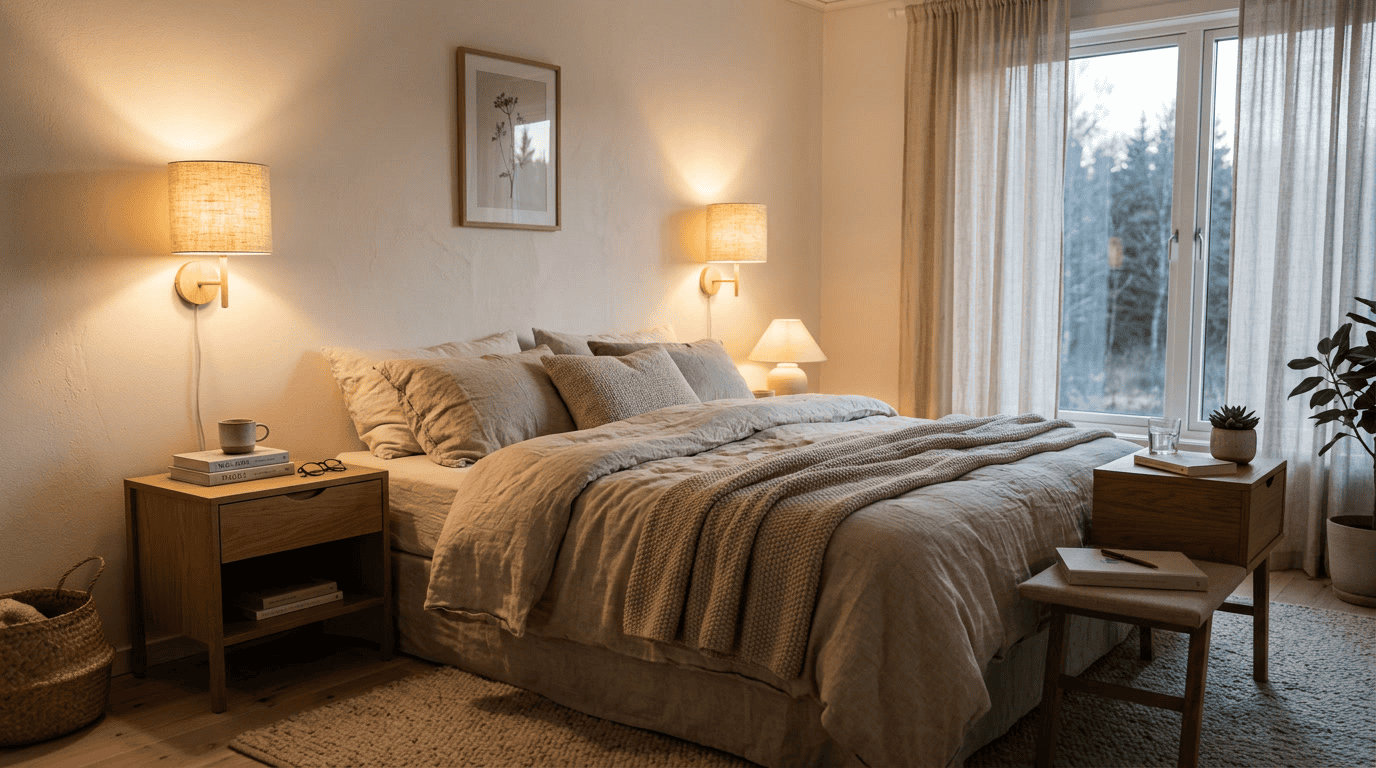
Bedside wall sconces free up nightstand surface area and position reading light at exactly the right height — roughly 30 inches above the mattress top. For this application, empire or drum shades in linen or cotton are the default choice: they produce soft, warm-toned downward light that is comfortable for reading without lighting the entire room.
Key sizing guideline: the bottom of the shade should sit at eye level when you are sitting up in bed (typically 48–52 inches from the floor for a standard mattress height). A shade that hangs too high washes the ceiling; too low, and you are staring into an exposed bulb.
Use a cream or off-white lining — not bright white — to avoid the clinical feel of cool light. In practice, a 3000K LED bulb behind a natural linen drum shade reads as warm as an old incandescent at 2700K.
Living Room Accent Walls
Flanking wall shades on either side of a fireplace, art piece, or console table are one of the most effective ways to create the “layered lighting” effect that professional designers charge a premium for. The shades do not need to match the overhead fixture — in fact, a deliberate material contrast (velvet shades against a rattan or ceramic fixture body) creates more visual interest than a perfectly matched set.
For living room accent walls, buffet shades and coolie styles deliver the widest spread of ambient fill. Position the center of the shade at approximately 60 inches from the floor — average eye level when standing — so the light cone frames the wall feature without casting hard shadows.
Bathroom Vanity Lighting
Vanity sconces flanking a mirror are the gold standard for task lighting: they eliminate the unflattering under-chin shadows that an overhead fixture creates. For bathrooms, choose shades rated for damp locations — or specifically designed for bathroom use. Fabric shades are generally unsuitable unless they are tightly sealed and positioned well away from water spray zones.
Frosted glass mini-drum shades or white porcelain half-shades are the safest material choices for vanity sconces. They provide even, diffused light across the face and are easy to wipe clean.
Wall shades in bathrooms also must account for electrical code requirements: fixtures within 3 feet of a shower or tub edge must be rated for wet locations. Fabric shades with open bottom openings do not qualify.
How to Choose the Right Light Shades for Wall
Selecting the correct light shades for wall fixtures comes down to three sequential checks: fitter compatibility, size proportioning, and material-to-room matching — in that order.
Measuring for a Perfect Fit
Start at the fixture, not the shade. Here is the measurement sequence:
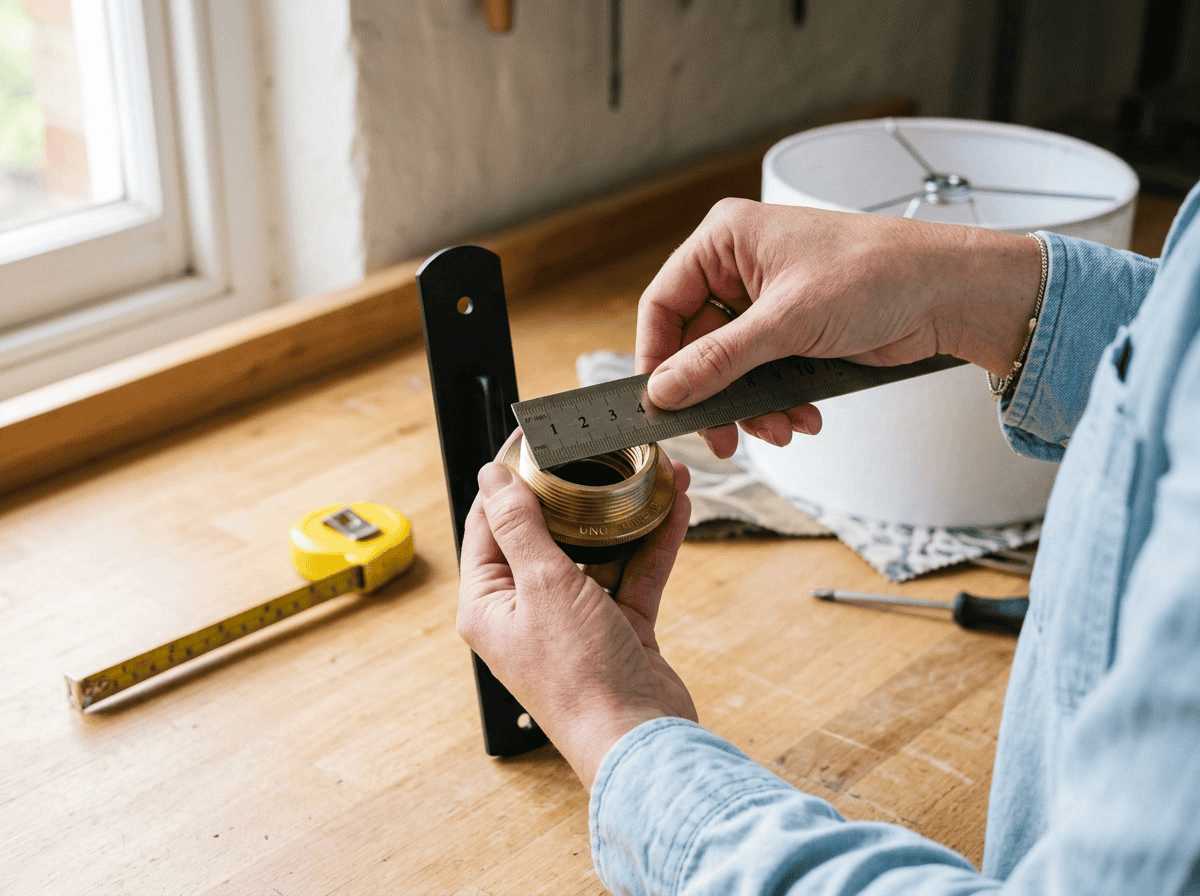
Step 1 — Identify your fitter type. Unscrew the existing shade (if any) or look at the exposed socket. UNO sockets have visible threading; clip-on sockets have no thread but accept a spring clip; euro duplex sockets have a collar ring.
Step 2 — Measure the fitter opening. For UNO shades, the standard fitter opening is 1⅝ inches (41mm). Confirm this matches your socket thread diameter. For clip-on, match the clip diameter to your bulb type — standard A19 bulbs accept 1⅝-inch clips.
Step 3 — Measure wall clearance. Hold a ruler from the wall surface to the center of the socket. This is your clearance distance. Your shade’s depth (front-to-back) must not exceed this — allow at least ½ inch of breathing room.
Step 4 — Determine shade height and width. General proportioning rule: the shade height should be roughly two-thirds the height of the fixture base (including arm length). The bottom diameter should be approximately equal to the height. For a swing-arm fixture with a 12-inch arm, a shade 10–12 inches tall and 10–12 inches wide at the bottom is a good starting point.
Step 5 — Check bottom clearance. The bottom rim of the shade should sit at least 2 inches above any surface (tabletop, console) below the fixture.
Matching Material to Room Style
The shade material is the primary driver of light quality — more than bulb wattage, more than fixture finish. Here is what each material delivers:
Linen and cotton: Soft, warm diffusion. The natural fiber irregularities scatter light slightly, producing a gentle glow rather than a focused beam. Best for bedrooms, living rooms, dining areas. Available in natural, ivory, cream, charcoal, sage, and blush — the palette of every contemporary interior trend since 2022.
Faux silk and shantung: Richer visual texture, slightly higher light transmission than linen. The shimmer picks up the light source and adds a decorative element even when the light is off. Well-suited to Hollywood Regency, glam, or transitional interiors.
Paper and rice paper: Excellent light diffusion with minimal hot spots around the bulb. Lightweight — important for clip-on fitters that cannot support heavy shades. Not suitable for damp environments. Popular in Japanese-influenced and minimalist interiors.
Frosted glass: The highest durability option. Wipes clean, tolerates humidity, handles higher wattage bulbs without heat damage. Light output is cooler and more even than fabric. Best for bathroom vanities, kitchens, entryways.
Metal / perforated metal: Creates patterned light projection — the shade becomes a decorative element when lit. Best used as an accent rather than a task light. The pierced pattern can project leaf, geometric, or abstract designs onto the surrounding wall.
| Material | Light Quality | Durability | Humidity Tolerance | Style Best-Fit |
|---|---|---|---|---|
| Linen / cotton | Warm, diffused | Medium | Low | Organic, contemporary, farmhouse |
| Faux silk | Warm, slightly shimmery | Medium | Low | Glam, transitional, traditional |
| Paper / rice paper | Very soft, even | Low | Very low | Minimalist, Japanese-inspired |
| Frosted glass | Cool, even | High | High | Modern, bathroom, industrial |
| Perforated metal | Patterned projection | Very high | High | Bohemian, industrial, accent |
Avoiding Common Mistakes
Mistake 1: Buying by looks alone. A shade that photographs beautifully on a table lamp may look completely wrong on a wall sconce. The wall-mounting angle changes how light exits the shade. Always visualize the shade at eye level on a vertical surface — not sitting flat on a surface.
Mistake 2: Ignoring the lining color. The outer fabric can be a deep navy or forest green, but if the lining is bright white, every time that light switches on you will see a white halo through the fabric. Match lining tone to your intended mood: white for neutral cool, off-white or gold for warmth, black for drama.
Mistake 3: Mismatching the scale. A 6-inch-wide shade on a fixture with a 10-inch arm looks like a dot at the end of a stick. As a rule, the shade’s bottom diameter should be at least 80% of the arm length.
Mistake 4: Forgetting the bulb. The shade’s minimum clearance rating (printed inside most fabric shades) must be checked against your bulb’s heat output. Vintage Edison-style filament bulbs run hotter than their wattage suggests — a 60W equivalent LED is fine, but an actual 60W incandescent inside a drum shade with ½-inch clearance will scorch the fabric.
Future Trends in Wall Light Shades (2026 and Beyond)
The dominant 2026 trend is handcrafted, tactile materials that prioritize sensory warmth over technological novelty — a direct reaction to the overly sleek finishes that dominated the early 2020s smart-home boom.
Sustainable and Natural Materials
Bamboo, seagrass, rattan, and recycled cotton are replacing synthetic fabrics at a striking rate. According to Statista’s 2024 global lighting market report, the sustainable home lighting segment grew 22% year-over-year in 2023 and is projected to outpace conventional fixtures through 2028.
For light shades for wall, this translates to woven grass shades, bamboo ribbed cylinders, and undyed cotton shades — all of which produce a warmer, more textured light than synthetic alternatives. The environmental angle is real: natural fiber shades are biodegradable, often produced without synthetic dyes, and their weight typically allows clip-on or lightweight UNO fitter use, reducing metal hardware requirements.
Manufacturers producing certified OEKO-TEX Standard 100 lampshade fabrics — which verifies the textile is free from harmful substances — are seeing lead times stretch as demand outpaces supply. If you want a specific natural-fiber shade, ordering 6–8 weeks in advance is increasingly the standard.
Smart Lighting Compatible Shades
Tunable LED bulbs — which shift from 2700K warm white to 6500K daylight on a schedule or via app — require shades with sufficient light transmission to allow the color shift to be perceived. Dense fabrics (heavy linen, velvet) absorb too much of the light output for color temperature changes to be meaningful through the shade.
The emerging standard for smart-compatible wall shades is a fabric weight of 80–120 g/m² — light enough for the full color temperature range to pass through, heavy enough to prevent seeing the bulb as a hot spot. According to the U.S. Department of Energy’s LED lighting efficiency data, household LED adoption in the US has crossed 47% as of 2023 — meaning smart-shade compatibility is no longer niche.
Integrated dimmer compatibility is the related trend: shades are increasingly being specified alongside fixtures that include in-built dimmer switches, avoiding the need for a wall dimmer installation. The shade material directly affects perceived dimming quality — paper and thin cotton show the hot spot of the filament at very low dim levels, while frosted glass and dense linen maintain an even glow at 5% output.
| Trend | Material/Feature | 2026 Relevance | Best Application |
|---|---|---|---|
| Natural fibers | Bamboo, seagrass, linen | ⭐⭐⭐⭐⭐ | All rooms |
| Pleated fabric revival | Silk, poly-silk pleats | ⭐⭐⭐⭐ | Bedrooms, dining |
| Smart-compatible weight | 80–120 g/m² fabric | ⭐⭐⭐⭐ | Living rooms |
| Half-shade resurgence | Wall-flush mounting | ⭐⭐⭐ | Hallways, entries |
| Perforated metal | Steel, brass | ⭐⭐⭐ | Accent, industrial |
Frequently Asked Questions About Light Shades for Wall
What size shade do I need for a wall sconce?
Start with the arm length. The shade’s bottom diameter should be roughly equal to or slightly smaller than the arm’s wall-to-socket distance. For a standard 8-inch swing-arm sconce, a shade with a 7–10-inch bottom diameter typically works. Always confirm the shade’s depth (front-to-back measurement) does not exceed the wall clearance of your bracket.
Can I use a regular lamp shade on a wall sconce?
Only if the fitter type matches. Many table-lamp shades use a spider fitter designed to sit on a harp — wall sconces typically use UNO or clip-on fitters. A spider shade will not attach to a UNO socket without an adapter ring (available at most hardware stores). Confirm the fitter before purchasing any shade for a wall fixture.
What is the difference between a UNO shade and a clip-on shade?
A UNO shade has a threaded opening that screws directly onto the lamp socket. A clip-on shade has a spring clip that grips the bulb itself. UNO is the more secure attachment; clip-on is easier to remove for bulb replacement. If your sconce has a visible ring of thread around the socket, it is UNO. If it is just a smooth socket with a bulb exposed, it takes clip-on.
Are fabric wall shades safe near LED bulbs?
Yes — LED bulbs produce very little heat compared to incandescent or halogen bulbs, making fabric shades significantly safer with modern lighting. The main precaution: check the shade’s minimum clearance requirement (usually marked inside the shade). LED equivalents of 60W or less stay well within safe temperature ranges for linen, cotton, and paper shades.
How do I measure the fitter opening of my existing shade?
Turn the shade upside down and measure the inside diameter of the opening at the top. Standard UNO fitters are 1⅝ inches (approximately 41mm). If the measurement is close to this and you can see threading, it is a UNO shade. If the opening is larger with a metal ring, it is likely a euro duplex.
Can wall shades be used outdoors?
Standard fabric wall shades are not rated for outdoor use. For exterior sconces, look for shades explicitly marked “damp rated” (covered porches, sheltered entrances) or “wet rated” (fully exposed) — typically made from glass, sealed resin, or outdoor-grade fabrics. Using an indoor fabric shade outdoors will cause rapid deterioration from UV exposure and moisture.
What is the best color shade for a small room?
White or off-white linen shades are the default answer, but the nuance matters. A bright white lining can feel institutional in a cozy space. For small rooms, use a cream or warm ivory lining with a natural fiber exterior — the warm-toned diffused light will make the space feel larger and more inviting than a cool-toned bright white would.
Conclusion
Light shades for wall fixtures are a high-leverage detail — small in surface area, enormous in effect. The right shade transforms a bare bulb screwed into a bracket into a considered design decision. The wrong shade — wrong fitter, wrong depth, wrong material for the room — turns a perfectly good sconce into something that just sits there.
The framework is straightforward: confirm your fitter type first, measure wall clearance second, proportion the shade to the arm third, and choose material based on the room’s function and existing palette. If you are replacing shades in a bedroom, lean natural fiber and warm lining. Bathroom vanity? Frosted glass or sealed ceramic. Living room accent wall? Coolie or drum in linen for maximum ambient coverage.
For production-quality wall shades in both custom and wholesale quantities — including OEM fabric selection and custom fitter configurations — jxlampshade.com offers factory-direct sourcing across drum, empire, coolie, and half-shade profiles with natural and synthetic fabric options.
Start with your fitter type. Everything else follows from there.