# Glass Lamp Shades for Living Room: A 2026 Style and Sourcing Guide
Glass lamp shades for the living room are decorative or replacement glass covers fitted to table lamps, floor lamps, pendants, and ceiling lights to diffuse light, set ambience, and match interior design. The best choice depends on bulb type, fitter size, room palette, and how diffuse the light needs to be.
The living room is the only room in the house where lighting is judged twice — once by daylight when nobody is using it, and once at night when everyone is. A glass lamp shade has to survive both inspections. It has to look intentional during the day, and disappear into pure light at night.
Most buyers pick a shade based on a single photo on a retail page. That’s how living rooms end up with lamps that “looked nice in the picture” and then sit dim, glaring, or just slightly wrong for the next five years. This guide takes the practical, manufacturer’s view — what actually works in a real living room, why, and how to pick correctly the first time.
What Counts as a Glass Lamp Shade for a Living Room
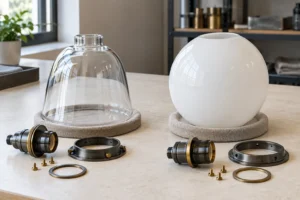
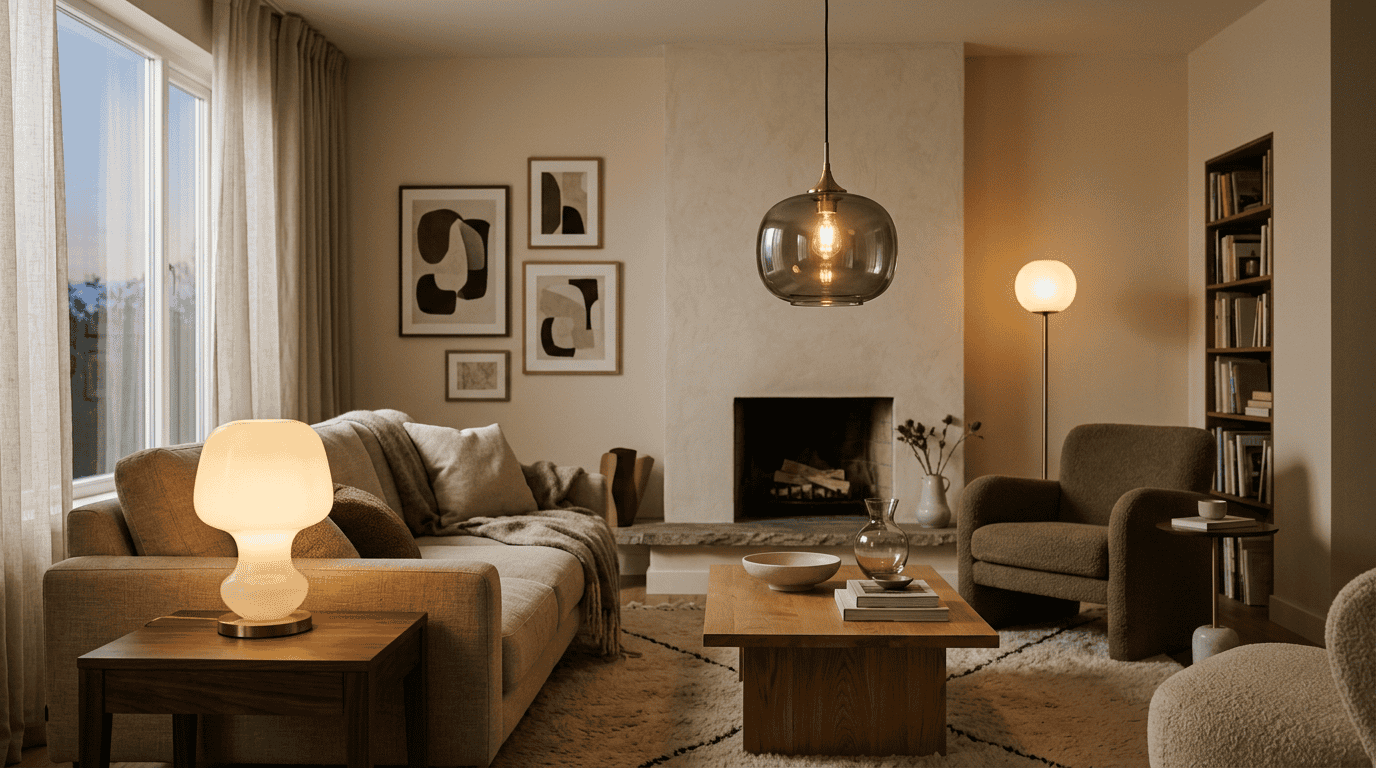
A glass lamp shade is the rigid glass component that surrounds a light source on a lamp or fixture. In a living room context, you’ll typically encounter it on five fixture types: table lamps, floor lamps, pendant lights, flush-mount or semi-flush ceiling lights, and wall sconces. Each requires a slightly different shade geometry, glass thickness, and fitter (the mechanical joint that attaches the shade to the lamp’s hardware).
What separates living-room shades from, say, kitchen or bathroom shades is the diffusion and warmth standard. Living rooms are evening-dominant rooms. The light needs to look soft, low-glare, and slightly warm even when the bulb itself isn’t. That makes glass selection — clear, frosted, opal, ribbed, smoked, amber — far more important than in utility rooms, where output and cleanability trump aesthetics.
Where this differs from “general” glass shade buying
Three living-room specifics most generic shade guides ignore:
- Layered lighting — A living room is rarely lit by one fixture. You’re layering ambient (ceiling), task (table and floor), and accent (wall sconces, picture lights). Each glass shade has to behave when its neighbors are on AND off.
- Sofa-level glare line — When you’re seated on a sofa, your eye height is roughly 1100 mm above the floor. Bare bulbs become visible in clear glass shades at that angle. Frosted or opal glass solves this without darkening the room.
- Mixed-finish tolerance — Living rooms almost always combine brass, oil-rubbed bronze, brushed nickel, or matte black hardware. The glass shade needs to act as the *neutral* layer that doesn’t fight any of them. That’s why opal, smoked, and amber dominate in editorial living-room photography.
For the broader context on diffusion physics, our glass light diffusion explained: clear vs frosted vs opal glass for lighting covers the underlying material science.
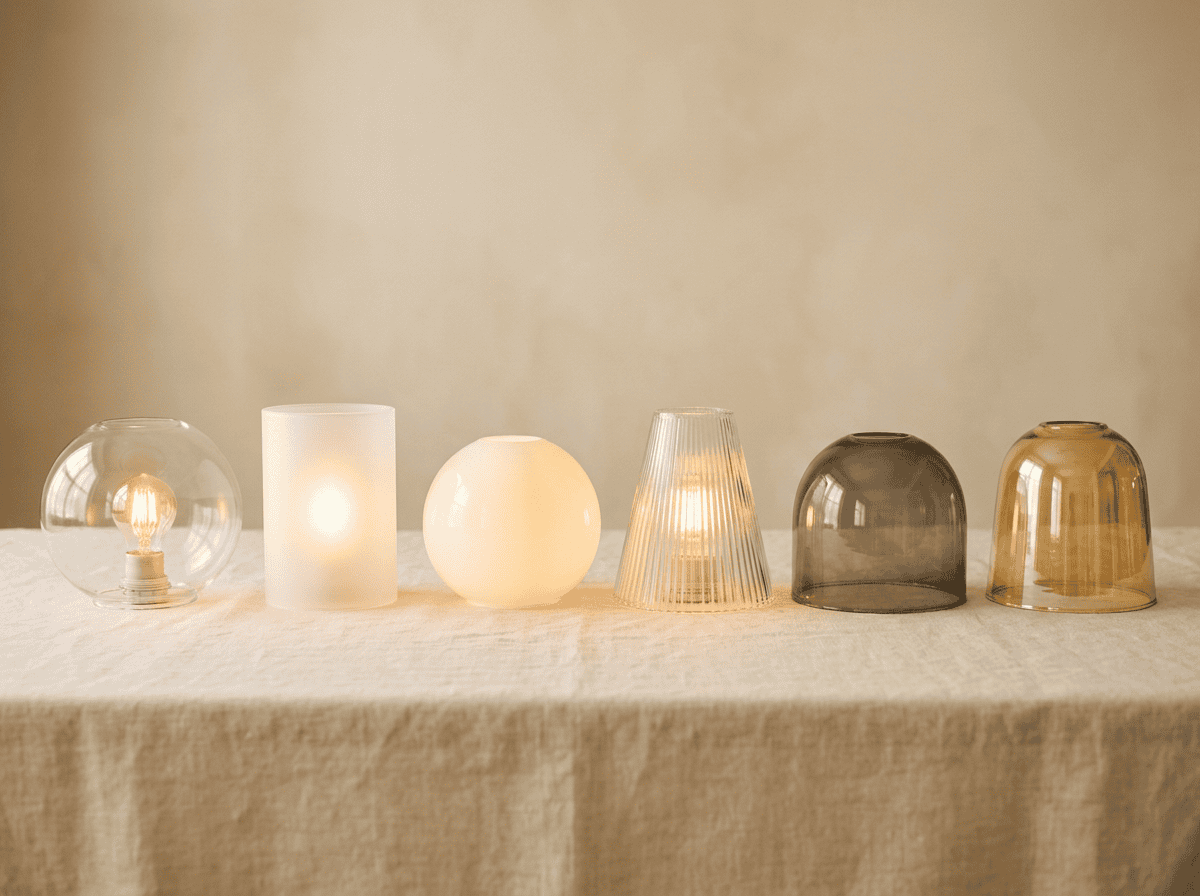
The Six Glass Shade Types You’ll Actually Use in a Living Room
There are dozens of glass shade categories in a manufacturer’s catalog, but only six show up regularly in residential living rooms. We’ll go through each by physical behavior, not marketing label.
| Shade type | Light quality | Best living-room use | Typical fitter | Bulb compatibility |
|---|---|---|---|---|
| Clear glass (smooth) | Highest output, hardest glare | Mid-century accent pendants over coffee table | Various | Decorative filament LED only |
| Frosted glass | Soft, even, ~70% transmission | Table lamps next to seating | Uno / spider / clip | Standard A19 LED, max 60W eq. |
| Opal (milk) glass | Diffuse, ~50% transmission, no hotspot | Floor lamps, primary table lamps | Uno / neckless | Any bulb shape — diffusion hides it |
| Ribbed / fluted glass | Sculpted highlights, ~80% transmission | Statement pendants, sconces | Various | Filament LED preferred |
| Smoked glass | Moody, ~30–50% transmission | Bedrooms / TV-room lamps near screens | Uno / spider | Higher lumen LED to compensate |
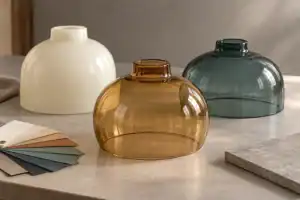
| Amber glass | Warm wash, ~40–60% transmission | Reading lamps, sofa-side tables | Uno / clip | 2700K LED for cohesion |
Clear glass shades
Clear shades show the bulb. That’s their entire purpose. Used badly, they create direct-glare points you’ll see from every seat. Used well — paired with a decorative filament LED at no more than 600 lumens — they become the most “designed” object in the room. The mid-century revival has made clear globe pendants over the coffee table almost a default in editorial photography.
Practical note: thickness matters. A 3mm pressed-glass globe rings cheap. A 5mm hand-blown or thick borosilicate globe carries presence. The cost difference at the supplier level can be 4x, and you can feel it in the lamp’s center of gravity when you lift it.
Frosted glass shades
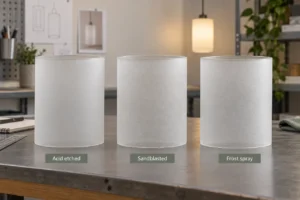
Frosted glass is acid-etched on the inside surface (not the outside — outside-etched shades collect dust and become impossible to clean). The etch scatters incoming light without absorbing much of it, so you keep ~70% of bulb output but lose the hotspot.
This is the workhorse living-room shade. It tolerates any standard A19 or A21 LED, hides cheap bulbs, and pairs with every hardware finish. We sell more of this in the residential channel than any other category.
Opal (milk) glass shades
Opal is the gold standard for “the glass IS the light source.” Two-layer or three-layer cased glass — a milky white inner layer behind an outer clear or tinted shell — gives true 360° diffusion with no bulb image at any viewing angle. The trade-off is transmission: a heavy opal shade can absorb 50% of bulb output, so you compensate with a higher-lumen bulb.
For dedicated coverage of opal physics, how opal glass improves light diffusion in lampshades walks through the cased-glass technique. According to Wikipedia’s article on opal glass, the milky appearance comes from internal scattering of light by microscopic particles, which is exactly what makes the surface look softly luminous from any angle.
Ribbed and fluted glass shades
Ribbed shades — vertical flutes pressed or blown into the glass surface — give you the sculpted highlights of clear glass without the harshest glare points. They photograph beautifully, which is why they dominate hospitality and showroom lighting. In a living room, they work best on pendants or wall sconces where the shade is above eye level, so the ribbed pattern catches light without bouncing the bulb image directly into your eye.
Smoked and amber tinted shades
Smoked grey glass and amber glass both reduce total output. Smoked is the cooler-toned option, amber the warmer. Amber in particular re-shifts the apparent color temperature of any LED bulb warmer by roughly 200–400K, which lets you mix a single 2700K bulb stock across the room and get visible variation without changing bulbs.
Our amber vs clear vs smoke glass shades comparison covers the choice between these three in more detail.
How Glass Shade Choice Interacts With Living-Room Layout
Most living rooms break into three lighting zones, and the right glass shade for each zone is different.
Zone 1: Seating area (sofa, armchairs, coffee table). Eye level here is ~1100 mm from the floor. Anything below ~1700 mm fitter height that uses clear glass will produce visible bulb hotspots when you’re seated. Default to frosted or opal in this zone — table lamps on side tables and floor lamps behind sofas.
Zone 2: Ceiling plane. Pendant lights over coffee tables sit at ~1500–1800 mm above the floor (1500–1800 from floor; ~600–900 above the coffee table surface). Because they’re above eye line, you can use clear, ribbed, or smoked without glare. This is where the “design statement” piece of the room lives.
Zone 3: Wall plane. Sconces, picture lights, and accent wall pendants are normally above ~1800 mm and aimed up or sideways. Ribbed, opal, or amber suits this zone. Avoid pure clear glass on wall sconces — they tend to be at sofa-eye-level for someone walking through the room.
A working example: a 4×5 m living room
A typical urban living room has:
- One overhead pendant or semi-flush ceiling fixture
- One pendant or chandelier over the dining or coffee table (if open plan)
- Two table lamps on side tables flanking the sofa
- One reading floor lamp behind a chair
- Optional: two wall sconces flanking a TV or fireplace
That’s 5–7 fixtures. If every single one used a clear glass shade, the room would feel like a hardware showroom — too many bulb hotspots, too much specularity, no soft middle. The working pattern is to put clear or ribbed on the ceiling-plane statement piece and default everything seating-zone to opal or frosted. The room then has one “look at me” lighting piece and four “just glow softly” pieces. The eye reads it as designed.
This logic applies to any rectangular living room — apartment, loft, or 5,000 sqft estate. The variable is fixture count, not the layering rule.
Sizing the Glass Shade Correctly
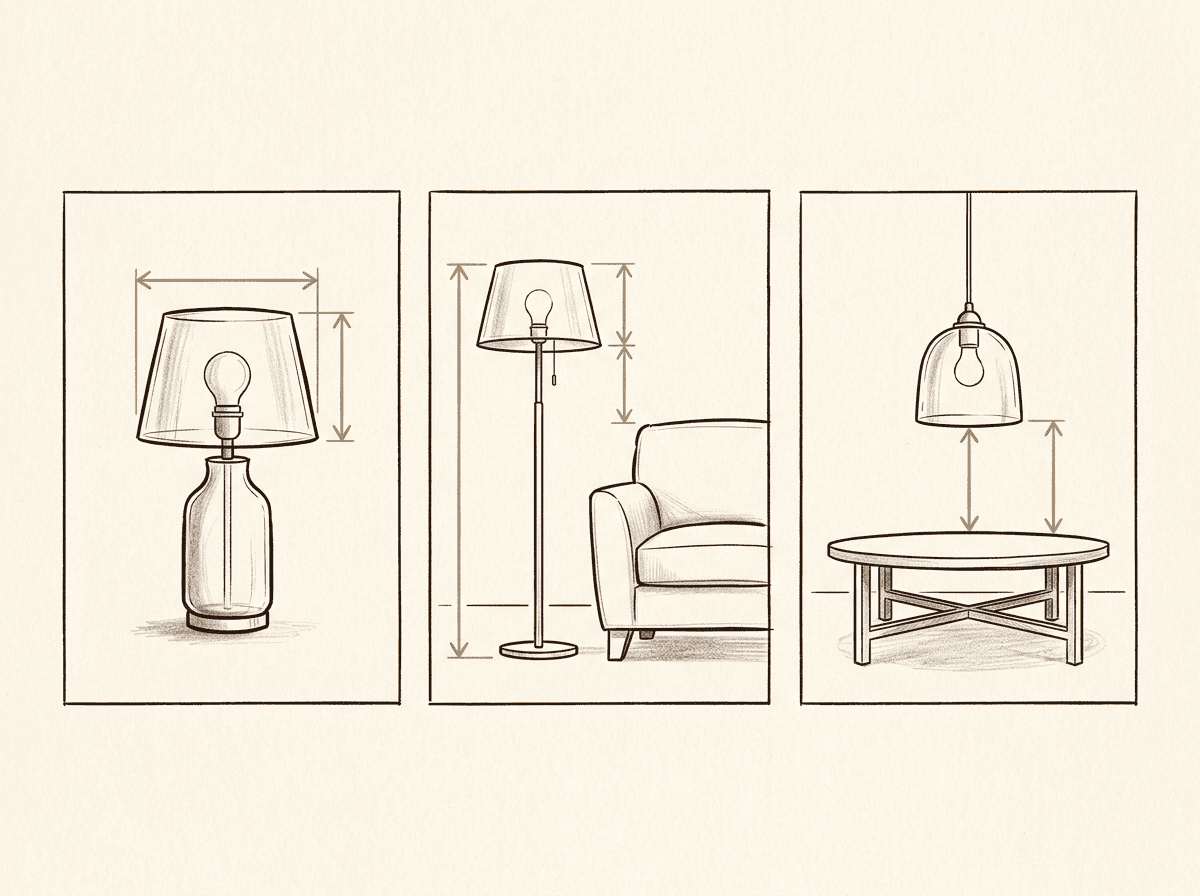
Even the most beautiful glass shade looks wrong in the wrong proportion. Three numbers matter: fitter diameter, shade outer diameter, and shade height.
Fitter diameter — non-negotiable, mechanical
The fitter is the mechanical opening. If it doesn’t match your lamp’s hardware, the shade physically will not attach. The US/UK common sizes are:
| Fitter type | Common inner diameter | Where you find it |
|---|---|---|
| Uno fitter | 7/8″ (22mm) | Table lamps and many floor lamps — threads onto the bulb socket itself |
| Spider fitter | 1 5/8″ (41mm) | Floor lamps with harp-and-finial — also used on many higher-end table lamps |
| Clip-on fitter | varies by bulb shape | Bulb-mounted shades for candelabra bulbs |
| Neckless | no rim — held by 3 thumb screws | Ceiling pendants, certain wall sconces |
| 2 1/4″ / 3 1/4″ / 4″ | actual measured inner diameter | Standardized pendant and sconce fitter holders |
If you’re replacing an existing shade, measure twice. Most failed replacement purchases come from fitter mismatch — clear measurement instructions are in how to measure a replacement glass lamp shade, and the broader spec context is in our glass lamp shade fitting standards: the complete technical guide.
Outer diameter — aesthetic, but governed by rules
For table lamps, the classic rule is: shade outer width should equal lamp base height (or come within ±20%). A 16″ tall lamp base wants a roughly 16″ wide shade. Wider than the base it sits on, narrower than the table beneath.
For floor lamps, the shade outer width should not exceed the chair or end table it sits next to by more than 25%. Visually it should “belong to” the seating group rather than dominate it.
For pendants, the shade diameter follows the table size below: roughly 1/3 to 1/2 the table width. A 1.2 m coffee table wants a pendant in the 400–600 mm diameter band.
Shade height
For table lamps, shade height = lamp base height ÷ 2 to ÷ 1.5. Too short and the bulb peeks under; too tall and the lamp looks top-heavy.
For pendants, height matters mostly because of clearance — the bottom of the shade should sit 700–900 mm above a coffee table or 760–900 mm above a dining table.
How to Choose: The 30-Minute Selection Process
If you’re starting from a blank room, the fastest reliable selection sequence is:
- Decide your primary fixture (the statement piece). Usually the pendant over the coffee table or dining area. This is your “clear glass moment” or “ribbed glass moment.” Pick one.
- Pick a color temperature target. 2700K (warm) is correct for 95% of residential living rooms. 3000K acceptable for modern/minimalist palettes. Above 3000K reads cold in evening use.
- Pick a default secondary shade type. This is what you’ll put on every table lamp, floor lamp, and sconce that isn’t the statement piece. Default to opal if the room is on the smaller side or has a lot of mixed clutter, frosted if you want slightly more output and your bulb choices are reliably good-quality LEDs.
- Pick one accent. One amber shade (often the reading floor lamp by the sofa) makes a 5-fixture room feel layered rather than uniform.
- Check fitter sizes against existing hardware. Or buy hardware that matches your chosen shade — easier than chasing matching shades for legacy lamps.
That’s it. Most people overthink the choice because retail filtering forces them to “browse” rather than “decide.”
Common mistakes we see in returned orders
After a decade of supplying residential and hospitality clients, the same five mistakes account for 80% of “looked fine in the picture, doesn’t work in person” returns:
- Buying clear glass for sofa-height lamps. Glare from any seat. Almost always returned within a week.
- Mixing 2700K and 4000K bulbs across the same room. The shades absorb and emit, but they can’t fix bulb color mismatch. Your eye reads “yellow lamp / blue lamp” within seconds.
- Picking glossy glass when the room has glossy floors. Reflection-on-reflection. Pick matte-finish opal or sandblasted glass instead.
- Going too small on the pendant over a 1.2m+ coffee table. A 200mm pendant over a 1400mm coffee table looks like a single beauty mark on a large surface. Scale up.
- Forgetting bulb access. Some opal shades have so small a fitter ring that you can’t get a hand inside to change the bulb. Check before ordering.
Glass Shade Material Choices for Living Rooms
A glass shade isn’t just a shape — it’s a piece of formed glass with measurable properties that affect lighting, durability, and feel.
Soda-lime vs borosilicate
Most decorative residential shades are pressed or hand-blown soda-lime glass. It’s cheaper, accepts color and frost easily, and breaks predictably. For high-heat fixtures (incandescent or older halogen bulbs), some manufacturers spec borosilicate, which has a much lower coefficient of thermal expansion — meaning it tolerates thermal shock without cracking. In an all-LED living room, soda-lime is fine. If you have any heat-generating bulbs, ask the supplier.
Hand-blown vs machine-pressed
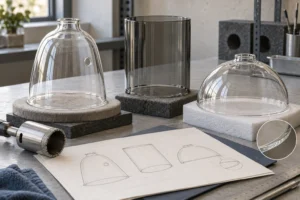
Hand-blown glass has visible wall-thickness variation, occasional small bubbles, and a slightly asymmetric profile. These are not defects — they’re the proof of process. Machine-pressed glass is mathematically uniform and noticeably “perfect.” For traditional or craft-led interiors, hand-blown reads as the higher-end choice. For minimalist or modernist interiors, machine-pressed reads as the cleaner choice. Both are correct in their context.
Wall thickness
Most decorative shades are 3–4mm. Premium shades are 5–6mm. The visual difference is subtle but real: heavier glass holds the bulb’s heat better (irrelevant with LED), feels more substantial in the hand, and rings differently if tapped. For tall floor lamps where the shade sits high and is rarely touched, 3mm is fine. For tabletop shades that get bumped or moved, lean toward 4–5mm.
Bulb Pairings: What Goes Inside the Shade
You can’t separate shade selection from bulb selection. The shade is half the lighting; the bulb is the other half.
| Shade | Recommended bulb | Why |
|---|---|---|
| Clear glass | Decorative filament LED, 400–600 lm, 2700K | The bulb IS the visual feature. Quality of filament pattern matters. |
| Frosted | A19 LED, 800 lm, 2700K, high CRI (90+) | Frosted hides imperfect-looking bulbs while keeping output. |
| Opal | A19 LED, 1000–1100 lm, 2700K | Opal absorbs more — bump lumens to compensate. |
| Ribbed / fluted | Decorative filament LED, 400–600 lm | Sculpted highlights need a visible source. |
| Smoked | A19 LED, 1100+ lm, 2700K, dimmable | Smoked absorbs ~50%; compensate. |
| Amber | A19 LED, 800 lm, 2700K, dimmable | Amber shifts apparent warmth; pair with dimmer. |
High CRI (Color Rendering Index above 90) matters more in living rooms than in any other room — it’s where you see human faces, fabric textures, and food on a coffee table. A 5 USD low-CRI bulb behind a 200 USD glass shade is a tactical mistake. The U.S. Department of Energy’s page on lighting choices covers CRI and color temperature for residential use in plain language.
Visualizing How the Shade Will Look at Night
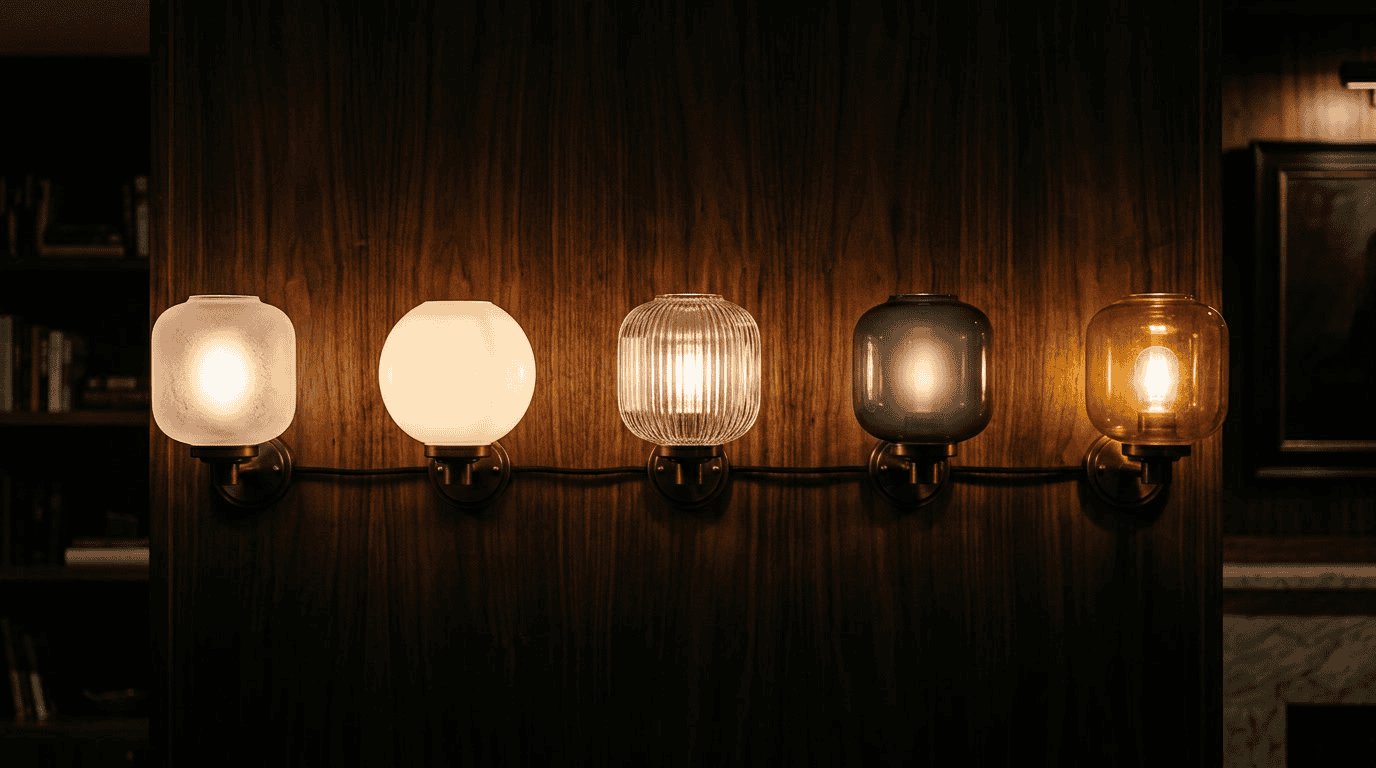
A common buyer’s failure mode: they picture the lamp during a sunny daytime showroom visit, when the glass is being lit from outside. At night, the lamp is being lit from inside — and the glass behaves completely differently.
Rules of thumb for night appearance:
- Clear glass at night = visible bulb. The shade essentially disappears and you see the filament. This is a feature for design pendants. It is a defect for sofa-side table lamps.
- Frosted glass at night = bright, even glow. Almost no bulb image. Reads as a warm sphere or cylinder of light.
- Opal at night = pure glowing object. Looks like a piece of luminous porcelain. No bulb visible at any angle.
- Ribbed at night = vertical light streaks. The flutes break the bulb’s image into discrete bright columns, very sculptural.
- Smoked at night = subdued lantern effect. Reads as an “off-but-glowing” object even when on.
- Amber at night = warm ember. Looks like a glass full of slightly molten honey.
If you can’t see the lamp in operation, ask the supplier for a “lit photo.” Reputable suppliers keep these on file because they get asked daily. Anyone who can’t send you one isn’t actually a manufacturer, just a re-seller using stock images.
Maintaining Glass Lamp Shades in a Living Room
Glass shades collect dust faster than any other lamp component because they’re heated slightly by the bulb (even LED bulbs warm 5–10°C above ambient), and the temperature differential pulls airborne dust onto the glass surface.
Basic monthly maintenance:
- Turn the lamp off and let it cool (15 minutes is fine for LED).
- Remove the shade if removable. Most Uno and spider fitters detach in seconds; neckless and pendant fitters usually require a screwdriver.
- Dust with a microfiber cloth first. Never a paper towel — paper towels scratch borosilicate and leave fiber residue on frosted glass.
- For inside soiling, mix one part white vinegar to two parts warm distilled water. Spray into a microfiber cloth (not directly on the glass). Wipe gently.
- Air dry — never reinstall while wet. Trapped moisture against a warm bulb can leave water spots.
Avoid ammonia-based cleaners on cased opal or hand-painted glass — ammonia can dull the surface or attack any pigment layer. For laminated or coated shades, check the manufacturer’s care guide.
For scratch hardness reference, soda-lime glass sits at ~5.5–6 on the Mohs scale — softer than diamond dust but harder than typical household debris. The point: clean glass shades carefully but they’re more durable than you think.
Sourcing: Why a Manufacturer Beats a Re-Seller
Most living-room shades sold online come from re-seller catalogs, not manufacturers. The price you pay reflects two markups (factory → importer → retailer) and a stocking decision someone made eight months ago. That’s why you get four sizes and three colors instead of the actual range of what exists.
A direct manufacturer relationship gives you:
- Custom dimensions — you spec the diameter, height, and fitter rather than picking from a catalog.
- Custom finish — you can spec frost level, opal layering, amber intensity, ribbing pattern.
- Wholesale pricing — 30–60% lower than retail for the same physical product.
- Sample units — you can order one before committing to a batch.
- Verified compatibility — the manufacturer can confirm fitter dimensions against your existing lamp bases or hardware.
For US, UK, and EU residential designers ordering anything more than ~10 units, going direct to a glass lamp shade manufacturer is the obvious play. Bulk pricing thresholds usually start at 20–50 units depending on the supplier.
Future Trends in Glass Shade Design (2026 and Beyond)
Three movements are visibly shaping glass shade design as of early 2026.
Sculpted hand-blown is returning to the high end. Editorial photography in 2026 is dominated by lamps that look post-industrial-craft — visible wall thickness variation, intentional irregularity, smoked or sepia-tinted glass. The pure machine-pressed minimalism of 2018–2022 is fading.
Smart-glass shades are emerging slowly. Electrochromic or PDLC (polymer-dispersed liquid crystal) glass — which can switch between clear and frosted on demand — has appeared in a few luxury fixtures. The cost is still 5–10x normal shades, but in 2027–2028 expect mid-market versions.
Sustainable glass is the new spec sheet line. Recycled-content soda-lime, lead-free borosilicate, and low-energy melting processes are now being called out on product pages. The construction industry’s emphasis on embodied carbon is reaching residential lighting components. Buyers ordering 100+ units for hospitality should ask for recycled-content percentage in 2026.
| Trend | What it changes | Buyer implication for 2026 |
|---|---|---|
| Sculpted hand-blown revival | Aesthetic preference shifts to craft over precision | Stock 1–2 statement pieces in this style per room |
| Smart switchable glass | Single shade can serve different moods | Watch for mid-market 2027 launches |
| Sustainable / recycled glass | Spec sheet differentiator | Ask suppliers for material composition data |
Frequently Asked Questions
What’s the best glass lamp shade type for a living room sofa table lamp?
Opal or frosted glass with a 2700K LED bulb. Opal hides the bulb completely and gives a pure glowing-orb appearance. Frosted is slightly brighter with a similarly soft look. Both eliminate the glare problem that clear glass creates at sofa-seated eye level.
Are glass lamp shades safe for use with LED bulbs?
Yes, safer than with old incandescent bulbs. LEDs produce 70–90% less heat at the same lumen output, so thermal stress on the shade is minimal. Standard soda-lime glass is fully rated for any LED in normal residential wattage.
Can I mix different glass shade types in the same living room?
Yes, and you should. The working pattern is one statement shade (clear or ribbed pendant over the coffee table) + a default secondary shade (opal or frosted on the seating-zone lamps) + one accent (amber on a reading lamp). Three shade types maximum keeps the room from looking chaotic.
How do I know what fitter size my lamp uses?
Look at the lamp body where the old shade attached. Uno fitters thread directly onto the bulb socket (you’ll see screw threads). Spider fitters sit on a wire harp and lock with a finial nut. Neckless fitters have no rim — they’re held by 3 screws around a circular opening. When in doubt, measure the inner diameter of the existing shade’s opening and send the number to the supplier.
Are hand-blown glass shades worth the extra cost?
For statement pieces, yes. The visible wall thickness variation, subtle bubbles, and slightly off-axis profile read as authentic craft to the eye. For routine secondary lamps, machine-pressed is fine — the difference is hard to see at a distance and you save 50–70% on cost.
How often should I clean glass lamp shades in a living room?
Once a month is the right cadence for active living rooms. Dust accumulation drops light output 5–15% over a month, and it’s visible against opal or frosted glass under bulb light. Quick microfiber dusting takes 2 minutes per shade.
What’s the best color temperature for living room glass shades?
2700K for almost every residential living room. It matches incandescent’s warm tone and reads as “comfortable evening light” to the eye. Move to 3000K only if your interior is strongly modern, minimalist, or features cool-tone materials (white marble, polished chrome, cool grey).
The Bottom Line for Living Room Glass Lamp Shades
A living room’s lighting is judged at night, by people who are relaxing rather than evaluating. That sets the bar: the glass shades have to disappear into pure light when they’re on, and look intentional during the day when they’re off. Opal and frosted glass do most of the work. Clear and ribbed glass earn their place as one or two statement pieces. Amber and smoked glass do the accent work.
Pick fitter sizes first, finish style second, and color temperature third — and the lamp will work in the room before you ever see it lit. If you’re sourcing more than ten shades, talk to a manufacturer directly. The pricing, customization, and dimension control are dramatically better than the retail re-seller path, and the lamp’s gravity in the room reflects the difference.
Next step: identify the statement fixture you’ll build the rest of the room around. Once that decision is locked, the rest of the shade choices follow in twenty minutes.