# Glass Lamp Shades for Floor Lamps: Sizing, Style, and Replacement Guide
Glass lamp shades for floor lamps are decorative glass covers – typically opal, frosted, or amber – mounted on harp-and-finial, uno-fitter, or torchiere brackets to soften upward or downward light. The correct shade depends on lamp type (reading, torchiere, arc, or tree), fitter size, and ceiling height.
Floor lamps are the lighting category most people get wrong. They occupy more visual real estate than any other lamp in the room, they’re the most awkward to replace shades on, and the geometry is unforgiving – a shade that’s slightly off proportion looks much worse on a floor lamp than the same mismatch on a table lamp. This guide walks through floor-lamp shade selection from a manufacturer’s perspective: what to measure, what to spec, and what almost always goes wrong.
What Makes a Floor Lamp Glass Shade Different
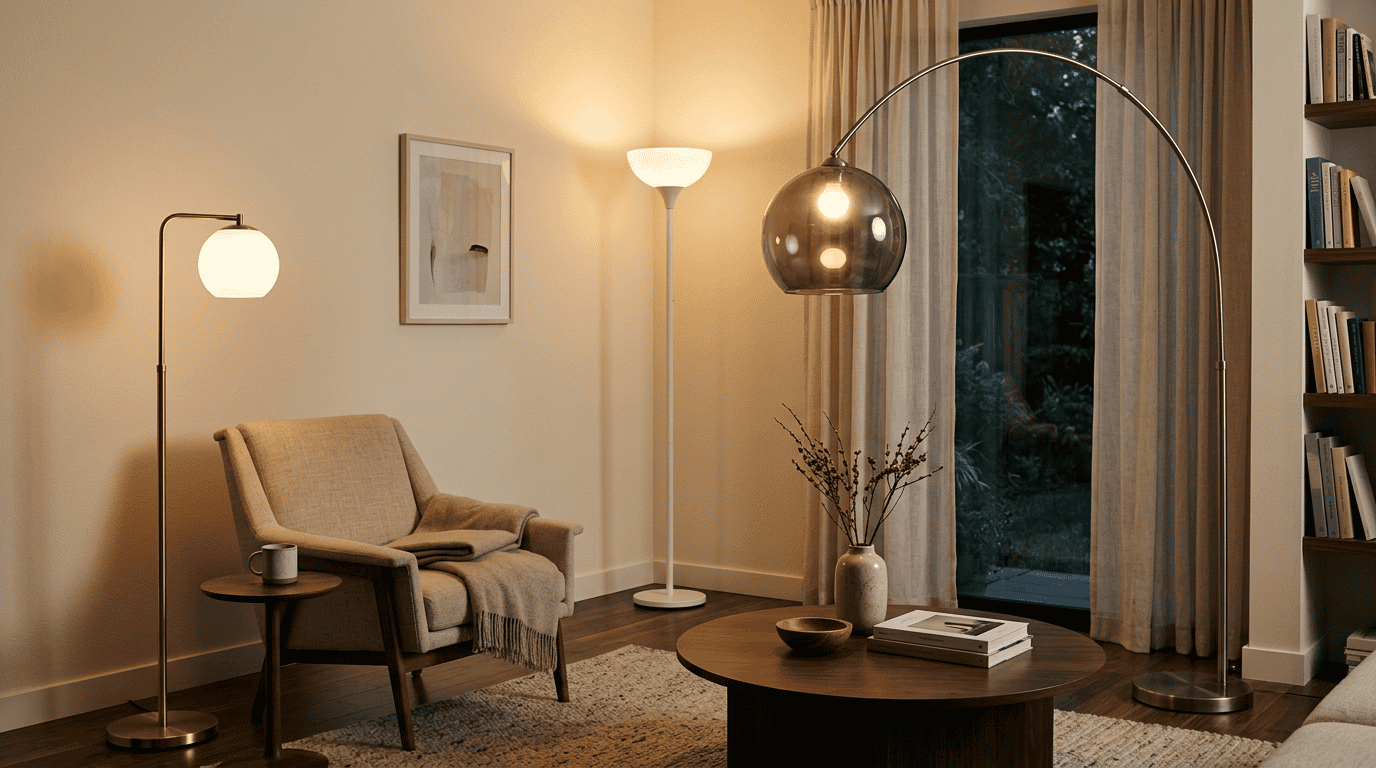
A floor lamp lives in a different lighting zone than any other fixture. It typically rises 1500-1800 mm above the floor, putting the bulb plane right at standing-adult eye level when walking past it, and slightly above seated eye level. That single fact dictates almost every shade decision.
A floor lamp shade has to:
- Diffuse aggressively at eye level. Anyone walking through the room looks directly at the bulb plane.
- Throw useful task light downward (for reading lamps) or upward (for torchieres) without losing the shade’s role as an aesthetic object.
- Stay rigid under its own weight. A wide glass shade on a tall stem flexes the stem visibly. The shade-to-stem weight ratio matters.
- Tolerate being knocked. Floor lamps get bumped by chair backs, vacuum cleaners, children, and pets. Wall-thickness and fitter security become real durability factors.
Most homeowners select a floor lamp shade the same way they’d pick a table lamp shade. That’s the underlying mistake. A floor lamp is, optically and mechanically, a different species.
Floor Lamp Categories – and Their Glass Shade Logic
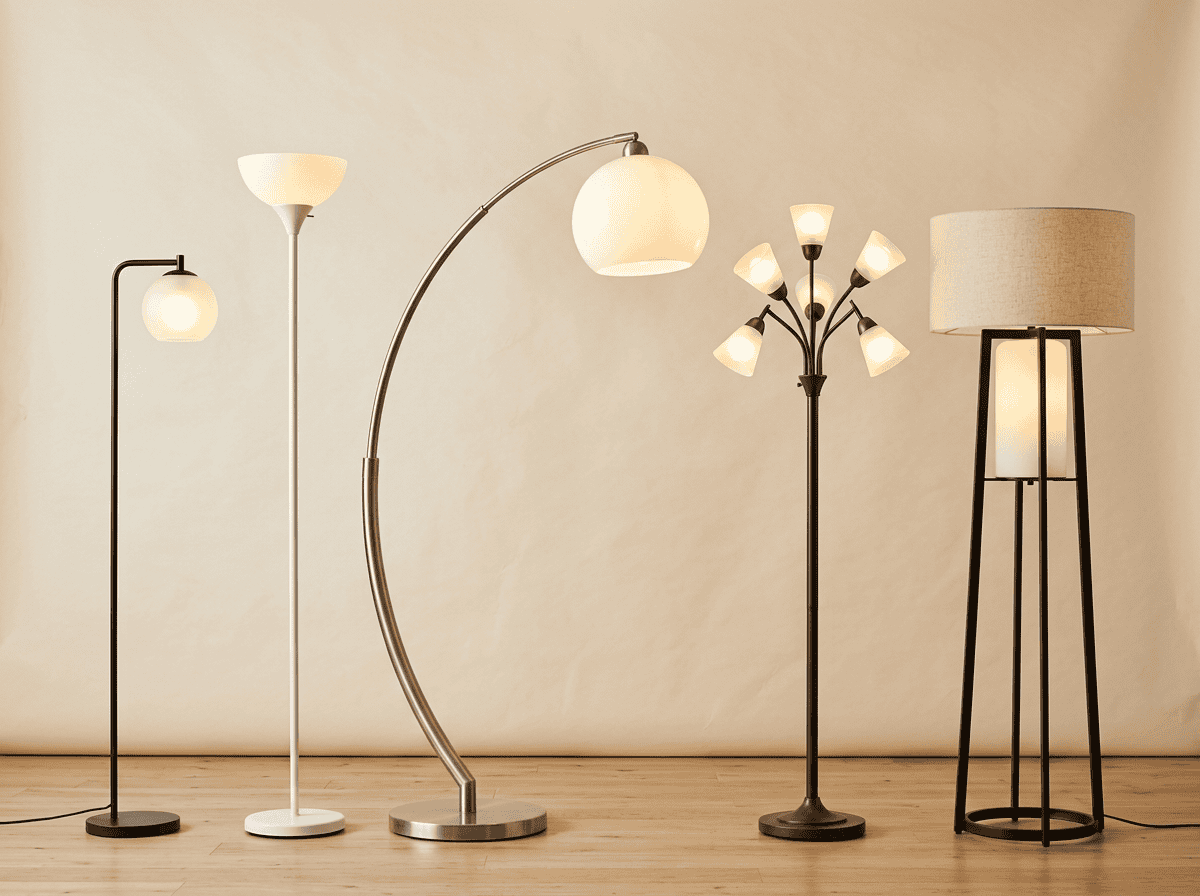
There are five practical categories of floor lamp in residential and hospitality use. Each takes a different shade.
| Floor lamp type | Typical height | Light direction | Best glass shade | Common fitter |
|---|---|---|---|---|
| Reading floor lamp | 1500-1600 mm | Downward, focused | Frosted or opal globe | Uno or spider |
| Torchiere | 1700-1900 mm | Upward, ambient | Opal bowl, white inside | Torchiere bracket |
| Arc / arched | 1800-2000 mm | Downward, broad | Opal sphere or smoked dome | Uno |
| Tree / multi-arm | 1500-1700 mm | Mixed, ambient | Frosted bell or small dome (3-5 shades) | Spider or clip |
| Drum-shade floor lamp | 1500-1600 mm | Diffuse, ambient | Opal cylinder or drum | Spider |
Reading floor lamps
The single most useful floor-lamp category and the most commonly mis-shaded. A reading lamp’s job is to put 400-600 lumens of light onto an open book or magazine roughly 700 mm below the bulb. A clear glass shade puts a hotspot on the page (uncomfortable for sustained reading). A heavy opal shade absorbs too much and forces a much higher-wattage bulb (which then heats the shade more than necessary).
The right answer is almost always inside-frosted glass or light opal, in a globe or downward-cone shape. Output stays high, the bulb image disappears, the page reads cleanly.
Torchieres
Torchieres throw their light at the ceiling, which then reflects down to the room. Critical detail: the inside of the shade matters more than the outside. A torchiere with a glossy white inside surface puts ~85% of bulb output onto the ceiling. A matte-white inside puts ~70%. A tinted inside (amber, smoked) puts ~50% – which can be the right choice for mood lighting but the wrong choice for replacing a 300W halogen torchiere with an LED equivalent.
For inside-finish information, manufacturer spec sheets should show the inner reflectance percentage. Re-sellers almost never have this number; manufacturers always do.
Arc and arched floor lamps
Arc lamps put a single large shade out over a coffee table or seating area, typically 1800-2000 mm above the floor. The shade is the visual anchor. Most arc lamps use a large opal sphere (300-450 mm diameter), which reads as a luminous moon hovering over the seating zone. A smoked or amber dome works for moodier interiors but requires LED output compensation.
Tree and multi-arm floor lamps
Tree lamps have 3-5 small shades on individually positioned arms. Because each shade is small (typically 100-150 mm diameter), each one is much closer to eye level for someone walking past. Frosted or opal is mandatory; clear glass creates 3-5 simultaneous hotspots, which is visually exhausting.
Drum-shade floor lamps
A drum shade is a tall vertical cylinder, usually 350-450 mm diameter and 300-400 mm tall. It works as ambient or accent rather than task light. Opal glass cylinders read as the cleanest version of this archetype. Frosted glass with a contrasting (brass or bronze) trim ring reads as a more traditional version.
Sizing the Shade for a Floor Lamp
Three measurements matter: fitter type, shade outer diameter, and height ratio against the lamp base. Get any of these wrong and the lamp looks wrong even before you turn it on.
Fitter compatibility – the mechanical gate
| Fitter | Inner diameter | Where it lives on a floor lamp |
|---|---|---|
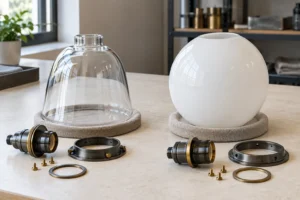
| Uno | 7/8″ (22mm) | Reading lamps and many traditional floor lamps – threads onto the bulb socket |
| Spider | 1 5/8″ (41mm) | Floor lamps with a wire harp and finial nut |
| Torchiere bracket | 250-450 mm shade rim | Bracket holds a torchiere bowl from underneath |
| Clip-on | varies by bulb | Tree lamp arms with candelabra bulbs |
| Neckless | 3-screw mount | Custom or higher-end floor lamps |
Spider fitter is the most common on residential floor lamps because the harp-and-finial system can accommodate a wide range of shade sizes and shapes. Uno fitters are most common on reading lamps because they hold the shade extremely close to the bulb (good for focused downward light).
If you’re buying a floor lamp shade as a replacement, the fitter is non-negotiable. Send the supplier a photo of how the existing shade attached to the lamp, plus a millimeter measurement of the rim opening if there is one. Detailed measurement procedure: how to measure a replacement glass lamp shade.
Outer diameter
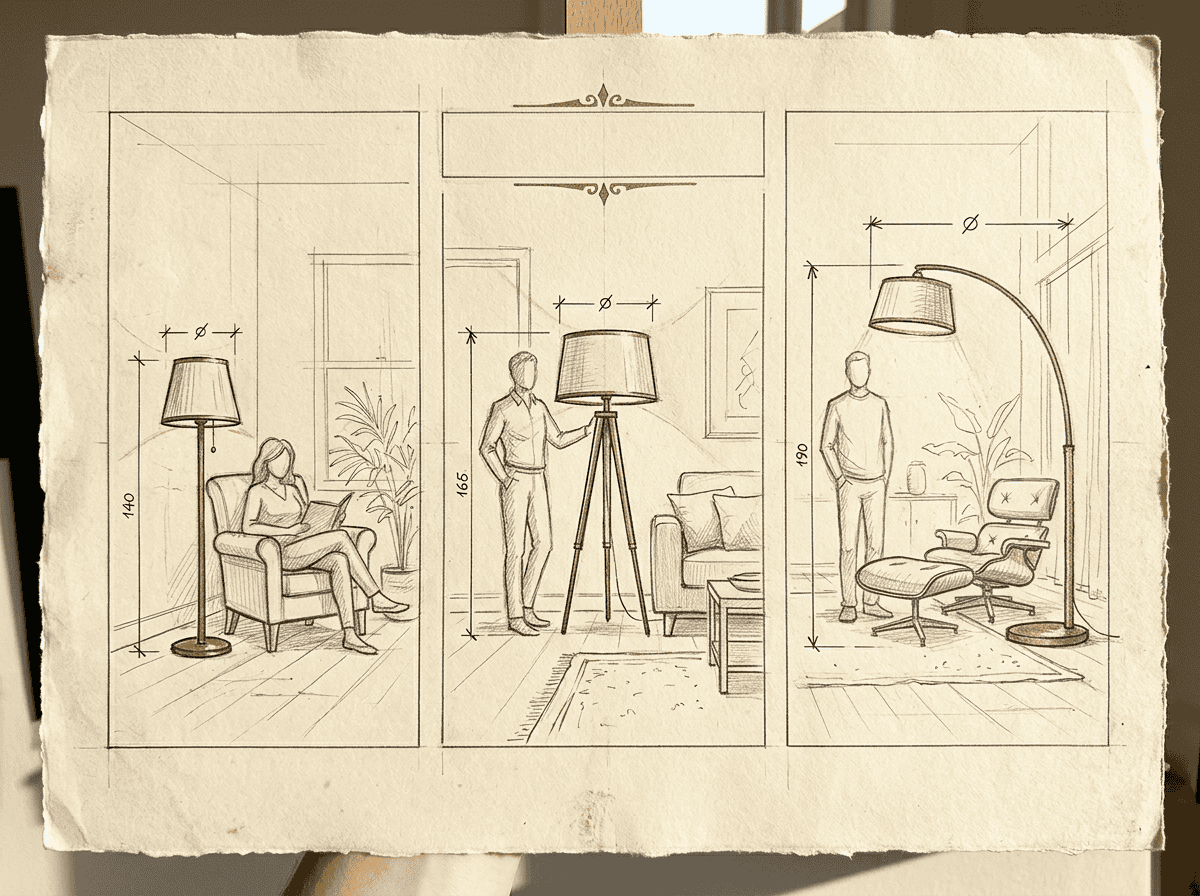
For a standalone floor lamp (not paired with adjacent furniture), the shade diameter should be 1/3 to 2/5 the lamp’s total height. A 1600 mm tall reading lamp wants a shade 250-320 mm in outer diameter. Outside that range, the lamp looks either top-heavy (too big) or undersized (too small).
For floor lamps that sit next to an armchair or sofa arm, the shade should never be wider than the chair arm it’s adjacent to, plus 25%. A 600 mm wide chair arm tolerates a 750 mm shade at most before the lamp starts visually fighting the seating.
For arc lamps, the shade diameter follows the coffee table beneath: roughly 1/3 to 1/2 the table width. A 1.2 m coffee table wants a 400-600 mm arc shade.
Height ratio
Shade height should be 1/4 to 1/3 the visible distance from the lamp’s bulb plane to the floor. Too short and the lamp looks like a stand with a marble on top; too tall and the lamp looks like a tower with a vase nailed to it. The proportion that works almost universally on contemporary floor lamps is a shade height equal to the lamp base’s width.
Glass Material Choices for Floor Lamp Shades
Floor lamps eat shades faster than any other fixture in the home because they’re the lamp most commonly bumped. Glass material and wall thickness matter more here.
Soda-lime vs borosilicate
Standard residential floor lamps use soda-lime glass. It’s cheaper, blowable in any color, and adequate for LED operation. If your floor lamp has a halogen bulb or any incandescent (rare in 2026 but still present in legacy fixtures), spec borosilicate, which tolerates thermal shock – a critical property when a hot bulb can suddenly cool from a draft or splash.
Wall thickness for floor lamp shades
The floor-lamp-specific recommendation:
- 3 mm wall – acceptable for high-mounted shades on torchieres or tall arc lamps that don’t get touched
- 4 mm wall – the residential default for reading lamps and tree lamps
- 5-6 mm wall – the right choice for any floor lamp shade in a room with children, pets, or heavy foot traffic
Thicker glass also damps the “ringing” sound of the shade when bumped – a quality detail you don’t notice until you compare a 3 mm shade to a 5 mm shade side by side.
Inside frost vs outside frost
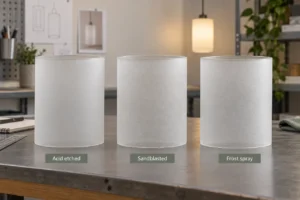
Floor lamp shades benefit enormously from inside frost. Outside frosting collects dust in the etched texture – and floor lamps gather dust faster than any other lamp because their air column rises continuously past the shade when the bulb is on. Inside frosting keeps the outer surface smooth and dust-resistant while still scattering light. Outside-frosted shades on floor lamps need cleaning twice as often.
For the full physics, our glass light diffusion explained: clear vs frosted vs opal glass for lighting covers this in detail.
Selecting a Floor Lamp Shade in the Right Order
A reliable selection process for any floor lamp:
- Identify the floor lamp’s job – reading, ambient torchiere, accent arc, or background fill. The job determines glass type.
- Measure the existing fitter (for replacements) or read the lamp’s spec sheet (for new lamps). Fitter mismatch is the most common return reason.
- Decide between transmission and absorption. Opal absorbs ~50%, frosted absorbs ~30%, amber absorbs ~40-60%, smoked absorbs ~50-70%. Pair absorption with bulb lumen output – 1100 lm LED behind opal gives roughly 550 lm of usable room light.
- Pick the diameter. Follow the 1/3 to 2/5 rule against lamp height for standalone lamps, or 1/3 to 1/2 coffee-table width for arc lamps.
- Pick the color temperature. 2700K for almost every residential context. 3000K only for modernist palettes.
- Order a sample if buying in volume. Reputable manufacturers offer sample units for designers and procurement specialists working on multiple installations.
Common selection mistakes
After supplying many thousands of floor lamp shades to residential and hospitality clients, the same five mistakes account for the bulk of returns:
- Buying a clear globe shade for a reading lamp. The hotspot lands directly on the page – eye-watering. Frosted or opal solves it.
- Buying a torchiere shade without checking inside reflectance. A matte-grey-inside torchiere is dim. White-inside or glossy-white-inside torchieres reach the ceiling.
- Buying a 4 mm shade for an active-household floor lamp. Cracks within months from cumulative bumps. Spec 5-6 mm wall.
- Buying a shade narrower than the bulb’s halo zone. Bulb sticks out, ruining the silhouette. Always order a shade slightly wider than bulb halo width.
- Buying a heavy shade for a thin floor lamp stem. Stem flexes visibly. Match shade weight to stem rigidity.
Floor Lamp Shade Replacement: The Step-by-Step
Floor lamp shade replacement is the single most common B2B B2C order in our floor-lamp category. The procedure:
- Unplug the lamp. Always.
- If the shade is on a harp-and-finial (spider fitter), unscrew the finial counterclockwise. Lift the shade straight up off the harp.
- If the shade is uno-fittered, unscrew the shade counterclockwise from the socket threading. (Some uno shades are threaded; others lift off if held in place by a stopper ring.)
- If the shade is on a torchiere bracket, look underneath the shade rim. There are usually 3 thumb screws holding it in the bracket. Loosen all three, then lift the shade out.
- Photograph and measure the fitter. Inner diameter, depth, threading or screw type.
- Send measurements and photos to the supplier. A reputable manufacturer can confirm match before you order.
- Install the new shade in reverse order. Hand-tighten only. Glass cracks under over-tightened finials.
For broader replacement guidance and standards, the glass lamp shade fitting standards: the complete technical guide covers fitter standards across all lamp types.
Bulb Selection for Floor Lamp Glass Shades
| Floor lamp type | Recommended bulb | Lumens | CCT | Dimmable |
|---|---|---|---|---|
| Reading lamp | A19 LED, high CRI (90+) | 800-1100 | 2700K | Yes |
| Torchiere | A19 LED with reflector, or G25 globe | 1500-1800 | 2700K | Yes |
| Arc lamp | A19 LED | 1100 | 2700K | Yes |
| Tree lamp (per arm) | Candelabra E12 LED filament | 250-400 each | 2700K | Yes |
| Drum-shade floor | A19 LED, frosted | 800-1100 | 2700K | Yes |
Color rendering matters more for floor lamps than for any other fixture. Reading lamps illuminate text – high CRI bulbs (90+) render printed colors correctly. The U.S. Department of Energy’s lighting guide covers CRI selection in plain language and confirms the 90+ recommendation for residential reading conditions.
Dimmability matters because floor lamps are evening fixtures. A reading lamp at 100% in evening light reads as harsh. Dim to 60% and the same lamp reads as luxurious. The shade absorbs roughly the same percentage of light at any dim level – so plan the bulb’s maximum output to be roughly 1.7x what you want at the room’s eye level after the shade absorbs its share.
Where Floor Lamp Shades Sit in Room Lighting Layers
A working living room generally has 3-5 floor lamps across its various roles. The pattern:
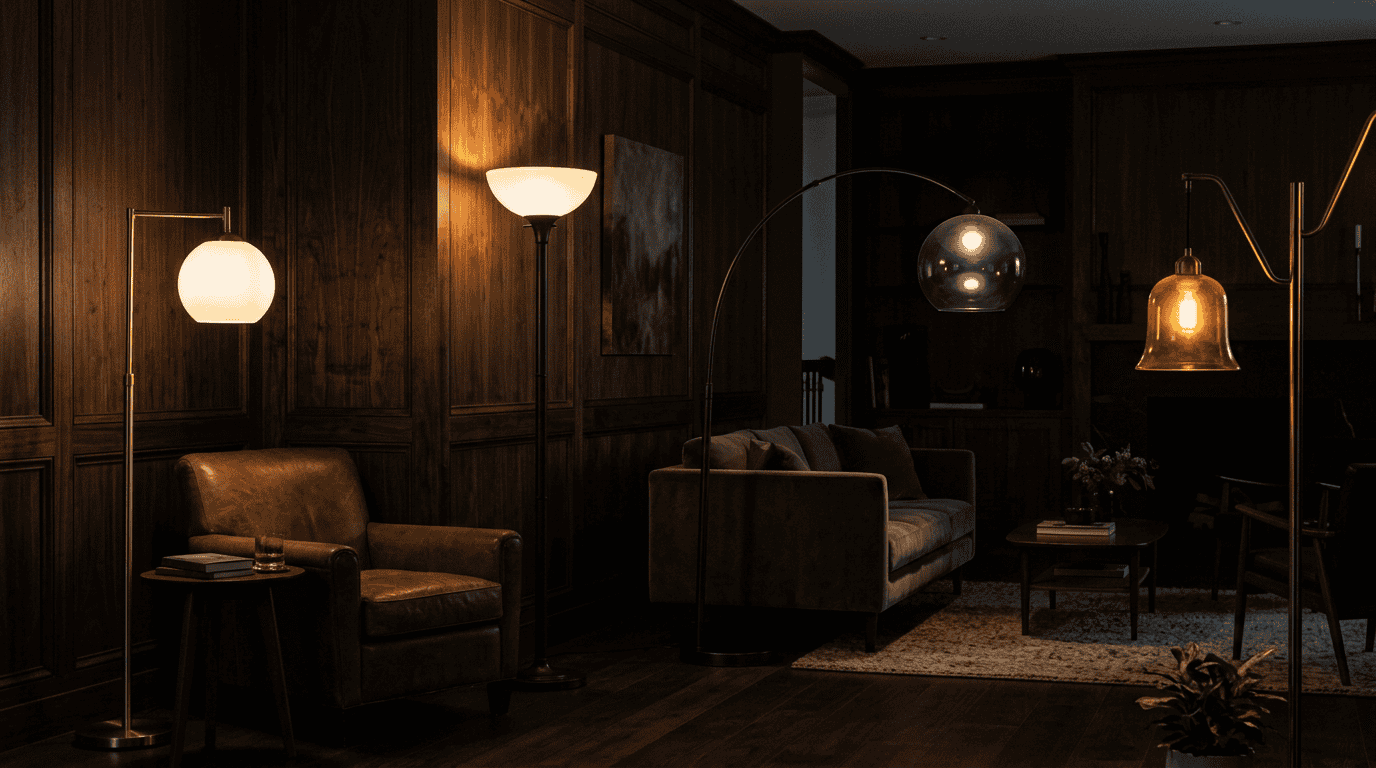
- One reading floor lamp near the primary reading chair or sofa corner – frosted or opal globe, downward-focused
- One ambient floor lamp (often torchiere or arc) lighting the room’s primary seating zone from above – opal bowl or sphere
- Optional accent floor lamp in a corner – smoked or amber for moody background
For mood-zone variation in larger rooms, how to choose the right glass lamp shade for pendant lights covers the parallel logic for overhead fixtures – useful because pendants and floor lamps usually need to coordinate as part of a layered lighting scheme.
Hospitality and Commercial Floor Lamp Shade Specifications
Commercial floor lamps – hotel rooms, hospitality lounges, executive offices – operate under different constraints:
- Durability standard – floor lamps in hotel rooms get bumped by housekeeping vacuums daily. Spec 5-6 mm wall minimum.
- Bulb access – housekeeping changes bulbs without an instruction sheet. Quick-access shades (no tools, simple lift-off) are favored.
- Standardized fitter – hotels typically standardize on spider fitter across all rooms to allow shade replacement from a single inventory.
- Light output consistency – hospitality groups want measurable lux levels at sofa/desk surface. Opal glass with 1100 lm bulb is the common spec.
- Fire safety – check the local jurisdiction’s regulations. The Underwriters Laboratories (UL) standards cover portable luminaire testing in North America.
For full hospitality specification context, our hotel glass lamp shades page covers the broader sourcing pattern.
Custom Floor Lamp Shades from a Manufacturer
Most floor lamp shades sold in retail channels come from re-seller catalogs – meaning four sizes, three colors, two finishes. If your fixture doesn’t match the catalog, retail can’t help.
Direct manufacturer relationships unlock:
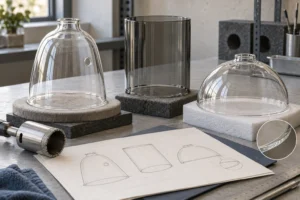
- Custom diameter and height to fit non-standard fitters
- Custom finish – frost level, opal layering, inside reflectance percentage, ribbing pattern
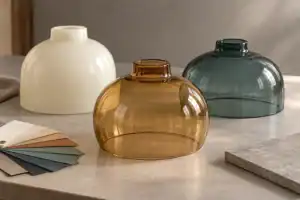
- Custom color – amber intensity, smoke depth, decorative tints
- Wholesale pricing at 30-60% retail
- Sample units before bulk order
- Compliance documentation for hospitality and commercial procurement
For procurement teams ordering 20+ units across a property, this is the obvious path. Bulk pricing thresholds typically start around 20-50 units depending on the supplier and the customization level.
Future Trends in Floor Lamp Glass Shades (2026 and Beyond)
Three movements are shaping floor lamp shade design as of early 2026:
| Trend | What it changes | 2026+ implication |
|---|---|---|
| Heritage hand-blown revival | Visible craft markings, intentional irregularity | Premium residential gravitates back to hand-blown |
| Slim-profile torchieres | Smaller bowls, more directional uplight | Older bulky torchiere designs feel dated |
| Layered cased opal | Multi-layer glass for selectable transmission | Higher absorption opal becomes a design choice rather than a flaw |
| Recycled-content glass | Sustainability spec sheet differentiator | Hospitality procurement actively asks for this |
According to industry analysis (notably from Architectural Digest’s recent design coverage on floor lamp trends), the slim-profile torchiere is replacing the bulky 1990s halogen torchiere across most newly-photographed residential interiors.
Frequently Asked Questions
What’s the best glass lamp shade for a reading floor lamp?
Inside-frosted glass or light opal, in a globe or downward-cone shape, with a 800-1100 lumen 2700K LED at 90+ CRI. This combination eliminates the hotspot on the page while keeping enough light output for comfortable sustained reading.
How do I know if my floor lamp uses a spider, uno, or torchiere fitter?
Look at how the current shade attaches. Spider fitter has a wire harp with a finial nut on top. Uno fitter has shade threading that screws onto the bulb socket. Torchiere fitter has 3 thumb screws in a circular bracket. If the lamp has none of these but the shade is held by 3 screws around the rim, it’s a neckless fitter.
Can I use a clear glass shade on a floor lamp?
Generally no for reading lamps – the bulb hotspot lands on whatever you’re reading. Clear glass works on arc lamps with the shade well above eye level, and on accent torchieres with decorative filament bulbs designed to be seen. Default to frosted or opal for any seated-zone floor lamp.
Are glass floor lamp shades safe with LED bulbs?
Yes, safer than with old halogen bulbs. LEDs run cool, so thermal stress on the shade is minimal. Soda-lime glass at 4 mm wall handles any residential-wattage LED indefinitely.
What thickness should I order for a high-traffic family room floor lamp?
5-6 mm wall thickness. Floor lamps in active households get bumped repeatedly by chairs, vacuums, children, and pets. The price difference between a 3 mm and a 5 mm shade at the supplier level is roughly 30-50% but the shade lasts indefinitely instead of cracking within a year.
What’s the right ratio between floor lamp shade diameter and lamp height?
1/3 to 2/5 the total lamp height. A 1600 mm tall floor lamp wants a 250-320 mm shade. Outside that range the lamp looks visually unbalanced. Arc lamps follow a different rule – the shade follows the coffee table width below it.
Can I custom-order a floor lamp shade for an unusual fitter?
Yes, if you’re working with a manufacturer rather than a re-seller. A direct manufacturer can match any fitter dimension, threading, or screw pattern – just provide a photograph and millimeter-accurate measurements. Re-sellers can only ship what’s in their pre-stocked catalog.
The Bottom Line on Floor Lamp Glass Shades
A floor lamp is a lighting fixture you walk past, sit next to, and occasionally bump into – all of which the glass shade has to survive. Pick frosted or opal for almost any seated-zone floor lamp, opal bowls for torchieres (with attention to inside reflectance), and large opal or smoked spheres for arc lamps. Spec 4 mm walls for normal residential use and 5-6 mm for high-traffic households.
If you’re sourcing more than ten units – for a hotel property, a serviced apartment block, or a residential design project at scale – go direct to the manufacturer. The customization, pricing, and dimensional accuracy beat the retail catalog path by a wide margin.
Next step: identify which floor lamps you currently have, what shade jobs each one is doing (reading, ambient, accent), and which one (if any) is using the wrong shade type for its job. That single audit usually surfaces the upgrade priority in five minutes.