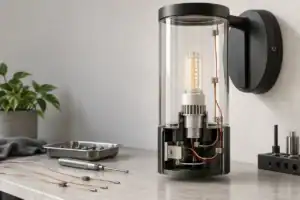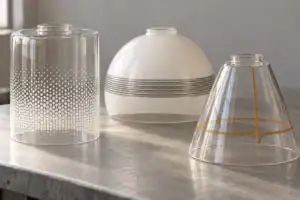
Direct answer: Cut glass pendant light shades are faceted geometric glass covers for hanging pendant fixtures that create prismatic light effects. They attach via neckless thumb-screw fitters, gallery rings, or pendant cord-through openings. Common forms include faceted globes, bell pendants, cylindrical lanterns, and tiered crystal drops.
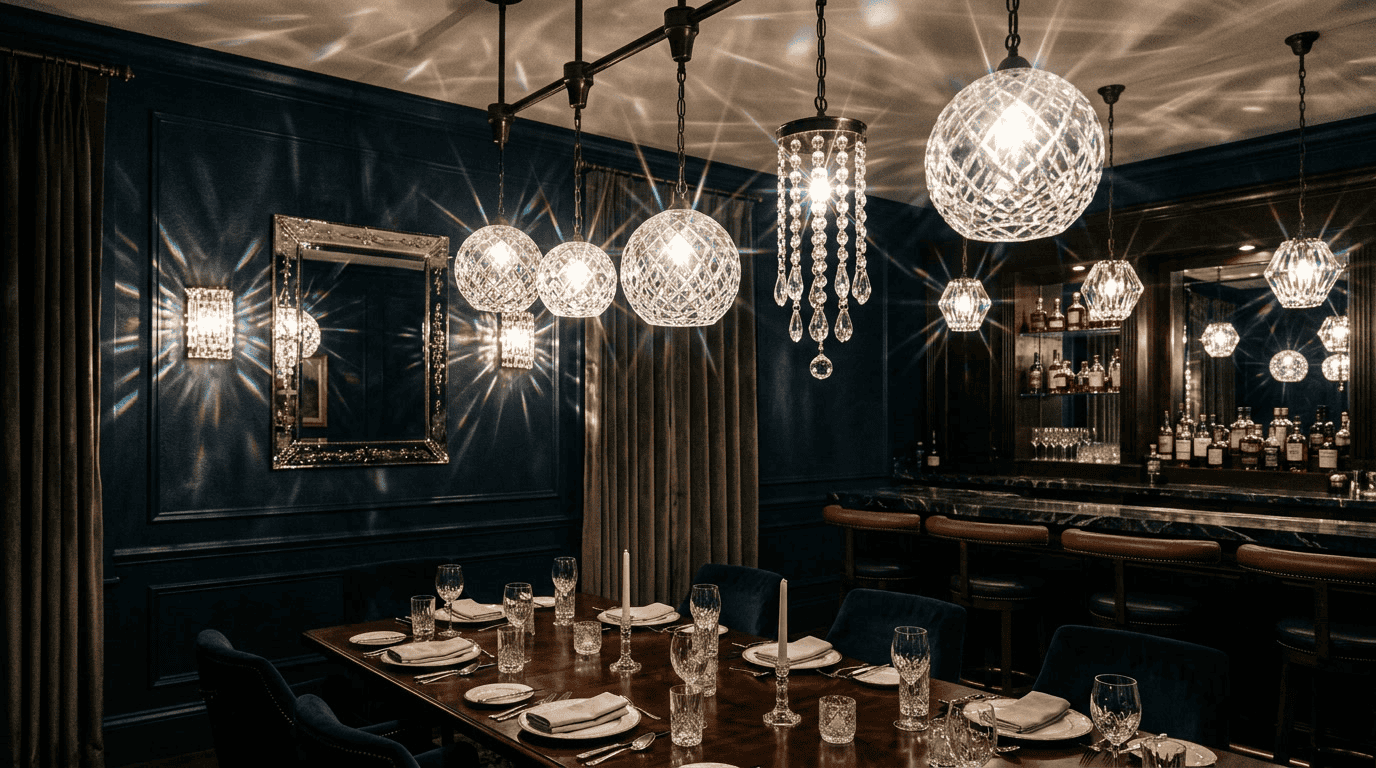
Pendant lights with cut glass shades do something no other lighting type can replicate in quite the same way: they cast prismatic patterns on the ceiling, walls, and table surface simultaneously. The pendant’s overhead position means the light passes through the faceted glass in all directions, creating a 360° light effect that moves subtly with any air current.
In the right setting — a formal dining room, a hotel lobby, a wine bar — this effect is spectacular. In the wrong setting, it can be overwhelming. This guide covers the selection, sizing, and installation of cut glass pendant shades with enough specificity to get the choice right.
Where Cut Glass Pendants Work Best (and Where They Don’t)
Best contexts:
- Formal dining rooms with dark walls: prismatic patterns visible and dramatic against dark surfaces
- hotel lobbies and reception areas: the scale advantage of a crystal pendant chandelier over a seating area
- Wine bars and cocktail lounges: dim ambient + crystal pendants = exactly the right atmosphere
- Entry halls and staircases: high ceilings give the pendant visual clearance; the prismatic effect greets guests immediately
- Statement kitchen islands: one large cut glass globe over a kitchen island reads as designed; three or more begins to feel like a showroom
Contexts where cut glass pendants underperform:
- Contemporary minimalist rooms: the prismatic effects compete with the minimalism
- Rooms with busy patterned walls: patterns on patterns creates visual noise
- Low-ceilinged rooms: cut glass at head height creates glare; the prismatic effect requires distance to read as beautiful rather than obtrusive
- Brightly lit task-focused spaces: the full brilliance of cut glass requires dimmed ambient to be at its best
Four Classic Cut Glass Pendant Forms
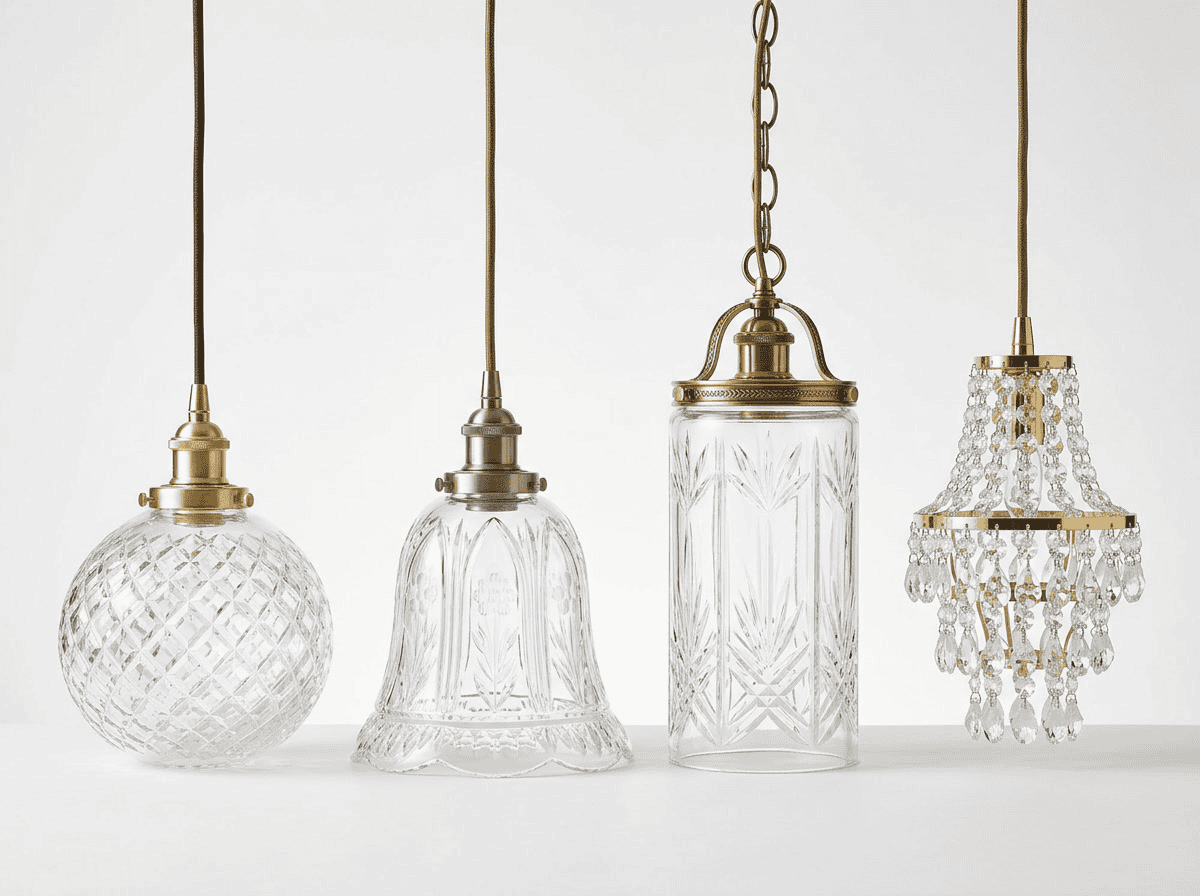
Faceted globe pendant: Spherical or near-spherical with overall diamond or hexagonal faceting. The most versatile cut glass pendant form. 8–16″ outer diameter covers most residential pendant applications. Neckless fitter (thumb screws) or gallery ring.
Faceted bell pendant: Bell silhouette with diamond or fluted cuts on the exterior surface. More directional light output than a globe (more downward light, less lateral). Appropriate over surfaces where downward light is wanted (coffee table, dining table) while still providing prismatic wall effects.
Cylindrical lantern with cut panels: Four or six flat cut-glass panels in a metal frame forming a cylindrical or hexagonal lantern. The cut panels provide geometric light patterns; the metal frame adds structure. Common in traditional and formal entry fixtures.
Tiered crystal drop assembly: Multiple individual crystal shade components (drops, pendants, beads) arranged in tiers — chandelier style. Each component is small; the effect comes from the cumulative collection. Typically 8–14″ overall diameter for the assembled form.
Fitter Types and Sizing for Cut Glass Pendants
| Fitter type | Inner diameter | Where found |
| Neckless thumb screw | 2¼” or 3¼” opening | Mid-century to present ceiling fixtures |
| Gallery ring | 2¼”, 3¼”, or 4″ | Older fixtures, wall sconces |
| Pendant cord-through | Opening sized to cord diameter | Drop pendant components, crystal drops |
| Slip collar | Varies | Industrial-style fixtures |
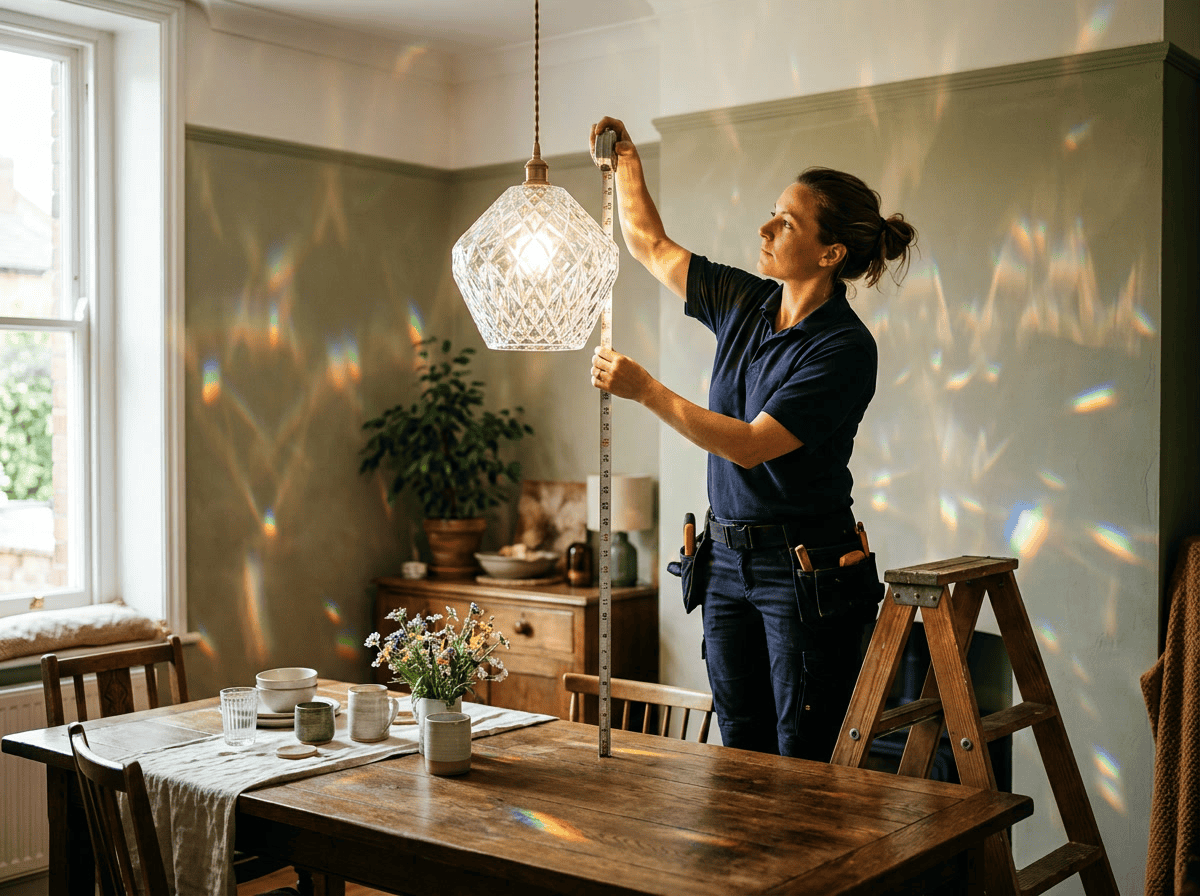
Hanging height for dining/island pendants:
- Bottom of shade 700–900mm above table or island surface
- 1700–1900mm above kitchen floor for island pendants
- Multiple pendants in a cluster: space centers 300–450mm apart over an island
Outer diameter scale rules:
- Single pendant over dining table to 1.2m: 12–18″ outer diameter
- Three-pendant cluster over 1.8m island: 8–10″ each
- Entry foyer statement pendant: 14–20″ depending on ceiling height
For measuring existing pendant fixtures: how to measure a replacement glass lamp shade.
Installation Notes for Cut Glass Pendant Shades
Weight check: Cut glass shades are heavier than comparable size opal or frosted glass shades. Confirm the pendant fixture’s maximum weight rating before installing a large cut glass globe. Standard pendant canopies are typically rated for 2–5 kg total fixture weight; large cut glass globes can weigh 1–3 kg.
Bulb clearance: Faceted globe pendants often enclose the bulb more completely than bell-shaped shades. Confirm the shade’s interior depth accommodates the bulb before final installation. LED bulbs are shorter than fluorescent and fit comfortably in most glass globes.
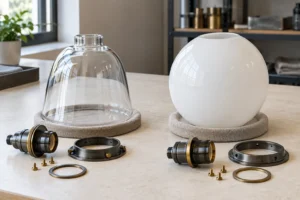
Neckless fitter installation: Turn off power, loosen thumb screws, slide shade over socket cluster until it seats, tighten screws gently (do not over-tighten — glass can crack from uneven pressure on a point). Use a piece of fabric or rubber pad between the screw tip and glass if the shade’s glass is thin.
Prismatic Effects: How to Maximize Them
The prismatic light quality of cut glass pendants is most apparent under specific conditions:
Single bright source + dark surroundings: A single LED bulb at full brightness behind cut glass, in a room otherwise kept dark or dim, produces maximum prismatic effect. Bright ambient from other sources washes out the prismatic patterns.
Dimmer control: Dimming the pendant itself while keeping ambient low creates the ideal condition for cut glass prismatic effects. Dimming from 100% to 40% can completely change the character of the light.
Bulb type: A decorative filament LED (visible filament shape) produces more complex prismatic patterns than a compact LED or omnidirectional globe. The filament’s extended shape creates multiple refraction points through the facets.
Background contrast: The prismatic patterns are most visible on dark, matte surfaces. Charcoal walls, dark wood ceilings, and matte plaster show prismatic patterns clearly. White walls and high-gloss surfaces reflect and wash out the patterns.
According to Wikipedia’s article on refraction, the prismatic effect of cut glass comes from dispersion — different wavelengths of light bending at different angles when passing through the glass-air interface. Higher refractive index glass (lead crystal) produces more dispersion, hence more vivid rainbow effects.
Selecting Between Multiple Pendants for a Space
For multi-pendant installations, three rules apply:
Consistency within a zone: All pendants in a single zone (over one island, over one dining table) should be from the same production batch — matching glass type, density, and pattern. Mixed production looks unintentional.
Scale for the application: Resist the temptation to use small pendants on a large island because they’re cheaper. An island that needs three 10″ pendants and gets three 6″ pendants looks underfurnished. Scale to the space.
Pattern coordination: If using cut glass pendants alongside other cut glass elements (sconces, table lamps), coordinate the cut pattern. All diamond crosshatch reads as a design language; mixing diamond crosshatch with hobstar and step cut on adjacent fixtures reads as a collection of unrelated pieces.
For our cut glass pendant shade range, our cut glass lamp shades collection shows available forms with sizing and fitter specifications.
Maintaining Cut Glass Pendant Shades
Pendant shades accumulate dust inside the shade as well as outside because the upward air current from the bulb (even LED bulbs create slight convection) pulls dust into the shade interior.
Monthly exterior: Soft microfiber cloth, warm water with mild soap, along the cut pattern lines.
Quarterly interior: Remove shade (turn off power, cool down, loosen fitter). Clean interior with a soft brush and damp cloth. Pay attention to the top interior surface where dust accumulates.
Annual: Clean entire shade off the fixture; inspect fitter hardware for corrosion; inspect glass for any developing hairline cracks near the fitter opening.
Frequently Asked Questions
What pendant mounting does a cut glass globe shade use?
Most commonly a neckless fitter — the shade slips over the socket cluster and is held by 3–4 thumb screws around the fitter opening. Measure the inner diameter of your existing shade’s opening: standard neckless sizes are 2¼” and 3¼”. Gallery ring mounts are used in some older fixtures.
How heavy are cut glass pendant shades?
Depends on diameter and glass thickness. A 10″ faceted globe in soda-lime pressed glass weighs approximately 600–900g. True lead crystal of the same size is heavier — approximately 900–1300g. Always verify pendant canopy weight rating before installing a large or heavy cut glass shade.
Can I replace just one pendant shade in a three-pendant cluster?
Technically yes, but matching the glass color, density, and pattern to the remaining two shades is difficult unless you order from the same production batch. If one shade in a cluster breaks, the most practical replacement strategy is to replace all three from the same new batch.
What bulb produces the best prismatic effect in cut glass pendants?
A decorative filament LED bulb (visible filament coil or mesh) at 400–600 lumens, 2700K warm white. The filament shape creates complex multiple-point refraction through the facets. Use on a dimmer to vary the effect.
Are cut glass pendant shades appropriate for kitchen island use?
Yes, particularly for kitchen islands in kitchens that are designed as part of an open living/dining space rather than purely functional kitchens. For purely task-focused commercial-style kitchens, frosted or opal glass pendants are more practical. For residential kitchen-dining combinations, cut glass over the island brings the decorative language of the adjacent dining/living area into the kitchen zone.
How far apart should pendant shades be hung over an island?
For a standard 1.8m (72″) island with three pendants, space the pendant centers 450–500mm apart with roughly equal spacing at each end. For two pendants over a shorter island, space centers approximately 1/3 of the island length from each end.
What is the minimum ceiling height for cut glass pendant shades?
Hanging height should place the shade bottom at 1700–1900mm above the floor for clearance in walking areas. This requires a ceiling of at least 2.2m (7’3″) to allow a 300–500mm hanging drop for the pendant itself. For standard 2.4m (8′) ceilings, this is easily achievable.
Related Articles in This Series
Conclusion
Cut glass pendant light shades deliver unmatched visual drama in the right setting — the 360° prismatic effects, the ceiling patterns, the way the light changes with dimming, all combine into something no other pendant type achieves. The selection criteria are specific: scale to the surface below, fitter to match your fixture’s hardware, glass quality appropriate to the lamp’s visual prominence, and adequate dark background to show the prismatic effects.
The applications where cut glass pendants work best — formal dining rooms, hotel lobbies, intimate bar environments — are also the spaces where lighting is most scrutinized. Getting the scale and glass quality right in these spaces pays back immediately in visual quality.