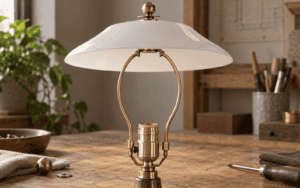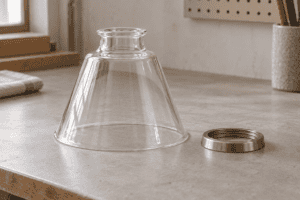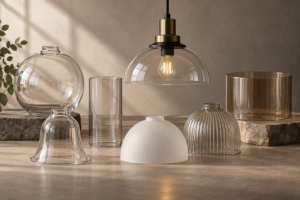
Measure three dimensions: fitter diameter (the inside opening), globe height (from the fitter lip base to the bottom rim), and maximum width. The fitter diameter must match your lamp’s shade holder ring size exactly.
You found the lamp at an estate sale. Solid brass base, original patina, clearly Victorian. The cut glass shade is gone, or cracked across two panels. You order a “standard” replacement based on the photo and a rough sense of size. It arrives. The opening is either too narrow to seat or it wobbles loose on the holder ring. Getting cut glass lamp shade measurements right on the first attempt means knowing three specific numbers and understanding which one is non-negotiable.
Why fitter diameter is the only measurement that must be exact
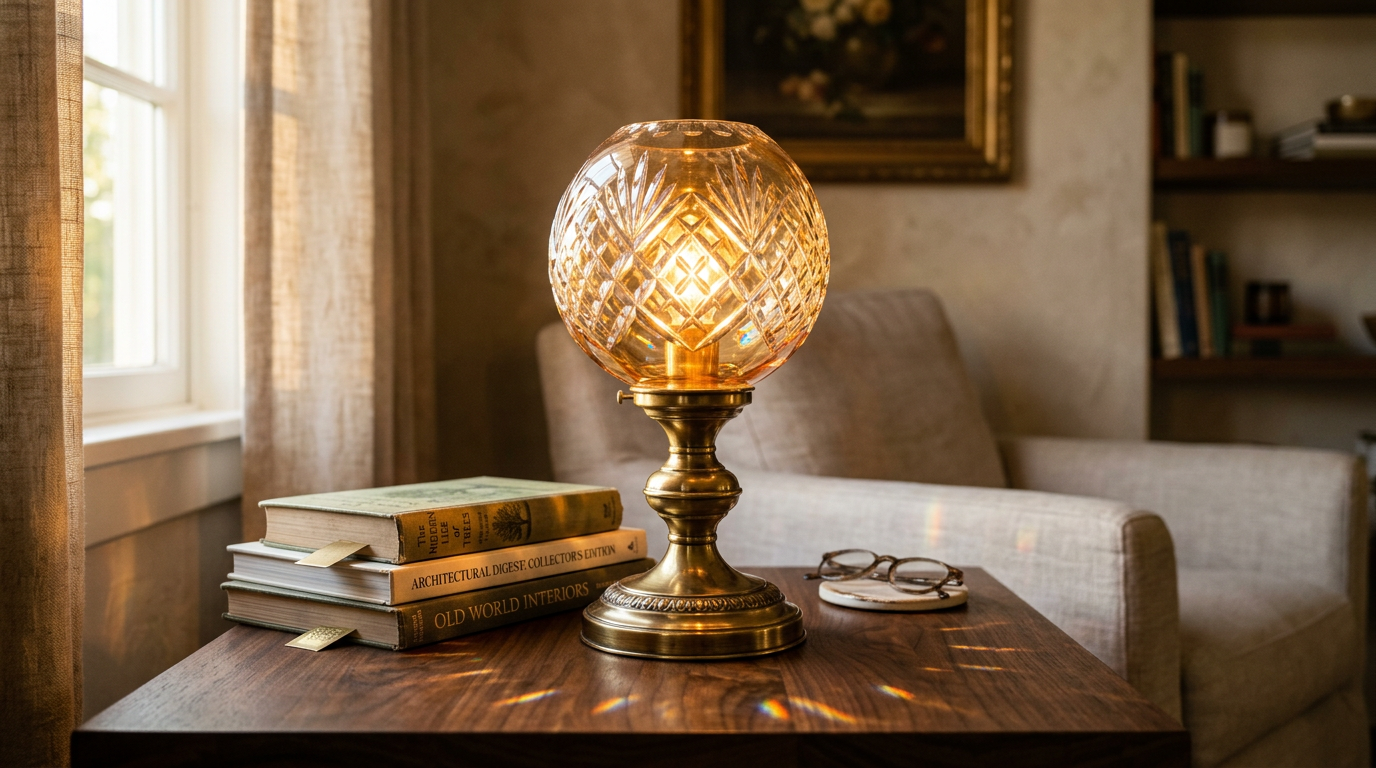
The single measurement that determines whether a cut glass lamp shade will physically fit your lamp is the fitter inside diameter. Get this wrong by 1/8″ and the shade either won’t seat on the holder ring or will rock loose. Height and width affect proportion; fitter diameter is the hard gate.
The fitter lip: inside diameter vs. outside diameter
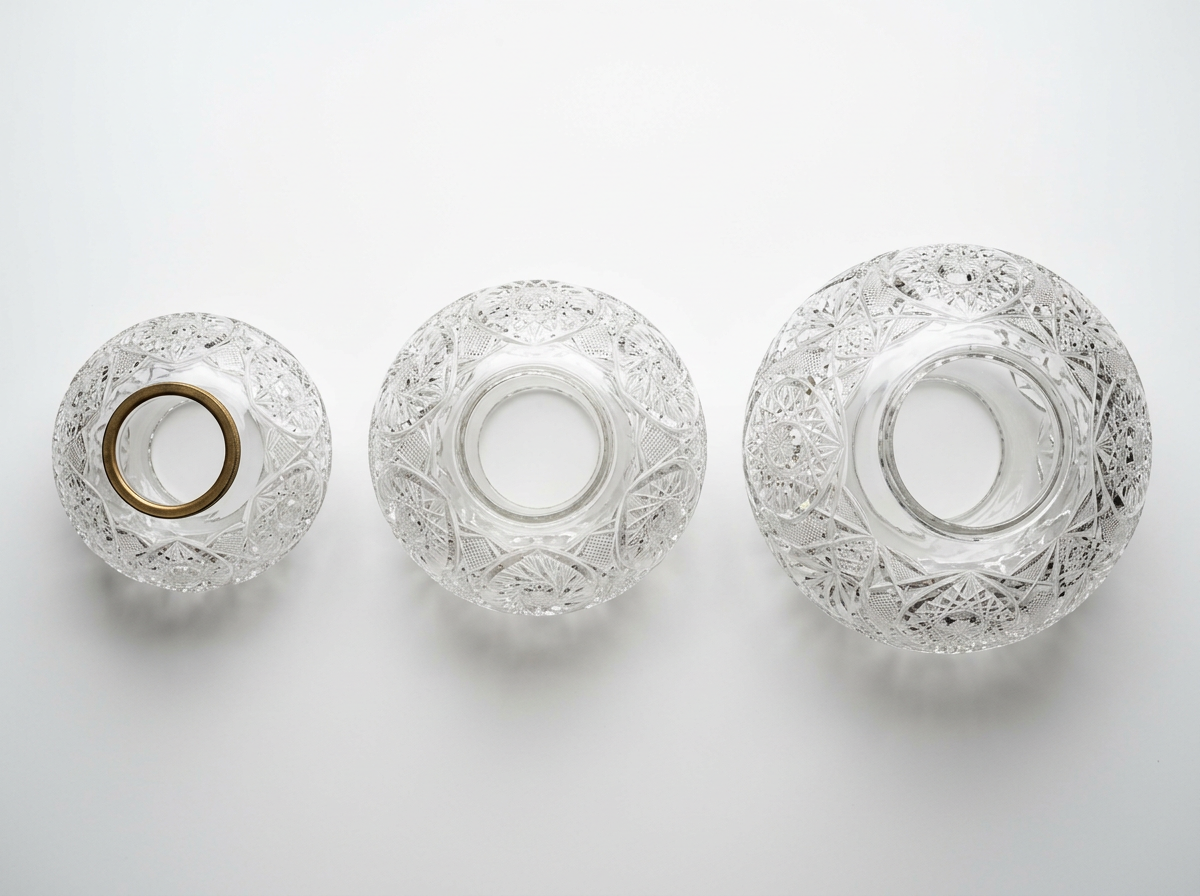
Every cut glass lamp shade has a ground or fire-polished rim at its top opening called the fitter lip. The fitter lip has an inside diameter (the hole) and an outside diameter that includes the glass wall. The measurement that matters for fit is the inside diameter, and it’s the number suppliers use when they say a shade is “2¼ fitter” or “3¼ fitter.”
Most people who measure a cut glass lamp shade for the first time measure the outside diameter of the lip and get a number ¼”–½” larger than the correct fitter size. Caliper jaws go inside the opening at the narrowest interior span. That’s the number to order by.
In practice: we’ve measured Victorian pressed-glass shades where the outside lip diameter reads 2¾” but the correct inside diameter (the fitter spec) is 2¼”. Always specify inside diameter when contacting suppliers or checking shade listings.
Standard fitter sizes and the eras they come from
Cut glass shades, whether American Brilliant Period faceted pieces or Georgian-era prismatic panels, were made to a limited set of fitter standards. The Corning Museum of Glass documents that late 19th and early 20th century glass shade production concentrated around industry-standard fitter rings that allowed shades to be interchangeable across lamp manufacturers. That standardization is still the reference system used today.
| Fitter Inside Diameter | Typical Lamp Application | Primary Era | Notes |
|---|---|---|---|
| 1⅝” (~42mm) | Fairy lamps, small boudoir lamps | 1880s–1920s | Rare; measure carefully |
| 2¼” (~57mm) | Standard table lamps, student lamps | 1890s–1940s | Most common antique size |
| 3¼” (~83mm) | Larger table lamps, hall lamps | 1900s–1930s | Often paired with chimney styles |
| 4″ (~102mm) | Floor lamp torchieres, large hall fixtures | 1910s–1940s | Pendant use common |
| 6″ (~152mm) | Ceiling pendants, gas-converted fixtures | 1880s–1920s | Usually chimney-style fitter |
The 2¼” fitter is the size most commonly needed for antique table lamp replacements. When browsing our cut glass lamp shade collection, filter by fitter size first: it’s the gating specification before height or width.
The three measurements, step by step
To order a replacement, you need three numbers. The fitter diameter gates the fit; height and width determine proportion and bulb clearance. Measure them in this order.
Step 1: fitter diameter
Use a digital caliper set to inside-jaw mode. Position the inside jaws inside the fitter opening at the widest interior span. Read to the nearest 0.5mm (nearest 1/32″). This is the critical number.
If you don’t have calipers, a flexible tape works as a workaround: loop it around the inside of the fitter opening and measure the circumference, then divide by 3.14159 to get inside diameter. For a 2¼” fitter, the interior circumference should be approximately 7⅛”.
What you’re matching is the inside diameter of the shade holder ring on your lamp. The shade holder (a small metal ring on three arms, or a full stamped ring mounted to the socket body) has a specific inside diameter. Your shade’s fitter lip must rest on top of it without dropping through or wedging. That requires the fitter inside diameter to be within 1/16″ of the holder ring inside diameter.
Step 2: globe height
Globe height (sometimes called shade height or overall height) is measured from the flat base of the fitter lip, not from the top of the opening, down to the lowest point of the shade’s bottom rim.
The start point matters. The fitter lip has a small step or shoulder where the fitter wall transitions into the shade body. Start your measurement there, not at the top rim of the glass. On most cut glass shades this transition is clearly visible as a change in wall angle.
For depth-rod measurement: set the shade upright on a flat surface and use a caliper’s depth rod from the lip shoulder down through the shade interior to the table surface. For a steel rule: hold it vertically along the shade’s outer profile from the lip base down.
Step 3: maximum shade width
Measure across the widest diameter of the shade: near the equator on globes, at the bottom rim on bell or cone shapes. This is a diameter, not a circumference.
For cut glass specifically: if the shade has deep miter cuts or hobstar patterns, measure between the outermost peaks of the cuts, not across the valleys. The outermost facet peaks define the true shade width.
This measurement affects visual proportion and bulb clearance but not fitter compatibility. As a rough guide, the maximum shade width should be roughly 2–3x the lamp base diameter at its widest point for a balanced look.
| Fitter Size | Typical Globe Height Range | Typical Max Width Range | Common Cut Glass Style |
|---|---|---|---|
| 1⅝” | 3″–4½” | 4″–5½” | Small ribbed globe, fairy lamp style |
| 2¼” | 4″–7″ | 5″–8″ | Standard globe, bell, or student shade |
| 3¼” | 6″–9″ | 8″–12″ | Large globe, Victorian ruffled, chimney |
| 4″ | 8″–12″ | 10″–16″ | Torchiere dome, large pendant globe |
| 6″ | 10″–18″ | 12″–20″ | Chimney style, hall pendant |
Cut glass-specific considerations
Cut glass shades have structural differences from blown-glass shades that affect both measurement and fit. The main issues: thick fitter-lip walls and collar-lip geometry. Neither is obvious if you haven’t run into them before.
How faceted cut panels affect shade proportions
Cut glass, whether American Brilliant Period (1876–1917), Georgian facet-cut, or mid-century Bohemian, is made by cutting prismatic facets into a thick-walled glass blank and then polishing the cuts to optical clarity. The result is heavier and thicker-walled than comparable blown glass.
That wall thickness matters at the fitter. A shade with a 2¼” inside fitter diameter may have an outside fitter lip diameter of 2¾” or more. The glass wall on brilliant-cut pieces is often ¼” thick at the lip, sometimes more. When you measure your lamp’s shade holder ring (not the shade), verify the ring is wide enough to support the outside of the fitter lip without the shade dropping through.
The practical check: with the shade seated in the holder, the glass lip should rest on the ring, not wedge inside it. If the shade wedges, the outside fitter lip diameter is slightly oversize for that holder. You’ll need a holder ring with a marginally larger inside diameter, or a wider-armed holder.
Victorian and Edwardian fitter styles: chimney, ring, and bulb clip
Antique cut glass shades used three distinct fitter mechanisms, and which one your lamp has changes both how you measure and what shade geometry to order.
The ring fitter (shade holder) is the most common type on electric table lamps. A ring of wire or stamped metal, mounted on three or four arms off the socket body, holds the shade by its lip. The shade rests by gravity. Your inside fitter diameter measurement is the spec that matters here.
The chimney fitter was used on oil lamp conversions and some early electric fixtures. The shade slides down over a chimney tube. You’re measuring the inside diameter of the shade’s bottom opening, which must clear the chimney tube without binding. The top fitter opening on a chimney shade is typically the same diameter or slightly smaller.
The bulb clip fitter (spider fitter) is a spring-loaded clip that clamps directly onto the bulb, bypassing the holder ring entirely. For these shades, the fitter opening is sized for the specific bulb diameter. The lamp base standard that defines Edison-screw and bayonet sizes also determined the bulb clip shade opening dimensions developed around those bulb profiles.
If you’re not sure which type your lamp has, look at the socket body: a ring on arms is a ring fitter, a protruding tube is a chimney fitter, a spring assembly near the socket is a bulb clip.
Collar-lip fitters vs. straight-edge fitters
Some cut glass shades, particularly later Victorian pieces from roughly 1895 to 1910, have a collar lip: a short cylindrical section at the top that drops down into the holder ring rather than resting on top of it. Measuring a collar-lip shade at the flare (where it appears widest at the top) gives a larger number than the collar itself.
For a collar-lip shade, the relevant fitter measurement is the outside diameter of the collar wall: the section that sits inside the holder ring, not the outer flare above it. Get this wrong and a shade that looks correct at 2¼” measured across the flare won’t drop into a 2¼” holder ring, because the collar itself is 2⅛”. Or the reverse: a collar that’s 2¼” at the fitter but widens to 2⅝” at the flare, and looks like the wrong shade in a listing photo.
Our guide to identifying vintage glass lamp shades covers a four-step diagnostic framework for narrowing down era and hardware type, which helps confirm whether a shade is collar-lip or straight-edge before ordering.
How to measure when the original shade is missing
The most common reason people need to know how to measure a cut glass lamp shade is that the original shade is already gone. Here’s how to work from the lamp hardware alone.
Reading the shade holder ring directly
The shade holder ring is your primary reference when the shade is missing. Measure its inside diameter with a digital caliper: this gives you the fitter size to order. In almost all cases, the holder ring inside diameter equals the correct shade fitter inside diameter, within 1/16″.
Common holder ring inside diameters and the fitter shades they take:
- 2¼” holder ring: order a 2¼” fitter shade
- 3¼” holder ring: order a 3¼” fitter shade
- 4″ holder ring: order a 4″ fitter shade
If the holder ring is worn or slightly deformed (common on older spring-steel rings), measure at two or three points and average the readings.
Inferring size from socket position and hardware geometry
If the holder ring is also missing, look at the socket body for clues. Screw holes or solder traces show where the holder arms were attached. Their attachment radius gives you the holder ring’s approximate outside diameter. Subtract the typical arm wire width (~3/16″) twice to get the ring inside diameter, and from that, the shade’s fitter size.
The distance from the top of the socket to the expected bottom of the shade tells you the minimum globe height. On a standard 2¼” fitter table lamp with an A19 bulb (4.6″ length), a globe height of 5½” or more keeps the bulb fully enclosed.
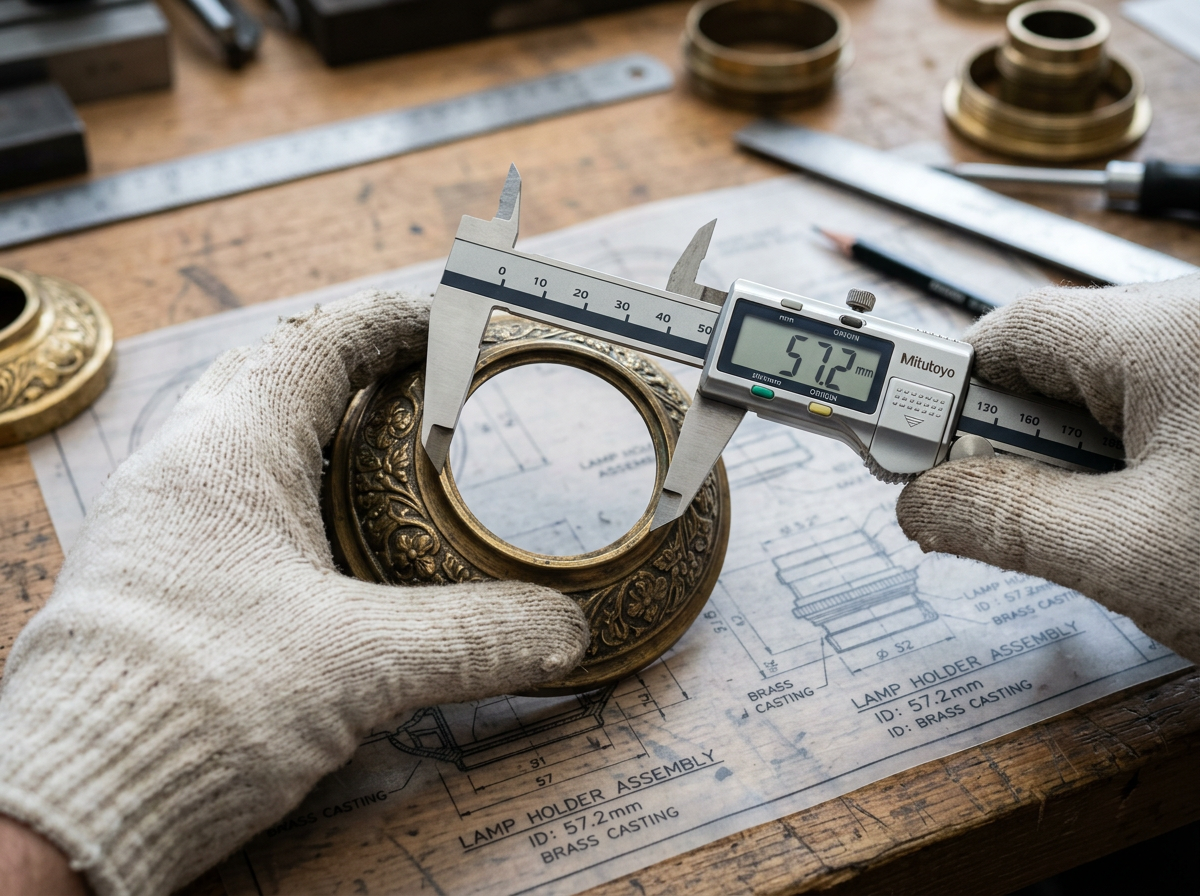
The Smithsonian’s guidance on handling antique glass objects recommends supporting glass pieces from below and avoiding bare-hand contact with polished cut surfaces during measurement. Skin oils accelerate micro-etching on optical-quality facets over time. Cotton gloves are worth using when measuring an existing cut glass shade.
Cross-referencing maker marks and patent dates
Many American Brilliant Period cut glass shades carry paper labels, acid-etched maker marks, or mold marks inside the fitter. If you can identify a maker (Libbey, Hawkes, Dorflinger, Pairpoint), their historical production catalogs, available through the Corning Museum of Glass research library, often list fitter specifications for identified patterns. That gives you a confirmation number to compare against your direct measurement.
When a cut glass shade is broken beyond repair and a replacement is needed, our antique glass lamp shade replacement guide covers the full spectrum of reproduction options, material verification, and how collar-lip versus ring-fitter variations can be specified in custom production.
Standard cut glass shade sizes reference
People searching lamp shade size chart, lamp shade size calculator, 2.25 fitter glass shade, 4-inch fitter replacement, all want the same answer: does this shade fit my lamp? Use this table as a starting point, but always verify with direct measurement before ordering.
Fitter-to-lamp type pairing guide
| Fitter Size | Lamp Type | Typical Wattage Era | Cut Glass Pattern Notes |
|---|---|---|---|
| 1⅝” | Fairy lamp, small boudoir | Pre-1920 | Thin-wall, delicate cutting; rare in market |
| 2¼” | Student lamp, small table lamp | 25–60W equiv. | Most cut glass patterns available |
| 3¼” | Medium table lamp, hall lamp | 60–100W equiv. | Larger hobstar and miter cut patterns |
| 4″ | Large table lamp, floor lamp | 100–150W equiv. | Torchiere and pendant globe forms |
| 6″ | Pendant hall light, ceiling fixture | Gas/early electric | Usually chimney style; deep geometric cuts |
Modern LED bulbs are dimensionally equivalent to the incandescent sizes they replace. The U.S. Department of Energy confirms that LED replacements for A19, G25, and candelabra bulb types match the original dimensional envelope. A shade sized for a 60W A19 incandescent fits an equivalent LED with no fitter modification needed.
When your measurement falls between standard sizes
This trips up most buyers. Your inside fitter measurement reads 2⅜”, between the standard 2¼” and 3¼”. Three situations to consider:
Within 1/16″ of a standard size: the holder ring may be slightly stretched, or you measured at a worn point. Try the nearest standard. A 2¼” shade will seat in a holder ring up to about 2⅜” inside diameter before it becomes noticeably loose.
Genuinely midway between two standards: this usually indicates a non-standard European fitter (common on German and Czech Bohemian lamps), a modified holder ring, or a damaged fitter rim. In these cases, a fitter adapter ring (a brass insert that steps from one standard to another) is the correct solution, not a custom shade.
Specifying shades for production: custom fitter diameters can be specified in glass production, but only at minimum order quantities. For single-piece antique replacement, standard fitter sizes are the practical route.
Tools and measurement accuracy tips
Accurate cut glass lamp shade measurement depends on using the right tool for each dimension. Flexible tape and rigid steel rules measure different things. Using either for the wrong step introduces errors that cause wrong-size orders.
Calipers vs. flexible tape: which to use for each
Fitter inside diameter: use digital calipers with inside-jaw capability (the small stepped jaws, not the large outside jaws). Accuracy to ±0.5mm is sufficient. A standard 150mm (6″) digital caliper covers all fitter sizes up to 6″; a 200mm (8″) model handles chimney shades. Calipers are the only tool that measures the inside of the fitter opening directly.
Globe height: use a rigid steel rule or the caliper’s depth rod. Flexible tape is unreliable for height because it follows the shade’s curved profile rather than the true straight-line dimension. Stand the shade base-down on a flat surface and hold the rule vertically.
Maximum width: a flexible measuring tape works well. Wrap it around the equator, read the circumference, divide by 3.14159. Or set two steel rules vertical against opposite sides of the shade at its widest point and measure between them.
Never use a cloth sewing tape for any of these. Stretch error in a worn cloth tape can reach ¼” or more, and that margin matters for fitter sizing.
Five common measuring mistakes on a cut glass lamp shade
- Outside instead of inside fitter diameter. Always put the caliper jaws inside the opening. Outside diameter is 10%–20% larger and will send you to the wrong size.
- Height from the top of the glass. The measurement starts at the base of the fitter lip shoulder, not the very top rim.
- Width at the wrong point. On bell shades, the widest point is at the bottom rim. On globes, it’s the equator. On cone shades, also the bottom.
- Rounding down on fitter size. If your measurement is 56mm (2.2″), that rounds to 57mm (2¼”), not down to 42mm (1⅝”). Round to the nearest standard.
- Ignoring the collar-lip geometry. On collar-lip shades, measuring at the flare gives a larger number than the collar. The collar is the fitter dimension. If the shade has a visible cylindrical section just below the top flare, measure there.
FAQ
What does fitter size mean on a cut glass lamp shade?
Fitter size is the inside diameter of the shade’s top opening, the measurement that determines whether the shade seats correctly on the lamp’s holder ring. A 2¼” fitter cut glass lamp shade has an inside opening of 2¼” (57mm). The fitter size must match the inside diameter of the shade holder ring on your lamp. Height and width can vary; fitter diameter cannot.
What is the most common fitter size for antique cut glass shades?
The 2¼” (57mm) fitter is the most common size for antique American and European cut glass table lamp shades. Most standard Victorian and Edwardian holder rings are 2¼” inside diameter. If you’re replacing a shade on a typical antique table lamp and don’t have the original to measure, start with 2¼”. It covers the majority of student lamps, parlor lamps, and small hall fixtures from 1890 to 1940.
How do I measure a cut glass shade when the original is already broken?
Measure the inside diameter of the shade holder ring directly using digital calipers: this gives you the fitter size to order. If the holder ring is also missing, look for screw holes or solder marks on the socket body showing the original ring mounting radius. Multiply that radius by 2 for approximate holder ring diameter, which corresponds to the replacement shade’s fitter size.
Can a fitter adapter fix a size mismatch on a cut glass shade?
Yes, for one-step mismatches. Brass fitter adapter rings step from 2¼” up to 3¼”, or from 3¼” down to 2¼”. They fit inside the holder ring and change the effective inside diameter. For mismatches larger than one standard size, adapters get bulky and may tilt the shade, so sourcing the correct fitter size is a better solution. Adapters also change the seating height slightly, which can affect how much of the socket is visible below the shade.
What is the difference between a chimney shade and a cut glass globe shade?
A chimney shade has a tall, narrow cylindrical form that slips over an oil lamp chimney tube. You measure it by the inside bottom diameter that must clear the chimney, not by a holder ring. A cut glass globe shade is spherical or near-spherical and rests on a holder ring by its fitter lip, measured by inside fitter diameter. Both forms appear in cut glass, but they use entirely different hardware and measurement methods. Chimney shades were common on oil lamp conversions; globe shades are standard for electric table lamps. Ordering a globe shade for a chimney lamp (or vice versa) is a non-starter regardless of diameter.
How do I know if the shade height is right for my lamp?
With the shade seated in the holder, the bulb should be fully enclosed, not projecting below the shade’s bottom rim. For a standard A19 LED bulb (approximately 4.6″ length), a minimum globe height of 5″–5½” keeps the bulb inside. The shade’s bottom rim should also clear the lamp base by at least 1″–2″ for visual proportion. If the lamp has a decorative socket body you want to show, a shorter shade is intentional, but the fitter diameter must still match the holder ring exactly.

Conclusion
Knowing how to measure a cut glass lamp shade correctly comes down to one non-negotiable number and two supporting ones. The fitter diameter (inside the opening) must match the lamp’s shade holder ring exactly. Globe height and maximum width inform proportion and bulb clearance, but they don’t determine whether a shade physically seats.
For cut glass specifically: measure inside diameter at the collar, not across the flare. Account for thick fitter-lip walls that make outside diameter noticeably larger than inside. Confirm the fitter type (ring, chimney, or bulb clip) before assuming a standard holder-ring dimension applies. When the original shade is gone, the holder ring inside diameter is your starting point. When that’s also missing, socket geometry and hardware traces can give you the number you need.
Browse the full cut glass lamp shade collection filtered by fitter size. If you need a non-standard fitter diameter or a collar-lip variation for a specific fixture, custom production is available with a stated specification.