Choose glass lamp shades for restaurants by matching the dining concept first: frosted or opal glass at 2700K for fine dining (longer stays, higher spend per cover), clear glass at 3000K for fast-casual and bar (higher turnover), and amber glass for intimate lounge settings — pendant height 28–34 inches above table, commercial-grade glass for durability.
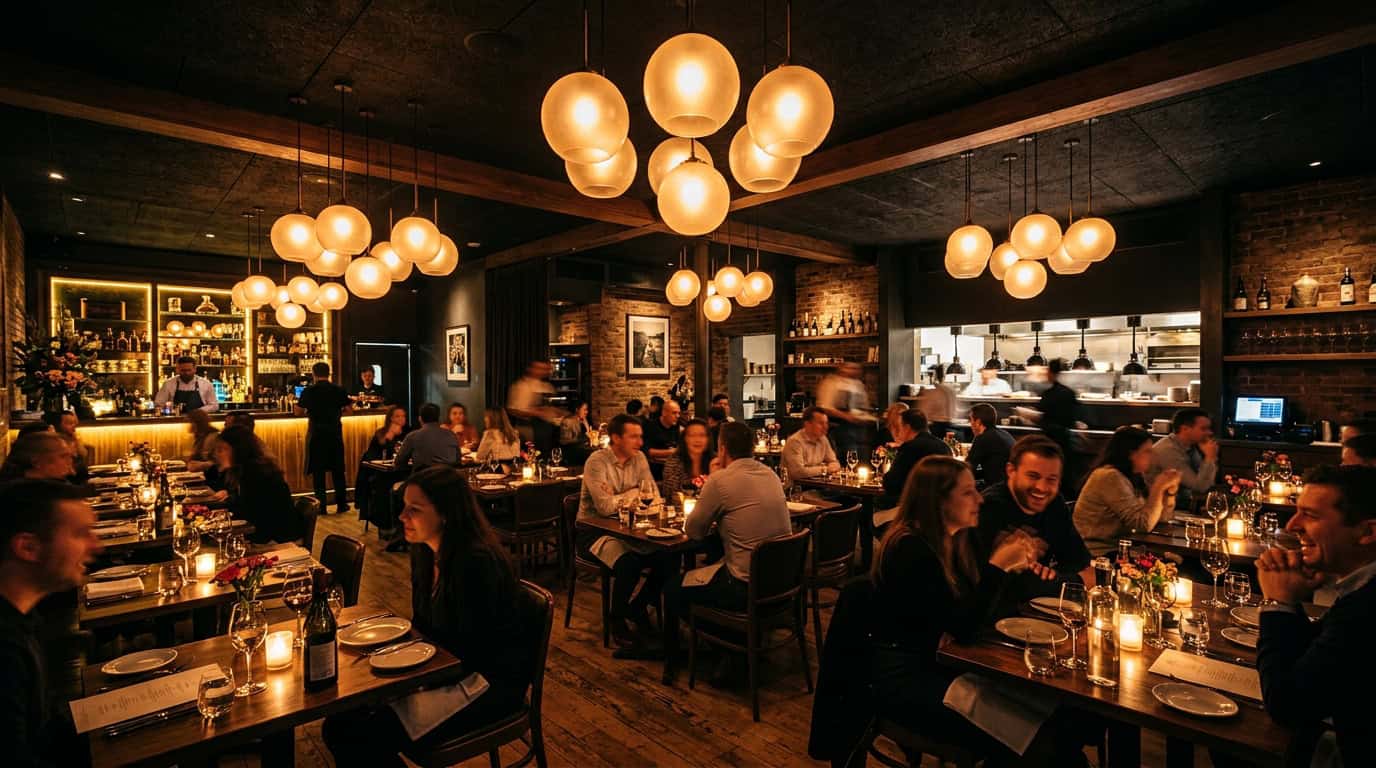
Restaurant lighting is not a design decision — it is a revenue decision. The glass shade above every dining table determines how long guests stay, how much they spend, how much they photograph the space, and whether they come back. Get it right and the lighting amplifies everything else in the room: the food, the service, the atmosphere. Get it wrong and you’re fighting the lighting every service.
This guide provides the complete specification framework for how to choose glass lamp shades for restaurants — from dining concept to glass type, color temperature, hanging height, and commercial durability requirements. The product listing pages that dominate this search provide options but not the decision logic. We’ll provide the decision logic.
Why Restaurant Glass Shade Selection Is Different from Residential
Restaurant glass lamp shade selection involves considerations that home lighting ignores entirely:
Revenue impact of lighting. A landmark study cited by the Cornell School of Hotel Administration found that lighting environment directly affects dwell time and spending: well-designed ambient lighting in fine dining contexts increases average check size by 12–16% versus standardized bright lighting, because guests stay longer and order additional courses and beverages. The glass shade type — and the light quality it produces — is a direct input to this effect.
Consistency at scale. A 60-seat restaurant may have 20 pendant fixtures over dining tables. All 20 glass shades must be identical — same fitter size, same glass type, same transmittance, same color — so the dining room reads as a coherent visual environment rather than a patchwork. This requires ordering from a supplier who can guarantee batch consistency, not sourcing from a retail selection of individual pieces.
Commercial cleaning demands. Restaurant glass shades are cleaned significantly more often than residential shades — typically weekly or biweekly in the kitchen-adjacent areas where cooking vapor, grease aerosol, and steam settle on glass surfaces. The glass must withstand repeated contact with commercial degreasing agents (pH 10–12 alkaline solutions) without surface degradation or etching. Standard soda-lime glass holds up adequately; borosilicate glass provides superior chemical resistance for heavy-duty cleaning programs.
Health and safety compliance. In many jurisdictions, commercial food service operations are required to document glass management programs that identify all glass in the production and service environment, establish breakage procedures, and maintain replacement records. Specifying commercial-grade glass shades with documented glass construction supports this compliance documentation.
Visual photography and social media. Modern restaurant marketing is heavily photo-dependent — guests photograph their meals, the space, and the ambient lighting. A glass shade at the right height that creates a warm pool of light around the table produces the photogenic “restaurant bokeh” that appears in food photography. Clear glass with visible filament LEDs is particularly popular because it photographs dramatically; the specification choice affects how the restaurant appears in guests’ social media posts.
Step 1: Match Glass Shade Choice to the Dining Concept
The dining concept determines the lighting strategy, which determines the glass shade specification. Different dining concepts have fundamentally different revenue models that map to different lighting requirements.
Fine Dining and Upscale Casual
Fine dining revenue is built on high average check size and extended dwell time — guests stay 90–150 minutes, order multiple courses, and choose wines. The lighting goal is flattering, warm, intimate illumination that makes food look appetizing, faces look attractive, and conversation feel private.
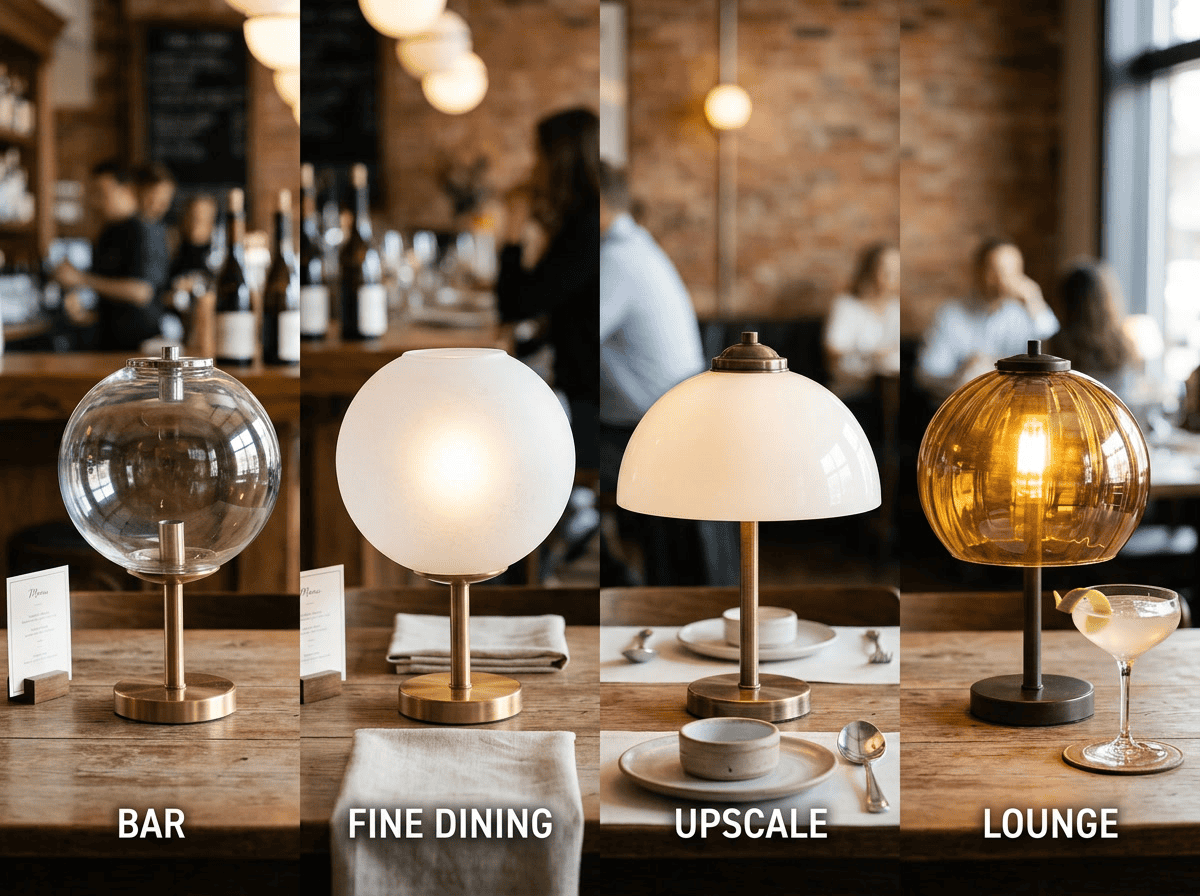
Best glass shade choice: frosted or opal glass at 2700K or lower.
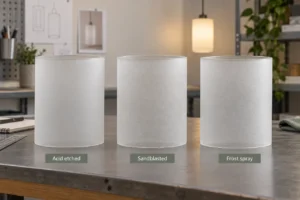
Frosted glass (75–82% transmittance) and opal glass (60–75% transmittance) both eliminate the harsh point-source glare that clear glass creates at dining distances. At fine dining table heights (28–30 inches from pendant bottom to table surface), a frosted or opal globe produces a soft, even pool of warm light that illuminates food and faces without creating the uncomfortable brightness that disrupts the mood of an expensive meal.
Color temperature: 2700K warm-white LED is the standard for fine dining. Warmer still — 2400K — is achievable with amber glass, which shifts the transmitted spectrum toward candlelight-like quality that particularly suits upscale dining without requiring specialty bulbs.
According to the Illuminating Engineering Society’s restaurant lighting recommendations, fine dining spaces should deliver 30–75 footcandles at the table surface — achievable with 10–15 watt frosted glass globe pendants at 28–32 inches above the table.
Fast-Casual and Casual Dining
Fast-casual and casual dining revenue is built on high table turns — guests spend 30–60 minutes, and the revenue per hour of table occupancy is higher with faster turns than with extended dwell time. The lighting goal is bright enough to create an energetic, social atmosphere, easy food viewing, and comfortable conversation — but not so warm and intimate that guests linger.
Best glass shade choice: clear glass or lightly frosted glass at 3000K.
Clear glass at 3000K produces a visibly brighter, more energetic atmosphere than frosted glass at 2700K. The visible filament or LED chip through clear glass adds visual interest and visual energy. Guests in bright, active environments tend to eat faster and turn tables more quickly — a revenue-positive outcome in the fast-casual model.
For casual dining that wants to feel lively but not clinical, lightly frosted glass (transmittance 78–82%) at 3000K is the right middle ground: enough brightness for a social atmosphere, enough diffusion to remain comfortable.
Bar and Lounge
Bar and lounge revenue comes from beverage sales over extended stays. The lighting goal is atmospheric and intimate — guests should feel comfortable lingering, ordering additional rounds, and occupying space for 2–3 hours. The lighting should make people look attractive (faces, skin tones) and the bar look photogenic.
Best glass shade choice: amber tinted glass at any LED color temperature, or clear glass with filament LED at 2200–2400K.
Amber glass selectively absorbs blue-wavelength light (400–500nm), shifting the transmitted spectrum toward red and orange. The practical effect at a bar: faces look warm and flattering (amber light suppresses the cold shadows that white light creates on faces), cocktails with warm colors (whiskey, bourbon, rosé) glow dramatically, and the overall atmosphere reads as sophisticated and intimate.
The bar lighting spectrum also affects how guests feel — the amber spectrum produces a physiologically relaxing effect by reducing the alertness-maintaining blue-light exposure that standard LED sources provide.
Café and Coffee Concept
Café lighting must balance two competing requirements: productive daytime lighting for the laptop-worker customers who drive morning and afternoon revenue, and warm ambient lighting for the social customers in the evening.
Best glass shade choice: frosted glass at 3000K with supplemental task lighting at counter and workstation areas.
Frosted glass at 3000K provides enough lux for comfortable laptop work (typically 300–400 lux at table surface for a focused productivity environment) while producing a pleasant, non-clinical atmosphere that distinguishes the café from an office. Ceiling lighting or wall-mount fixtures at 4000K can supplement the table pendants for counter and service areas where color-accurate food display matters.
Glass Types for Restaurant Applications
Clear Glass
Clear glass transmits 88–92% of the LED source output and makes the lamp source visible. The visible LED chip or filament creates a visual “spark” that reads as energy and vitality in a restaurant space — effective in fast-casual, bar, and café contexts where visual interest at the pendant level contributes to the room’s energy.
Clear glass is the natural pairing for Edison-style filament LED bulbs — the visible glowing filament is the visual element, and clear glass is the only way to display it. Filament LED pendants over bar tops and counter seating are a reliable visual formula for casual and bar-concept restaurants.
At table height in a restaurant context, clear glass creates more glare potential than frosted — relevant for fine dining where guests face each other across the table and a visible bright point in the sightline is uncomfortable. For casual and bar contexts where seating is side-by-side at a counter or guests are focused on the bar environment rather than each other, this is less problematic.
Frosted Glass
Frosted glass (75–82% transmittance) eliminates visible bulb hot spots and produces even, glare-free illumination. For restaurant table pendants hung at 28–32 inches, frosted glass produces the most comfortable light quality for face-to-face dining — no glare across the table, flattering soft shadows, uniform illuminance on the food.
Frosted white glass with 2700K LEDs is the most widely specified glass shade combination in fine dining and casual dining restaurant fit-outs because it delivers the appropriate light quality for both dining modes without requiring concept-specific customization.
Opal Glass
Opal glass (60–75% transmittance) produces the densest, most uniformly white glow of any glass type — the globe glows rather than diffuses. For upscale restaurant concepts where the pendant shade itself is a design element that should look premium lit and unlit, opal glass provides visual weight and substance that frosted glass does not.
The trade-off: opal glass transmits significantly less light than frosted at the same wattage. Restaurant pendant fixtures with opal glass require 15–20 watt LED sources (versus 10–15 watt for frosted) to achieve the same footcandle level at the table surface. This is not a significant cost difference at commercial energy rates but affects the initial fixture specification.
Amber and Tinted Glass
Amber glass is the bar and lounge specialist. Its blue-filtering characteristic produces:
– Warmer, more flattering light on faces at bar seating
– Dramatically enhanced appearance of amber-colored beverages (whiskey, bourbon, beer, rosé)
– A physiologically relaxing atmosphere that encourages longer stays and additional round orders
– A visually distinctive, photogenic bar environment that differentiates the space
Amber glass transmits 50–65% of the LED source output — significantly less than frosted. For bar pendant and wall sconce fixtures with amber glass, specify 15–20 watt warm-white LEDs to achieve adequate bar counter illuminance (100–200 footcandles at the bar surface for comfortable drink preparation and guest visibility).
Per Energy.gov commercial lighting efficiency guidelines, commercial bar and restaurant lighting systems should target 30–75 lux for dining areas and 150–300 lux for bar service surfaces — specifications that require LED wattage calibration based on the glass shade transmittance.
Step 2: Specify Pendant Hanging Height for Restaurant Tables
Pendant hanging height is the second critical specification after glass type — and it is the most commonly wrong dimension in restaurant lighting fit-outs.
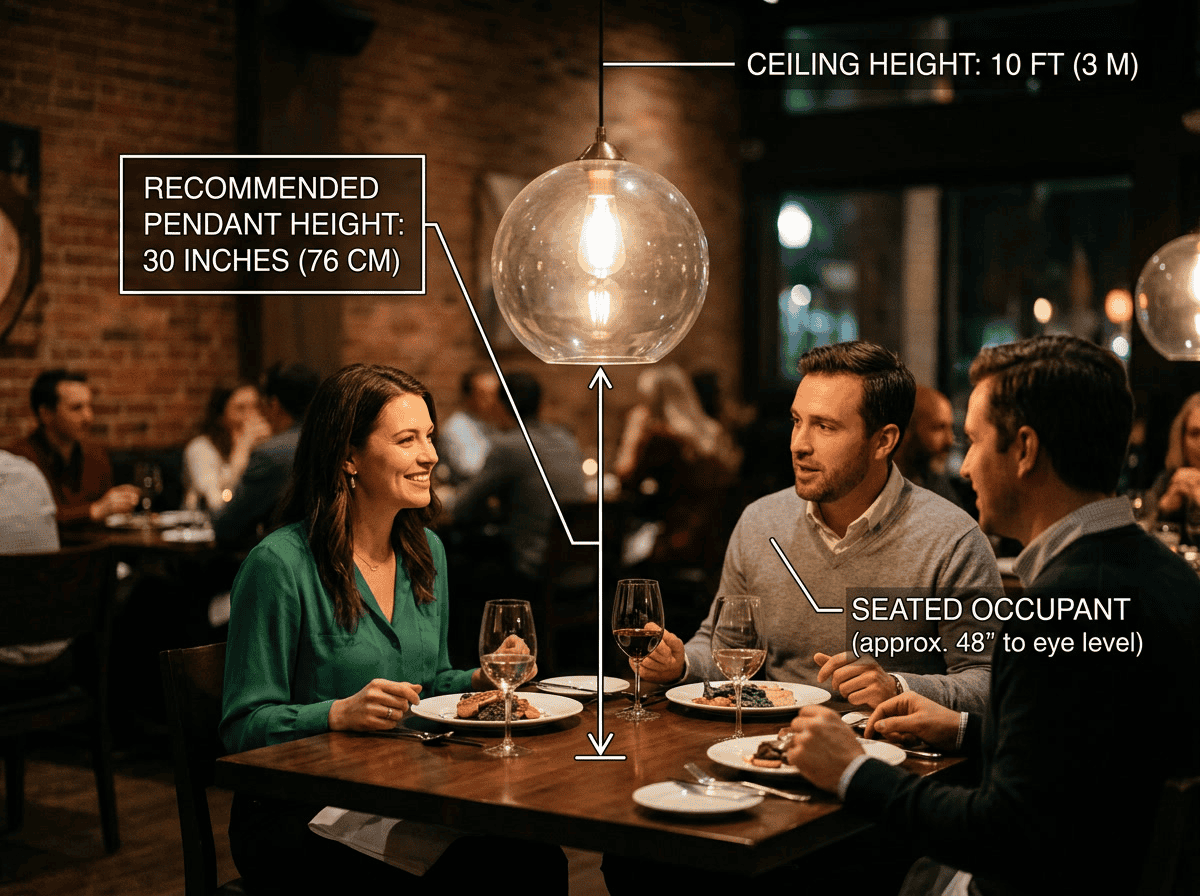
The rule for restaurant table pendants: the bottom of the glass shade should be 28–34 inches above the table surface. At this height:
– The pendant is above the eyeline of seated guests (preventing direct glare)
– The pendant is close enough to the table to create a concentrated pool of light around the diners (not flooding the whole room)
– The pendant is above the heads of guests rising from their seats
– The visual intimacy of the pendant — “this table, this conversation, this meal” — is created rather than lost
At 40+ inches above the table, the pendant’s psychological focal effect is lost — it becomes a ceiling element rather than a table element, and the sense of intimate occasion that drives extended stays and higher checks is correspondingly reduced.
At 26 inches or less, the pendant obstructs sightlines between guests across the table and is in range of head contact when guests stand.
Height Adjustment by Ceiling Height
The 28–34 inch above-table specification assumes the room ceiling height is 9–12 feet — the standard for most restaurant spaces. For rooms with:
- Ceiling below 9 feet: Use 28–30 inches above table (shorter pendants keep the ceiling from feeling oppressive)
- 9–12 foot ceiling: Standard 28–34 inches above table
- 12–16 foot ceiling: 34–40 inches above table (high ceilings require slightly lower pendants to maintain the table-focal effect)
- Above 16 feet (warehouse lofts, converted industrial spaces): Multiple pendant layers or very large-diameter shades at 36–44 inches to maintain table intimacy despite extreme ceiling height
Table Size and Pendant Configuration
Pendant count and spacing affects how the glass shade choice reads in the room:
| Table Size | Pendant Configuration | Globe Diameter |
|---|---|---|
| 2-top (24×24 inch) | Single pendant centered | 8–10 inch |
| 4-top round (36 inch) | Single pendant centered | 12–14 inch |
| 4-top rectangular (36×60 inch) | Two pendants in row | 8–10 inch each |
| 6-top rectangular (36×72 inch) | Two or three pendants | 8–10 inch each |
| Bar counter (per seat) | One pendant per 2 seats | 6–8 inch |
Step 3: Color Temperature and Glass Shade Interaction
The color temperature of the LED source and the glass shade type interact to produce the actual light quality that guests experience. Getting this interaction right is what separates good restaurant lighting from exceptional restaurant lighting.
The 2700K + Frosted Glass Standard
2700K warm-white LED through frosted glass is the baseline standard for quality restaurant table lighting in fine dining and casual contexts. The 2700K source produces warm incandescent-like light that renders food and faces with high red-spectrum fidelity. Frosted glass eliminates point-source glare and distributes this warm light evenly over the table surface.
This combination — 2700K, frosted glass, 28–32 inches above table, 10–15 watts — consistently produces:
– Table surface illuminance: 40–80 footcandles (fine dining target: 30–75fc)
– Shadow quality: soft, warm, flattering
– Face rendering: excellent — skin tones appear warm and healthy
– Food rendering: excellent — warm colors (meats, sauces, bread) rendered accurately
The 3000K + Clear Glass Alternative
3000K neutral-warm white through clear glass is the standard for fast-casual and bar concepts. The 3000K source is slightly cooler and produces a more “alert” quality of light. Clear glass at this temperature creates:
– Higher apparent brightness per watt (due to clear glass transmittance of 88–92%)
– Visible energy from the LED source
– A more active, social atmosphere
– Table surface illuminance: 60–120 footcandles (fast-casual target: 50–100fc)
Amber Glass as a Concept-Level Choice
Amber glass at any LED color temperature effectively produces light in the 2200–2400K range — lower than standard warm-white and approaching candlelight on the color spectrum. This “effective color temperature” from amber glass:
– Cannot be achieved from LED sources alone at equivalent warmth
– Requires no specialty bulbs — standard 2700K or 3000K LEDs through amber glass achieve the amber effect
– Is not appropriate for table surfaces where food color accuracy matters (amber light makes some food colors appear muted or unusual) but is ideal for bar, cocktail, and lounge contexts where atmosphere matters more than food rendering
Dimmer Compatibility
Restaurant glass shade pendants should always be connected to dimmer circuits — the ability to shift from full-service brightness to a lower, more atmospheric setting between service periods (late-night, quiet periods, special events) expands the functional range of the same glass shade specification without requiring fixture changes.
Glass shades paired with dimmable LED sources produce a significant “warmth shift” as dimming increases — the color temperature of most warm-white LEDs drops from 2700K at full power toward 2200–2400K at 30% power, increasing apparent warmth. Frosted and opal glass accentuate this effect; clear glass allows it to be visible. Amber glass provides an additional warmth layer on top of the dimming effect.
Commercial Durability and Cleaning Requirements
Restaurant glass lamp shades must survive commercial cleaning — weekly or biweekly contact with alkaline degreasing solutions, steam, and heat — that residential shades never encounter.
Glass durability requirements for restaurant contexts:
- Chemical resistance: Commercial kitchen degreasers operate at pH 10–14. Standard soda-lime glass is adequate for most commercial cleaning; the surface may show some etching over 5–10 years of repeated strong-alkali contact. Borosilicate glass provides superior chemical resistance and is specified for restaurant applications where heavy-duty degreasers are used frequently.
- Thermal resistance: Kitchen-adjacent glass shades near open cooking stations may experience significant temperature variation — cold glass hit by steam, hot glass hit by cool cleaning water. Borosilicate glass handles this thermal cycling without fracturing; standard soda-lime glass may develop micro-fractures over 3–5 years in hot kitchen proximity.
- Fracture safety: In commercial food service environments, glass breakage must be contained and documented. Clear glass and frosted glass fracture in similar patterns when broken (large shards or pieces depending on heat treatment). Tempered glass fractures into small rounded fragments — a safer pattern in food service proximity.
Per NEMA standards for commercial luminaire enclosures, commercial pendant fixtures in food service environments should be rated for damp location use at minimum — and wet location if in direct proximity to food preparation or dishwashing areas.
IP Ratings for Restaurant Locations
Different areas of a restaurant have different IP rating requirements:
| Restaurant Area | IP Requirement | Glass Specification |
|---|---|---|
| Dining room table pendants | IP44 (splash-proof) | Standard soda-lime or borosilicate |
| Bar counter pendants | IP54 (dust + splash) | Borosilicate preferred |
| Kitchen pass-through area | IP65 (water jets) | Borosilicate, sealed gallery ring |
| Outdoor dining/terrace | IP65 | Borosilicate, marine-grade hardware |
| Open kitchen over cooking | IP65 + heat rated | Borosilicate, high-temp rated |
Ordering and Consistency Considerations for Restaurant Fit-Outs
The commercial glass shade procurement process differs from retail purchasing in ways that affect specification, lead time, and project management.
Batch consistency: A single restaurant order may require 20–60 identical pendant glass shades. All shades in the batch must match in:
– Fitter inner diameter (±0.5 mm maximum variation for consistent seating in identical holder rings)
– Globe outer diameter (±3 mm maximum variation for visual consistency in a row)
– Glass transmittance (frosted shades should have consistent opacity — a batch with variable opacity creates visible inconsistency when all pendants are lit simultaneously)
– Glass color (opal and frosted glass can have subtle batch-to-batch color variation; specify “matched batch” for restaurant orders)
Lead time planning: A restaurant fit-out with 30 custom-diameter pendant shades requires a 6–10 week lead time for production, quality check, and delivery. Plan the glass shade specification into the fit-out timeline before other interior elements are finalized — the glass shade spec affects fixture hardware specification, which affects electrical rough-in positioning.
Replacement stock: Order 10–15% extra shades beyond the installation quantity for the first order. Restaurant glass shade breakage from cleaning, occasional impact, and thermal stress in commercial environments means replacements will be needed within the first 2–3 years. Having matching replacement stock from the same production batch prevents the visual inconsistency that occurs when replacement shades are sourced from a different batch or supplier.
According to National Restaurant Association data on commercial equipment lifecycle, commercial lighting components in full-service restaurants are typically replaced every 5–8 years — a planning horizon that should inform the initial specification decision between standard soda-lime glass (lower initial cost, shorter replacement interval in demanding environments) and borosilicate glass (higher initial cost, longer replacement interval).
Restaurant Glass Shade Style by Concept
The functional specification determines what the glass shade must do. The style selection determines how it reinforces the restaurant’s brand and atmosphere.
Industrial and Urban Restaurant Style
Exposed brick, concrete, reclaimed wood, black metal hardware. Glass shade choices:
– Clear glass globes with visible filament LEDs
– Opal dome pendant on black iron conduit (engineering lamp aesthetic)
– Amber glass cylinders at bar counter positions
The industrial restaurant look is built on material authenticity — glass shades that look manufactured (rather than decorative) reinforce the concept.
Contemporary and Minimalist Restaurant Style
Clean lines, light materials, architectural simplicity. Glass shade choices:
– Frosted white spheres in polished brass or matte black hardware
– Simple cylinder or teardrop forms in frosted or smoked glass
– Consistent, tightly-matched batch for visual repetition
Traditional and European Restaurant Style
Warm wood tones, upholstered seating, classic materials. Glass shade choices:
– Opal white glass with decorative brass gallery rings
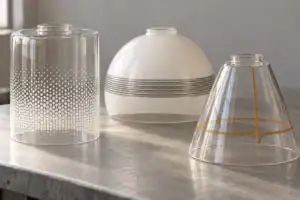
– Seeded glass in warm amber or clear finishes
– Multi-arm chandeliers with small opal glass cups
Contemporary Asian Restaurant Style
Clean sightlines, natural materials, restrained decoration. Glass shade choices:
– Clear glass spheres of varying sizes at different pendant heights (installation art as lighting)
– Smoke grey glass for depth and sophistication
– Simple frosted globes in minimal hardware
Trends in Restaurant Glass Lamp Shade Specification for 2026
Dark and dramatic glass growing. Smoked grey glass pendant shades are gaining ground in high-end restaurant design — the dark glass creates atmosphere at the expense of lux, which suits bar and lounge areas but requires supplemental lighting at table surfaces. Used strategically, smoked glass pendants create visual drama that enhances the restaurant’s social media photogenicity.
Handmade glass as a differentiator. In an era of commoditized restaurant aesthetics, handmade or artisan glass shades are increasingly used as brand differentiators — the visible uniqueness of hand-blown glass creates a “this space is special” signal that designed-but-mass-produced fixtures cannot replicate.
Amber glass for hospitality wellness. Post-2026, the hospitality industry is increasingly aware of circadian-rhythm-friendly lighting in extended-stay environments (hotels, destination restaurants, hospitality resorts). Amber glass in dining and bar fixtures reduces blue-spectrum exposure for guests spending extended evening hours in the space — an amenity that intersects with growing consumer awareness of sleep health.
| Trend | Glass Shade Choice | Restaurant Context |
|---|---|---|
| Dark and dramatic | Smoked grey glass | Bar, cocktail lounge |
| Artisan differentiation | Hand-blown seeded glass | Upscale casual, fine dining |
| Amber wellness | Amber tinted glass | Bar, extended-stay dining |
| Filament LED display | Clear globe | Fast-casual, industrial |
| Minimalist repetition | Matched frosted white | Contemporary, modern |
Frequently Asked Questions
What glass shade is best for restaurant table lighting?
Frosted glass at 2700K LED is the best specification for most restaurant table lighting — it eliminates glare across the table at dining distances, produces flattering warm light on food and faces, and works in any dining concept from casual to fine dining. Clear glass at 3000K is better for high-turnover fast-casual and bar environments where energy and brightness matter more than intimacy. Amber glass is the specialist choice for bar and lounge settings.
How high should pendant lights hang over a restaurant table?
28–34 inches above the table surface for standard 9–12 foot ceiling restaurant spaces. At this height, the pendant creates a focused pool of warm light around the diners without obstructing sightlines or creating head-height hazards when guests rise. Higher ceilings allow slightly lower pendant positioning (relative to ceiling height, not table height — the 28–34 inch above-table measurement remains constant).
What color temperature is best for restaurant lighting?
2700K warm-white is the standard for fine dining and upscale casual — it renders food and faces with warm, flattering color quality and creates a relaxed, extended-stay atmosphere. 3000K neutral-warm works better for fast-casual and café contexts where energy and visual clarity are valued. Amber glass effectively shifts any LED source to approximately 2400K output regardless of bulb color temperature.
Do glass lamp shades need to be commercial grade for restaurants?
Standard residential glass lamp shades will function but are not the best specification for commercial environments. Commercial restaurant glass shades should have documented glass construction (borosilicate preferred for kitchen-adjacent or heavy-cleaning-program locations), matched batch consistency across the full installation quantity, and IP44 minimum rating for dining room pendants. Borosilicate glass is particularly important in high-cleaning-frequency locations where alkaline degreasing solutions contact the glass regularly.
How many pendant lights over a restaurant table?
One pendant for 2-top and round 4-top tables; two pendants for rectangular 4–6 top tables (60–72 inches long); one pendant per 2 bar seats at a bar counter. All pendants in a row should be from the same production batch for visual consistency when lit. For long communal tables (8–12 person), three pendants spaced evenly across the table length.
What glass shade size for restaurant table pendants?
Globe diameter of 12–14 inches for single-pendant 4-top table installations. Globe diameter of 8–10 inches for two-pendant row configurations over rectangular tables, or for bar counter pendants. Larger globes (16–20 inch) are used for feature single pendants over round tables in high-ceiling dining rooms where a larger focal element is proportionally appropriate.
Can clear glass globes work in a fine dining restaurant?
Clear glass with a filament LED bulb can work in fine dining if the pendant is hung high enough that the visible bulb is above typical seated sightline (34 inches or more above the table) and the filament’s warm color temperature (2200–2400K) suits the concept. Clear glass with a standard LED chip at 3000K+ is generally too bright and harsh for fine dining environments — the visible hot spot creates uncomfortable glare at the close face-to-face dining distances typical of fine dining seating.
Conclusion
How to choose glass lamp shades for restaurants follows a revenue-logic sequence: identify the dining concept and its revenue model, then specify the glass type and color temperature that creates the right atmosphere for that model. Frosted glass at 2700K for fine dining and upscale casual. Clear glass at 3000K for fast-casual and bar. Amber glass for intimate lounge and bar environments.
The second decision — hanging height — is fixed at 28–34 inches above the table surface regardless of concept. The third decision — commercial durability — is often underspecified in initial fit-out budgets and oversold as an upgrade, but the difference between standard soda-lime glass and borosilicate glass in a 5-year commercial cleaning program is a measurable reduction in replacement frequency and associated downtime.
For commercial restaurant glass pendant shades in frosted, opal, clear, amber, and hand-blown configurations — in documented borosilicate or soda-lime construction with matched batch consistency for large-quantity fit-outs — our glass lampshade product line at jxlampshade.com covers commercial hospitality specifications from initial specification through replacement stock sourcing.