ホテル・ホスピタリティ用ガラスランプシェード:仕様調達ガイド

目次

# Hotel & Hospitality Glass Lamp Shades: Specification Sourcing Guide

A hotel glass lamp shades supplier provides custom-spec lighting components – typically opal or frosted glass shades with standardized 4-inch neckless or spider fitters – to hospitality properties at wholesale prices, with lead times of 60-90 days for large orders and ongoing replacement inventory support.

Hospitality lighting procurement runs on different rules than residential lighting. A residential buyer might agonize over a single pendant for a coffee table; a hotel procurement specialist signs off on 800 identical opal globes for a 200-room property and another 1500 shades across the restaurant, bar, and lobby fixtures. The unit economics, durability standards, and supply chain logistics are entirely different.

This guide covers what hospitality buyers actually need to know when sourcing glass lamp shades – specification standards, supplier evaluation, and the procurement workflow that experienced operators use.

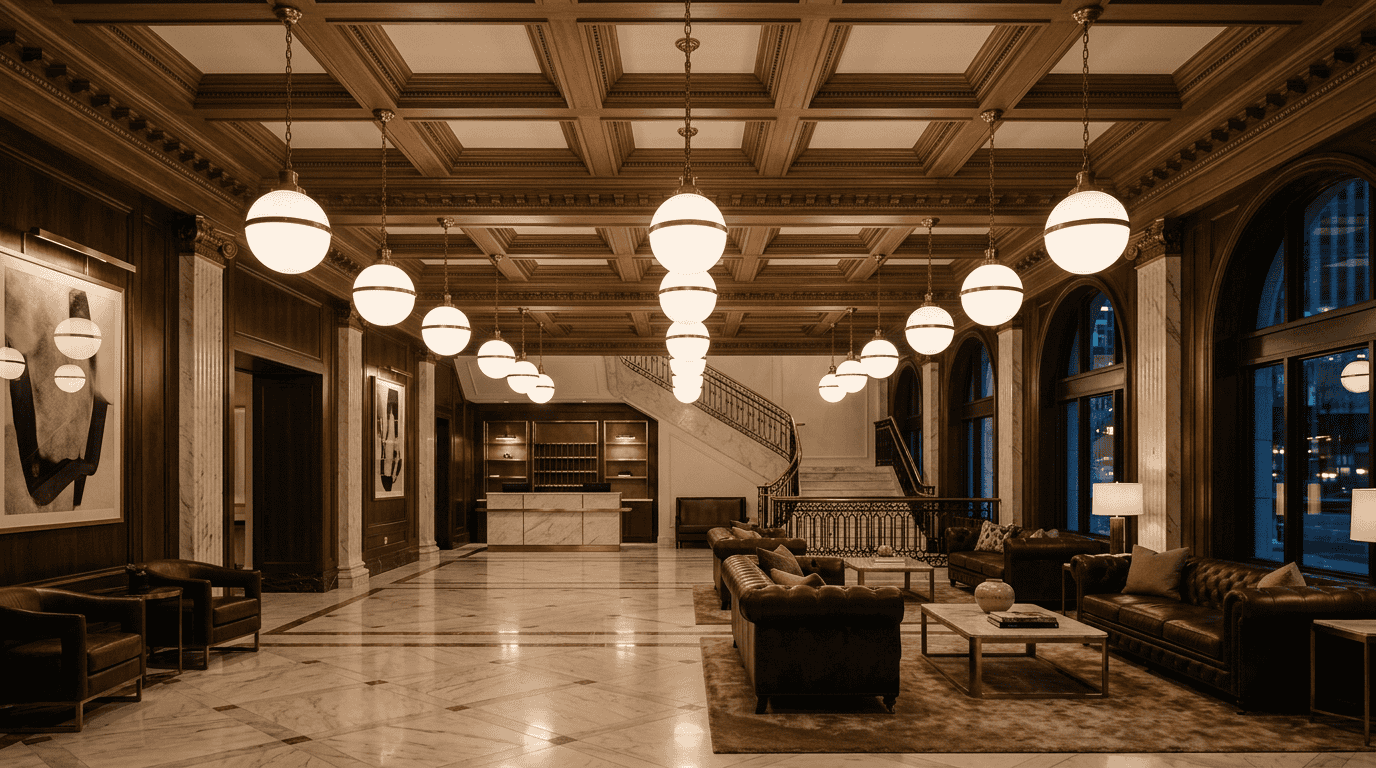
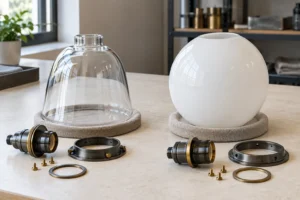
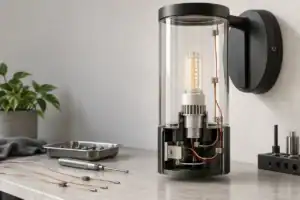
美しいガラスランプシェードがクラシックな装飾と高級感のあるホテル内装を照らす。.

What Hospitality Glass Shades Need to Solve

Five operational requirements drive every hospitality specification:

1. Consistency across the property

Every guest room needs visually identical lighting. Every room in a hotel chain needs to match the brand standard. This consistency requirement means hospitality almost always orders custom shades to spec rather than mixing-and-matching from retail catalogs. The procurement minimum order quantity (MOQ) is typically 200-500 units per spec, with chain rollouts running 5000-15000 units across multiple properties.

2. Durability under hospitality conditions

A hospitality fixture absorbs more wear in a week than a residential fixture sees in a year. Housekeeping cleans every fixture daily. Guests turn lamps on, off, and adjust them. Vacuum cleaners bump into floor lamps. Beverages get spilled near table lamps. The glass shade has to survive 5-10 years of this at minimum, often 10-15 years before the property does a full refresh.

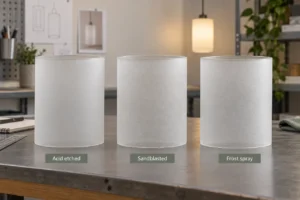
Practical durability spec: minimum 4 mm wall thickness, properly annealed soda-lime glass, and inside-frost (never outside-frost – dust collection is impossible to remove).

3. Light quality consistent with brand experience

Hospitality lighting is part of the brand experience. Luxury brands want warm, diffuse, glare-free light. Mid-tier business hotels want adequate-but-not-fussy lighting that photographs well for marketing. Budget chains want efficient, low-maintenance lighting that doesn’t generate complaints.

The light-quality spec dictates the glass type: opal for luxury and most mid-tier, frosted for budget and many mid-tier, clear glass only for design-feature spaces (lobby pendants, restaurant statements).

4. Replacement supply chain

When a glass shade breaks (which happens occasionally – guest accidents, housekeeping mishaps, transit damage), the property needs to replace it immediately, ideally from on-hand inventory. Hospitality procurement specifies “replacement units” on the original order – typically 10-15% over the working count – and verifies the supplier can manufacture replacements years later if the on-hand inventory runs low.

5. Compliance with regulatory and brand standards

Fixtures and components need to meet local fire safety, electrical safety, and accessibility codes. Brand standards manuals dictate specific finishes, colors, and dimensions. The glass shade supplier needs to provide documentation: material certifications, compliance test reports, and brand-standard adherence confirmations.

Standard Specifications for Hospitality Glass Shades

The hospitality industry has converged on several de facto standard specifications. Working list:

Guest room table lamps

  • ガラスタイプ: Opal (cased, 2-layer) or inside-frosted
  • フィッター: Spider (1-5/8 inch, 41 mm)
  • 外径: 280-380 mm
  • 高さ: 240-300 mm
  • 壁の厚さ: 4-5 mm
  • Color temperature compatibility: 2700K bulb
  • Bulb wattage rating: 60-75W incandescent equivalent (LED actual: 9-13W)
  • Cost FOB China: $12-22 per unit at 500-unit MOQ

Guest room floor lamps

  • ガラスタイプ: Inside-frosted or light opal
  • フィッター: Spider (1-5/8 inch, 41 mm) or Uno (7/8 inch, 22 mm)
  • 外径: 280-380 mm
  • 高さ: 280-360 mm
  • 壁の厚さ: 5 mm (heavier than table lamps because more bumping)
  • Bulb wattage rating: 60-75W incandescent equivalent
  • Cost FOB China: $15-28 per unit at 500-unit MOQ

Bathroom vanity sconces

  • ガラスタイプ: Opal (cased) – mandatory for bathroom because the user is close and looking directly at the shade
  • フィッター: Uno (7/8 inch, 22 mm) typically, or neckless
  • 外径: 150-220 mm
  • 高さ: 120-180 mm
  • 壁の厚さ: 3-4 mm
  • 電球の互換性: A19 LED, 90+ CRI, 800-1000 lumens
  • Cost FOB China: $9-16 per unit at 500-unit MOQ

Corridor ceiling lights

  • ガラスタイプ: Opal or inside-frosted
  • フィッター: Neckless 4-inch (101.6 mm) – hospitality industry standard
  • 外径: 280-400 mm
  • 高さ: 120-180 mm (low-profile flush-mount)
  • 壁の厚さ: 4 mm
  • 電球の互換性: A19 LED, 800-1100 lumens
  • Cost FOB China: $14-22 per unit at 500-unit MOQ

Lobby and feature pendants

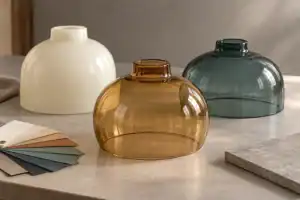
  • ガラスタイプ: Highly variable – opal globes for clean luxury, clear glass with decorative filament bulbs for industrial-luxury, smoked or amber for moody/atmospheric
  • フィッター: Custom per fixture, but typically spider or neckless
  • 外径: 350-700 mm (much larger than guest rooms)
  • 壁の厚さ: 5-6 mm (decorative grade)
  • Cost FOB China: $35-150 per unit (varies widely)

For broader specification context: ガラスランプシェードのフィッティング規格:完全な技術ガイド.

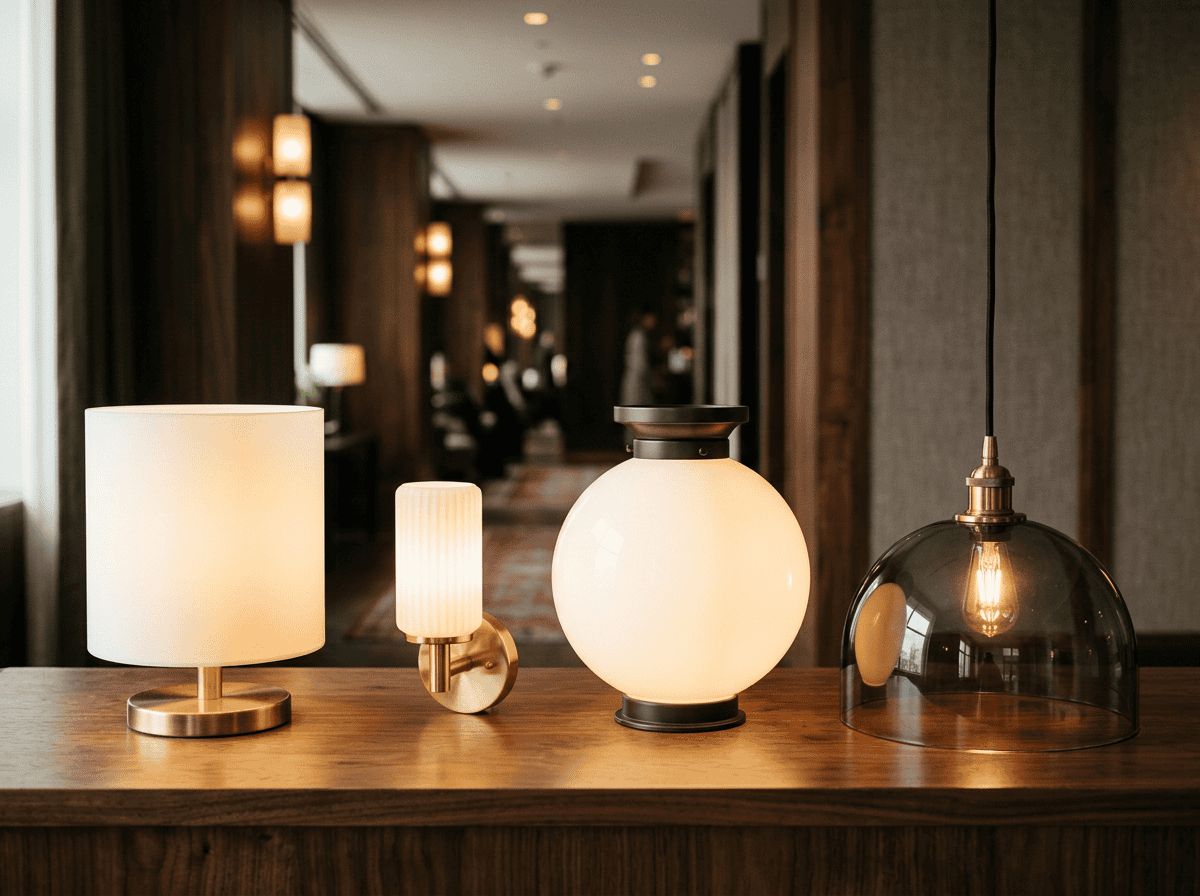
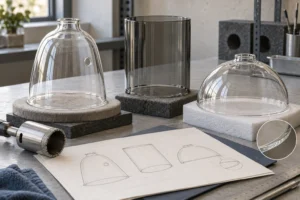
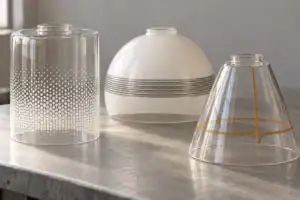
Glass lampshade manufacturer for stylish and high-quality lighting solutions.

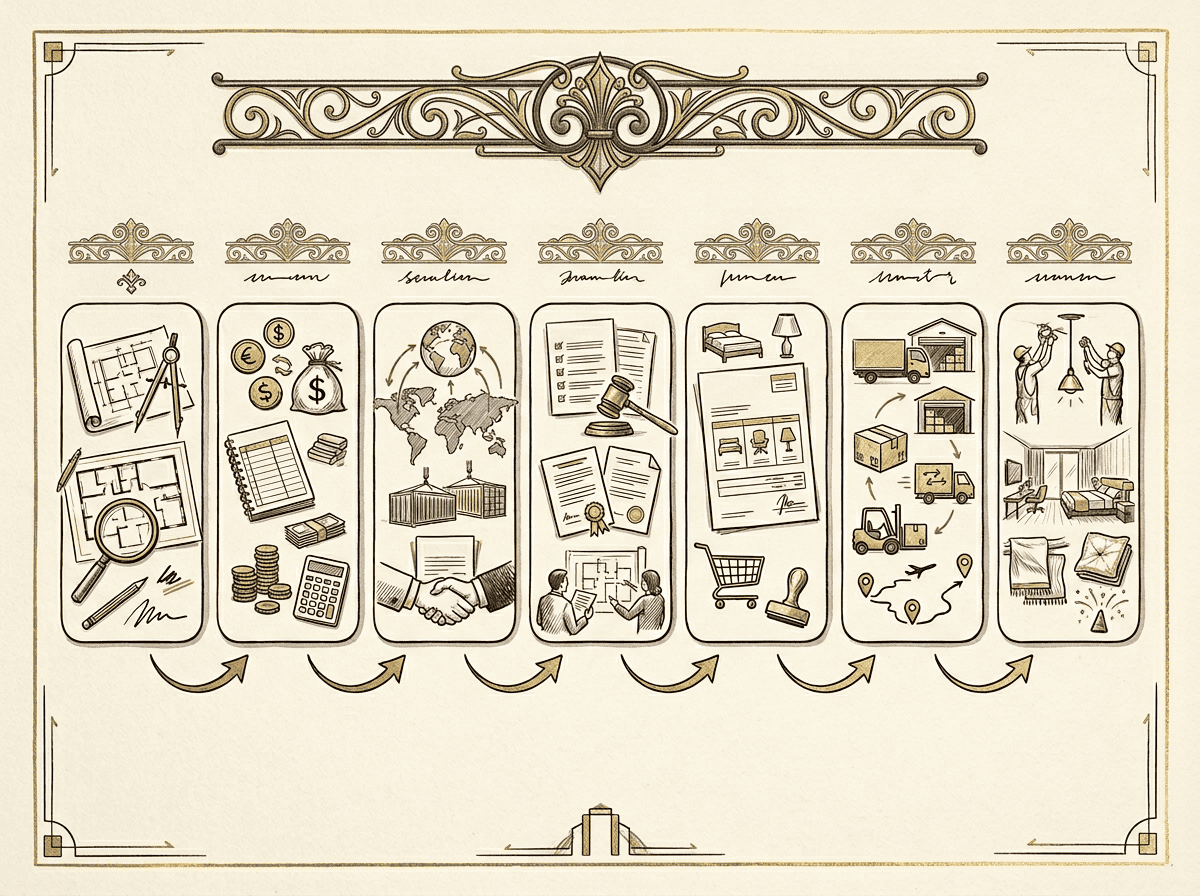
How a Hospitality Procurement Project Actually Runs

Standard timeline for a 200-room hotel sourcing project:

Month 1: Scope and supplier shortlist

  • Designer or procurement manager defines fixture count, fitter type, glass spec, finish, budget envelope
  • Contacts 3-5 manufacturers for initial quote (China-based factories dominate this category)
  • Receives initial proposals with FOB pricing, sample policy, and lead time

Month 2: Sample evaluation

  • Each shortlisted supplier produces 1-2 samples to the project spec
  • Samples shipped to the buyer (typically via express courier, 3-7 days from production completion)
  • Property team evaluates: dimensions vs spec, glass quality, finish quality, perceived value vs cost
  • Often 1-2 rounds of sample revision before final approval

Month 3-4: Contract negotiation and order placement

  • Final supplier selection
  • Contract terms: pricing, payment terms (typically 30% deposit / 70% before shipment), warranty, replacement supply commitment
  • Order placement and production start
  • Throughout: communication on production progress, quality inspection scheduling

Month 5: Production and pre-shipment inspection

  • Factory completes 1500-2000 units (200 rooms × ~7 fixtures average + replacement stock)
  • Buyer arranges third-party inspection (SGS, Bureau Veritas, or Intertek) for orders above $50K value
  • Inspection report covers dimensions, finish, color consistency, packaging

Month 6-7: Ocean freight and customs

  • Container shipment from China to destination port (typically Long Beach for US West Coast, Newark/Savannah for East Coast, Felixstowe/Rotterdam for UK/EU)
  • Customs clearance and import duty payment (varies by destination – typical 3-7% duty on glass lighting components)
  • Warehouse handling at destination

Month 7-8: Distribution and installation

  • Warehouse-to-property distribution
  • On-site installation (concurrent with broader interior fit-out)
  • Final QA check on installed fixtures
  • Replacement inventory stored on-site

End-to-end: 7-8 months from initial scope to fully installed lighting. Compressed timelines (3-4 months) are possible by air-freighting, but cost roughly 6-8x ocean freight.

High-quality glass lampshades for custom lighting fixtures and home decor. Durable, stylish, and cra.

How to Evaluate a Glass Shade Supplier

Hospitality procurement evaluation differs from residential evaluation. Five practical criteria:

1. Production capacity vs your order size

Ask: “What’s your monthly capacity for the glass type and dimensions I’m ordering?” The right answer is “comfortable capacity for your order plus other concurrent orders.” A factory near its capacity ceiling will either delay your order or rush production (and rushed production = quality problems).

For 1000-unit orders, you want a supplier with ≥5000 unit monthly capacity. For 5000-unit orders, ≥20,000 unit monthly capacity. Below that ratio, the supplier is operationally at-risk.

2. Export experience to your destination market

Ask: “What countries do you currently ship to? What’s your export volume per month?” A supplier shipping 50+ containers per month to US East Coast has the freight, customs, and quality relationships in place. A supplier with one US customer per year is going to surface unexpected delays.

3. Quality control system

Ask: “Walk me through your inspection process from glass batch through pre-shipment.” Good answers describe multiple inspection stages, written QC procedures, and trained inspectors. Avoid suppliers who answer vaguely or say “the workers check as they go.”

4. Replacement supply commitment

Ask: “Can you produce replacement units of this exact spec in 1, 3, and 5 years from now? Is there a mold storage and retention policy?” Reputable manufacturers store project-specific molds for at least 5 years. Without mold retention, you can’t get exact-match replacements after a future shade breaks.

5. Compliance documentation

Ask: “Can you provide RoHS compliance, REACH compliance, ISO 9001 certification, and material composition documentation?” These should be readily available. The European Union’s REACH regulation covers chemical compliance for components shipping into the EU.

Costs and Pricing for Hospitality Orders

The wholesale cost structure for hospitality glass shades:

Order quantityPer-unit price (opal globe, 300mm, 4mm wall)Typical lead time
50-100 units (sample/pilot)$25-4030-45 days
200-500 units$18-2645-60 days
500-1500 units$14-2250-70 days
1500-5000 units$11-1860-90 days
5000+ units$9-1590-120 days

Add to FOB cost:

  • Ocean freight: $0.50-1.50 per unit (depending on volume and destination)
  • US import duty: 3-7% of FOB value
  • US warehouse handling: $0.30-0.80 per unit
  • US distribution to property: $0.50-2.00 per unit

Landed cost for hospitality opal glass shades at typical project scale: $14-28 per unit, depending on volume and spec.

Brand-Standard Specifications by Property Tier

The hospitality industry has implicit specification standards by property tier. Working framework:

Luxury (5-star)

  • Glass type: Cased opal with subtle texture (seeded glass, hand-blown irregularities)
  • Wall thickness: 5-6 mm
  • Hand-blown preferred over machine-pressed for visible fixtures
  • Custom finishes (proprietary tint, signature edge detail)
  • Cost premium: 2-3x mid-tier

Upper upscale / Premium (4-star)

  • Glass type: Cased opal or premium frosted
  • Wall thickness: 4-5 mm
  • Machine-pressed acceptable for utility fixtures, hand-blown for feature pendants
  • Standard finishes with subtle brand customization
  • Cost: industry baseline

Mid-scale (3-star)

  • Glass type: Frosted or pressed opal
  • Wall thickness: 3-4 mm
  • Machine-pressed throughout
  • Standard finishes from supplier catalog
  • Cost: 30-50% below mid-tier baseline

Economy / Budget (2-star, limited service)

  • Glass type: Frosted soda-lime
  • Wall thickness: 3 mm
  • Machine-pressed only
  • Standard finishes, often re-using existing supplier SKUs
  • Cost: 50-70% below mid-tier baseline

Compliance and Certification Considerations

Hospitality fixtures must comply with local building codes, electrical codes, and fire safety codes. The glass shade component specifically affects:

  • Fixture wattage rating: The shade material must be rated for the heat generated by the maximum-wattage bulb the fixture accepts. With LED, this is rarely a constraint. With residual halogen fixtures, it matters.
  • Toxic substance compliance: RoHS (Restriction of Hazardous Substances) and REACH (Registration, Evaluation, Authorisation and Restriction of Chemicals) compliance for EU shipments. California Proposition 65 compliance for US shipments.
  • Glass safety: For overhead fixtures (pendants, ceiling lights), some jurisdictions require tempered or laminated glass for safety against falling shards if the shade breaks. Most jurisdictions exempt small residential-scale fixtures from this requirement.
  • Fire rating: Some hospitality projects in stricter jurisdictions require fire-rated fixture components. The shade itself is rarely the issue (glass is inherently fire-resistant) but documentation should be available on request.

日本の Underwriters Laboratories website covers UL certification scope for North American compliance, and the European Union’s CE marking guidance covers EU compliance markings.

Why a Manufacturer Beats a Distributor or Re-Seller

Distributors and re-sellers add 30-60% markup over the manufacturer’s FOB price. For hospitality scale, this matters enormously. A 5000-unit order at $14/unit FOB becomes $20-23/unit through a US distributor – a $30,000-45,000 cost difference at scale.

What you get for the markup:

  • US-based shipping and warehousing (faster availability for replacements)
  • Single point of contact in your local time zone
  • US-based service support
  • Possibly inventory of standard SKUs

What you lose:

  • 30-60% of project budget
  • Customization flexibility (distributors stock standardized SKUs)
  • Direct factory relationship (which matters for future replacement orders)

For one-off small orders (<200 units), distributors are reasonable. For sustained hospitality procurement, going direct to manufacturer is the obvious play.

For broader sourcing context: 適切なガラスランプシェードメーカーの選び方 covers supplier evaluation in depth.

Replacement Inventory Strategy

Smart hospitality procurement orders 10-15% extra units beyond the working count, as on-property replacement inventory. Reasoning:

  • Glass shades break (housekeeping accidents, guest accidents, transit damage in storage)
  • Sourcing identical replacement shades is faster from on-hand inventory than from a re-order to the factory (saves 4-6 months of wait)
  • Identical replacement maintains visual consistency (a mismatched shade in a single guest room photographs poorly and generates guest complaints)

The 10-15% buffer is the industry rule of thumb. For high-wear fixtures (corridor lights, bar pendants), the buffer can be 20-25%.

Storage: Replacement inventory typically goes into the property’s central housekeeping storage. Wrapped in original packaging, glass shades store indefinitely without degradation.

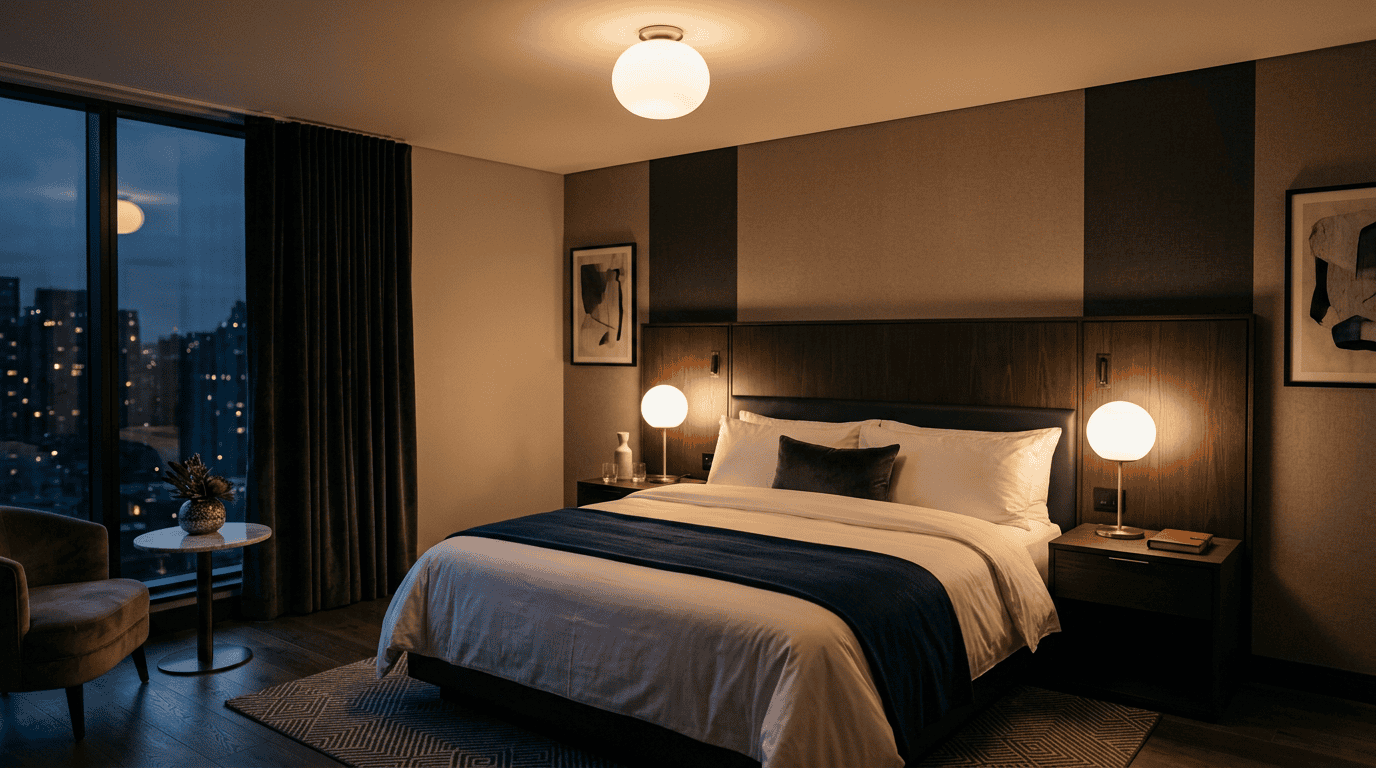
Modern bedroom featuring stylish glass lampshades and cozy lighting for a relaxing atmosphere.

Future Trends in Hospitality Glass Shade Procurement (2026 and Beyond)

Three movements are shaping hospitality lighting specifications in 2026:

トレンド何が変わるかProcurement implication
LED-integrated fixturesNo separate bulb, no separate shade in some new fixturesReplacement strategy changes – module vs shade
Sustainable spec lineRecycled-content glass increasingly specifiedNew supplier evaluation criteria
Brand-standard tighteningHotel chains specifying tighter dimensional tolerancesManufacturer selection narrows
Smart-glass switchable shadesOne shade serves multiple moods via electronic controlEarly luxury launches, mid-tier adoption 2027+
Local sourcing for ESGSome chains shifting from China-only to mixed sourcingHigher cost, ESG benefit

あたり the U.S. Green Building Council’s LEED v5 framework, embodied carbon of building components – including lighting fixtures and their replaceable parts – is increasingly factored into hospitality property certifications. This is shifting procurement toward suppliers who can document material composition, recycled content, and manufacturing energy use.

よくある質問

What’s the typical MOQ for hospitality glass shade orders?

200-500 units per spec is the typical minimum for cost-effective custom manufacturing. Some manufacturers accept 50-100 unit pilots at higher per-unit pricing. Chain-scale rollouts run 5000-15000 units across multiple properties.

How long does a hospitality glass shade project take end-to-end?

7-8 months is typical, from initial scope through delivered and installed. Sample stage: 1-2 months. Production: 2-3 months. Freight: 1-2 months. Installation: 1 month. Compressing this is possible with air freight (cuts 4-6 weeks) but at significant cost premium.

What’s the standard glass spec for guest room table lamps?

Opal glass (cased, 2-layer), 280-380 mm outer diameter, 4-5 mm wall thickness, spider fitter (1-5/8 inch). This is the de facto industry standard for mid-tier and upper-tier hospitality globally.

Should I order replacement inventory upfront?

Yes – 10-15% over the working count is the industry standard. Glass shades break, identical replacement matters for brand consistency, and on-property inventory beats re-ordering by 4-6 months. The marginal cost is small relative to the maintenance benefit.

What certifications should I require from a hospitality glass shade supplier?

At minimum: ISO 9001 quality management certification, RoHS/REACH compliance (for EU shipments), and material composition documentation. For US shipments, California Proposition 65 compliance documentation. Specific properties may require additional certifications based on local codes.

Can I source glass shades locally instead of from China?

Yes but at significantly higher cost. North American and European glass manufacturers operate at smaller scale and per-unit prices are typically 2-4x Chinese FOB pricing. Some hospitality groups specify domestic sourcing for ESG reasons; most accept the cost premium of 2-4x.

What’s the warranty on hospitality glass shades?

Industry standard: 1-2 years manufacturer warranty against defects (chips, cracks from manufacturing flaws, finish defects). Breakage from impact or misuse is not warranted – that’s covered by the replacement inventory strategy. Some premium manufacturers offer extended 3-5 year warranties on cased opal and hand-blown shades.

The Bottom Line for Hospitality Glass Shade Sourcing

Hospitality procurement runs on consistency, durability, and supply chain reliability – not on the unit-by-unit selection process residential buyers use. The right specification, the right supplier, and the right replacement inventory strategy together determine project success.

For projects above 200 units, go direct to manufacturer. For projects above 1000 units, conduct third-party quality inspection. For chain-scale rollouts above 5000 units, structure the contract with mold retention and replacement supply commitments out 5+ years.

Next step: define your specification (room type, glass type, fitter, dimensions, finish) and contact 3-5 manufacturers for initial quotes. Sample 2 finalists, evaluate, and proceed with the better fit.

共有する:
JXランプシェード技術チーム

JXランプシェード技術チーム

ガラスランプシェード技術エンジニア/技術コンテンツスペシャリスト

ガラスランプシェードプロジェクトのための技術的な内容サポート(ガラス素材の選定、成形プロセスの指導、表面処理の提案、耐熱性の考慮、品質検査のポイント、カスタム照明部品の応用を含む)。.

<?php return ob_get_clean(); }add_shortcode('jx_lampshade_engineer_card', 'jx_lampshade_engineer_card_shortcode');

関連記事:

よくある質問

塩城晶新ガラス製品株式会社は、専門的なガラスメーカーです 1999年に設立されました。自社の生産拠点とオフィスエリアは48,430平方フィート(約4,500平方メートル)以上あり、設計、製造、品質管理、輸出サービスを統合しています。.

幅広い種類の製品を製造しています。 オーダーメイドガラスランプシェード  吹きガラスランプシェード、機械プレスガラスランプシェード、ホウケイ酸ガラスランプシェード、遠心ガラスランプシェードなどを含みます。OEMおよびODM生産に対応しており、様々な用途や業界向けに提供しています。.

はい、当社は完全なOEMおよびODMカスタマイズサービスを提供しています 含まれる内容:

  • カスタム製品設計およびエンジニアリング
  • 社内金型開発
  • ロゴ印刷およびブランディング
  • 表面処理および仕上げ
  • カスタマイズされたパッケージングソリューション

はい、当社のデザインチームはお客様のコンセプトからカスタムガラス製品を開発できます。. お客様のアイデア、参考サンプル、または機能要件に基づき、専門的なデザインサービスを提供します。技術図面は不要です。.

当社のプロセスは量産前に品質を確保します。

お客様によるデザイン確認

自社施設での金型開発

承認用サンプルの製作

お客様によるテストとフィードバック

最終サンプル承認後のみ量産を開始します

私たちは提供します 安全な国際配送のための包括的なカスタムパッケージ:

  • 保護用の内側梱包材
  • 輸出用グレードの段ボール箱
  • カスタムカラーボックスと小売用パッケージ
  • ラベル印刷とブランディング
  • 国際配送基準に合わせて設計されたパッケージ
  • 各生産段階での検査
  • 科学的な品質管理手順
  • 各ロットの出荷前検査
  • 国際輸出基準への準拠
  • 認証された品質管理システム

私たちは運営しています 経験豊富な作業員による複数の生産ライン, これにより、あらゆる規模の注文に対して安定した大量生産が可能です。私たちの施設は、小ロットから大量注文まで、一貫した品質と信頼できる納期を保証します。.

リードタイムは複雑さや数量によって異なります:

  • サンプル生産:通常2~4週間
  • 量産:サンプル承認後にスケジュールされます
  • 具体的な納期はご注文内容に基づきご案内いたします

当社は日本を含む全世界120以上の国と地域に輸出しています, 例として:

  • 日本(日本国内)
  • ヨーロッパ(イギリス、ドイツ、フランスなど)
  • アジア太平洋市場
  • 中東
  • アフリカ
  • オセアニア(オーストラリア、ニュージーランド)

当社は包括的なグローバル流通ネットワークを維持しています。.

見積もり依頼 一緒に働く準備はできていますか?私たちとプロジェクトを作りましょう!

見積もり依頼
トップへスクロール
見積もり依頼